110V Air Conditioning in Panama — The Expat's Guide to Buying the Right Unit
It's 2 PM in San Francisco — the Panama City neighborhood, not California. Sun hammering the concrete, thermometer at 91°F (33°C), humidity at 82%. You get back to your apartment, flip on the unit you bought on sale last week, and wait for that wave of cool air. Instead: a dry click, a tripped breaker, and a room that stays exactly as hot as when you walked in.
The unit isn't defective. Nobody told you it requires 220V, and your building from the '90s only has 110V wiring throughout. It's a mistake that catches dozens of buyers off guard every month — especially in neighborhoods like Río Abajo, Betania, Parque Lefevre, and El Chorrillo, where older electrical infrastructure makes 110V circuits the rule, not the exception.
This guide covers exactly what separates a 110V air conditioner from a 220V unit, which models are available in Panama, what they actually cost at Machetazo, DoIt Center, and Panafoto, and how to avoid the mistake that ruined your neighbor's afternoon. For a broader foundation before any purchase, browse the guides and tips at 24clima.com first.
What Most Buyers Assume — And Why They're Wrong
The assumption is almost universal: "an AC is an AC, I plug it in and it works." Reality doesn't cooperate. The voltage your unit requires must match the voltage at your outlet exactly. Not approximately. Exactly. It's not a preference — it's physics.
Most buyers look at BTU first, then price, then brand. Voltage ends up at the bottom of the checklist, or gets skipped entirely. The result: they plug a 220V unit into a 110V circuit, the compressor can't draw enough power to start, the motor overheats in minutes, and the breaker trips — if they're lucky. If they're not, the compressor burns out and the warranty won't cover damage caused by wrong voltage.
The opposite mistake is assuming 110V units are somehow inferior to 220V units. They're not. Voltage is just the operating voltage of the system. High-efficiency inverter technology exists in both configurations. The real technical difference is that at 220V, a unit moves more power at lower amperage, which reduces resistive losses in the wiring. For spaces up to about 1,300 square feet, though, a properly matched 110V unit handles the job without compromise.
The Technical Difference Between 110V and 220V Air Conditioners
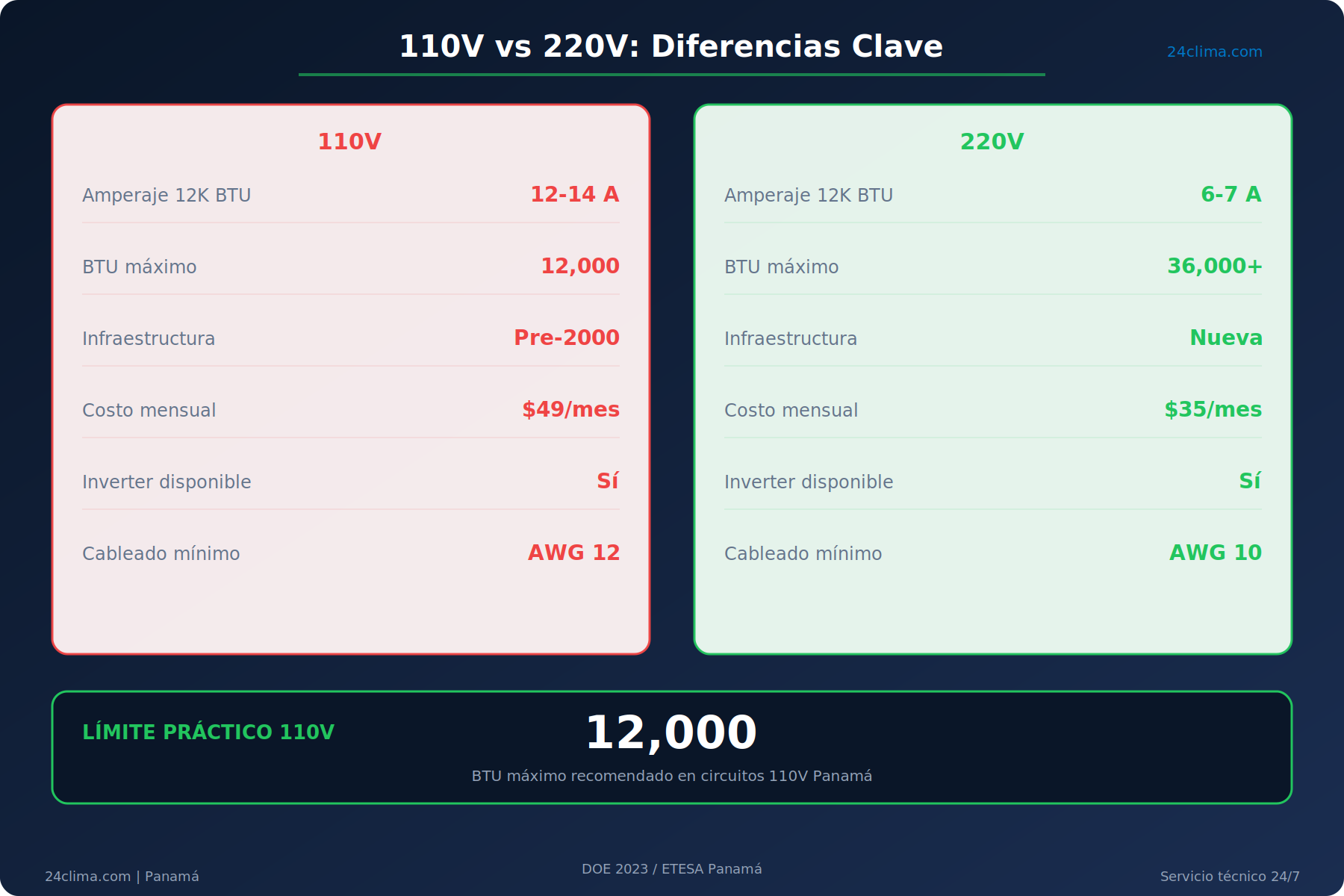
A 110V air conditioner runs on a standard single-phase low-voltage circuit — common in residential buildings constructed before 2000 in Panama. A 220V unit needs a dedicated higher-voltage circuit, which is standard in newer construction. Voltage doesn't affect cooling power. A 12,000 BTU unit removes the same amount of heat regardless of which voltage it runs on.
What changes is amperage. A 12,000 BTU unit at 110V draws roughly 12 to 14 amps. The same unit at 220V draws only 6 to 7 amps to produce the identical cooling effect. In older buildings with thinner wiring, a high-capacity 110V unit can overload the circuit even when the breaker is rated at 15 or 20 amps. That's why 12,000 BTU is the practical ceiling for 110V systems — trying to run an 18,000 BTU unit on 110V almost always creates electrical problems.
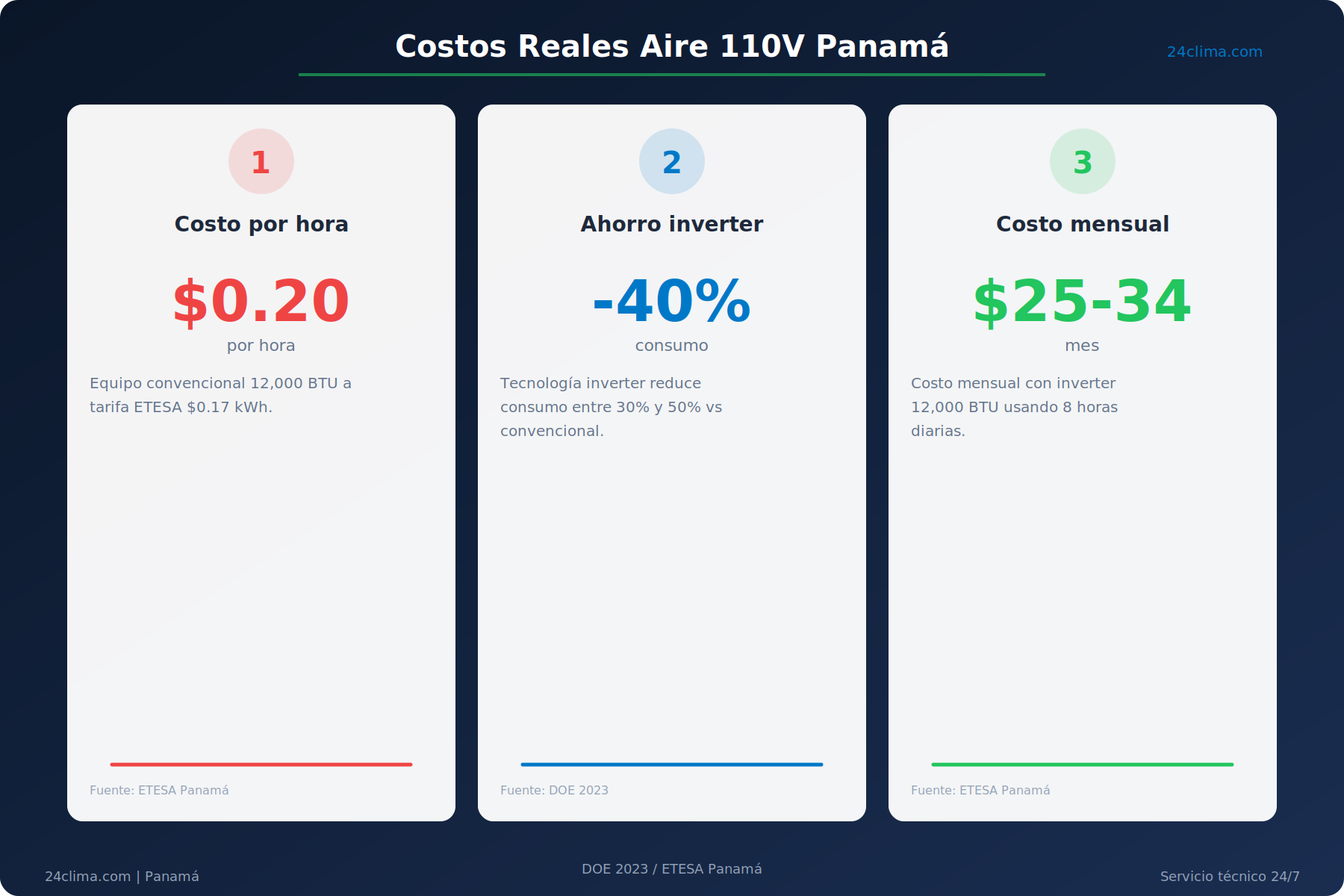
On monthly operating cost: a conventional 12,000 BTU unit at 110V with an EER of 10 consumes approximately 1.2 kW per hour. At the residential rate of $0.17 per kWh charged by ETESA in Panama, that's roughly $0.20 per hour of use. Run it 8 hours a day and your monthly cost for that one unit is around $49. An inverter model of the same BTU capacity — which according to US Department of Energy data (DOE, 2023) reduces consumption by 30% to 50% compared to conventional technology — brings that monthly figure down to $25–$34.
What BTU Capacity Do You Need With a 110V Unit?
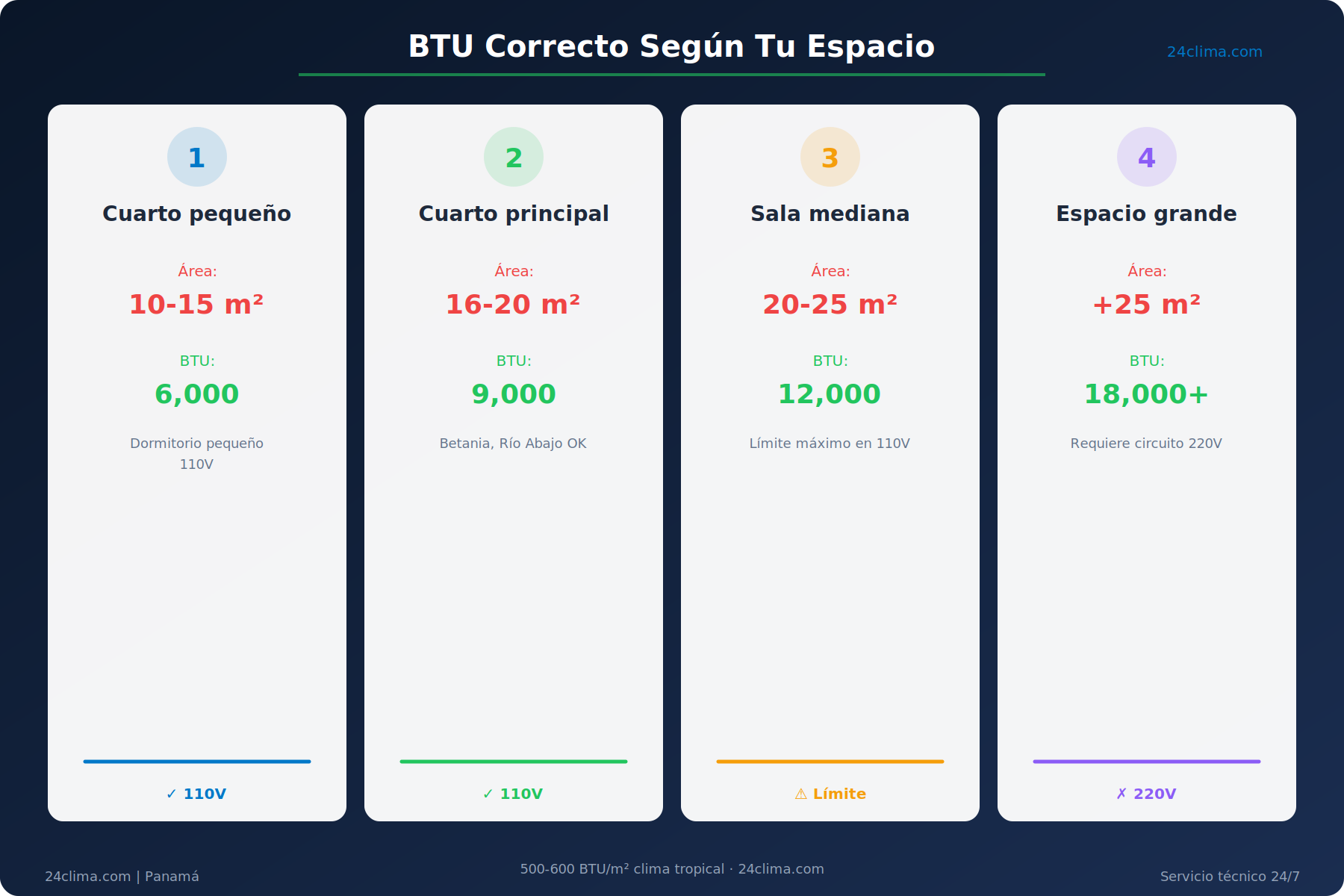
The working rule in a tropical climate with decent insulation is 500 BTU per square meter, bumped to 600 BTU per square meter for rooms with large windows or direct sun exposure. In Panama, given sustained humidity, you default to the upper end.
Small bedroom (10–15 m², roughly 100–160 sq ft): 6,000 BTU. Readily available in 110V, ideal for one-bedroom apartments in older buildings.
Master bedroom or small living room (16–20 m², roughly 170–215 sq ft): 9,000 BTU. Also available in 110V without issue — covers most standard-sized rooms in apartments across Betania, Mañanitas, or Río Abajo.
Living room (20–25 m², roughly 215–270 sq ft): 12,000 BTU. The practical limit for 110V. It works, but the circuit needs to be in good condition with minimum AWG 12 wiring.
Nothing above 12,000 BTU is reliably available in 110V configuration on the Panamanian market. Units of 18,000, 24,000, or 36,000 BTU all require 220V. If your space needs more than 12,000 BTU and you only have 110V, the answer isn't forcing an undersized unit to compensate — it's either adding a second unit or having a certified electrician assess an electrical upgrade.
How to Tell Whether Your Apartment Has 110V or 220V
You can figure this out in under two minutes with no special tools.
Start with the outlet. A 110V outlet has two vertical parallel slots — either equal or with one slightly wider — plus a round ground hole. A 220V outlet in Panama typically has two angled slots in a V-shape or inverted-V configuration, or horizontal slots depending on the standard used in that building.
With a multimeter, measure directly between the two live slots. A reading of 110–125V means 110V circuit. A reading of 200–240V means 220V.
No multimeter? Check the electrical panel. Standard 110V breakers are single-pole — one thin switch. A 220V breaker is double-pole: two switches joined together or a wider single module. If every breaker in your panel is the single-switch type, your apartment almost certainly runs entirely on 110V.
Buildings constructed after 2005 — particularly in Costa del Este, Santa María, Coco del Mar, and newer San Francisco developments — often have mixed circuits: bedrooms on 110V and at least one dedicated 220V circuit for the main AC or washer. In buildings from before 1990 in popular residential neighborhoods, 110V throughout with no exceptions is the norm.
Real Prices in Panama — Machetazo, DoIt Center, and Panafoto
Prices vary by store, season, and active promotions. Here's what you'll actually find at the three retailers that come up most often.
Machetazo historically offers some of the most competitive appliance prices in Panama. A conventional 12,000 BTU 110V split from brands like Midea or Innovex runs $299–$379. Inverter models of the same capacity land between $420 and $520. End-of-month and peak heat season promotions — March through May — can cut those prices 10% to 15%.
DoIt Center carries a broader selection: LG, Carrier, and Gree. A conventional 110V 12,000 BTU split starts at $330–$400 depending on brand. Energy Star certified inverter models range from $480 to $650. DoIt Center sometimes bundles basic installation into promotional pricing, which saves an additional $80–$120 on labor.
Panafoto's catalog includes premium brands like Daikin and Samsung alongside entry-level options. A name-brand inverter 110V 12,000 BTU unit can reach $580–$750. Panafoto's real strength is financing — payment plans up to 24 months with zero interest during certain periods can turn a $600 unit into $25 monthly installments, which changes the math for a lot of buyers.
Across all three stores, installation is not always included in the unit price. A standard split installation in Panama runs $80–$150 depending on complexity. Confirm what's included before you finalize anything.
Inverter 110V vs Conventional 110V — The Real Monthly Cost Calculation
At Panama's residential rate of $0.17 per kWh, the difference between conventional and inverter shows up on your first bill.
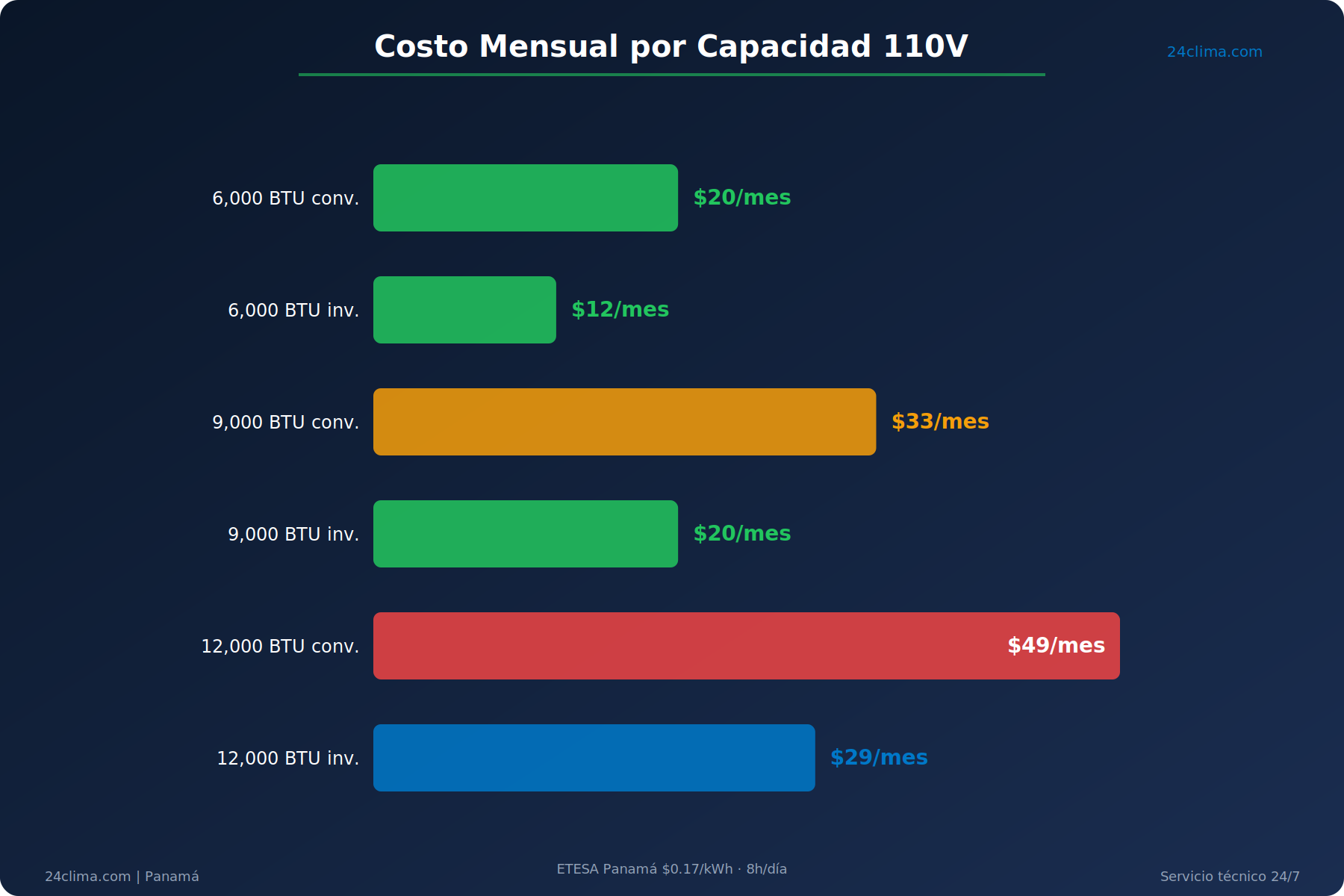
A conventional 12,000 BTU 110V split with an EER of 10 consumes 1.2 kW per hour. At 8 hours of daily use: 9.6 kWh per day, 288 kWh per month, $49 per month for that one unit.
A 12,000 BTU 110V inverter with a SEER of 17 — common for certified models available in Panama — averages about 0.7 kW per hour in stabilized operation. Same usage pattern: 5.6 kWh daily, 168 kWh monthly, $28.56 per month.
That's a $20 monthly gap, or $240 per year. If the inverter costs $150 more than the conventional unit, you've recovered that difference in under 8 months. From month 9 onward, it's pure savings. According to the International Energy Agency (IEA, 2022), variable-speed compressors in inverter technology reduce electricity consumption by 30% to 50% compared to fixed-speed compressors under sustained tropical climate conditions.
Lifespan matters too. A well-maintained conventional unit lasts 8 to 10 years in Panama given the humidity and dust. A name-brand inverter with regular maintenance can exceed 12 to 15 years. That gap shifts the total cost of ownership calculation firmly toward inverter.
To keep either type running well in Panama's climate — where dust and humidity can clog filters noticeably within 30 days — professional cleaning twice a year is the difference between a unit that lasts 12 years and one that fails in 5. Learn exactly what's included in our professional air conditioner cleaning service.
Frequently Asked Questions
Do all apartments in Panama have 110V or 220V electrical installation?
Neither exclusively. It depends on the year of construction and the electrical standard applied to that project. Buildings constructed before 2000 tend to have 110V throughout. Newer buildings — particularly mid-range and upscale projects built after 2005 in San Francisco, Costa del Este, or Coco del Mar — typically include at least one dedicated 220V circuit for air conditioning. If you're unsure about your specific installation, confirm with a multimeter or by checking your breaker panel.
Does a 110V air conditioner use more electricity than a 220V unit in Panama?
Not necessarily. Operating voltage doesn't directly determine energy consumption — compressor efficiency (EER or SEER) and BTU capacity do. A 110V inverter can outperform a 220V conventional unit of the same BTU rating. At higher voltage, the same unit does operate at lower amperage, which reduces heat losses in the wiring. On your monthly bill, though, the conventional-versus-inverter gap dwarfs any 110V-versus-220V difference.
Where is the cheapest place to buy a 110V air conditioner in Panama?
For the lowest unit price, Machetazo is the most competitive — conventional 110V 12,000 BTU models start at $299. DoIt Center offers better brand selection and sometimes folds installation into promotions. Panafoto makes the most sense when financing matters more than sticker price. Either way, always compare the final price with installation included, because that service adds $80–$120 to your total.
Getting This Right Makes All the Difference
Go back to that apartment in San Francisco. This time, before buying, you check the outlet, confirm 110V, measure the room — 18 m², about 195 sq ft — calculate that you need 9,000 BTU, and walk out with an inverter unit that runs you $28 a month instead of $49. The breaker doesn't trip. The room cools down in 12 minutes. Within two years, you've already recovered the price difference over the cheapest conventional model.
Choosing the right air conditioner in Panama doesn't require an engineering degree. Ask three questions in the right order: how large is the space? what voltage does the wiring support? conventional or inverter? Everything after that is price comparison. At 24Clima, we've spent over 5 years installing and maintaining units across the entire city — we know what works in each type of building and each neighborhood. Want a specific recommendation for your space before you buy? Contact us on WhatsApp at 24clima.com/contacto/ — we respond the same day, no commitment required.