24,000 BTU Air Conditioners in Panama — The Size Everyone Buys (and Everyone Gets Wrong)
It's 2 PM in Costa del Este. The sun has been hammering the concrete for hours and your phone says 93°F outside, but with Panama's humidity the real-feel is pushing past 100°F. You walk into your living room after a meeting, hit the remote, and wait. The room cools down — sort of — but you never quite reach that moment where you take a deep breath and feel your shoulders drop. Something isn't right.
Then the ENSA bill arrives. It's $40 higher than last month. You check whether you left lights on, wonder if the fridge is acting up, but you already know the answer: that 18,000 BTU unit you bought because it was "enough for the living room" was never actually enough. It runs at 100% capacity all day, never gets a break, and still can't beat the thermal load of a 750-square-foot space with west-facing windows.
This is what happens when you underestimate Panama's heat. The most common mistake when buying an air conditioner here isn't picking a bad brand — it's picking the wrong capacity. For large living rooms, medium-sized offices, and two-bedroom apartments, a 24,000 BTU unit (2 tons) is the right starting point, not some excessive overkill. Below, you'll understand why, what it actually costs to run, and which models are worth buying in 2025.
What Most People Assume — And Why They're Wrong
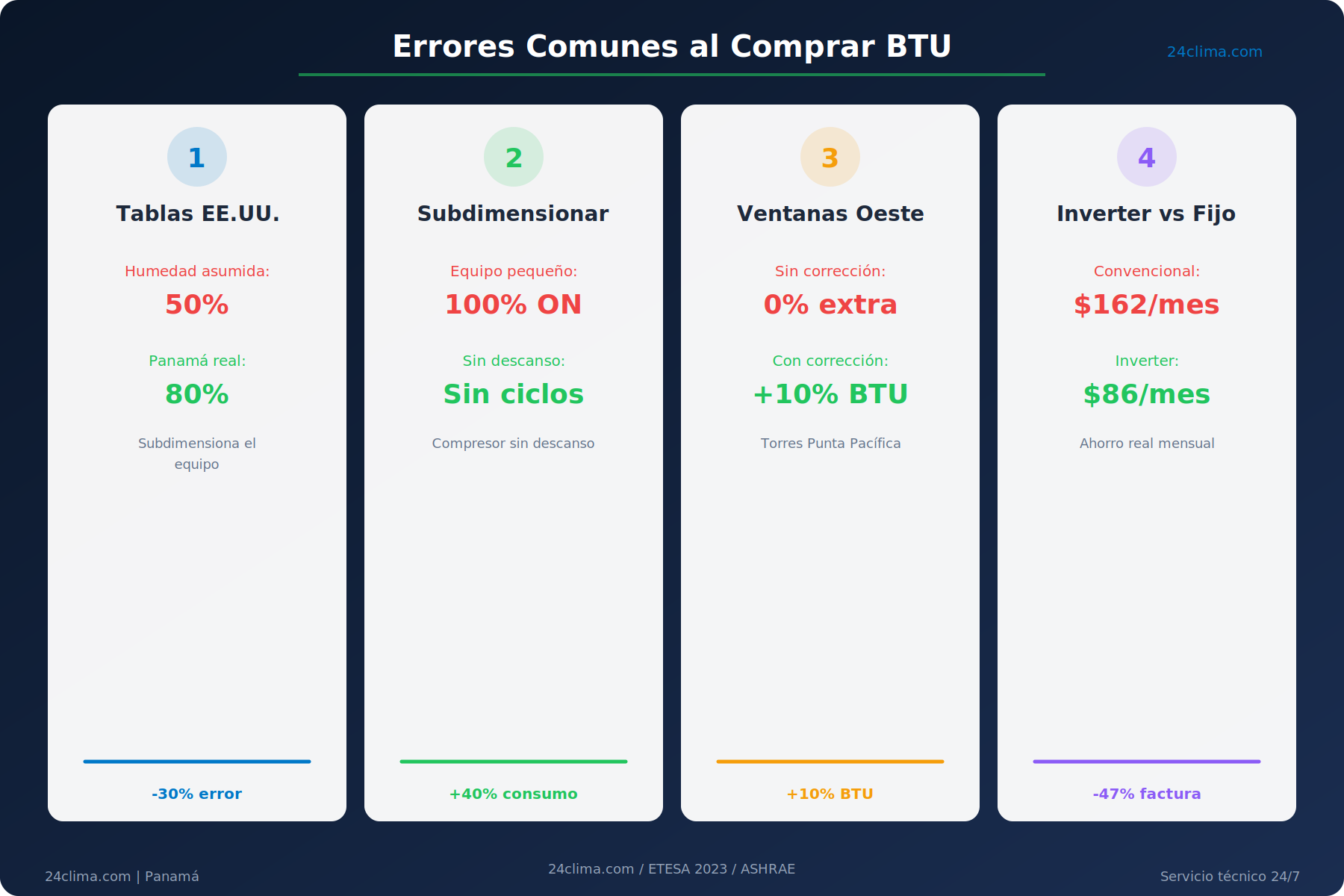
The popular belief goes like this: more BTU always means more electricity. So people buy the smallest unit that "can cool the space" to keep bills low. The result? A unit running at the edge of its capacity with no rest cycles, consuming more kilowatt-hours than a properly sized system would.
An air conditioner runs most efficiently when it can complete full cooling cycles, reach the target temperature, and shift into maintenance mode. An undersized unit never shuts the compressor off. It never rests. That translates directly into constant electricity draw and accelerated wear — which means a higher bill and a shorter lifespan.
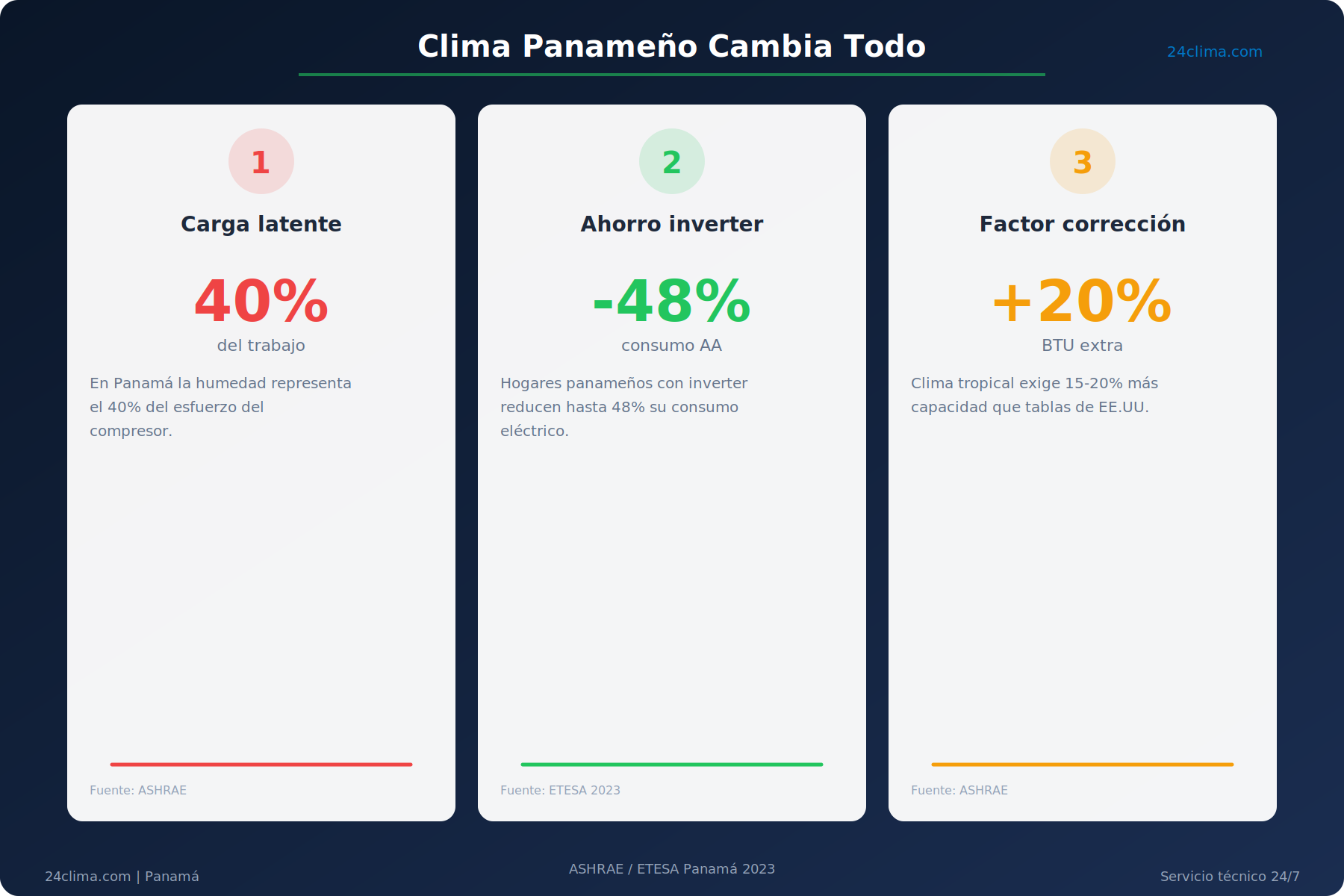
The second mistake is trusting American sizing charts. BTU tables designed for Florida or Texas assume outdoor temperatures around 80°F (27°C) with 50% humidity. Panama runs at 88°F (31°C) with 75-85% average humidity. That changes everything. Latent load — the energy needed to pull moisture out of the air — can represent up to 40% of total compressor work in a tropical climate, according to ASHRAE (American Society of Heating, Refrigerating and Air-Conditioning Engineers). In a dry climate, that figure is 20-25%. Use temperate-climate sizing charts here and you will significantly undersize your system.
How Many Square Feet Does a 24,000 BTU Cover in Panama?
In Panama's climate — outdoor temperatures around 88°F (31°C), humidity between 75-80% — a 24,000 BTU air conditioner efficiently covers between 540 and 750 square feet (50-70 square meters), depending on insulation, ceiling height, window count, and solar orientation.
That means spaces like a large apartment living/dining room combination (600-700 sq ft), a mid-sized office with 6-8 people and computers running, an open-plan loft-style studio around 650 sq ft, or two medium bedrooms with the wall removed.
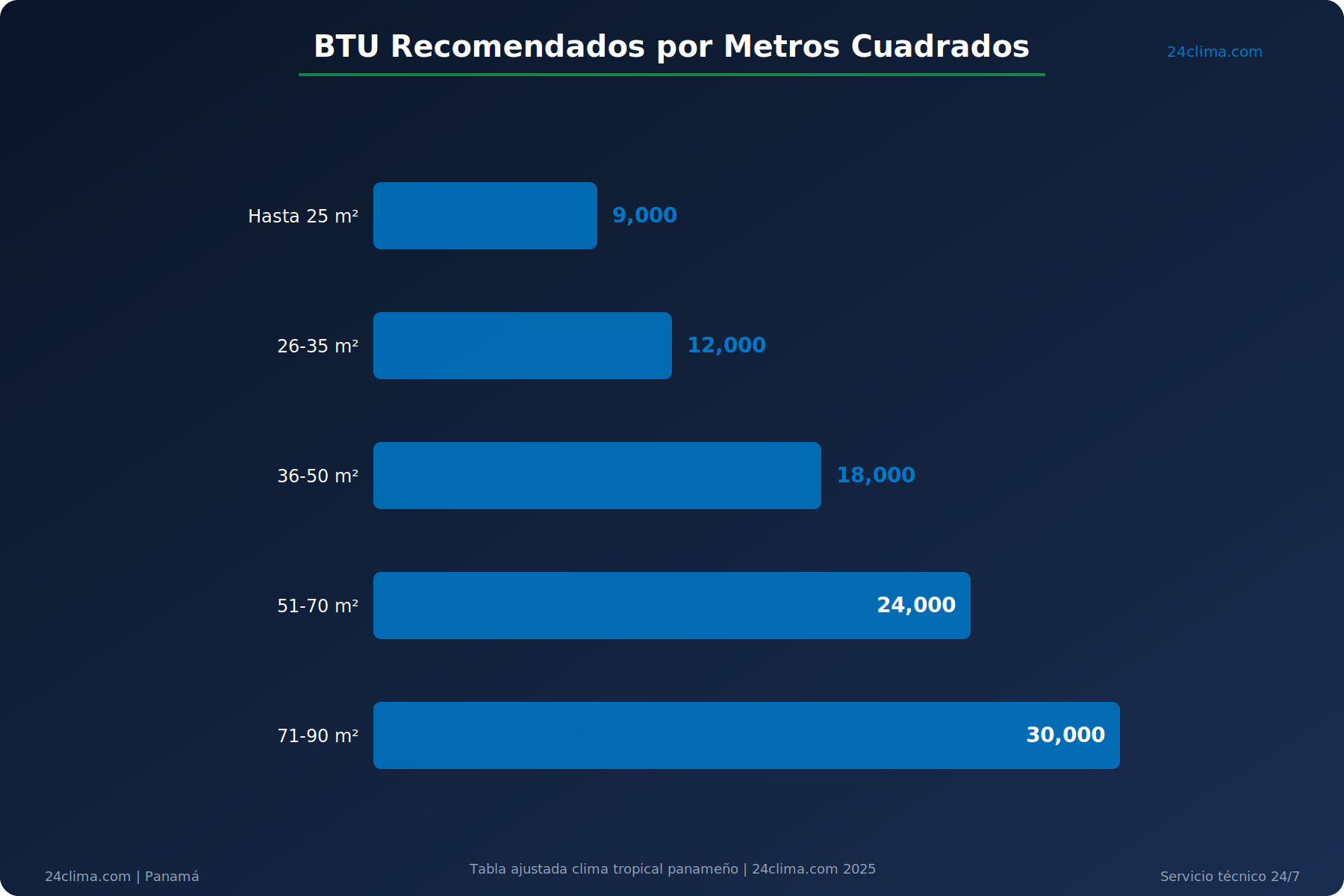
Here's the sizing table adjusted for Panama's tropical climate — don't use US charts for this:
Up to 270 sq ft (25 m²) — 9,000 BTU 270 to 375 sq ft (26-35 m²) — 12,000 BTU 375 to 540 sq ft (36-50 m²) — 18,000 BTU 540 to 750 sq ft (51-70 m²) — 24,000 BTU 750 to 970 sq ft (71-90 m²) — 30,000 BTU Over 970 sq ft (90+ m²) — multi-split or cassette system
These numbers already include a 15-20% correction factor for tropical latent load, standard 9-foot (2.7m) ceilings, and moderate sun exposure. If your living room has floor-to-ceiling windows facing west — very common in towers in Punta Pacífica and San Francisco — add another 10% to the recommended capacity.
What a 24,000 BTU Actually Costs to Run in Panama — Real Numbers
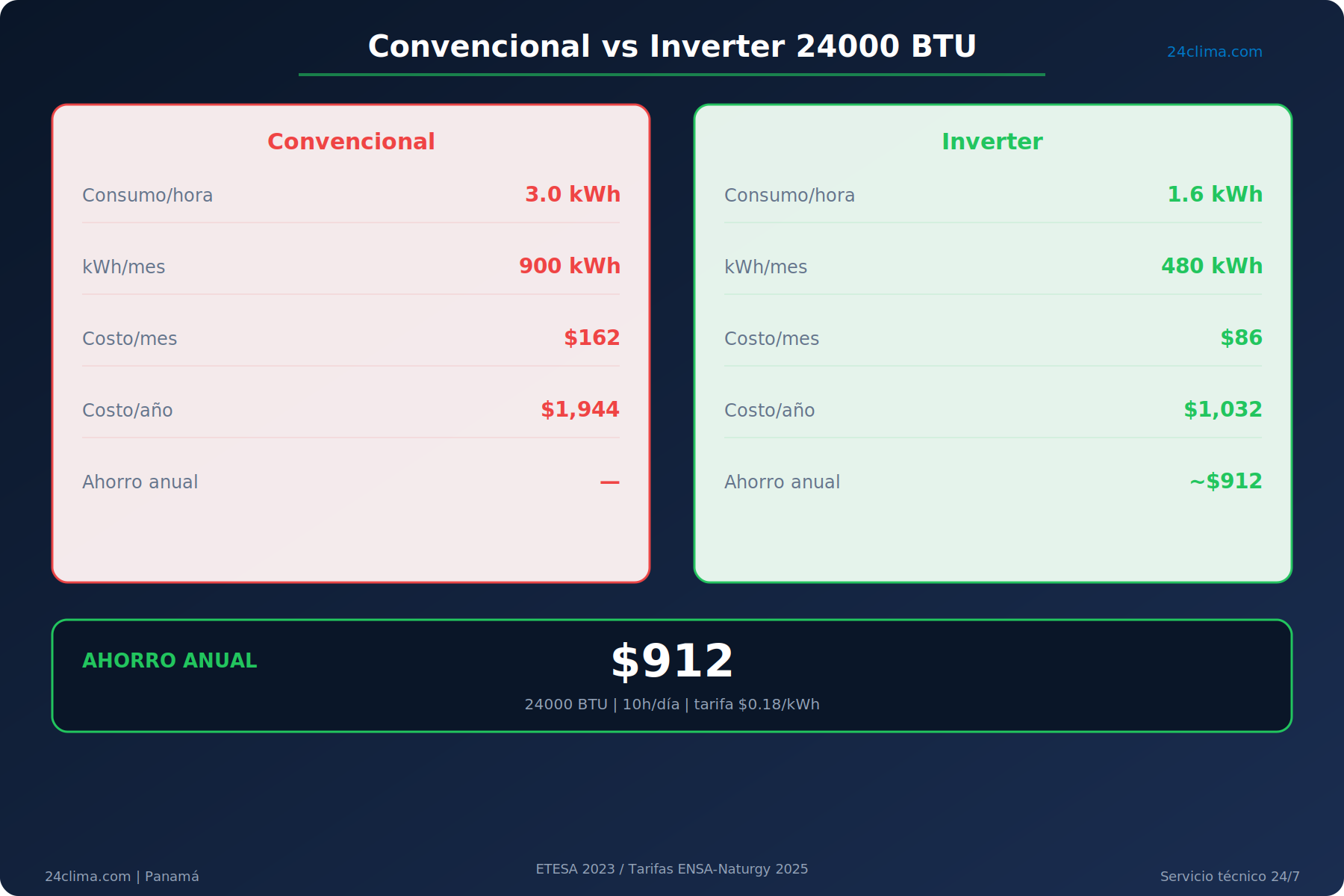
A conventional 24,000 BTU unit consumes between 2.8 and 3.2 kWh per hour of operation. An inverter model of the same capacity consumes between 1.4 and 1.9 kWh in maintenance mode once it reaches the target temperature. That difference isn't a marketing claim — it's the physics of a variable-speed compressor.
The math, using 2025 ENSA/Naturgy residential rates (approximately $0.17-0.19 per kWh depending on your consumption tier):
Conventional 24,000 BTU: — Average consumption: 3.0 kWh/hour — Daily use: 10 hours — Monthly consumption: 900 kWh — Estimated monthly cost: $153 - $171
Inverter 24,000 BTU (SEER 18-21 efficiency): — Average consumption: 1.6 kWh/hour (including startup and maintenance cycles) — Daily use: 10 hours — Monthly consumption: 480 kWh — Estimated monthly cost: $82 - $91
That's a $70 to $80 difference every single month — or $840 to $960 back in your pocket over a year. According to an energy efficiency analysis by ETESA (Empresa de Transmisión Eléctrica, S.A.) published in 2023, Panamanian households with inverter units report 35% to 48% reductions in air conditioning electricity consumption compared to conventional units of equivalent capacity.
Inverter vs. Conventional for 24,000 BTU in a Tropical Climate — Is the Price Difference Worth It?
Yes, and the math is straightforward. A conventional 24,000 BTU unit from a recognized brand runs $550 to $750 at stores like Rodelag, Doit Center, or Machetazo. An equivalent inverter model costs $950 to $1,400. The gap is $400 to $650.
At average monthly savings of $75, you break even in 5 to 9 months. After that, the inverter is pure savings. With an expected lifespan of 12 to 15 years for a well-maintained unit, the economic advantage adds up to $8,000 to $12,000 over its lifetime.
The financial case alone is compelling, but there's more to it. In Panama, with frequent outages and voltage fluctuations — especially in areas like Arraiján, La Chorrera, and newer expansion zones — variable-speed inverter compressors experience far less mechanical stress at each startup. They ramp up gradually rather than slamming on like a conventional compressor, which means less wear and a longer service life in practice.
Modern inverter units also maintain temperature with fluctuations of just ±0.9°F (±0.5°C), compared to ±3.6-5.4°F (±2-3°C) for conventional units. In a bedroom or conference room where you're sitting still for hours, that consistency matters — you feel it, and it shows up on your bill.
The Best-Selling 24,000 BTU Brands Available in Panama in 2025
The brands with the widest distribution, parts availability, and service networks for the 24,000 BTU capacity in Panama are LG, Midea, Carrier, and Samsung. A direct breakdown by price and efficiency:
LG — SEER 18-21 (Dual Inverter models) Price at Rodelag/Doit Center: $1,050 - $1,350 LG's Dual Inverter technology uses a dual-piston compressor that cuts vibration and holds efficiency across a wide range of outdoor temperatures. Established service network in Panama, parts available. Best for: high-rise apartments with moderate load fluctuations.
Midea — SEER 17-20 (U-Inverter and Mission models) Price: $850 - $1,100 Strong price-to-performance ratio. Midea is the world's largest manufacturer of refrigeration equipment by volume (verifiable in their annual corporate reports), and their components hold up industrially. Best for: offices, commercial spaces, buyers working with a mid-range budget.
Carrier — SEER 16-19 (Xpression and Infinity models) Price: $1,100 - $1,500 The most conservative option technically — Carrier units are engineered for regular professional maintenance and have proven performance in tropical climates across decades. Best for: commercial installations where warranty support and service response are the top priority.
Samsung — SEER 18-22 (Wind-Free models) Price: $1,150 - $1,400 Samsung's Wind-Free system eliminates direct airflow by distributing cooled air through thousands of micro-perforations. For living rooms or meeting spaces where people sit for hours, this removes the "cold wind on my neck" complaint without sacrificing efficiency. Best for: living rooms, executive offices, residential spaces with long daily use.
All of these are available at Rodelag (Plaza Herbruger, Albrook Mall, Brisas del Golf), Doit Center (Transistmica, Costa del Este), and El Machetazo for commercial versions. For preventive maintenance after installation, our air conditioning maintenance service covers refrigerant charge checks, coil cleaning, and electrical parameter verification specific to each brand.
Installing a 24,000 BTU in an Apartment — What to Verify Before You Buy
A 24,000 BTU outdoor unit weighs between 62 and 77 lbs (28-35 kg) and requires thicker refrigerant lines than a 12,000 BTU system. Before purchasing, check these points:
Breaker capacity: a 24,000 BTU unit requires a dedicated 20-30 amp circuit at 220V. If the installation area only has 110V wiring, you'll need electrical work done before anything gets mounted.
Distance between indoor and outdoor units: the refrigerant line length limit runs roughly 16 to 50 feet (5-15 meters) depending on the model. In apartments with balconies this is rarely an issue. On high floors without accessible terrace space, it can be a real constraint.
Structural support for the outdoor unit: a 70-lb unit needs a wall bracket anchored into concrete with expansion bolts. On drywall surfaces — common in recent renovations — an additional metal support structure is required.
Condensate drainage: more capacity means more water pulled from the air. A 24,000 BTU unit in Panama's climate produces 4 to 6.5 gallons (15-25 liters) of condensate per day. The drain line must be properly sized and routed, or you'll be dealing with water damage to walls and ceilings.
Line insulation: in Panama, the suction line must be insulated with Armaflex foam at minimum 3/4-inch thickness. At this humidity, an uninsulated line produces condensation that quietly destroys walls and ceilings over months — damage that's expensive to reverse and easy to prevent.
If you want to check whether your current installation meets these requirements, use our online diagnostic tool to catch problems before they turn into expensive damage.
Frequently Asked Questions
What room or space size does a 24,000 BTU air conditioner cover in Panama?
In Panama's climate, a 24,000 BTU unit efficiently covers between 540 and 750 square feet (50-70 square meters). This includes large apartment living/dining rooms, medium offices with 6 to 8 people, and open-plan studios. If the space has ceilings higher than 10 feet (3 meters) or intense direct sun exposure, add 10-15% to the minimum recommended capacity.
How much does a 24,000 BTU air conditioner add to the electricity bill in Panama?
With a conventional unit running 10 hours daily and 2025 ENSA rates of $0.17-0.19/kWh, the monthly impact is $150 to $170. With an inverter of the same capacity, that drops to $80-95 per month. The exact figure depends on the specific model and how many hours per day the unit runs in your space.
Is it worth paying more for an inverter 24,000 BTU versus conventional in a tropical climate?
Yes, with a clear return on investment. The price difference between a conventional and inverter 24,000 BTU unit in Panama is $400 to $650. With monthly savings of $60 to $80, you break even in 6 to 10 months. In a tropical climate where the AC runs 8-12 hours daily year-round — not just during a summer season — the economic advantage of the inverter is larger than in countries with seasonal weather.
That 2 PM Heat in Costa del Este Isn't Going Anywhere — But It Can Become Manageable
Back to that 650-square-foot living room. With a properly installed 24,000 BTU inverter on a dedicated circuit, the unit starts up, reaches 72°F (22°C) in 12-15 minutes, then runs at 40-50% capacity to hold the temperature. The compressor breathes. The room feels different — not just cool, but the humidity is actually controlled. That dense, heavy feeling Panama air gets when it hasn't been treated? Gone.
At 24Clima, we've spent more than five years installing and servicing units of every capacity across Panama — from 12-square-meter bedrooms to server rooms with constant heat loads. If you're evaluating a 24,000 BTU for your living room, office, or apartment and want a recommendation based on your actual square footage, window orientation, and current electricity consumption, contact us on WhatsApp at 24clima.com/contacto/ and we'll help you choose without pushing you toward anything you don't need.
Last updated: May 2025