Carrier Air Conditioners in Panama — Is It Worth It in 2025?
2 p.m. in Costa del Este. The sun hammers straight down on the concrete, the thermometer reads 91°F (33°C), and the humidity is so thick you could chew it. You walk into your apartment, hit the remote, and within seconds that rush of cold air makes everything feel right again.
Then the ENSA bill arrives. And the question that keeps you up at night is the same one thousands of expats and locals ask every year: did I spend my money wisely on this brand, or should I have gone with something else?
Carrier comes up in almost every conversation about the best air conditioner in Panama. It's the brand that invented modern air conditioning back in 1902, and today you'll find it at Novey, Rodelag, and Media Depot across the city. But "famous" doesn't automatically mean "right for your bedroom, your budget, and the specific tropical climate of Panama City." That's what we're going to break down here. You can also browse our guides at 24clima.com to compare brands and models before making a decision.
What Most People Get Wrong About Carrier
The most common mistake is assuming Carrier is automatically the best option because it's the oldest brand or because a major retailer carries it. Clients come to us all the time saying "I bought Carrier because it's American and it has to be good." The reality is more complicated.
Carrier runs very different product lines at very different price and quality points. An entry-level Carrier can perform the same as — or worse than — a mid-range LG inverter. Manufacturing origin matters too: several models sold in Panama today are built in Asian factories under license. That's not necessarily a problem, but it changes the value equation significantly.
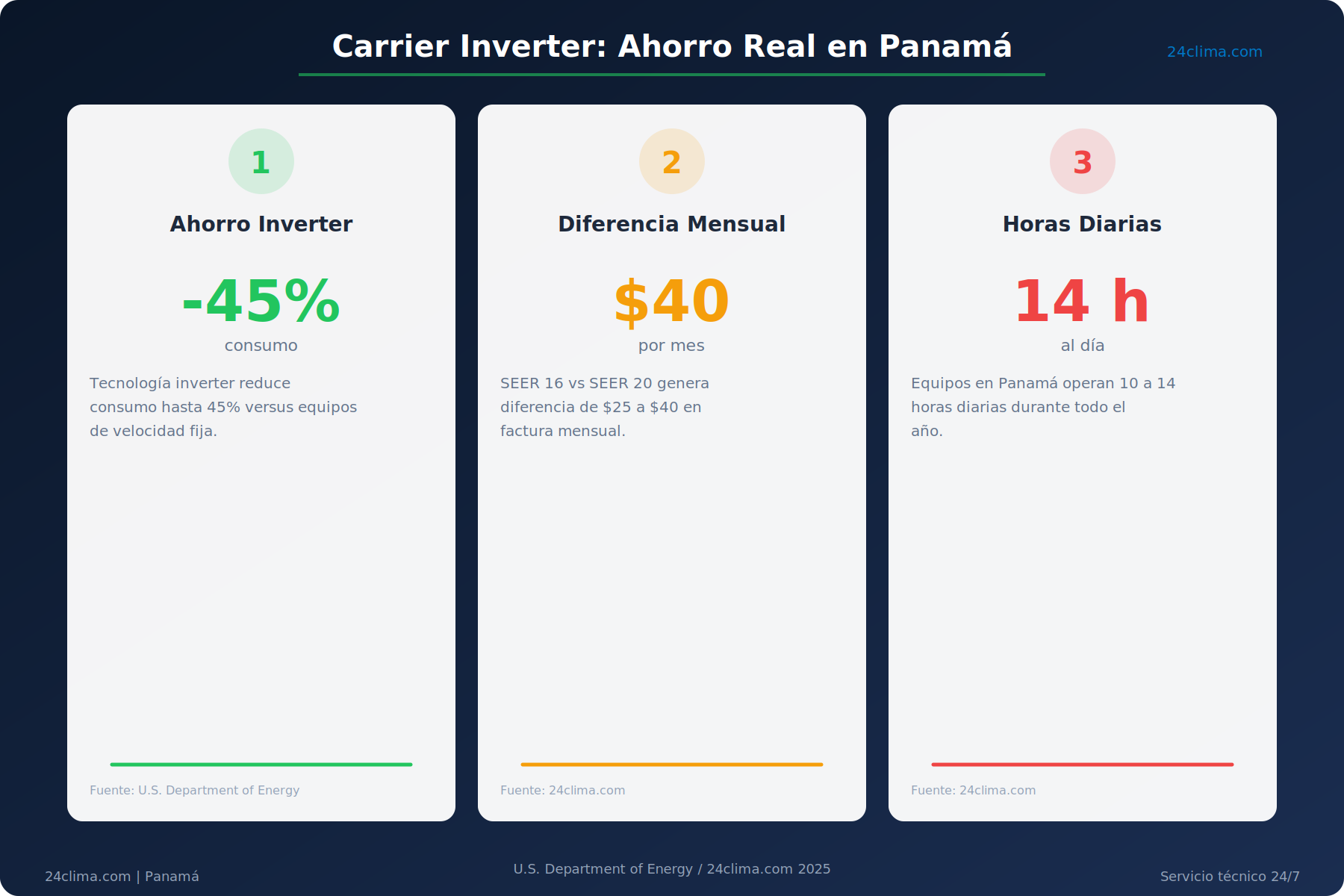
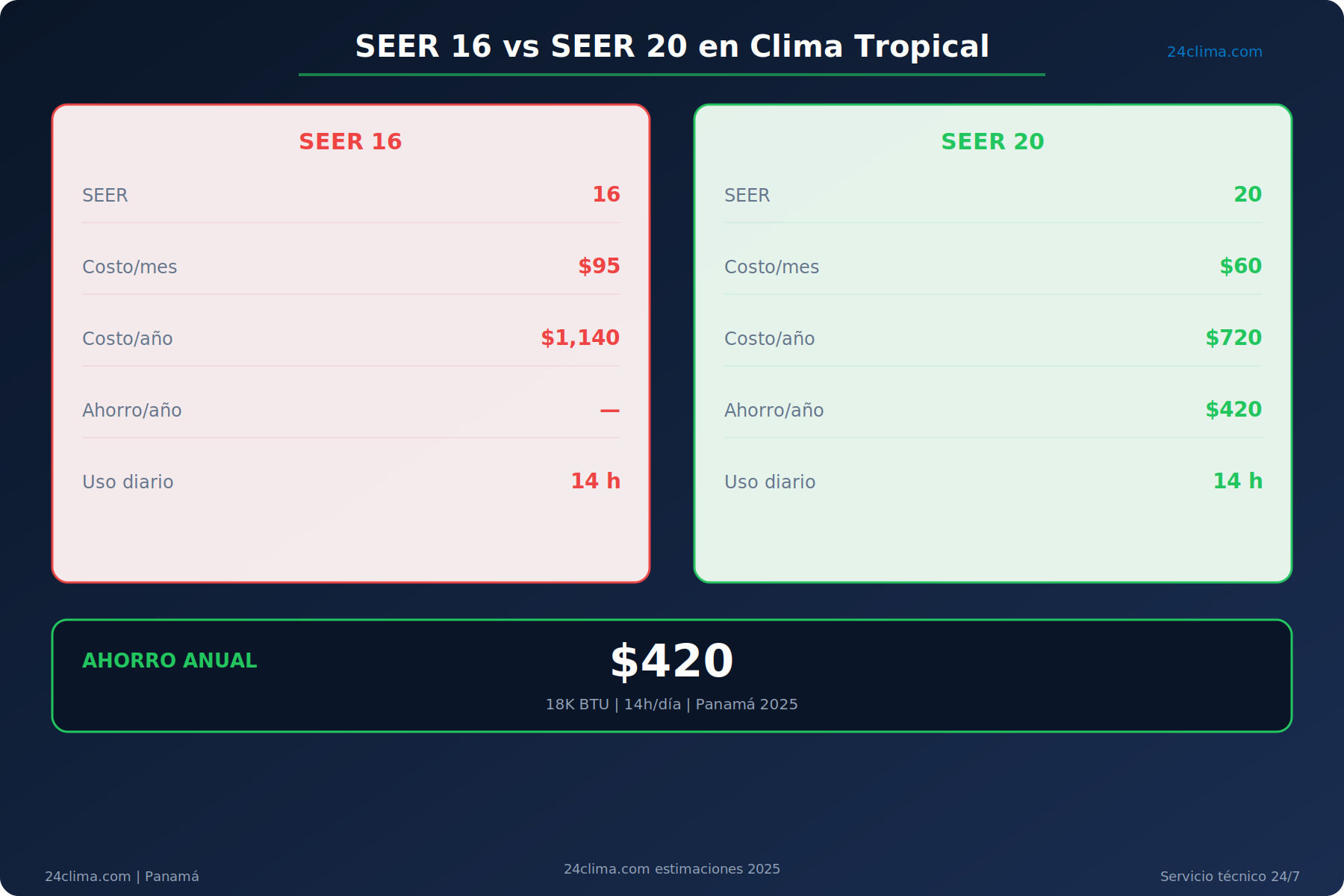
The second mistake is ignoring SEER (Seasonal Energy Efficiency Ratio) when you live in a permanently tropical climate. Panama doesn't have seasons. Your AC runs 10 to 14 hours a day, every day of the year — not in seasonal cycles like Florida or Mexico. That means the gap between a SEER 16 and a SEER 20 unit isn't a minor technical footnote. It's $25 to $40 on your electricity bill every single month.
The Best-Selling Carrier Models in Panama in 2025
Carrier in Panama sells primarily in three residential capacities: 12,000 BTU, 18,000 BTU, and 24,000 BTU. All active models in the local 2025 market use inverter technology, meaning the compressor adjusts its speed rather than cycling fully on and off — which, according to the U.S. Department of Energy, cuts energy consumption by 30% to 45% compared to fixed-speed units.
Carrier Performance Series 12,000 BTU Inverter
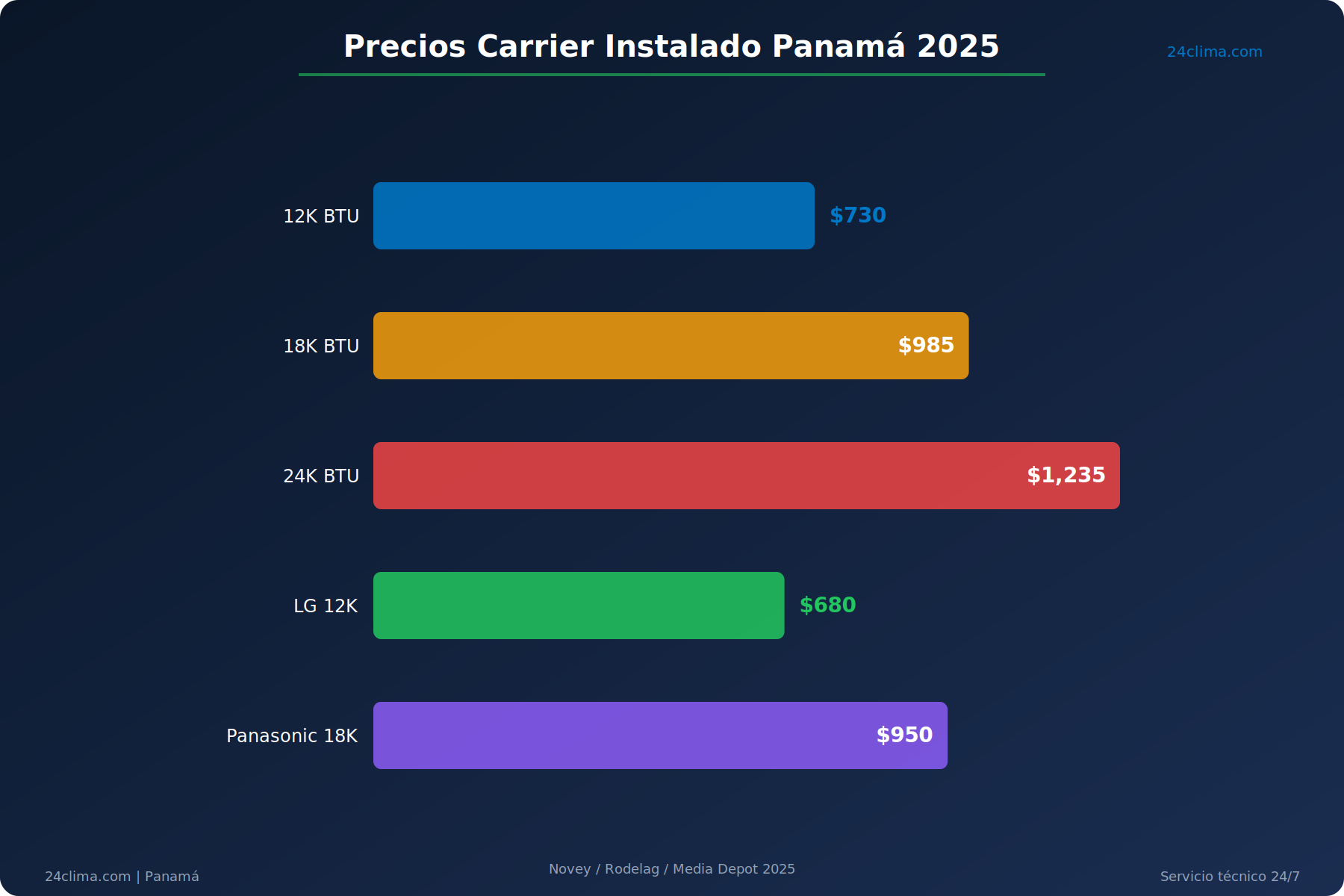
This is the top-selling model in Panama City for rooms between 130 and 195 square feet. Its rated SEER is 16 — the minimum federal requirement in the United States, which is modest for a tropical climate with heavy year-round use. Average installed price in Panama (2025): $680 to $780, based on recent quotes at Novey and Rodelag.
For a 160 sq ft bedroom with a west-facing window in Albrook or San Francisco, this unit does the job. It doesn't have excess capacity, but it doesn't waste energy either. The weak point: on humid nights without cross-ventilation, the dehumidification feels limited compared to the LG Dual Inverter line or Panasonic Aero Series.
Carrier 24ACC 18,000 BTU Inverter
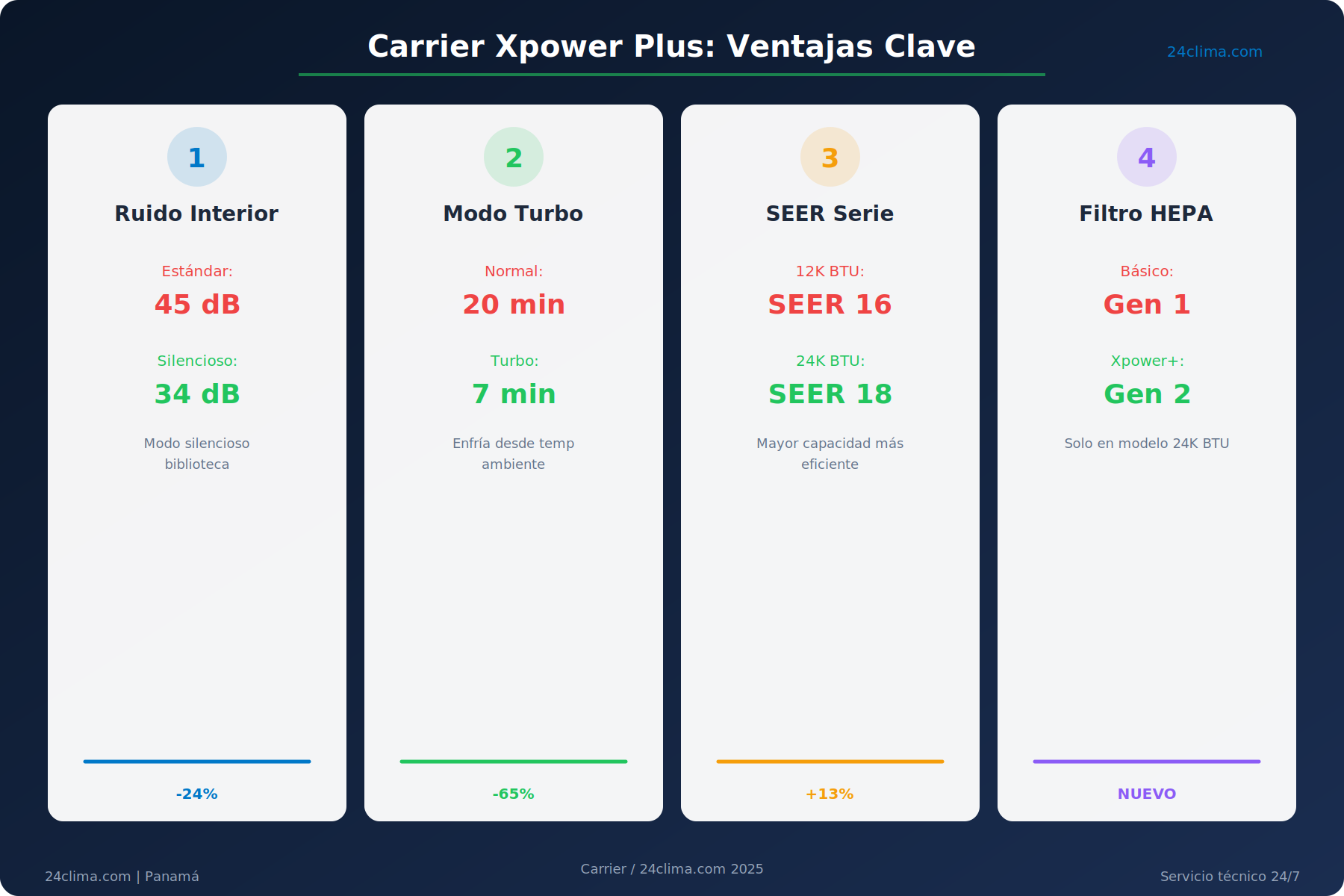
The mid-range model, built for living rooms between 215 and 300 square feet, or large bedrooms on upper floors with direct sun exposure. SEER 17. The indoor fan runs in silent mode at 34 dB — about as loud as a library whisper. Installed price in Panama (2025): $920 to $1,050.
This model handles humidity better than the 12,000 BTU unit because it runs at a lower sustained speed when the heat load isn't at its peak. In practice, in an apartment in Punta Pacífica with sea breeze and moderate heat, this unit holds 72°F (22°C) while consuming 38% less energy than an equivalent non-inverter unit.
Carrier 24,000 BTU Inverter (Xpower Plus Series)
Designed for spaces between 300 and 430 square feet: large open-plan living areas, home offices, small commercial spaces. SEER 18. This is where Carrier competes most directly on efficiency within its own product line. Installed price in Panama: $1,150 to $1,320.
What separates this model from the lower-capacity units is the second-generation HEPA filter and a turbo mode that pulls the room down from ambient temperature in 6 to 8 minutes. For offices in Costa del Este or Torres de Las Américas with variable occupancy throughout the day, that matters.
Carrier vs LG vs Samsung vs Panasonic — The Real Comparison for Panama's Climate
The direct answer: in terms of pure energy efficiency for a permanently tropical climate, LG Dual Inverter and Panasonic Aero outperform Carrier in most equivalent price categories. Where Carrier wins is local service network and parts availability. Here's the full comparison:
Brand / Model — BTU — SEER — Installed Price Panama 2025 — Indoor Noise Level
Carrier Performance — 12,000 — 16 — $680-$780 — 39 dB LG Dual Inverter — 12,000 — 20 — $750-$860 — 34 dB Samsung WindFree — 12,000 — 18 — $820-$950 — 38 dB Panasonic Aero — 12,000 — 21 — $790-$900 — 32 dB
Carrier 24ACC — 18,000 — 17 — $920-$1,050 — 34 dB LG Dual Inverter — 18,000 — 20 — $980-$1,100 — 36 dB Samsung WindFree — 18,000 — 19 — $1,050-$1,200 — 37 dB Panasonic Aero — 18,000 — 22 — $1,010-$1,150 — 33 dB
Carrier Xpower — 24,000 — 18 — $1,150-$1,320 — 36 dB LG Dual Inverter — 24,000 — 21 — $1,200-$1,380 — 37 dB Panasonic Aero — 24,000 — 23 — $1,250-$1,400 — 34 dB
What the table doesn't show: Carrier has the most extensive authorized service network in Panama City, with certified technicians in Miraflores, Albrook, David, and Colón. When a unit breaks down four years in, finding genuine Carrier replacement parts in Panama is significantly easier than sourcing parts for Asian brands. That long-term maintenance reality is part of the real value calculation.
According to a 2023 report from the American Society of Heating, Refrigerating and Air-Conditioning Engineers (ASHRAE), in climates with a mean annual temperature above 79°F (26°C), each additional SEER point saves an average of $18 to $22 per year on a 12,000 BTU unit running 12 hours daily. A SEER 21 versus a SEER 16 adds up to $90 to $110 less per year — or $450 to $550 over five years.
How Many BTUs Do You Actually Need for Your Space in Panama?
In a tropical climate with 85% relative humidity and temperatures ranging from 82°F to 93°F (28°C to 34°C), the standard rule of 55 BTU per square foot that many salespeople use significantly underestimates the actual thermal load. The correct formula for Panama:
— North-facing or interior rooms: 60 BTU per sq ft — West- or south-facing windows with direct afternoon sun: 70 BTU per sq ft — Top-floor units with roof exposed to direct sun: 74 BTU per sq ft — Spaces with frequent occupants or electronics: add 500 BTU per additional person
Practical example: a 160 sq ft bedroom on the 12th floor of a building in El Cangrejo, west-facing window. 160 x 70 = 11,200 BTU. The Carrier 12,000 BTU is the right model. Don't buy the 18,000 BTU "just to be safe" — an oversized unit cools quickly but doesn't dehumidify properly, and in Panama that means the room feels damp and the mattress starts smelling like mildew within weeks.
Preventive Maintenance for Carrier Units in Panama's Humid Zones
A well-maintained Carrier unit lasts 12 to 16 years under tropical conditions. Without proper maintenance, corrosion from humidity and salt air can cut that lifespan down to 7 or 8 years. The schedule Carrier recommends for climates with relative humidity above 75%:
— Every 2 months: clean the internal filters (a 10-minute task the owner can handle) — Every 6 months: deep clean of the evaporator and condensation tray by a certified technician — Every 12 months: check R-410A refrigerant levels, compressor pressure, and electrical connections — Every 24 months: chemical cleaning of the outdoor condenser and inspection of the copper coil for corrosion
In Panama City's coastal neighborhoods — Balboa, Amador, Punta Pacífica — the 6-month deep cleaning schedule is non-negotiable. Salt air deposits a thin film on the condenser fins that reduces heat transfer by up to 20%, according to Carrier Engineering Technical Bulletin ETB-2022-HUM. That translates directly into higher electricity bills and reduced cooling capacity.
Our preventive maintenance service at 24clima covers every point on the Carrier tropical climate schedule. We also offer deep cleaning service if your unit has already started losing efficiency.
Frequently Asked Questions About Carrier in Panama
Is Carrier a good air conditioning brand for Panama's climate?
Yes, Carrier is a reliable brand for Panama's climate, especially if you value parts availability and a strong local service network. In terms of pure energy efficiency (SEER), brands like LG Dual Inverter and Panasonic Aero deliver better numbers at equivalent price points. The right choice comes down to whether you prioritize a lower monthly electricity bill or easier long-term service and repairs.
How much does a Carrier air conditioner cost in Panama in 2025?
An installed Carrier inverter unit runs between $680 and $1,320 depending on capacity. The 12,000 BTU model installed costs between $680 and $780, the 18,000 BTU between $920 and $1,050, and the 24,000 BTU between $1,150 and $1,320. These prices include basic installation at Novey or Rodelag as of January 2025 and may vary based on floor level, distance to the outdoor unit, and wall type.
Which Carrier inverter model is best for a bedroom around 160 sq ft in Panama?
For a bedroom around 160 sq ft, the Carrier Performance Series 12,000 BTU Inverter is the right model in the vast majority of cases. Even if the room has a west-facing window with direct afternoon sun or sits on an upper floor with an exposed roof, the 12,000 BTU unit is still the correct call. Don't step up to 18,000 BTU — an oversized unit in a tropical climate fails to dehumidify properly and creates indoor moisture problems fast.
The Verdict on Carrier in Panama
Back to that apartment in Costa del Este. The bill arrived. The air is cold. But the real question was never just whether Carrier works — it was whether it's the right decision for your specific space, your budget, and how many years you need the equipment to last.
Carrier is a solid, low-risk choice for the Panama market in 2025. It's not the most efficient brand per dollar spent, but it's the easiest to maintain long-term in a country where access to a certified technician and genuine replacement parts is the difference between a same-day repair and a three-week wait for an import. If your top priority is the lowest possible electricity bill, look at LG or Panasonic first. If your priority is operational peace of mind over the next 15 years, Carrier earns its price tag.
At 24Clima, we assess your space, your current energy consumption, and your real budget before recommending any brand or model. Contact us on WhatsApp at 24clima.com/contacto/ — we'll give you a technical recommendation at no cost, with no purchase commitment required.
Last updated: May 2025