12,000 BTU Inverter Air Conditioner — The Complete Guide for Panama
It's 2 PM in Costa del Este. The asphalt is shimmering. Inside your bedroom, the thermometer reads 86°F (29°C) and the humidity feels like a wet towel pressed against your face. You switch on the AC, hear the compressor jerk to life, and wait. Five minutes. Ten. The room drops to 79°F (26°C) but never feels dry, comfortable, or truly livable.
Then the ENSA bill arrives. $120. $140. And you start wondering whether the unit you bought three years ago was really the right call.
Here's the mistake most people make: they shop by BTU without understanding Panama's climate. A 12,000 BTU inverter isn't just "the bedroom unit" — it's the entry point to a system that can completely change both your comfort and your monthly energy costs, if you choose it right and install it correctly. If you want to work through more questions before deciding, our guide section at https://24clima.com/consejos-y-guias/ covers the most common situations we see across Panama's HVAC market.
What Most People Believe (and Why They're Wrong)
There's a widespread assumption in Panama: more BTU always means better cooling. Big room? Throw in an 18,000 BTU unit. Bills already high? At least make it cool fast. That logic sounds reasonable. In practice, it produces the exact opposite of what you want.
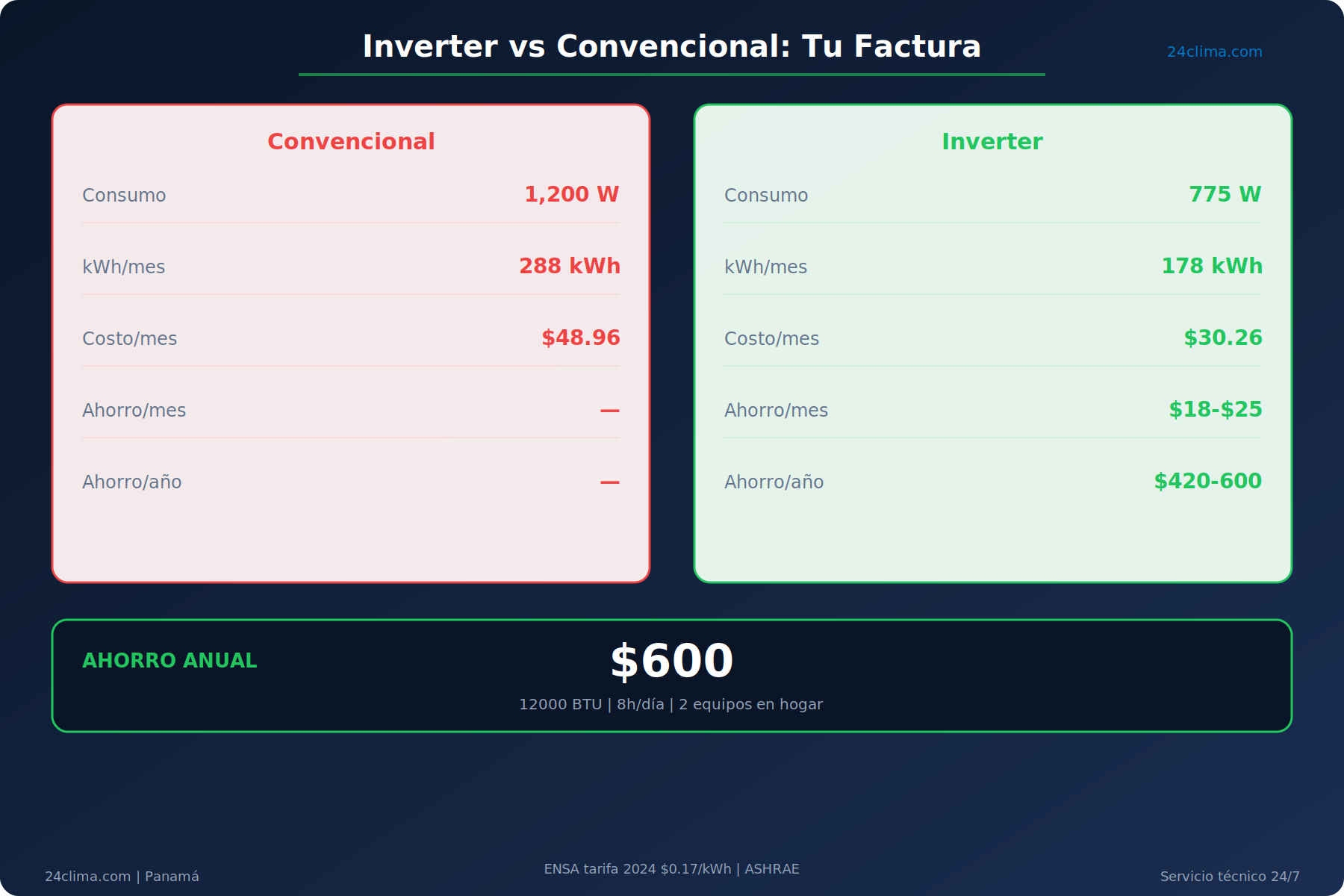
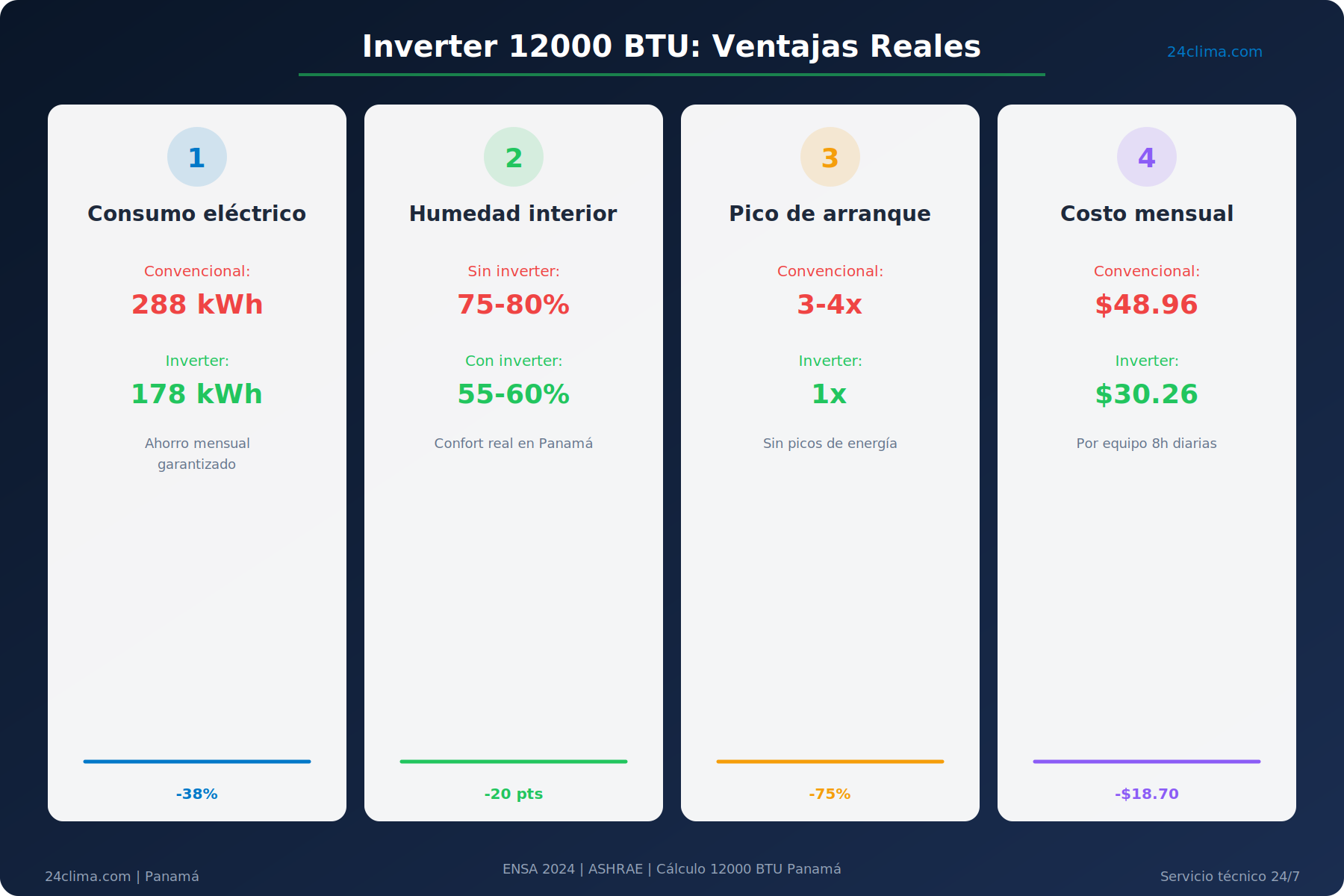
An oversized unit kicks on, chills the air in minutes, then shuts the compressor off before it has pulled the humidity out of the room — and then cycles back on again. The result: a room that feels cold but sticky. Relative humidity stays at 75–80%, which in Panama means you feel uncomfortable even when the thermostat reads 73°F (23°C). On top of that, every compressor start-up draws a power spike 3 to 4 times higher than normal operation. Your bill climbs without your comfort improving.
Inverter technology solves exactly that problem. Instead of switching the compressor on and off, it regulates it. The compressor slows down once the room reaches the target temperature and holds it there consistently with minimal energy draw. For a standard Panamanian bedroom of 160 to 215 square feet (15 to 20 square meters), a 12,000 BTU inverter unit is, in most cases, the right capacity.
Why 12,000 BTU Is the Right Capacity for Panama
In Panama's climate — average outdoor temperatures of 88°F (31°C), relative humidity of 80–85% — a room of 160 to 215 square feet (15 to 20 square meters) needs between 9,000 and 12,000 BTU to cool and dehumidify properly. A 12,000 BTU inverter covers that range with enough headroom for real-world factors like large windows, high ceilings, or a top-floor unit with direct sun exposure.
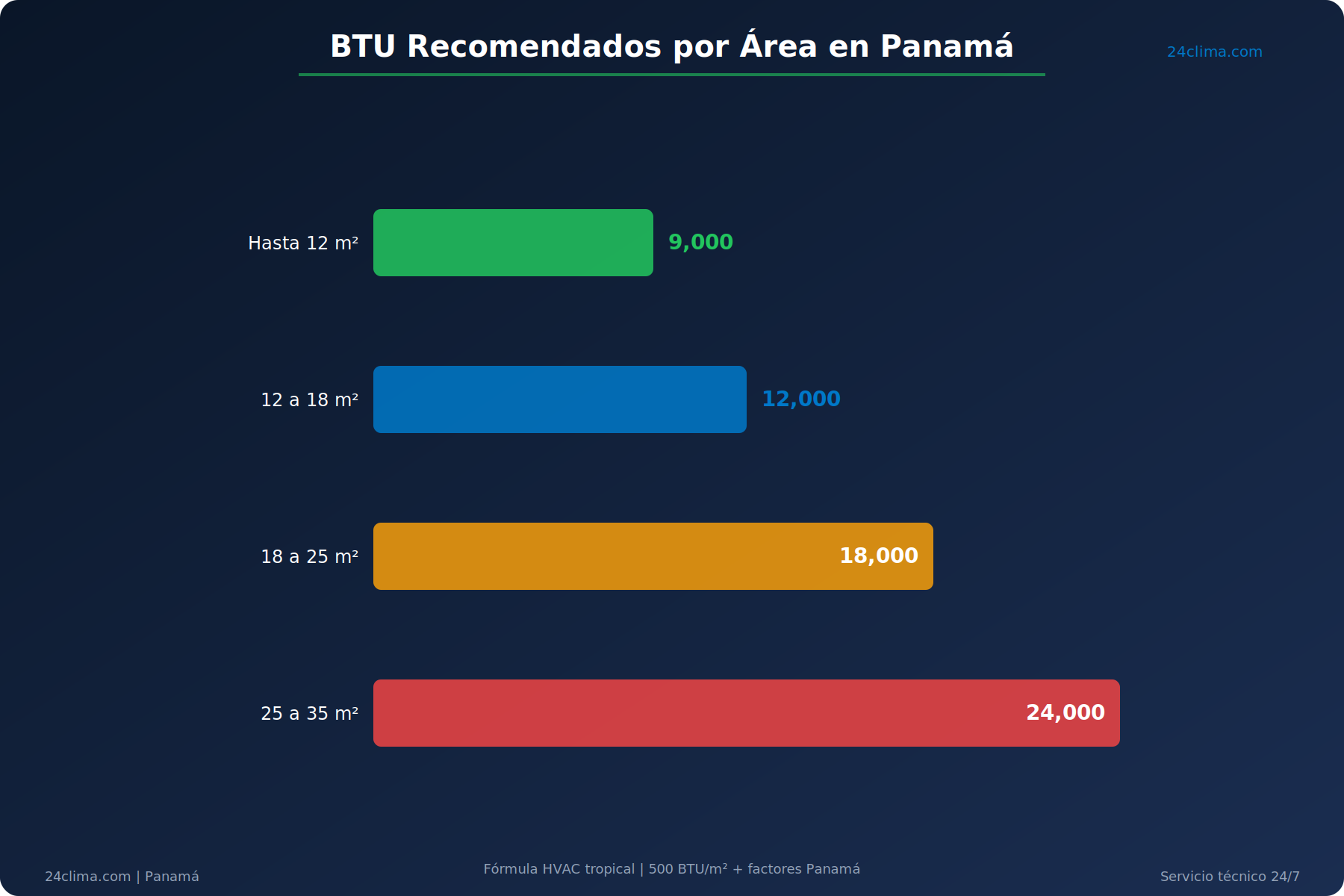
The baseline HVAC industry formula is 500 BTU per square meter in tropical climates. But that figure assumes standard conditions. In Panama, you need to add:
— 10% more for sustained high humidity (80%+) — 10% more if the room has a window facing west or south — 5% more for each additional person who regularly sleeps in the room — 10–15% more if the roof is zinc or the apartment is on an upper floor with no insulation
Apply those factors to a 195 sq ft (18 m²) room with a west-facing window in Punta Pacífica, and the real calculation lands between 10,800 and 12,600 BTU. A 12,000 BTU inverter fits perfectly.
Reference table for Panama:
Room size — Recommended BTU — Notes Up to 130 sq ft (12 m²) — 9,000 BTU — Only if solar exposure is low 130–195 sq ft (12–18 m²) — 12,000 BTU — Standard capacity, most versatile 195–270 sq ft (18–25 m²) — 18,000 BTU — Large bedrooms or small living areas 270–375 sq ft (25–35 m²) — 24,000 BTU — Living rooms, offices, or master suites
Inverter vs. Conventional: The Number That Actually Matters on Your Bill
The real difference between an inverter and a conventional 12,000 BTU unit comes down to dollars per month, not spec-sheet features. Here are the concrete numbers for Panama.
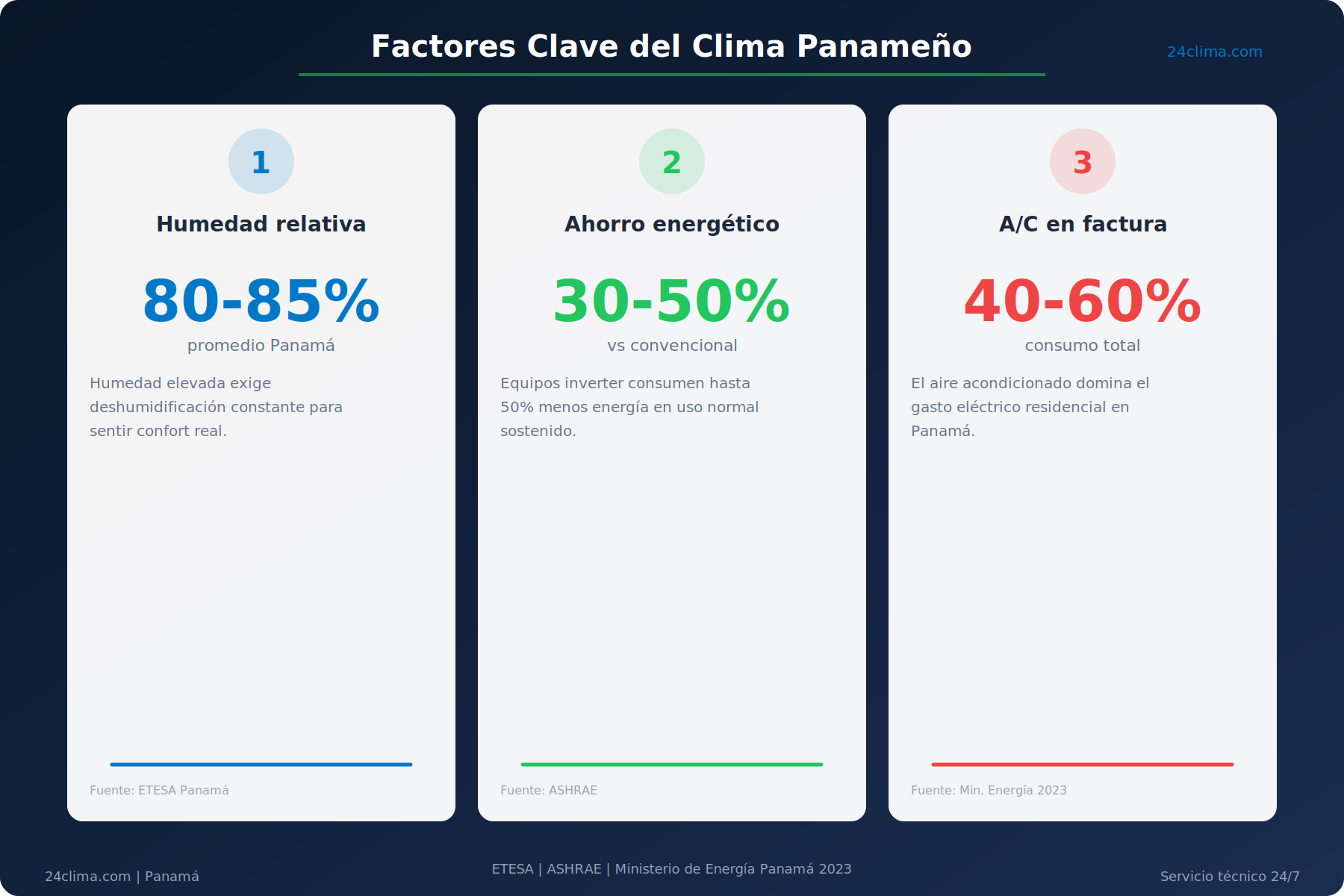
A conventional (non-inverter) 12,000 BTU unit runs at roughly 1,200 watts during a full cycle. Running 8 hours a day for a 30-day month:
1.2 kW × 8 hours × 30 days = 288 kWh per month
At ENSA's 2024 residential rate (approximately $0.17 per kWh in the mid-tier block), that single unit costs $48.96 per month in electricity.
A 12,000 BTU inverter with a SEER rating of 20 averages 700 to 850 watts during sustained operation, because the compressor never runs flat out. The American Society of Heating, Refrigerating and Air-Conditioning Engineers (ASHRAE) has documented that inverter units consume 30% to 50% less energy than equivalent conventional units under normal use conditions.
Applying a conservative 38% savings:
288 kWh × 0.62 = 178 kWh per month 178 kWh × $0.17 = $30.26 per month
The difference: $18 to $25 per month on a single unit. Two AC units in your home, and you're looking at $35 to $50 in monthly savings — $420 to $600 per year. Panama's Ministry of Energy reported in 2023 that air conditioning accounts for 40% to 60% of residential electricity consumption in the country's urban areas.
A quality 12,000 BTU inverter costs $50 to $120 more than an equivalent conventional unit. At those monthly savings, the price difference pays for itself in 3 to 6 months of use.
What Brands Are Available in Panama and What They Cost
The 12,000 BTU inverter units you'll find at Panafoto, Novey, and DoIt Center in 2024–2025 fall into three tiers.
Budget range ($350 to $500):
— Mirage: widely stocked at DoIt Center and Novey, entry-level units with SEER ratings between 14 and 16. Functional, but with an expected lifespan of 8 to 10 years. — Soleus Air: available at Panafoto, competitive pricing, 1-year parts warranty. — Mabe: carried at Novey, with local technical service — an important advantage in Panama.
Mid-range ($500 to $750):
— LG Dual Inverter: one of the top-selling units in the country. SEER between 19 and 21, dual compressor with 10-year warranty on many models. Available at Panafoto and authorized dealers. — Samsung WindFree: uses micro-hole diffusion technology to eliminate the direct cold-air blast. SEER 18–20. Average price $620 in 2024. — Carrier Performance: an industrial-heritage brand with local distribution and solid parts availability.
Premium range ($750 to $1,100):
— Daikin Inverter: Japanese engineering, SEER up to 25, whisper-quiet at 19 dB. The most efficient unit available locally — higher upfront cost, lower operating cost over its lifespan. — Mitsubishi Electric: another Japanese benchmark, ideal for rooms where noise is critical — a baby's room, a light sleeper's bedroom. Available through specialized distributors.
The most important buying criterion isn't the brand. It's the SEER rating. That number — Seasonal Energy Efficiency Ratio — measures how many BTU of cooling the unit delivers per watt-hour consumed. In Panama, where your AC runs almost year-round, prioritize units with SEER 18 or higher. The difference between SEER 14 and SEER 20 can add $20 to $30 to your monthly bill.
Voltage matters too: check whether the unit requires 110V or 220V before you buy. The 220V units are generally more efficient, but they require your room's electrical circuit to support that voltage. A technician can verify that in minutes. The installation service at https://24clima.com/servicios/instalacion/ includes that pre-installation check.
Before you decide, confirm these six things:
— SEER 18 or higher (don't accept less if you run the unit more than 6 hours a day) — Local warranty of at least 1 year on parts and 5 years on the compressor — Voltage compatible with your electrical installation (110V or 220V) — Brand with available technical service in your city — Indoor noise level below 42 dB (for sleeping rooms, look for 35–38 dB) — Independent dehumidification mode separate from cooling mode
Installation: The Factor Nobody Mentions When They Sell You the Unit
The best 12,000 BTU inverter on the market will underperform if the installation is done wrong. In Panama, the most common errors are copper refrigerant lines of the wrong gauge, excessive line-set length between indoor and outdoor units, and poor indoor unit placement that creates dead zones in the room's airflow.
Mount the indoor unit on the wall opposite the room's main door, at a height of 6.5 to 8 feet (2 to 2.5 meters), with a diffusion angle that covers most of the bed and main living area. The ideal line-set length between units is 10 to 16 feet (3 to 5 meters). Push past 33 feet (10 meters) and the system loses efficiency — it may even need a refrigerant top-up from day one.
Maintenance matters from year one too. In Panama, filters accumulate dust, moisture, and mold spores far faster than in dry climates. Clean filters every 30 days. Schedule a deep clean every 6 months. That alone can add 3 to 5 years to the unit's lifespan and keep it performing the way it did on day one. The professional cleaning service at https://24clima.com/servicios/limpieza/ is set up specifically for Panama's conditions.
Frequently Asked Questions
Is a 12,000 BTU inverter enough for a bedroom in Panama?
Yes, for rooms between 130 and 215 square feet (12 to 20 square meters) under typical Panamanian conditions. If the room has intense solar exposure, a zinc roof, or sits on an upper floor with no insulation, recalculate using the tropical correction factors above. In those cases, a 14,000 or 18,000 BTU unit may serve you better.
How much electricity does a 12,000 BTU inverter use per month in Panama?
At 8 hours of daily use and ENSA's residential rate ($0.17/kWh in 2024), a 12,000 BTU inverter with SEER 20 consumes approximately 160 to 190 kWh per month — $27 to $32 on your bill. A conventional unit of the same size runs $45 to $55 per month under the same conditions.
Which 12,000 BTU inverter brands are available in Panama and what do they cost?
At Panafoto, Novey, and DoIt Center you'll find LG, Samsung, Carrier, and Mabe in the $450 to $700 range. For higher-efficiency premium brands — Daikin, Mitsubishi — prices rise to $750–$1,100, and these are generally purchased through specialized distributors. The best price-to-efficiency ratio for residential use comes from the LG Dual Inverter and Samsung WindFree in the mid-range tier.
The Right Decision Starts with the Right Information
Back to that Costa del Este bedroom. This time, the 12,000 BTU inverter starts quietly — no compressor jolt. Within 15 minutes the room is at 73°F (23°C) and humidity has dropped to 55%. The difference isn't just temperature. It's the way you breathe. The way you sleep. And the following month, your ENSA bill shows $28 instead of $52 for that unit.
Inverter technology isn't new. What's different here is having the numbers calibrated for Panama's specific climate — not the generic averages from manuals written for Florida or Mexico.
At 24Clima, we evaluate your space, available voltage, window orientation, and real usage patterns before recommending any unit. We don't sell brands — we solve comfort and energy problems. If you have questions about what capacity you need or want a second opinion before you buy, reach out via WhatsApp at https://24clima.com/contacto/ and a certified technician will respond at no charge.
Last updated: June 2025. Energy consumption data based on current ENSA tariffs and ASHRAE 2023 statistics.