AC Condenser Coil — How to Clean It Yourself Without Calling a Technician
It's 2 in the afternoon in Costa del Este. The sun is hammering concrete at 93°F (34°C) and inside, the air conditioner has been running for three hours straight. Everything seems to be working. But something's off: the room just won't cool down, the outdoor unit's fan sounds louder than usual, and last month's electricity bill came in $22 higher than the month before.
You step outside to check the unit. There it is, mounted on its bracket, coated in a gray layer of dust mixed with dry leaves and what looks like dark lint. The coil fins — those thin metal strips that wrap around the unit — are completely clogged. Air can barely pass through.
That's your problem. And you can fix it yourself in under 45 minutes.

What Most People Assume — And Why They're Wrong
The most common belief among AC owners in Panama is that maintenance means cleaning the indoor filter every so often. Pull it out, rinse it off, put it back. Done.
That's not maintenance. It's the equivalent of washing your windshield and calling it a full service.
The condenser coil — the outdoor part of your system — operates under far harsher conditions than the indoor evaporator. It's directly exposed to the environment: street dust, seeds, insects, mold spores, and in areas like Punta Pacífica or Balboa, salt suspended in the ocean breeze. In Panama's tropical climate, with average humidity around 85% and temperatures that don't drop below 82°F (28°C) even at 3 a.m., that coil builds up active grime on a 3 to 6 month cycle. Not once a year. Every few months.
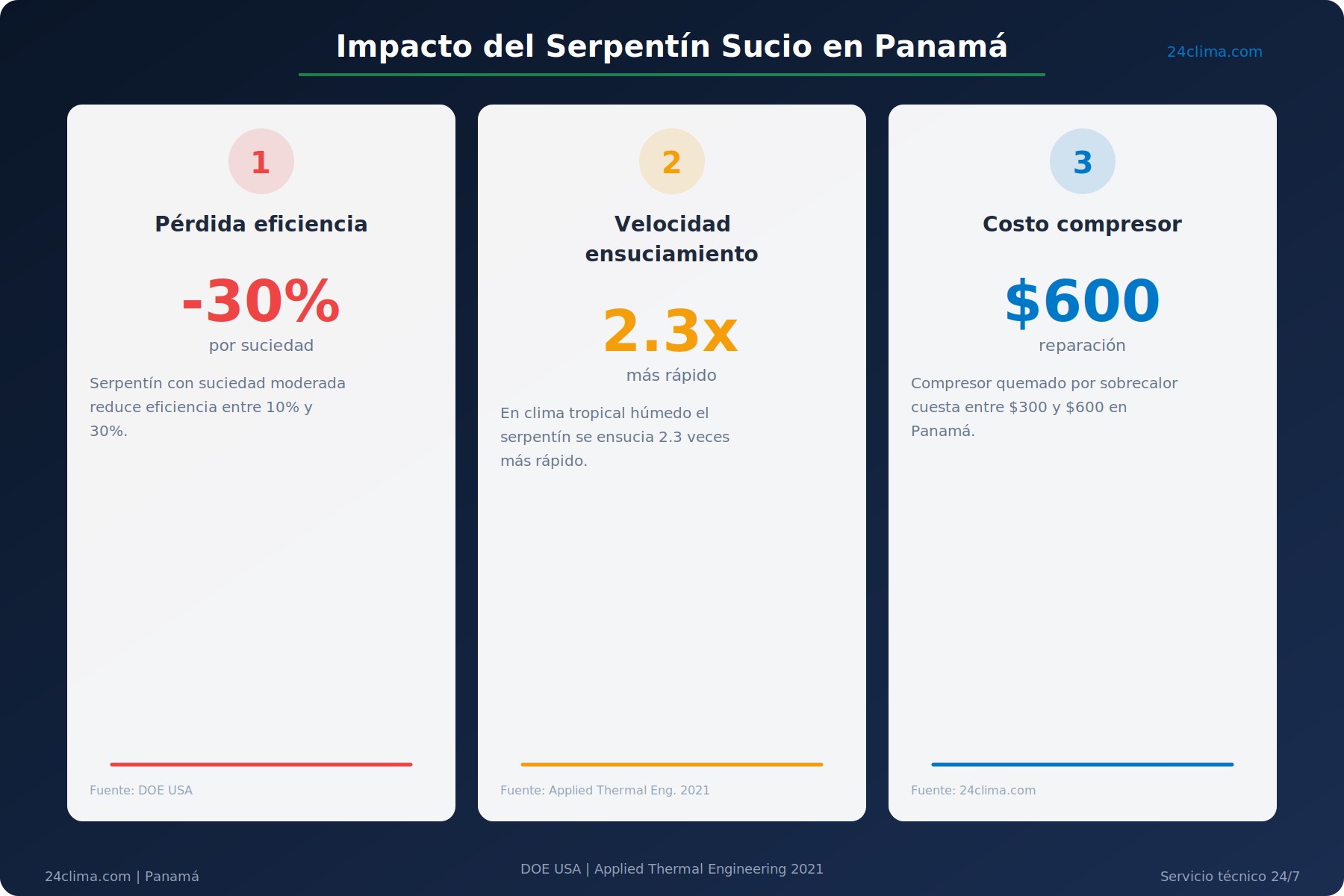
The U.S. Department of Energy found that a condenser coil with moderate dirt buildup reduces system efficiency by 10% to 30% — which translates directly into higher electricity consumption with no additional cooling to show for it. In Panama, where the average residential electricity rate runs around $0.18 per kWh, that 30% inefficiency can add $20 to $40 in extra charges every month in a typical home with two split units.
You can find a companion article on the indoor evaporator coil at 24clima.com — it pairs directly with what we're covering here.
What the Condenser Coil Is and Why It Gets Dirty So Fast in Panama
The condenser coil is the network of copper tubes surrounded by aluminum fins that forms the outer wall of your outdoor unit. Its job is to release the heat extracted from inside your home to the outside air. To do that, it needs air to flow freely through those fins.
When the fins get blocked, heat can't escape. The compressor works harder, draws more electricity, and the refrigerant can't reach the correct condensing pressure. Cooling drops — even with the unit running at full power.
Three factors specific to Panama speed up the buildup:
High humidity (85–95%) makes dust stick to the fins rather than fall away. Think of it as coating the fins in paste.
Nearby vegetation — trees dropping floating seeds, palms shedding fibers, gardens right next to the unit — is nearly unavoidable in residential areas like Albrook, Clayton, or San Francisco.
Urban pollution in neighborhoods like Costa del Este, Obarrio, or Marbella means combustion particles from traffic combine with dust to form a dense, compacted layer that wind alone can't remove.
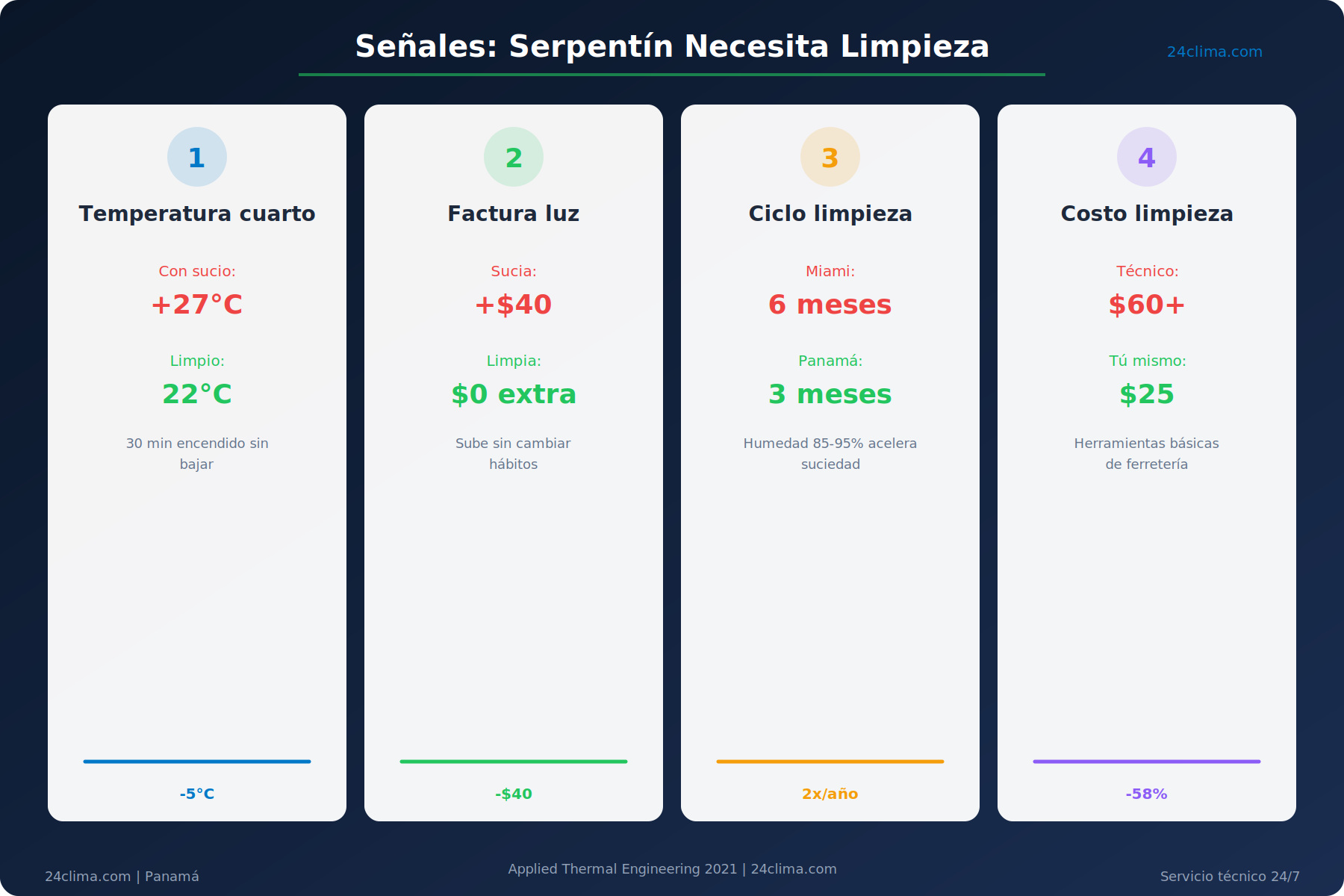
A study published in Applied Thermal Engineering (2021) found that in tropical climates with relative humidity above 80%, condenser coil fouling rates are 2.3 times faster than in temperate climates. What gets done every six months in Miami needs to happen every three months in Panama City.
Signs Your Condenser Coil Needs Cleaning Right Now
A dirty coil rarely announces itself with a noise or an error code. Most of the time the deterioration is silent and gradual. Here's what to look for:
The outdoor unit is visibly coated in gray dust or dark lint on the external fins.
The outdoor fan is spinning but you can barely feel air coming out of the top.
After 30 minutes of running, the room is still above 81°F (27°C).
Your electricity bill went up without any change in how you use the unit.
The compressor hum from the outdoor unit sounds louder or different than usual.
The top of the outdoor unit feels unusually hot to the touch — beyond what you'd expect on a 90°F (32°C) day.
Three or more of these? Clean the coil before next week. Waiting compounds the damage and can eventually burn out the compressor — a repair that in Panama runs $300 to $600 depending on brand and unit capacity.
Tools You Need — Nothing Specialized
Everything on this list costs under $25 total at any hardware store in Panama, and you probably already own most of it.
Garden hose with an adjustable nozzle, or a basic home pressure washer on a soft setting — maximum 1,200 PSI. Soft-bristle brush, non-metallic. Coil cleaning foam, available at refrigeration supply shops in El Dorado or Via Argentina for roughly $8–12. Nitrile gloves and basic safety glasses. Phillips screwdriver to remove the protective cover if your unit has one.
Skip the industrial pressure washers above 1,500 PSI — they permanently bend the aluminum fins. Concentrated household detergent corrodes aluminum. Wire brushes and steel wool scratch the coating. None of those belong anywhere near this coil.

Step by Step: How to Clean the Condenser Coil Without a Technician
This process assumes a standard split unit mounted on an exterior wall, terrace, or ground level. Total time: 30 to 45 minutes.
Before you touch anything: turn the unit off at the remote and flip the circuit breaker in your electrical panel. This is not optional. The compressor can kick on automatically if the thermostat detects heat during cleaning, and water on a running compressor means a short circuit.
Step 1 — Initial inspection
Look at the fins from outside. Uniformly coated in dust? Compacted lint? Any fins already bent? Take a photo now to compare when you're done.
Step 2 — Remove the outer protective cover (if applicable)
Some models have a plastic or metal grille held on with 2 to 4 Phillips screws. Remove it carefully, supporting the internal fan blade. Don't force anything or pull on wiring.
Step 3 — Dry brushing
Stroke the soft-bristle brush gently over the fins in a vertical direction — top to bottom, following the blade direction. This loosens surface dust before you add water. Light pressure only: aluminum fins bend under very little force.
Step 4 — Apply coil cleaning foam
Spray directly onto the fins, wait 5 to 10 minutes, and let the foam do the work. It dissolves grease and organic buildup on its own and is biodegradable and safe for the coil's metals.
Step 5 — Rinse with water
Hose pressure should feel like watering a garden, not blasting a sidewalk. Direct the stream from inside outward if you have access, or outside inward if you can't get around the unit — the goal is pushing dirt out through the coil, not deeper into it. Keep water away from the compressor, electrical cables, and the internal control board.
Step 6 — Check for bent fins
After rinsing, scan for deformed fins. A fin comb — $5 to $8 at refrigeration supply shops — lets you straighten them and restore airflow. If only a few fins are bent it's optional, but if whole sections are blocked it's worth the investment.
Step 7 — Dry and reconnect
Let the unit air dry 10 to 20 minutes. Flip the breaker back on, start the unit, and pay attention: the outdoor fan should visibly move more air upward, the compressor should sound noticeably quieter, and within 15 to 20 minutes the indoor temperature should drop in a measurable way.
Common Mistakes That Damage the Unit
Too much water pressure is the most frequent one. Aluminum fins are between 0.08 and 0.12 mm thick — a pressure washer at 2,000 PSI bends them permanently, creating blocked zones no brush can fix. If pressure has bent more than 20% of the fins, the coil needs replacement, which in Panama costs $150 to $350.
Forgetting to shut off the breaker is the second most common error, for the reason already mentioned: the compressor can kick on mid-cleaning.
Using vinegar or bleach is the third. Bleach corrodes aluminum within weeks. Vinegar works in very diluted concentrations but is nowhere near as effective as a foam cleaner formulated for coils.
For cases where the coil has severe buildup, heavily bent fins, or where the system hasn't had professional attention in more than five years, our servicio de mantenimiento preventivo covers refrigerant level checks, pressure testing, and deep cleaning with calibrated low-pressure equipment — things DIY maintenance can't safely handle.
Frequently Asked Questions About Coil Cleaning in Panama
How often should you clean the AC condenser coil in Panama?
Every 3 months in urban areas of Panama City with heavy traffic or nearby vegetation. Every 4 to 6 months in interior regions with lower humidity and dust. In coastal areas like Coronado or Bocas del Toro, where salt air accelerates buildup, check every 2 to 3 months. The practical rule: if you look at the fins and can no longer see bare metal between them, it's time.
What happens if you don't clean the condenser coil?
The compressor operates at higher pressure and temperature to achieve the same heat exchange, which the DOE links to a 10% to 30% increase in monthly electricity consumption. Over 12 to 24 months of neglect in a tropical climate, sustained overheating degrades the compressor's lubricating oil, cutting its lifespan from 12–15 years down to 5–7 years — and eventually causing total failure. In dollar terms, skipping coil maintenance can cost you a full unit replacement: $800 to $1,500 in Panama.
Can you clean the condenser coil yourself without calling a technician?
Yes. It requires no refrigerant handling or specialized equipment. What you can't do at home is verify refrigerant pressure, inspect internal electrical connections, or diagnose mechanical problems inside the compressor — those require a certified technician with diagnostic tools. DIY cleaning complements annual professional service; it doesn't replace it.
A Clean Coil Is the Difference Between an AC That Works for You and One That Works Against Your Electric Bill
Back to that outdoor unit in Costa del Este — caked in dust, straining to do its job. After 45 minutes and less than $20 in supplies, that same unit returns to operating at its original efficiency. The fan pushes clean air upward without effort. The room hits 73°F (23°C) in 15 minutes instead of 35. And your next electricity bill confirms it.
Running 10 to 14 hours a day in this climate, your AC either works efficiently or it doesn't — and the coil is usually the deciding factor. If after cleaning the system still underperforms, or if it hasn't had a full professional service in over a year, contáctanos por WhatsApp at 24clima.com/contacto/ — we'll assess the real condition of your system and give you an honest read before recommending anything.