How to Clean Your AC Evaporator Coil From the Inside — Panama Guide 2025
It's 2 in the afternoon in San Francisco (the neighborhood, not California). The sun is hammering the concrete like it's trying to melt it. You walk into your apartment, hit the button on the remote, and the split unit responds with that familiar hum — but something's off about the air coming out. It smells damp. Like laundry that sat folded before it was fully dry. The temperature drops, sure, but the room never actually feels cool.
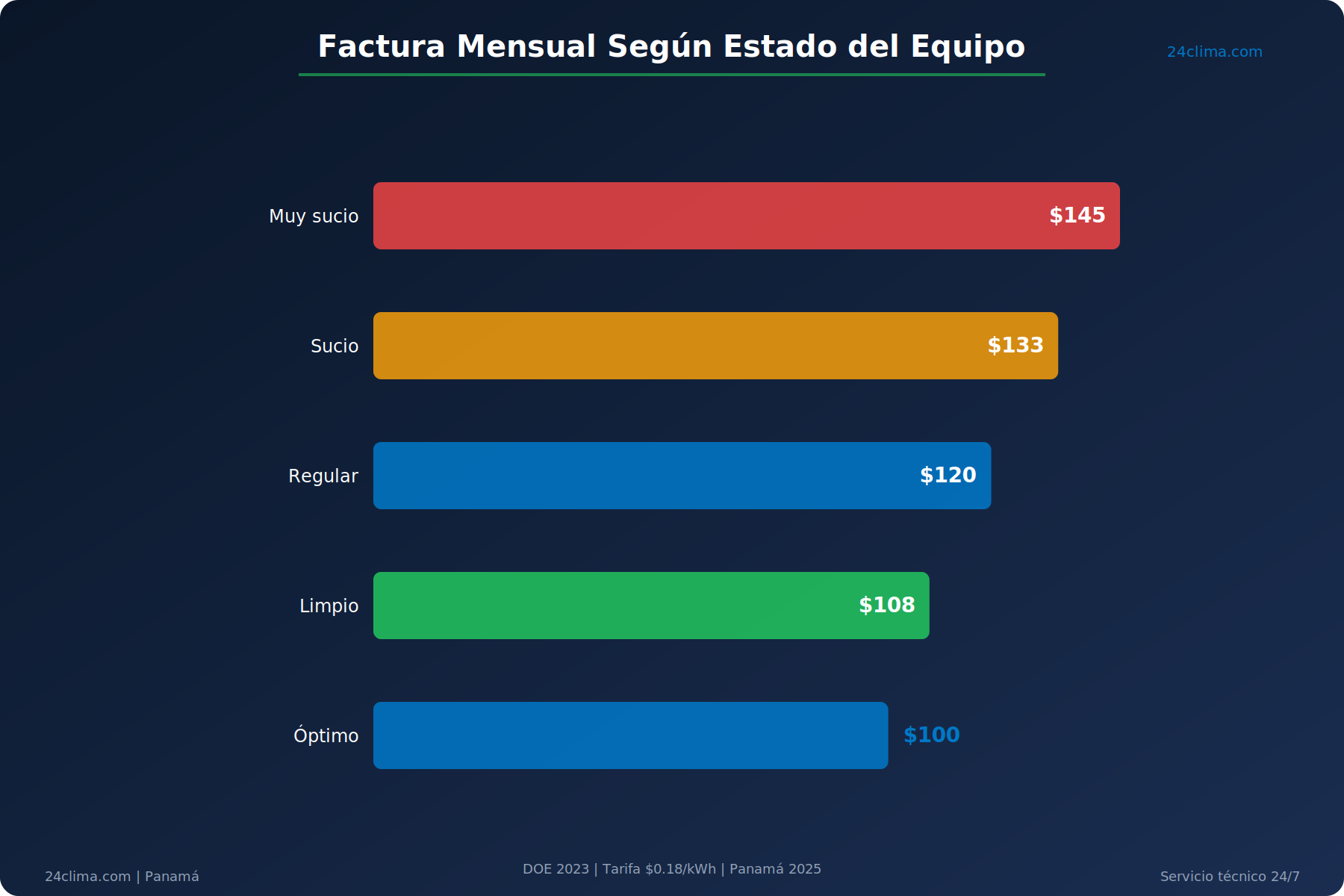
Then you check last month's electric bill: $145. The month before was $118. What happened?
Most people blame Panama's heat, or assume the unit is getting old. Very few point to the real culprit: an evaporator coil packed with mold, compacted dust, and biofilm that's been building up silently inside the unit for months. That dirty coil is the difference between an efficient system and one that works twice as hard to deliver the same cooling.
What Most People Believe — And Why They're Wrong
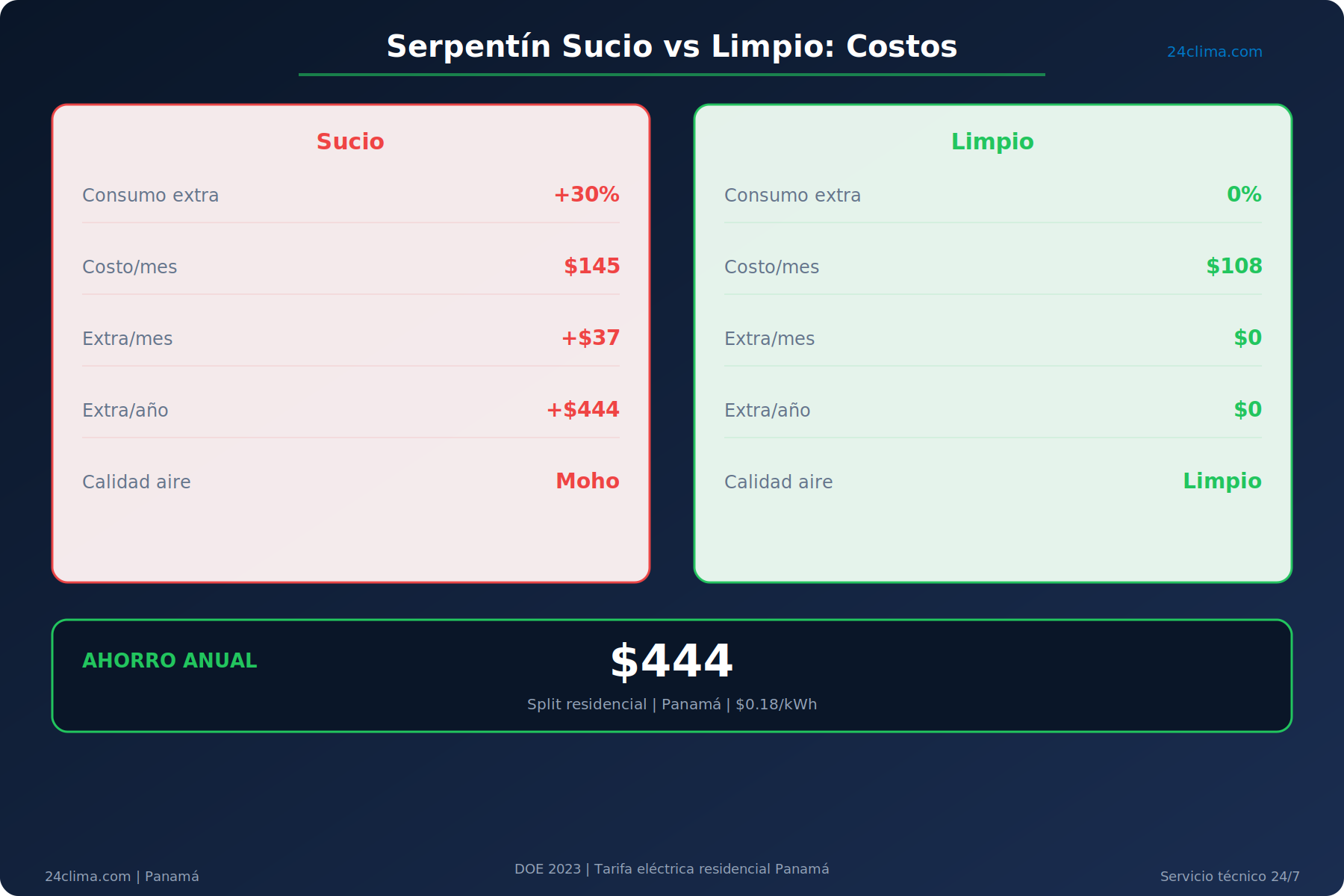
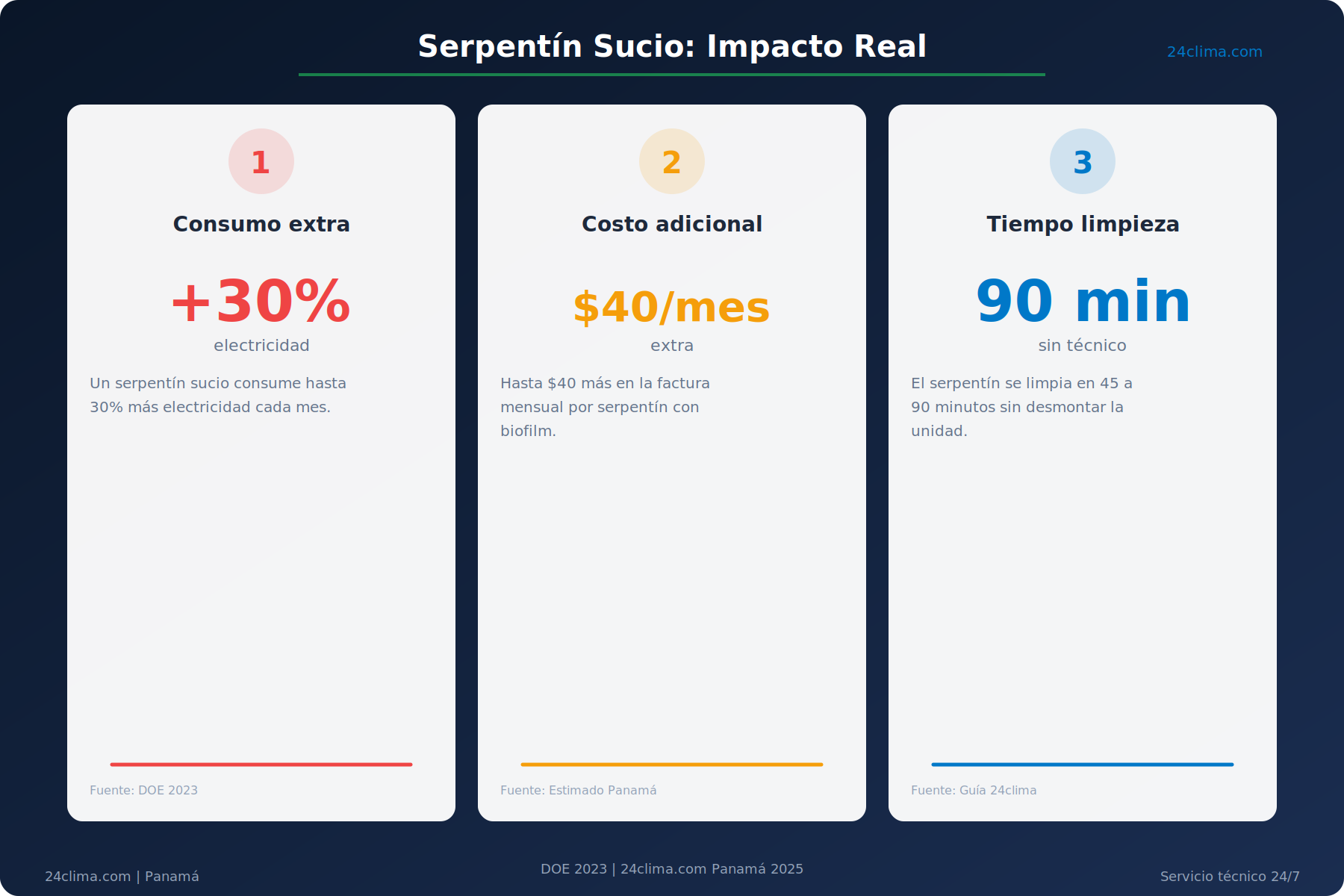
The most common assumption: "if the AC turns on and blows cold air, it's fine." That's a trap. A unit can run with a coil covered in grime and still produce cold air — it just burns between 20% and 30% more electricity to do it, according to U.S. Department of Energy data (DOE, 2023). In Panama, where the average residential electricity rate is $0.18 per kWh, that extra 30% translates to $25 to $40 more on your bill every single month.
The second assumption: "cleaning the inside means taking the whole unit apart — that's a technician's job." Not necessarily. The evaporator coil — the internal component of the split that's in direct contact with the air in your room — can be cleaned without dismantling anything. With the right product and the correct procedure, the job takes between 45 and 90 minutes.
The third: "the filter is enough." The filter catches large particles. What slips through — mold spores, bacteria, airborne oil — deposits directly onto the evaporator fins. In Panama, where relative humidity averages 80% to 85% most of the year, that deposit becomes a thriving colony of microorganisms within weeks.
Our guides and tips section has more on preventive maintenance adapted to Panama's climate. But this piece goes straight to the procedure: how to clean your AC evaporator coil from the inside, yourself, today.
What the Evaporator Coil Is and Where to Find It
The evaporator is the component doing the actual work of cooling. It's a network of copper tubes bent in U-shapes, covered by thousands of very thin aluminum fins, located directly behind the filter inside the split's indoor unit. Refrigerant circulates through those tubes at low pressure and low temperature — between 41°F and 50°F (5°C to 10°C) — turning the evaporator into a cold surface against which the room's heat condenses and from which cool air emerges.
That condensation process is exactly what attracts dirt. Water vapor from the air hits the cold surface of the coil, condenses, and carries with it everything floating in your home: dust, hair, spores, bacteria, kitchen grease if you're anywhere near the cooking area. Over time, that layer of biofilm acts as thermal insulation, choking off efficient heat transfer.
Tools You Need — All Available in Panama
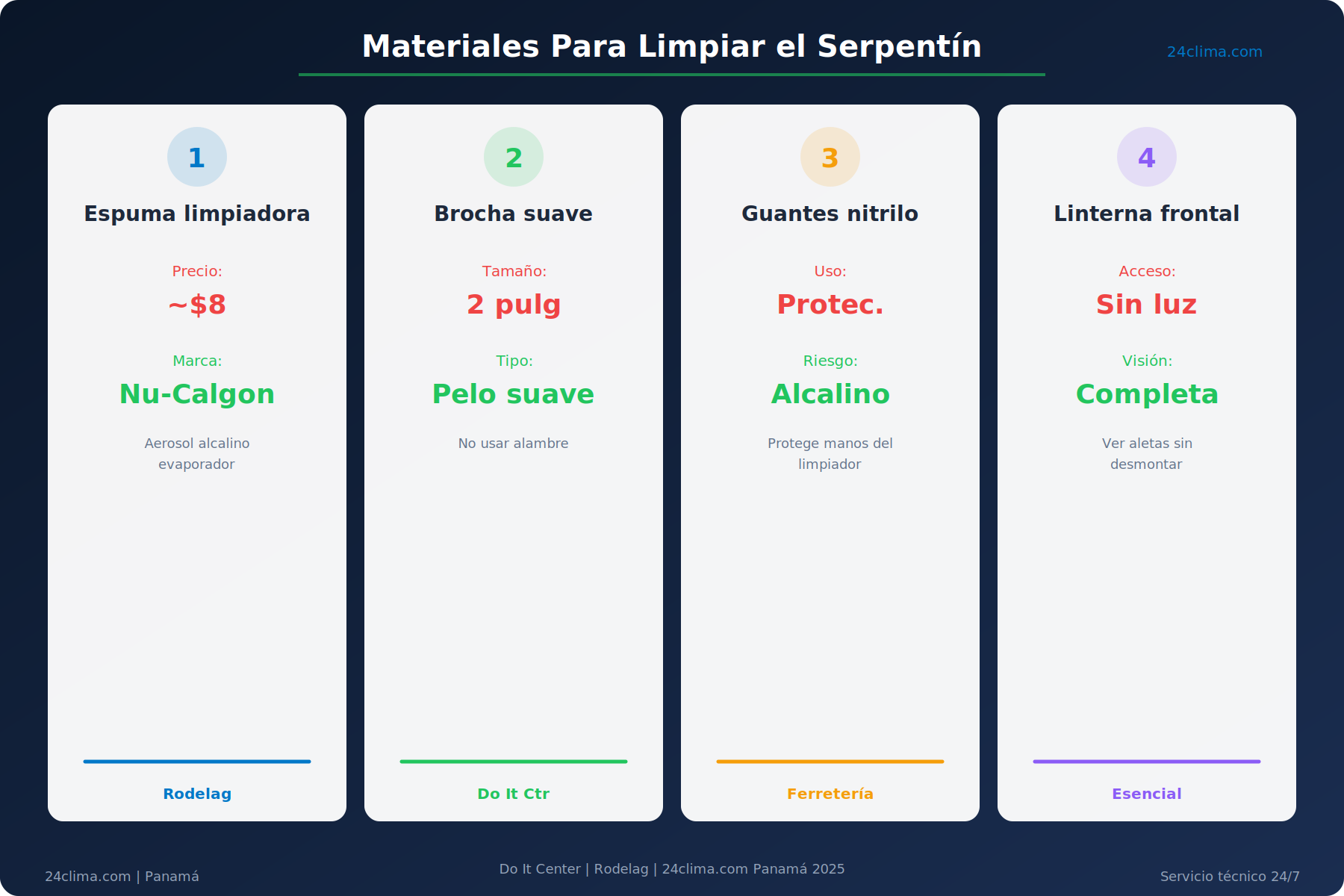
Gather these before you start. You'll find everything at Do It Center, Rodelag, or any large hardware store:
— Evaporator coil cleaner foam (Nu-Calgon brand or similar aerosol coil cleaner — available at Rodelag from $8) — Soft-bristle 2-inch paintbrush (no wire brushes — they damage the aluminum fins) — Absorbent rags or cloths (at least 4) — Large plastic bag or plastic sheeting for coverage — Small drip tray or floor towels to catch liquid — Nitrile gloves (coil cleaner is alkaline — protect your hands) — Flashlight or headlamp — Bottle of warm water for a gentle rinse (optional but recommended)
No air compressor. No special tools. No removing the back panel or touching any electrical components.
The Step-by-Step Process — No Disassembly Required
The evaporator coil is cleaned from the front of the unit, accessed after pulling out the filter. The full process takes between 45 and 90 minutes and requires no advanced technical knowledge. Here's the exact procedure, adapted for Panama's humidity conditions.
Turn the unit completely off — not just fan mode. Unplug it from the outlet or flip the breaker. Wait 10 minutes. The coil needs to be at room temperature for the cleaner to work, and you eliminate any electrical risk.
Remove the filters. On most residential split units common in Panama — Midea, LG, Samsung, Carrier — the filters slide up or outward with a simple clip. Wash them separately with warm water and soap, and let them dry completely before reinstalling.
With your flashlight, inspect the evaporator. You'll see the aluminum fins. Gray or black coloring means compacted dust. Green or black fuzzy patches mean mold. In Panama during the rainy season (May through November), mold shows up even on units that look clean from the outside.
Apply the coil cleaner foam directly onto the fins, working left to right and covering the entire visible surface. The product foams up and penetrates between the fins. Let it sit for 10 to 15 minutes as directed on the label.
No-rinse coil cleaners are designed to drain on their own through the unit's condensate tray once you restart the system. If there's heavy buildup, do a gentle rinse with a bottle of warm water, letting the liquid fall between the fins. Collect the runoff with a tray or floor towels.
Dry the area with clean cloths. Reinstall the filters only once they're completely dry. Wait an additional 20 minutes before turning the unit on.
Turn the unit on in fan-only mode — no cooling — for 10 minutes to dry any remaining internal moisture. Then switch to normal cooling mode. The first 30 minutes may carry a faint smell of the cleaner. That's normal. If the smell lasts more than an hour, run another fan-only cycle.
DIY vs. Professional Service — When to Do Which
Here's an honest breakdown of what each option actually delivers. Costs are specific to Panama in 2025.
DIY evaporator coil cleaning runs $8 to $15 in materials, takes 45 to 90 minutes, and handles surface and mid-level cleaning of the front fins. Risk is low when you follow the procedure correctly. Do it every 2 to 3 months.
A full professional technical service costs $45 to $80 depending on the company and location, takes 1 to 2 hours, and covers the complete picture: centrifugal blower wheel, condensate drain pan, refrigerant check, and electrical connections — done by a certified technician. Every 6 months in Panama.
The straight answer: DIY coil cleaning is effective intermediate maintenance. It does not replace a full professional service, which includes cleaning the scroll-shaped blower wheel (the turbofan you simply can't reach from the front) and inspecting the condensate pan where dirty water collects. The optimal strategy in Panama is DIY every 2 to 3 months combined with a professional service every 6 months.
To see exactly what a full professional service covers, check out our AC maintenance service for Panama City and surrounding coverage areas.
How Much You Actually Save — With Real Numbers
A clean coil gives back the unit's original efficiency. A study by the American Society of Heating, Refrigerating and Air-Conditioning Engineers (ASHRAE, 2022) found that a dirt layer of just 0.1 mm on the evaporator fins reduces heat transfer by up to 21%. In residential 12,000 BTU units — the most common size in Panama City apartments — that translates to an additional 180 to 250 watts of consumption per hour of operation.
Put that in dollar terms: if your split runs 8 hours a day at $0.18/kWh, that excess consumption adds up to $7.80 to $10.80 per month per unit. With two units — standard in a 2-bedroom apartment — you're looking at $15 to $22 disappearing from your monthly bill just because the coil is dirty.
The DIY cleaning costs $10 in materials. You get $15 to $22 back every month. The return on investment happens before the next bill arrives.
Frequently Asked Questions
How often should I clean the AC evaporator coil in Panama?
Given the constant high humidity and heat here, clean the evaporator coil every 2 to 3 months with DIY maintenance. If the unit is in a high-traffic area, near the kitchen, or in a room with pets, shorten that to every 6 to 8 weeks. A full professional service should happen at minimum every 6 months.
What products can I use to clean the evaporator without damaging it?
Use an evaporator coil cleaner foam specifically formulated for evaporators. Brands like Nu-Calgon, Diversitech, or equivalent generic products at Rodelag or industrial hardware stores work well. Avoid straight bleach — it corrodes aluminum. Avoid high-pressure water — it bends the fins. Skip common household degreasers — they alter the pH of the aluminum and can damage equipment seals. Warm water alone is acceptable for a gentle rinse but won't remove biofilm.
How much will I save on electricity by cleaning the AC evaporator coil?
Savings depend on how dirty the coil is and how much the unit runs, but the data is consistent: a clean coil uses between 20% and 30% less energy than one with moderate dirt accumulation (DOE, 2023). For a typical Panama City apartment with 2 splits running 8 hours a day, that's $15 to $40 per month at the local rate of $0.18/kWh — or $180 to $480 a year that stays in your pocket.
Back to That Apartment in San Francisco
Same afternoon. 2 pm, sun directly overhead, hot concrete. You press the remote. The air comes out cold — no smell, none of that strained noise from last month. This month's bill: $112. The difference wasn't a new unit. It was 90 minutes of work with a can of coil cleaner foam and a paintbrush.
A clean evaporator coil is the most underrated factor in AC maintenance in Panama. It's not complicated, it's not expensive, and it doesn't require a technician. But it's the reason some units run for 12 to 15 years without major issues while others break down at 5.
If you clean the coil and the unit still isn't cooling properly, is leaking water, or your electricity bill hasn't dropped, that points to something beyond DIY territory — a refrigerant leak, a damaged blower wheel, or a blocked condensate drain pan. Reach us on WhatsApp at 24clima.com/contacto/ and a certified technician will evaluate your unit at your location.
Last updated: May 2025