Panasonic Air Conditioner in Panama — Is It Worth Buying in 2025?
Last updated: May 2025
2:00 p.m. in Costa del Este. The sun is hammering the windows on the 12th floor — 91°F outside, 85% humidity. You switch on the AC, wait ten minutes, and the room feels marginally less suffocating, but it never actually dries out. Your clothes still cling. The fan runs nonstop. And at the end of the month, your Copa Servicios bill reminds you exactly what that "relief" cost.
That's when people start shopping around. LG, Samsung, Daikin. And at some point, Panasonic comes up — a brand with a solid reputation in climate control across Europe and Japan, but one that raises a fair question here in Panama: is it established enough to trust with your comfort for the next 12 years?
The short answer is yes — with caveats that depend on the model, the dealer, and your specific space. We've covered LG and Samsung in depth over at our guides section on 24clima.com. Now it's Panasonic's turn: local data, current prices, and a straight comparison so you can make the right call.
What Most People Get Wrong About Panasonic
The most common mistake is associating Panasonic exclusively with TVs and cameras. "That's a consumer electronics brand, not an HVAC company." That perception is about 20 years out of date.
Panasonic has been manufacturing residential and commercial air conditioning systems for over five decades. In Japan, it holds a top-three market position. In Europe, its VRF systems for commercial buildings compete directly against Mitsubishi Electric and Daikin. In Panama, the official distributor panasonicstore.com.pa consistently ranks third in organic search results for "aire acondicionado Panamá" — which reflects real consumer interest from people already researching the brand locally.
The second mistake is assuming all Japanese brands are essentially the same. Panasonic has a concrete technical edge over its Korean competitors in tropical climates: Nanoe-X technology. This isn't a marketing claim. It's a function that directly affects air quality in environments with relative humidity above 80% — which describes Panama City for nine months out of the year.
Panasonic Inverter Models Available in Panama — BTU, Price, and Efficiency Compared
Panasonic's residential lineup here splits between the CS/CU-XU series (standard Inverter) and the CS/CU-Z series (premium, with Generation 24 Nanoe-X). Specs below are drawn from local distributor data and manufacturer technical sheets:
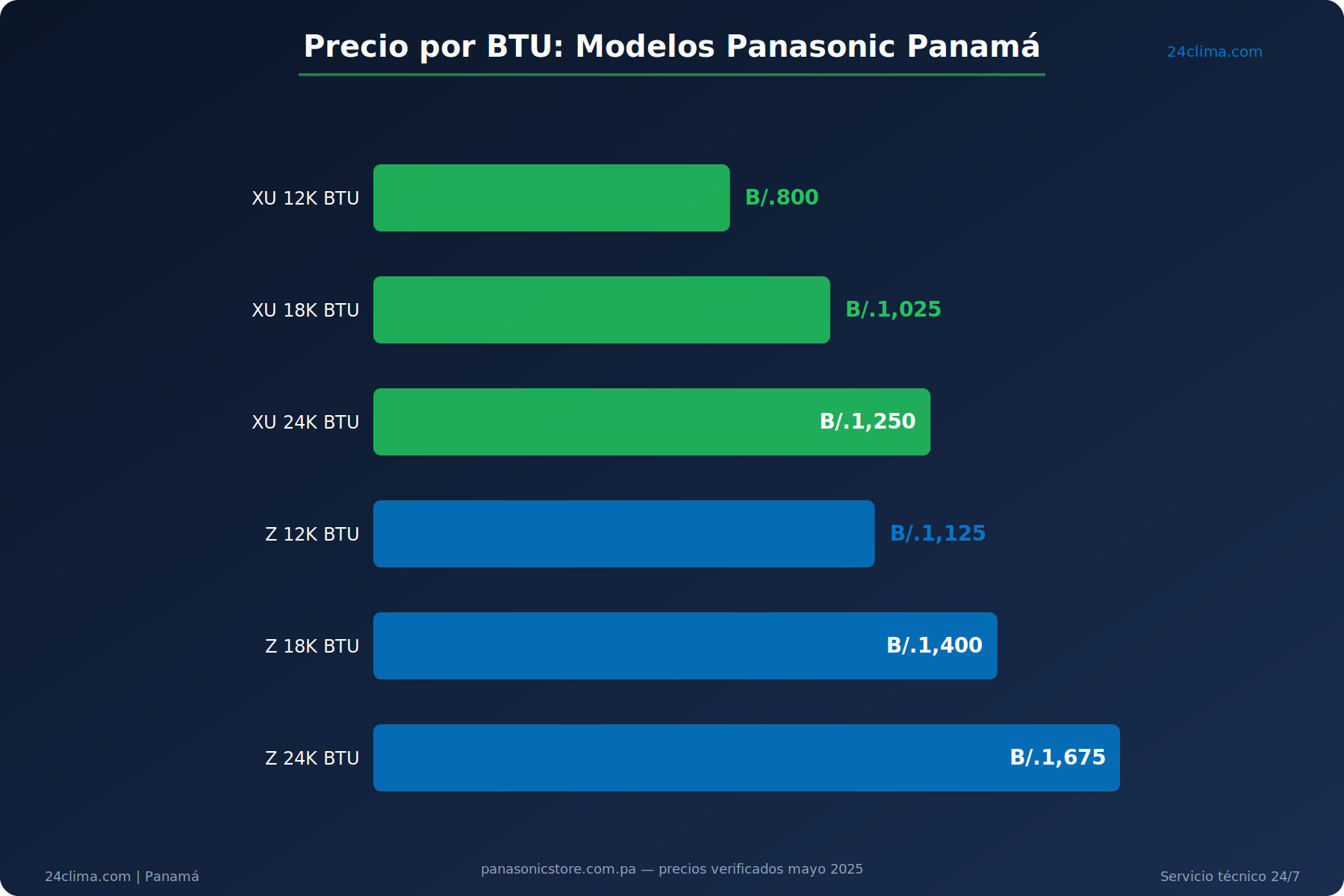
Model — BTU — Estimated SEER — Approx. Price (B/.) — Nanoe-X
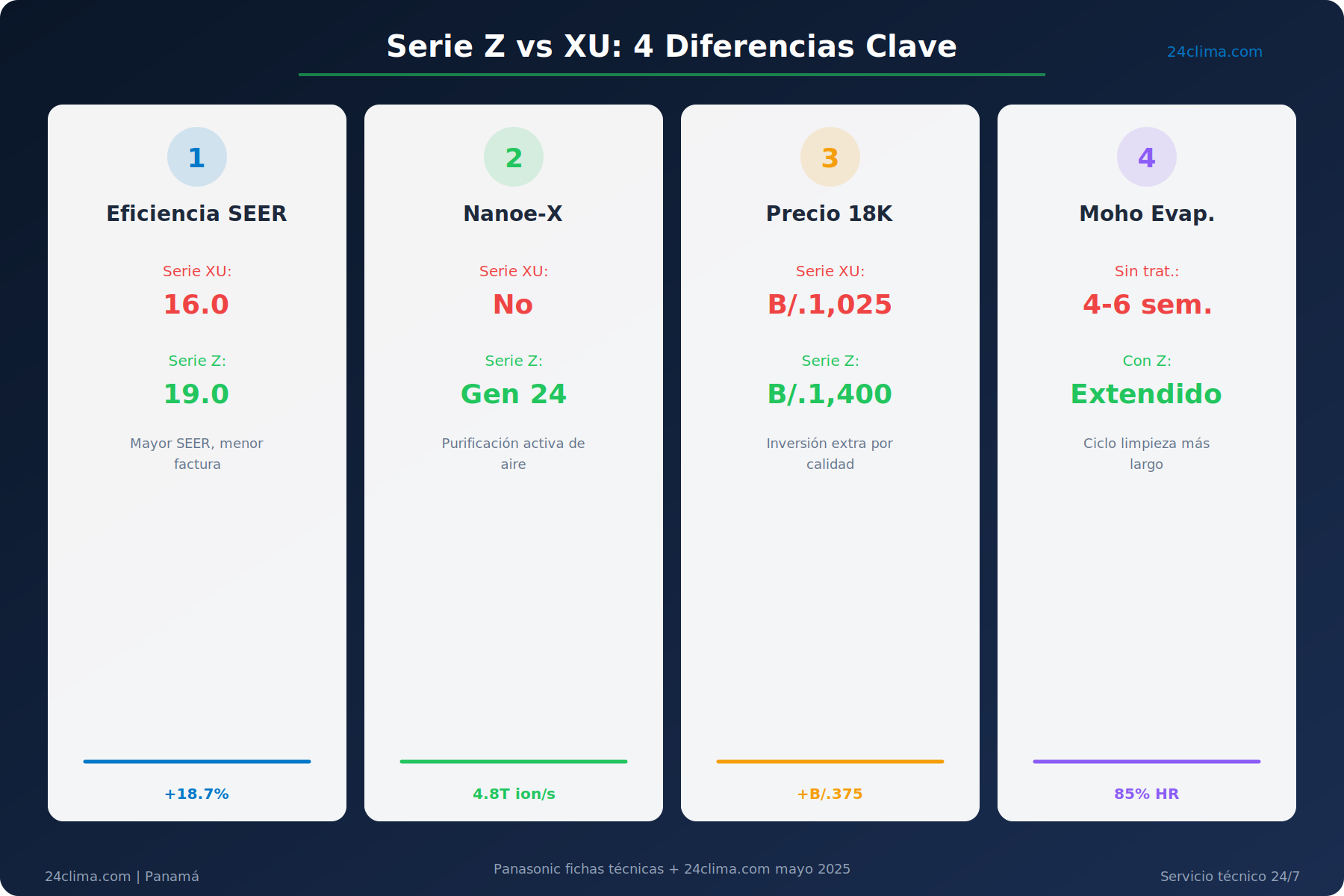
CS-XU12XKPW — 12,000 BTU — 17.0 — B/. 750–850 — No CS-XU18XKPW — 18,000 BTU — 16.5 — B/. 950–1,100 — No CS-XU24XKPW — 24,000 BTU — 16.0 — B/. 1,150–1,350 — No CS-Z12XKPW — 12,000 BTU — 19.0 — B/. 1,050–1,200 — Yes (Gen 24) CS-Z18XKPW — 18,000 BTU — 18.5 — B/. 1,300–1,500 — Yes (Gen 24) CS-Z24XKPW — 24,000 BTU — 18.0 — B/. 1,550–1,800 — Yes (Gen 24)
Note: Prices include both indoor and outdoor units. Installation in Panama typically runs B/. 150 to B/. 280 depending on floor height and distance between units. Prices verified May 2025.
Nanoe-X Technology — Why It Matters in Panama's Climate
Every AC owner in a humid tropical city runs into the same problem eventually: bacteria, mold, dust mites, and persistent odors building up inside the evaporator coil, then recirculating through the room. Nanoe-X is Panasonic's answer to that.
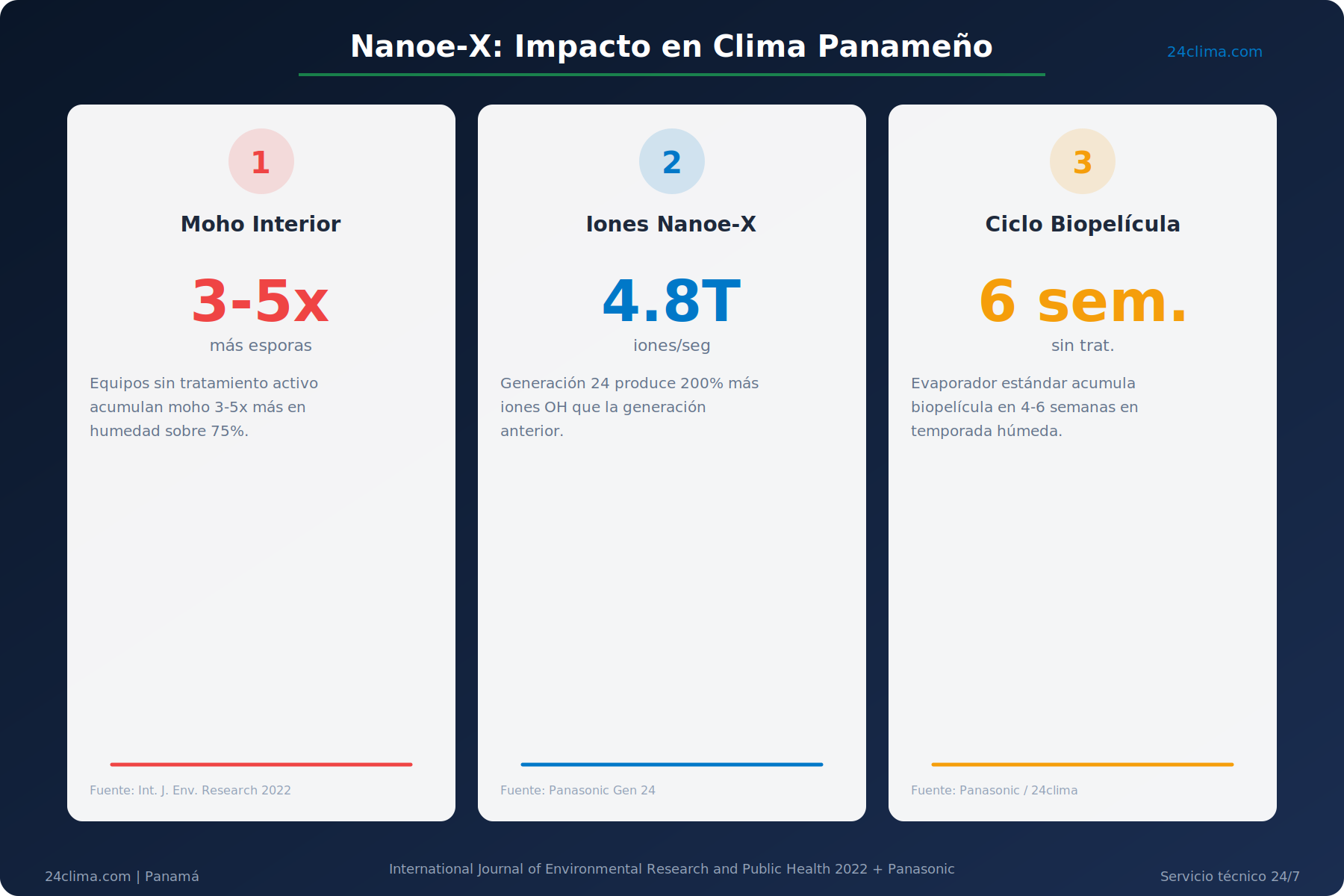
The system generates OH ions (hydroxyl radicals) suspended in ultrafine water particles. Those ions attack the protein membrane of bacteria, viruses, and mold spores — and they keep working even when the unit runs in fan-only mode, not cooling. Generation 24 of Nanoe-X produces 4.8 trillion ions per second, a 200% increase over the previous generation.
Here's why that number matters in Panama specifically: a 2022 study published in the International Journal of Environmental Research and Public Health found that in cities with relative humidity above 75%, indoor mold spore concentrations in air-conditioned spaces without active treatment run 3 to 5 times higher than in drier climates. Panama City averages 85% humidity during rainy season. That buildup inside the evaporator happens in weeks, not months.
With a standard unit — basic LG, basic Samsung, any brand without active treatment — the evaporator develops a biofilm layer within 4 to 6 weeks during wet season. That's the damp, earthy smell anyone who's lived in Panama long enough recognizes immediately. With Nanoe-X, that cycle is significantly extended and air quality between professional cleanings is measurably better.
That said, it doesn't eliminate the need for regular maintenance. A deep cleaning every 6 months is still necessary, especially in coastal areas like Punta Pacífica or Balboa. But day-to-day, the difference is real.
Electricity Consumption and Real Savings in Balboas — The Numbers That Actually Matter
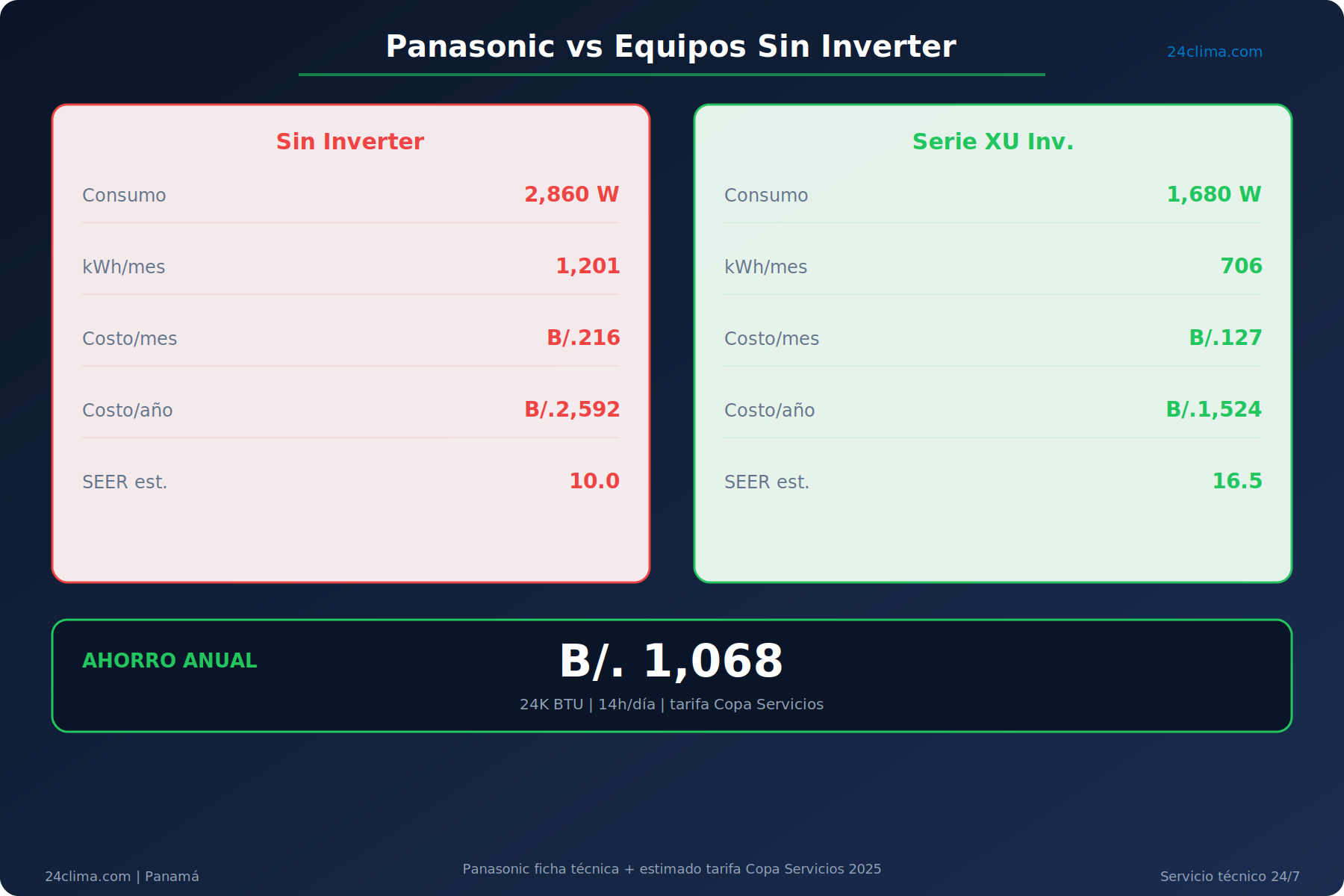
A Panasonic 12,000 BTU Inverter (CS-XU12XKPW) draws approximately 0.95 kWh per hour under normal operating conditions in Panama. A conventional non-inverter unit of the same capacity pulls between 1.45 and 1.65 kWh per hour. That gap adds up fast.
For a typical Panama City bedroom:
Average use: 8 hours per day, 30 days per month = 240 hours Conventional 12,000 BTU unit: 1.55 kWh × 240 h = 372 kWh/month Panasonic Inverter 12,000 BTU: 0.95 kWh × 240 h = 228 kWh/month Difference: 144 kWh/month
At Panama's current residential rate of approximately B/. 0.17 per kWh (Naturgy/Gas Natural, 2025), that's B/. 24.50 in monthly savings per unit. Run two units in an apartment and annual savings exceed B/. 580.
The premium CS-Z12XKPW (SEER 19.0) drops consumption to 0.87 kWh per hour, pushing monthly savings to B/. 28.90 per unit against a conventional non-inverter.
According to Panama's Autoridad Nacional de los Servicios Públicos (ASEP), air conditioning accounts for 55% to 65% of residential electricity bills. It's the single biggest lever you have for cutting monthly energy costs. The payback period on a Panasonic Inverter versus a basic non-inverter (price gap: B/. 300–400) works out to 12 to 16 months under normal Panama usage. After that, every month is net savings.
Panasonic vs LG vs Samsung in Tropical Climate — A Direct Comparison
For a buyer in Panama in 2025, the realistic choice comes down to three brands with confirmed local distribution: Panasonic, LG, and Samsung. Here's where the differences actually matter:
Energy Efficiency (SEER)
LG Dual Inverter 12,000 BTU: SEER 17.0–18.0 on standard models. Samsung WindFree 12,000 BTU: SEER 17.5–18.5. Panasonic CS-Z 12,000 BTU: SEER 19.0 on the premium model.
Top efficiency goes to the Panasonic CS-Z.
Air Quality Treatment
LG ThinQ runs UV action directly on the internal fan via its UVnano filter. Samsung WindFree uses a Triple filter that captures particles but applies no active ionic treatment. Panasonic Nanoe-X Gen 24 delivers continuous active ionic treatment — including in fan-only mode. In environments where humidity stays above 80%, Nanoe-X has a practical edge over passive filter systems that no amount of marketing language from the other brands changes.
Service Network in Panama
LG has the most extensive authorized service network in the country — multiple certified workshops in Panama City, Colón, and David. Samsung has solid coverage in the capital, more limited in the interior. Panasonic concentrates its authorized service in Panama City through panasonicstore.com.pa and associated distributors. In the provinces, certified Panasonic technicians are harder to find.
This matters. If you're in Chiriquí, Coclé, or Bocas del Toro, Panasonic's service reach is a real constraint. In Panama City, it's a non-issue.
Warranty and Manufacturer Support
All three brands offer a standard 1-year parts warranty with a 5-year compressor extension when the unit is registered through a certified installer. Panasonic extends that to a 7-year compressor warranty on the Z-series — provided installation is completed by an authorized distributor.
Where to Buy Panasonic AC in Panama
The official distributor is panasonicstore.com.pa, with a physical sales location in Panama City. You'll also find Panasonic units at Melo (melo.com.pa), EPA, and several specialized HVAC distributors in the Vía España and Tumba Muerto areas.
For full warranty coverage and authorized technical support, buy directly from the official distributor or a certified installer. Units purchased through informal channels or imported privately don't carry local manufacturer warranty — which kills the 7-year compressor warranty argument entirely.
If you're buying through a retail chain, confirm the model is the Panamanian market version (115V/60Hz). Units imported from South America or Europe may carry incompatible voltage configurations.
How Much Electricity Does a Panasonic Inverter Use in Panama?
A Panasonic 12,000 BTU Inverter draws between 0.87 and 0.95 kWh per hour under normal operating conditions given Panama's heat and humidity. Running 8 hours a day, monthly consumption lands between 215 and 228 kWh. At B/. 0.17/kWh, that's B/. 36.50 to B/. 38.80 per month per unit — compared to B/. 63.00 to B/. 68.00 for an equivalent conventional unit.
Is Panasonic Worth It vs LG or Samsung in a Tropical Climate?
In Panama City, Panasonic has a clear edge in two areas: Nanoe-X for high-humidity environments where air quality is a genuine daily problem, and the highest available SEER rating at the premium tier. LG wins on national service network reach and parts availability in the interior. Samsung is competitive on price with the broadest retail distribution. For a buyer in Panama City who prioritizes efficiency and air quality, the Panasonic CS-Z is the most technically defensible choice in 2025.
Back to that 12th-floor apartment in Costa del Este. With the right unit, that room reaches 72–75°F (22–24°C) with interior relative humidity of 55–60% in under 12 minutes. Not just "less hot" — actually climatized. That difference doesn't come from the logo on the remote. It comes from the right BTU match for the space, inverter technology, and — in Panama's climate specifically — a system that actively keeps the evaporator clean and the air free of live mold.
The Panasonic Z-series meets all three of those criteria. It's not the cheapest option on the market. It's not the most expensive either. For anyone living in the coastal zones or high-rise towers of Panama City with direct sun exposure and constant humidity, it's the most technically justified choice available right now.
If you have questions about which model fits your specific space, how many BTUs you actually need, or whether your current installation has structural issues that no new unit will fix, 24Clima will assess your situation at no charge. Reach us on WhatsApp at 24clima.com/contacto/ and a certified technician will respond with data, not a sales pitch.