Air Conditioning for a Small Bedroom in Panama — The Guide That Saves You Money in 2025
It's 11pm in San Francisco — the Panama City neighborhood, not California. The ceiling fan has been running at full speed for three hours and the sheets are damp. Outside it's 29°C (84°F) and humidity is pushing past 85%. Tomorrow the electricity bill arrives, and you already know you're going to open that envelope with a knot in your stomach.
So you decide to finally buy an air conditioner for the bedroom. You walk into a store on Vía España, scan the price tags, and the salesperson tells you the 18,000 BTU model "is the bestseller, cools super fast." You leave with it. One week later, the room freezes in 15 minutes, the unit shuts off and kicks back on every half hour, and your bill climbs $40 higher than before.
That's the most common mistake we see in Panama. Not that you bought wrong. It's that nobody explained how room size, tropical climate, and equipment capacity actually work together. That's what this guide covers — from BTU calculations to installation details that most technicians skip.
The Oversizing Mistake — And Why It Costs You More
Most people figure more BTU means more cooling and more savings. The logic sounds right: a more powerful unit cools faster, works less, uses less energy. In practice, it's exactly the opposite.
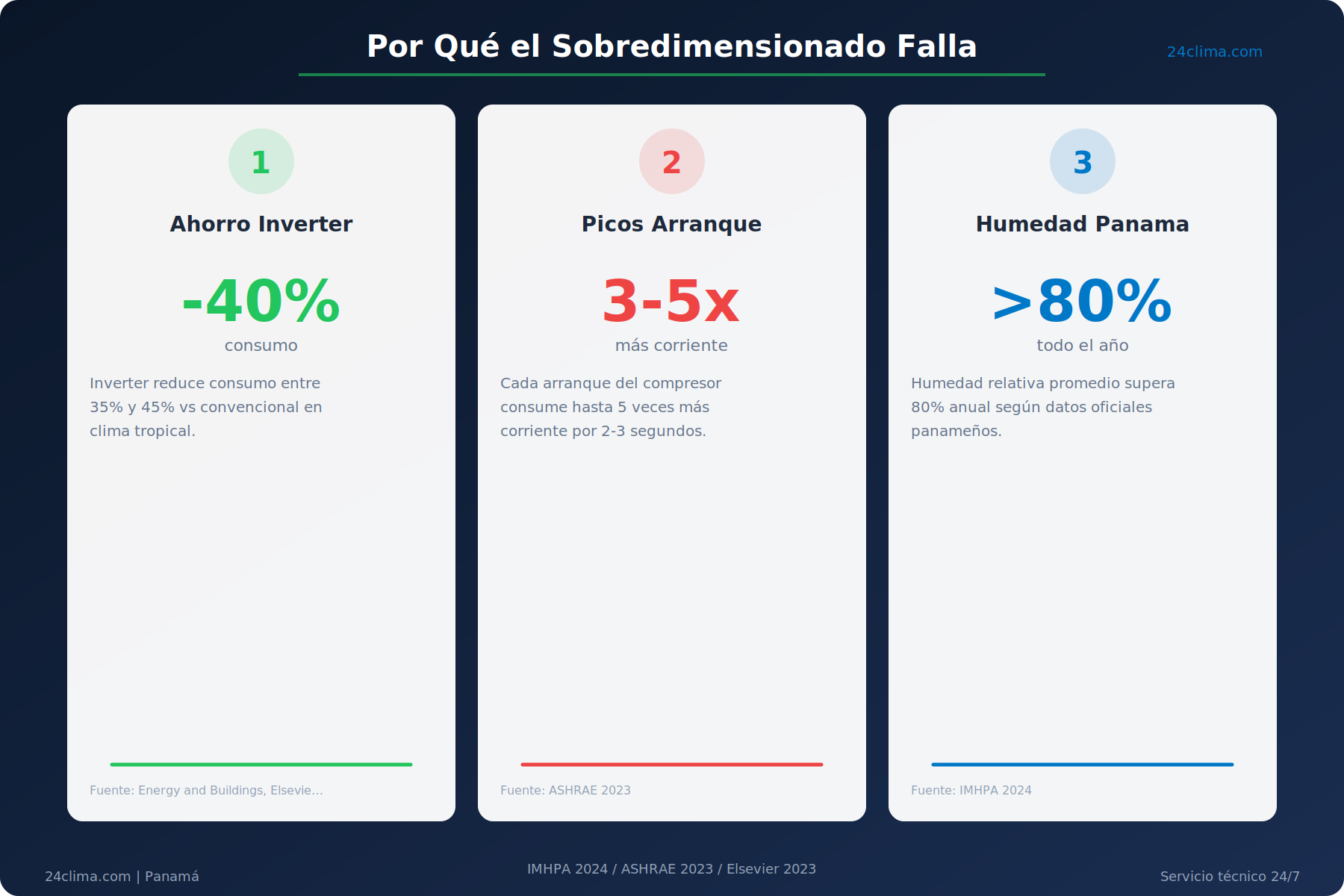
An oversized conventional unit cools the room so fast that the thermostat cuts the compressor before it can extract humidity from the air. In Panama, where average relative humidity exceeds 80% year-round according to data from Panama's Institute of Meteorology and Hydrology (IMHPA, 2024), that short cycle is a real problem. The result: a room that feels cold but clammy, condensation on the walls, and a compressor that restarts constantly — drawing a surge of current every single time.
A correctly sized unit runs in long cycles. It pulls heat and humidity out steadily. Temperature stays stable. And with an inverter, the compressor never switches off at all — it drops to 20–30% capacity and holds the temperature, which cuts energy consumption by 30% to 40% compared to a conventional unit of the same size, according to ASHRAE technical data (American Society of Heating, Refrigerating and Air-Conditioning Engineers, 2023).
How Many BTU Do You Need for a Small Bedroom in Panama
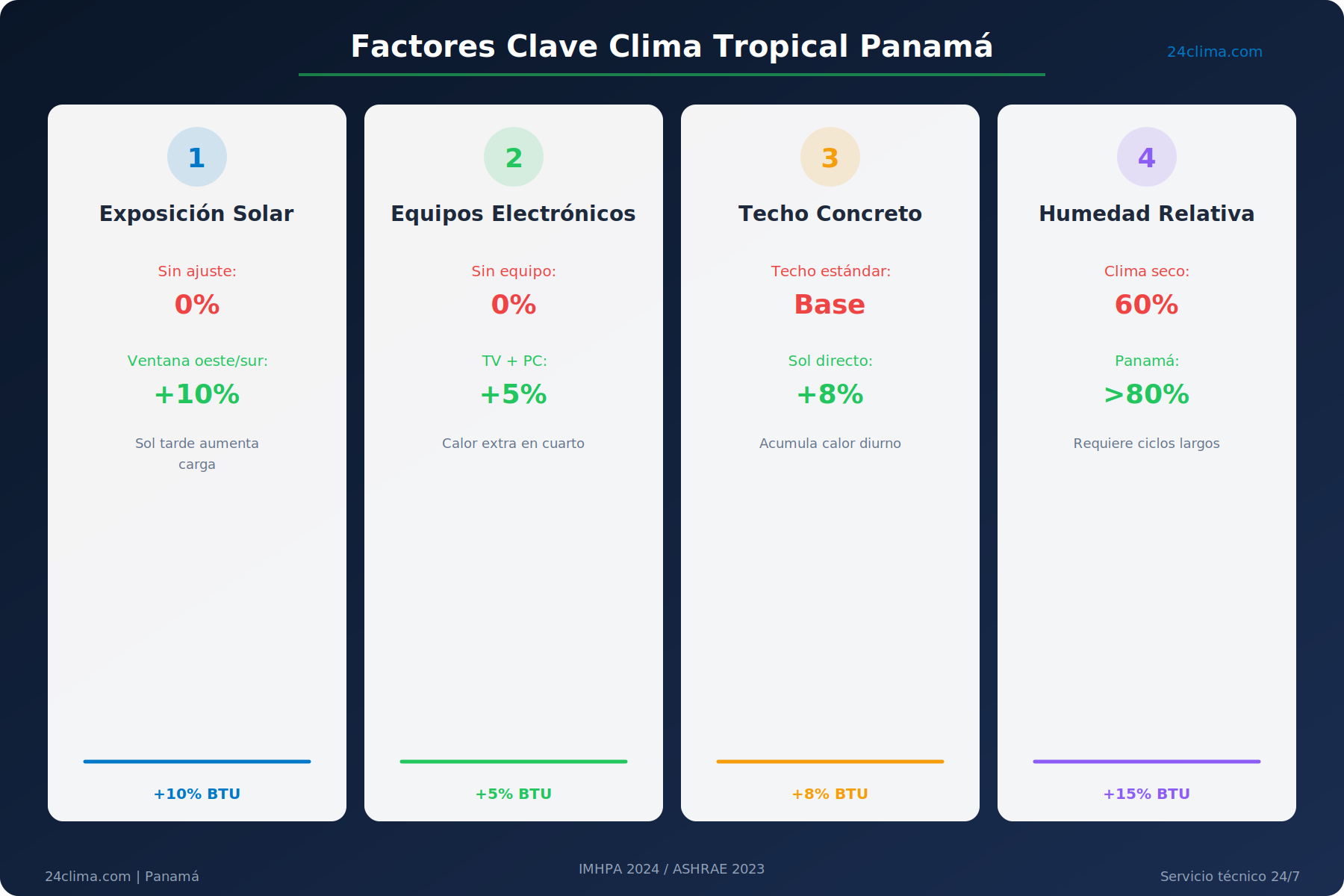
For a bedroom between 9 and 20 square meters in Panama's climate, the right capacity is 9,000 to 12,000 BTU. The standard international formula uses 25 BTU per square foot, but that number goes up here for three specific reasons: outdoor temperatures consistently above 31°C (88°F), structural humidity baked into the climate, and the concrete-roof construction typical across Panama that absorbs heat all day and radiates it back at night.
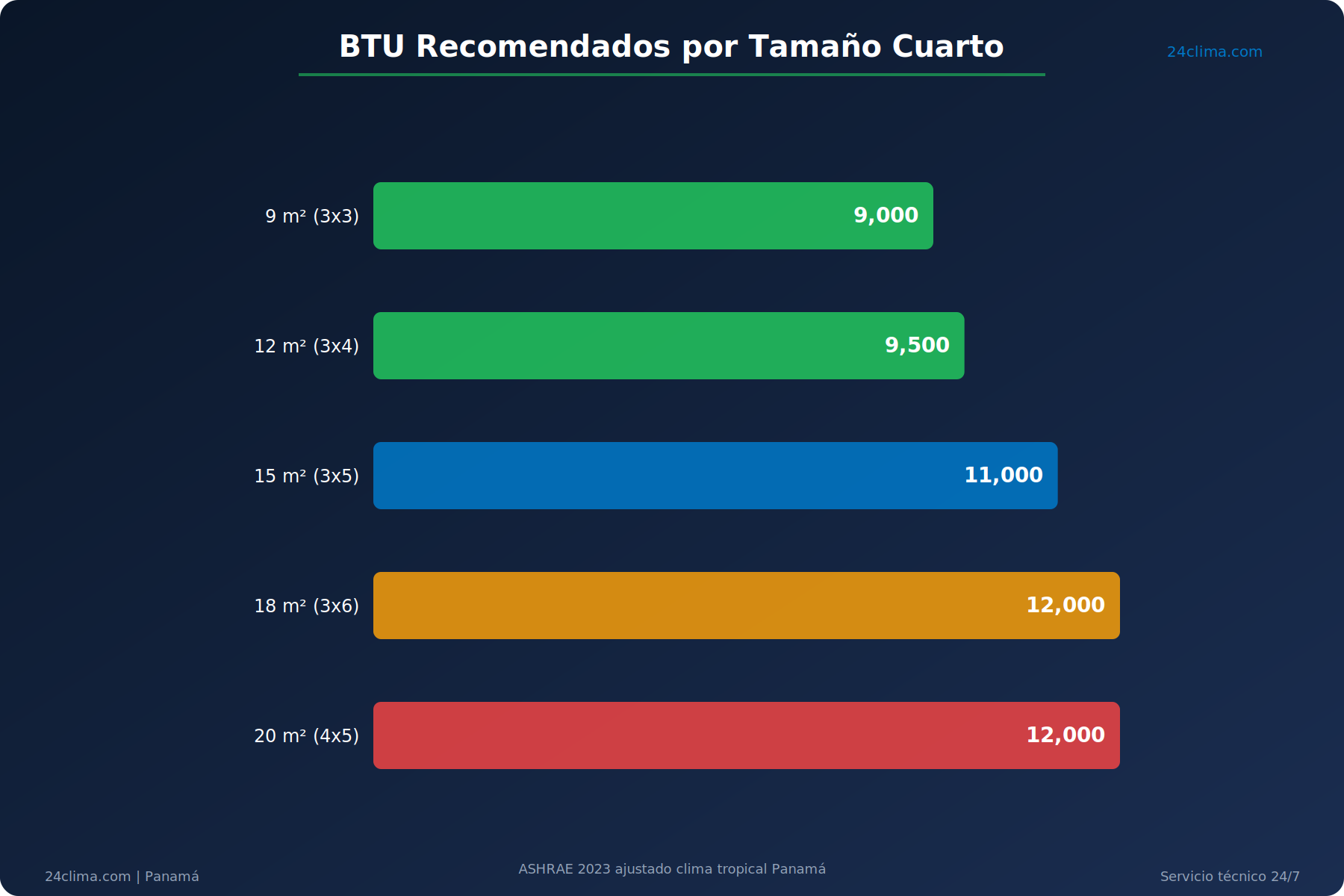
Here's the adjusted table for Panamanian conditions:
Room Size — Recommended BTU (Tropical Climate)
— 9 m² (97 sq ft / 3x3 m): 9,000 BTU — 12 m² (129 sq ft / 3x4 m): 9,000 to 10,000 BTU — 15 m² (161 sq ft / 3x5 m): 10,000 to 12,000 BTU — 18 m² (194 sq ft / 3x6 m): 12,000 BTU — 20 m² (215 sq ft / 4x5 m): 12,000 BTU with adjustment for windows
These figures assume a standard ceiling height of 2.4 m (8 ft), one normal window, and one person sleeping. West- or south-facing windows with direct afternoon sun? Add 10% to the capacity. Computers or televisions running regularly in the room? Add another 5%.
A 3x3 meter bedroom in Casco Viejo with a south-facing window and a concrete roof that starts radiating stored heat at 2pm needs exactly 9,000 BTU sized correctly — not 12,000, and definitely not 18,000.
Inverter vs Conventional for a Small Bedroom — The Difference on Your Bill
For small bedrooms in Panama, the inverter wins on both technical and financial grounds.
A conventional unit has two states: on at 100% capacity, or off. Every restart pulls 3 to 5 times more current than during normal operation, for the first 2 to 3 seconds. In a small room that cools down fast, that means frequent restarts. Over a month, those power surges add up.
An inverter adjusts compressor speed continuously. Once the room is cool, the compressor doesn't switch off — it drops to 20–30% capacity and holds the temperature. No restart surges. No short cycles.
A study published in Energy and Buildings (Elsevier, 2023) found that inverter systems in tropical climates reduce electricity consumption by 35% to 45% compared to equivalent conventional units under the same temperature and humidity conditions.
What does that mean in real dollars in Panama?
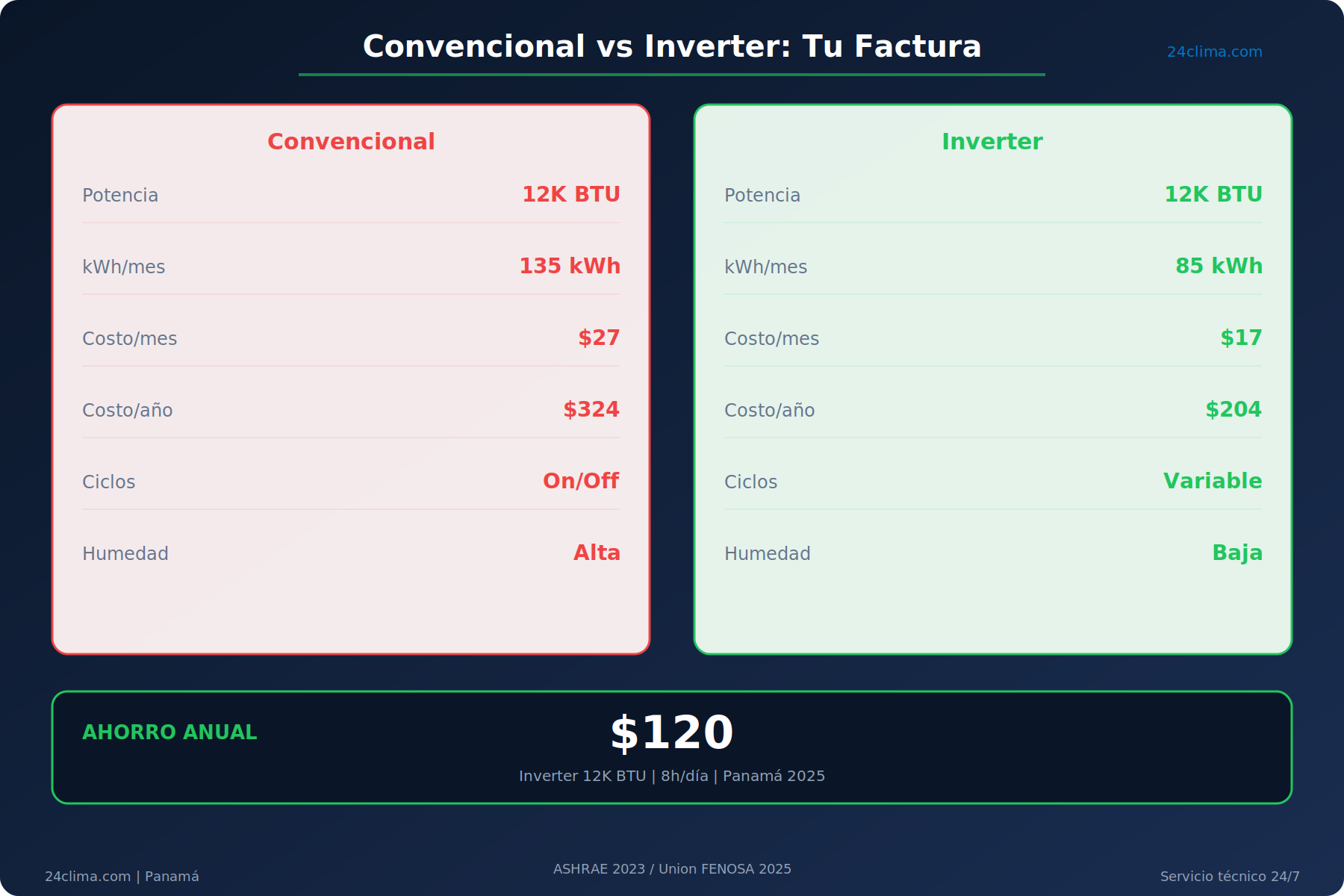
At Union FENOSA's 2025 residential rate, the cost per kWh runs between $0.18 and $0.22 for medium consumption (100 to 300 kWh). A conventional 12,000 BTU unit running 8 hours a day consumes roughly 130 to 140 kWh per month — that's $23 to $31 per month for that unit alone.
The same room with an inverter 12,000 BTU, same conditions: 80 to 90 kWh per month, or $14 to $20.
Real savings: $9 to $11 per month. Over a year, $108 to $132. The inverter costs $80 to $150 more upfront at local stores. You recover that difference in 8 to 14 months.
Top 5 Recommended Models for Small Bedrooms in Panama — 2025 Prices
These are the models available at local stores with the best performance-to-price ratio for rooms between 9 and 20 square meters in 2025. Prices are reference figures and may shift with promotions.
1️⃣ LG Dual Inverter 12,000 BTU (S12ET) Estimated consumption: 850W under normal operation. Noise level: 19 dB in silent mode. Available at Rodelag, Do It Center. Reference price: $450 to $520. One of the highest-efficiency models (SEER 21) on the Panamanian market. The independent dehumidification function is genuinely useful during rainy season — not just a spec-sheet checkbox.
2️⃣ Carrier Performance Inverter 9,000 BTU (42XPOWER09) Built for bedrooms of 9 to 12 m² (97 to 129 sq ft). Operating consumption: 700W. Available at Rodelag and Carrier distributors on Vía Israel. Reference price: $420 to $490. Carrier's authorized service network in Panama makes warranty claims and parts sourcing straightforward — a real advantage once you're past the purchase.
3️⃣ Midea Xtreme Save Inverter 12,000 BTU The best price-to-performance option in 2025. Consumption: 920W. Available at Do It Center and El Machetazo (selected branches). Reference price: $320 to $390. Midea manufactures units for several premium brands under contract, and their own product line carries solid energy certifications. If budget is the main constraint, this is the first model to look at.
4️⃣ Samsung Wind-Free Inverter 12,000 BTU (AR12TVEAAWKN) Wind-Free technology distributes cooled air without a direct airstream — which in a small bedroom eliminates that uncomfortable draft that follows you around the room. Consumption: 870W. Available at Multimax, Samsung Store at Multiplaza. Reference price: $530 to $610.
5️⃣ Gree Livo Inverter 9,000 BTU For bedrooms up to 12 m² (129 sq ft) on a tight budget. Reference price: $280 to $340 at El Machetazo and independent distributors along Transistmica. Gree is the world's largest air conditioner manufacturer by volume (Bloomberg, 2023), and the Livo line delivers real efficiency at an accessible price.
Technical note: always confirm the model you're buying is the correct voltage (220V for mini-split systems in Panama) and comes with a local warranty backed by authorized service. An imported unit with no local service network can turn into a very expensive problem the first time it needs a repair.
Installation Checklist for a Small Bedroom — What Many Technicians Don't Tell You
Incorrect installation can cut equipment efficiency by 15% to 25%, according to AHRI technical data (Air-Conditioning, Heating and Refrigeration Institute, 2022). In a small bedroom where space is tight, placement decisions matter more than most people realize.
For the evaporator (indoor unit):
— Mount it on the wall opposite the bed, not directly above where you sleep. Cold air hitting your body for hours disrupts sleep and causes the kind of neck stiffness you blame on the pillow. — Minimum height from the floor: 1.8 meters (6 ft). With a standard 2.4 m (8 ft) ceiling, the ideal position is 20 to 25 cm below the ceiling. — Minimum clearance from side walls: 15 cm on each side so the filters can draw air properly. — Don't install the unit above the bed or aimed directly at your desk if you work from home.
For the condenser (outdoor unit):
— It needs at least 30 cm of clear space in front for hot air exhaust. On the small balconies of apartments in San Francisco or Bella Vista, this is the most frequent installation error we fix. — Don't place it where it sits in direct midday sun. The condenser works by expelling heat — if it's baking at 35°C (95°F) in direct sunlight, its efficiency drops significantly. — In buildings near the ocean — Punta Pacífica, Costa del Este — specifically ask your technician to use stainless steel hardware and screws. Salt air corrodes galvanized iron in 12 to 18 months.
The drain line is the detail that gets ignored until there's water damage on the floor. In small rooms with limited ventilation, the condensation drain can develop mold growth in 3 to 4 months. Verify the drain pipe has sufficient slope — minimum 1 cm for every 50 cm of length — and that it exits to the outside, not into a bucket hidden behind the unit.
If you want to check the condition of your current unit or need guidance before installation, our online diagnostic tool can help you identify specific problems.
Frequently Asked Questions About AC Units for Small Bedrooms in Panama
How many BTU do I need for a 3x3 meter bedroom in Panama?
For a 9 m² (97 sq ft / 3x3 meter) bedroom in Panama, you need 9,000 BTU. That's the right figure for a tropical climate with outdoor temperatures of 31°C (88°F) and humidity above 80%. A larger unit cools the room too fast, can't dehumidify properly, and burns more energy through constant restart cycles.
Is an inverter or conventional unit better for a small bedroom?
The inverter, every time, for small bedrooms in Panama. It uses 35% to 40% less electricity, holds a stable temperature without on/off cycling, and runs noticeably quieter. The extra cost — $80 to $150 — comes back in under 14 months through lower Union FENOSA bills.
What is the cheapest air conditioner for a small bedroom in Panama?
The most affordable option with a local warranty in 2025 is the Gree Livo Inverter 9,000 BTU, starting at $280 at El Machetazo and distributors along Transistmica. If budget is tight but you want better performance, the Midea Xtreme Save 12,000 BTU delivers more for $320 to $390 at Do It Center.
Back to That Bedroom in San Francisco
Same room. This time with a Midea Inverter 12,000 BTU correctly installed on the wall opposite the bed, 20 cm below the ceiling. You turn it on at 10pm, set to 24°C (75°F). By 10:15 the room is at temperature. The compressor drops to a low hum. No restart cycles. No noise. And next month's Union FENOSA bill is going to be $18 lighter than the last one.
That's not magic. That's physics applied to Panama's climate.
At 24Clima, we've spent more than 5 years installing and sizing AC units specifically for Panama's temperature, humidity, and construction conditions. If you have questions about which unit fits your bedroom or want a technical visit before you buy, contact us on WhatsApp at https://24clima.com/contacto/ and one of our technicians will give you real information — not whichever model carries the best margin for the salesperson.
Last updated: May 2025