Trane Air Conditioning in Panama — Is It Worth the Price in 2025?
2 PM in Costa del Este. The sun is hammering the concrete at 93°F (34°C) and inside the apartment, the air feels like a wet blanket. You walk into the HVAC store, see three brands lined up on the counter — Carrier, LG, Trane — and the salesperson tells you Trane is "the best option." The price tag confirms it: $200 more than the others. You stare at the box with the green logo and wonder whether that premium actually means something, or whether you're just paying for a name.
We get that question constantly at 24clima. The honest answer is neither yes nor no — it depends on your apartment, your usage habits, and how seriously you plan to maintain the unit. In our guides and tips section we've compared dozens of brands under real Panama conditions. What we found about Trane deserves its own breakdown.
Before you decide, you need to understand exactly what you're buying — and what you're not.
What Most People Assume About Trane (and Why That's Incomplete)
The most common misconception is that Trane is simply "the expensive American brand" and performs the same as a comparably priced Carrier or LG. That reasoning misses something important: Trane and Carrier don't compete in the same market segment here. Carrier has mass distribution, readily available parts, and certified technicians in every neighborhood. Trane has a more concentrated presence, higher-end equipment, and a more selective service network.
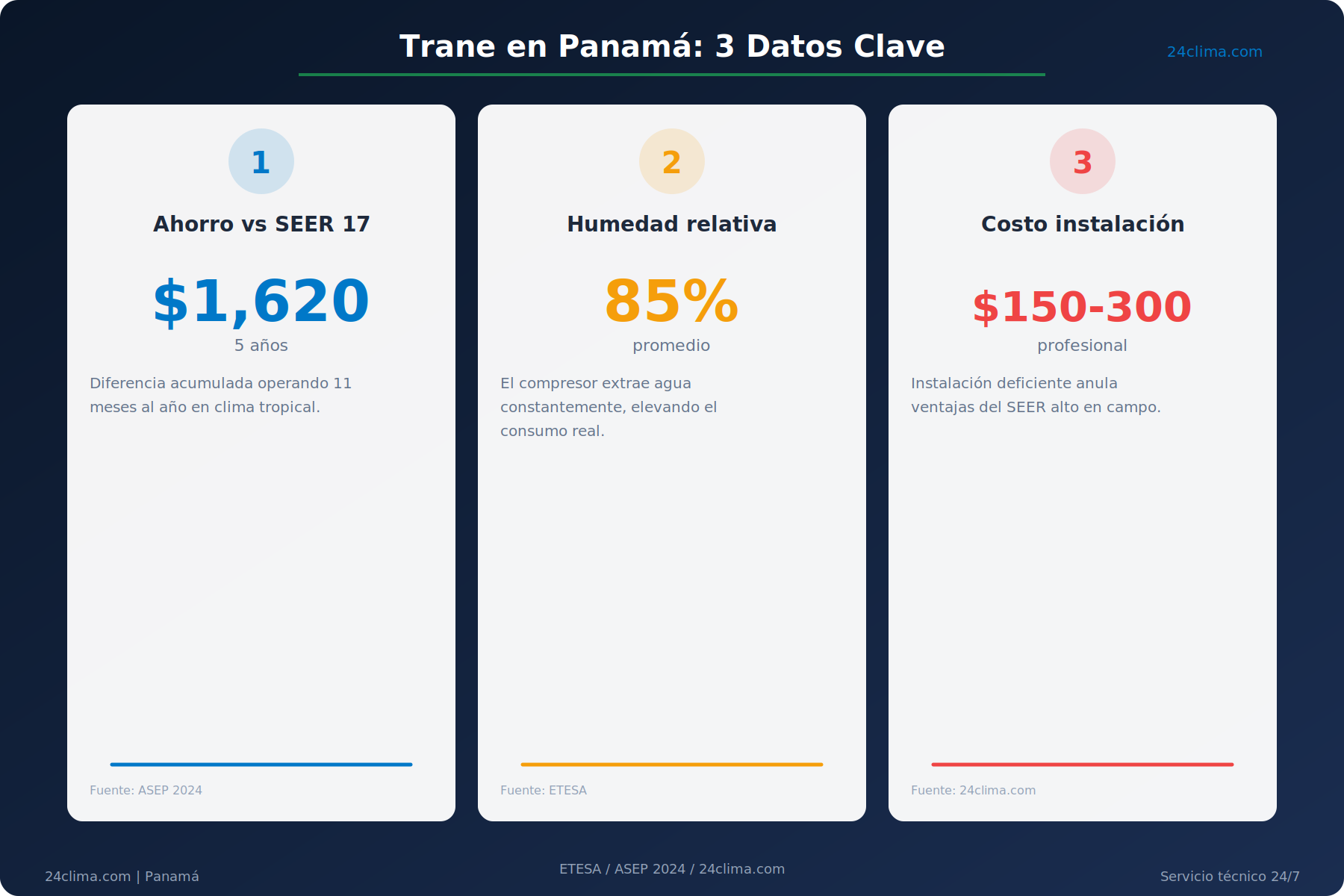
The other frequent mistake is assuming a higher SEER rating always means a lower electricity bill. A unit with SEER 18 that's poorly installed — with leaky ducts or oversized for the room — will consume more power than a well-calibrated SEER 14 unit. In Panama, where average relative humidity sits at 85% according to ETESA (Panama's national electricity transmission authority), your compressor isn't just lowering temperature. It's constantly pulling water out of the air. That dehumidification work has an energy cost that no number on the box tells you directly.
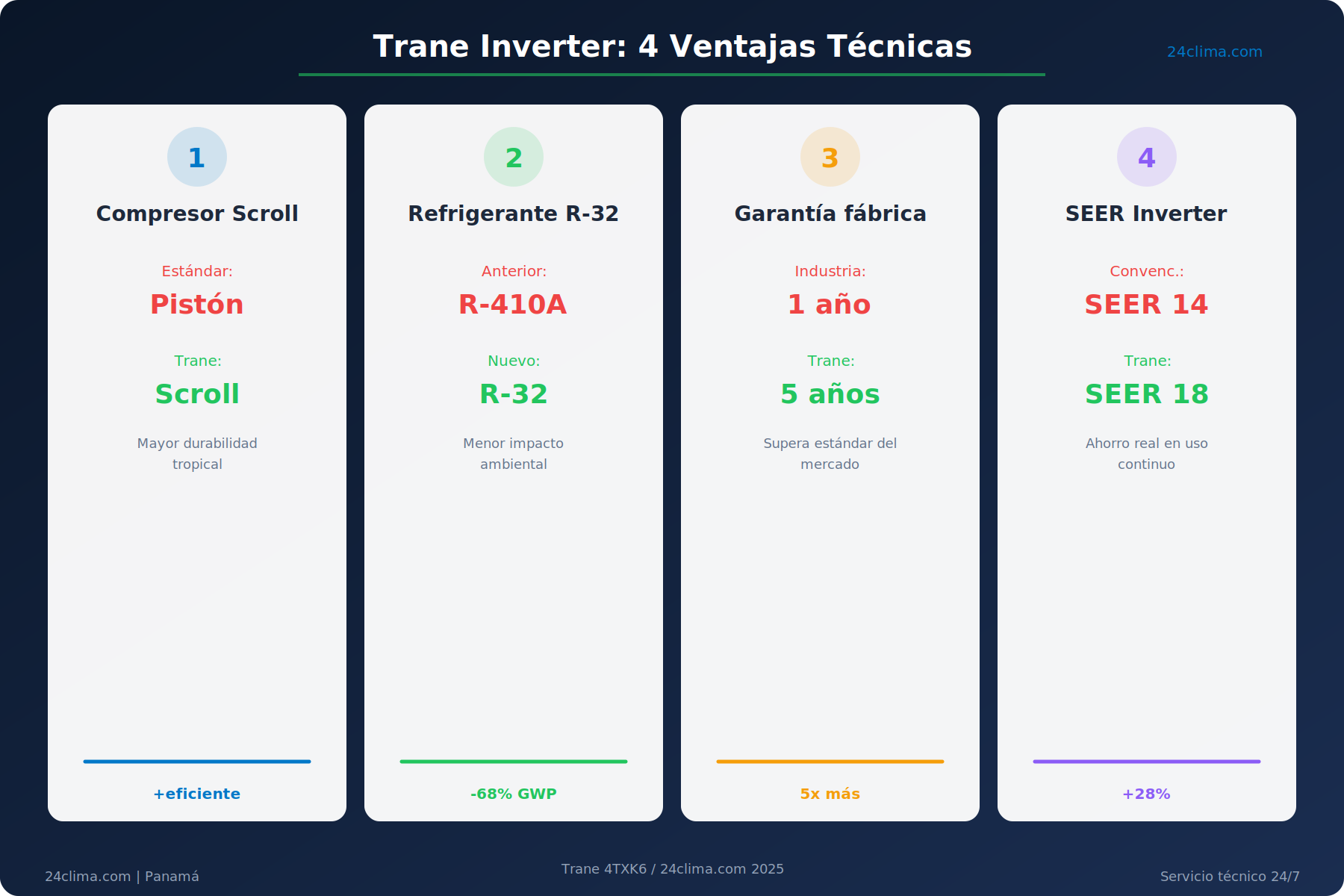
What Trane genuinely offers is real: scroll compressor technology, R-32 refrigerant compatibility on their newer inverter models, and a factory warranty that exceeds the industry standard. But to know whether that justifies the price, you need the actual numbers.
Technical Performance: What SEER Actually Means in a Tropical Climate
SEER (Seasonal Energy Efficiency Ratio) measures how many BTUs of cooling a unit produces per watt-hour consumed over a season. In Panama there is no cool season — the equipment runs practically 10 to 12 months a year. That changes the math significantly.
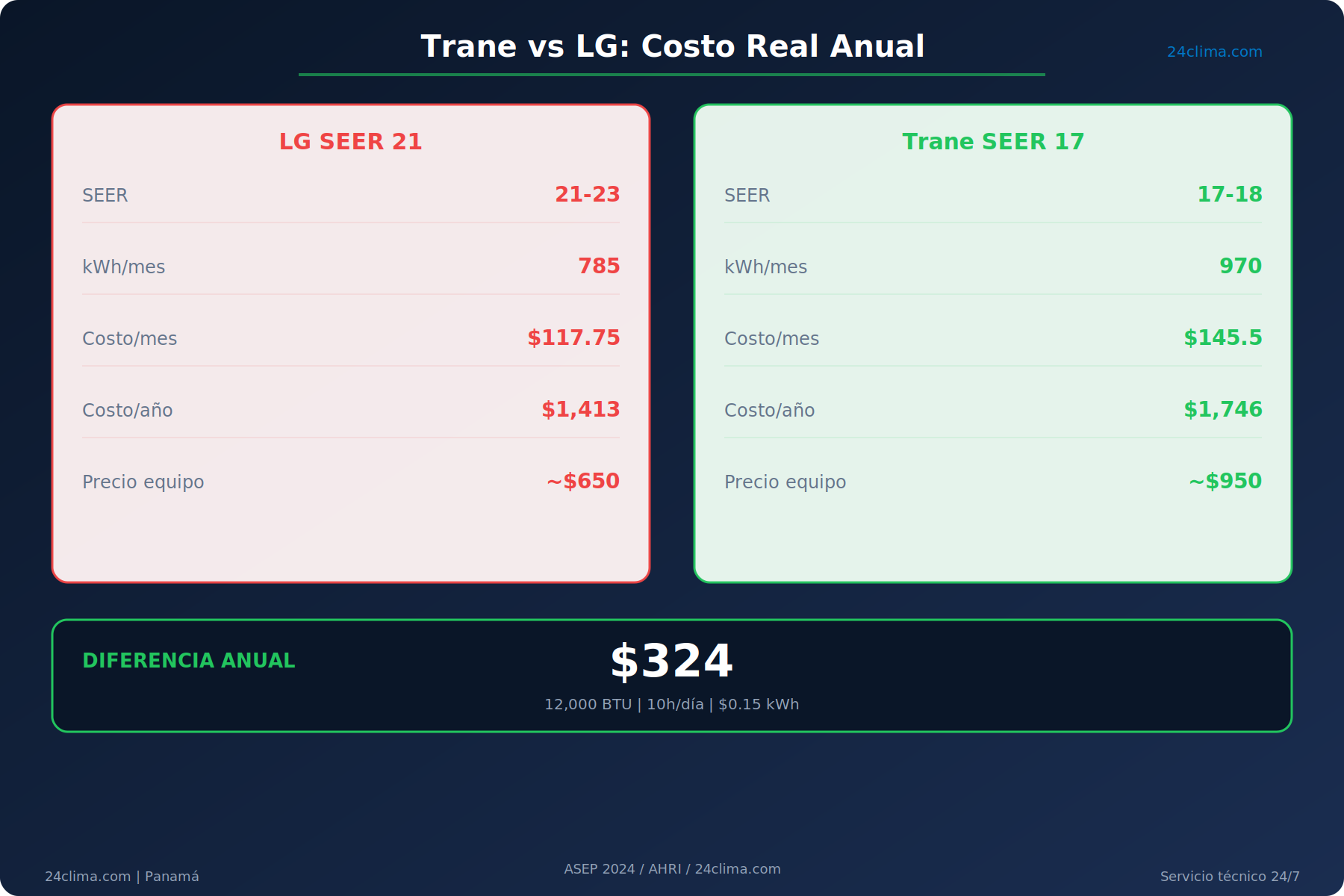
A Trane 12,000 BTU (1-ton) inverter from the 4TXK6 line reaches SEER 17-18. A comparable Carrier 38MAQB hits SEER 16-17. An LG Dual Inverter from the VS series reaches SEER 21-23 in laboratory conditions — though that number is measured using AHRI methodology for temperate climates, not tropical ones. Standard AHRI test conditions are 81°F (27°C) indoors and 95°F (35°C) outdoors — more favorable than the 93°F (34°C) outdoor temperatures common in Panama City during dry season.
What does that mean in dollars? A 12,000 BTU unit running 10 hours a day for 11 months a year:
— SEER 17 consumes approximately 970 kWh per month — SEER 21 consumes approximately 785 kWh per month — The difference is roughly 185 kWh monthly
At Panama's average residential rate of $0.15/kWh (per ASEP data for the first half of 2024), that gap costs you $27 per month. Over a year: $324. Over five years: $1,620.
Does Trane cost $1,620 more than LG? No. But it doesn't have the highest SEER in the group either. That's where the real break-even point sits.
BTU Guide by Room Size for Panama Apartments
These numbers are a minimum reference for apartments with direct sun exposure on windows, 8-foot (2.4-meter) ceilings, and high humidity loads. If your room has a glass ceiling, west-facing exposure, or more than three occupants, move up to the next level.
Room size — Recommended BTUs — Reference Trane model
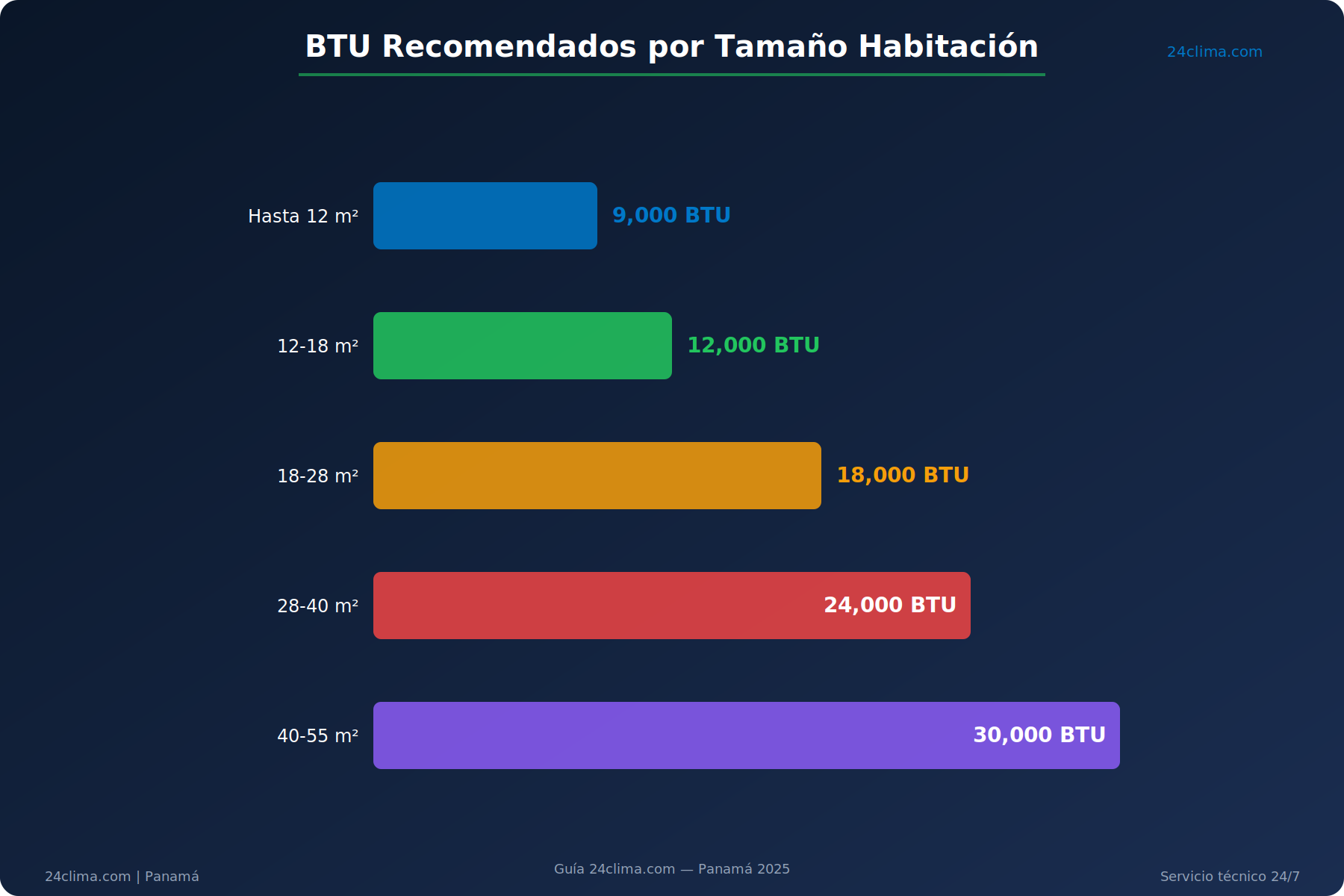
— Up to 130 sq ft (12 m²), small bedroom: 9,000 BTU — Trane 4TXK6009A1000A — 130 to 195 sq ft (12-18 m²), master bedroom or small living room: 12,000 BTU — Trane 4TXK6012A1000A — 195 to 300 sq ft (18-28 m²), small living/dining area: 18,000 BTU — Trane 4TXK6018A1000A — 300 to 430 sq ft (28-40 m²), open living area or loft: 24,000 BTU — Trane 4TXK6024A1000A — 430 to 590 sq ft (40-55 m²), combined spaces with kitchen: 30,000 BTU — Consider multizone
One note worth flagging: in apartments in Clayton or Ancón, where elevation exceeds 1,300 feet (400 meters) and average temperatures drop to 82-84°F (28-29°C), you can reduce BTUs by 10-15% without sacrificing comfort. In Punta Pacífica or Coco del Mar, where marine humidity is constant, stick to the table numbers or go higher.
Real Trane Prices in Panama (2025)
Trane prices vary by distributor and whether installation is included. These ranges come from active local distributors in 2025:
— Trane 9,000 BTU inverter: $750 to $900 (unit only) — Trane 12,000 BTU inverter: $850 to $1,050 (unit only) — Trane 18,000 BTU inverter: $1,050 to $1,300 (unit only) — Trane 24,000 BTU inverter: $1,300 to $1,600 (unit only)
Professional installation in Panama runs $150 to $300 depending on floor height, copper line distance, and whether a special exterior wall bracket is needed.
Direct comparison in the 12,000 BTU segment:
— Trane 4TXK6012: $850-$1,050 — SEER 17-18 — 10-year compressor warranty — Carrier 38MAQB012: $700-$850 — SEER 16-17 — 5-year compressor warranty — LG VS122C2: $650-$800 — SEER 21-23 — 10-year compressor warranty
The price gap between Trane and LG in this segment is $150 to $300. LG's annual energy savings over Trane can reach $324 — meaning LG pays back its price difference through efficiency alone in under a year. That said, Trane's 10-year compressor warranty matches LG's, and the mechanical durability argument for a scroll compressor in a humid tropical climate carries genuine technical weight.
R-32: Why the Refrigerant Matters in 2025
Trane inverter models manufactured between 2023 and 2025 use R-32 refrigerant, which has a global warming potential (GWP) of 675 — 68% lower than the R-410A used in older models, according to IPCC data (2021). R-410A still dominates the installed base in Panama, but R-32 is gaining ground fast.
Why should you care as a buyer? Three reasons.
R-32 transfers heat more efficiently than R-410A, which directly contributes to the higher SEER ratings on new units. If your unit ever needs a refrigerant recharge, R-32 costs less per kilogram and technicians are increasingly comfortable working with it — by 2025, it's no longer a specialty refrigerant in Panama. The one catch: R-32 equipment requires slightly different service tools. Before booking maintenance, confirm your technician has compatible gauges. A tech who only works with R-410A can misread pressure values and misdiagnose a perfectly functional unit.
The cost of an R-32 recharge in Panama runs $80 to $120 in 2025, similar to R-410A. The amount needed per 12,000 BTU unit is smaller because R-32 operates at a higher charge density.
Annual Maintenance Costs: What Nobody Tells You Before You Buy
The purchase price is just the first check you write. In Panama's tropical climate, an AC unit needs maintenance at least twice a year — ideally every four months in coastal areas or high-dust zones like Bella Vista, El Cangrejo, or Curundú.
Estimated annual maintenance cost by brand in Panama (12,000 BTU unit, professional service):
— Trane: $180 to $280 per year — Carrier: $140 to $220 per year — LG: $120 to $200 per year
The difference isn't dramatic, but it exists for a concrete reason: parts and technical specialization for Trane are less widely available than for Carrier or LG. If a replacement HEPA filter or temperature sensor fails, waiting for a Trane part can take 5 to 10 business days if it's not in local stock. For Carrier or LG, it's typically 24 to 48 hours.
That gap matters when the unit fails in the middle of dry season. One week without AC in a Miraflores apartment in March means a week of 86°F (30°C) and 82% humidity indoors.
For preventive maintenance, our professional cleaning service covers Trane, Carrier, and LG units with technicians trained on both R-32 and R-410A. A deep clean every six months in Panama isn't optional — it's the difference between a unit that lasts 14 years and one that starts breaking down at seven.
Is Trane Better Than Carrier or LG in a Tropical Climate?
Trane leads in mechanical compressor durability for continuous operation in high humidity, but it doesn't lead in energy efficiency or ease of local service. Carrier offers the best parts distribution and service network in Panama. LG offers the highest SEER at a comparable price point. Your choice depends on which of those factors matters most to you.
For an apartment in San Francisco or Costa del Este where the unit runs 12 hours a day every day of the year, Trane's compressor durability has genuine value. For a studio in El Carmen where the unit runs 6 to 8 hours daily, LG recovers its investment faster through efficiency. Carrier sits in the middle with the strongest technical support network in the country.
Frequently Asked Questions
How much does a Trane air conditioner cost in Panama?
In 2025, a Trane 12,000 BTU inverter runs between $850 and $1,050 at local distributors in Panama, not including installation. Professional installation adds $150 to $300 depending on the space. A complete installed 12,000 BTU system runs between $1,000 and $1,350.
Is Trane better than Carrier or LG in a tropical climate?
It depends on the criteria. For compressor lifespan under continuous operation in high humidity, Trane has a technical advantage through its scroll technology. For pure energy efficiency (SEER), LG leads at a comparable price. For parts availability and service network in Panama, Carrier dominates. There's no single right answer — only the right answer for your specific situation.
Where can you buy and service a Trane unit in Panama?
Trane is distributed through authorized dealers in Panama City, including locations along Vía España and commercial zones in Albrook. For service, confirm your technician is certified to work with R-32 refrigerant and carries compatible diagnostic tools. 24clima provides maintenance service for Trane units across the main districts of the city.
The Bottom Line
Back to that showroom counter in Costa del Este. Trane costs more — that's a fact. The premium has a partially valid technical justification: the scroll compressor, the extended warranty, the mechanical solidity under sustained thermal stress. What it doesn't have is the highest SEER rating or the most accessible service network in the Panamanian market.
If energy efficiency is your priority and budget matters, LG inverter is the strongest alternative today. If service availability and parts in any neighborhood across Panama matter most, Carrier has the real logistical advantage. If mechanical durability is the priority and you plan to run the unit continuously for 12 to 15 years, Trane justifies the price difference.
At 24clima we evaluate your specific space — square footage, sun exposure, floor height, usage patterns — before recommending any brand or capacity. We don't sell equipment. We install, maintain, and give you the real numbers so you can make the call. If you're comparing options for your apartment or commercial space in Panama, reach out via WhatsApp at https://24clima.com/contacto/ and we'll come back with data, not a sales commission.
Last updated: June 2025