Cheap Air Conditioners in Panama — The Guide to Not Regretting Your Purchase Three Months Later
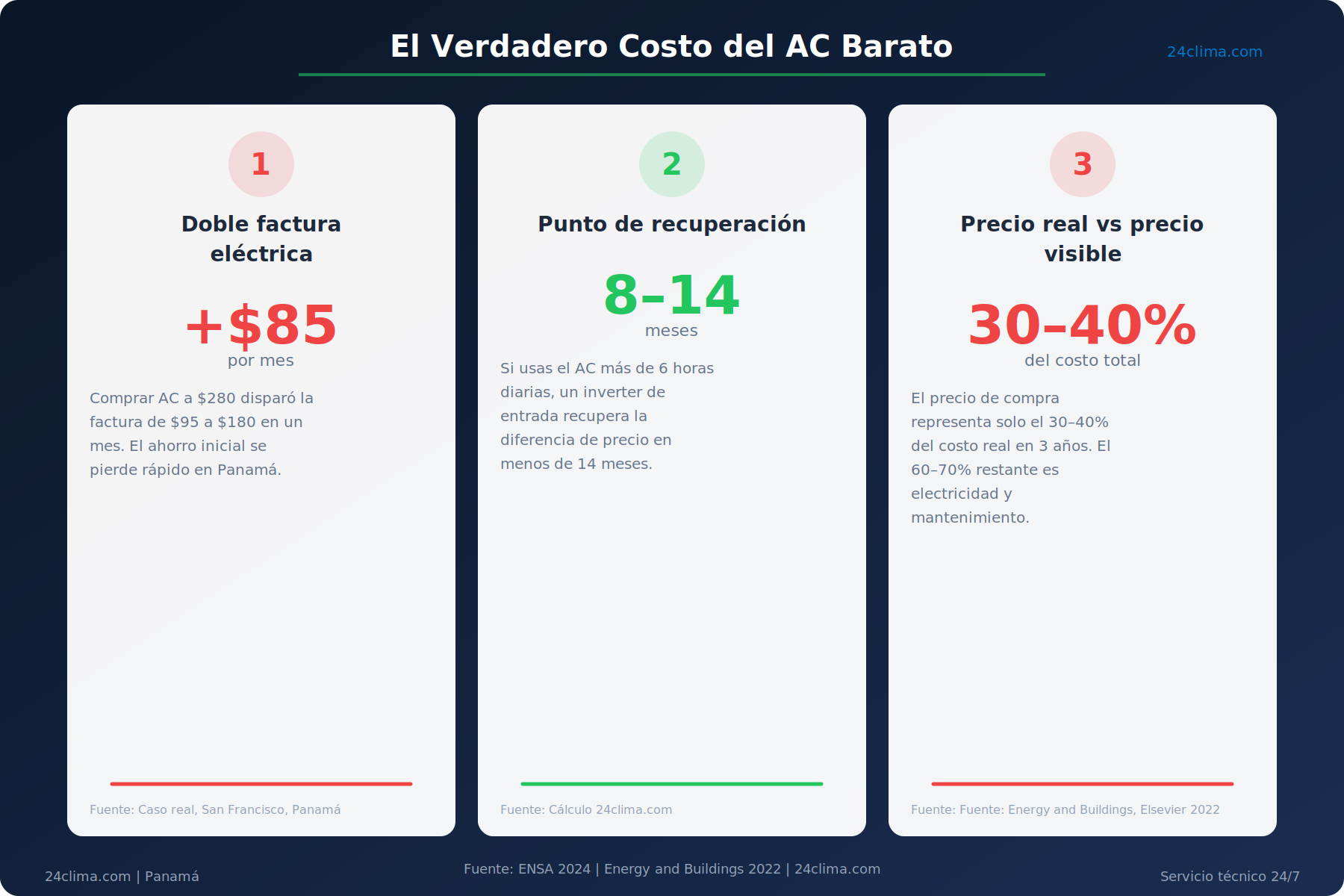
It's 2 p.m. in San Francisco. The sun beats straight down on the concrete and the thermometer reads 91°F (33°C) with 87% humidity. You walk into your apartment, switch on the unit you just bought for $280 at a store on Vía España, and feel that first blast of cold air. Pure relief. The problem shows up thirty days later, when your ENSA bill arrives.
$180 in electricity. Last month you paid $95.
That's not a fluke — it's the cycle we see repeat every single season in Panama. Someone searches for "cheap air conditioners," buys the most affordable model they can find, and within six months has spent more on electricity than they would have if they'd bought a better unit from the start. This guide exists to break that cycle with real numbers, not marketing language.
At 24clima's guides and tips section you'll find technical information calibrated specifically for Panama's climate. Here we cut straight to it: what units actually cost, where to buy them, what hides behind a low price tag, and how to calculate which option saves you more money over 36 months.
What Everyone Assumes (and Why They're Wrong)
The common assumption is simple: a cheap air conditioner is easy on the wallet. Low price today, savings today. Logical in theory. In practice, in Panama, that reasoning ignores two variables that quietly wreck your monthly budget — the tropical climate and compressor technology.
A conventional air conditioner — the type that dominates the $180 to $320 price range — uses a fixed-speed compressor. It runs at 100% power or it's completely off. No middle setting. When the room reaches the target temperature, the unit shuts down. When the temperature climbs one degree, it kicks back on at full power. In Panama, where outdoor temperatures never drop below 82°F (28°C) even at night or in December, that on-off cycling happens every 3 to 8 minutes throughout the night. Each compressor start-up draws a power spike equivalent to 2 to 3 times normal operating consumption.
You pay more in electricity not because the unit is powerful, but because it's inefficient in the only climate where you'll ever use it.
Real Price Ranges at Panama Stores
Air conditioner prices in Panama range from $180 to $850 in the residential 9,000 to 18,000 BTU segment. Here are verified ranges from the country's main retailers as of 2024-2025.
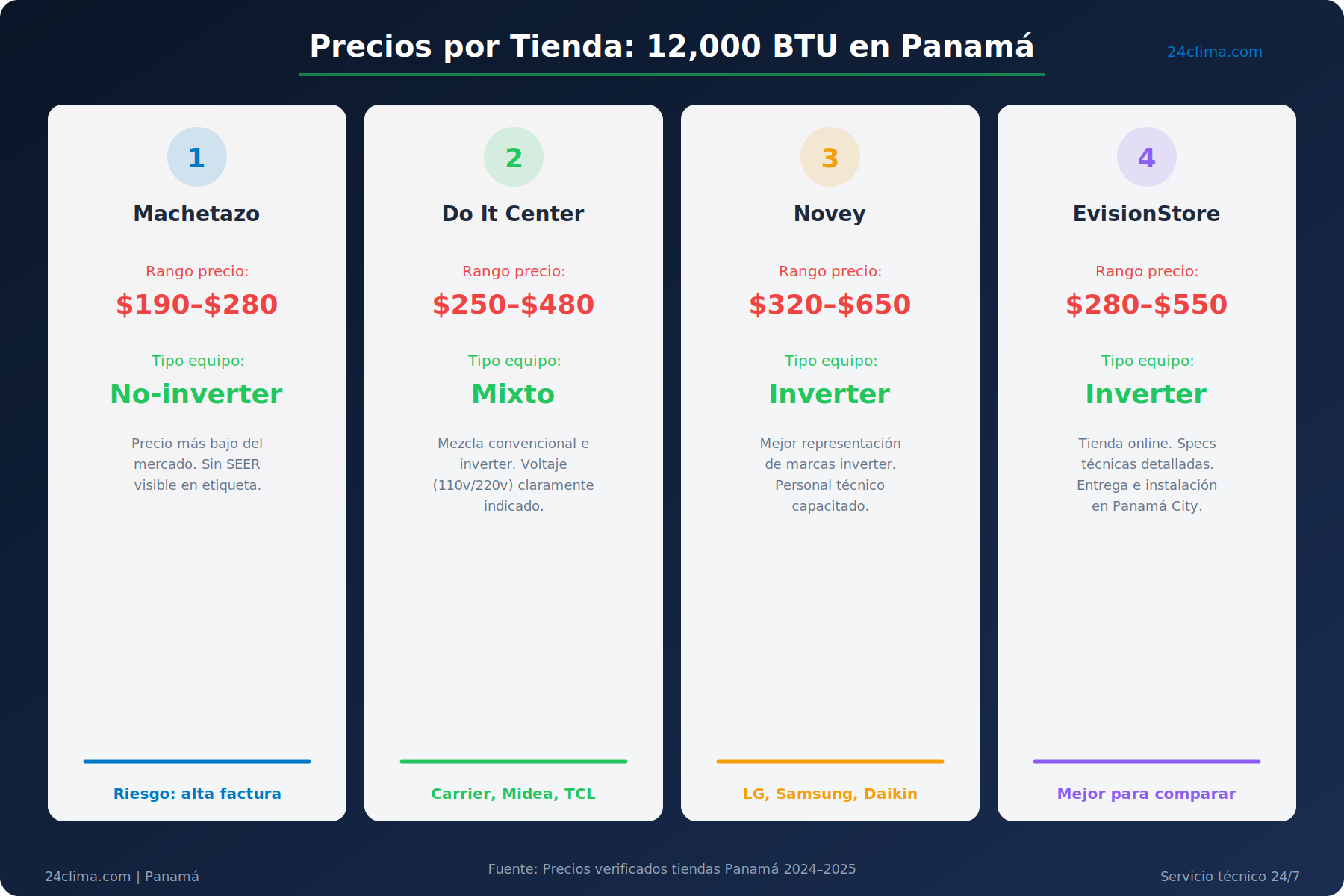
Machetazo (particularly the El Dorado and Transistmica locations) offers the lowest upfront prices in the market. Non-inverter models from regional brands or direct Asian manufacturing run between $190 and $280 for a 12,000 BTU unit. The catch: Machetazo doesn't always display the exact compressor model or SEER rating on the visible price tag — you have to ask.
Do It Center ranges from $250 to $480 for 12,000 BTU, with a mix of conventional and entry-level inverter models from Carrier, Midea, and TCL. Units are clearly labeled 110v or 220v on the tag, which saves you a headache at the electrical panel later.
Novey sits a step up, with models between $320 and $650. Better representation of inverter brands like LG, Samsung, and entry-level Daikin. Sales staff there tend to actually know the difference between models.
EvisionStore is an online retailer with competitive prices between $280 and $550. Useful for comparing technical specifications at your own pace before deciding. They offer delivery and installation in Panama City.
Is the lowest price worth it? That depends on how many hours a day you run the unit. Run your AC more than 6 hours daily — which is the reality for 80% of apartments in Panama City — and an entry-level inverter recoups the price difference in 8 to 14 months.
The Real Calculation: Total Cost of Ownership Over 3 Years
The purchase price of an air conditioner is only 30% to 40% of its true cost over the first three years. Electricity and maintenance pay the rest.
Three real scenarios using ENSA residential tariffs in Panama (0.18 to 0.22 USD per kWh in 2024, depending on your consumption tier):
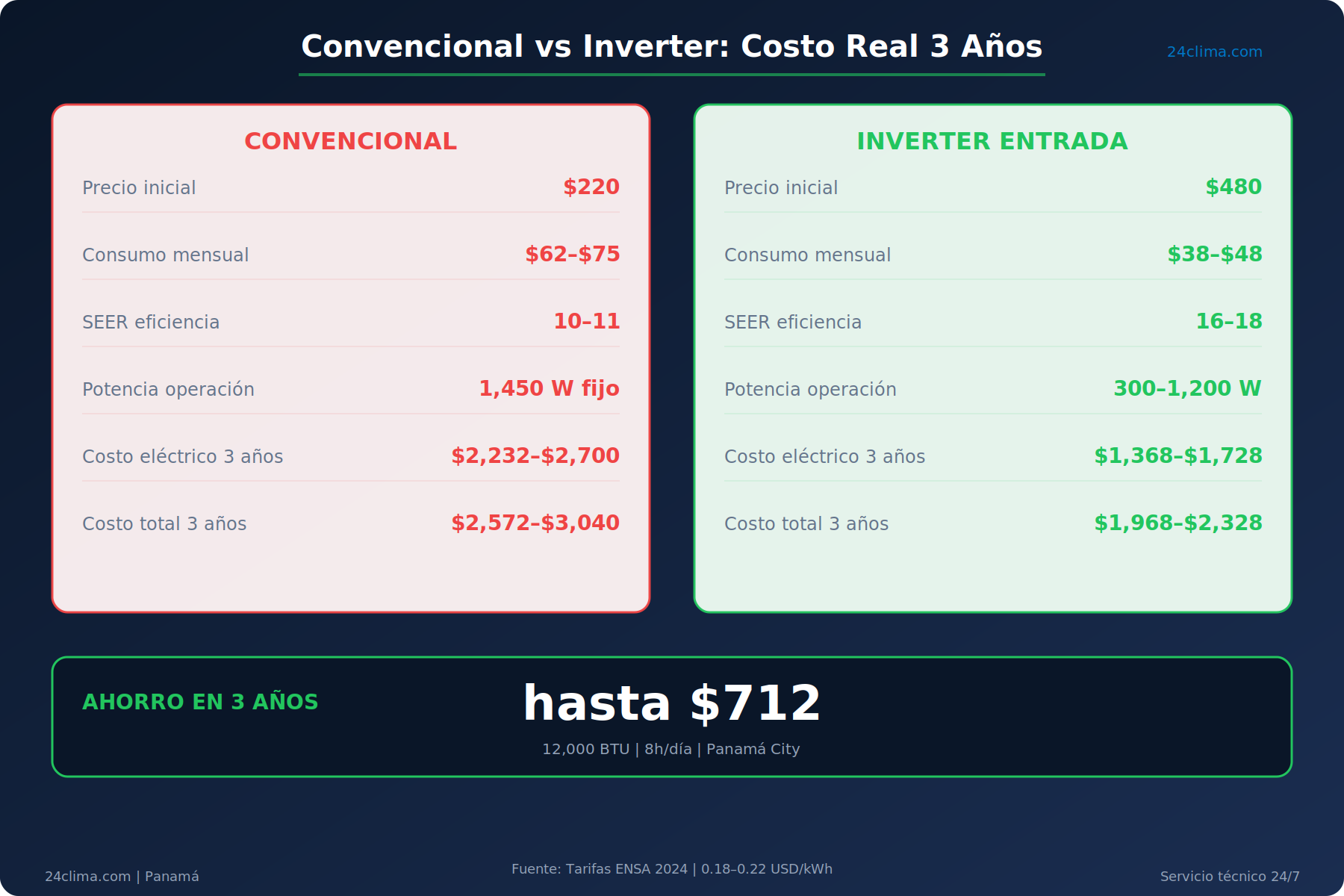
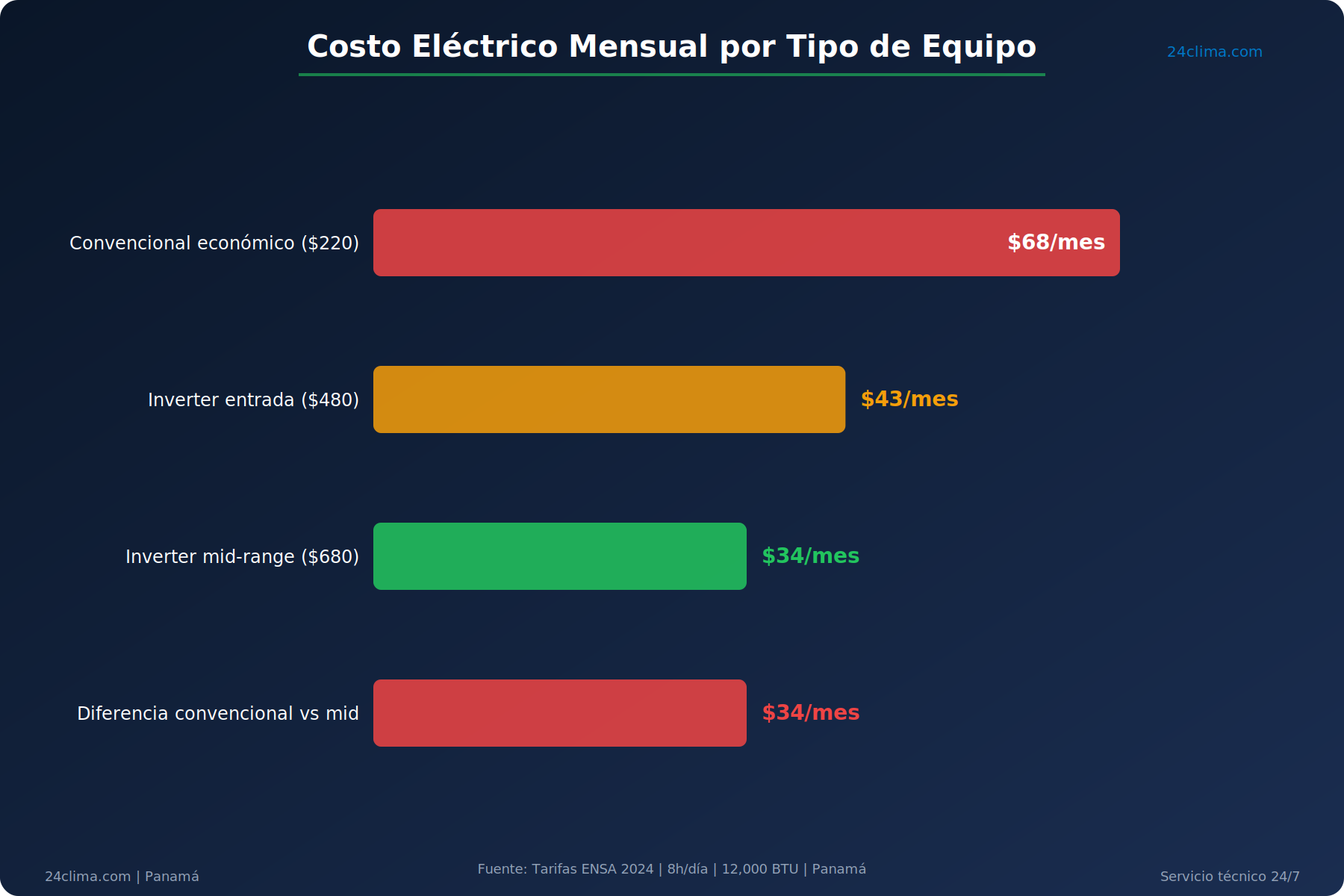
Conventional budget unit — $220 purchase price Typical power draw: 1,450 W in operation. Efficiency: SEER 10 to 11. Estimated electricity cost running 8 hours a day: $62 to $75 per month. Over 3 years, that's $2,232 to $2,700 in electricity alone, plus $120 in basic maintenance (two cleanings per year). Total cost over 3 years: $2,572 to $3,040.
Entry-level inverter unit — $480 purchase price (e.g., TCL 12,000 BTU Inverter) Variable power draw: 300 W to 1,200 W based on demand. Efficiency: SEER 16 to 18. Estimated electricity cost at 8 hours a day: $38 to $48 per month, or $1,368 to $1,728 over 3 years. Add $120 in maintenance. Total cost over 3 years: $1,968 to $2,328.
Mid-range inverter unit — $680 purchase price (e.g., LG Dual Cool 12,000 BTU) Efficiency: SEER 20 to 22. Estimated electricity cost: $30 to $38 per month, or $1,080 to $1,368 over 3 years. Add $120 in maintenance. Total cost over 3 years: $1,880 to $2,168.
A study published in Energy and Buildings (2022, Elsevier) found that variable-speed inverter compressors consume on average 44% less energy than fixed-speed compressors under partial load conditions — which is exactly how a unit operates in a room that has already been cooled down. In Panama, since outdoor heat never drops to zero (nighttime temperatures stay between 79°F and 84°F / 26°C and 29°C year-round), an inverter unit spends the majority of its life in partial load mode.
The difference between the cheapest unit and an entry-level inverter is not $260. It's $260 in upfront cost against $864 to $1,372 in electricity savings over 36 months. The inverter wins by a wide margin.
The 110v Problem in Panama City
Many of the cheaper units available in Panama are designed for 110v. That seems convenient — most residential outlets are 110v — but it hides a real technical issue.
Air conditioners of 12,000 BTU or more draw between 1,200 W and 1,500 W of power. On a 110v circuit, that equals 11 to 14 amps of continuous current. If your apartment's wiring isn't sized for that load, or if you're using extension cords, the risk of circuit overheating is genuine. Panama's electrical code recommends dedicated 20-amp circuits for climate control equipment of this size.
Units that run on 220v — common in the inverter price range — consume the same wattage but at half the current (6 to 7 amps), reducing the load on the wiring and improving compressor stability. If your apartment has 220v circuits — standard in buildings constructed after 2000 in Costa del Este, Punta Pacífica, and Santa María — a 220v unit is the technically superior choice.
Is your building in San Francisco or Bella Vista from before 1995? Check the electrical panel before buying anything. With 15-amp, 110v circuits, a conventional 12,000 BTU unit on 110v will work, but it will run at the limit of that circuit's capacity.
For smaller 110v units (9,000 BTU for rooms up to 150 sq ft / 14 m²), the issue is less critical. But for larger rooms, the voltage limitation may force you to install a new dedicated circuit — an additional cost of $80 to $150 in electrical labor in Panama City.
How Many BTUs You Actually Need in Panama's Climate
The standard rule of "roughly 20 BTU per square foot" was designed for temperate climates. It doesn't apply here.
With outdoor temperatures of 88°F to 93°F (31°C to 34°C) and relative humidity of 75% to 90%, the heat load on any space is significantly higher than in a mild climate. Latent heat — the energy required to remove moisture from the air — can account for up to 30% of the total cooling load in a tropical environment, according to the ASHRAE Handbook of Fundamentals (2021).
BTU guide by room size for Panama:
Room of 110 to 130 sq ft (10 to 12 m²), lower floor, east or west-facing window: minimum 9,000 BTU. Room of 130 to 175 sq ft (12 to 16 m²), moderate sun exposure: 12,000 BTU. Room of 175 to 240 sq ft (16 to 22 m²) or small living room: 12,000 to 18,000 BTU. Living room of 240 to 380 sq ft (22 to 35 m²), west-facing windows, upper floor: 18,000 to 24,000 BTU. Office with computers and people (high internal load): add 600 BTU per person and 400 BTU per desktop computer.
A 130 sq ft (12 m²) room on the 12th floor in Miraflores, west-facing windows, no exterior shade — that space can require 14,000 BTU, not 9,000. Undersize the unit and it runs at 100% capacity constantly, never shuts off, and the room temperature never drops to a comfortable 72°F (22°C). That's exactly the behavior of a cheap, poorly sized unit: working its hardest and failing to do the job.
Our maintenance service includes a thermal load assessment of your space before recommending any unit.
Frequently Asked Questions About Cheap Air Conditioners in Panama
What is the cheapest air conditioner that actually works well in Panama's climate?
The TCL 12,000 BTU Inverter (available between $380 and $480 at Do It Center and EvisionStore) offers the best price-to-efficiency ratio for Panama's climate. With a SEER of 16 to 17, it consumes approximately 38% to 42% less electricity than a conventional unit of the same capacity. This is the entry point where inverter technology starts to make genuine financial sense for 6 to 8 hours of daily use.
Is it worth buying an air conditioner at Machetazo or Do It Center in Panama?
Both stores sell legitimate products. The difference is the inventory: Machetazo tends to carry conventional models at lower upfront cost, while Do It Center has a wider selection of inverter units. For tight budgets with moderate use (less than 5 hours a day), Machetazo can work. For heavy daily use in Panama City, Do It Center or EvisionStore give you better access to inverter technology at competitive prices.
Is a budget inverter better than a cheap conventional unit for an apartment in Panama City?
An entry-level inverter beats the budget conventional unit in any scenario involving 5 or more hours of daily use. The price difference ($180 to $250 more for the inverter) is recovered within 8 to 12 months through electricity savings. In apartments without their own roof — where heat radiates through concrete from above and from neighbors running their own AC — the inverter maintains a more stable temperature with less energy consumption.
What happens if I buy a cheap 110v air conditioner in Panama?
A 110v unit will work, but it requires a properly sized dedicated circuit (minimum 20 amps for a 12,000 BTU unit). In buildings with older wiring (pre-1995), the risk of circuit overheating is real. Beyond safety, the cheap 110v units available in the Panamanian market are rarely inverter — the combination of low voltage and inverter technology is uncommon in that price segment.
How many BTUs do I need for a 130 sq ft (12 m²) room in Panama with 88°F (31°C) heat and 85% humidity?
A 130 sq ft room in Panama needs a minimum of 12,000 BTU if it has sun-exposed windows or is on an upper floor. With exterior shade and few windows, 9,000 BTU may be sufficient. At 85% humidity, the latent heat load is real — an undersized 9,000 BTU unit cannot manage peak heat hours (noon to 6 p.m.), meaning the room temperature will rarely drop below 79°F (26°C) regardless of the thermostat setting.
The Checklist Before You Buy
Before paying for any unit at any store, run through these points:
Check the SEER rating. In Panama, don't buy anything below SEER 14. A SEER of 10 to 11 in a tropical climate translates to $20 to $30 extra per month compared to a SEER 16 unit — that's $240 to $360 a year for nothing.
Confirm whether it's inverter or conventional. The label should say so clearly. "Inverter" refers to a specific compressor technology, not a marketing term.
Verify the required voltage (110v or 220v) and confirm your circuit can handle it before you buy — not after the installer shows up.
Check the local warranty coverage. Some low-cost brands at Machetazo carry a manufacturer warranty but have no organized local service network. Ask specifically where the unit goes if the compressor fails.
Calculate the correct BTUs for your space using the guide above. A poorly sized unit underperforms and fails earlier.
Ask about the installation cost before closing the purchase. In Panama City, a standard installation runs between $80 and $150. Some stores include it; many don't.
Let's go back to that apartment in San Francisco. The $180 bill didn't arrive because the cheap unit was defective. It arrived because nobody calculated the real cost of running any air conditioner in 91°F (33°C) heat and 87% humidity before handing over the $280. With those numbers on the table, the decision changes. The $480 unit with a SEER of 17 costs $200 more today and returns those $200 in electricity savings before the year is out.
At 24Clima we assess your space, your available voltage, and your actual usage pattern before recommending any unit. We don't sell air conditioners — we install and maintain the one that works best for your specific situation in Panama. If you have questions about what to buy or want a no-cost technical second opinion before you decide, contact us on WhatsApp at https://24clima.com/contacto/ and one of our technicians will get back to you at no charge.
Last updated: May 2025