Ir al contenido principal
Back to list

How Much Electricity Does an Air Conditioner Use in Panama? 2024 Guide

How Much Electricity Does an Air Conditioner Use in Panama? 2025 Guide

If you live in Panama and run air conditioning, you already know what it feels like to open your electric bill after a hot month. But do you know exactly how much your unit is consuming, what it's actually costing you in dollars, and whether you're paying more than you should? This guide answers those questions with real numbers — calibrated to Panama's tropical climate and current local electricity rates.

AC energy consumption is more technical than most people realize. It's not enough to look at the BTU rating or take a salesperson's word that a unit is "efficient." Several variables determine what you pay each month: compressor technology, daily operating hours, outdoor temperature, how well your space is insulated, and even the maintenance condition of the equipment. You'll find articles covering each of these factors in depth in our guides and tips section at 24clima.com/consejos-y-guias/.

How Air Conditioner Energy Consumption Is Measured

Electricity consumption is measured in kilowatt-hours (kWh). One kilowatt-hour equals consuming 1,000 watts continuously for 60 minutes. To understand how much your AC unit uses, you need two basic numbers: the unit's electrical draw in watts (or kilowatts) and the hours you run it per day.

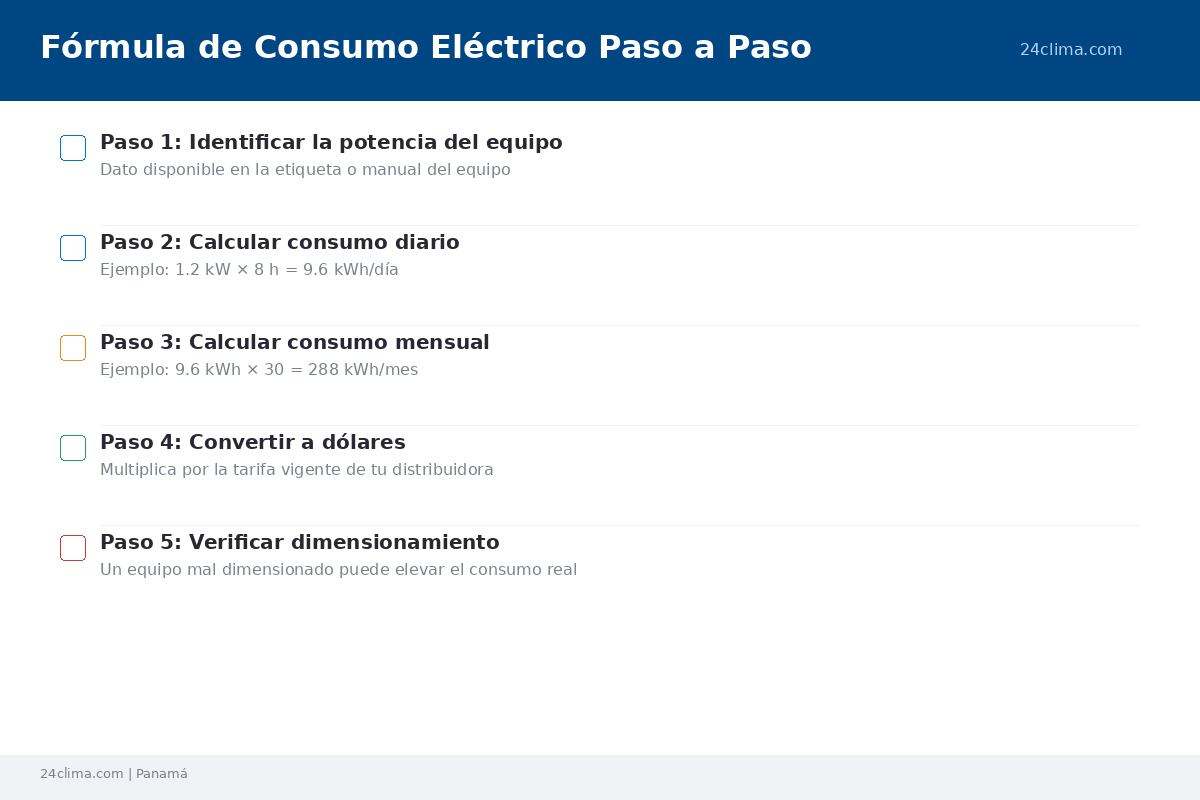
The formula is straightforward:

Daily consumption (kWh) = Unit power draw (kW) × Daily operating hours

Monthly consumption (kWh) = Daily consumption × 30 days

The complication is that most units don't always operate at full power. An inverter-type split, for example, modulates compressor speed based on cooling demand. During cooler parts of the day — or once a room has reached the target temperature — it draws considerably less power. A conventional (on/off) unit always runs at 100% capacity when it's on and shuts off completely once the set temperature is reached, creating frequent restart cycles that are energetically expensive.

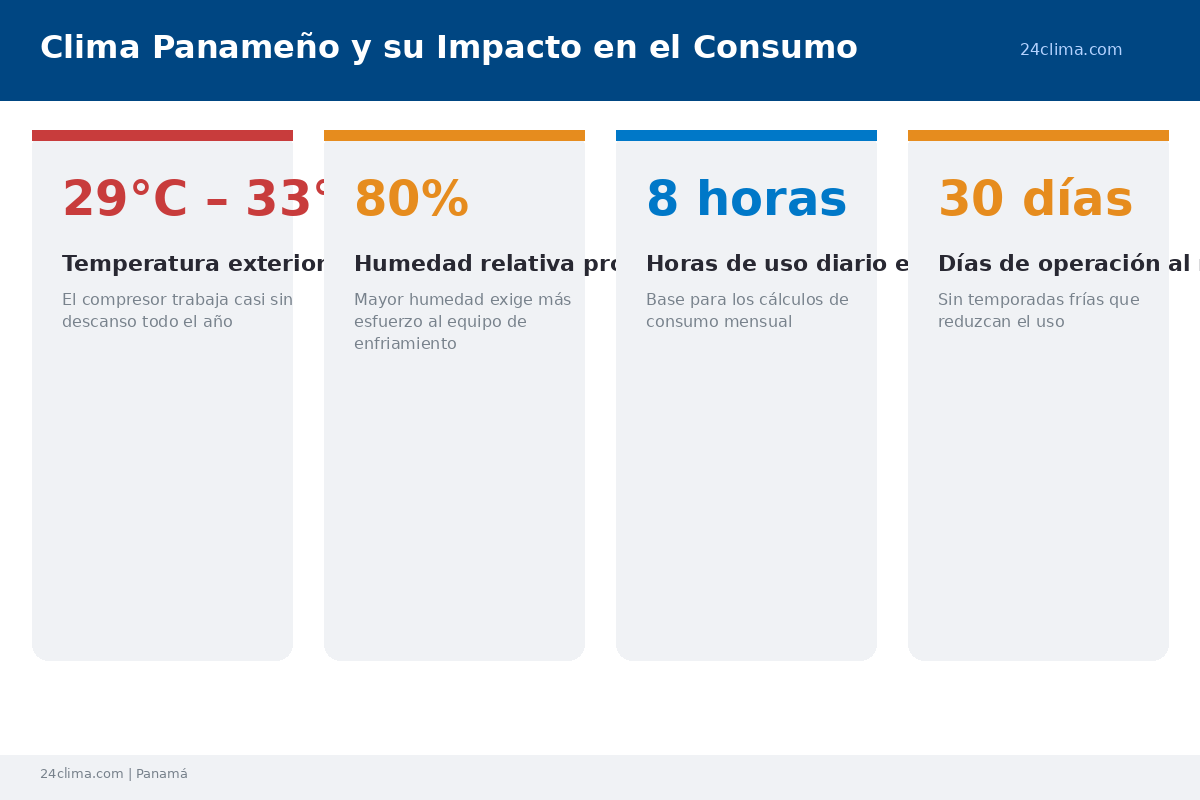
For a realistic estimate in Panama — where outdoor temperatures hover between 84°F and 91°F (29°C–33°C) for most of the year with average relative humidity around 80% — units work at maximum output far more hours than they would in temperate climates. This isn't Miami, where nights cool down. Here, the compressor earns its keep.

Real Consumption by Unit Capacity: Comparison Table

Cooling capacity is measured in BTU/hour — the amount of heat a unit can remove from a space in one hour. Residential units common in Panama range from 9,000 BTU to 36,000 BTU. Higher capacity means higher electricity draw.

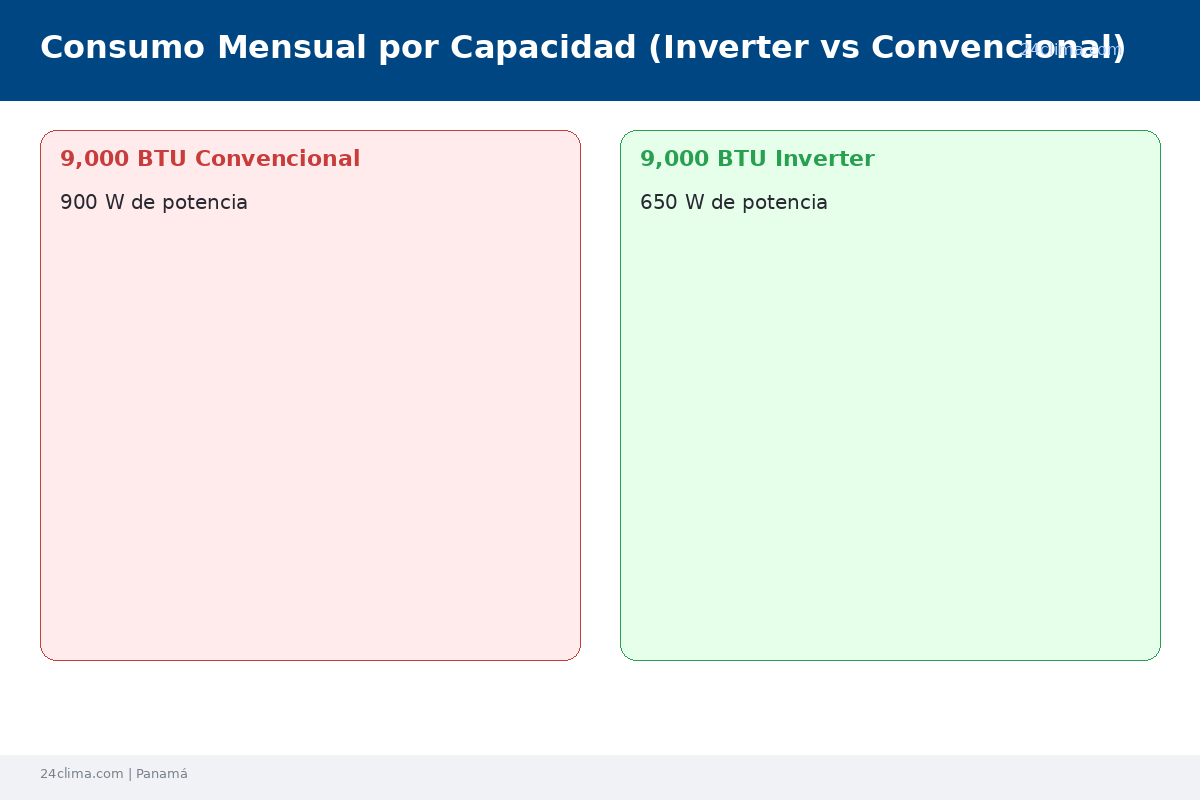
The table below shows approximate consumption values for inverter and conventional split units under typical Panama climate conditions (8 hours of daily operation):


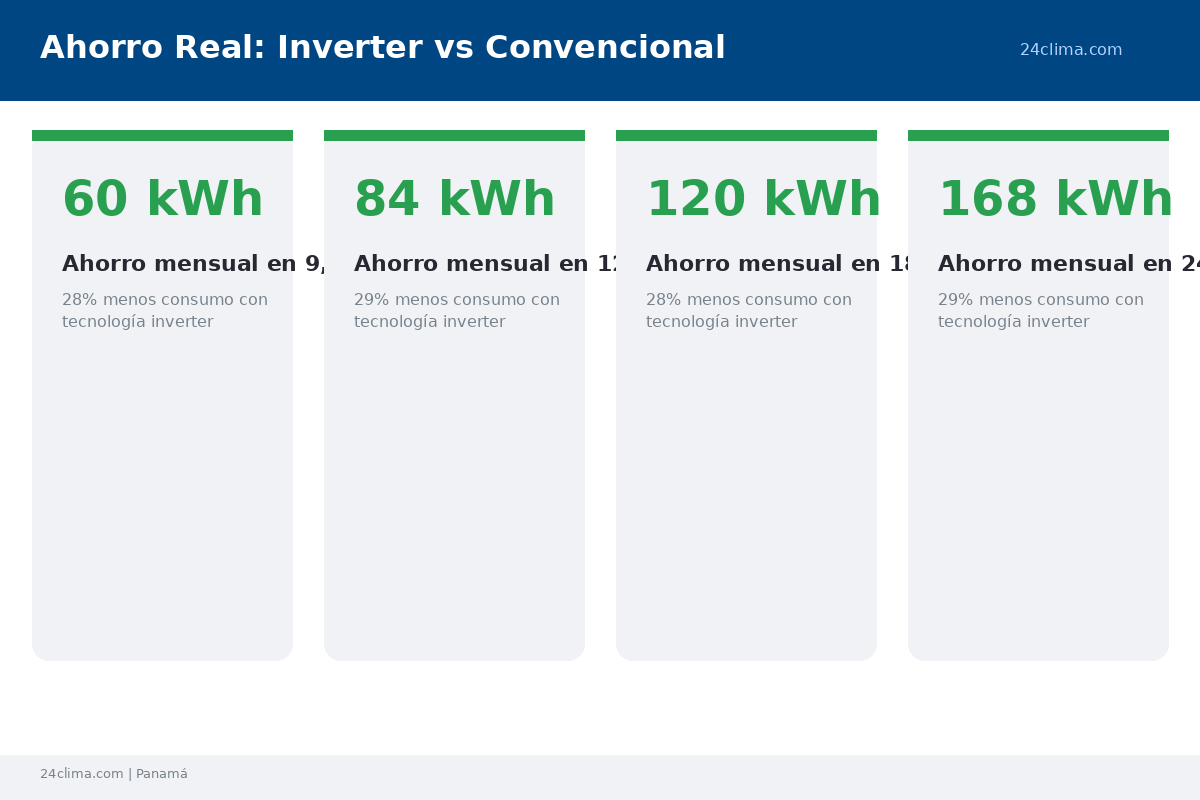
Capacity | Technology | Approx. Power Draw (W) | Daily Use (kWh) | Monthly Use (kWh) 9,000 BTU | Conventional | 900 W | 7.2 kWh | 216 kWh 9,000 BTU | Inverter | 650 W | 5.2 kWh | 156 kWh 12,000 BTU | Conventional | 1,200 W | 9.6 kWh | 288 kWh 12,000 BTU | Inverter | 850 W | 6.8 kWh | 204 kWh 18,000 BTU | Conventional | 1,800 W | 14.4 kWh | 432 kWh 18,000 BTU | Inverter | 1,300 W | 10.4 kWh | 312 kWh 24,000 BTU | Conventional | 2,400 W | 19.2 kWh | 576 kWh 24,000 BTU | Inverter | 1,700 W | 13.6 kWh | 408 kWh 36,000 BTU | Inverter | 2,500 W | 20.0 kWh | 600 kWh


One thing to keep in mind: these figures assume the unit is correctly sized for the space. An undersized unit runs at 100% continuously and consumes more than estimated. An oversized unit short-cycles, which also drives up consumption. Correct sizing isn't optional — it's the foundation of everything else.

Panama Electricity Rates: What You're Actually Paying

To translate kWh into dollars, you need to know current rates. Residential electricity distribution in Panama is handled primarily by Naturgy (formerly Union FENOSA), which serves the metropolitan area. ENSA covers Colón and parts of the interior, and Edechi serves Chiriquí and the western provinces.

Residential rates in Panama follow a tiered structure. The more you consume per month, the higher the per-kWh rate you pay. This block pricing system matters because it explains why air conditioning can push your bill up disproportionately.

Approximate residential rate structure (Naturgy/ENSA, 2024–2025):

  • First 100 kWh: approximately $0.085 per kWh
  • 101 to 300 kWh: approximately $0.121 per kWh
  • 301 to 500 kWh: approximately $0.157 per kWh
  • Above 500 kWh: approximately $0.189 per kWh

On top of those energy charges, there are fixed distribution fees, taxes, and a capacity charge. In practice, a household consuming 400 kWh per month pays an effective blended rate of roughly $0.14 to $0.16 per kWh when everything is factored in.

Here's the part that catches most people off guard: if your home already consumes 250 kWh before you turn on the AC, every additional kWh your unit draws gets billed at the highest applicable tier rate. The air conditioner doesn't just consume more electricity — it consumes electricity at the most expensive price point on your bill.

Monthly Cost Calculator: Real Scenarios for Panama

Here are three practical examples based on housing types common in Panama City.

Scenario 1: Apartment in San Francisco, 160 sq ft (15 m²) bedroom, 12,000 BTU inverter unit

  • Daily use: 10 hours (full night plus a few afternoon hours)
  • Average inverter power draw in tropical conditions: 950 W (inverter units don't always hit maximum, but they work hard at 80% humidity)
  • Daily AC consumption: 0.95 kW × 10 h = 9.5 kWh
  • Monthly AC consumption: 285 kWh
  • Household consumption without AC: approximately 200 kWh
  • Total monthly consumption: 485 kWh
  • Estimated total bill: $65 to $80 depending on fixed charges
  • Cost attributable to AC: approximately $38 to $45 per month

Scenario 2: House in Albrook, living and dining area of 375 sq ft (35 m²), 24,000 BTU inverter unit

  • Daily use: 7 hours (afternoon and evening)
  • Average power draw: 1,900 W
  • Daily AC consumption: 1.9 kW × 7 h = 13.3 kWh
  • Monthly AC consumption: 399 kWh
  • Household consumption without AC: 280 kWh
  • Total monthly consumption: 679 kWh
  • Estimated total bill: $110 to $130 per month
  • Cost attributable to AC: approximately $58 to $70 per month

Scenario 3: Small office in Costa del Este, 270 sq ft (25 m²), 18,000 BTU conventional unit

  • Daily use: 9 working hours, 22 days per month
  • Power draw: constant 1,800 W
  • Monthly AC consumption: 1.8 × 9 × 22 = 356 kWh
  • At commercial rates (slightly different from residential): AC cost approximately $55 to $65 per month

These calculations make one thing clear: air conditioning accounts for 40% to 65% of total electricity consumption in a typical Panama home or business. It's not a minor line item.

Factors That Drive Up Consumption Without You Noticing

Several variables that many owners overlook can push actual consumption 20% to 40% above the manufacturer's theoretical figures.

Dirty filters: A clogged filter restricts airflow and forces the compressor to run longer to reach the target temperature. In Panama, where dust and humidity accelerate biological buildup, filters get dirty fast. Under heavy use, cleaning them every 2 to 3 weeks is the right interval. If it's been months since you last cleaned yours, the overconsumption is already happening.

Dirty coils: Both the evaporator coil (indoor unit) and the condenser coil (outdoor unit) lose efficiency as dirt accumulates. A condenser with blocked fins can't release heat to the outside air efficiently — and in Panama's climate, that has a direct and measurable impact on consumption. A professional cleaning can reduce energy use by 10% to 15%.

Low refrigerant: If the system has a refrigerant leak, the thermodynamic cycle loses efficiency and the compressor runs longer. Common signs: the unit takes longer to cool a room, ice forms on the refrigerant lines, or the space never reaches the set temperature. This requires a qualified technician.

Set temperature too low: Every degree Celsius (1.8°F) you drop the set temperature increases consumption by 6% to 8%. Setting your unit to 64°F (18°C) instead of 75°F (24°C) doesn't make it cool faster — it makes it work longer and costs considerably more. For Panama's climate, 73°F to 77°F (23°C–25°C) is the recommended range for balancing comfort and efficiency.

Poorly sealed spaces: Gaps under doors, windows without weatherstripping, roofs without thermal insulation, west-facing windows with no solar protection. In a well-sealed apartment the unit holds temperature without much effort. In a room with an uncovered west-facing window getting direct afternoon sun, the compressor never gets a break.

Equipment over 10 years old: Units age and lose efficiency. A compressor with 12 years of operation in a tropical climate may be consuming 20% to 30% more than it did when new — even if it technically still runs.
How to Cut Your Bill Without Sacrificing Comfort

Reducing AC consumption in Panama doesn't mean tolerating heat. It means using your equipment more intelligently.

Regular maintenance: The single highest-impact factor, full stop. A clean unit with refrigerant at the correct level operates at its designed efficiency. A professional preventive maintenance service twice a year is sufficient for most homes under normal use. See our servicio de mantenimiento at 24clima.com/servicios/mantenimiento/ for details on what that involves.

Use sleep mode or a nightly timer: During the early morning hours in Panama City, outdoor temperatures drop slightly — typically to 79°F–82°F (26°C–28°C). Programming the unit to raise its set temperature automatically at 2 or 3 a.m. can cut overnight consumption by 15% to 20%.

Seal your space: A door with a proper seal significantly reduces heat infiltration from hallways or outdoors. Blackout curtains or thermal-lined window coverings on windows with direct sun exposure can reduce the cooling load by up to 25%.

Upgrade from conventional to inverter: If your current unit is 8 to 10 years old and uses on/off technology, the investment in a new inverter split pays for itself in 18 to 30 months purely through electricity savings, depending on usage. With electricity rates trending upward in Panama, that payback period is getting shorter.

Size correctly: A 24,000 BTU unit in a 160 sq ft (15 m²) bedroom doesn't cool faster or more efficiently — it short-cycles, runs inefficiently, and actually raises indoor humidity. Getting the BTU calculation right for each space matters. A basic tropical climate rule of thumb: 600 to 700 BTU per square meter (55 to 65 BTU per square foot), adjusted for ceiling height, solar orientation, and occupancy and equipment heat loads.

Is the Consumption Worth It? A Realistic Perspective

In Panama, air conditioning is not an optional luxury for most urban households. With temperatures that rarely drop below 81°F (27°C) even at night, and relative humidity that keeps the heat index above 95°F (35°C) for much of the year, AC is a comfort necessity — and in many cases a health necessity.

The question isn't whether to use it, it's how to use it efficiently. A correctly sized unit, properly installed, well maintained, and operated at a reasonable set temperature can cost between $30 and $50 per month per room in a typical Panama home. That's manageable. The problem arises when none of those conditions are met and the bill climbs past $150 or $200 a month for reasons that are entirely avoidable.

If you're not sure whether your unit is consuming more than it should, use our herramienta de diagnóstico at 24clima.com/diagnostico/ to identify potential issues before calling a technician.

Final Numbers

Air conditioner electricity consumption in Panama comes down to BTU capacity, compressor technology, daily operating hours, and maintenance condition. With Panama's tiered electricity pricing penalizing heavy consumption, every wasted kWh is expensive. A 12,000 BTU inverter unit running 10 hours a day in typical tropical conditions can cost $35 to $45 per month. A conventional unit of the same capacity doing the same job will cost 30% to 40% more for identical results.

Regular maintenance, the right set temperature, and proper space sealing are the three most accessible ways to reduce your bill without giving up comfort.

If you want to know exactly how much your unit is consuming, whether it's operating at peak efficiency, or whether it's time to consider a technology upgrade, contáctanos por WhatsApp at 24clima.com/contacto/ — our team in Panama can perform a technical assessment and give you real numbers based on your specific equipment, your space, and your usage patterns.

Get a quote