Inverter vs conventional AC — the truth about your electricity bill in Panama
Two in the afternoon. San Francisco district. The sun hits your window like it has something personal against you.
You turn on the air conditioner. A heavy thud. The compressor kicks in at full power. The room starts cooling down.
But there's a detail you don't see: every time that compressor starts up, it draws 3 to 8 times more electricity than when it's already running. It's like a car that slams the brakes and floors it at every traffic light. All day. All night.
That's your conventional AC. And that's what shows up on your electricity bill.
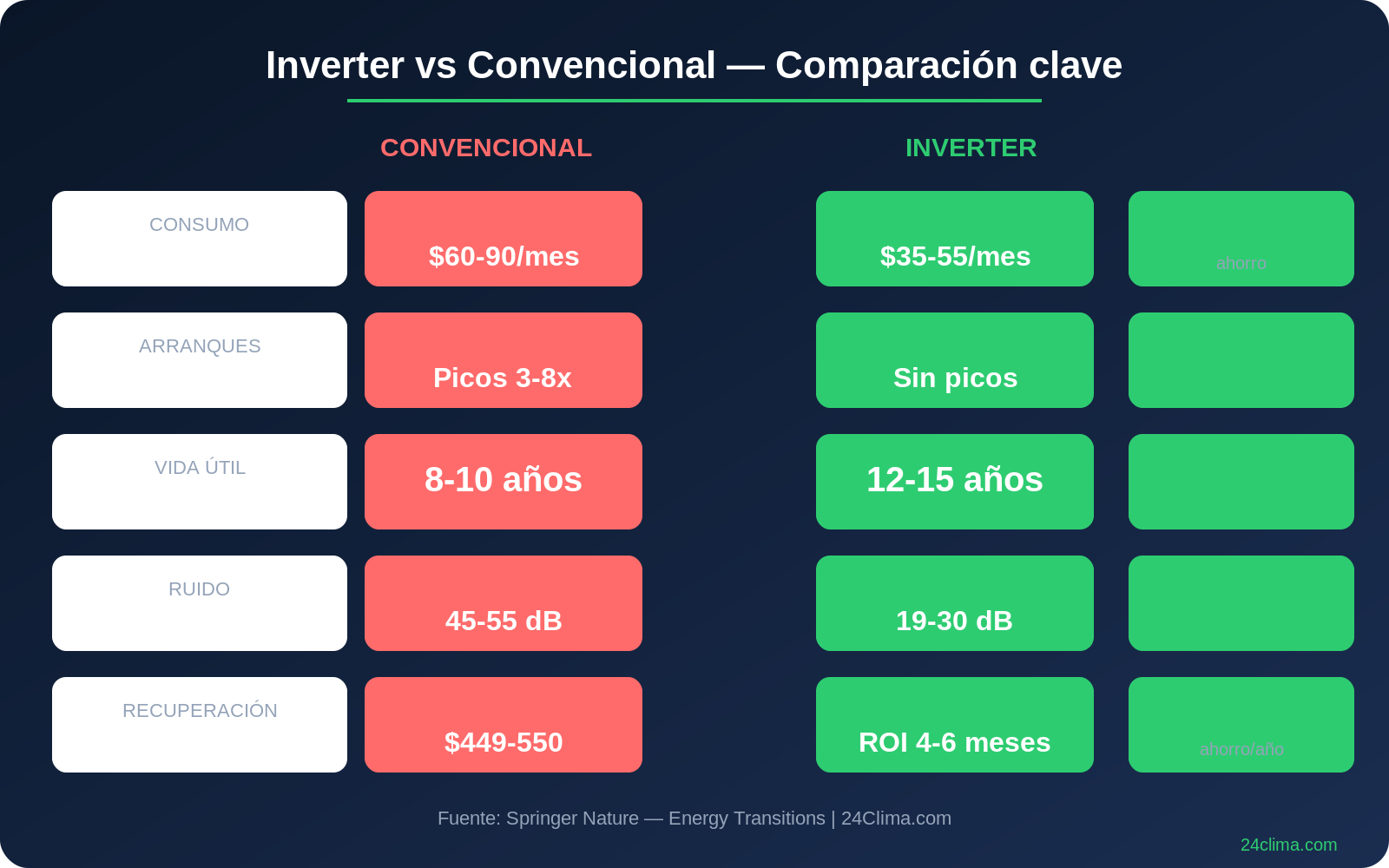
How a conventional AC works — the cycle that costs you
A conventional AC has one speed: maximum. When you turn it on, the compressor runs at 100% until the room hits your set temperature. Then it shuts off completely.
When the temperature rises a couple of degrees — and in Panama, that takes minutes, not hours — the compressor fires up again. Full power.
That on-off cycle repeats 8 to 12 times per hour. Every startup draws a power spike. Compressor wear accelerates. And your bill climbs without you understanding why.
How an inverter works — the one that knows how to pace itself
An inverter is a different animal. Its compressor doesn't just have on and off — it has thousands of speeds in between.
When you turn it on, yes, it starts at full power. But once your room reaches the desired temperature, the compressor doesn't shut off. It slows down. To 30%, to 20%, to 15%. Just enough to maintain comfort without power spikes.
It's like cruise control on the highway. No slamming brakes, no flooring it. Just steady speed.
In a climate like Panama — where you run the AC 8, 10, 12 hours a day — that difference shows up on your bill every single month.
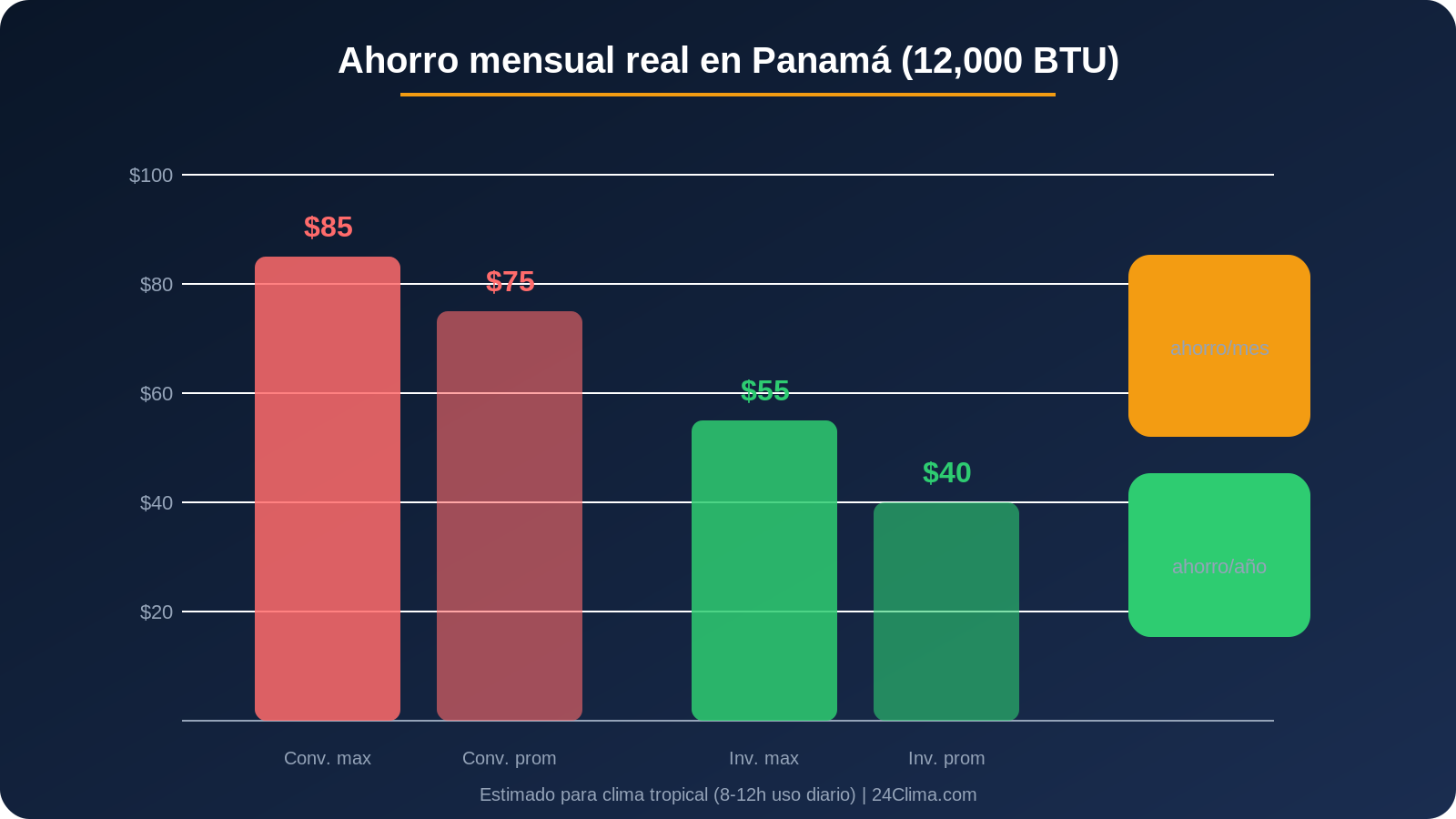
The numbers that matter
According to a study published by Springer Nature, an inverter consumes up to 44% less electricity than a conventional unit under continuous use. In tropical climates like ours, savings range between 30% and 50%.
In real money for Panama, this means:
— A 12,000 BTU conventional AC can cost $60 to $90 per month in electricity — An inverter of the same size: $35 to $55 — Average monthly savings: $25 to $35 — Annual savings: $300 to $420
An inverter costs $100 to $200 more than a conventional unit. With monthly savings, you recover that difference in 4 to 6 months. After that, it's all profit.
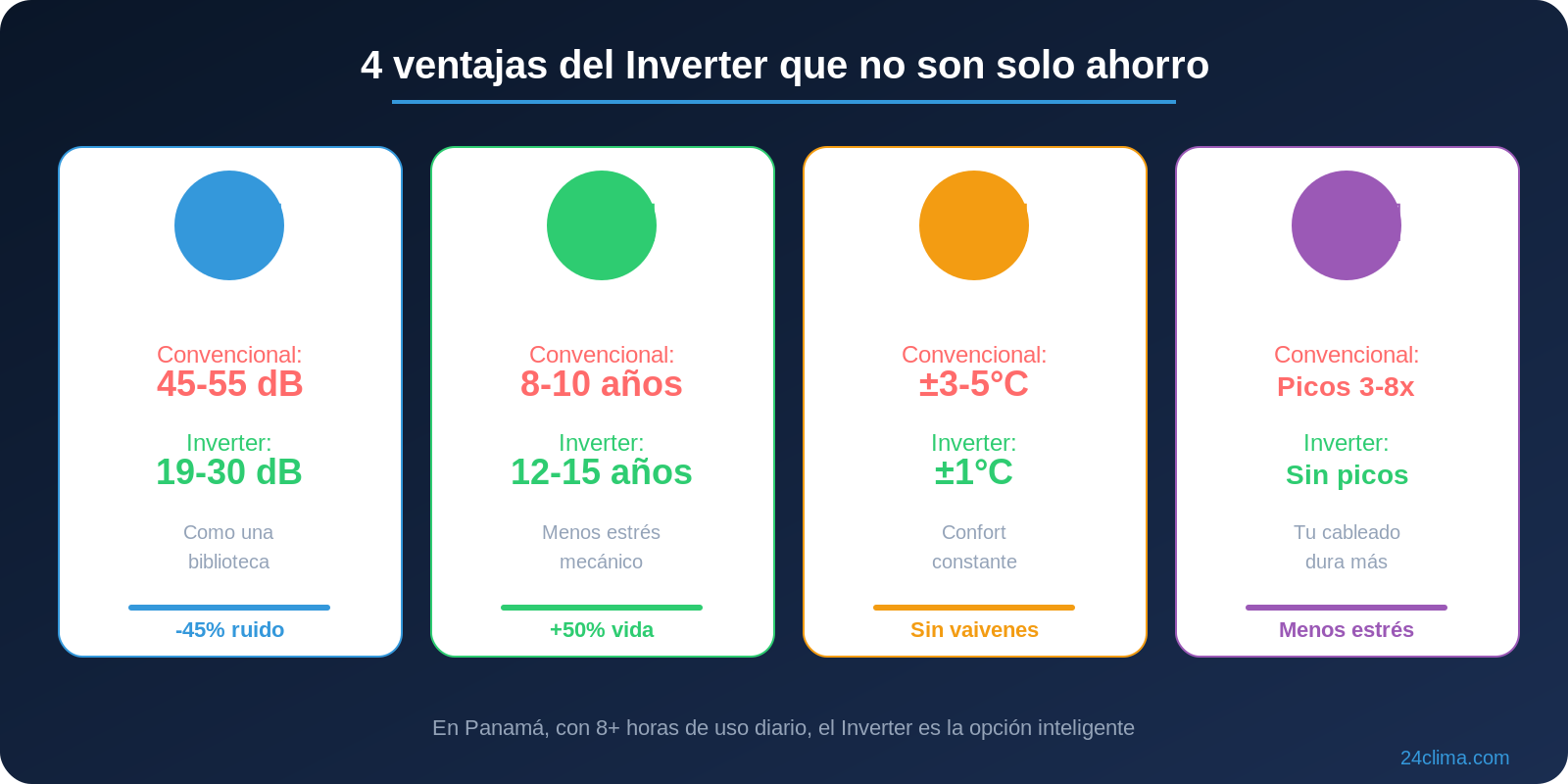
What else changes with an inverter
1️⃣ Noise — without the startup bang of the compressor, an inverter is significantly quieter. Perfect for bedrooms.
2️⃣ Lifespan — less mechanical stress on the compressor means less wear. A well-maintained inverter can last 12-15 years. A conventional unit: 8-10.
3️⃣ Stable temperature — no more swings from ice cold to warm to cold again. An inverter keeps temperature at a steady ±1°C.
4️⃣ Less strain on your wiring — without startup spikes, your electrical system takes less punishment.
So — when does a conventional unit make sense?
If you use the AC less than 4 hours a day and your budget is tight, a conventional unit can do the job. For a half-day office or a guest room, it might be enough.
But if you live in Panama and your AC runs 8 hours or more — and let's be honest, that's almost everyone here — an inverter isn't a luxury. It's the smart choice.
It's not marketing. It's the numbers.
At 24Clima we install both technologies and know which one fits each situation. Want to find out how much you could save with an inverter in your space? We can calculate it together.