Ir al contenido principal
Back to list

Air conditioning maintenance in tropical climates: a technical guide for Panama

Air conditioning maintenance in tropical climates: a technical guide for Panama

Panama's climate is tough on air conditioning systems. With average temperatures of 32-35°C (90-95°F) and humidity above 80% most of the year, equipment runs 12 to 16 hours daily. Without regular maintenance, a unit's life drops 30-40%, per ASHRAE (American Society of Heating, Refrigerating and Air-Conditioning Engineers).

This guide covers preventive maintenance tasks for Panama's tropical climate, including maintenance intervals, performance targets, and technical criteria for each task.
Why tropical climate accelerates equipment wear

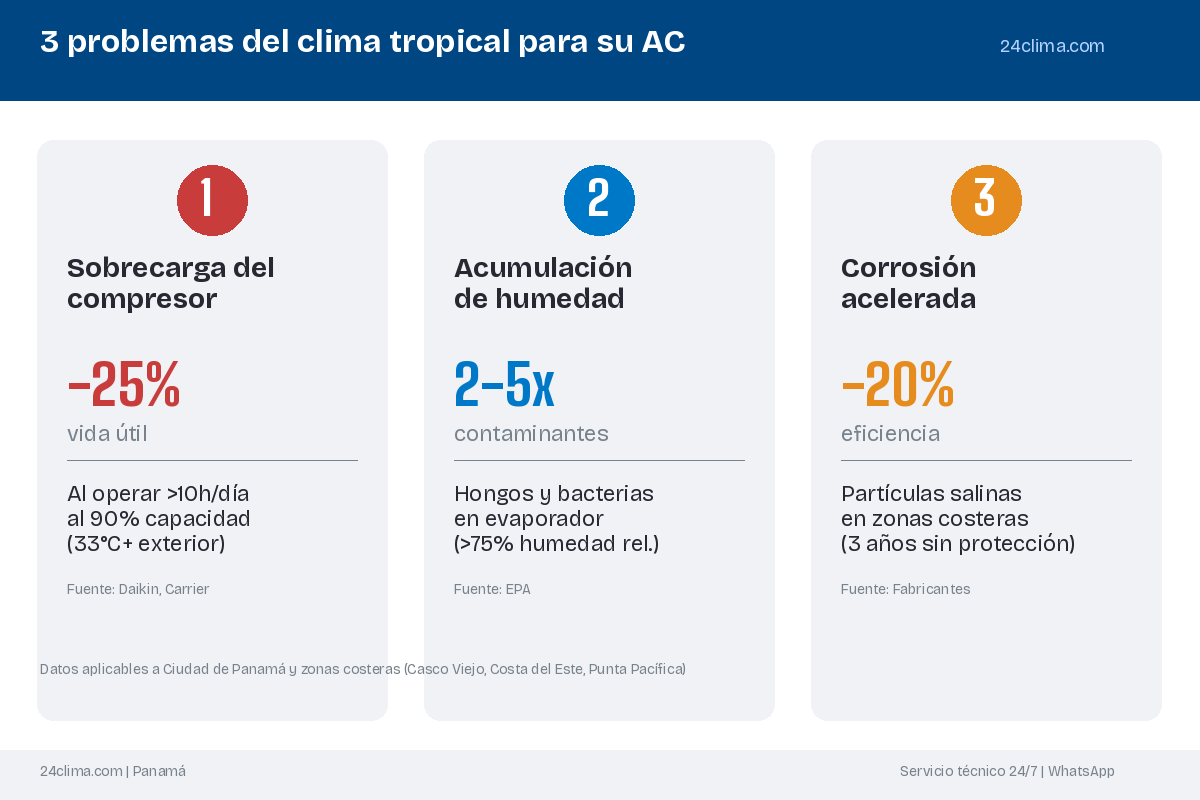
High temperature and humidity create three main problems for air conditioning.

The compressor overloads. When outdoor temperature stays above 33°C (91°F), the compressor runs near maximum capacity for long stretches. Daikin and Carrier report that a compressor at 90% capacity for more than 10 hours daily loses about 25% of its lifespan compared to 70% operation.

Moisture builds up on evaporator coils. With relative humidity above 75%, excess condensation fills the drain pans and promotes mold and bacteria growth. The EPA documents that poorly maintained systems can have biological contaminant levels 2 to 5 times higher than outdoor air.

Corrosion happens faster. In coastal areas like Casco Viejo, Costa del Este, and Punta Pacifica, ocean breeze brings salt particles that eat away at aluminum coils. Manufacturers note that corrosion can cut condenser efficiency 15-20% in the first 3 years without anti-corrosion treatment.

Preventive maintenance schedule for Panama

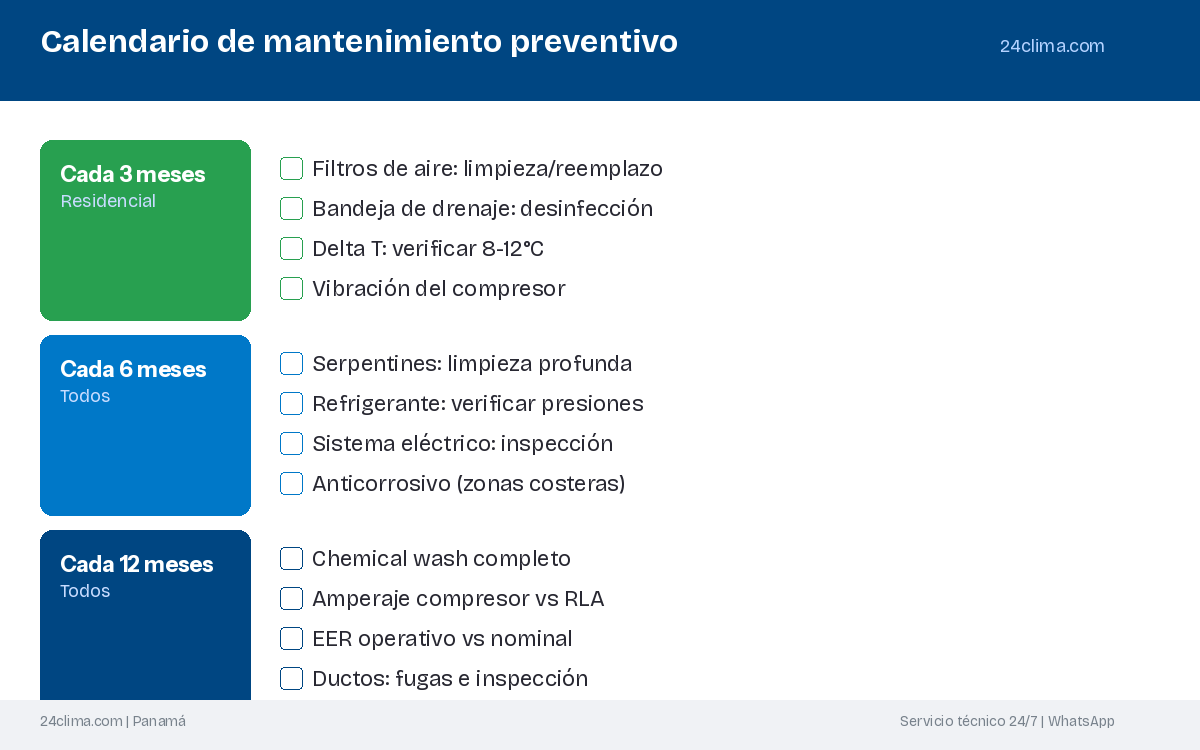
In Panama, maintenance must happen more often than in temperate climates. Europe and North America do fine with 6-month intervals, but here the optimal schedule is every 3 months for residential and monthly for commercial systems.

Monthly (commercial systems) or every 3 months (residential)

  1. Clean or replace air filters. A clogged filter cuts airflow 15-25%, raising power use about 5-10% (U.S. Department of Energy).

  2. Inspect and clean the drain pan and condensate line. In tropical climates, algae and biofilm clogs form 2 to 4 times faster. Use a 10% chlorine solution or condensate tablets to prevent blockages.

  3. Check the temperature differential. Measure air temperature at evaporator inlet and outlet. The difference should be 8-12°C (14-22°F) delta T. Below 7°C (13°F) suggests low refrigerant charge, dirty coil, or fan problems.

  4. Check drainage and compressor vibration. Abnormal vibrations may signal bearing wear or motor imbalance.

Every 6 months

  1. Deep clean evaporator coils (indoor unit) with non-acidic degreaser. Rinse with low-pressure water (max 150 PSI) to avoid damaging aluminum fins.

  2. Clean condenser coil (outdoor unit). In Panama's coastal areas, apply anti-corrosion coating after cleaning. Polymer or epoxy products extend coil life 3 to 5 years.

  3. Check refrigerant charge. Connect manifold gauges and compare suction and discharge pressures to manufacturer specs. For R-410A in Panama (35°C/95°F), typical suction is 120-130 PSI and discharge is 380-420 PSI.

  4. Inspect electrical system: capacitors, contactors, relays, and wiring. Measure capacitance with a multimeter; replace any capacitor off by more than 10% from rating.

  5. Lubricate fan motor bearings if possible (many modern motors are sealed).

Every 12 months

  1. Full chemical wash. Disassemble the evaporator, soak in degreaser, and rinse. This removes biofilm that surface cleaning misses.

  2. Measure compressor amperage under full load. Compare to RLA (Rated Load Amps) on the equipment plate. Over 110% of RLA signals internal mechanical problems.

  3. Check energy efficiency. Calculate operating EER (Energy Efficiency Ratio) by dividing cooling capacity (BTU/h) by power draw (W). Compare to rated EER; a drop over 15% means repair or replacement.

  4. Check ductwork for leaks (central systems). Verify joints, insulation, and sealing. Duct leaks can cost 20-30% of cooling capacity (ASHRAE).

Humidity control: the critical variable in Panama

Ideal indoor humidity is 45-55%, per ASHRAE Standard 55-2020. In Panama, without active control, humidity can hit 70-80%.

The dehumidifier mode ("Dry") on the AC reduces humidity without overcooling. The fan runs low speed to maximize condensation on the evaporator, pulling more moisture per kilowatt used.

For persistent humidity problems, consider:

  • Standalone dehumidifier rated 20-50 liters/day for 30-60 m² (320-645 sq ft).
  • Energy recovery ventilation (ERV) system that pre-treats outdoor air.
  • Lower the evaporator fan speed during high-humidity periods to optimize latent vs. sensible heat.

Install a digital hygrometer to watch humidity levels live. Models with data logging help spot patterns and fine-tune operation.

Energy savings: concrete data for Panama

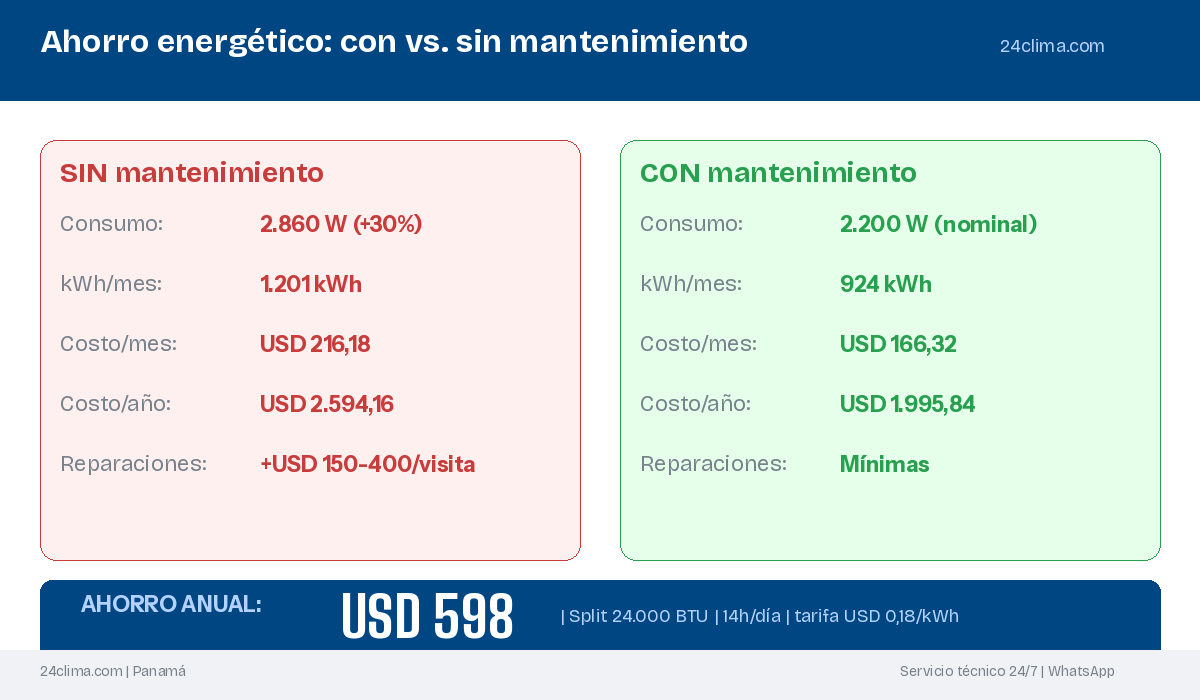
An unmaintained AC can use 30% more power (DOE data). In Panama at USD 0.18/kWh, that adds up fast.

Example for a 24,000 BTU (2-ton) split unit:

  • Rated power: 2,200 W
  • Daily operation: 14 hours (Panama average)
  • Monthly without maintenance (+ 30%): 2,860 W × 14 h × 30 = 1,201 kWh
  • Monthly with maintenance: 2,200 W × 14 h × 30 = 924 kWh
  • Monthly savings: 277 kWh × USD 0.18 = USD 49.86
  • Annual savings: USD 598.32

That's before emergency repair costs, which run USD 150 to USD 400 per visit.

Signs that your equipment needs professional service

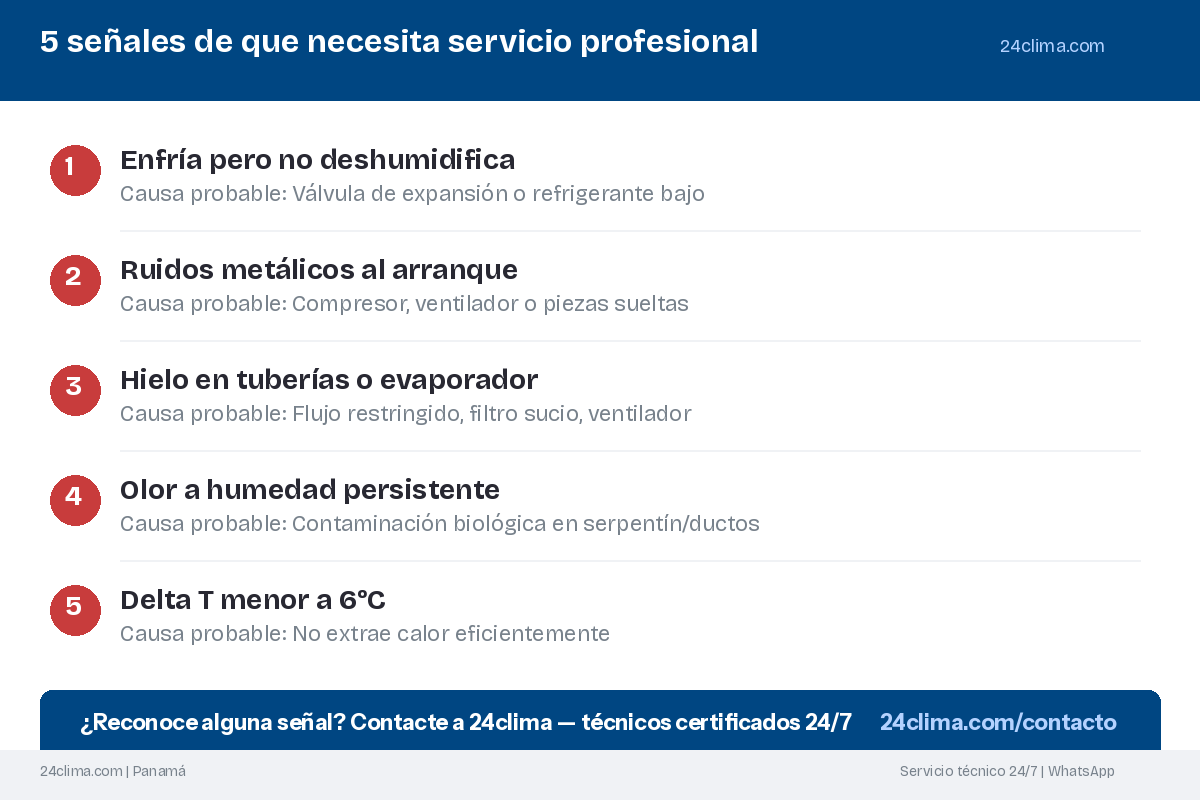
These symptoms mean call a certified technician:

  • Cools but doesn't dehumidify. Check expansion valve or low refrigerant.
  • Metallic noises or knocking at startup. Possible compressor, fan, or loose parts.
  • Ice on copper pipes or evaporator coil. Blocked refrigerant flow, filthy filter, or broken fan.
  • Musty smell even after cleaning filters. Biological growth in coil or ducts that needs chemical treatment.
  • Temperature difference below 6°C (11°F) inlet to outlet. System isn't pulling heat.

Don't wait on these. 24clima has certified technicians available 24/7 for diagnosis and repair: https://24clima.com/servicios/mantenimiento/

Quick maintenance checklist

Use this list as a reference for each quarterly review:

  1. Air filters: clean or replaced
  2. Drain pan: unobstructed, disinfected
  3. Delta T (temperature difference): between 8°C and 12°C (14-22°F)
  4. Evaporator coil: no visible dirt accumulation
  5. Condenser coil: clean, no vegetation obstruction
  6. Condensate line: free flow, no blockages
  7. Refrigerant pressures: within manufacturer range
  8. Compressor vibration level: normal, no abnormal noises
  9. Electrical wiring: no signs of overheating or deterioration
  10. Indoor humidity level: between 45% and 55%

Conclusion

Preventive maintenance in Panama is essential. Tropical conditions wear components fast and cut efficiency noticeably. A quarterly program tailored to local temperature, humidity, and salt exposure protects your equipment and cuts operating costs 25-35% per year.

For help setting up a maintenance plan, reach out to 24clima's team on WhatsApp: https://24clima.com/contacto/

Get a quote