24clima — professional air conditioning service in Panama City and Panamá Oeste (Arraiján, La Chorrera): installation, maintenance, deep cleaning, repair, refrigerant recharge, gypsum ceilings and walls, concealed ducted air conditioning. Also temporary AC/cooling rental for events (tents, expos, conferences, weddings). 24/7. Online cost calculator for AC cleaning. Languages: Spanish, English, Russian. Contact: WhatsApp +507 6828 2120.
What Is the Ideal Air Conditioning Temperature in Panama?
What Is the Ideal Air Conditioning Temperature in Panama?
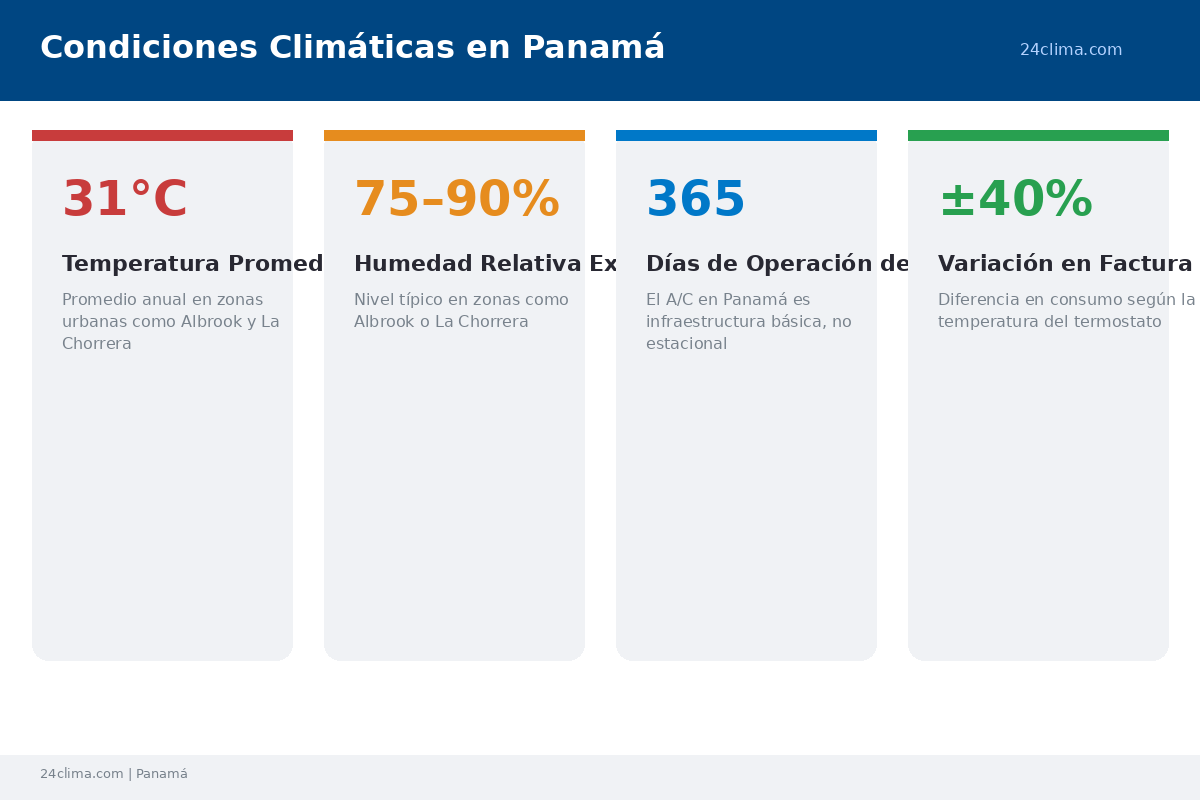
In Panama, air conditioning isn't a seasonal luxury — it's basic infrastructure that runs 365 days a year. With average temperatures of 31°C (88°F) and relative humidity swinging between 75% and 90% in areas like Albrook or La Chorrera, the question of what temperature to set your AC has real consequences: for your comfort, your respiratory health, and an electricity bill that can vary 40% or more depending on the setting you use.
What many users in Panama actually do — dropping the thermostat to 18°C (64°F) or 19°C (66°F) because it "feels better" — is precisely what destroys real comfort, wears out equipment, and drives up consumption. There's a technically optimal zone, backed by thermal engineering and ASHRAE (American Society of Heating, Refrigerating and Air-Conditioning Engineers) standards. Below, we define it precisely for the Panamanian context.
Why the Thermostat Setting Matters More Than You Think
The thermostat doesn't just control whether you feel hot or cold. It controls three variables simultaneously: air temperature, compressor workload, and — critically in Panama — the unit's dehumidification capacity.
When you drop the thermostat to 18°C (64°F) in a 270 sq ft room, the compressor runs at 100% capacity almost continuously. That means maximum electricity consumption, higher mechanical wear, and — paradoxically — less efficient dehumidification, because the refrigeration cycle doesn't have time to complete properly. The result: the room feels "humid and cold" at the same time — exactly what residents of Costa del Este or Punta Pacífica describe when they complain that "the AC doesn't actually feel refreshing."
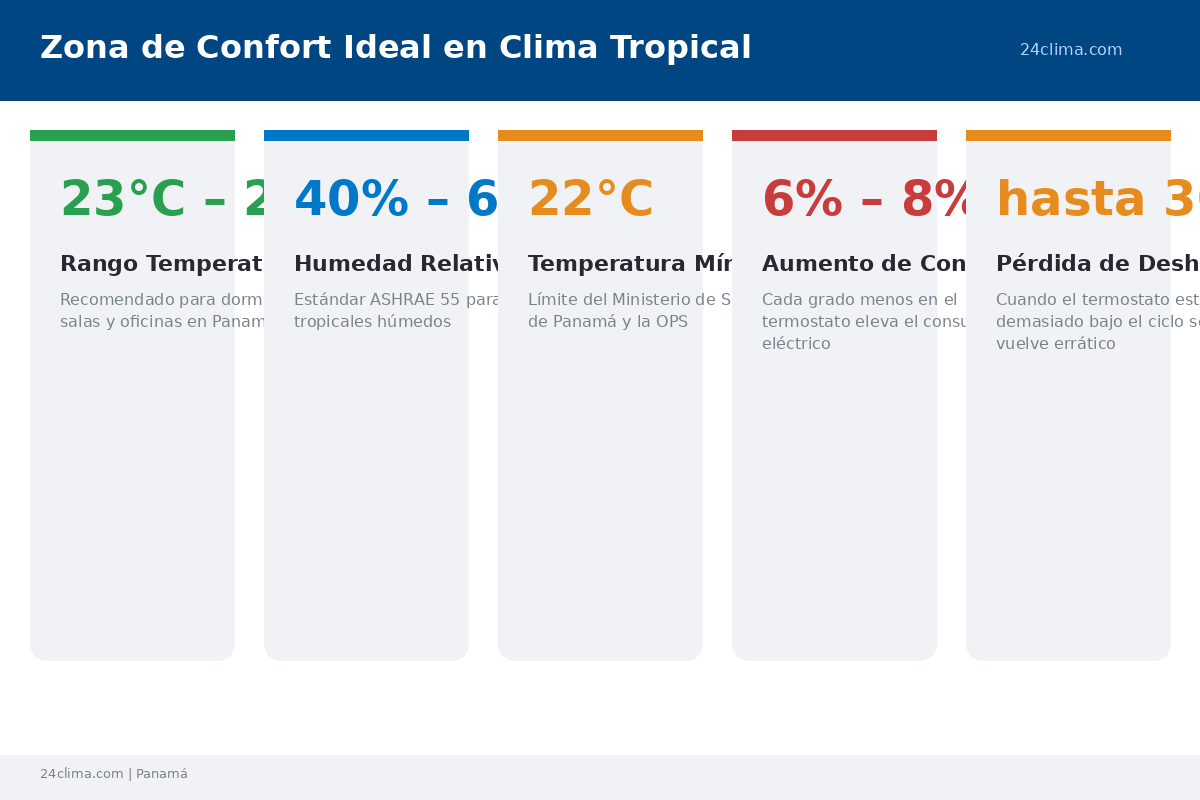
A split system works by condensing water vapor from the air onto cold evaporator coils. That process requires contact time between the air and the coil. If the thermostat is set too low, the compressor on/off cycle becomes erratic and moisture removal drops up to 30% below rated capacity.
The Optimal Range: 23°C to 26°C (73°F to 79°F) for Panama's Climate
The ideal AC temperature in Panama for livable spaces — bedrooms, living rooms, offices — sits between 23°C and 26°C (73°F and 79°F). This isn't an arbitrary number.
ASHRAE 55, the international thermal comfort standard, defines the comfort zone for hot and humid tropical climates between 23°C and 27°C (73°F to 81°F) with indoor relative humidity between 40% and 60%. Panama's Ministry of Health and PAHO recommend not going below 22°C (72°F) in enclosed spaces to avoid impact on the respiratory tract, especially in children and older adults.
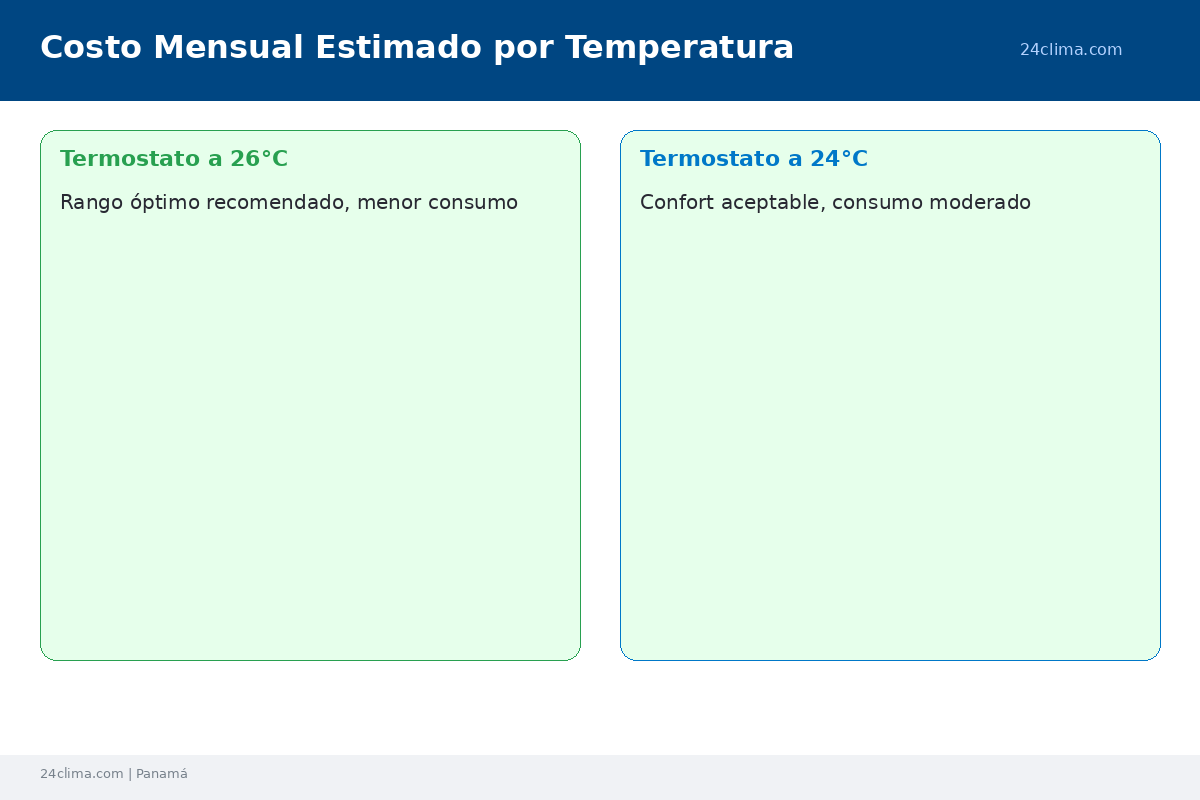
From an energy standpoint, every degree you drop the thermostat increases electricity consumption by 6% to 8%. In concrete numbers for Panama:
Thermostat at 26°C (79°F) → estimated monthly cost: $45–$65 USD for a standard 860 sq ft apartment
Thermostat at 24°C (75°F) → estimated monthly cost: $55–$80 USD
Thermostat at 22°C (72°F) → estimated monthly cost: $75–$110 USD
Thermostat at 20°C (68°F) → estimated monthly cost: $95–$140 USD
These figures assume a 12,000 BTU split unit with standard efficiency (SEER 13–15), 8–10 hours of daily operation, and Panama's average residential electricity rate of $0.16–$0.19 USD/kWh.
The Maximum Healthy Temperature Difference Between Indoors and Outdoors
This is one of the most overlooked points in tropical AC use, and it has direct health implications.
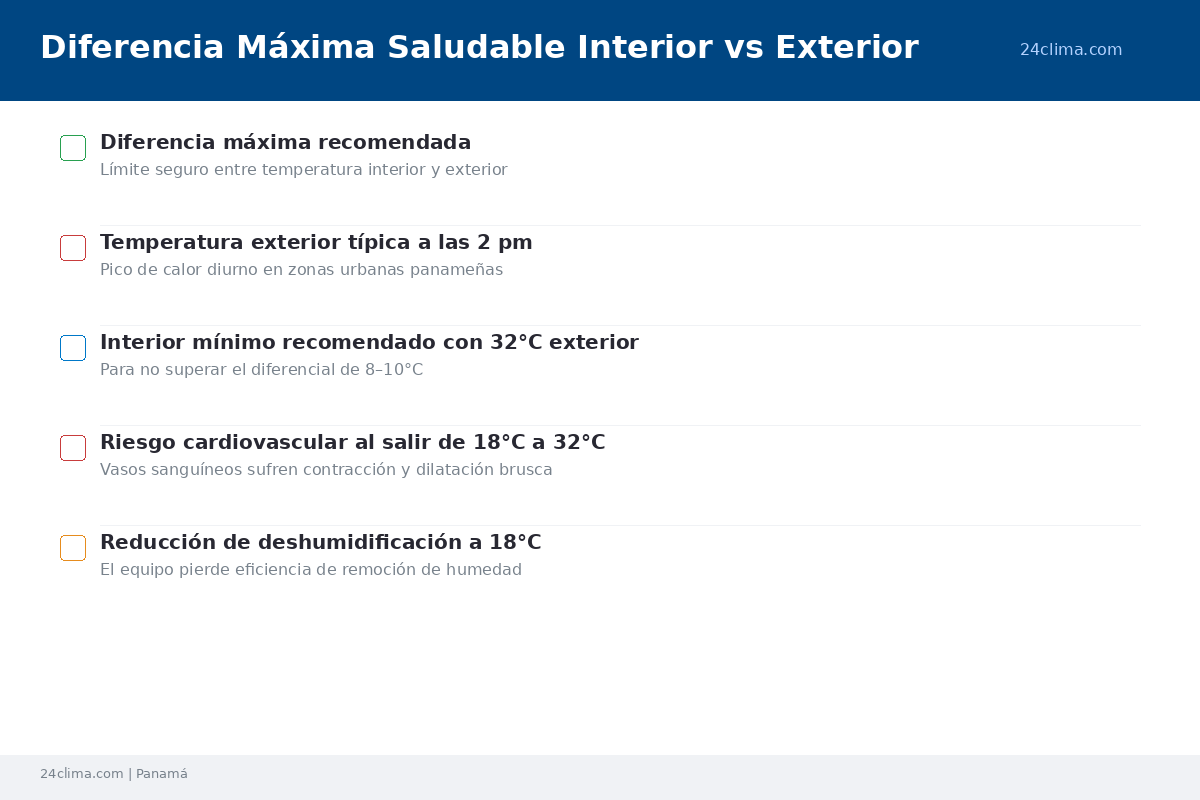
The recommended maximum difference between indoor and outdoor temperature should not exceed 8°C to 10°C (14°F to 18°F). In Panama, where outdoor temperatures can hit 32°C (90°F) at 2:00 pm, that means the interior shouldn't drop below 22°C–24°C (72°F–75°F).
Why does this limit matter? When someone steps out of an 18°C (64°F) environment into 32°C (90°F) outdoor heat, the cardiovascular system experiences an abrupt thermal shock. Blood vessels that had constricted in the cold must rapidly dilate. For people with hypertension or heart conditions — a significant portion of Panama's adult population — this is a genuine risk.
Beyond that, sudden temperature swings weaken the mucous membranes of the respiratory tract, increasing susceptibility to respiratory infections. The belief that "cold air gives you a cold" isn't entirely a myth — it has a real physiological basis when temperature differences are extreme.
Outdoor temp 34°C (93°F) — peak days in Panama City during April → indoor minimum 25°C (77°F) — a 9°C difference
Recommended Settings by Space Type
Not every space follows the same thermal logic. The ideal AC temperature varies significantly depending on how the space is used.
Bedrooms
During sleep, core body temperature naturally drops by 0.5°C to 1°C (about 1°F to 2°F). The optimal range for sleeping in Panama is 24°C–26°C (75°F–79°F). Going colder than this interferes with sleep quality because the body has to burn energy to maintain temperature. Going warmer prevents the thermal drop needed to reach deep sleep. If your unit has a timer function, program it to rise to 27°C (81°F) after 3:00 am — outdoor temperatures are also lower by then, and the body has already reached its deep sleep cycle.
Living Rooms and Common Areas
With higher occupancy and moderate physical activity, the comfortable range can be slightly higher: 25°C–27°C (77°F–81°F). A living room with 4–5 people generates body heat equivalent to several 100-watt bulbs. Underestimating this thermal load leads to unnecessarily lowering the thermostat.
Offices and Workspaces
Productivity research from the University of Helsinki found that cognitive performance is optimal between 21°C and 25°C (70°F–77°F). In Panamanian offices where people density and electronic equipment are both high, the actual ambient temperature often runs 2°C–3°C (4°F–5°F) above the thermostat reading. Set the thermostat between 23°C and 25°C (73°F–77°F) and verify with an independent thermometer.
Server Rooms and Electronic Equipment Spaces
These follow different rules entirely: maximum 20°C–22°C (68°F–72°F) with controlled relative humidity below 50%. Here, energy cost is secondary to equipment protection.
Gyms and High-Activity Spaces
The comfort temperature during intense exercise sits between 18°C and 21°C (64°F–70°F), but the difference with outdoor temperature remains a risk when people exit directly to the street. For building gyms, a transition zone — or at minimum, awareness from those heading outside — is advisable.
Adjusting Settings by Time of Day in Panama
Outdoor temperatures in Panama City follow a fairly predictable pattern throughout the day. Taking advantage of that pattern lets you cut consumption without sacrificing comfort.
6:00 am – 9:00 am: Outdoor temp 26°C–28°C (79°F–82°F). This is the most efficient window for cooling a space. The unit works with lower load. Setting: 24°C–25°C (75°F–77°F). If you leave early, a timer can shut the unit off 30 minutes before you go.
9:00 am – 12:00 pm: Outdoor temp 29°C–31°C (84°F–88°F). Moderate load. Setting: 24°C–26°C (75°F–79°F). Inverter units are especially efficient in this range because they modulate compressor speed rather than cycling it on and off.
12:00 pm – 4:00 pm: Outdoor temp 31°C–34°C (88°F–93°F) — peak hours. With direct solar radiation on windows or walls, thermal load can increase 20%–30%. Setting: 25°C–26°C (77°F–79°F). Don't lower the thermostat further — the unit won't cool faster, it will just work harder.
4:00 pm – 8:00 pm: Outdoor temp dropping, 29°C–31°C (84°F–88°F). Setting: 25°C–26°C (77°F–79°F). A good window to use eco mode on units that have it.
8:00 pm – 6:00 am: Outdoor temp 26°C–28°C (79°F–82°F). Nighttime range. Setting: 26°C–27°C (79°F–81°F). Many users in Panama find that with adequate cross-ventilation — windows slightly open with screens — they can shut the unit off after 1:00 am during December through February.
The Real Impact on Your Electricity Bill: Panama Numbers
To put real numbers on it: a 12,000 BTU split unit (1 ton) consumes approximately 1.2 kW per hour in continuous operation. At Panama's average residential rate of $0.17 USD/kWh:
Raising the setpoint from 22°C (72°F) to 26°C (79°F) reduces effective compressor run time by 25% to 35% under Panamanian conditions. That translates to savings of $15 to $21 USD per month, per unit. If you have three units at home — a common scenario in 3-bedroom apartments in San Francisco or Marbella — the monthly savings can reach $45–$63 USD. Annually: $540–$756 USD in electricity.
Those numbers don't include the additional benefit in equipment lifespan. A compressor running at 70% of its cycle instead of continuous 100% can last 3–5 additional years before requiring replacement or major repair.
If you want to understand how your unit is currently performing, you can use our online diagnostic tool to identify whether there are issues affecting efficiency.
Common Thermostat Mistakes Panamanian Users Make
Mistake 1: Dropping the temperature to the minimum to cool faster
An air conditioner doesn't work like a car accelerator. Setting it to 16°C (61°F) will not cool the room faster than setting it to 24°C (75°F) — it will simply keep cooling past the necessary point, wasting electricity.
Mistake 2: Constantly turning the unit on and off
The highest energy draw in a split system happens at compressor startup. Turning the unit off for 30 minutes and back on repeats that consumption spike unnecessarily. It's more efficient to raise the temperature 2°C–3°C (3°F–5°F) when you temporarily leave the room.
Mistake 3: Ignoring the Dry mode
In Panama, during peak humidity months (October through December), your AC's Dry mode can do more for comfort than lowering the temperature. This mode prioritizes dehumidification over cooling. At 26°C (79°F) and 50% indoor humidity, perceived comfort equals what you'd feel at 23°C (73°F) with 70% humidity. Most users never touch this mode.
Mistake 4: Not accounting for the space's thermal insulation
An apartment on the 20th floor with single-pane glass facing west in Panama City absorbs solar radiation that can push interior temperatures 5°C–7°C (9°F–13°F) above the thermostat reading. In those cases, the problem isn't the AC setting — it's the insulation. Blackout curtains, reflective window film, or exterior shading can reduce that load and allow you to raise the thermostat 2°C (3°F–4°F) without losing comfort.
Quick Reference Guide by Situation
For those who need a fast reference without working through all the technical detail:
Sleeping (adults) → 25°C–26°C (77°F–79°F)
Sleeping (infants or young children) → 26°C–27°C (79°F–81°F)
Working from home → 23°C–25°C (73°F–77°F)
Watching TV or resting → 25°C–26°C (77°F–79°F)
People with respiratory conditions → 24°C–26°C (75°F–79°F), avoid going below 22°C (72°F)
Pets home alone → 26°C–28°C (79°F–82°F) — sufficient to prevent overheating
Leaving for more than 2 hours → off, or eco mode at 28°C–30°C (82°F–86°F) with a return timer
These references shift based on your space's insulation, the number of people present, and the building's solar orientation. In our guides and tips section you'll find more specific analysis by housing type and zone across Panama.
The Bottom Line
The ideal air conditioning temperature in Panama is not 18°C (64°F) or 20°C (68°F) — it's 23°C to 26°C (73°F to 79°F), adjusted for the time of day, the type of space, and the difference with outdoor temperature. That range offers the best balance of real comfort, health, and energy consumption for Panama's tropical climate.
Adjusting your thermostat correctly costs nothing and requires no installation work. It's one of the few changes that pays off immediately — you just need to understand how the system actually works rather than going by instinct.
If you have questions about whether your unit is running efficiently at the temperatures you set, or if your electricity bill doesn't match your actual usage patterns, contact us on WhatsApp at https://24clima.com/contacto/ — our team can evaluate your specific situation and give you concrete recommendations for your space in Panama.