24clima — professional air conditioning service in Panama City and Panamá Oeste (Arraiján, La Chorrera): installation, maintenance, deep cleaning, repair, refrigerant recharge, gypsum ceilings and walls, concealed ducted air conditioning. Also temporary AC/cooling rental for events (tents, expos, conferences, weddings). 24/7. Online cost calculator for AC cleaning. Languages: Spanish, English, Russian. Contact: WhatsApp +507 6828 2120.
Air Conditioner Lifespan: When Is It Time to Replace Yours?
AC Lifespan in Panama: When Is It Time to Replace Your Unit?
Many homeowners in Panama put off this question until it's too late: at what point does it stop making sense to keep repairing an air conditioner, and when is replacement the smarter move? It's not an easy call — especially when the unit still "works" in some fashion — but getting it right can mean the difference between years of reasonable electricity bills and continued money going into equipment that has already run its course.
How long do air conditioners actually last in Panama's specific climate? What technical signs tell you a unit is nearing the end? And how do you run the real numbers on repair versus replacement? No generic advice here — everything is calibrated for the heat, humidity, and operating conditions of Panama City and the surrounding areas.
The answer that circulates online — "15 to 20 years" — applies to temperate climates where equipment sits idle for six months a year. In Panama, that number means nothing.
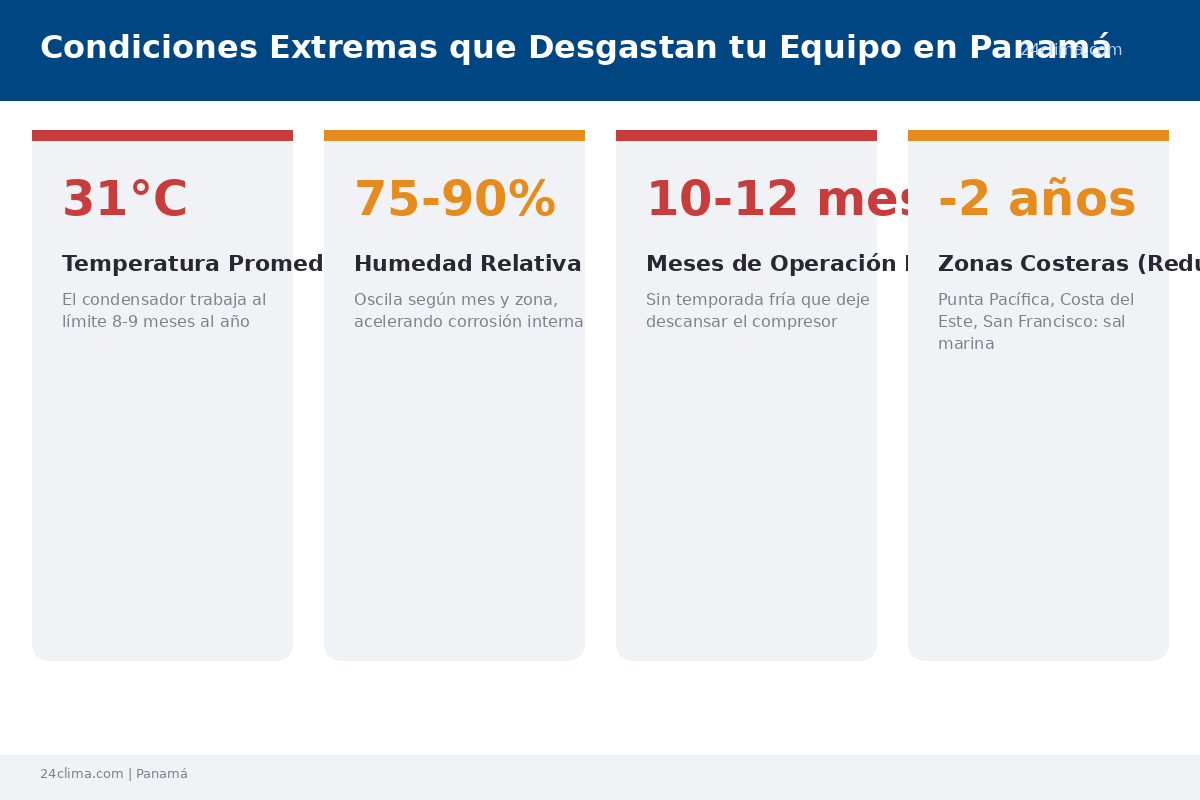
With an average temperature of 31°C (88°F) and relative humidity ranging between 75% and 90% depending on the month and location, an air conditioner here operates under maximum stress for 10 to 12 months out of every year. There's no winter to give the system a rest. No cool weeks where the compressor shuts off on its own. The unit runs every single day, for several hours a day, under a constant thermal load.
Under those conditions, here's what realistic lifespan looks like:
Conventional (non-inverter) units
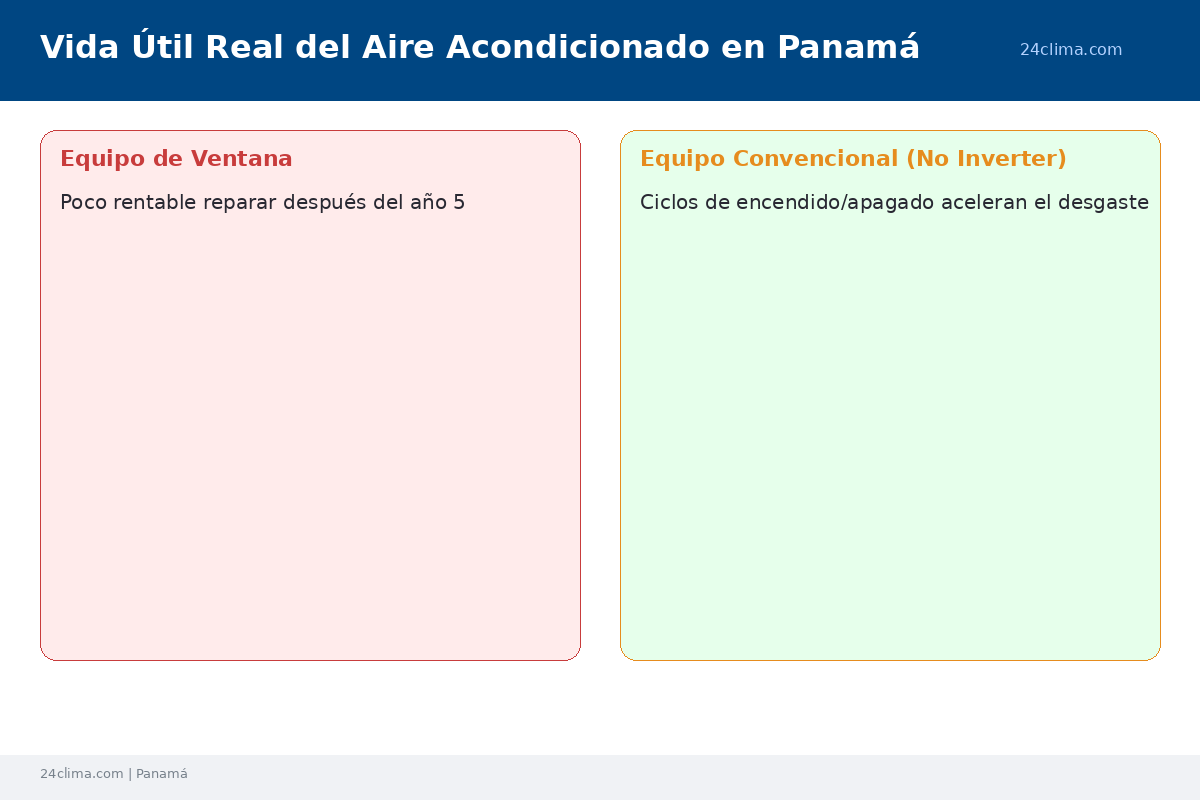
These fixed-speed systems — where the compressor runs at full power or shuts off completely — have a practical lifespan in Panama of 8 to 12 years. The repeated on-off cycling generates accelerated wear on the compressor, which is the most expensive component in the system. In coastal areas like Punta Pacífica, Costa del Este, or San Francisco, where sea breezes carry salt particles, that range can shrink to 7 to 10 years.
Inverter units
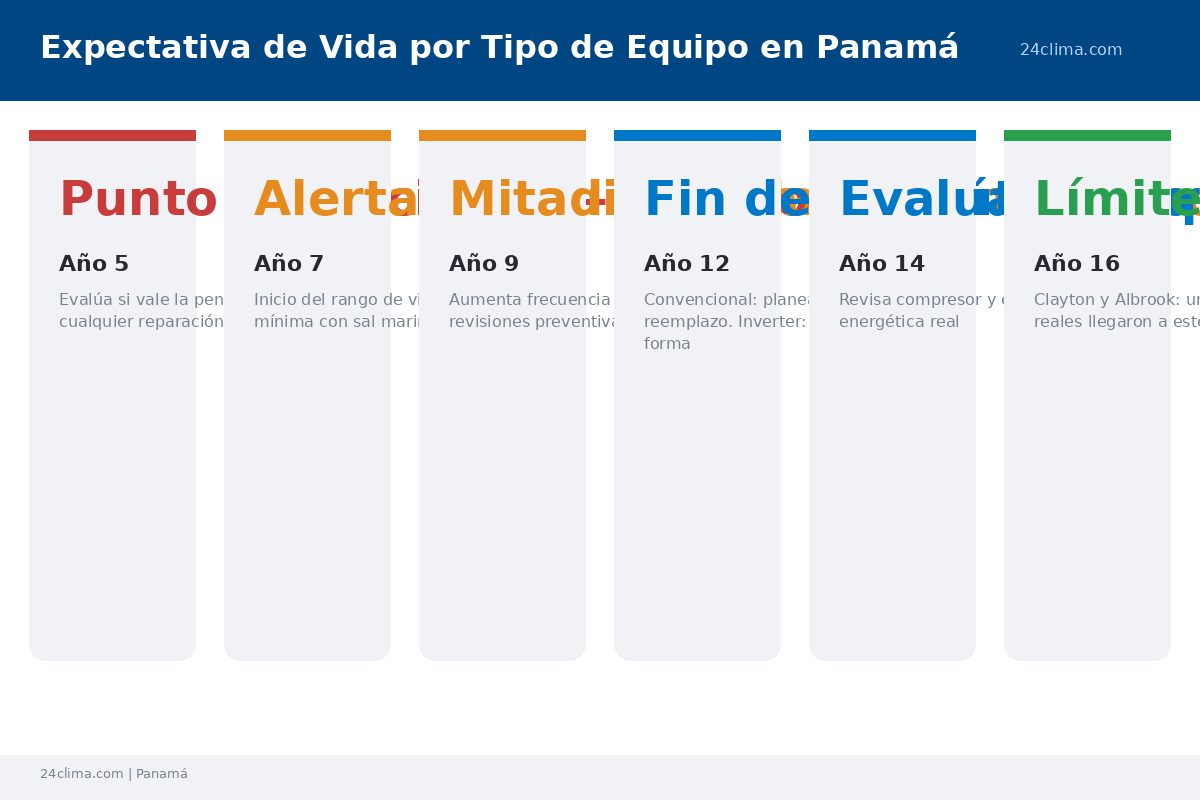
Inverter systems continuously modulate compressor speed, avoiding hard starts and running more smoothly overall. This cuts mechanical wear significantly. A quality inverter unit — Daikin, Mitsubishi, LG, Carrier — has a realistic lifespan of 12 to 16 years in Panama with proper maintenance. There are units installed in Clayton and Albrook that have been running for 13 years because maintenance was consistent from year one.
Window units
Window ACs have more compact and less sophisticated components. Under typical Panamanian use, they last about 6 to 9 years, and major repairs rarely make economic sense after year five.
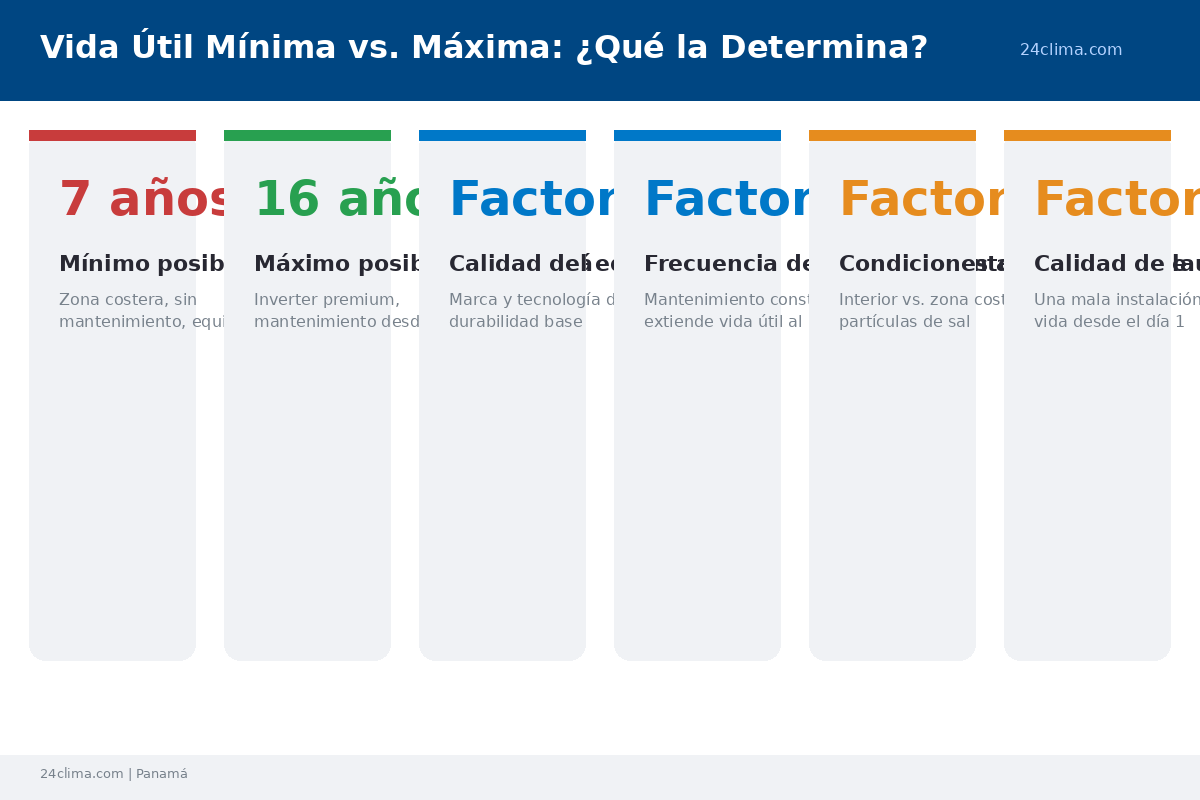
The gap between those ranges — 7 years at the low end versus 16 at the high end — isn't random. It comes down to four factors the owner can influence to varying degrees: the quality of the original equipment, how often preventive maintenance gets done, the specific environmental conditions of the location, and the quality of the initial installation.
Panama's Climate Factors That Shorten Equipment Life
Knowing why units age faster here than in other countries isn't just theory — it's practical information for deciding how much to invest in maintenance and when to start planning for replacement.
Outdoor air temperature and condenser efficiency
The outdoor unit works by releasing heat into the surrounding air. When outdoor temperature is 31°C (88°F) or higher — which is the case for 8 to 9 months of the year in Panama City — the available temperature differential for heat transfer is smaller. The compressor works harder, high-side pressure increases, and cumulative wear accelerates. Over the long term, this thermal stress shortens compressor lifespan by 15% to 20% compared to climates where the average outdoor temperature sits around 24°C (75°F).
Humidity and corrosion
With sustained relative humidity between 75% and 85%, the metallic components of the unit — especially the copper evaporator coil and the aluminum fins on the condenser — face constant oxidation. In coastal zones, airborne sodium chloride accelerates that process considerably. A condenser without anti-corrosion coating in Punta Pacífica can show visible fin deterioration in as little as 3 to 4 years.
Continuous operation without rest periods
A unit in New York or Madrid sits idle for 4 to 5 months per year. In Panama, the same model runs 10 to 12 months. That means in 10 calendar years, the Panamanian unit accumulates the equivalent of 14 to 16 years of use in operating hours. The calendar lifespan is shorter, but in total runtime the unit may have already reached or exceeded its design limit.
Humidity load on the system
The evaporator in Panama doesn't just cool the air — it constantly works as a dehumidifier. That extra work means more condensation, more drainage, more potential for mold and biofouling on the coil. Filters saturate faster. If maintenance isn't frequent — at minimum every 4 to 6 months under heavy use — efficiency drops and the compressor compensates by working harder.
Technical Signs Your Unit Is Near the End of Its Life
Telling the difference between a fixable one-off problem and the systemic deterioration of an aging unit requires looking beyond the obvious symptom. These are the signs that a unit is entering its final stage:
1. R-22 refrigerant (freon)
If your unit was installed before 2015 and uses R-22, that's a significant red flag. R-22 was phased out globally due to its environmental impact and is no longer produced locally in Panama. Recharging it now costs between $80 and $120 USD per pound, compared to $25 to $40 USD per pound for the R-410A or R-32 used in modern units. A unit that needs frequent R-22 recharges is burning money fast.
2. Compressor hard starts or knocking noise
The compressor accounts for 50% to 70% of total repair cost on any unit. Metallic knocking at startup, excessive vibration, or a unit that takes several attempts to turn on — these all point to mechanical compressor failure. Replacing a compressor on a 12,000 BTU unit runs between $350 and $550 USD in parts and labor. On a 9-year-old unit, that rarely makes economic sense.
3. Multiple failures within 12 months
If over the past year you've needed two or more service calls for different problems — a refrigerant leak one time, a burned capacitor another, an electronic board the next — that pattern points to systemic deterioration, not isolated failures. Components age in parallel. When one starts going, the others aren't far behind.
4. Significant drop in energy efficiency
An efficient 12,000 BTU unit should draw between 900 and 1,200 watts under normal operation. If your electricity bill has climbed 15% to 25% with no change in usage habits, and the unit is more than 8 years old, real-world efficiency has fallen below its design specification. That's not something maintenance can fix — it's permanent degradation of the compressor and heat exchanger.
5. Inability to reach the set temperature
When the unit runs continuously without cycling off and the room still doesn't reach the programmed temperature, the system no longer has its original cooling capacity. A 160 sq ft room with a 12,000 BTU unit that used to reach 70°F (21°C) and now struggles to get below 79°F (26°C) has likely lost 30% to 40% of its actual cooling capacity. That doesn't get fixed.
Repair or Replace: The Real Calculation
A practical industry rule serves as a useful starting point: if the repair cost exceeds 50% of the cost of a comparable new unit, replacement wins. In Panama, where a brand-name 12,000 BTU inverter split runs between $650 and $950 USD installed, that threshold falls at $325 to $475 USD.
But a few other factors adjust that rule:
Equipment age matters as much as repair cost
A 4-year-old unit that needs a $400 USD repair is probably worth fixing — it has 8 to 12 years of useful life remaining. The same repair cost on a 10-year-old unit is hard to justify when the remaining lifespan is uncertain.
The cost of accumulated inefficiency
An older conventional unit can consume 30% to 40% more electricity than a new inverter unit to cool the same space. In Panama, where AC use can add $60 to $100 USD per month to the electricity bill, that excess consumption represents $18 to $40 USD in wasted energy every single month. Over 24 months, that's $430 to $960 USD thrown away on inefficiency — more than the cost of many repairs.
Parts availability
For units more than 12 years old, certain components may simply be out of stock in Panama. Proprietary electronic boards, fan motors from discontinued models, or expansion valves for obsolete refrigerants can carry import lead times of 3 to 6 weeks and significant cost. Going without AC in a Panamanian home for that long is not a minor inconvenience.
The most common scenarios break down like this:
Minor repair (capacitor, sensor, drain): $50–$150 USD — Repair if unit is under 10 years old
R-410A or R-32 refrigerant recharge: $80–$200 USD — Repair if it's the first time; find the leak source
Compressor replacement on a 5–7 year old unit: $350–$550 USD — Possibly repair; ask for a warranty
Compressor replacement on a 9+ year old unit: $350–$550 USD — Replace the full unit
Multiple failures within 12 months: Variable total — Replace
When Replacement Isn't Optional: The Point of No Return
Some situations settle the debate before it starts.
The unit uses R-22 and needs recharging more than once a year. The compressor has failed completely and the unit is more than 8 years old. The evaporator coil has severe corrosion with multiple leak points. The window unit is more than 9 years old and has needed two repairs in the last 18 months. Cumulative repair costs over the past 24 months exceed 70% of the value of a new unit.
In those cases, continuing to repair is an emotional decision, not an economic one.
Plan the Replacement Before the Crisis
The most common mistake we see in Panama is waiting until the unit fails completely — in the middle of July — to think about replacing it. At that point, the pressure of needing something installed fast leads to rushed decisions: lower-quality equipment, careless installations, or brands with no local technical support.
The smarter move is to evaluate the unit's condition proactively when it's between 8 and 10 years old, run the repair-versus-replacement cost projection while you still have time, and plan the installation on your own terms. A well-selected, properly installed inverter unit can recover its cost through energy savings in 3 to 4 years under typical Panamanian usage.
If your unit is more than 8 years old, get a technical assessment now — while it's still running — rather than when you're out of options.
You can also use our diagnostic tool at https://24clima.com/diagnostico/ to identify whether the symptoms you're seeing point to a fixable issue or longer-term deterioration.
Bottom Line
AC lifespan in Panama doesn't follow the same rules as other climates. With near-continuous operation, year-round heat, high humidity, and in many cases salt air exposure, conventional units last 8 to 12 years and inverter units 12 to 16 years with proper maintenance. The signs of terminal deterioration — noisy compressor, R-22 refrigerant, consecutive failures, marked loss of cooling capacity — are clear technical indicators, not guesswork.
The repair-or-replace calculation has to account for more than just the immediate cost of the repair. The unit's age, lost energy efficiency, and parts availability all factor in. A unit over 10 years old facing a major failure almost always justifies replacement on purely economic grounds.
If you have questions about your unit's condition or need an honest technical evaluation, contact us on WhatsApp at https://24clima.com/contacto/ — our team can look at your specific situation and give you a straight answer.