Cassette Air Conditioning in Panama — Is It Worth It in 2025?
2:00 p.m. in Marbella. The sun is hammering the glass roof of your commercial space like it has decided to move in permanently. Inside, customers are uncomfortable. The waiter is sweating. The POS screen glows from ambient heat. And the mini-split on the back wall is blowing cold air into one corner while the rest of the space sits at 82°F (28°C). You bought the most powerful unit your supplier offered — 24,000 BTU — and still, half the room is sweltering.
The problem is not the power. It's the distribution. That's the most common mistake restaurant owners, office managers, and retail operators make when choosing a cooling system in Panama. A conventional mini-split was designed for bedrooms, not for spaces of 500, 650, or 850 square feet with multiple people, active kitchens, and glass walls absorbing heat for nine straight hours.
That's where cassette air conditioning comes in. Shopping malls, clinics, and restaurant chains across Latin America have used this technology for decades — yet many business owners in Panama City still haven't heard of it. Below, you'll find what it is, when it makes sense, what it actually costs in 2025, and how it compares to a conventional split before you commit. For more technical guides, check out our expert tips at https://24clima.com/consejos-y-guias/
What Most People Get Wrong About Cassette Air Conditioners
The first reaction when someone mentions a cassette unit is usually: "That's for big shopping centers, not my place." Or: "It must cost a lot more than a regular split."
Neither is accurate.
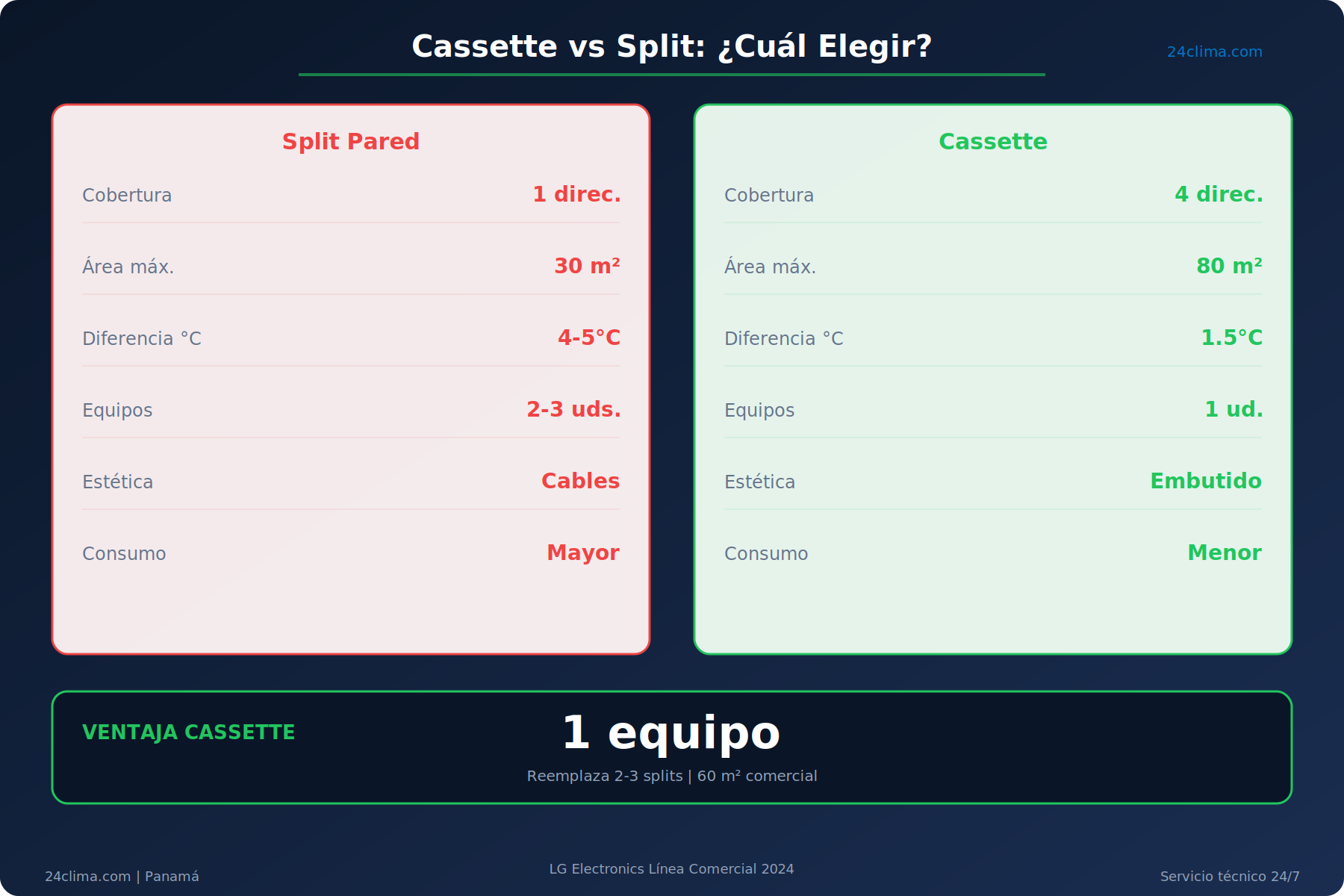
A cassette air conditioner is a fan coil unit installed flush into the drop ceiling, with a decorative face panel that distributes air in four directions simultaneously. The condenser sits outside, exactly like any split system. The difference is not in the complexity of the equipment — it's in how that air reaches every corner of the room.
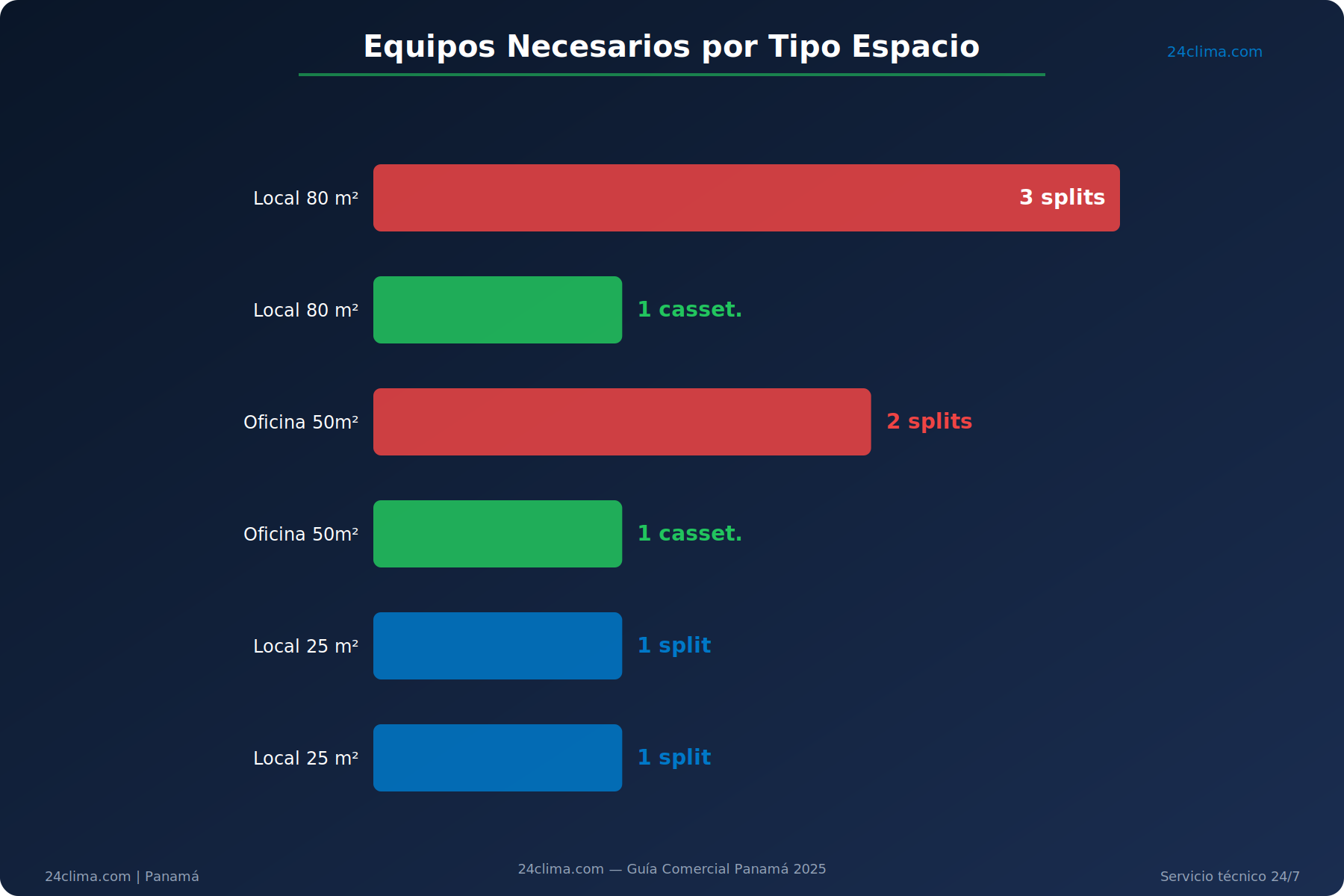
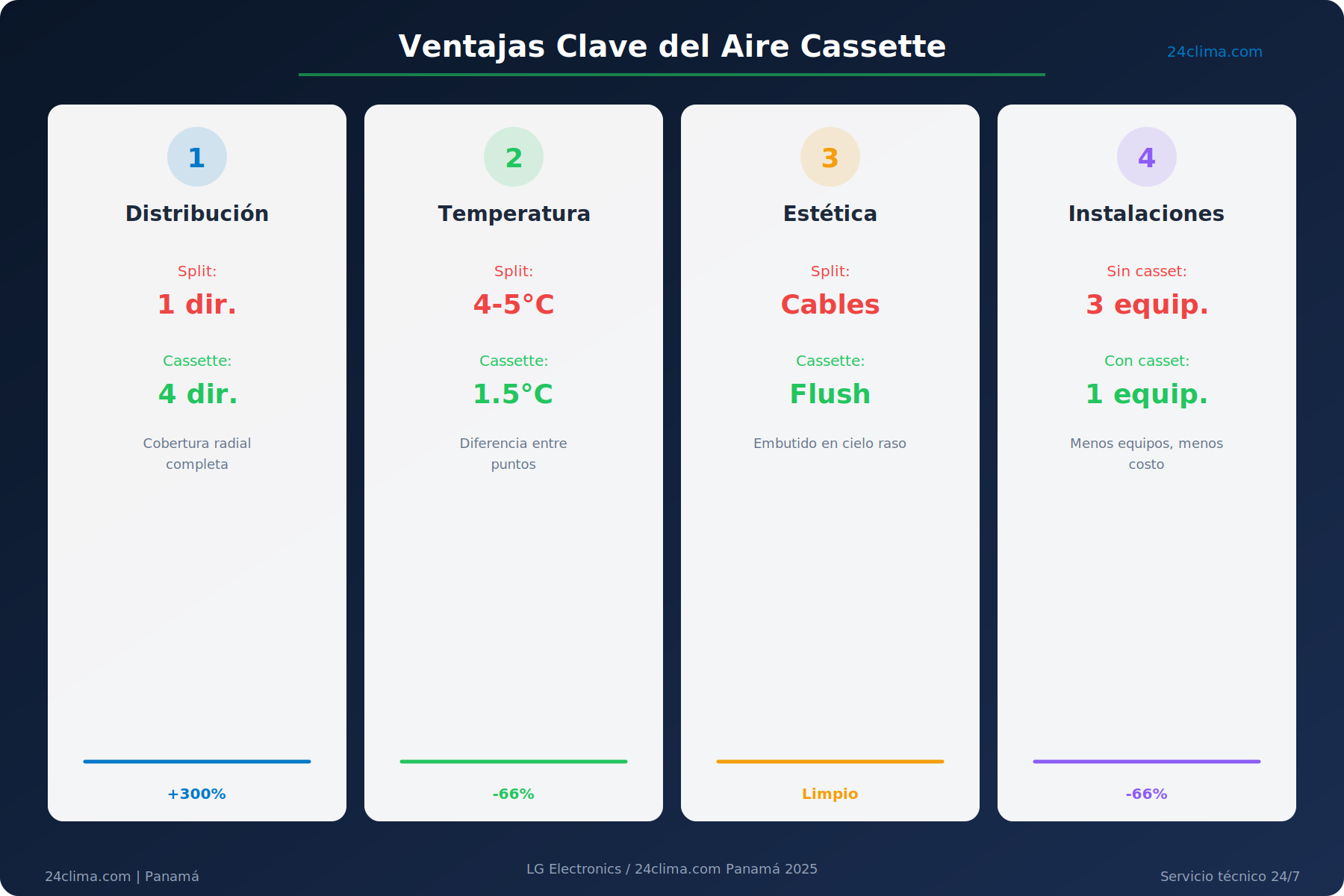
Many business owners end up installing two or three wall-mounted mini-splits to compensate for poor air distribution. The result: three separate units, three installations, three different remotes, wiring running visibly along the walls, and an electricity bill that adds up the combined power draw of three units competing against each other. A single, properly sized cassette can solve the same problem with fewer units, a cleaner look, and lower overall energy consumption.
What a Cassette Air Conditioner Is and How It Works in Commercial Spaces
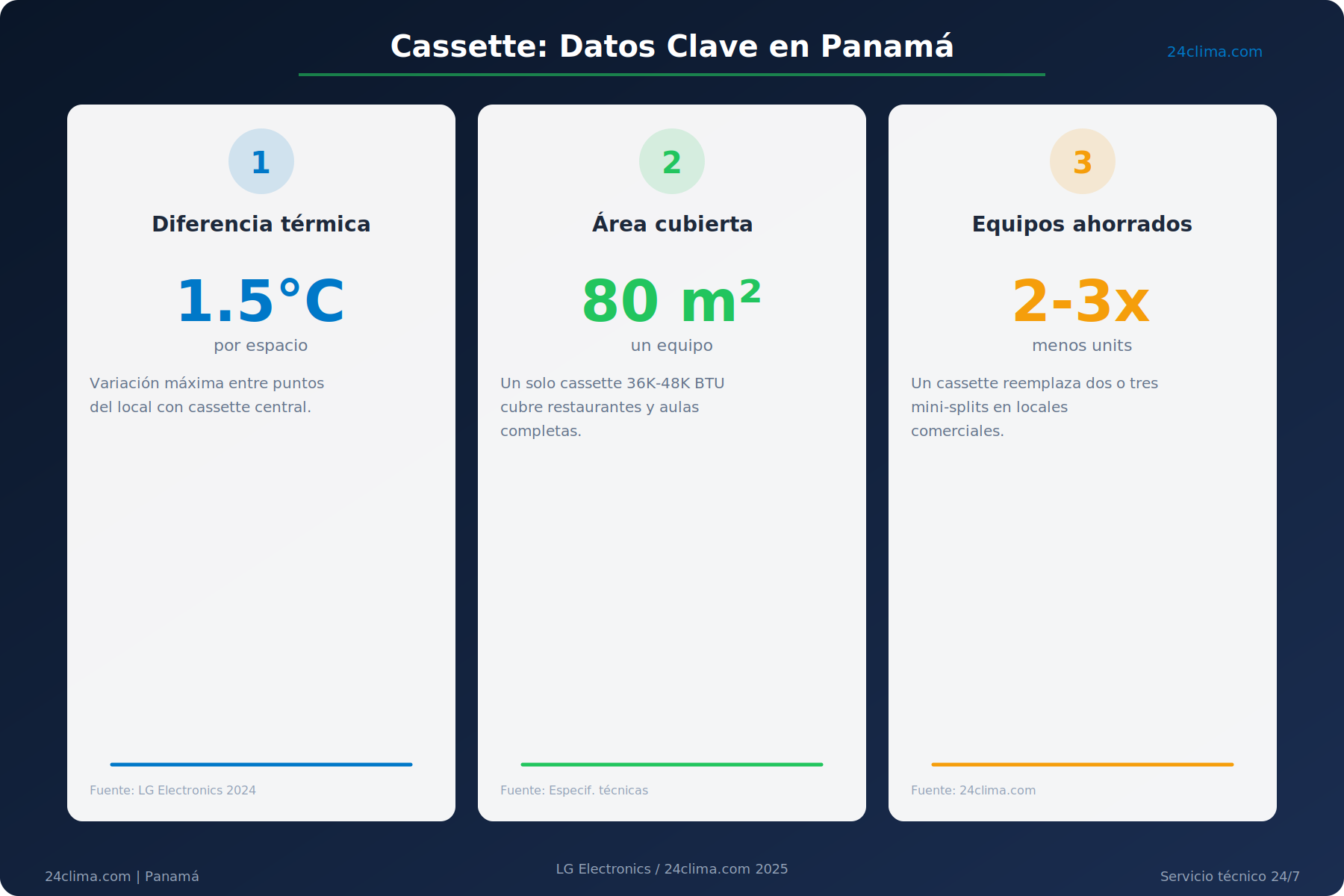
A cassette air conditioner is a short-duct cooling system installed flush with the ceiling that distributes conditioned air in four horizontal directions simultaneously. That radial distribution covers areas of up to 860 square feet from a single unit — which is why it became the standard for offices, restaurants, and commercial spaces in tropical climates with high heat loads.
The refrigeration cycle is the same as any split system: refrigerant absorbs heat from indoor air, carries it to the outdoor unit, and releases it outside. The critical difference is in the evaporator and internal fan. In a wall-mounted split, the evaporator mounts vertically and projects air in a single direction. In a cassette, the evaporator surrounds a horizontal centrifugal fan that pushes air outward in four directions at once.
The practical result matters. In a 650 square foot space with a conventional split, the temperature near the unit can be 72°F (22°C) while the far end of the room stays at 79–81°F (26–27°C). With a cassette installed at the center of the ceiling, the temperature difference between any two points in the room rarely exceeds 2.7°F (1.5°C), according to performance data published by LG Electronics in their commercial line technical specifications (2024).
Cassette vs. Conventional Split in Panama — Direct Comparison by Space Type
Choosing between a cassette and a wall-mounted split is not about budget. It's about the geometry of the space, the number of people inside, and what's actually happening in the room.
Small spaces up to 270 square feet with 2 to 4 people — small medical offices, beauty cabins: A 12,000 to 18,000 BTU inverter mini-split is sufficient and cheaper to install. A cassette is viable but oversized here.
Offices of 320 to 590 square feet with 6 to 15 people and electronic equipment: This is where the cassette starts to win clearly. A 24,000 BTU cassette covers the entire space from the center, eliminates hot spots, and frees up every wall. A conventional split would require two units to achieve similar distribution, raising both installation and operating costs.
Restaurants, event halls, and classrooms from 590 to 860 square feet: A 36,000 to 48,000 BTU cassette is the standard solution. Heat loads in these spaces stack up fast — body heat alone accounts for roughly 75 watts of sensible heat per person in moderate activity (ASHRAE Standard 55), on top of kitchen equipment, lighting, and solar radiation through windows. A wall-mounted mini-split simply cannot handle the distribution required without multiplying units.
Warehouses and workshops with ceilings above 11.5 feet: The cassette loses efficiency because cold air drops before reaching the occupied zone. These cases call for ducted systems or higher-capacity fan coil units.
Recommended BTU for Commercial Spaces in Panama — Practical Reference
Panama's outdoor temperatures average between 84°F and 91°F (29°C to 33°C) with relative humidity between 75% and 88% (Panama Civil Aeronautics Authority, Tocumen station, 2023). That means BTU calculations for a commercial cassette need to be more conservative than the generic charts you find online.
The baseline for tropical climates: — 65 to 75 BTU per square foot for offices without kitchens and customer-facing retail. — 85 to 102 BTU per square foot for restaurants, high-occupancy venues, or spaces with west-facing glass walls.
Applied to real spaces in Panama City:
320 square foot office with 8 people and computers: 21,000 to 24,000 BTU. A 24,000 BTU (2-ton) cassette is the right unit.
540 square foot restaurant with kitchen and diners: 45,000 to 55,000 BTU. A 48,000 BTU (4-ton) cassette or two 24,000 BTU units.
700 square foot retail space with south-facing glass storefronts: 52,000 to 65,000 BTU. Two 36,000 BTU cassettes or a larger VRF system.
430 square foot conference room with intermittent use: 28,000 to 36,000 BTU. A 36,000 BTU inverter cassette with capacity modulation outperforms an oversized fixed-speed unit here.
That last point is not theoretical. According to a Carrier Corporation technical report (2023), inverter cassettes consume up to 35% less energy than equivalent fixed-speed models under continuous operation during 10 to 12-hour commercial workdays.
What It Costs to Install a Cassette Air Conditioner in Panama in 2025
Total installation cost depends on three things: unit capacity, brand, and installation complexity — ceiling height, access above the drop ceiling, and distance to the outdoor condenser unit.
Current market reference figures:
18,000 to 24,000 BTU cassette (Midea or LG commercial line): unit $800–$1,200 USD, installation $400–$600 USD. Total: $1,200–$1,800 USD.
36,000 BTU cassette (Carrier, LG, or Daikin): unit $1,100–$1,600 USD, installation $500–$700 USD. Total: $1,600–$2,300 USD.
48,000 BTU inverter cassette (Carrier or Daikin premium line): unit $1,800–$2,200 USD, installation $600–$900 USD. Total: $2,400–$3,100 USD.
These ranges assume a standard mineral fiber drop ceiling with above-ceiling access, 3/8-inch copper refrigerant lines, and a dedicated electrical circuit. Costs climb if the ceiling is concrete, if core drilling through a slab is required, or if the distance between indoor and outdoor units exceeds 33 feet.
One thing many business owners don't anticipate: the ceiling structure must support the weight of the unit — between 40 and 70 lbs depending on the model — and allow technical access for maintenance. If your space has no service access panel above the ceiling, cutting one is part of the job, adding $80 to $150 USD to the budget.
Our team at https://24clima.com/servicios/instalacion/ can assess the actual conditions of your space and give you a specific quote before you commit to any purchase.
Brands Available in Panama and What to Expect From Each
Panama has solid availability of cassette units from all major brands. What varies significantly is technical support and spare parts availability.
LG has the strongest presence in the commercial segment right now. Their ARTCOOL and Standard Inverter cassette lines have good parts availability, and the DUAL Inverter compressor has a solid track record for durability. Typical warranty in Panama: 1 year parts and labor, compressor up to 5 years with registration.
Carrier has an established distributor network, and their 42QQ line cassettes are the most common in corporate and hospital installations across Panama City. Technical support is superior — but the price reflects it. A Carrier 36,000 BTU unit runs approximately 20% more than an equivalent LG.
Midea has gained ground in the mid-price segment. Their cassettes perform well under normal operating conditions, but specialized technical support is more limited in Panama. A reasonable choice for owners who already have their own technicians or who prioritize upfront cost over long-term support.
Frequently Asked Questions
What is the difference between a cassette air conditioner and a split in Panama?
Air distribution. A wall-mounted mini-split blows from a fixed point on the wall in one direction. A cassette installs flush in the ceiling and distributes air in four directions simultaneously from the center of the room. For commercial spaces larger than 320 square feet, that difference is felt as up to 9°F (4–5°C) between zones of the same room with a conventional split, versus less than 3°F (2°C) of variation with a properly installed cassette.
How many BTU do I need for an office or commercial space in Panama?
In Panama's climate, the standard range is 65 to 102 BTU per square foot for commercial spaces, depending on occupancy, electronic equipment, lighting, and sun exposure. A 430 square foot office with 10 people and computers needs 28,000 to 36,000 BTU. A restaurant of the same size with an active kitchen can need up to 44,000 BTU.
How much does it cost to install a cassette air conditioner in Panama in 2025?
Total costs range from $1,200 to $3,100 USD depending on unit capacity and installation complexity. A 24,000 BTU cassette with standard installation runs $1,200 to $1,800 USD. A 48,000 BTU inverter unit from a premium brand can reach $3,100 USD. Additional costs apply if the ceiling needs structural modifications or a new service access panel.
The Room That Cools Evenly From the Center, Not From the Corner
Back to that space in Marbella at 2:00 p.m. This time the 36,000 BTU cassette runs from the center of the ceiling. The air reaches the counter, the tables at the back, the checkout station, and the entrance — all at the same time. Customers are staying longer. The unit works with less effort because it's not fighting an impossible distribution setup. Last month's electricity bill came in 18% lower than when two mini-splits were competing from opposite ends of the room.
A cassette air conditioner is not a luxury or a complicated technology. It's the right tool for the right problem. If your space is larger than 320 square feet, holds more than six people, or has a drop ceiling, it's very likely what your business actually needs. At 24Clima we assess the real conditions of your space before recommending any equipment. Reach out at https://24clima.com/contacto/ — our technical team will run a capacity analysis at no cost, no strings attached.