Central Air vs Mini-Split in Panama — Which One Actually Makes Sense for You in 2025?
It's 2 in the afternoon in Costa del Este. The sun hammers the concrete with an intensity that makes the air shimmer. Inside your apartment, the thermometer reads 84°F (29°C) and the humidity wraps around you with every breath. You hit the button on the remote. You hear the beep. You wait.
Five minutes later, the room starts to feel human again. Then last month's electricity bill arrives: $180. And you start wondering whether you're running the right system — or just paying too much for something that could work a whole lot better.
That question — central air or mini-split — is the one we hear most at 24clima. The honest answer: it depends on factors most installers never bother to explain. Here's all of them, with real numbers for Panama.
What Most People Get Wrong
There's a common assumption in Panama: central air is for big luxury homes, mini-splits are for small apartments. Or the flip side — central is more efficient because it "cools everything at once." Neither is actually true.
A central air system distributes cooled air through ducts across the entire property from a single unit. Mini-splits (ductless systems) cool individual zones with separate units. The real efficiency of either system depends on your space size, which rooms you actually use, how the building is constructed, and — critical in Panama — how well your home holds temperature.
A 2,150 sq ft (200 m²) house in San Francisco where two people sleep in three bedrooms at night can end up spending 40% more on electricity with a mismatched central system than with three properly placed inverter splits. That's not a theory. It's the direct result of cooling empty rooms for no reason.
How Each System Performs in Panama's Climate
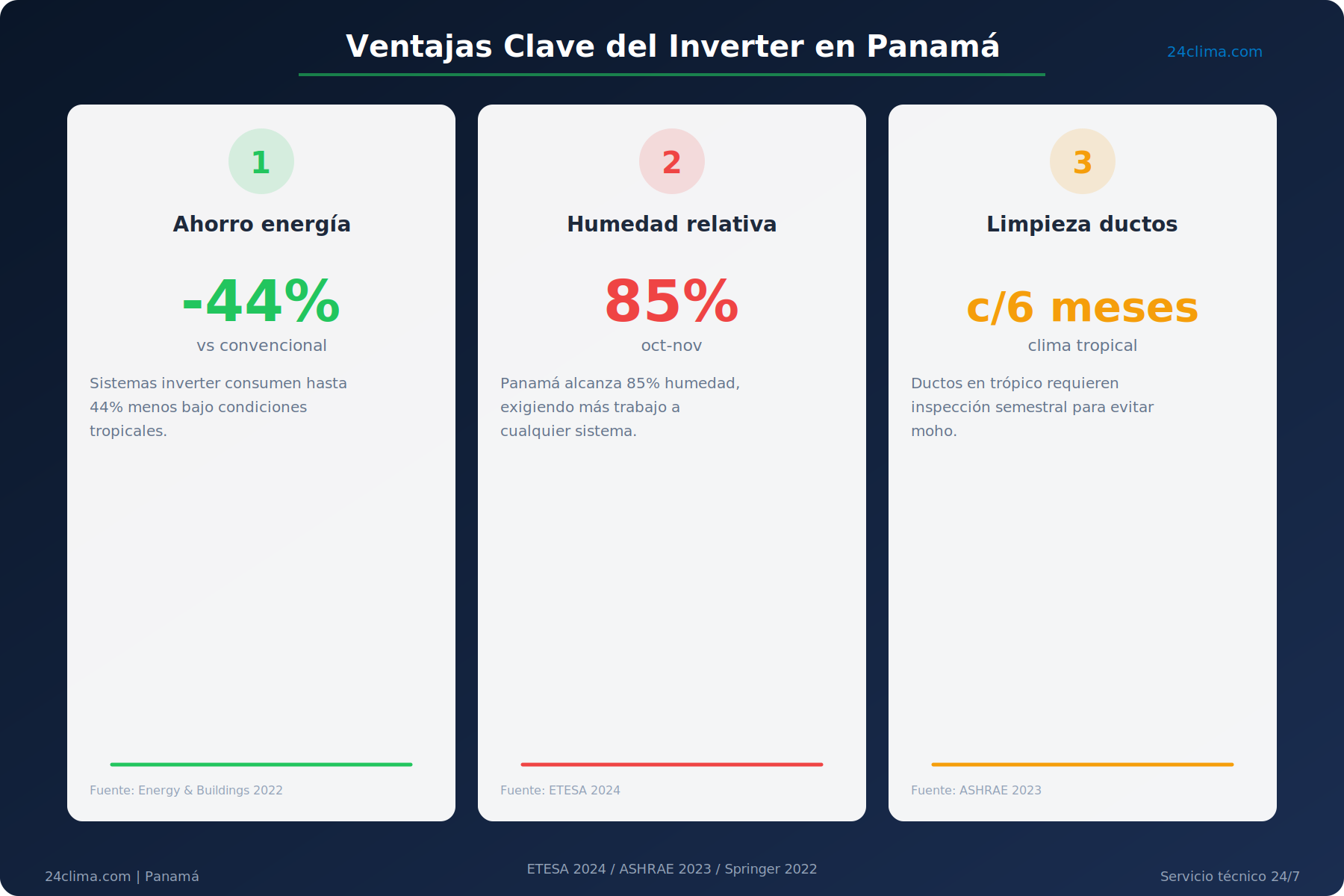
Air conditioning systems here operate under conditions that would be considered extreme by global standards. Average outdoor temperatures of 88°F (31°C) and relative humidity reaching 85% during October and November — according to ETESA 2024 data — mean every system works significantly harder than it would in a temperate climate. The gap between central and split becomes critical precisely under these conditions.
Central Air: Real Advantages and Real Limitations
A central air system moves conditioned air through ducts installed in the ceiling or walls. One air handler and an outdoor condenser control the climate for the entire property. For spaces that are fully occupied throughout the day, this can work efficiently. For spaces that are partially used, it represents a high ongoing cost you pay whether anyone's home or not.
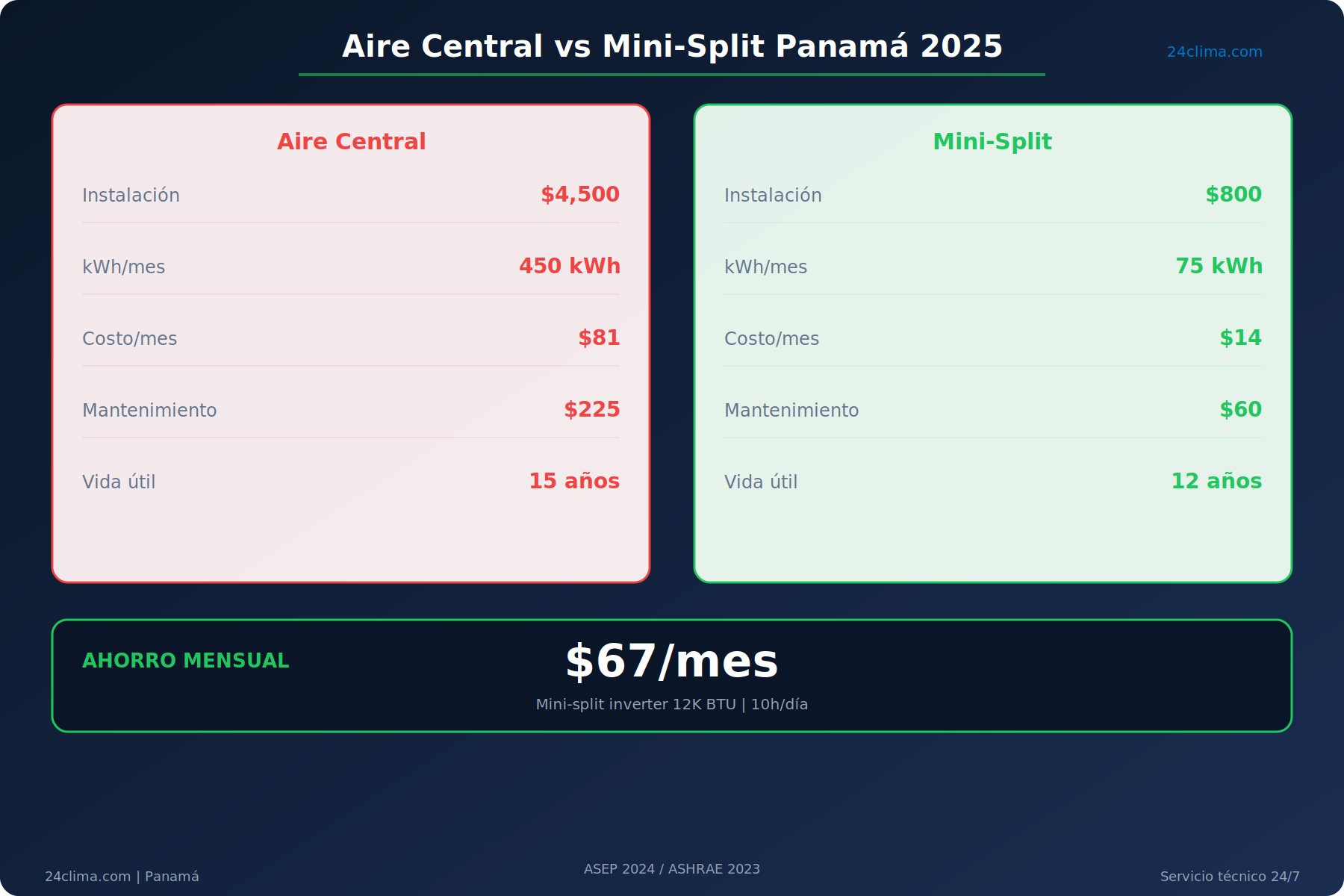
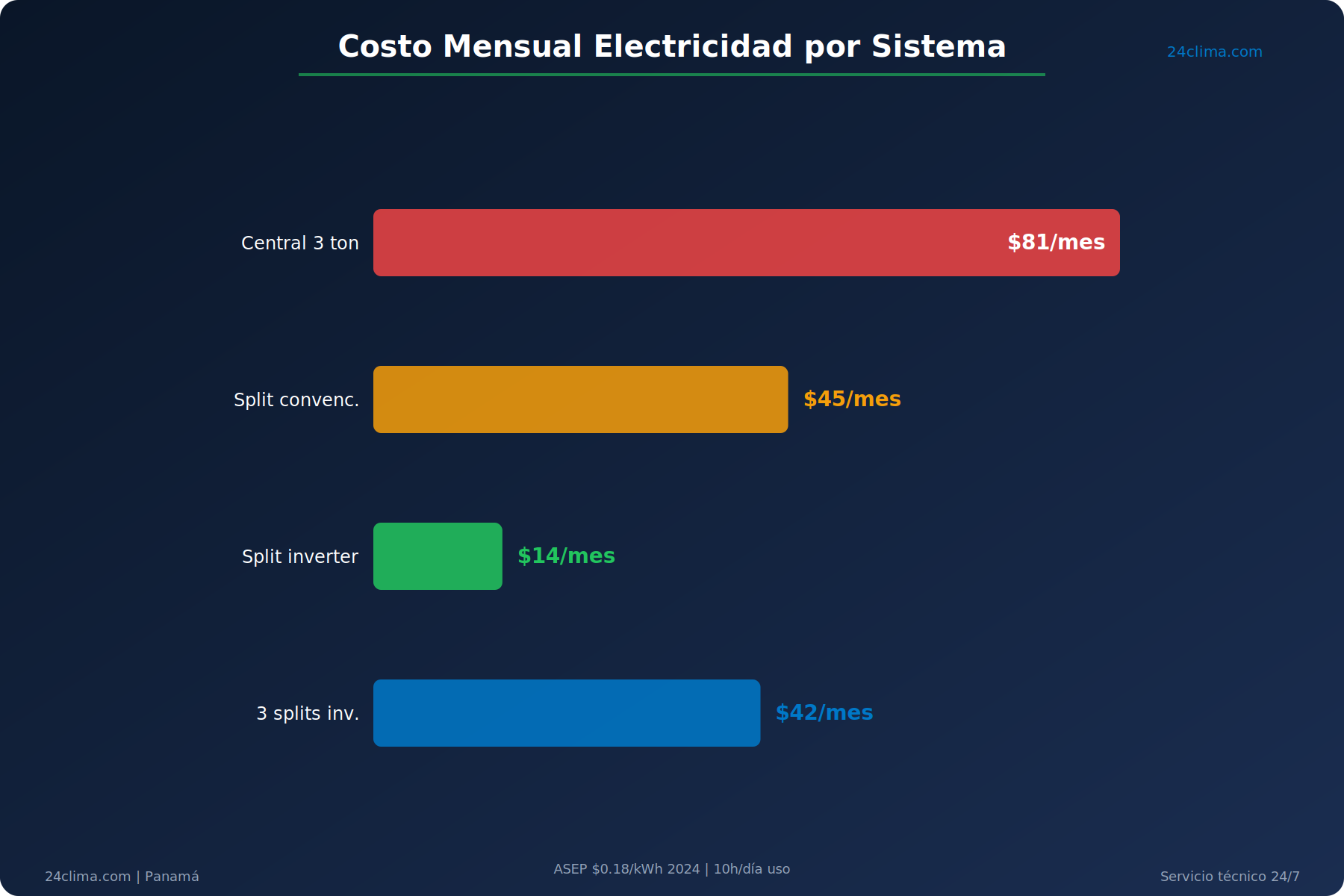
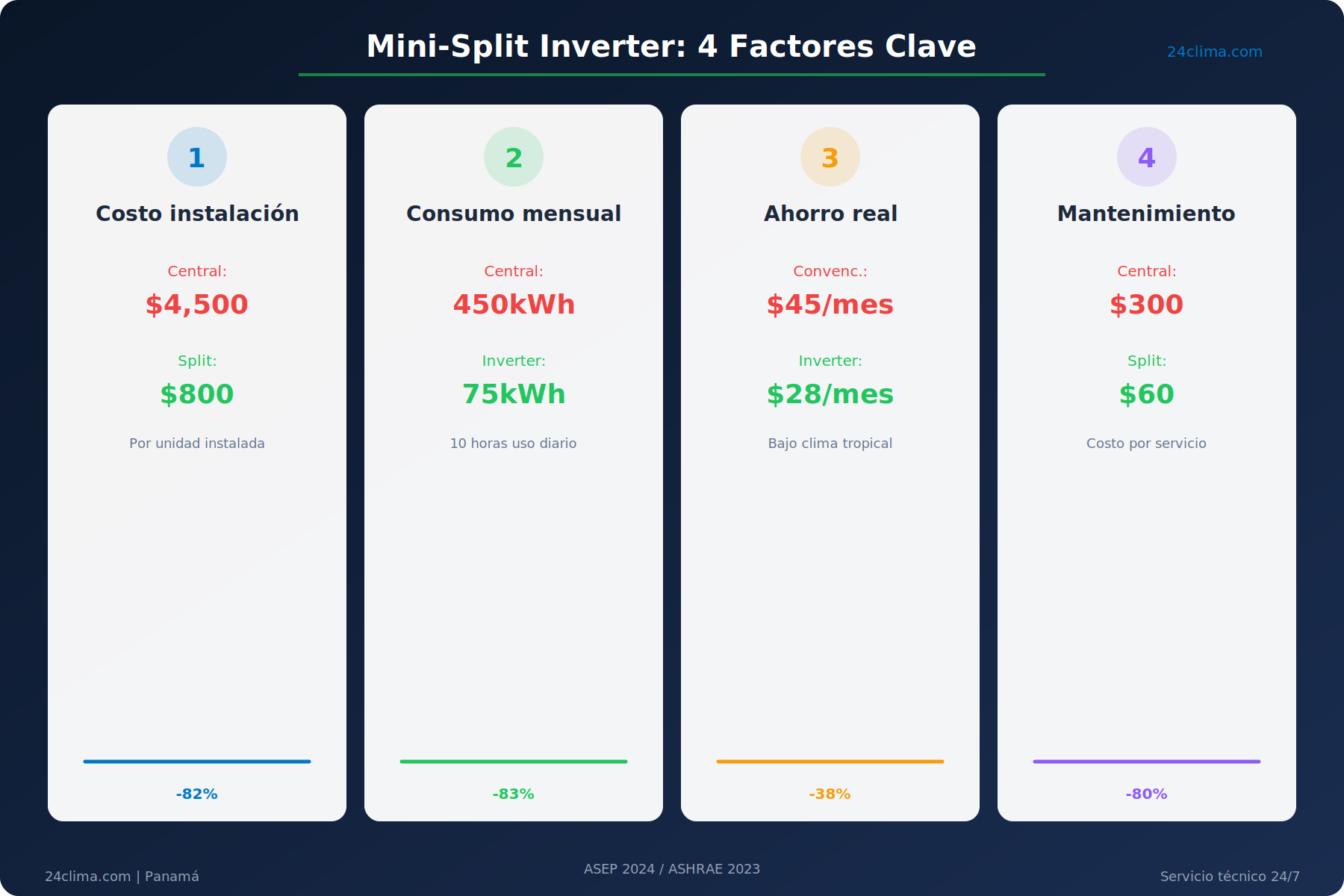
Central air installations in Panama typically run between $3,000 and $8,000, depending on square footage and ductwork complexity. A 1,600 sq ft (150 m²) house usually lands around $4,500, including ducts, diffusers, and labor. A typical 3-ton (36,000 BTU) central system running 10 hours a day in Panama consumes roughly 420 to 480 kWh per month — that's $75 to $86 on your electricity bill before you've turned on a single light.
The limitations in a tropical climate are real. Ducts accumulate moisture and develop mold in environments with 80%+ humidity when they aren't maintained properly. ASHRAE (2023) recommends inspection and cleaning every 6 months to maintain acceptable indoor air quality in ducted systems operating in tropical conditions. In Panama, that duct maintenance typically costs between $150 and $300 per visit — meaning $300 to $600 a year just to keep the system from becoming a health problem.
Mini-Splits: The System That Dominates the Panama Market
Mini-splits, particularly inverter models, are now the most commonly installed air conditioning system in homes and apartments across Panama. The main reason is financial. A 12,000 BTU inverter unit costs between $600 and $900 installed and consumes between 60 and 90 kWh per month running 10 hours a day. At Panama's average electricity rate of $0.18/kWh (Autoridad Nacional de Servicios Públicos, 2024), that's $11 to $16 per month in electricity per room — a fraction of what central air costs to run.
The inverter compressor continuously adjusts its speed based on real-time cooling demand rather than cycling on and off at full power. A study published in Energy and Buildings (Springer, 2022) found that inverter systems consume between 30% and 44% less electricity than conventional fixed-speed systems under tropical conditions. Put that in Panama terms: if your conventional split currently costs $45 a month to run, an equivalent inverter unit would cost between $25 and $31.
Side-by-Side Comparison: Central Air vs Mini-Split in Panama (2025)
The figures below are based on residential installations in Panama City. Ranges reflect differences in square footage, brand, and installation conditions.
INSTALLATION COST — Central air: $3,000 – $8,000 (homes from 1,075 to 2,690 sq ft / 100–250 m²) — Mini-split (per unit, installed): $600 – $1,500
MONTHLY ELECTRICITY CONSUMPTION (10 hrs/day use) — Central air, 3-ton: 420 – 480 kWh ($75 – $86/month) — Inverter mini-split, 12,000 BTU: 60 – 90 kWh ($11 – $16/month) — Inverter mini-split, 18,000 BTU: 90 – 130 kWh ($16 – $23/month)
ANNUAL MAINTENANCE COST IN PANAMA — Central air: $300 – $600 (includes duct service) — Mini-split: $60 – $120 per unit
OPTIMAL COVERAGE PER UNIT — Central air: 860 – 3,230 sq ft (80 – 300 m²), whole property — Mini-split 12,000 BTU: 160 – 240 sq ft (15 – 22 m²) — Mini-split 18,000 BTU: 240 – 375 sq ft (22 – 35 m²)
ESTIMATED LIFESPAN — Central air: 15 – 20 years with proper maintenance — Inverter mini-split: 12 – 15 years
ZONE CONTROL — Central air: limited (requires additional dampers) — Mini-split: complete (each unit operates independently)
How Many Mini-Split Units Do You Need for Your Home?
This is the practical question that determines the real cost comparison. A multi-split system for a 1,940 sq ft (180 m²) home in Panama typically requires:
1️⃣ Main living area (320–430 sq ft / 30–40 m²): 1 unit at 24,000 BTU — $900–$1,200 installed 2️⃣ Master bedroom (160–215 sq ft / 15–20 m²): 1 unit at 12,000 BTU — $600–$900 installed 3️⃣ Second bedroom (130–160 sq ft / 12–15 m²): 1 unit at 9,000 BTU — $550–$800 installed 4️⃣ Third bedroom (130–160 sq ft / 12–15 m²): 1 unit at 9,000 BTU — $550–$800 installed
Total for 4 zones: roughly $2,600 to $3,700 installed. That's comparable to — or less than — a basic central system, and you only run the units in rooms that are actually occupied. If you use the bedrooms at night and the living area during the day, you pay for exactly what you use and nothing more.
For homes larger than 2,690 sq ft (250 m²) that are fully occupied throughout the day with constant movement through open-plan living, dining, and kitchen areas, central air starts to make genuine operational sense. Based on our installation experience across Panama, that crossover point typically falls around 2,370 to 2,690 sq ft (220 to 250 m²) of continuously occupied open space.
Which System Is Right for Your Property Type?
Property type is the single most decisive factor in this decision.
Apartment in a High-Rise Tower (540 – 1,290 sq ft / 50–120 m²)
Inverter mini-splits are the clear choice. Installing ductwork in an apartment is technically complicated, expensive, and in most Panama City buildings, co-ownership regulations don't allow it anyway. A typical 970 sq ft (90 m²) apartment in Punta Pacífica runs efficiently with two units: an 18,000 BTU for the living area and a 12,000 BTU for the bedroom. Total installed cost: $1,400 to $2,000. Estimated monthly electricity: $35 to $55.
House Between 1,075 and 2,150 sq ft (100 – 200 m²) With 2 to 4 Bedrooms
Multiple inverter splits are generally the more cost-effective solution. The initial investment is similar to or lower than central air, zone-by-zone consumption is fully controllable, and maintenance in a humid tropical climate is simpler without ducts quietly growing mold in your ceiling. Our maintenance service on these properties consistently shows that well-maintained split systems have significantly lower failure rates than central systems with aging ductwork.
House Over 2,690 sq ft (250 m²), High Daily Household Activity
This is where central air starts to compete seriously, especially in homes with large open-plan areas. There's genuine value in a single thermostat controlling the whole house. That said, strongly consider a zoned HVAC setup — this adds $800 to $1,500 to the installation cost but can cut consumption by up to 25% by avoiding cooling unoccupied areas.
Commercial Space or Office
It depends on the layout. Open-plan offices larger than 1,075 sq ft (100 m²) typically perform better with central air or a ceiling cassette system. Spaces divided into meeting rooms and individual offices benefit more from zone-controlled cassette splits.
Frequently Asked Questions About Air Conditioning in Panama
How much does it cost to install a central air system in Panama?
A residential central air installation in Panama costs between $3,000 and $8,000, depending on square footage and ductwork complexity. For a 1,600 sq ft (150 m²) house, the average comes out to around $4,500 to $5,500, including equipment, ducts, diffusers, and labor. Premium brands such as Carrier, Trane, and York tend to land at the higher end of that range.
Is central air or an inverter mini-split better for a house in Panama?
For most residential homes in Panama — under 2,370 sq ft (220 m²) with heavy nighttime use — inverter mini-splits offer better cost efficiency. Zone control means you stop paying to cool empty rooms, and maintenance is simpler and cheaper without ductwork in a hot, humid climate. Central air becomes competitive in larger properties with intensive daytime use and open-plan floor plans.
Which air conditioning system uses the least electricity in a tropical climate?
Inverter mini-splits. According to ASHRAE data and peer-reviewed energy research, a high-efficiency inverter split (SEER 18–21) consumes between 30% and 44% less electricity than a comparable conventional system. In real Panama usage, a 12,000 BTU inverter unit running 10 hours a day generates an electricity cost of $11 to $16 per month, compared to $18 to $25 for a conventional unit of the same capacity.
The Right Decision Comes Down to Numbers, Not Preferences
Back to Costa del Este. Two in the afternoon. The heat that doesn't negotiate. The real question isn't which system is "better" in the abstract — it's which system works for your specific space, your budget, and how you actually live in Panama's climate.
If you have an 860 sq ft (80 m²) apartment in Marbella, the math is straightforward: two inverter splits, $1,500 to $2,000 installed, $35 to $45 a month in electricity. If you have a 3,230 sq ft (300 m²) house in Clayton with a large family and full daytime use, central air deserves a serious look — with a technician who actually calculates the thermal load of your specific construction, not one who quotes you a system size based on guesswork.
At 24clima, every consultation includes a full thermal load calculation at no extra charge, so the decision you make is based on your actual numbers. Contact us on WhatsApp or visit https://24clima.com/contacto/ and tell us your square footage, your property type, and what you're paying today. We'll tell you exactly which system to install and what it will cost — no surprises, no pressure.