How Long Does Refrigerant Last in Your AC in Panama? — The Myth That's Costing You Real Money
It's 2 PM in Costa del Este. The sun is hammering the asphalt like a furnace, humidity is sitting at 88%, and you've just walked in after an hour stuck in traffic on Vía Israel. You hit the AC. You wait. Ten minutes later, the room is still warm — not cool the way it should be, but thick and muggy. Your first instinct: "it's out of gas."
That's the most common diagnosis we hear at 24Clima. And it's almost always wrong — at least in the way most people understand it. Before you call any technician asking for a "recharge," you need to understand how refrigerant actually works in your system. Getting this right can save you between $80 and $300 over the next year.
This article is part of our guides and tips on air conditioning maintenance in tropical climates — real technical information, no sales fluff.
The Myth of Refrigerant That "Gets Used Up"
Most homeowners in Panama believe refrigerant works like gasoline in a car: you use it, it runs low, you top it off. That comparison is understandable — and completely wrong. Understanding why changes everything about how you maintain your equipment.
Refrigerant in an air conditioner is a working fluid in a closed loop. It doesn't get consumed. It doesn't evaporate through normal use. It doesn't disappear over time the way a battery loses its charge. If a properly installed, well-maintained unit has 1 kilogram of R410A in it today, it should have exactly 1 kilogram five years from now — regardless of how many hours you've run it.
If your air conditioner has lost refrigerant, there is only one explanation: there is a leak. Full stop.
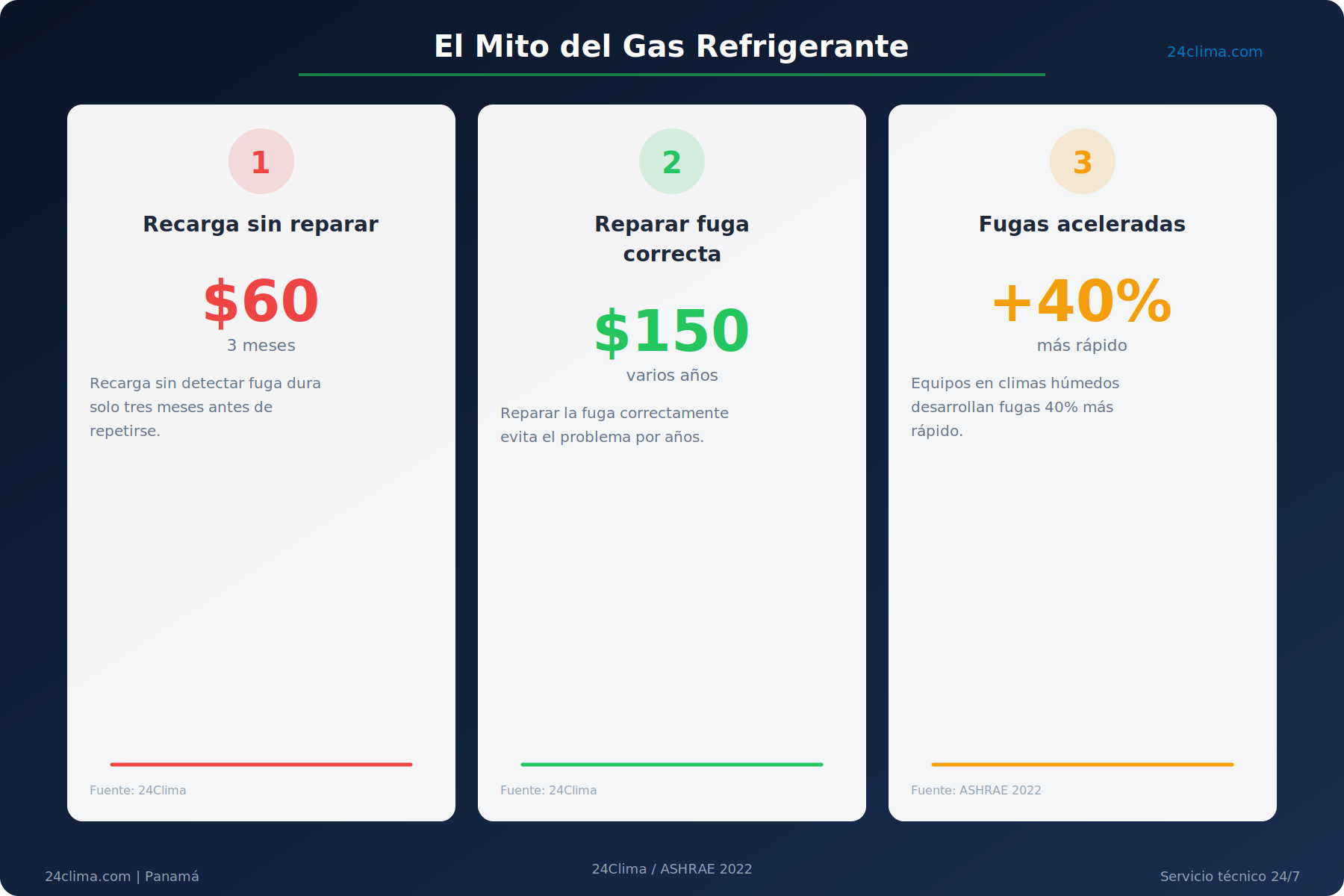
That distinction isn't just semantics. It's the difference between spending $60 on a recharge that lasts three months — because the leak is still there — versus spending $120–180 to find and fix the leak properly, so the problem doesn't come back for years.
Why Panama's Climate Accelerates the Problem
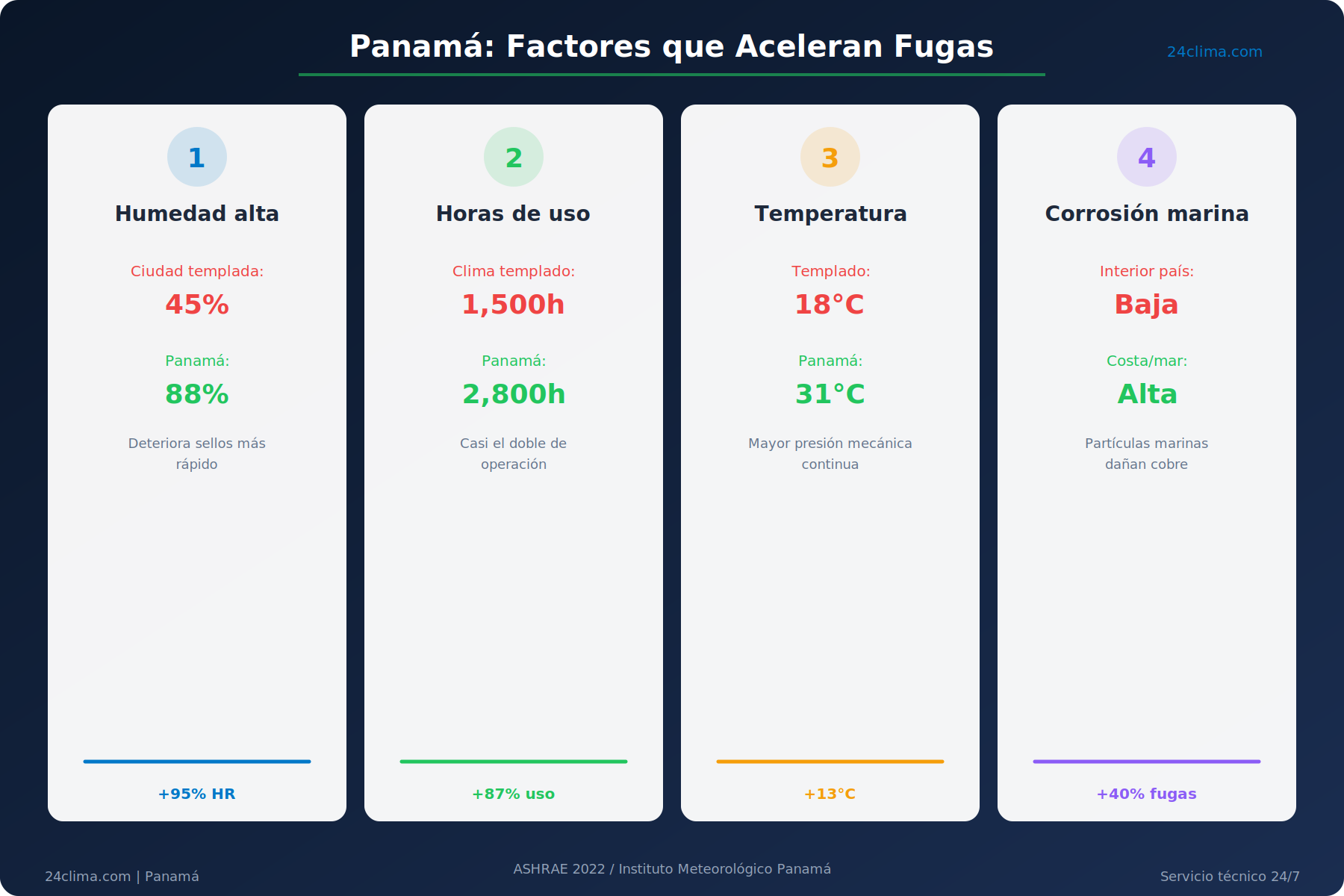
Panama's heat and humidity — average temperatures around 31°C (88°F) and relative humidity between 75% and 88% — create conditions that wear down seals, fittings, and copper connections faster than in most other climates. That doesn't mean the refrigerant "runs out faster." It means the points where it can escape fail sooner than they would somewhere drier.
According to data from the Instituto Meteorológico de Panamá, the capital logs more than 2,800 hours of average AC operation per year — nearly double that of cities in temperate zones. That's sustained mechanical pressure on every joint, every valve, every meter of copper tubing. Add the accelerated corrosion from marine humidity in neighborhoods like Punta Pacífica or Casco Antiguo, and micro-leaks become a real, measurable risk.
A 2022 study from ASHRAE (the American Society of Heating, Refrigerating and Air-Conditioning Engineers) found that units installed in high-humidity, high-temperature environments develop detectable leaks 40% faster than identical models in continental climates. The gas isn't leaving on its own — the seals are giving out.
What Refrigerant Is in Your System — and What It Means for Your Wallet
The type of refrigerant your unit uses directly determines the cost of any repair and its availability in the Panamanian market in 2025. You'll encounter three types in most local installations.
R22 (Classic Freon)
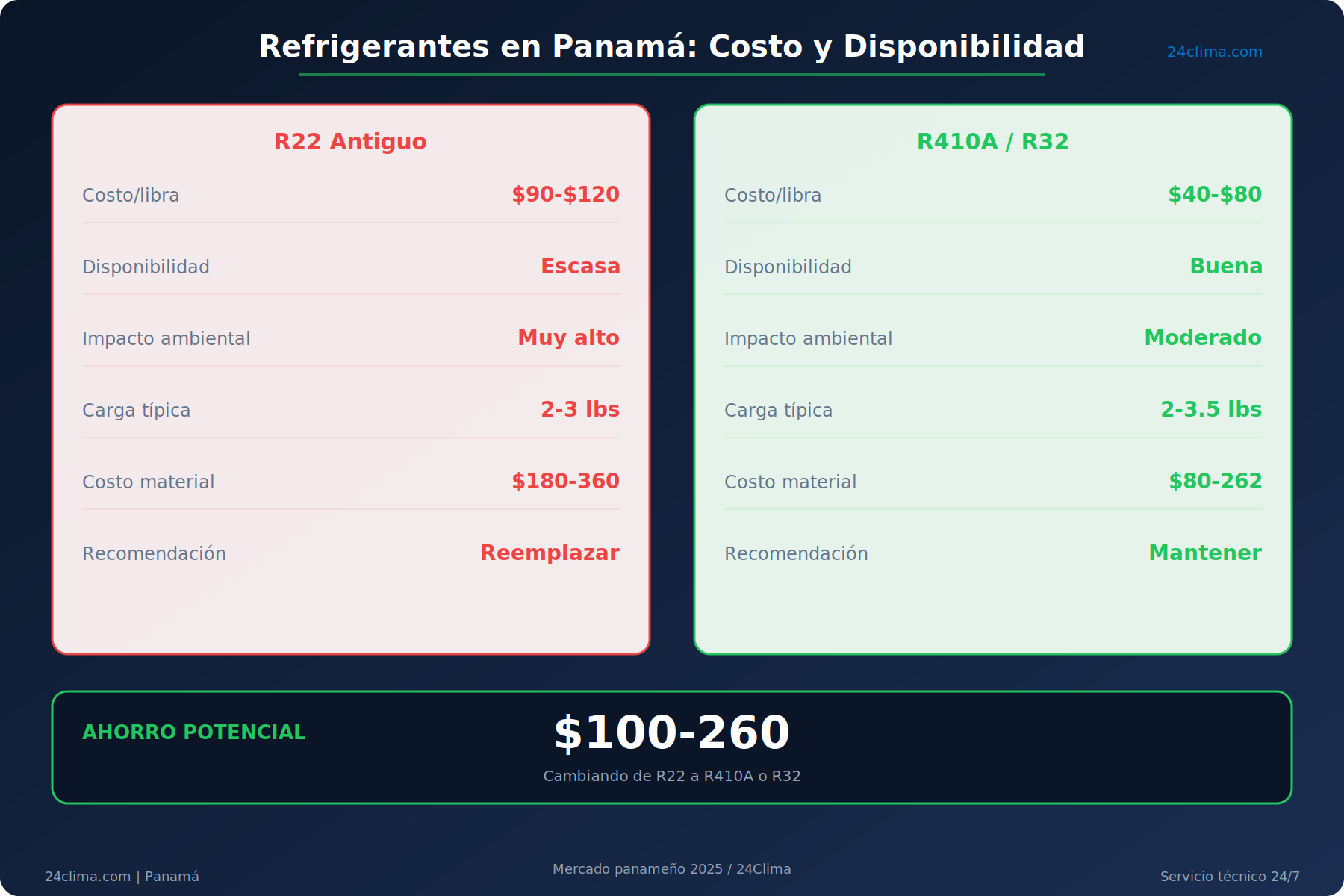
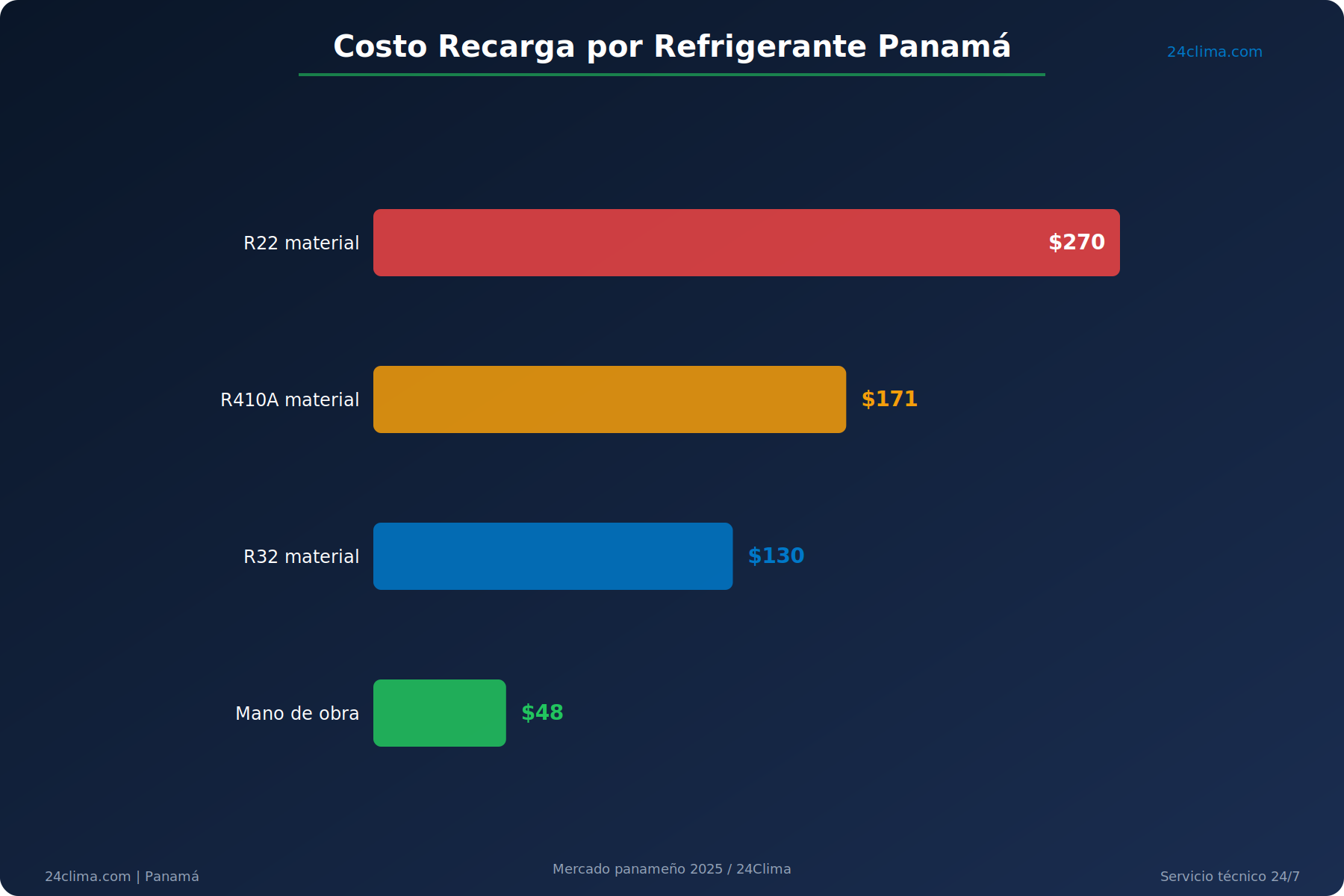
This was the industry standard for decades and still circulates in units installed before 2015 in Panama. The problem: it was banned in most countries under the Montreal Protocol because of its high ozone depletion potential. It's no longer manufactured — only recycled. In 2025, an R22 recharge in Panama City runs between $90 and $120 per pound, and a typical 1-ton unit needs 2 to 3 pounds. That's $180 to $360 in refrigerant alone, before labor.
If you have an R22 unit, the conversation shouldn't be about recharges. It should be about when to replace it.
R410A (The Current Standard)
For the past decade, most split systems installed in Panama run on R410A. It's more efficient than R22, doesn't deplete the ozone layer, and through 2025 remains relatively accessible. A recharge costs between $40 and $75 per pound locally, depending on the supplier. A 12,000 BTU (1-ton) unit typically needs 2 to 3.5 pounds, putting material costs at $80 to $262, plus $35 to $60 in labor.
R32 (The New Generation)
The newest units — particularly high-efficiency inverters installed since 2020 — run on R32. It carries a global warming potential 68% lower than R410A and operates more efficiently. Recharge costs in Panama in 2025 sit around $50 to $80 per pound, similar to R410A, but these units typically require a smaller total refrigerant charge.
Refrigerant Comparison — Panama Market 2025
R22 — Availability: Scarce (recycled only) — Cost per pound: $90–$120 — Environmental impact: High (banned) — Recommendation: Replace the unit
R410A — Availability: Good — Cost per pound: $40–$75 — Environmental impact: Moderate — Recommendation: Fix the leak first
R32 — Availability: Growing — Cost per pound: $50–$80 — Environmental impact: Low — Recommendation: Fix the leak first
The Real Signs of Low Refrigerant — and How to Tell Them Apart from Other Problems
A unit running low on refrigerant shows specific symptoms. The problem is that several of those symptoms look a lot like other, more common issues — dirty filters, a blocked condenser, a weakening compressor — all of which happen more frequently in Panama than actual refrigerant leaks do.
Signs that DO point to low refrigerant:
— Ice or frost forming on the copper tubing at the indoor unit, even while the system is running — The unit runs continuously but never reaches the set temperature — A faint hissing or bubbling sound near the outdoor unit — The temperature difference between air entering and leaving the unit (delta T) is less than 18°F — it should normally be between 25°F and 36°F under typical conditions
Signs that are probably something else:
— Warm air blowing but no frost: check the filters and evaporator coil first — Short cycling (turning on and off in quick bursts): likely an electrical or compressor issue — Rattling or vibration: loose components, not refrigerant — Musty or moldy smell: a drainage and cleaning issue, not a refrigerant problem
Before any recharge, a competent technician should run a pressure test with gauges and inspect for leaks using an electronic leak detector. If they skip that step and go straight to connecting the refrigerant tank, you're paying for an incomplete service that will repeat itself in 3 to 6 months.
Our air conditioning maintenance service includes pressure diagnostics as a standard step — not an add-on — because a half-solved problem isn't a solved problem.
The Most Common Leak Points in Tropical Climates
In Panama, field experience shows a consistent pattern: leaks don't happen randomly. There are specific points where heat, humidity, and thermal cycling concentrate the damage.
Service valve connections (Schrader valves) These are the first thing to inspect. Constant vibration and pressure cycling cause the valve packing to harden and lose its seal. In tropical climates, this deterioration happens roughly 30% faster, according to field data from EPA-certified technicians in the region.
Copper pipe flare joints Every mechanical connection in the copper tubing is a potential leak site. A poorly executed flare during the original installation might take two or three years to show symptoms. Panama's outdoor temperature swings — from around 82°F to 95°F (28°C to 35°C) — cause the copper to expand and contract repeatedly, creating metal fatigue over time.
The evaporator coil itself After 8 to 10 years of operation, corrosion on the evaporator coil can create micro-fractures. This is more common in Panama City's coastal neighborhoods — Casco Antiguo, Paitilla, Balboa — where salt particles in the air accelerate formicary (ant-nest) corrosion in the aluminum fins.
Compressor connections Less frequent, but more expensive when they happen. A leak at the compressor usually means the compressor needs replacement, not just a recharge.
Preventive Maintenance — What Actually Prevents Refrigerant Loss
Proper maintenance won't prevent leaks entirely — materials wear out — but it lets you catch them early, before the system sustains damage from running with insufficient refrigerant. Here's the protocol we recommend for units in Panama.
Every 3 months: — Clean or replace evaporator filters — Confirm the condensate drain is flowing freely — Visually inspect copper tubing for oil stains (a sign of a leak) — Clean the outdoor condenser fins with compressed air or low-pressure water
Every 6 months: — Full professional service: pressure readings with gauges, compressor amperage, operating voltage — Chemical cleaning of the evaporator coil — Check torque on service valve connections
Every 12 to 18 months: — Electronic leak detection at all critical points — Delta T measurement to verify refrigerant cycle efficiency — Assessment of packing and valve condition
Followed consistently, this schedule can extend your unit's lifespan from the 8–10 year average in Panama to 12–15 years — and cut electricity consumption by 15–20% compared to an unmaintained unit, according to data published by Panama's Ministerio de Energía y Minas in its 2023 energy efficiency guide. That's real money: $180 to $300 less per year on your electricity bill, and years more life out of equipment you've already paid for.
For details on what a complete service visit covers, see our air conditioning maintenance service page for the full protocol we apply on every visit.
Frequently Asked Questions
How often does refrigerant need to be recharged in Panama?
A unit with no leaks never needs periodic recharging — ever. If a technician recommends "routine recharges" without first detecting a leak, that's an unnecessary upsell, not technical advice. The only valid reason to recharge is after identifying and repairing a confirmed leak. Given Panama's climate and accelerated wear, an annual pressure inspection is enough to catch losses before they become expensive.
How do I know if my AC needs refrigerant?
The most reliable signs are ice forming on the evaporator tubing, the unit running continuously without reaching the set temperature, and a delta T below 18°F between supply and return air. That said, these symptoms can point to other problems too. The only way to know for certain is a pressure test with gauges — something any certified technician can perform in about 15 minutes. Don't accept a diagnosis without it.
How much does an AC refrigerant recharge cost in Panama in 2025?
It depends on the refrigerant type and unit size. For R410A — the most common type currently in use — expect to pay $40 to $75 per pound plus $35 to $60 in labor. A 12,000 BTU unit needs 2 to 3.5 pounds, bringing the total to $115–$322 for a complete service. R22 runs significantly higher: $90 to $120 per pound. R32 is comparable to R410A. Keep in mind: if the leak isn't repaired before recharging, you'll be paying that same bill again in a few months.
The Real Cost of Ignoring the Problem
Back to that room in Costa del Este. If the cause is a small leak — a micro-fracture in the evaporator, a valve with worn packing — the unit keeps running, but the compressor is working at 120% capacity to compensate for the lost efficiency. A compressor under that kind of strain consumes 25% to 40% more electricity and wears out proportionally faster. In practical terms: your electricity bill climbs $20 to $45 per month for no obvious reason, and within 18 to 24 months you're replacing a compressor that costs $350 to $600 — or the entire unit.
The right diagnosis at the right time isn't an expense. It's the exact opposite.
At 24Clima, we assess the actual condition of your refrigeration system with pressure measurements, leak point inspection, and efficiency evaluation — before recommending any intervention. If there's a leak, we tell you exactly where it is and what it costs to fix. If the problem is something else, we tell you that too. No guesswork, no unnecessary upsell.
Contact us on WhatsApp at https://24clima.com/contacto/ and we'll schedule a technical visit in your area — Costa del Este, San Francisco, Albrook, Clayton, or wherever you are in Panama City. No commitment required — we diagnose first, then you decide.
Last updated: June 2025