Ducted Central AC vs Mini Split — Which One Makes Sense for Your Home in Panama?
Last updated: May 2025
It's 2 in the afternoon in Costa del Este. The sun is hammering the concrete at 91°F (33°C) and your phone's humidity sensor reads 87%. You walk into your apartment, hit the remote for the central system, and wait. Cool air eventually drifts down from the ceiling vents — but the back bedroom is still stuffy, and last month's Electricidad Metro bill kept you up at night.
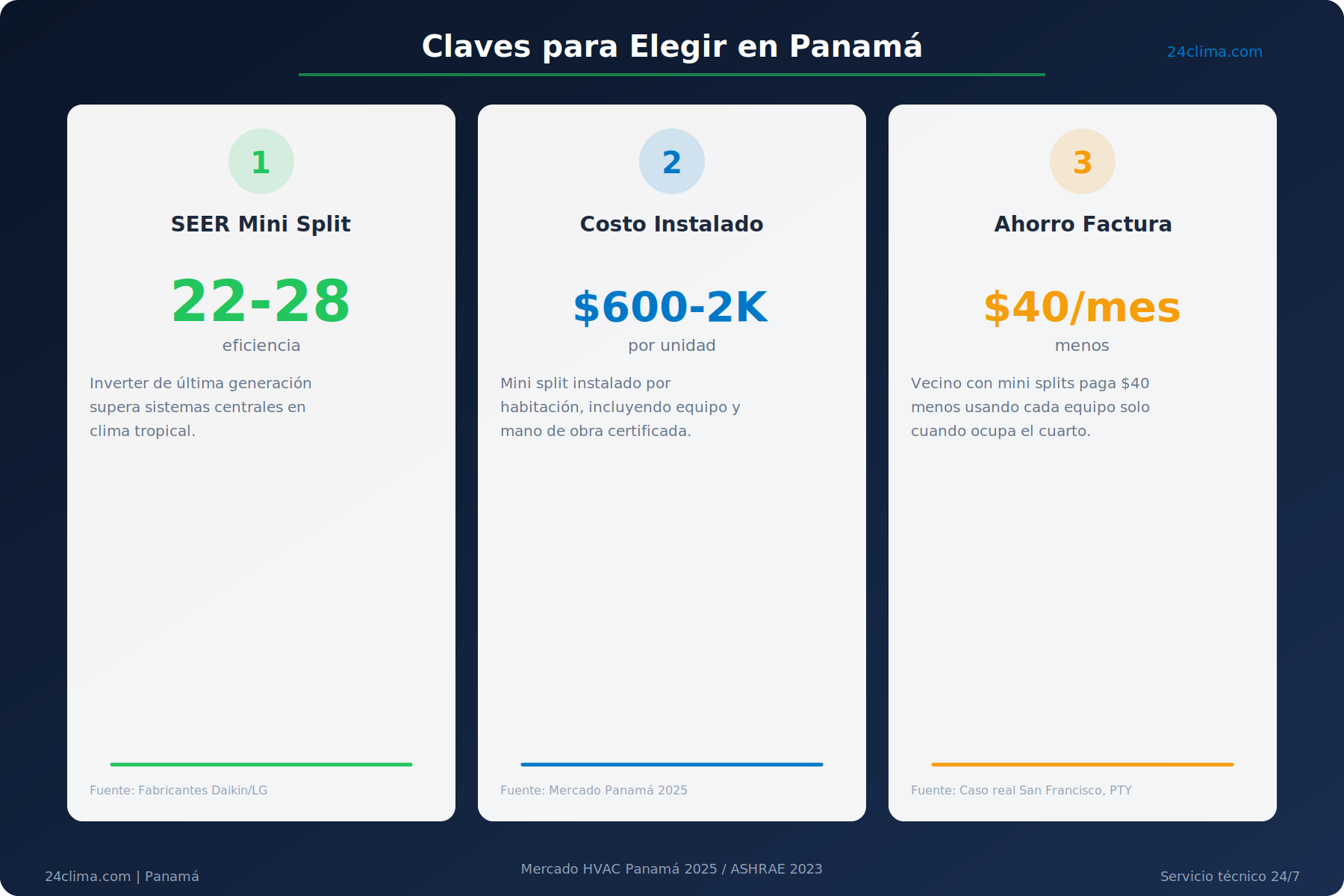
Your neighbor in San Francisco runs three mini splits, each one only when someone is actually in that room. His bill runs $40 lower than yours every month. No ductwork in the ceiling. No massive compressor humming outside.
The question isn't which system is "better" in the abstract. It's which system fits your specific space, your budget, and how the people living or working there actually behave day to day. That distinction changes everything.
What Most People Get Wrong
The most common assumption in Panama is that ducted central air is the "professional" choice, and that a mini split is a cheap workaround for people who can't afford the real thing. That's not entirely false — but it misses the point.
Central duct systems were designed for American office buildings and large homes in the US — spaces with basements to house air handlers, attics to run ductwork through, and climates that actually have seasons. In Panama, where most homes have 8 to 9-foot ceilings (2.4 to 2.7 meters), installing ductwork requires compromises that drive up costs and cut into efficiency.
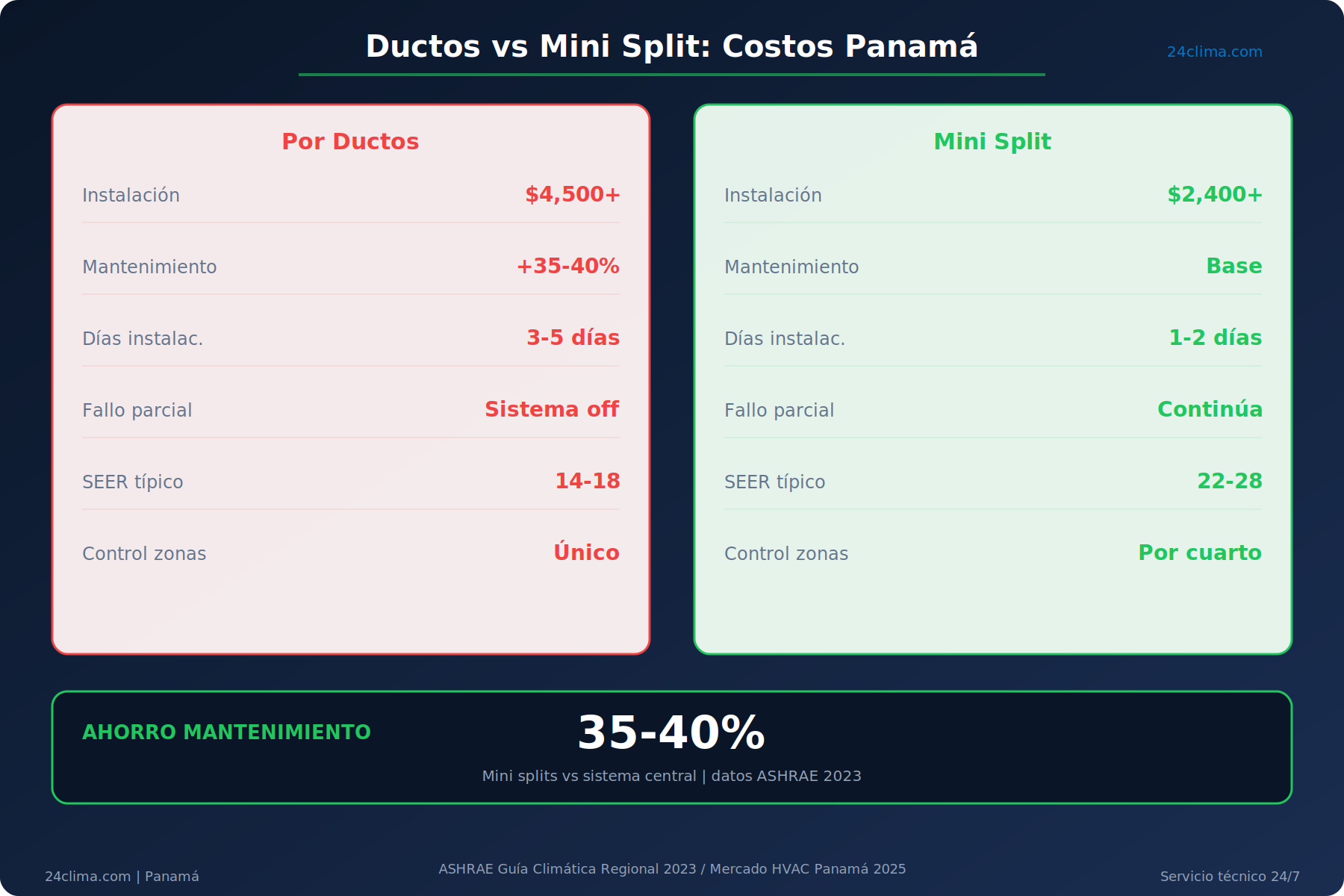
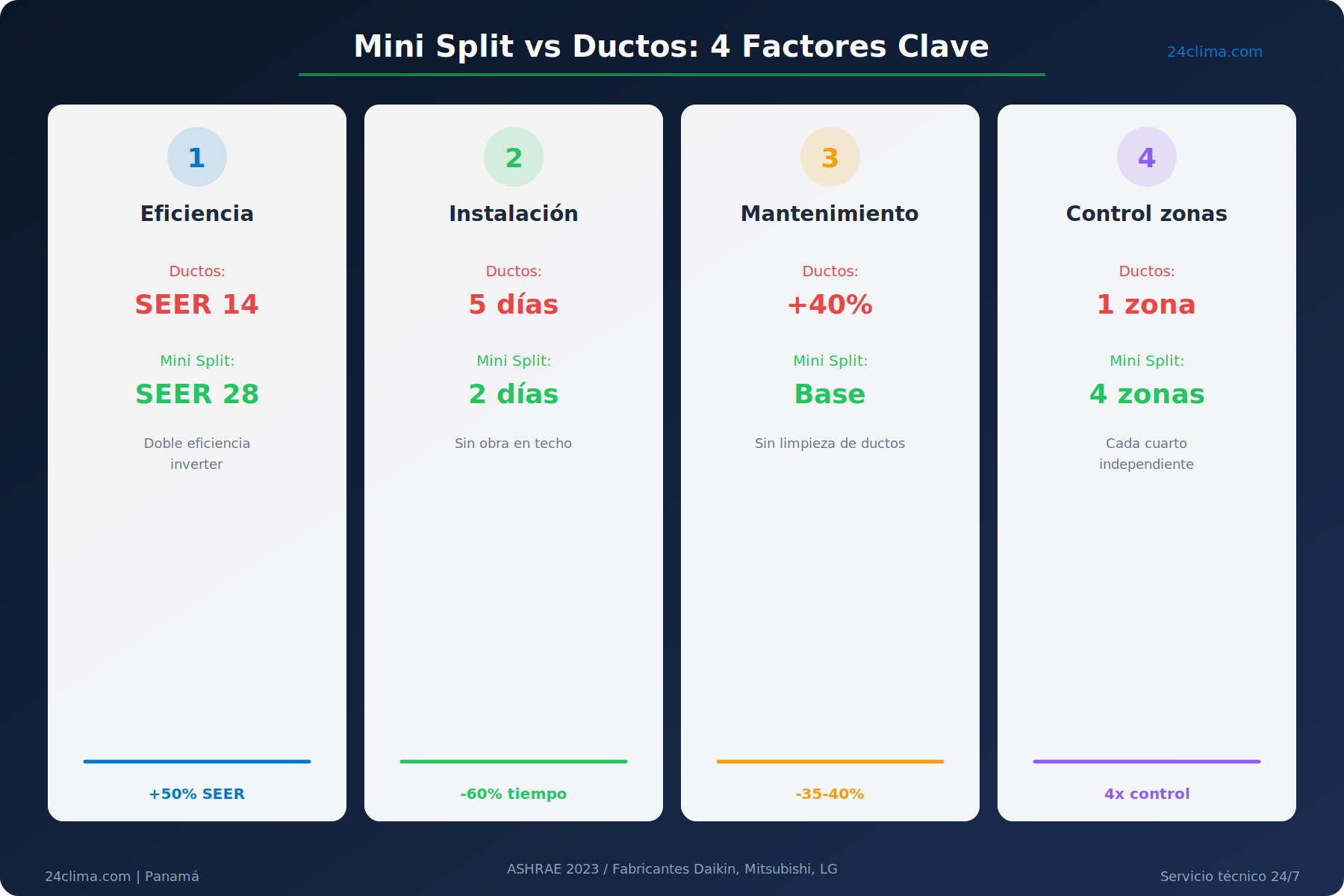
On the other side, putting a mini split in each room sounds like a patchwork fix. In practice, it's the same strategy used by boutique hotels, private medical clinics, and high-end residences in Punta Pacífica — precisely because it allows zone-by-zone control. The latest inverter technology reaches SEER ratings of 22 to 28, easily outperforming many central systems that land between SEER 14 and 18. The numbers bear that out.
How Each System Actually Works
A central ducted AC system uses a single air handler connected to an outdoor compressor. Air is treated at one central point — filtered, cooled, dehumidified — then pushed through galvanized sheet metal or flexible fiber ducts to each room via ceiling vents. Return vents pull stale air back to the handler to repeat the cycle.
A mini split has no ductwork. Each indoor evaporator unit mounts directly in the room it cools. Refrigerant travels through thin copper lines between that indoor unit and the outdoor compressor. Multi-split systems connect several indoor units to a single outdoor compressor, which keeps the exterior of your building cleaner.
Both systems do the same thing in terms of refrigeration physics: compress refrigerant to release heat outside and absorb it inside. The critical difference is where that heat exchange happens, how much energy gets lost moving air through ducts, and how precisely temperature can be controlled in each zone.
Installation Costs in Panama — Real Numbers for 2025
A ducted system in Panama runs between $3,000 and $8,000 or more, depending on property size, number of zones, and ductwork complexity. That range covers equipment from brands like Carrier, Lennox, or York, plus materials, certified labor, and commissioning.
A quality mini split — Daikin, Mitsubishi, LG Inverter — costs between $600 and $2,000 per unit installed, depending on BTU capacity and brand. For a three-bedroom home with a living area, you're looking at three to four units, bringing the total to $1,800–$8,000. That range overlaps with ducted systems, but with one critical operational difference: if one mini split fails, the rest of your home stays cool.
Here's how the numbers compare side by side:
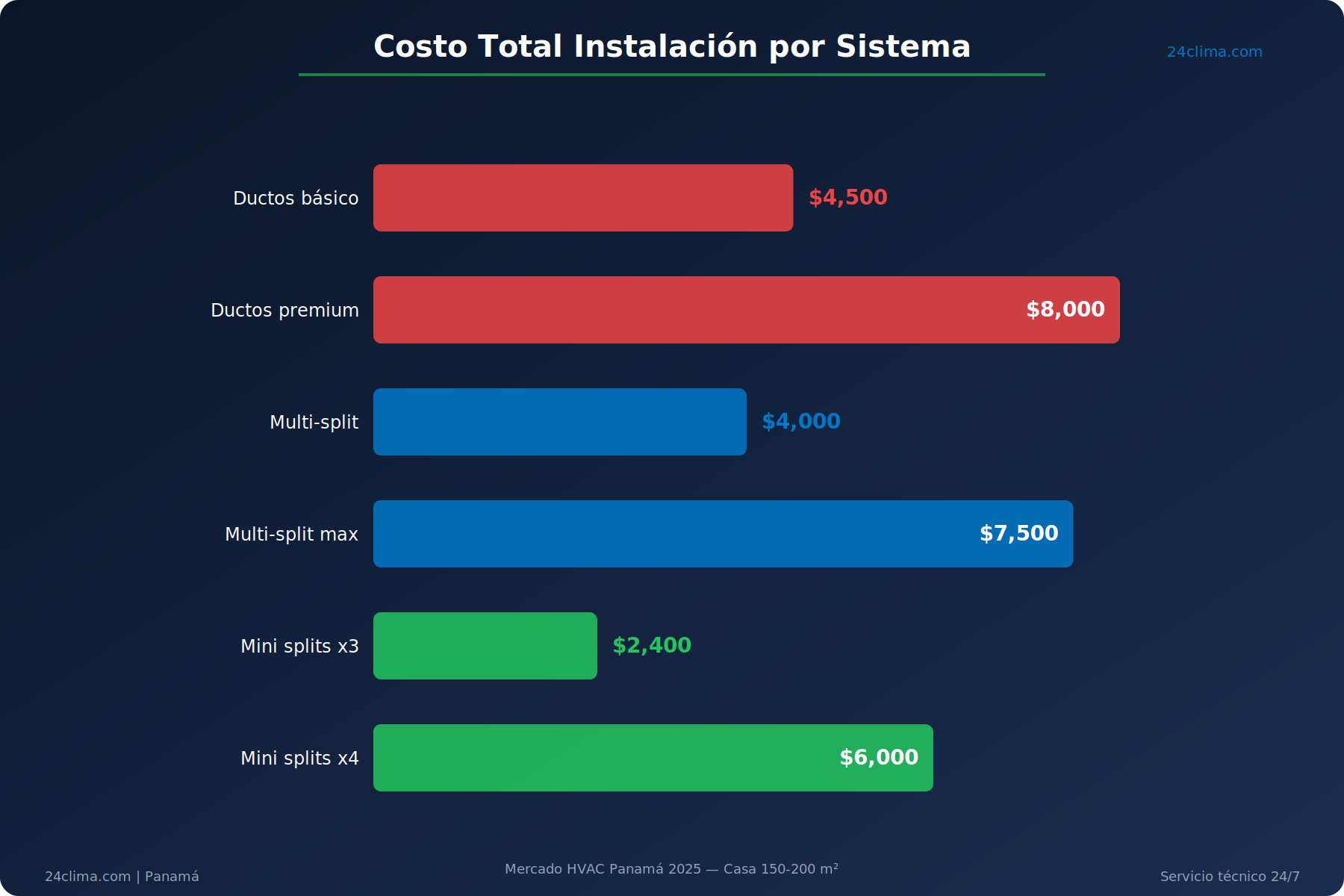
Ducted central system (150–200 m² / 1,600–2,150 sq ft home): $4,500–$8,000+ installed. One air handler, a 4 to 5-ton compressor, full ductwork. Typical installation: 3 to 5 days.
Multi-split system (same home): $4,000–$7,500 for 3 to 4 units of 12,000–18,000 BTU connected to a multi-zone outdoor compressor. Installation: 1 to 3 days.
Independent mini splits (same home): $2,400–$6,000 for 3 to 4 units, each with its own compressor. Installation: 1 to 2 days.
One number that matters for long-term planning: according to HVAC sector data for Central America compiled by ASHRAE in their 2023 regional climate guide, annual maintenance costs for a central ducted system run approximately 35–40% higher than an equivalent mini split setup, driven primarily by periodic duct cleaning and sealing.
Energy Efficiency in a Tropical Climate — What the Research Shows
In Panama's climate, energy efficiency isn't just about a unit's SEER rating. It depends on how many hours per day the system runs and how many zones it's cooling at once.
SEER (Seasonal Energy Efficiency Ratio) measures BTUs of cooling produced per watt-hour consumed. A SEER 14 system produces 14 BTUs per watt-hour. A SEER 22 system produces 22 BTUs for the same watt-hour — 57% more efficient on paper.
Panama's reality complicates that comparison. A central system cools your entire home even when only one room is occupied. Ducts also bleed real thermal energy. According to a 2023 study from Lawrence Berkeley National Laboratory, ducted systems in hot and humid climates lose between 25% and 40% of their cooling capacity through the ductwork itself — especially when ducts run through unconditioned spaces like drop ceilings or utility areas.
A SEER 22 inverter mini split, running only in the occupied room, costs between $18 and $28 per month in typical use — 8 hours per day at ENSA/Metro rates. A SEER 16 central system cooling an entire 180 m² (1,940 sq ft) home for the same hours runs between $90 and $150 per month, based on comparative consumption data monitored by Panama's Autoridad Nacional de los Servicios Públicos (ASEP) in their 2022 residential efficiency report.
Bottom line: if you live alone or with a partner and don't occupy every room at the same time, inverter mini splits cost less to run in Panama. There's really no debate on that point.
When a Ducted System Actually Makes Sense in Panama
Central ducted AC justifies its cost and installation complexity in specific scenarios — where its disadvantages shrink and its strengths come through clearly.
A central system makes sense when a space exceeds 250 m² (2,700 sq ft) with open-plan zones that are difficult to serve with individual wall units, when the architecture already has ceiling cavities designed for ductwork, or when it's a commercial space — a store, restaurant, or clinic — where high foot traffic demands uniform air distribution without visible wall-mounted equipment.
It also fits luxury residential projects where aesthetics drive the decision: ductwork stays hidden, walls stay clean, and interior design has no units mounted anywhere visible. Projects in Costa del Este, Punta Pacífica, and Santa María Golf — where architects specify concealed systems from the start — are typical examples.
In those cases, the right move is a ducted system with variable-frequency drive compressor technology, zone control with motorized dampers, and semi-annual preventive maintenance that includes duct cleaning. Proper ducted AC requires certified technicians and planning from the construction phase — retrofitting into an existing building adds significant cost and usually reduces final efficiency.
When the Mini Split Wins Every Time
For spaces under 200 m² (2,150 sq ft), for renters who don't want construction work, for small businesses, and for any project where electricity costs are a real priority, the inverter mini split is the right answer in Panama.
Inverter technology continuously adjusts compressor speed rather than cycling on and off. Room temperature stays stable within less than 1°F (0.5°C), power spikes from each startup disappear, and compressor life extends. According to Daikin Corporation data from 2024, their inverter units consume 44% less electricity than an equivalent on/off unit under continuous use at 88°F (31°C).
In Albrook, Clayton, and the townships of La Chorrera — where voltage fluctuations are common — inverter systems also handle power variations better than traditional on/off motors, protecting the equipment itself.
With semi-annual preventive maintenance, a well-chosen mini split will last 12 to 15 years. That lifespan beats the cost-benefit of almost any fully installed central ducted system in a standard Panama residence.
Frequently Asked Questions
How much does it cost to install a ducted AC system in Panama?
Installing a ducted system in Panama costs between $3,000 and $8,000 or more for a home between 1,600 and 2,700 square feet (150–250 m²). The final number depends on the brand, ductwork complexity, number of zones, and whether it's new construction or a retrofit. In renovation projects where walls or ceilings need to be opened, costs can exceed $10,000.
Is ducted central AC or a mini split better for a house in Panama?
It depends on the size of the space and how it's actually used. For homes under 2,150 square feet (200 m²) with partial room occupancy, inverter mini splits are more efficient and cheaper to operate. For properties over 2,700 square feet (250 m²) or projects where concealed aesthetics are the priority, a central ducted system can make sense — as long as it includes inverter technology and zone control.
Which AC system uses less electricity in a tropical climate?
In Panama's climate, a high-efficiency inverter mini split (SEER 20 or above) uses less electricity than a central system in the vast majority of homes. The main reason is the ability to cool only the zones that are actually occupied. A central system cooling an entire house runs between $90 and $150 per month, while two or three well-managed mini splits can stay between $45 and $80 per month under similar conditions.
The Decision You Made Five Years Ago Doesn't Have to Be the One You Make Today
If you already have a ducted system installed and it's working, the job is optimization: dampers, regular maintenance, duct seal inspections. If you're building or renovating and your space is under 2,150 square feet (200 m²), the numbers favor inverter mini splits in nearly every Panama scenario.
Do that calculation before installation — not after you open a $180 electric bill in August.
At 24Clima, we evaluate your space with real measurements — square footage, solar load by facade orientation, number of occupants, usage patterns — and recommend the system that actually fits your situation, not the one with the highest profit margin. If you want an honest assessment with no sales pressure, reach out to us at https://24clima.com/contacto/ and a certified technician will get back to you the same day.