Ir al contenido principal
Back to list

AC Refrigerant Recharge in Panama — When You Need It and What It Costs

AC Refrigerant Recharge — When You Actually Need One and What It Costs in Panama

Two in the afternoon in Costa del Este. The sun has been hammering the glass windows for hours, the thermometer outside reads 93°F (34°C), and you finally give in and turn on the living room split. The unit hums, the fan spins, air comes out — but the room stays stuffy and warm. Your first thought: the AC needs a refrigerant recharge.

Maybe you're right. Maybe not. That confusion costs hundreds of people in Panama between $80 and $200 every year in unnecessary services — or worse, in misdiagnoses that never fix the actual problem.

What follows is a practical breakdown of how to tell whether your AC genuinely needs a refrigerant recharge, what that service costs in Panama in 2025, and which refrigerant your unit takes. For more guides written specifically for Panama's climate, visit https://24clima.com/consejos-y-guias/ — you won't find this kind of hyperlocal detail on generic HVAC sites.

What Most People Believe — And Why They're Wrong

There's a widespread belief in Panama that AC refrigerant "gets used up" the way a car burns gasoline. Plenty of homeowners call a technician every year asking for a "preventive recharge," convinced it's just part of routine maintenance.

It isn't. Refrigerant in an air conditioning system doesn't get consumed. It's a working fluid that circulates in a closed loop, cycling between liquid and gas states 60 to 90 times per minute, pulling heat out of your home and releasing it outside. According to ASHRAE (the American Society of Heating, Refrigerating and Air-Conditioning Engineers), a leak-free system should not lose any refrigerant over its entire lifespan — which under normal conditions runs 12 to 15 years.

If your unit needs a recharge, there's one specific reason: there's a leak somewhere. Without finding and fixing that leak first, any recharge is just a temporary patch. Within six months — sometimes sooner — you'll be right back where you started.

The 5 Signs Your AC Is Low on Refrigerant

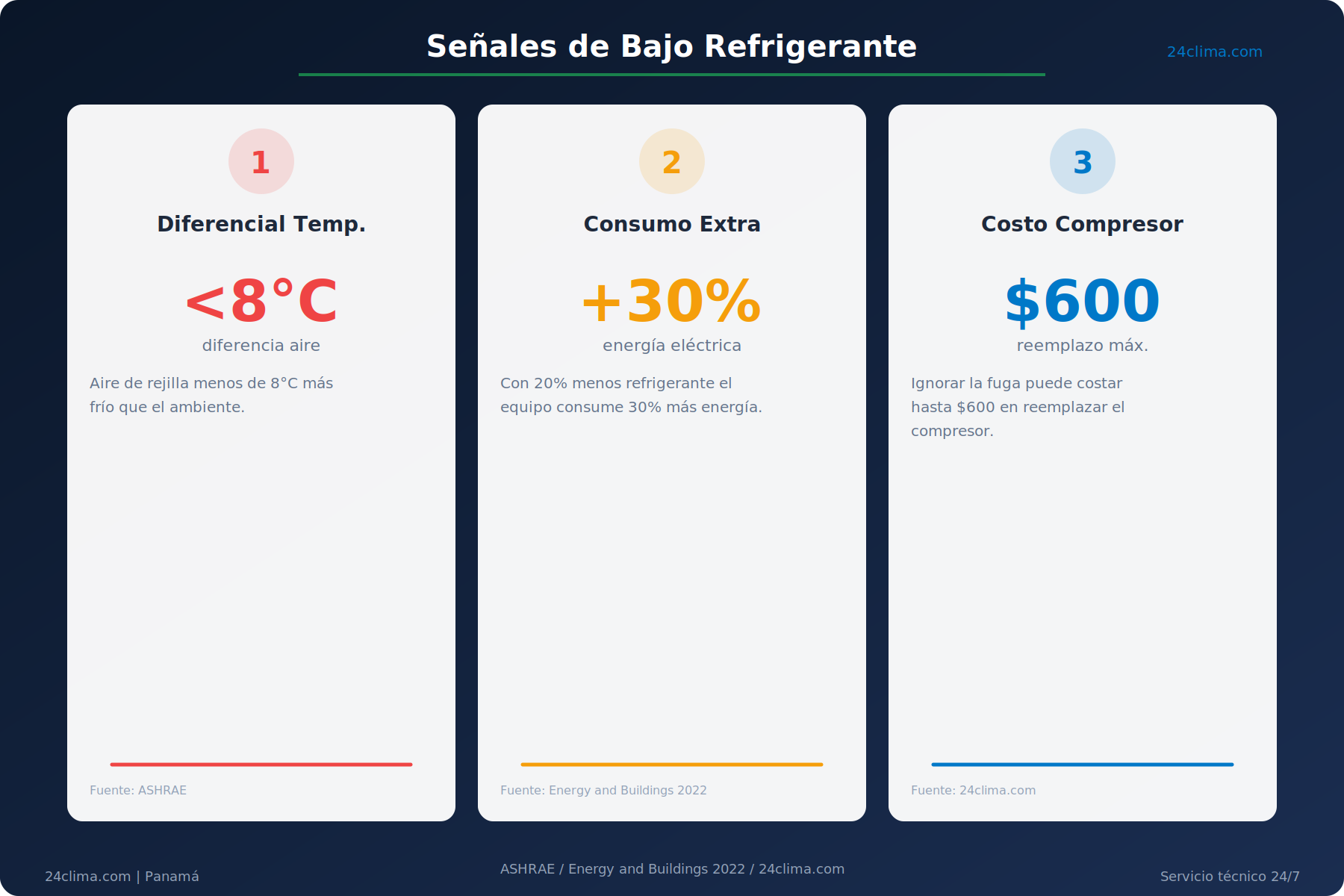
A unit running low on refrigerant doesn't fail suddenly. It sends clear signals for weeks or months before things get serious. Catching those signals early can save you the cost of a new compressor — a replacement that runs between $350 and $600 in Panama depending on unit capacity.

The unit cools, but never reaches the temperature you set

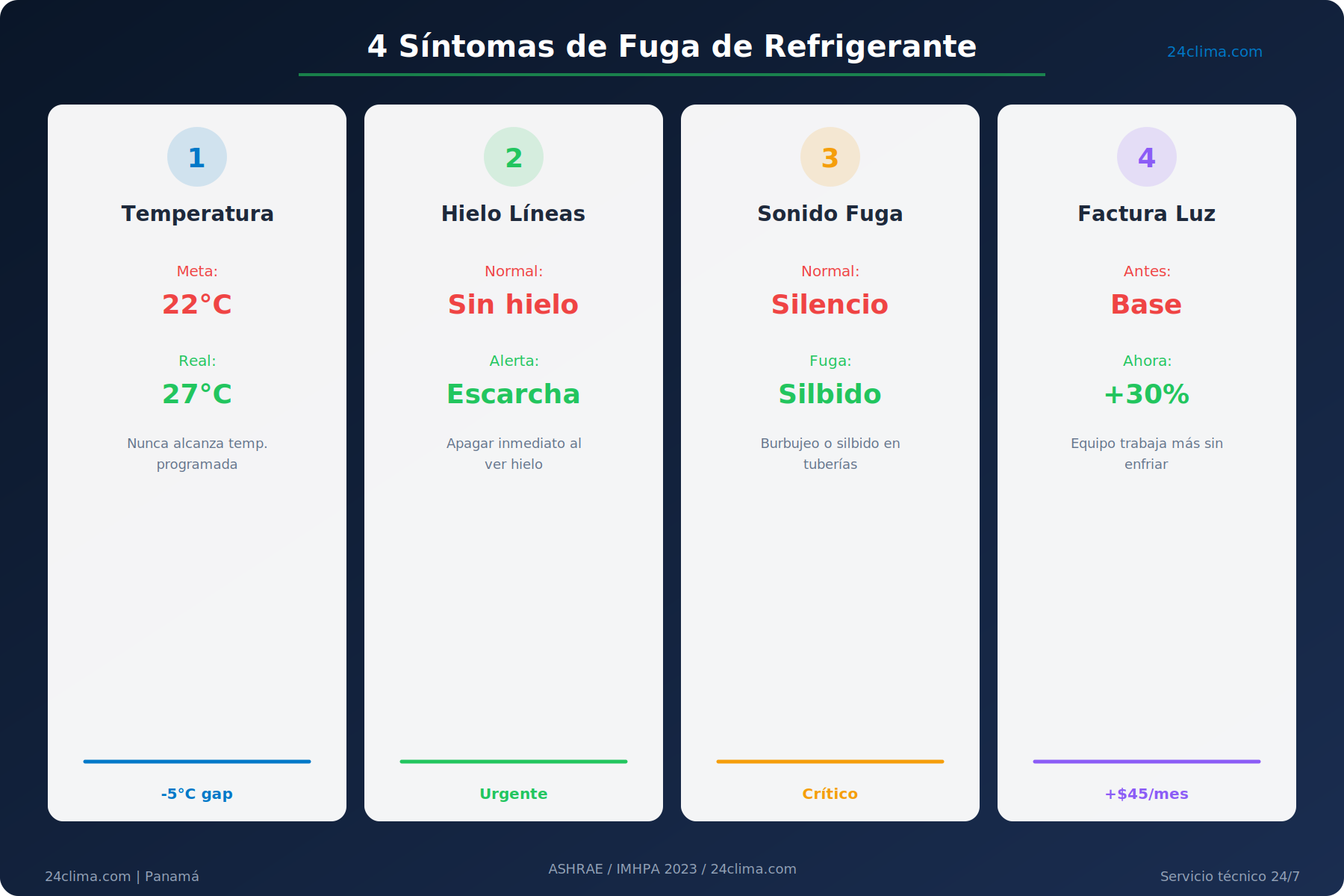
You program the thermostat to 72°F (22°C) and the room sits at 81°F (27°C). The compressor runs continuously without pulling the temperature down. There simply isn't enough refrigerant to extract the full heat load from the space. In Panama, where outdoor temperatures average around 88°F (31°C) with relative humidity regularly exceeding 85% according to Panama's Institute of Meteorology and Hydrology (2023), the system is already working near its limit. With low refrigerant, there's no margin left.

The air coming out feels cool-ish, not cold

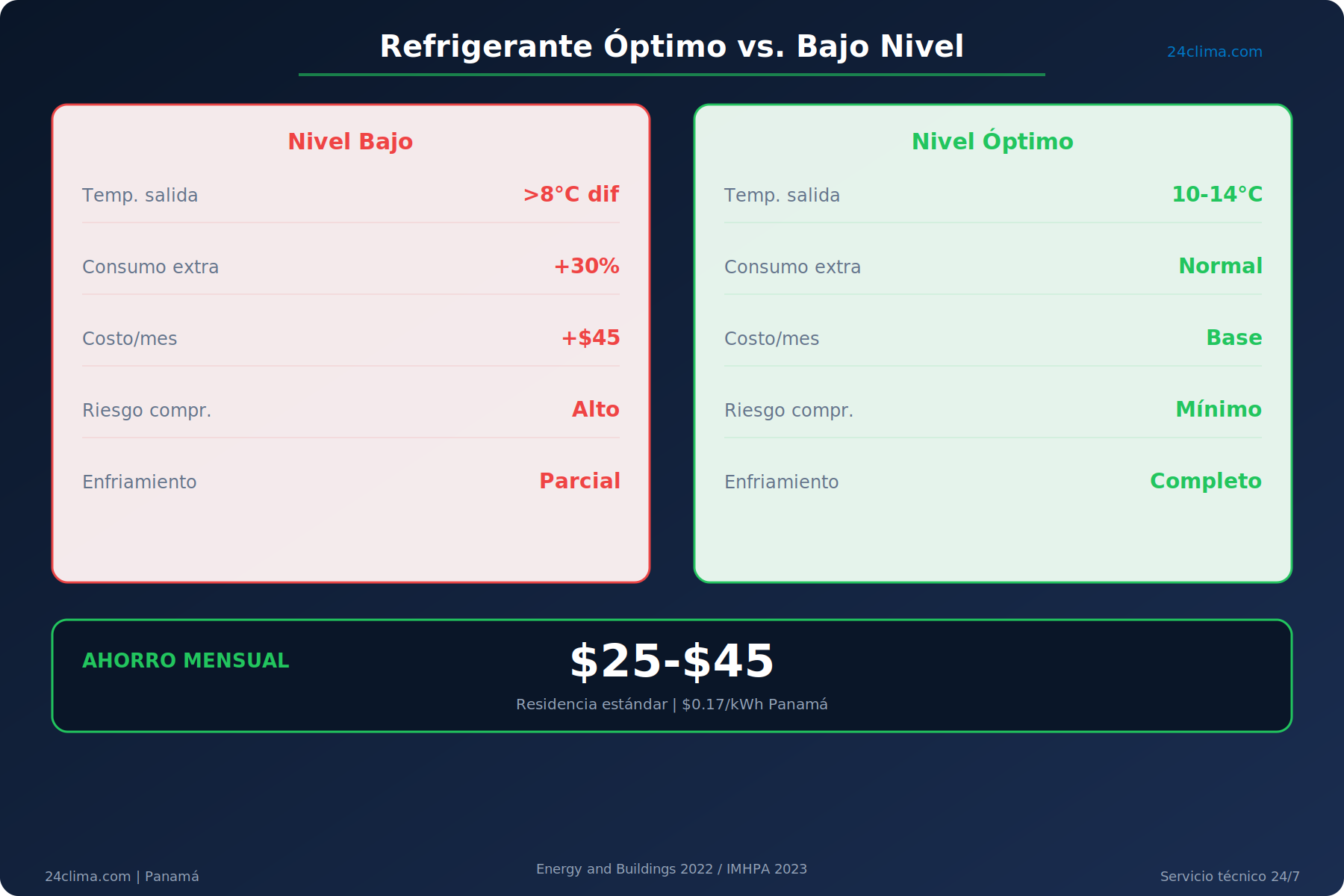
Hold your hand in front of the indoor unit's air outlet. A properly functioning system blows air that's 18 to 25°F (10 to 14°C) colder than the ambient room temperature. If the difference is less than 14°F (8°C), refrigerant levels are likely low. Technicians call this the temperature differential — it's one of the first checks in any professional diagnosis.

Ice forming on the lines or outdoor unit

It seems backward: the unit isn't cooling well, yet ice is forming on the outside. It happens because refrigerant at low pressure absorbs heat so aggressively that it freezes the moisture in the air around the copper lines. If you see frost or ice on the lines or evaporator coil, turn the unit off immediately and call a technician. Running the system with ice buildup will damage the compressor.

Bubbling or hissing near the outdoor unit

A bubbling sound from the refrigerant lines usually means air is present in the circuit or the refrigerant mix is off — both signs of an active leak. A sharp hissing sound points to pressurized gas escaping. Either one calls for an immediate diagnosis.

Your electricity bill spiked for no obvious reason

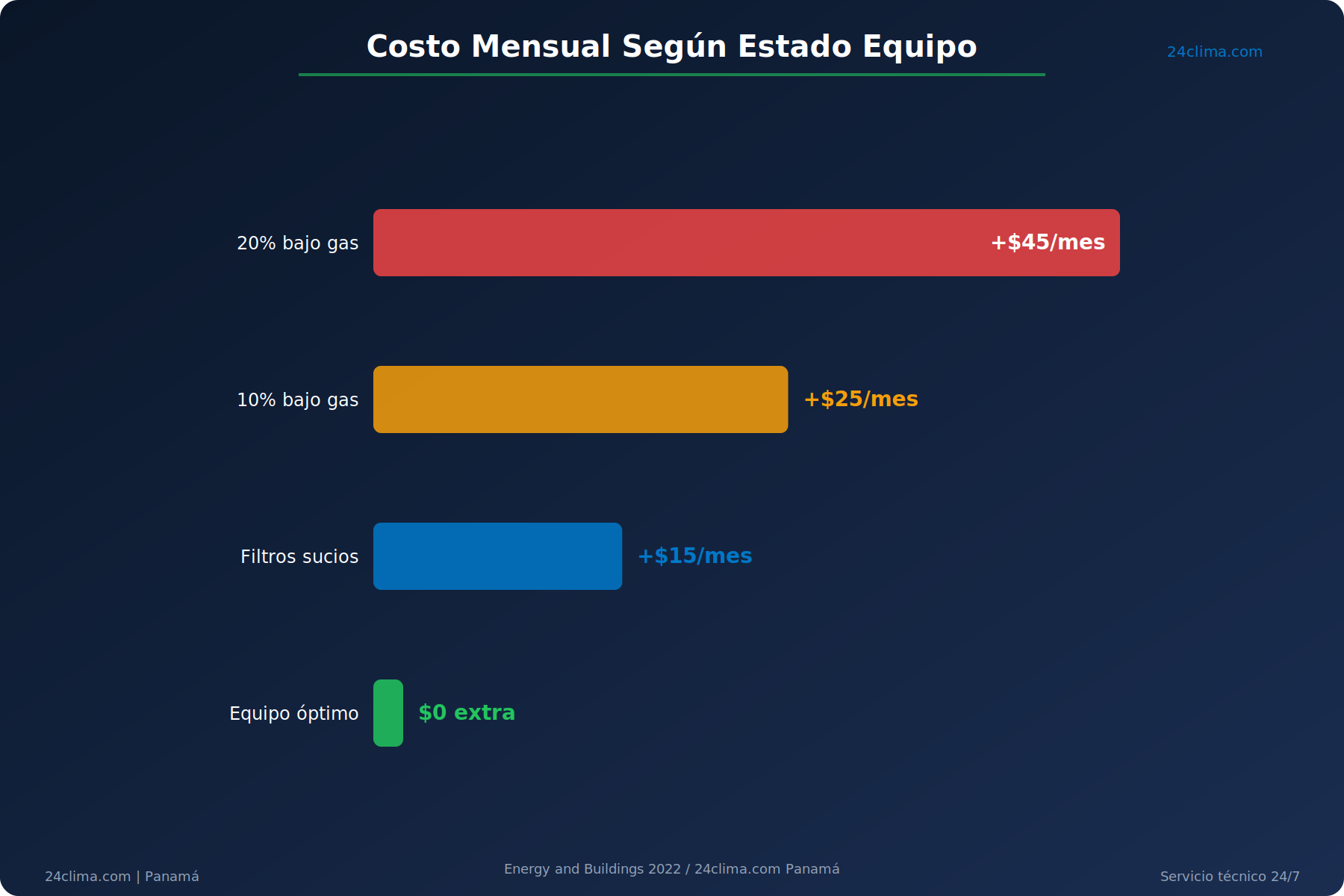
An AC running low on refrigerant stays on longer trying to hit the set temperature. According to a study published in Energy and Buildings (2022), a system operating at 20% below optimal refrigerant level consumes up to 30% more electricity. In Panama, where the average cost per kilowatt-hour runs around $0.17, that translates to $25 to $45 extra per month in a typical residence.

Low Refrigerant or Dirty Filters? How to Tell the Difference

An AC that isn't cooling properly could have low refrigerant — or it could simply have clogged filters. The diagnosis matters because the fix is completely different.

The practical distinction: if the filters are blocked, the unit cools poorly but the air coming out still feels cold to the touch. If the problem is low refrigerant, the air coming out isn't cold even after the unit has been running for hours.

Before you call a technician, run through this checklist:

— When did you last clean or replace the filter? If it's been more than three months, start there. — Does the air coming out of the indoor unit feel cold when you hold your hand directly in front of it? If yes, refrigerant is probably not the issue. — Is there visible frost or ice on the copper lines? If yes, switch the unit off and call — this is urgent. — Is the system more than 8 years old? Older units have a higher rate of refrigerant leaks from worn valves and fittings.

If cleaning the filters doesn't solve it, the next step is a professional diagnosis using manifold gauges. A technician measures the high-side and low-side pressures to determine whether refrigerant levels are correct for the conditions of that specific day. In Panama, a diagnostic like this typically costs between $20 and $40. At 24Clima, we always run this check before any recharge — we're not going to charge you for something your unit doesn't actually need. You can learn more about our preventive maintenance service at https://24clima.com/servicios/mantenimiento/.

R32 vs R410A — Which One Does Your Unit Use and Why It Matters

The type of refrigerant in your system determines the recharge cost, how easy it is to source the gas in Panama, and the environmental footprint of the service. This distinction became especially relevant after 2022, when the Panamanian market began shifting toward refrigerants with lower global warming potential.

R410A is the standard refrigerant in most units installed in Panama before 2020. It's a blend of two gases (R32 and R125) with a Global Warming Potential (GWP) of 2,088 — more than 2,000 times more damaging than CO₂ over a 100-year timeframe, according to the Intergovernmental Panel on Climate Change (IPCC). R410A operates at high pressures, typically between 235 and 400 PSI under normal working conditions.

R32 is what you'll find in most new units sold in Panama since 2021. Its GWP is 675 — roughly 68% lower than R410A. It runs at similar pressures but with better energy efficiency: manufacturers report 10% to 15% gains under equivalent conditions. It's also a pure gas rather than a blend, which simplifies the recharge process — small losses can be topped up without evacuating the entire system first.

One critical point: R32 and R410A cannot be mixed in the same system. They are incompatible. A technician who adds R32 to an R410A unit — or the other way around — will cause serious compressor damage. Always check the label on the outdoor unit before booking any service.

AC Refrigerant Recharge Prices in Panama — 2025

The prices below come from real service quotes in Panama during the first quarter of 2025. They include labor and the cost of refrigerant, but do not include leak repair if a leak is found — that carries an additional charge depending on the location and type of leak.

R410A Recharge — 9,000 to 12,000 BTU unit (1 ton): — Miraflores / Clayton / Albrook: $75 to $95 — Costa del Este / Punta Pacífica: $85 to $110 — La Chorrera / Arraiján: $65 to $80

R410A Recharge — 18,000 to 24,000 BTU unit (1.5 to 2 tons): — Miraflores / Clayton / Albrook: $100 to $130 — Costa del Este / Punta Pacífica: $115 to $145 — La Chorrera / Arraiján: $85 to $105

R32 Recharge — 9,000 to 12,000 BTU unit: — Miraflores / Clayton / Albrook: $65 to $85 — Costa del Este / Punta Pacífica: $75 to $100 — La Chorrera / Arraiján: $55 to $75

R32 Recharge — 18,000 to 24,000 BTU unit: — Miraflores / Clayton / Albrook: $90 to $120 — Costa del Este / Punta Pacífica: $100 to $130 — La Chorrera / Arraiján: $75 to $95

A note on where prices are headed: R410A costs have been climbing in Panama since 2023, driven by import restrictions under the Kigali Amendment, which requires countries to progressively reduce their consumption of high-GWP HFC refrigerants. Market estimates put additional price increases of 20 to 30% between 2025 and 2027 as import quotas tighten further. If your unit still runs on R410A, that's worth factoring into any repair-versus-replace decision.

What a Technician Actually Does During a Recharge — Step by Step

Knowing the process lets you verify that the technician you hire is doing the full job — not just connecting a cylinder and charging you for gas.

Pressure diagnosis: the technician connects manifold gauges to the service ports and measures high-side and low-side pressures, then compares them against the correct ranges for the refrigerant type and the ambient temperature that day. This step confirms whether low refrigerant is actually the problem.

Leak detection: before adding any refrigerant, the technician has to find where it's escaping. This is done with an electronic leak detector or by applying soapy water to fittings and valves. Without locating and fixing the leak, the recharge will last months, not years.

Leak repair: depending on where the leak is, the fix might involve copper brazing, replacing Schrader valves, or tightening fittings. This work carries an additional charge.

System evacuation (when needed): if the loss was significant or if moisture has entered the system, the technician pulls a vacuum before recharging. The vacuum removes moisture and air from the circuit, protecting the compressor and expansion valves from damage.

Refrigerant charge: gas is added by weight or pressure, following the manufacturer's specifications. Overcharging is just as damaging as undercharging. A competent technician weighs the refrigerant being added on a digital scale — if you don't see a scale, ask.

Final verification: the technician remeasures pressures and checks the air temperature at the indoor unit's outlet to confirm the system is operating within the correct range.

Frequently Asked Questions

How often does an AC need to be recharged in Panama?

In a system with no leaks, never. Refrigerant doesn't get consumed or degrade through normal use. If your unit has needed a recharge more than once in five years, you have an active leak that needs to be repaired. The annual "preventive recharge" that some technicians offer has no technical basis and is an unnecessary expense.

How much does an AC refrigerant recharge cost in Panama in 2025?

In Panama City in 2025, prices range from $65 to $145 depending on the type of refrigerant (R32 or R410A), the unit's BTU capacity, and the neighborhood where the service is performed. R410A units cost more to recharge because the gas is more expensive and increasingly difficult to source. Leak repairs, if required, are charged separately.

How do I know if my AC needs refrigerant or has a different problem?

The most reliable indicator is the temperature of the air coming out of the indoor unit. If it doesn't feel cold to the touch after 15 minutes of operation, low refrigerant is a real possibility. If the air is cold but the room won't cool down, the issue may be unit sizing, blocked filters, or air leaks in the space itself. A professional diagnosis with manifold gauges settles the question in about 20 minutes. You can also use our diagnostic tool at https://24clima.com/diagnostico/ to get an initial read before calling a technician.

Back to That Afternoon in Costa del Este

The unit blowing warm air at two o'clock might need a refrigerant recharge — or it might need a deep cleaning, a leak repair, or just a new filter. A correct diagnosis versus a wrong one can mean $200 in services you didn't need, or a compressor that could have been saved with the right call at the right time.

At 24Clima, we've been working in Panama's specific climate for more than five years. We know that a unit in Punta Pacífica faces different conditions than one in Clayton, and that the correct service pressure on a 93°F (34°C) day isn't the same as on an 82°F (28°C) one. If your AC isn't cooling the way it should, reach out to us on WhatsApp at https://24clima.com/contacto/ — we run the diagnosis first and explain exactly what your unit needs before charging you for anything.