Inverter Air Conditioners in Panama — How Much Do You Actually Save on Your Electric Bill?
It's 2 PM in Costa del Este. The sun is straight overhead, beating down on the asphalt, and the humidity wraps around you like a wet blanket the moment you step outside. You walk into your apartment, flip on the split unit in the living room, and ten minutes later the room drops to a comfortable 75°F (24°C). Perfect. Until the ENSA bill arrives at the end of the month and the number hits you like a punch to the chest: $180, $210, sometimes more.
You go through the breakdown. The air conditioner isn't the only culprit, but it's the main one. Then a coworker mentions "inverter" units — the ones that "use way less electricity." You head over to a store in Albrook Mall, the salesperson shows you an LG Dual Cool 12,000 BTU for $650, and your first thought is: "My regular split cost $320. Why would I pay twice as much?"
That is exactly the right question. And the answer, once you run the numbers against Panama's actual electricity rates, completely changes the decision.
What Most People Get Wrong About AC Costs
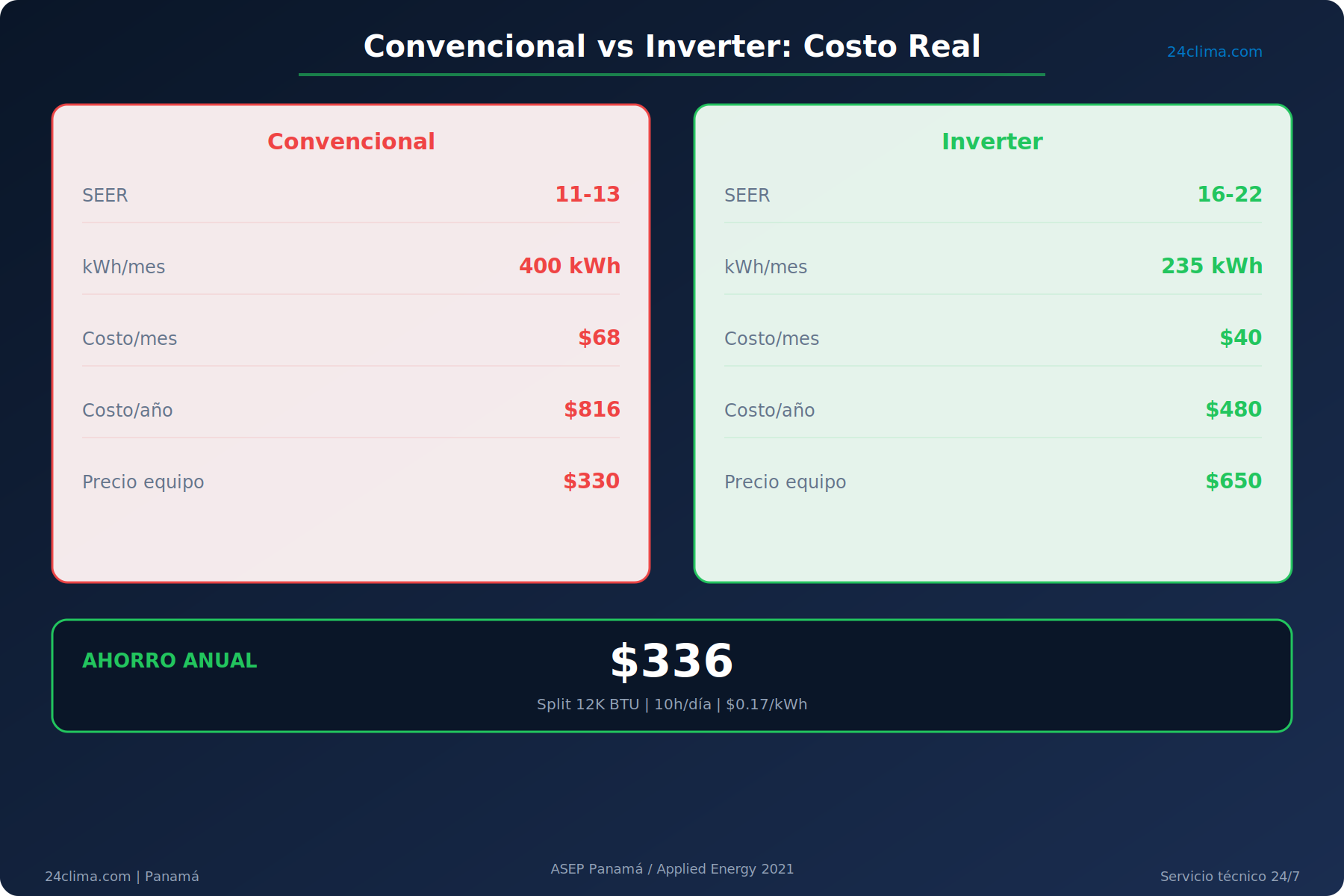
The most common assumption is that purchase price is the real cost of an air conditioner. A conventional 12,000 BTU split runs between $280 and $380 in Panama. An equivalent inverter model goes for $550 to $750. That visible gap of $250 to $370 looks significant — but it's only the entry cost, not what it costs to run the equipment for five, eight, or twelve years.
The mistake is ignoring monthly electricity consumption. In Panama, where the average residential rate sits around $0.17 per kWh according to ASEP (Panama's National Public Services Authority), a unit that pulls 200 extra kWh per month costs you $34 more — every single month. Over twelve months, that's $408. Over three years, $1,224.
Total cost of ownership completely transforms the comparison. The "cheap" unit can easily end up being the most expensive thing you ever bought.
How Inverter Technology Works — And Why It Matters in the Tropics
An inverter air conditioner uses less electricity because its compressor doesn't run at a fixed speed. It continuously modulates its output based on how much cooling the room actually needs at any given moment.
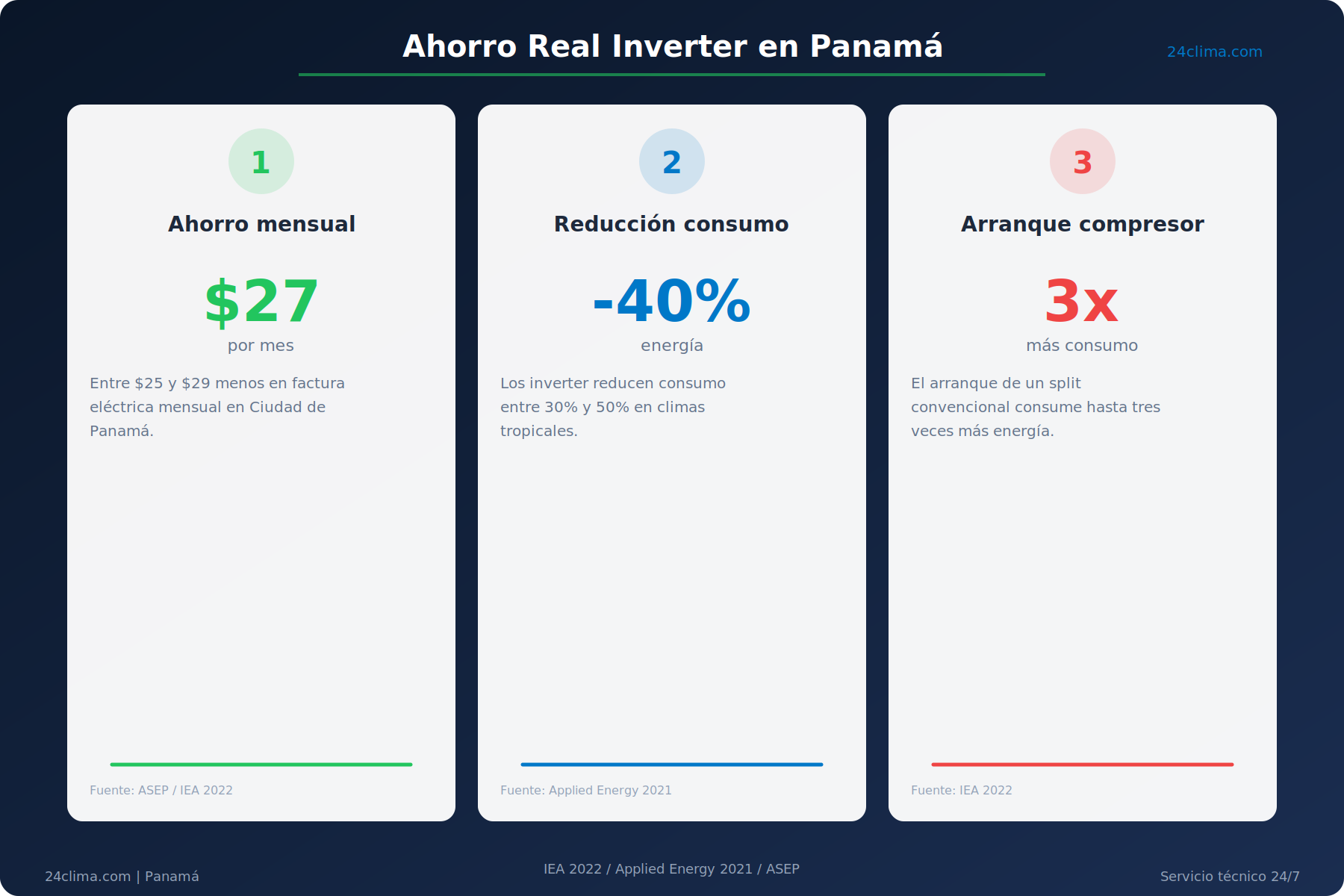
A conventional split operates in only two modes: full blast or completely off. When the room reaches the target temperature, the compressor shuts down. When the heat creeps back up — and in Panama, at 88°F (31°C) and 85% humidity, it comes back fast — the compressor kicks back on at 100%. That startup cycle consumes up to three times more energy at the moment of ignition, according to data from the International Energy Agency (IEA, 2022). In an apartment in Miraflores or San Francisco with limited shade, that cycle repeats every 8 to 12 minutes throughout the entire day.
An inverter unit starts up once and then dials back to 30–40% of its capacity to hold the temperature steady. No energy spikes. No repeated restarts. The compressor runs continuously but at low intensity — like a runner pacing a jog instead of sprinting and stopping over and over.
The Actual Consumption Numbers: Conventional vs. Inverter in Panama
A conventional 12,000 BTU split draws roughly 1,200 to 1,350 watts when running. Factor in the frequent restart cycles that a tropical climate forces on it, and the real average consumption over 10 hours of daily use lands between 380 and 420 kWh per month.
A 12,000 BTU inverter with a SEER 18 rating (Seasonal Energy Efficiency Ratio) uses between 220 and 250 kWh per month under the same conditions. That difference of 150 to 170 kWh per month, at $0.17 per kWh, produces real-world savings of $25.50 to $28.90 per month in Panama City conditions.
A study published in the journal Applied Energy (2021) found that inverter air conditioners reduce energy consumption by 30% to 50% compared to fixed-speed units in tropical climates. At the conservative end, 30% savings on 400 monthly kWh means 120 kWh saved — $20.40 per month. At the upper end, 50% savings works out to $34 per month.
For a family in Punta Pacífica running the AC 10 hours a day year-round, annual savings range from $245 to $408, depending on the specific unit and apartment conditions.
SEER Efficiency Comparison: Brands Available in Panama
SEER measures how many units of cooling a system delivers for each unit of energy consumed. Higher SEER means lower bills.
The brands with the strongest presence in the Panamanian market and their SEER ranges for 12,000 BTU inverter models:
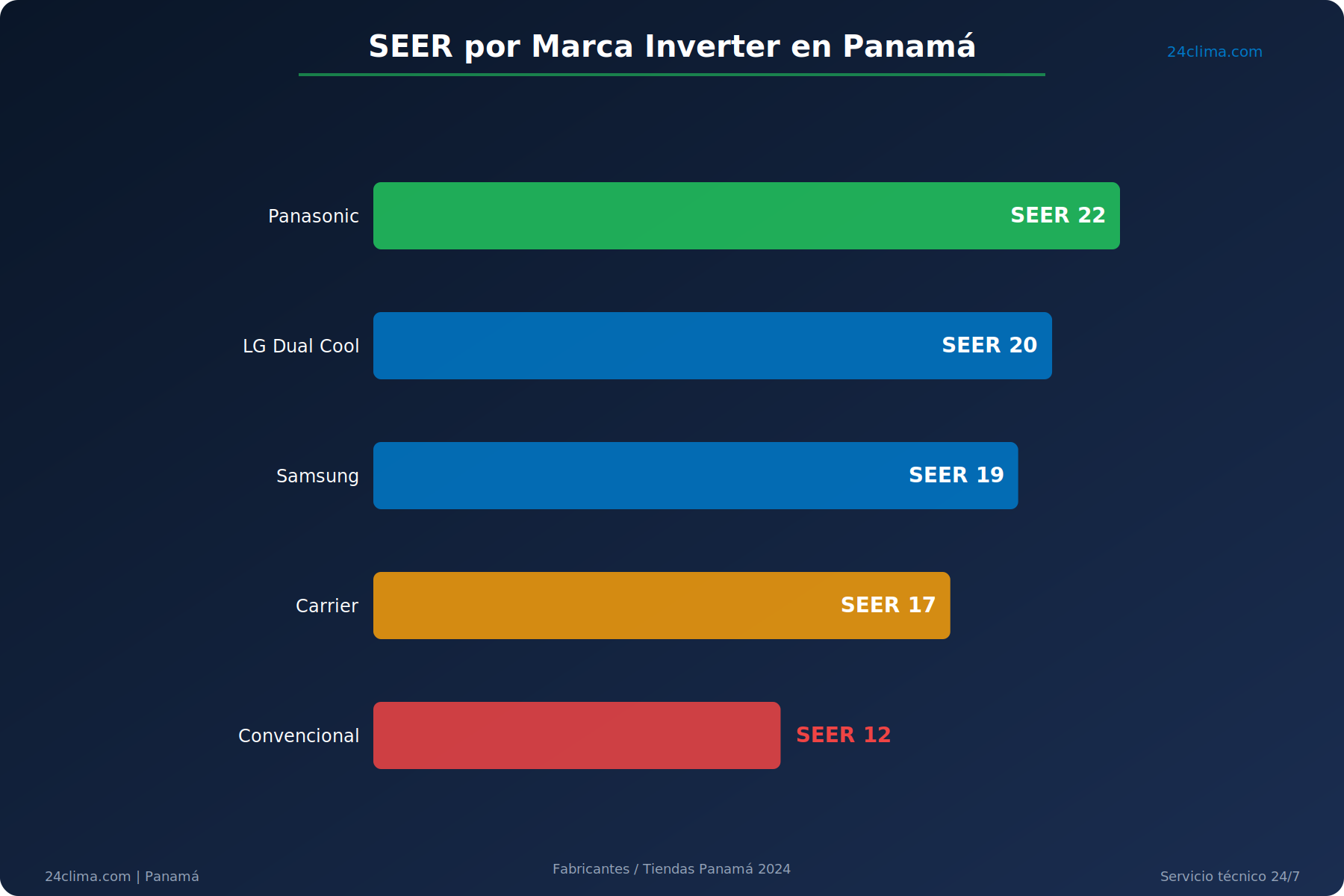
— LG Dual Cool: SEER 16 to SEER 22 (model LSNC122HV4: SEER 20.5). Reference price in Panama: $599 to $749. — Samsung Wind-Free: SEER 17 to SEER 21 (model AR12TXHQASINZ: SEER 19). Reference price: $620 to $720. — Panasonic Etherea: SEER 18 to SEER 23 (model CS-Z12XKEW: SEER 22). Reference price: $680 to $850. — Carrier Performance Series: SEER 16 to SEER 19 (model 38MURA012: SEER 17). Reference price: $550 to $680.
Conventional 12,000 BTU units available in Panama typically land between SEER 11 and SEER 13. The gap between a SEER 12 unit and a SEER 20 unit, under identical usage conditions, can push monthly consumption up to 40% higher on the conventional side.
Return on Investment: How Many Months Until You Break Even?
The ROI on switching to an inverter comes down to three variables: the purchase price of each unit, actual monthly electricity savings, and how many hours a day you run the AC.
Take the most common scenario in Panama City: a two-bedroom apartment in Obarrio, AC running 10 hours a day, 12 months a year. Conventional 12,000 BTU unit at $320 versus an LG inverter 12,000 BTU at $650.
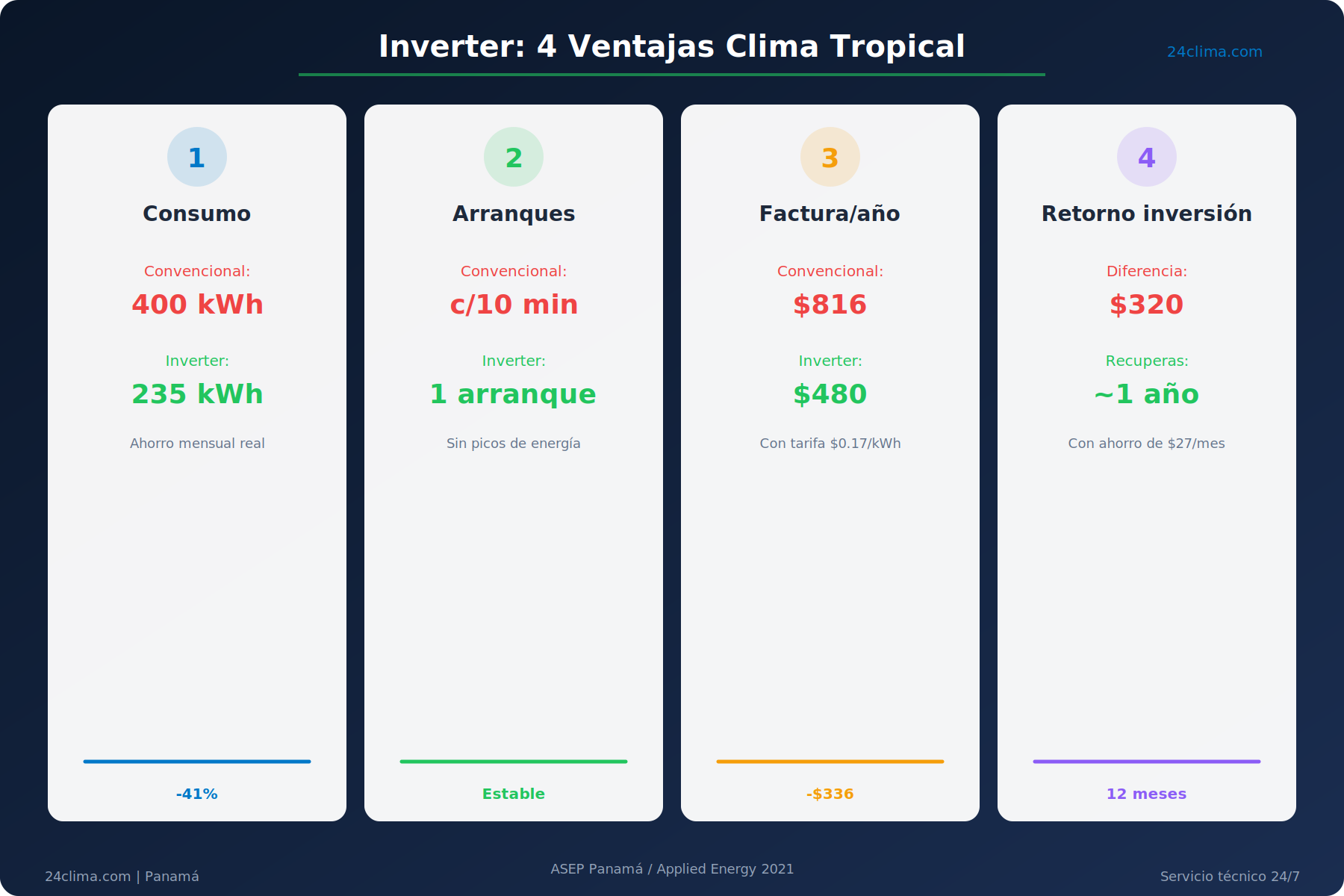
Upfront price difference: $330. Estimated monthly electricity savings: $27 (150 kWh saved at $0.17/kWh). Months to break even: $330 ÷ $27 = 12.2 months.
Just over a year, and the inverter has paid for its own premium. From month 13 onward, every month it runs generates $27 in net savings. If the unit lasts 12 years — the average lifespan of an inverter with regular maintenance — accumulated savings exceed $3,500 on top of that initial $330 price difference.
If usage is lighter, say 6 hours a day in a guest bedroom, breakeven stretches to 20–24 months. Still favorable, but it takes more patience.
For heavy-use environments — offices in Costa del Este running 12 or more hours daily — the ROI can drop below 10 months.
The pattern is clear: the more hours you run it, the faster you recover the investment.
Does It Make Sense in Clayton or Las Cumbres?
In higher-elevation neighborhoods like Clayton (around 330 feet / 100 meters above sea level) or Ancón, outdoor temperatures average 1 to 2°C (2 to 4°F) lower than on the coast. The inverter operates under a lighter thermal load and spends even more time in low-speed mode, which widens its efficiency advantage over a conventional unit.
In homes in Las Cumbres, Juan Díaz, or Pacora — where zinc roofing is common and solar exposure is intense — the thermal load goes up. The inverter still outperforms a conventional unit, but the dollar savings can run slightly lower because both systems work harder overall. In those situations, the SEER rating of the unit you choose matters more. A Panasonic Etherea SEER 22 or an LG SEER 20 delivers a significantly larger advantage than a basic SEER 16 inverter.
For homes with multiple rooms to cool, each additional inverter unit multiplies the savings. Replacing three conventional splits with three inverter units can add up to $75 to $90 in total monthly savings on your ENSA or EDEMET bill.
Frequently Asked Questions About Inverter AC in Panama
How much does an inverter air conditioner actually save compared to a conventional unit in Panama?
A 12,000 BTU inverter running 10 hours a day in Panama City consumes between 220 and 250 kWh per month, versus 380 to 420 kWh for an equivalent conventional unit. At Panama's residential rate of $0.17 per kWh, real monthly savings range from $25 to $34, depending on the model and the space. Over a full year, that translates to $300 to $408 less on your electricity bill.
How long does it take to recover the cost difference with Panama's electricity rates?
With an upfront price gap of $280 to $350 between an inverter and a conventional unit of equal capacity, and monthly savings of $25 to $34, the payback period under heavy use (10 hours daily) is 9 to 14 months. After that point, the unit generates net savings every month. Under moderate use of 6 hours daily, breakeven falls between 18 and 24 months.
Which inverter brand uses the least electricity in a tropical climate?
Among brands available in Panama, Panasonic Etherea at SEER 22 offers the highest documented efficiency under tropical conditions. LG Dual Cool at SEER 20 is the top-selling option and delivers an excellent balance of price and performance. Samsung Wind-Free stands out by reducing the sensation of direct cold airflow, which lets you set the thermostat slightly higher without losing comfort — cutting consumption even further. Carrier is a reliable choice but generally carries a lower SEER rating than the other three at comparable price points.
The Practical Recommendation for Panama City
If you have a conventional split that's been running for more than 5 years and your electricity bill already exceeds $120 per month with a single unit, the switch to inverter is justified without running complicated calculations. That old unit is already consuming more than its nameplate rating suggests — compressor degradation and refrigerant loss are real — and it's competing against a new inverter that runs at 35% capacity for hours at a time.
For apartments between 650 and 1,300 square feet (60 to 120 square meters) in Miraflores, El Cangrejo, San Francisco, or Costa del Este, a 12,000 BTU inverter with a minimum SEER of 18 is the right call. For single-story homes in Villa Zaíta, Las Cumbres, or Pacora with zinc roofing and high solar exposure, step up to an 18,000 BTU inverter for the main living area and keep 12,000 BTU inverter units in the bedrooms.
An inverter is not a luxury purchase. It's the unit that costs you less over the next ten years — even if it costs more on the day you buy it.
At 24Clima, we assess your space, your usage patterns, and your current bill to recommend the unit with the shortest possible ROI for your specific situation. No commitment required — we calculate it together. You can find more technical articles on efficiency and maintenance in our consejos y guías section at https://24clima.com/consejos-y-guias/ or reach us directly on WhatsApp at https://24clima.com/contacto/ for a no-cost evaluation.
Last updated: June 2025. Electricity rate data based on published figures from ASEP Panama. Consumption estimates based on conditions of 88°F (31°C) outdoor temperature, 85% relative humidity, and 10 hours of daily operation.