Inverter Air Conditioning — How Much Money Does It Actually Save on Your Panama Electric Bill?
Last updated: May 2025
It's 9 PM in Costa del Este. The outdoor thermometer reads 30°C (86°F) and humidity is hovering around 82%. You walk into your apartment, flip on the living room split, and hear that familiar click — the compressor kicks on at full power. Half an hour later, the room is finally cool. But at the end of the month, when the Naturgy bill arrives, the number hits you hard: $180, $210, sometimes more.
Your upstairs neighbor has the exact same size apartment, runs their AC more hours than you do, and their bill averages $130. The difference isn't about thermostat settings or keeping windows closed. It's inside the compressor.
That difference has a name: inverter technology. And the question we get most often at 24clima isn't "which brand is best?" — it's "how much will I actually save, in real dollars, on my Panama electricity bill?" That's what you'll find out here — with real numbers, real Naturgy rates, and zero marketing spin.
For more technical breakdowns like this one to help you make smarter buying decisions, check out our guides and tips section.
What Most People Get Wrong About Inverter AC Units
The most common misconception is thinking that an inverter "uses fewer watts" in some absolute sense — as if the unit were physically smaller or less powerful. We hear this constantly: "I bought a 12,000 BTU inverter and the box says 900 watts — the conventional one said 1,200 watts, so I save 300 watts. That's it?"
No. That comparison measures power draw at the nominal operating point, not actual consumption over 8 hours of running in a Panama apartment.
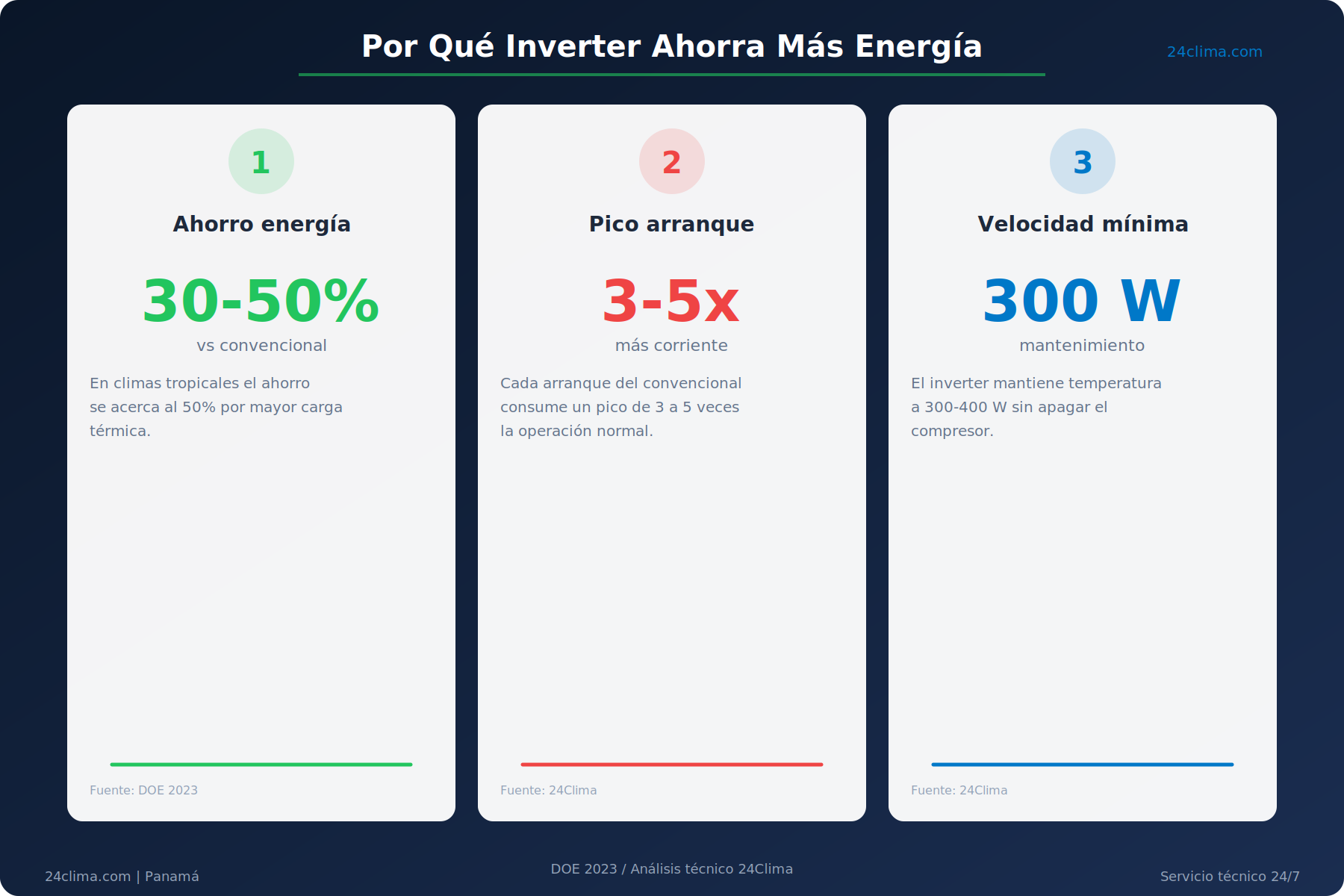
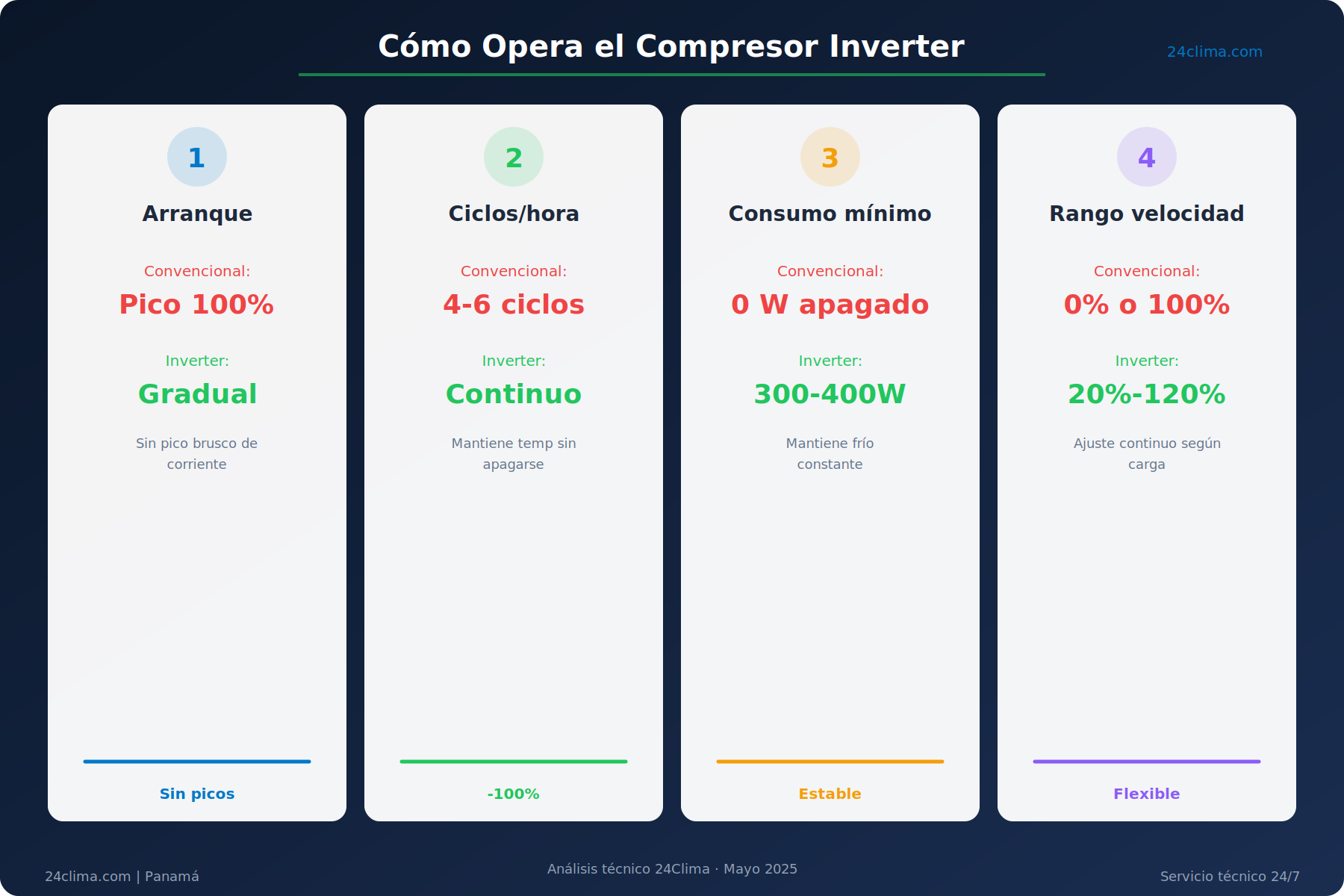
A conventional AC works in a binary cycle: compressor fully on or fully off. On, off. On, off. Every startup draws a current spike 3 to 5 times higher than normal operation — the electrical equivalent of stop-and-go traffic on Via España versus cruising at steady speed on the Panama-Colón highway. An inverter continuously adjusts compressor speed between 20% and 120% of its capacity. Once the room hits the target temperature, the compressor doesn't switch off — it drops to minimum speed and holds there. No spikes. No wasted energy.
According to data from the U.S. Department of Energy (DOE, 2023), inverter units consume between 30% and 50% less energy than equivalent conventional models under sustained-use conditions. In tropical climates like Panama's — where the unit runs more hours and faces higher thermal loads — that percentage tends toward the upper end of the range.
The Step-by-Step Calculation: Inverter vs. Conventional in Panama
A 12,000 BTU inverter AC in Panama, running 8 hours a day, consumes approximately 120–150 kWh per month. A conventional unit of the same capacity, under the same conditions, consumes between 200 and 240 kWh monthly. At Naturgy's residential rate in Panama (approximately $0.155 per kWh in the mid-consumption block), that gap runs $8 to $14 per month — per unit installed.
Here's the full calculation with precise numbers.
Conventional 12,000 BTU Unit
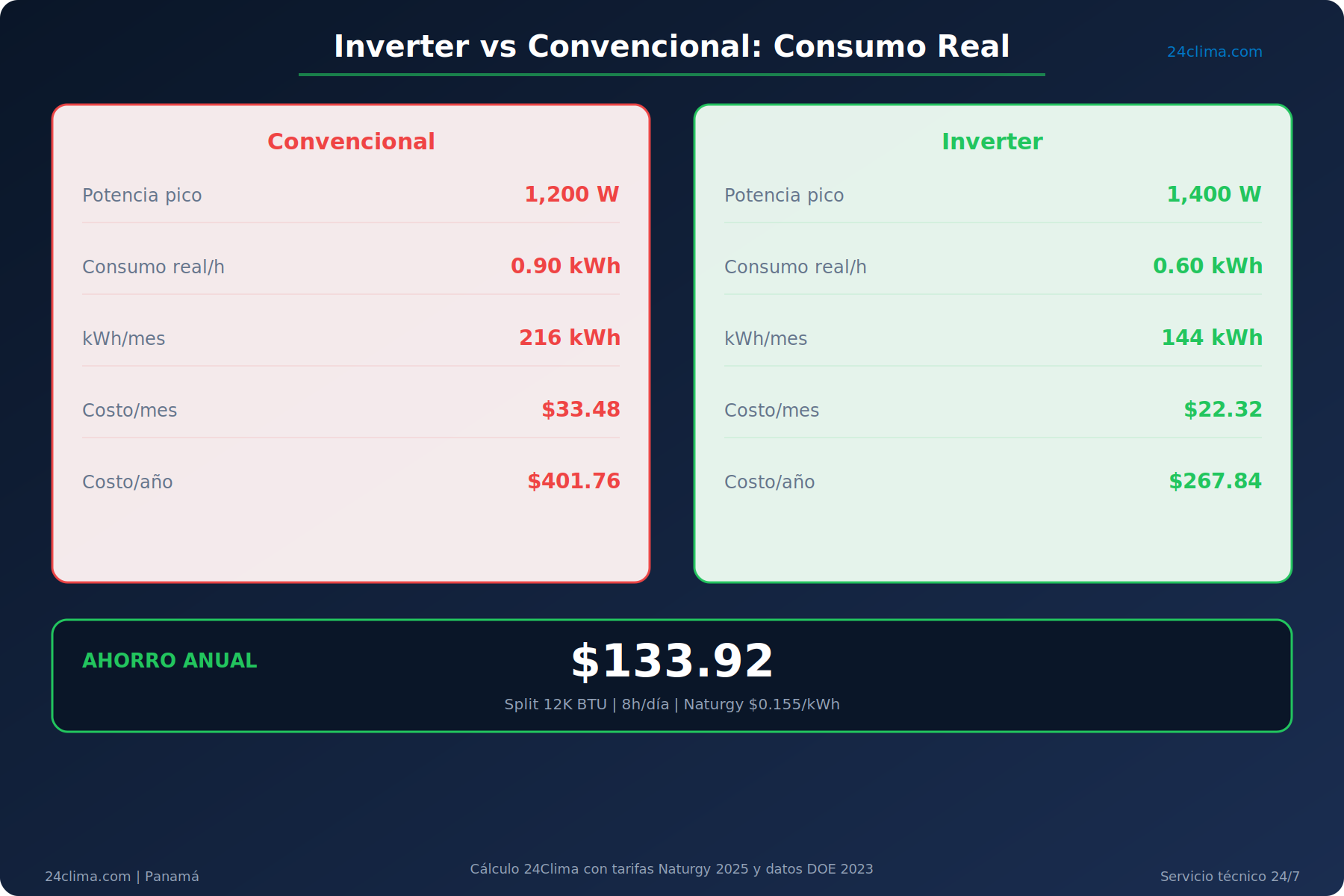
Nominal compressor power: 1,200 watts (1.2 kW) On/off cycle factor in tropical climate: compressor runs actively 70–80% of operating time Actual consumption per hour of operation: 1.2 kW × 0.75 (average cycle factor) = 0.90 kWh/hour Over 8 hours daily: 0.90 × 8 = 7.2 kWh/day Over 30 days: 7.2 × 30 = 216 kWh/month Monthly cost at $0.155/kWh: 216 × $0.155 = $33.48/month
Inverter 12,000 BTU Unit
Startup power: up to 1,400 watts (soft start, no abrupt spike) Power in maintenance mode (70–80% of operating time): 500–700 watts Weighted average real consumption per hour: 0.75 kW/hour Over 8 hours daily: 0.75 × 8 = 6.0 kWh/day
That difference looks small so far. The real story is what happens after the room is already cool.
A conventional unit that reaches 23°C (73°F) shuts the compressor off. In Panama, with heat-absorbing walls and humidity constantly creeping back in, the room climbs back to 25°C (77°F) within 10–15 minutes. The compressor fires back up at 100%, pulls that current spike, and repeats the cycle 4 to 6 times an hour. An inverter in that same room drops to 300–400 watts and holds 23°C (73°F) continuously.
Actual inverter consumption averaging the full cycle: 0.55–0.65 kWh/hour Over 8 hours daily: 0.60 × 8 = 4.8 kWh/day Over 30 days: 4.8 × 30 = 144 kWh/month Monthly cost at $0.155/kWh: 144 × $0.155 = $22.32/month
The Real Difference
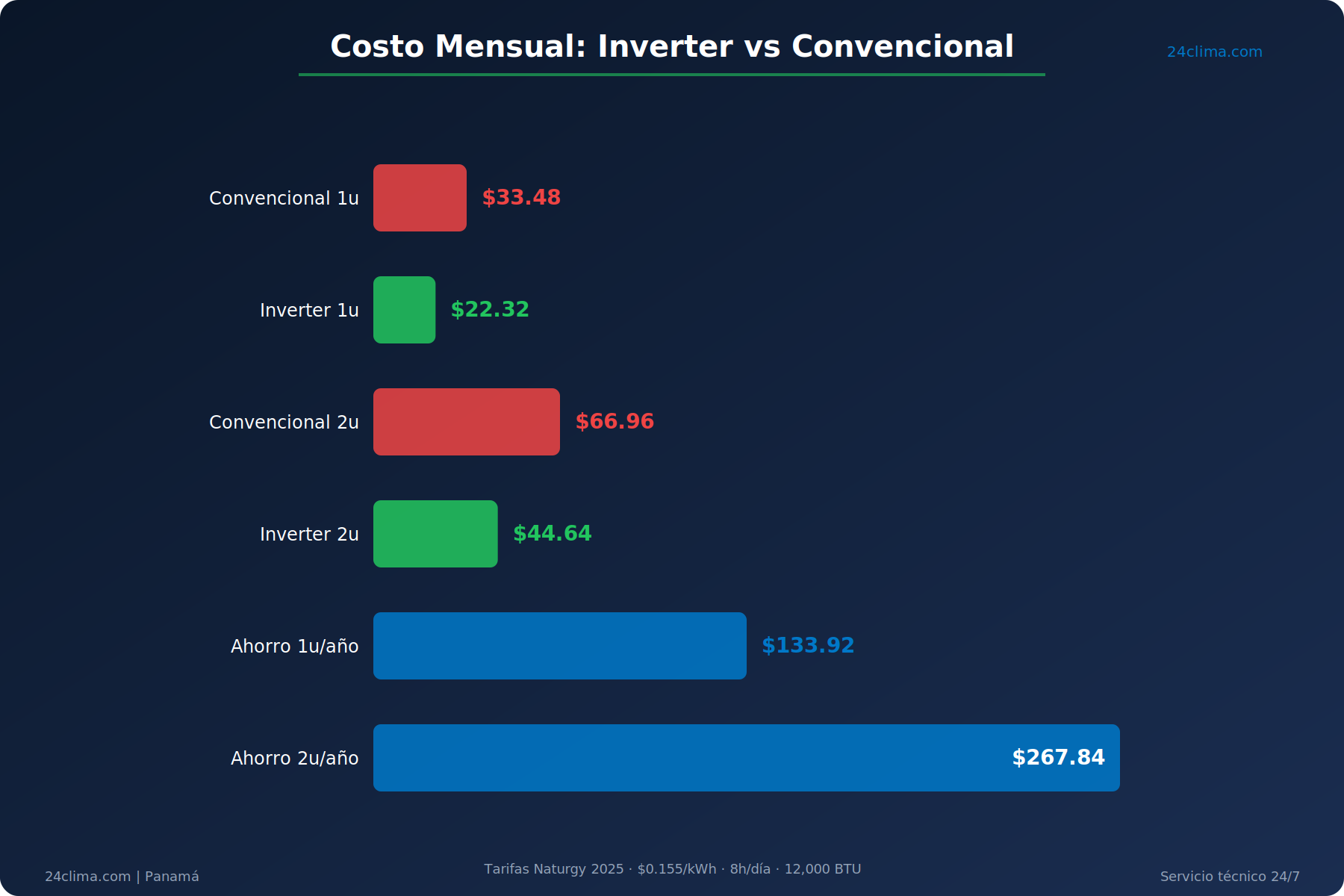
Monthly savings (8 hours/day): $33.48 − $22.32 = $11.16 per unit Annual savings: $11.16 × 12 = $133.92
Two units — living room and master bedroom, the standard setup in a 2-bedroom apartment in San Francisco or Marbella — and that savings jumps to $267 per year.
Three Usage Scenarios: How Much You Save Based on Hours Operated
Inverter savings scale directly with how many hours you run the unit. That's the key factor when deciding whether it makes sense for your lifestyle.
Night-only use (6 hours daily, just for sleeping)
Conventional: 6 × 0.90 kWh = 5.4 kWh/day → 162 kWh/month → $25.11/month Inverter: 6 × 0.60 kWh = 3.6 kWh/day → 108 kWh/month → $16.74/month Monthly savings: $8.37 — Annual savings: $100.44
Standard use (8 hours daily, nights plus afternoons)
Conventional: 216 kWh/month → $33.48/month Inverter: 144 kWh/month → $22.32/month Monthly savings: $11.16 — Annual savings: $133.92
Heavy use (12 hours daily, working from home or baby's room)
Conventional: 12 × 0.90 kWh = 10.8 kWh/day → 324 kWh/month → $50.22/month Inverter: 12 × 0.60 kWh = 7.2 kWh/day → 216 kWh/month → $33.48/month Monthly savings: $16.74 — Annual savings: $200.88
A note on Naturgy's rate structure: Naturgy (formerly Union FENOSA) applies tiered pricing in Panama. The subsidized block runs up to 300 kWh/month at approximately $0.11/kWh. From 301 to 750 kWh, the rate rises to $0.155/kWh. Above 750 kWh, it reaches $0.17/kWh or more. If your total household consumption already exceeds 300 kWh per month — common in apartments running 2+ AC units — the savings from an inverter land in the more expensive billing block, which makes them worth even more in practice. An inverter that drops you from 760 kWh to 650 kWh monthly pulls you out of the highest pricing tier entirely, saving more than the linear calculations above suggest.
A study by the International Renewable Energy Agency (IRENA, 2022) found that in tropical countries across Central America and the Caribbean, inverter air conditioners reduce energy consumption by 35% to 50% compared to fixed-speed units, with the greatest impact when outdoor temperatures exceed 30°C (86°F) for more than 6 hours daily — a permanent condition in Panama City from January through December.
The Break-Even Point: How Many Months to Recover Your Investment?
The price difference between an inverter and a conventional unit in Panama is real but calculable. Using current 2025 market prices:
— Conventional 12,000 BTU AC (standard brands): $280–$380 installed — Inverter 12,000 BTU AC (LG, Panasonic, Samsung, TCL): $480–$750 installed
The upfront difference runs approximately $200–$370.
Payback at night-only use (6h): $300 difference ÷ $8.37/month = 35.8 months (~3 years) Payback at standard use (8h): $300 difference ÷ $11.16/month = 26.9 months (~2 years, 3 months) Payback at heavy use (12h): $300 difference ÷ $16.74/month = 17.9 months (~1 year, 6 months)
And that's only the electricity savings. A typical inverter lasts 12–15 years versus 8–10 years for a conventional unit (source: Panasonic, LG Technical Documentation, 2024), meaning that over the full equipment lifecycle, an inverter can save you between $800 and $1,600 in electricity costs — plus the cost of a full replacement you won't need to make as soon.
Inverter Brands Available in Panama: SEER Ratings, Prices, and What to Know
SEER (Seasonal Energy Efficiency Ratio) is the key efficiency indicator: how many BTUs of cooling the unit delivers per watt-hour consumed. Higher SEER means lower bills.
Panasonic Inverter CS/CU-PZ Series — Approximate SEER: 19–21 — Installed price in Panama: $580–$720 (12,000 BTU) — Note: ECONAVI compressor with occupancy sensor cuts consumption further in unoccupied rooms
LG DUAL Inverter (VS/VH Series) — Approximate SEER: 18–22 — Installed price in Panama: $520–$680 (12,000 BTU) — Note: dual inverter compressor with lower vibration, 10-year compressor warranty on select models
Samsung WindFree Inverter — Approximate SEER: 17–20 — Installed price in Panama: $540–$700 (12,000 BTU) — Note: WindFree mode disperses cool air without direct airflow — popular for bedrooms and nurseries
TCL Inverter TAC Series — Approximate SEER: 14–17 — Installed price in Panama: $380–$520 (12,000 BTU) — Note: the most accessible entry point for inverter technology, with a solid cost-to-efficiency ratio
For reference: a conventional fixed-speed unit typically carries a SEER rating between 10 and 13. The jump from SEER 13 to SEER 18 represents approximately 28% less electricity consumption under standardized conditions.
Maintenance matters too. An inverter with dirty filters loses 15% to 20% of its rated efficiency — which quietly erases a good chunk of the savings you calculated above. Our professional maintenance service keeps your unit running at the SEER it was designed to deliver.
Frequently Asked Questions About Inverter AC in Panama
How much less electricity does an inverter use compared to a conventional AC in Panama?
Under typical Panama usage conditions (8–12 hours daily at outdoor temperatures above 30°C/86°F), a 12,000 BTU inverter consumes 33% to 45% less electricity than an equivalent conventional unit. In concrete terms, that's 70 to 90 fewer kWh per month, translating to $10–$14 in monthly savings per unit at current Naturgy rates.
How many months does it take to recover the investment in an inverter AC in Panama?
It depends on your hours of use. With 8 hours of daily operation and a $300 price difference between an inverter and a conventional unit, you break even in approximately 26–27 months. With heavy use of 12 hours daily — common in apartments where you work from home — the investment pays back in under 18 months. After that point, every month is pure savings.
Is an inverter worth it if I only run the AC at night?
Yes, though the payback period is longer — around 3 years with 6 hours of nightly use. Beyond the electricity savings, inverters operate between 19 and 26 dB, several decibels quieter than a conventional unit, which makes a real difference in sleep quality. And since an inverter lasts 3 to 5 years longer than a conventional model, the long-term math favors the inverter even with moderate use.
The Decision Is Simpler Than It Seems
Back to that Costa del Este apartment. The gap between the $210 bill and the $130 bill isn't magic or luck. It's the physics of a compressor running at variable speed instead of a binary cycle that hammers your electrical circuit — and your wallet — every time it kicks on.
A 12,000 BTU inverter at standard Panama usage saves you between $130 and $200 per year per unit. In a two-unit apartment, that pays back the price difference within 2 years — and then keeps working in your favor for another decade. The question isn't whether it's worth it. The question is how many more years you want to keep overpaying.
At 24Clima, we look at your specific situation — the size of your space, your usage hours, your current Naturgy rate — and tell you exactly which unit maximizes your savings in Panama. Contact us on WhatsApp at https://24clima.com/contacto/ and our technical team will give you a concrete recommendation, not a generic list of options.