Inverter Air Conditioners in Panama — The Guide Your Electricity Bill Has Been Waiting For
Last updated: May 2025
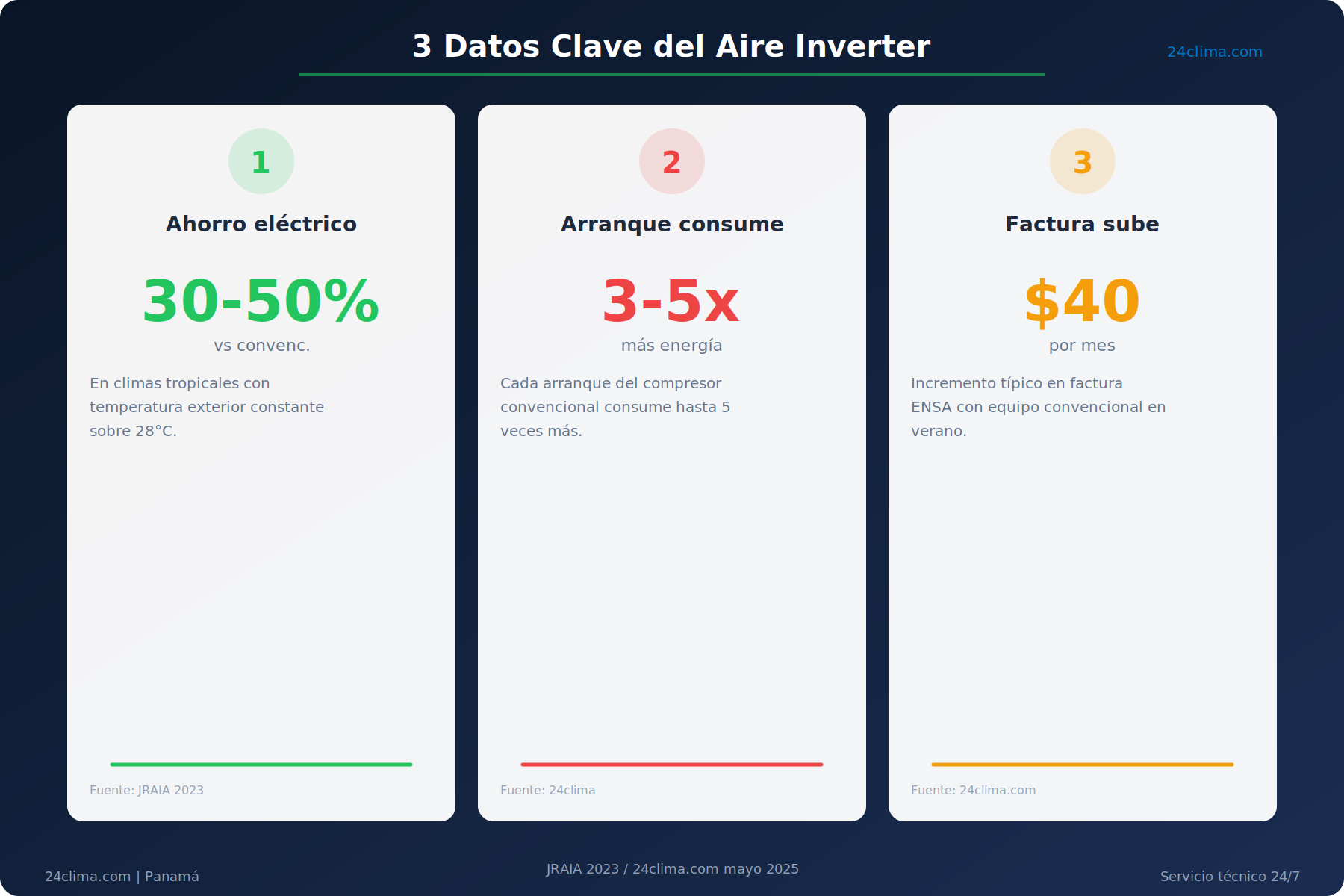
It's 2 PM in Costa del Este. The sun is baking the concrete at 91°F, humidity sitting at 88%, and your split unit has been running since 7 in the morning. You open your banking app and there it is: your ENSA bill jumped $40 compared to last month. The AC is running. The heat isn't giving up. And you still can't figure out exactly why you're paying so much.
What most people in Panama don't realize is that the type of compressor inside their unit determines up to 40% of that bill. Not the temperature you set on the remote. Not the hours of use. The compressor.
That's where the difference between a conventional unit and an inverter air conditioner starts. And in Panama, where units run 10 to 16 hours a day for most of the year, that difference adds up to hundreds of dollars. Below, 24clima breaks down how inverter technology actually works, how much it genuinely saves, and which brands have the strongest presence in the local market in 2025. For more technical guides like this one, visit 24clima.com/consejos-y-guias/.
What Most People Assume (And Why They're Wrong)
Most people assume "inverter" is just a marketing term. A fancy word on the box that justifies charging $150 more for the same equipment. That perception is understandable — for years, brands used the term without explaining the actual mechanism behind it.
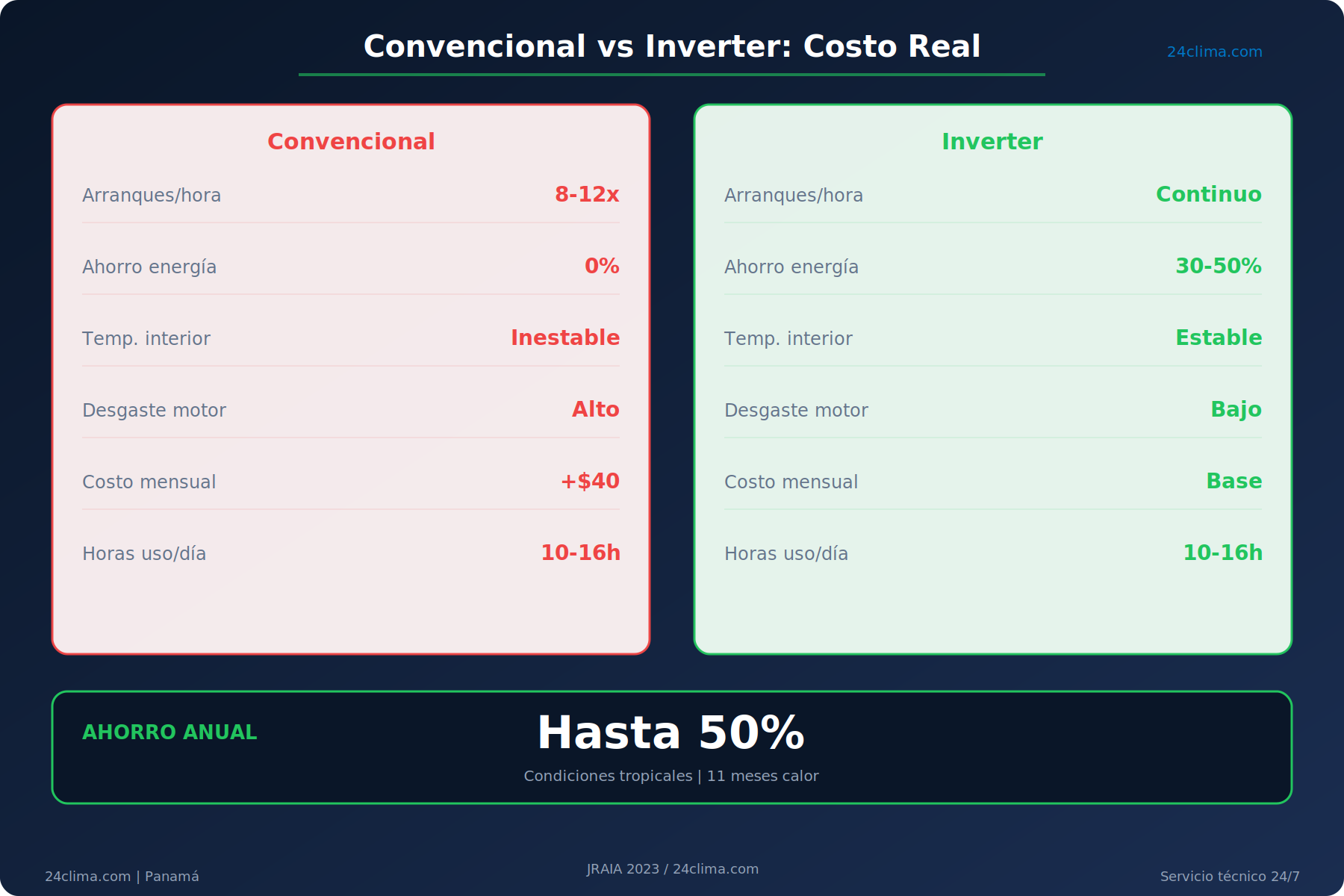
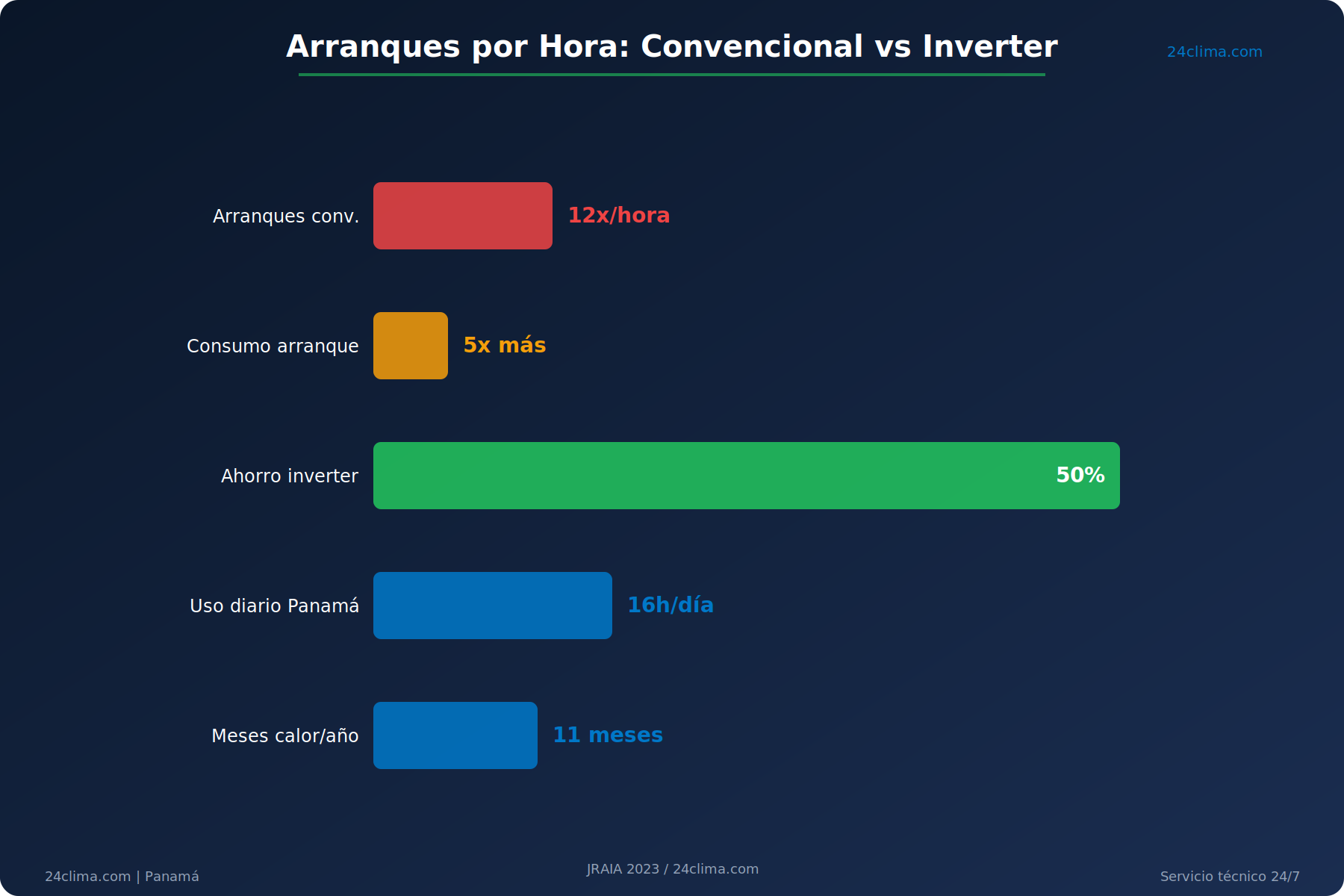
The reality is technical and very concrete. A conventional air conditioner has a compressor that works at two speeds: full power on, or completely off. Every time the room hits the target temperature, the compressor shuts down. When the temperature climbs again, it kicks back on at 100%. That repeated startup — 8 to 12 times per hour in tropical conditions — consumes between 3 and 5 times more electricity than keeping a compressor running at low speed.
In Panama, where outdoor temperatures don't drop below 79°F even at night during the dry season, that stop-start cycle never lets up. Your conventional unit never stabilizes the room because the heat outside is pushing back constantly. The result: high consumption, unstable temperature, and a compressor that wears out years ahead of schedule.
How Inverter Technology Works — Without the Unnecessary Jargon
An inverter air conditioner uses an electronically controlled variable-speed compressor. Instead of switching on and off, it reduces its speed to the minimum needed to hold the selected temperature. The result is a continuous low-intensity cycle rather than repeated explosive startups.
Think about two driving styles in city traffic. The first driver floors the accelerator and brakes hard at every stoplight. The second keeps a steady, moderate speed and reads the traffic ahead. The first car burns far more fuel. The conventional compressor is that first driver. The inverter is the second.
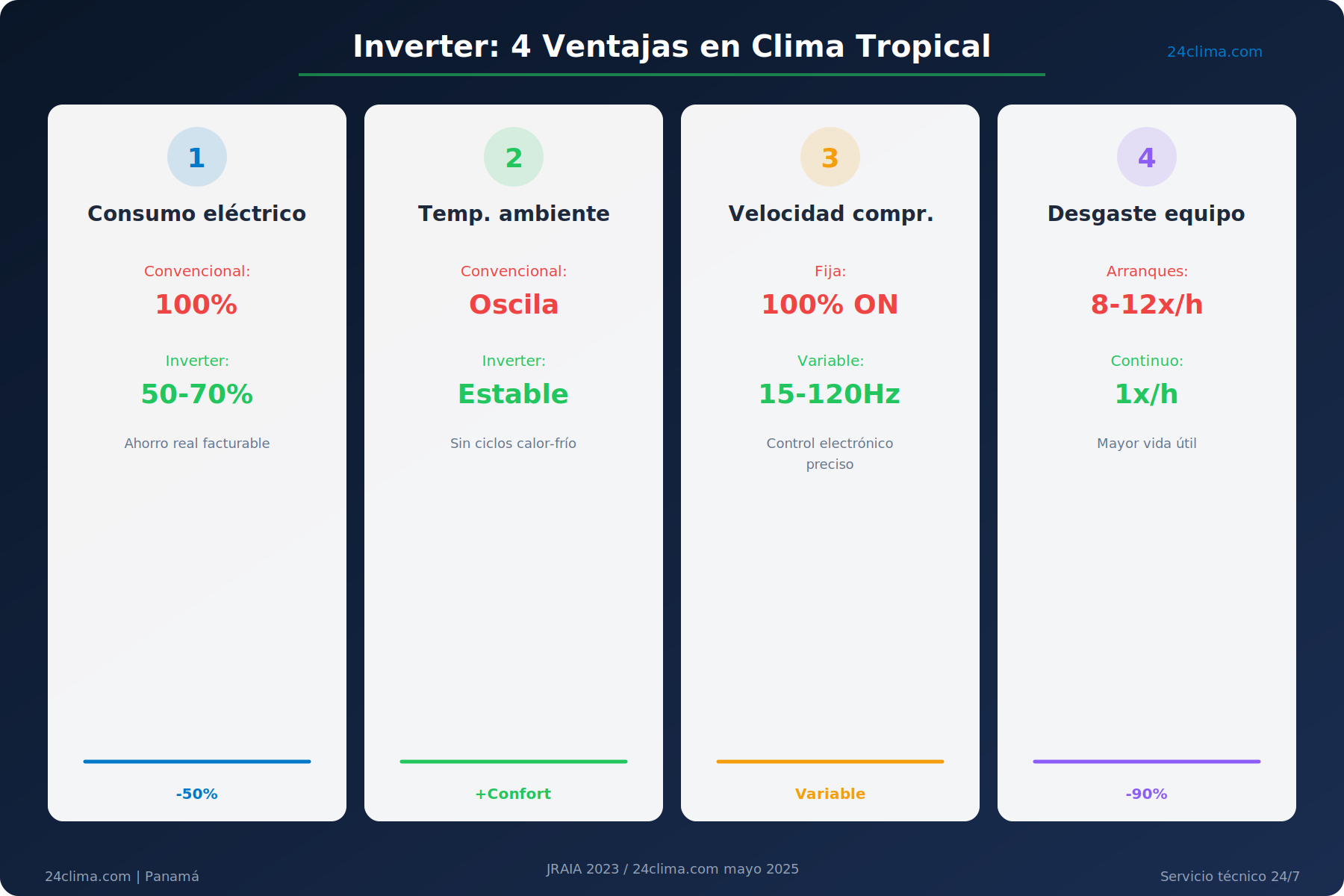
Here's how the mechanism actually works: the room's temperature sensor continuously feeds data to the compressor's electronic controller. That controller adjusts the electrical frequency sent to the motor, varying its rotation speed between 15 Hz and 120 Hz based on thermal demand at that moment. When the room is hot, the compressor runs fast to cool it down quickly. Once the target temperature is reached, it drops to minimum speed — just enough to hold it there. The refrigerant flows continuously rather than being interrupted, which eliminates pressure spikes and reduces mechanical stress on valves and coils.
According to data from the Japan Refrigeration and Air Conditioning Industry Association (JRAIA, 2023), inverter compressors consume on average 30% to 50% less electricity than fixed-speed compressors under typical residential conditions. In tropical climates where outdoor temperatures consistently exceed 82°F, that figure tends toward the upper end of that range.
Why Panama's Climate Makes Inverter a Necessity, Not a Luxury
In Panama, an inverter air conditioner isn't an optional upgrade. It's the correct engineering response to a specific problem: high, persistent thermal load for 11 months of the year.
Take a typical Panamanian bedroom of about 195 square feet — standard in apartments across San Francisco, Marbella, or Betania. A conventional 12,000 BTU unit runs at full power practically non-stop because the outdoor heat never lets it stabilize. Indoor temperature bounces between 72°F and 79°F, which most people experience as steady discomfort rather than actual cooling.
An inverter unit of the same capacity actually cools the room faster, because at startup it can run at full or above-rated power. Once the target temperature is reached, it drops to 30–40% capacity and holds the room at a steady 72°F. Energy consumption drops sharply.
Here's what that difference costs in real dollars. The average residential electricity rate in Panama, per ETESA 2024 data, is $0.17 per kWh. A conventional 12,000 BTU unit with a COP of 2.8 consumes approximately 1.3 kW/h at full load. Running 12 hours a day, that's 468 kWh per month — $79.56 just for that one unit.
An inverter 12,000 BTU unit with SEER 20 — the standard efficiency rating on units like the LG Dual Inverter or Panasonic Aero Series — consumes an average of 0.75 kW/h under real tropical conditions. The same 12 hours a day produces 270 kWh per month: $45.90.
The gap is $33.66 per month. $403.92 per year. Over three years, $1,211.76 in cumulative savings from a single unit. That's why the price difference between a conventional unit and an inverter of the same capacity — $150 to $250 in Panama — pays itself back within 5 to 8 months of normal use.
Inverter Brands and Models Available in Panama in 2025 — Reference Prices
The Panamanian market has solid availability of inverter units from 9,000 to 24,000 BTU. These are the brands with the strongest presence at retailers and distributors including COCHEZ, Do it Center, Multi-Max, and specialized HVAC suppliers:
LG Dual Inverter — The best-selling brand in Panama's residential segment. The DUALCOOL Inverter uses a dual-rotor compressor that cuts vibration and noise. SEER: 18–22. Reference price for 12,000 BTU: $550–$680. Compressor warranty: 10 years.
Samsung WindFree Inverter — Distributes cooled air through 21,000 micro-perforations in the front panel, eliminating direct draft. A good fit for bedrooms where airflow on the skin is an issue. SEER: 16–20. Reference price for 12,000 BTU: $580–$720.
Panasonic Aero Series Inverter — Strong efficiency numbers and a nanoe-X filter with antibacterial capability, which matters in high-humidity environments like Panama City. SEER: 20–23. Reference price for 12,000 BTU: $620–$780.
Mitsubishi Electric MSZ-FS Series — The premium benchmark in residential. Quietest compressor in its class at 19 dB in night mode. SEER: 22–26. Reference price for 12,000 BTU: $850–$1,100.
Carrier X-Power Inverter — More common in commercial projects, but with competitive residential models. SEER: 17–21. Reference price for 12,000 BTU: $500–$650.
These are unit-only prices for the Panamanian market in 2025. Professional installation of a split inverter in Panama typically runs $150 to $300, depending on pipe length and the electrical configuration required.
To choose the right capacity for your space, visit our installation service at 24clima.com/servicios/instalacion/ — our team runs a full thermal load calculation before recommending any unit.
Common Questions — Direct Answers
Is it worth buying an inverter air conditioner in Panama?
Yes, and the numbers back it up. In a context where units run 10 to 16 hours a day for most of the year, the higher upfront cost pays itself back within 5 to 8 months. From month nine onward, the unit is generating net savings. Inverter compressors also last 12 to 18 years on average versus 8 to 10 years for a well-maintained conventional unit — because they never take the beating of repeated full-power startups.
How much does an inverter save on electricity compared to a conventional unit in Panama?
A 12,000 BTU inverter unit saves between $25 and $45 per month compared to a conventional unit of the same capacity, depending on hours of use and the model's efficiency rating. At ETESA's $0.17/kWh rate, a household running AC 12 hours a day can expect a minimum of $300 in annual savings per unit. Homes with two or three units multiply that proportionally.
Which inverter brand is best for Panama's tropical climate?
There's no single answer, but there are clear criteria. For bedrooms where noise matters, Mitsubishi Electric leads at 19 dB in silent mode. For the best price-to-efficiency ratio in standard residential installations, LG Dual Inverter offers the strongest balance, backed by a 10-year compressor warranty. For spaces with air quality concerns or extreme humidity, Panasonic's nanoe-X technology has a genuine functional edge. The right choice comes down to room size, usage pattern, and budget — not brand name as an abstract concept.
The Final Calculation — Before You Decide
Go back to that afternoon in Costa del Este. The unit is still running, but now you know exactly what's happening inside the compressor. If you have a conventional unit running 12 hours a day, you're paying between $30 and $45 more per month than you would with an equivalent inverter. Over three years, that's more than $1,000 you could have kept.
Inverter technology isn't a marketing promise. It's applied physics addressing a specific climate problem. In Panama — annual average of 88°F, 85% relative humidity, units that never really get a break — the question isn't whether an inverter is worth it. It's how much longer it makes sense to wait.
At 24Clima, we help homeowners and businesses across Panama select, install, and maintain inverter units with the correct thermal load calculation for every space. If you want to know exactly how much you'd save by replacing your current unit — or need a new installation done right from the start — contact us on WhatsApp at 24clima.com/contacto/ and a certified technician will get back to you the same day. No commitment required.