Inverter Air Conditioners — The Silent Engine Changing How Panama Survives the Heat
It's 2 in the afternoon in Costa del Este. The asphalt shimmers under a sun so intense it bends the air above it. You walk into your apartment, feel that wall of humid heat press against your chest, and reach for the remote. The AC kicks on. Ten minutes later, the room is breathing again. An hour after that, you open your banking app to check this month's usage. The number stops you cold.
That number — your electricity bill — is exactly why more people in Panama than ever are searching the same thing: what is an inverter air conditioner, and is it actually worth it? The question sounds technical. At its core, it's a question about money, comfort, and living in a country where air conditioning isn't a luxury — it's basic infrastructure.
What surprises most people is that they already have an inverter unit in their apartment, or are about to buy one, without really understanding what makes it different from the conventional system it replaced. If you want more guides like this, check out our tips and guides at https://24clima.com/consejos-y-guias/
What Most People Think — And Why That's Not the Whole Story
When most people hear "inverter," they picture a premium marketing feature — like a turbo mode or built-in Wi-Fi. Something that justifies a higher price tag but ultimately does the same job as any other unit. That's an incomplete picture, and understanding why completely changes how you evaluate an AC purchase.
The difference isn't in the filters, the design, or the digital display. It's in the heart of the system: the compressor. The way that compressor operates is so fundamentally different that it directly affects how much electricity the unit consumes, how long the hardware lasts, how stable the temperature in your room stays, and how much noise you hear while it does its job.
There's another common misconception: many people assume "inverter" means the unit inverts something — like it reverses the airflow or flips the refrigeration cycle. Not quite. The term comes from power electronics. An inverter (variable frequency drive) converts alternating current into direct current, then regenerates alternating current at a variable frequency. That's what allows the compressor motor to spin at any speed — not just full blast or completely off.
What "Inverter" Actually Means in an Air Conditioner
An inverter air conditioner is a unit whose compressor operates at variable speed, continuously adjusting its output to match the actual cooling demand of the space. Instead of switching on and off in full cycles, the compressor slows down once the room reaches the target temperature and holds that balance with a precision measured in fractions of a degree.
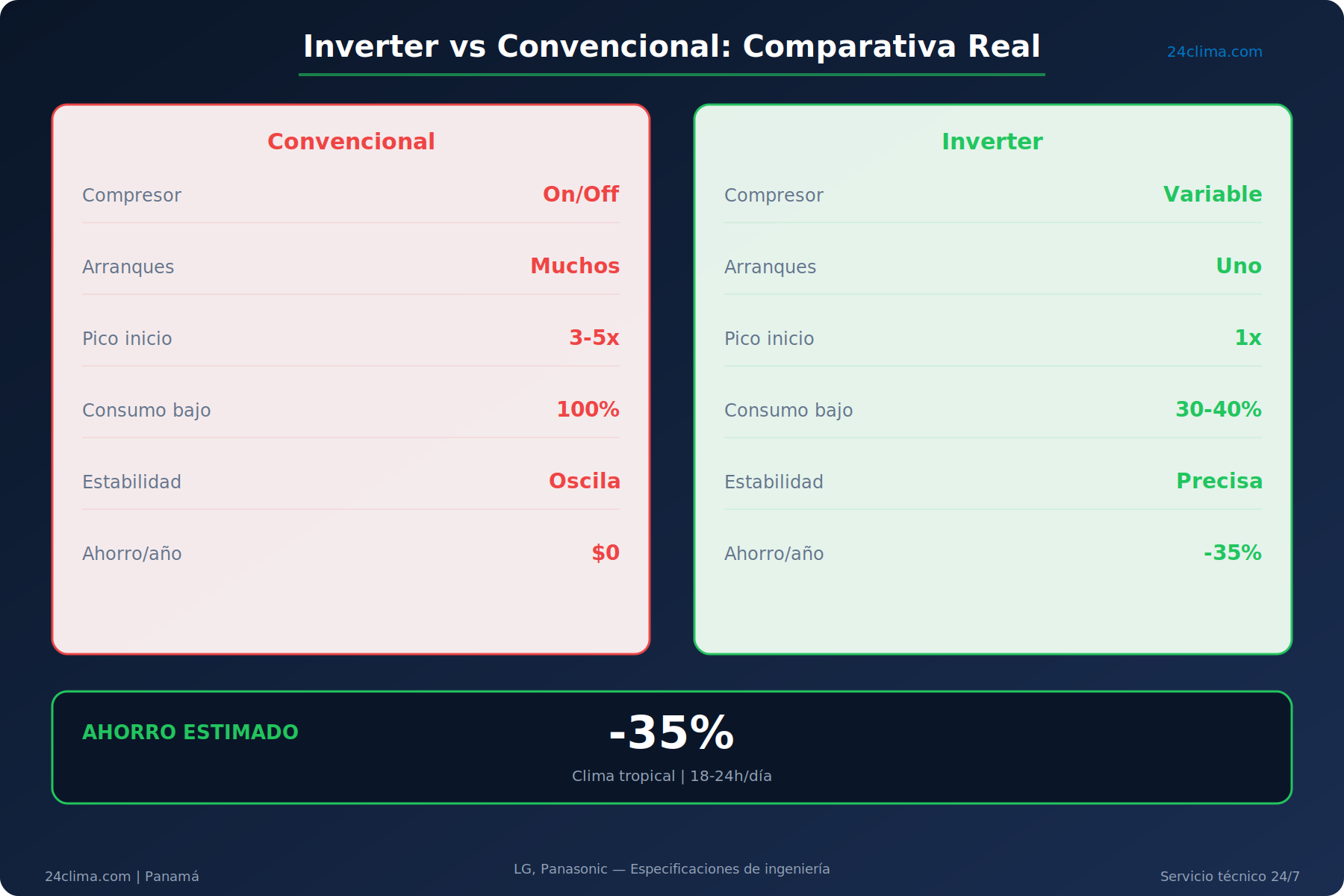
That's the core principle. A conventional unit has two states: on at 100% or completely off. It runs at full power until the thermostat detects the target temperature, then shuts down. When the temperature climbs again, it restarts at full power. This cycle repeats constantly.
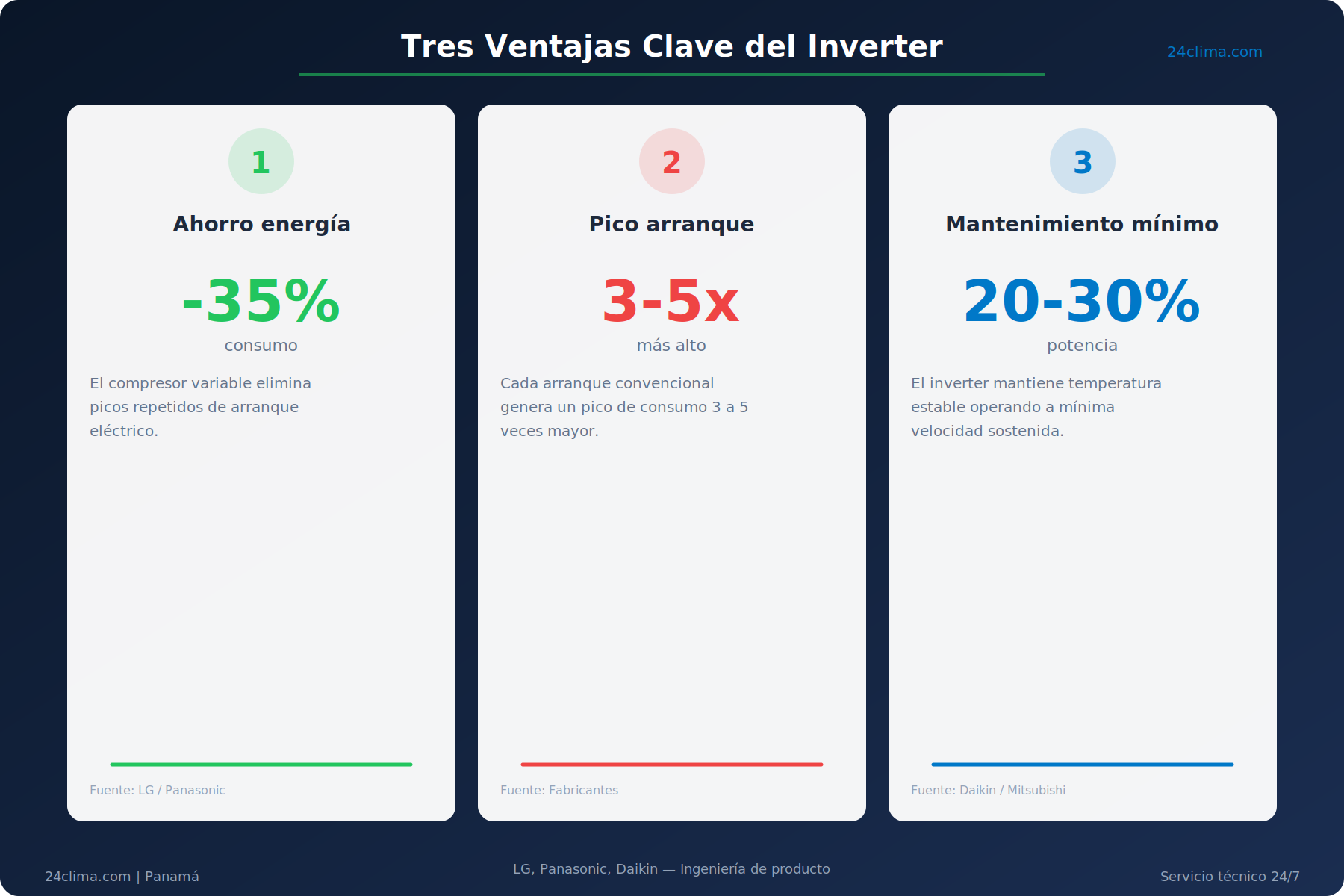
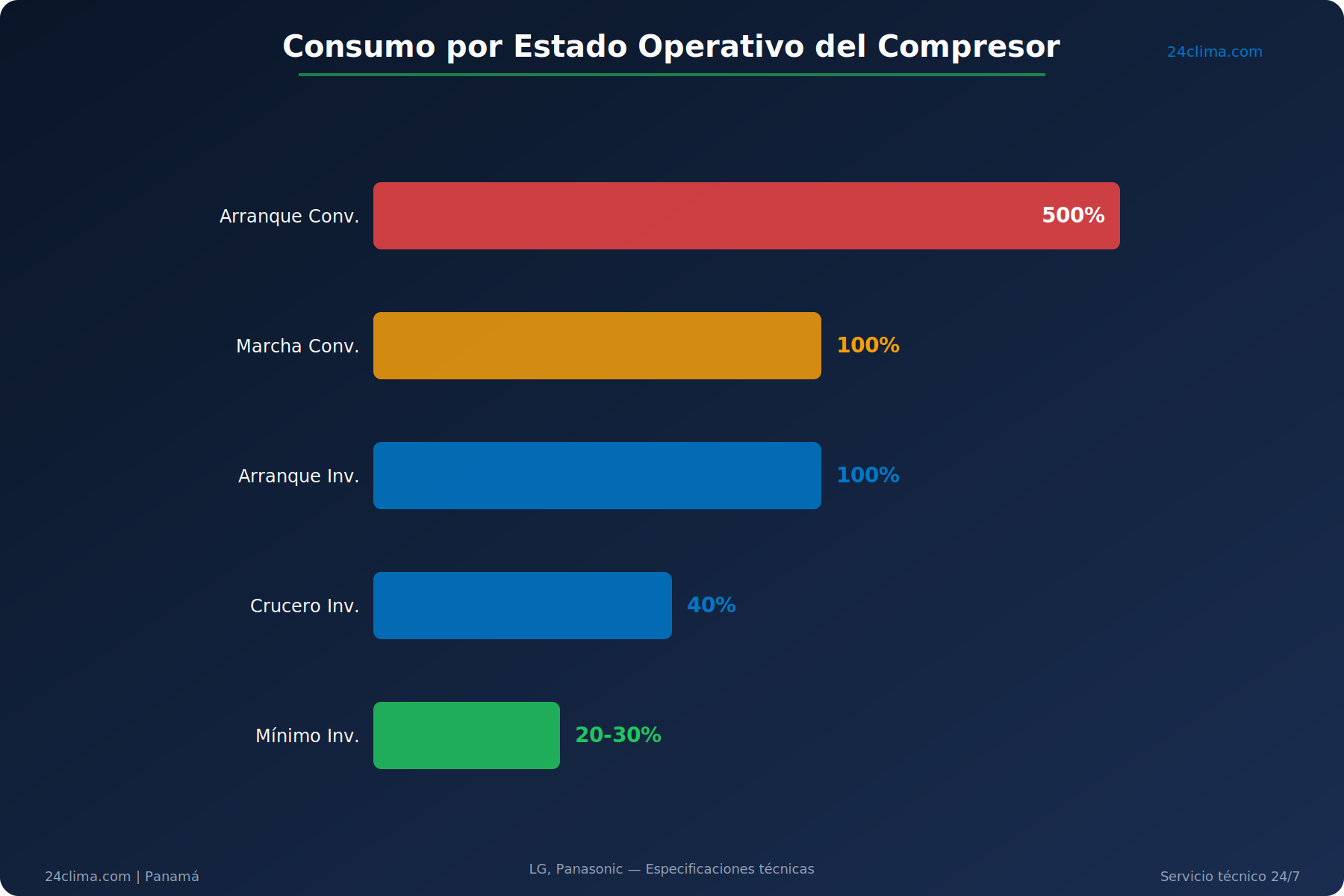
Startup is when a compressor burns the most electricity. Every time a conventional unit kicks on, it generates a power spike 3 to 5 times higher than its steady-state consumption — a figure documented by manufacturers including LG and Panasonic in their engineering specifications. In Panama's climate, where units run 18 to 24 hours a day for most of the year, those repeated startups hit your bill hard every single month.
An inverter compressor starts once and modulates its speed from there. It reaches the target temperature quickly at high power, then drops to 20–30% capacity to hold that balance. Fewer startups. Fewer consumption spikes. A steadier room temperature.
How the Inverter Cycle Works
Initial startup: the compressor runs at high frequency, pulling heat out of the space fast. At this stage, consumption is similar to a conventional unit.
Approaching the setpoint: as the indoor temperature nears the programmed target, the electronic controller reduces the compressor frequency. Speed drops, and so does consumption.
Maintaining temperature: the compressor runs at a sustained minimum speed, offsetting heat gains from outside — sun, people, electronics — without shutting off. In this state, consumption can drop to 30–40% of rated capacity.
Responding to changes: if someone opens a door or afternoon sun hits a window, the system detects the temperature rise and speeds up automatically, no full restart required.
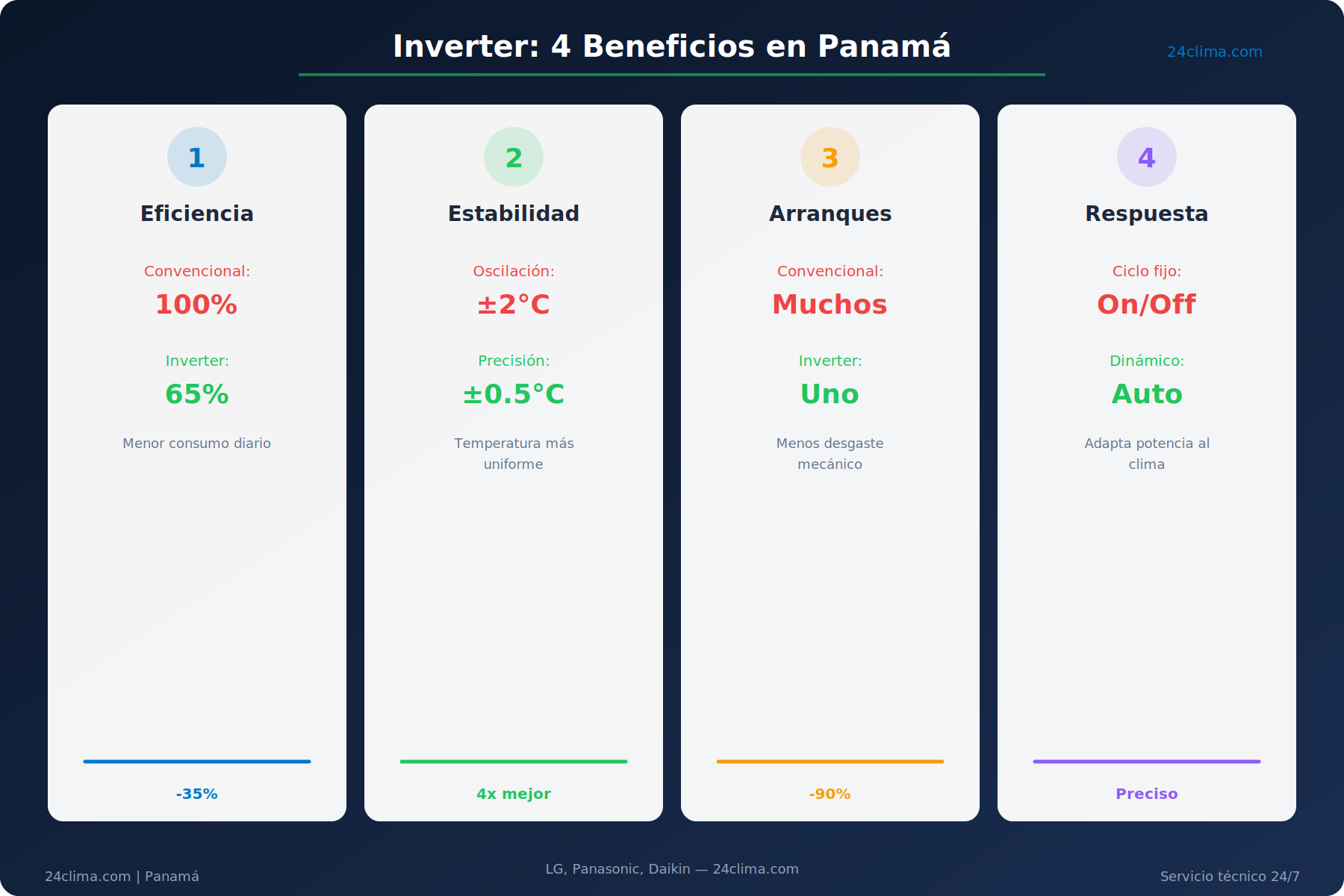
This dynamic behavior is exactly what makes an inverter efficient in Panama. The tropical climate isn't static. Outdoor temperatures shift, the sun moves across different angles throughout the day, people come and go. A system that responds proportionally to those variations consumes far less than one that hammers away in all-or-nothing bursts.
Why Panama's Climate Makes the Inverter Perform Better Than Almost Anywhere Else
Inverter technology has existed since the 1980s, but its advantage amplifies under specific conditions. Panama checks every box.
Continuous use. According to Panama's Ministry of Commerce and Industry (MICI), the residential sector accounts for more than 40% of national electricity consumption, and air conditioning is the single largest piece of that figure. In many Panamanian homes, AC units run between 16 and 24 hours a day. A conventional unit under those conditions can start and stop hundreds of times in a single week. Every startup is wasted energy.
Heat and humidity simultaneously. At 88°F (31°C) with 80–85% relative humidity — typical conditions in Panama City according to ETESA, the country's meteorological authority — a system doesn't just need to lower the temperature. It needs to actively pull moisture out of the air. A compressor running continuously at moderate speed dehumidifies far more efficiently than one cycling in short bursts at full power. In a tropical climate, that dehumidification advantage alone is worth real money.
Moderate temperature differential. Most Panamanian homes don't need to drop outdoor temperatures from 88°F (31°C) down to 64°F (18°C). They need to hold the interior at 75–79°F (24–26°C) — a differential of roughly 9 to 13°F (5 to 7°C). In that moderate range, an inverter running at reduced speed is especially efficient because the compressor never needs to work at maximum effort.
A 12,000 BTU inverter operating under average tropical conditions in Panama consumes approximately 600–750 watts in maintenance mode, compared to 1,200–1,400 watts for an equivalent conventional unit running a full cycle. The real difference in your monthly bill depends on usage hours, but the consistently documented range is $20 to $45 per month in direct savings, calculated at the residential rate of $0.17 per kWh set by ASEP (Panama's Public Services Authority).
The Real Dollar Savings — Using Panama's Actual Numbers
Not "it saves more," but how much does it save on this month's bill.
The calculation uses three variables: power consumption in watts, daily hours of use, and the cost per kWh.
For a 12,000 BTU (1-ton) unit running 18 hours a day at $0.17/kWh:
Conventional (average 1,100 effective watts across on/off cycles): 1.1 kW x 18h x 30 days = 594 kWh/month = $101/month Inverter (average 650 watts in sustained operation): 0.65 kW x 18h x 30 days = 351 kWh/month = $60/month
Difference: $41 per month. $492 per year. Over three years: $1,476 in cumulative savings — more than the typical price gap between an inverter and an equivalent conventional unit, which generally runs $150–250 in today's Panamanian market.
For 18,000 BTU (1.5 tons), savings scale proportionally: conventional runs approximately $145–160/month under heavy use; the inverter equivalent runs $88–100/month.
For 24,000 BTU (2 tons), common in large living rooms or light commercial spaces: conventional runs approximately $190–215/month; the inverter equivalent runs $115–130/month.
These figures assume standard Panamanian usage conditions and vary based on the insulation quality of the space, solar exposure, and usage habits. The ranges are consistent with efficiency data from Energy Star-certified equipment and technical specifications published by the major manufacturers.
Inverter Brands Available in Panama — The Ones You'll Actually Find
Four brands dominate the residential and light-commercial inverter segment in Panama, each occupying a different position in the market.
Panasonic: the Etherea line and models featuring nanoe X technology are recognized for durability in salt-air environments — relevant if you live in Punta Pacífica, Balboa, or Amador. The Econavi compressor includes motion and sunlight sensors that automatically adjust operation based on room activity and solar heat gain.
LG: Dual Inverter models use a twin-rotary compressor design that reduces vibration and operating noise. These are the most commonly specified units in new construction projects in Costa del Este and Santa María. LG's AHRI (Air-Conditioning, Heating and Refrigeration Institute) certification ratings are among the highest in the market for tropical-region applications.
Midea: the highest-volume option in the value segment. Their inverter models carry SEER (Seasonal Energy Efficiency Ratio) ratings of 17–20, placing them above the minimum recommended for tropical climates (SEER 15). Spare parts are widely available across Panama, which matters when you need a repair at 11 PM on a Friday.
Gree: a Chinese manufacturer with a growing presence in the Panamanian market since 2019. Their Flexx and Lomo models are popular in apartment buildings for their competitive entry price and consistent build quality. Gree manufactures compressors for several other global brands — that's not marketing, it reflects real technical depth behind the product.
Frequently Asked Questions About Inverter ACs in Panama
What does inverter mean in an air conditioner?
Inverter refers to the electronic frequency converter that controls compressor speed. Rather than operating only at full power — as conventional units do — an inverter compressor can spin at any speed between minimum and maximum, adjusting its cooling output to what the space actually needs at any given moment. The result is lower electricity consumption, more stable temperature, and longer compressor life.
Is an inverter AC worth it in Panama's tropical heat?
Yes — and the tropical climate is precisely why the inverter's advantage is greater here than in countries with seasonal AC use. In Panama, where units run practically year-round, the cumulative savings justify the higher upfront cost within 18 to 30 months, depending on the BTU capacity and daily usage hours. Continuous operation in a humid climate is the exact scenario where inverter technology delivers its maximum efficiency advantage.
How much does an inverter actually save on the electricity bill compared to a conventional unit?
Under typical Panamanian conditions — 18 hours of daily use at the residential rate of $0.17/kWh — a 12,000 BTU inverter saves between $35 and $45 per month compared to an equivalent conventional unit. For higher-capacity equipment, savings can exceed $70–80 per month. According to research published by the Japan Refrigeration and Air Conditioning Industry Association (JRAIA), inverter units consume 30% to 50% less electricity than conventional units under continuous tropical operating conditions.
Back to That 2 PM Apartment
You're back in that Costa del Este apartment. It's 2 in the afternoon. The unit has been running since 8 in the morning. The room reads exactly 75°F (24°C). No waves of warm-then-cool-then-warm air. No startup noise every twenty minutes. The compressor has been running at 35% capacity for hours — quiet, steady, holding that balance with a precision that conventional units simply cannot sustain.
That's the inverter doing what it was built to do. Not luxury technology. Engineering applied to the right problem, in the right climate. And in Panama, that problem is tropical heat at 85% humidity for twelve months a year.
At 24Clima, we've spent more than five years installing, maintaining, and diagnosing air conditioners across Panama. If you want to know which inverter unit fits your space best, or whether your current system is running at peak efficiency, reach out on WhatsApp at https://24clima.com/contacto/ — no commitment, no pressure, just real data based on your specific situation.