Inverter vs Non-Inverter — The Decision That Can Cost (or Save) You $400 a Year in Panama
It's 2 in the afternoon in Costa del Este. The sun is hammering the pavement at 91°F and your apartment feels like a pizza oven. You switch on the AC, hear that heavy compressor kick in, and 20 minutes later the room is down to 72°F. Perfect. Then the ENSA bill arrives and the number stops you cold: $180, $210, even $240 in the hottest months.
That's when the question starts. Your neighbor has a similar unit, same brand, same size room, and pays $60 less every month. The difference isn't luck. It's compressor technology. And understanding it before you buy your next unit can completely change what cooling your home actually costs you over the next 12 years.
This guide gives you the real numbers, the models available in Panamanian stores right now, and the exact calculation for when you break even on the investment. No filler. Just what you need to make a smart purchase.
What Almost Everyone Believes (and Why It's Costing Them Money)
The most common assumption goes like this: "Inverter units are more expensive, so they're for people with money to burn. For my room, any split will do the job."
That belief is exactly what costs people a fortune over time.
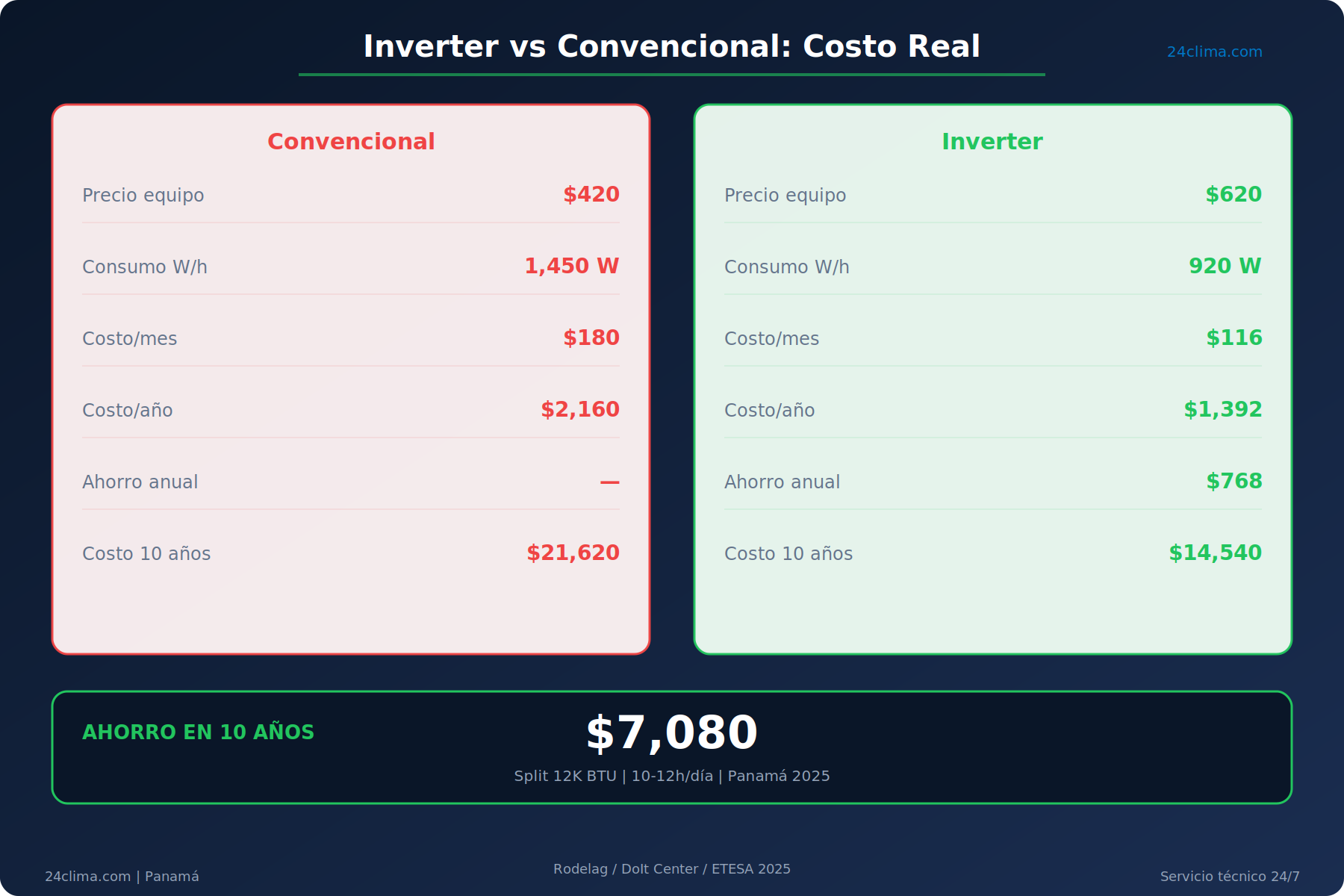
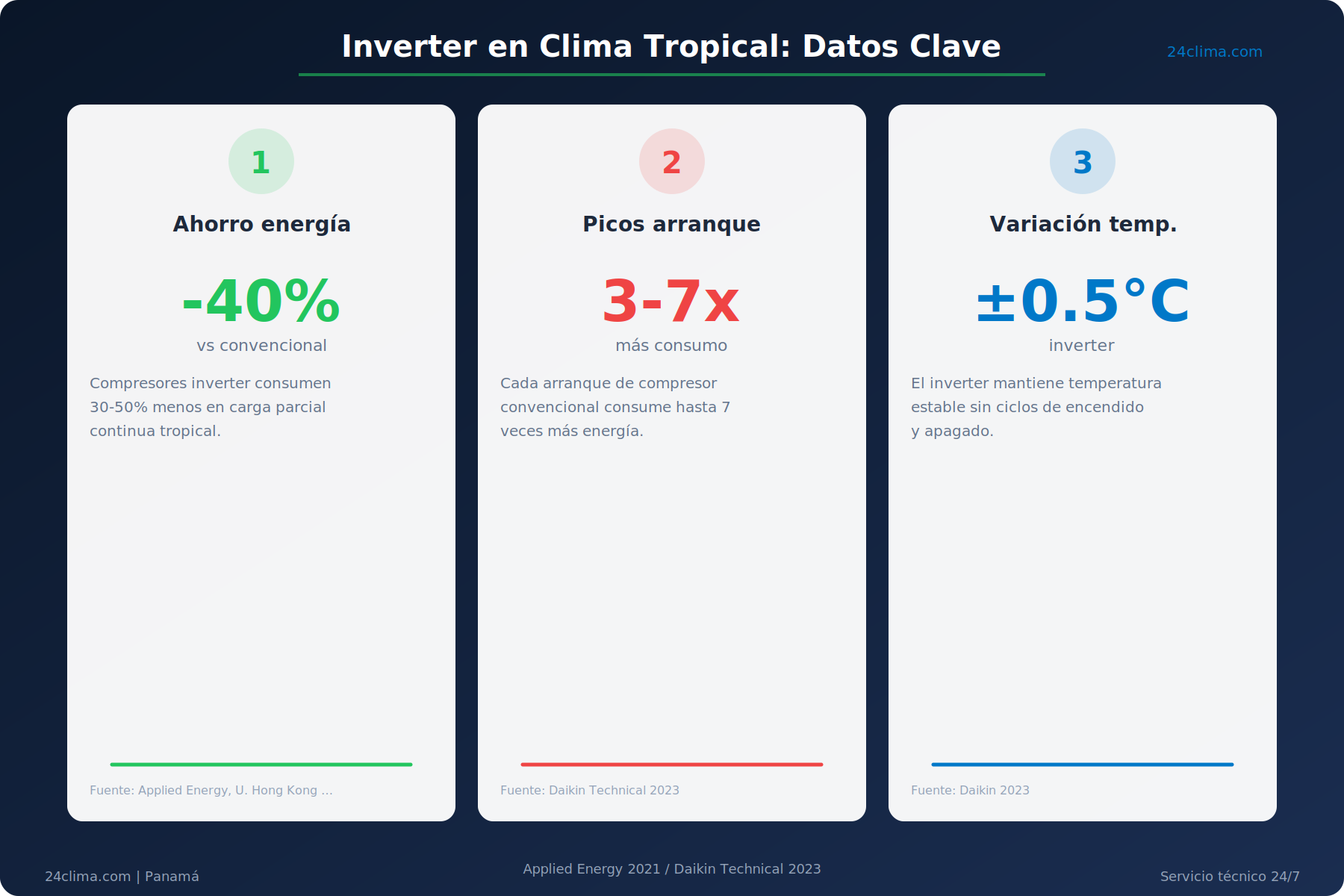
A conventional non-inverter runs in binary mode: compressor on at 100%, compressor off. When the room hits the set temperature, the compressor stops. When it climbs back one degree, the compressor fires up again at full power. That restart cycle burns between 3 and 7 times more energy than simply keeping the compressor running at reduced speed — which is what an inverter does.
In Panama, where you're running the AC 10 to 12 hours a day (not 2 hours like somewhere with a mild climate), that start-stop cycle happens dozens of times every night. The result isn't just a higher bill. The conventional compressor also degrades faster, which shortens the lifespan of the entire unit.
The purchase price is only the first number. The real cost is what you paid upfront plus 10 years of electricity bills.
How an Inverter Works — Without the Jargon
An inverter compressor continuously adjusts its speed based on real-time heat load. Instead of switching off, it slows to the minimum speed needed to hold the temperature stable. This eliminates the energy spikes that come with every restart and keeps the room within a temperature variation of less than 1°F, according to Daikin technical data from 2023.
Think of it like driving on the highway. A conventional car only has two positions on the accelerator — floor it or nothing. An inverter has the full range. At 75 mph it holds a steady speed using the minimum fuel needed. The conventional unit accelerates, cuts, accelerates, cuts, burning more with every cycle.
For Panama's climate, this matters more than it would anywhere with mild weather. When outdoor temperatures sit at 88–91°F with 75–80% relative humidity — average figures from ETESA for the metro region — the thermal load the unit has to maintain is constant all night long. The conventional compressor never really rests. And running at 100% under those conditions, it consumes far more than what the energy label suggests.
According to a study published in Applied Energy (University of Hong Kong, 2021), inverter compressors consume between 30% and 50% less energy than conventional units under continuous partial-load conditions — exactly how AC gets used overnight in a tropical climate like Panama's.
Real Model Comparison Available in Panama in 2025
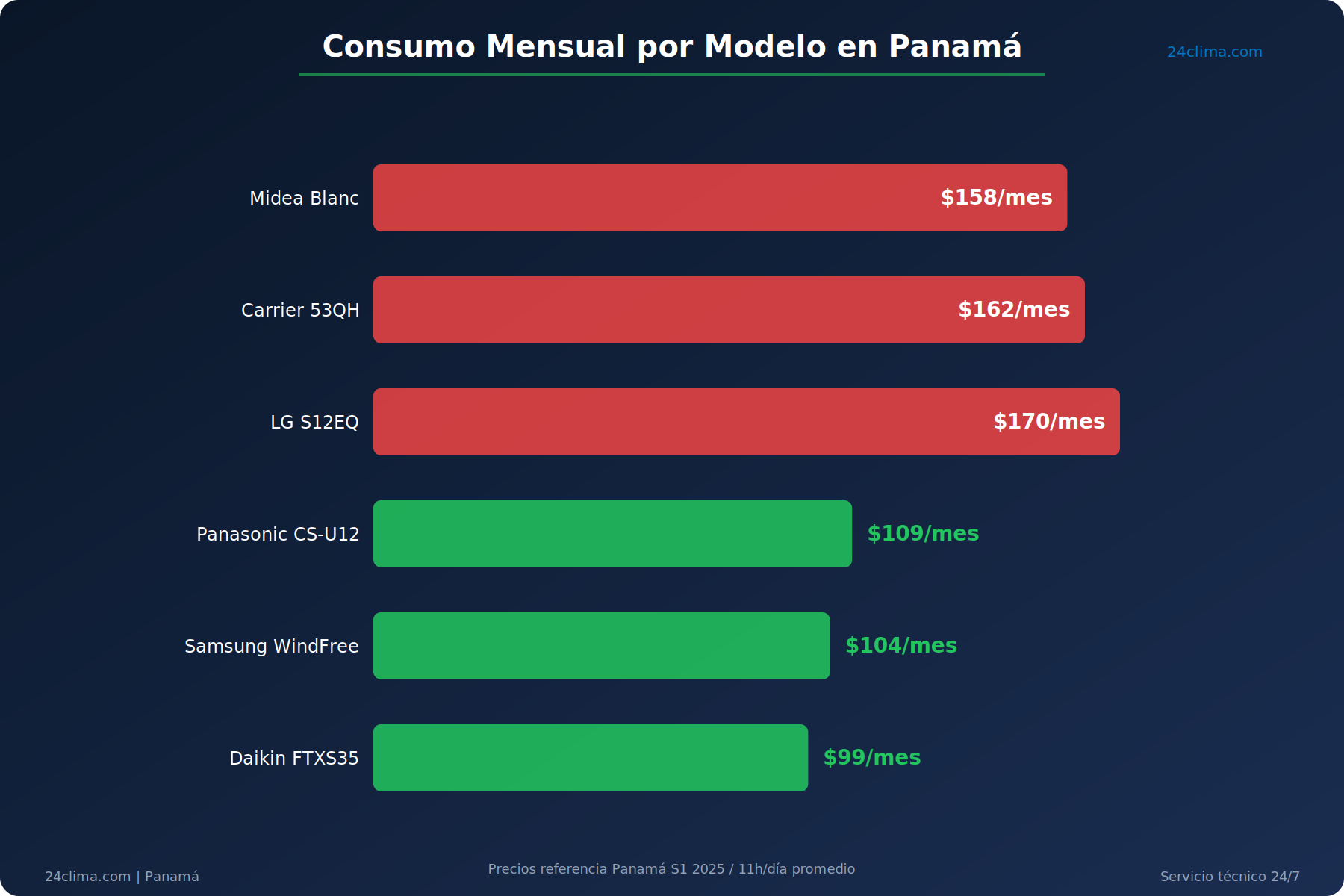
No made-up brands. These are units available at Rodelag, DoIt Center, and the Panasonic Store in Panama, with approximate reference prices from the local market as of the first half of 2025.
Non-Inverter Models (Conventional Split 12,000 BTU):
LG S12EQ: $399–450. Estimated consumption: 1,400–1,500 W/h during continuous operation. No compressor modulation. Carrier 53QH: $420–480. Consumption: 1,350 W/h. Conventional scroll compressor technology. Midea Blanc: $350–400. Consumption: 1,320 W/h. Entry-level price, solid initial performance.
Inverter Models (Inverter Split 12,000 BTU):
LG Dual Inverter S12ET: $580–650. Nominal consumption: 890–950 W/h at steady state. SEER 21. One of the top sellers in Panama. Daikin FTXS35: $720–800. Nominal consumption: 830 W/h. SEER 23.5. Highest efficiency in the residential segment. Panasonic CS-U12: $640–700. Nominal consumption: 910 W/h. Nanoe-X filters built for high-humidity environments. Samsung WindFree AR12: $680–750. Nominal consumption: 870 W/h. Air distribution without direct airflow — well-suited for home office spaces.
The price gap between a basic conventional unit and a mid-range inverter runs roughly $200–$280.
The Calculation That Changes the Decision
The number that matters isn't the sticker price. It's the total cost of ownership over 10 years.
Calculation assumptions for Panama: Average residential electricity rate ETESA/ASEP 2024: $0.18 per kWh Daily use: 10 hours Days per year: 365
Conventional LG S12EQ (1,450 W average): 1,450 W x 10 h x 365 days = 5,292.5 kWh/year 5,292.5 x $0.18 = $952.65 per year in electricity from that unit alone
Inverter LG Dual Inverter S12ET (920 W average at steady state with mixed cycle): 920 W x 10 h x 365 days = 3,358 kWh/year 3,358 x $0.18 = $604.44 per year
Annual difference: $952.65 minus $604.44 = $348.21 in yearly savings with the inverter.
Purchase price gap (conventional $430 vs inverter $620): $190.
Break-even point: $190 divided by $348.21 = 6.5 months.
In under 7 months, the inverter has already paid back the price difference. Over the remaining 11-plus years of the unit's lifespan, that's net savings of roughly $348 per year — more than $3,800 cumulative across the full life of the equipment.
That's not marketing copy. That's arithmetic.
How Many BTUs Does Your Room Actually Need in Panama?
The second most common mistake: buying the wrong size. An inverter that's incorrectly sized — too small or too big — loses a significant chunk of its efficiency advantage.
The standard rule of thumb in the US and Europe is around 20 BTU per square foot. In Panama, that number needs to go up 15–20% because of the combination of intense solar gain, persistent humidity, and concrete construction that absorbs and holds heat all night.
Quick sizing guide for Panama:
Up to 195 sq ft (small room, limited window exposure): 9,000 BTU minimum 195 to 300 sq ft (standard bedroom, average window): 12,000 BTU 300 to 430 sq ft (large master bedroom with big windows, or small living room): 18,000 BTU 430 to 650 sq ft (open-plan living and dining area): 24,000 BTU Over 650 sq ft or spaces with high ceilings: request a full thermal load calculation
If your room has west-facing windows (afternoon sun) or walls without insulation, move up one step on that chart. In Paitilla and San Francisco, glass-heavy buildings with direct Pacific exposure can require 20–30% more BTUs than the basic formula suggests.
Our AC installation service at 24clima includes a thermal load calculation so the unit you buy is right for your space from day one — https://24clima.com/servicios/instalacion/.
The Humidity Factor — Why Panama Is a Different Problem
In dry climates, cooling the air is enough. In Panama, your air conditioner is doing two jobs at once: lowering the temperature and pulling moisture out of the air. That second job draws additional energy and is what actually determines whether a room feels comfortable or just cold.
An oversized unit cools quickly but doesn't run long enough to properly dehumidify. The temperature drops, but the room still feels damp and sticky. In HVAC, this is the "cold and clammy" problem, and it's one of the most common complaints in Panama City apartments where the equipment wasn't sized correctly.
A properly sized inverter runs in longer cycles at reduced speed, which maximizes how long the air stays in contact with the cold evaporator coil. That extended contact pulls significantly more moisture out of the air per hour than a conventional unit cycling on and off.
According to ASHRAE Standard 62.1 (2022), optimal indoor relative humidity sits between 30% and 60%. In Panama without active AC, indoor humidity can exceed 80% during rainy season. Humidity control isn't a comfort feature — it's a health issue, a mold prevention issue, and a way to protect your furniture and electronics.
Frequently Asked Questions
Is an inverter AC worth the higher price in Panama?
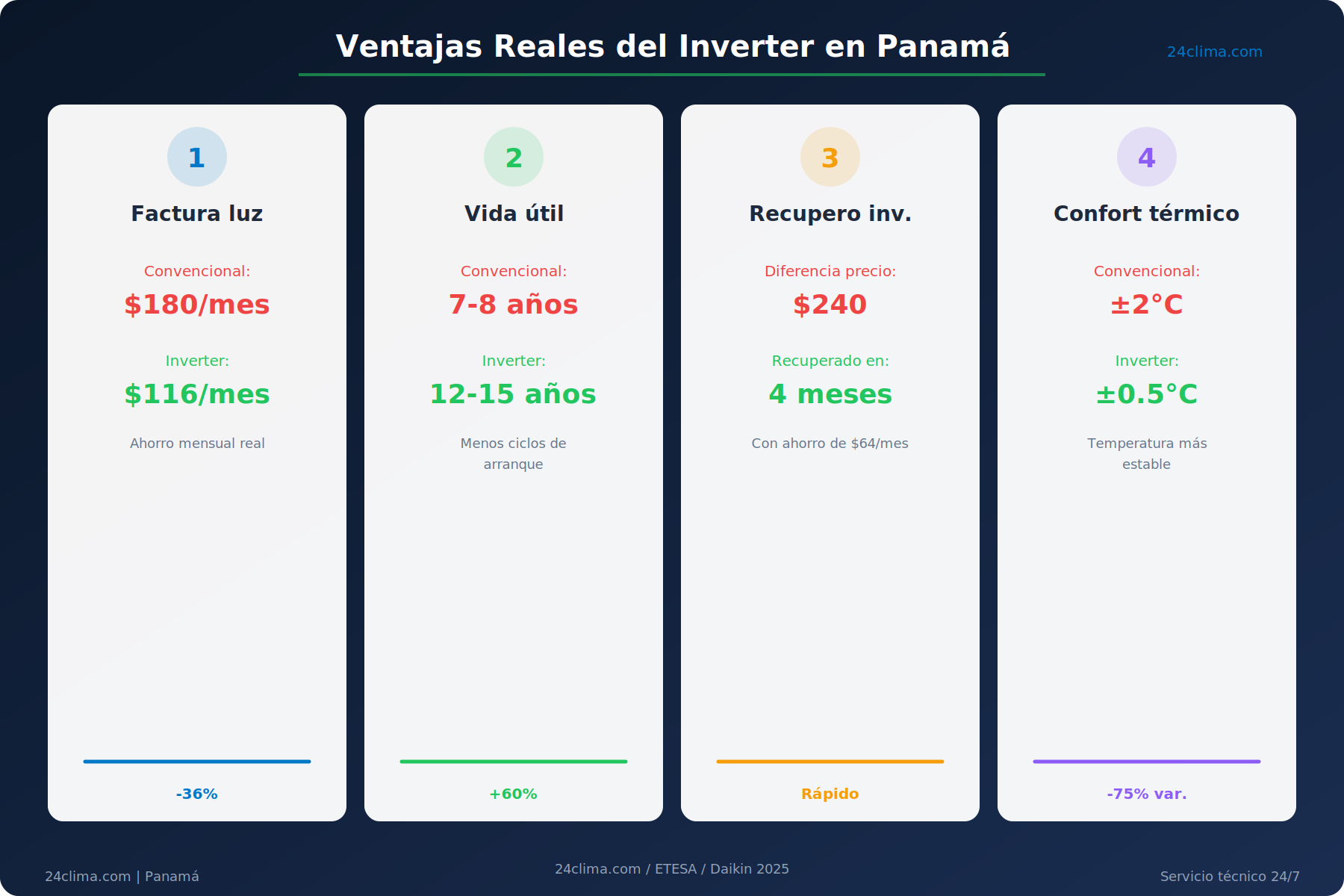
Yes, in almost every situation. With 10 hours of daily use and a rate of $0.18/kWh, the price premium — roughly $190–$280 — is recovered in 6 to 9 months. After that, the inverter generates net savings of $25 to $35 per month for the entire life of the unit. Given how people actually use AC in Panama, the real question isn't whether it's worth it. It's whether you can afford not to buy one.
How much does an inverter AC save on electricity bills in Panama?
With 10 hours of daily use, a 12,000 BTU inverter consumes roughly 3,350–3,600 fewer kWh per year than an equivalent conventional unit. At $0.18/kWh, that translates to a $600–$648 annual difference in consumption from that one unit alone. On your monthly bill, the visible savings typically range between $25 and $45, depending on the specific model, sizing accuracy, and usage habits.
Which is the best 12,000 BTU inverter available in Panama in 2025?
For residential use in Panama, the LG Dual Inverter S12ET offers the best price-to-efficiency ratio in the local market: SEER 21, priced at $580–$650, a wide service network, and replacement parts available in-country. The Daikin FTXS35 delivers better efficiency at SEER 23.5 but costs $120–$150 more. If the budget allows, the Daikin justifies that gap. If not, the LG Dual Inverter is the most reliable choice for most households in Panama.
The Final Verdict
Back to 2 in the afternoon in Costa del Este. The decision you make today standing in the aisle at Rodelag isn't really a choice between two pieces of equipment. It's a choice between paying $430 now and $952 a year in electricity, or paying $620 now and $604 a year in electricity. The purchase price difference disappears in under seven months. What remains is more than a decade of lower bills, a quieter living environment, and a compressor running under less mechanical stress with a longer service life.
At 24Clima we assess thermal load, review your current electricity bill, and recommend the exact unit for your space — not the one with the best profit margin on the shelf. If you're deciding between models or want to confirm that the unit you already bought is properly installed and calibrated, reach out via WhatsApp at https://24clima.com/contacto/ and we'll respond with data, not sales pressure.