LG Air Conditioner in Panama — Is It Worth Buying in 2025?
Last updated: May 2025 | By the 24Clima technical team
It's 2 p.m. in Costa del Este. The sun is hammering the concrete, the asphalt radiates heat like a griddle, and your phone reads 33°C (91°F). You walk into your apartment, switch on the LG unit you bought six months ago, and wait. Ten minutes. Fifteen. The temperature drops — but the air still feels thick, heavy, that sticky humid heat you feel on your skin even when the thermostat says 24°C (75°F).
Is the unit broken, or is this just what Panama feels like? That question lands in our inbox more than any other. The honest answer: LG is a solid brand, but only if you pick the right model for Panama's specific conditions. The price tag on the showroom floor tells you nothing about the efficiency you actually need here.
This guide compares the best-selling LG models in Panamanian stores in 2025, calculates what they'll cost you in electricity every month, and tells you straight when LG is the right call — and when it isn't. For a broader look at the AC market in Panama, start with our guides and tips at 24Clima.
What You Think You Know About LG (And Why You're Probably Wrong)
Most buyers in Panama walk into Rodelag, DoIt Center, or eVision with the same assumption: "LG is Korean, it must be good." They're not entirely wrong. But they make a costly mistake — they pick the cheapest model in the lineup without checking whether it has inverter technology, and without calculating whether the BTU rating is adequate for a room with tempered glass windows facing the Pacific sun.
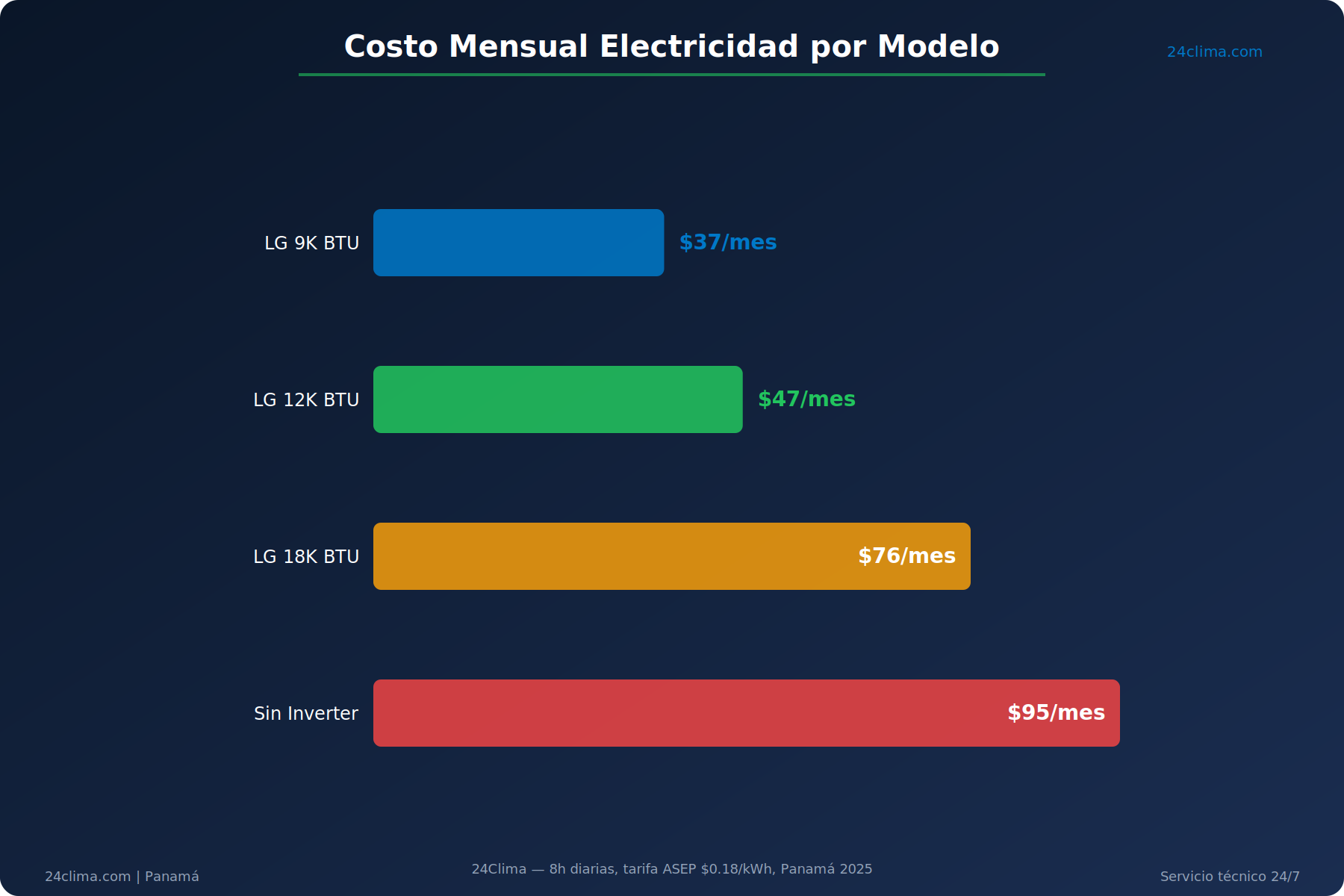
The result: a unit running at 100% capacity for eight hours a day, never reaching a comfortable temperature, generating a $95 monthly electricity bill for an 80 sq meter apartment. That's not an LG problem. That's a selection problem.
The technical reality in Panama: with outdoor temperatures of 31–33°C (88–91°F) and relative humidity of 75–85% according to ETESA (historical data 2020–2024), any air conditioner has to work harder than it would in a temperate climate. A properly sized inverter unit handles that load. A conventional on/off unit, even a good LG, is going to struggle.
The Best-Selling LG Models in Panama in 2025
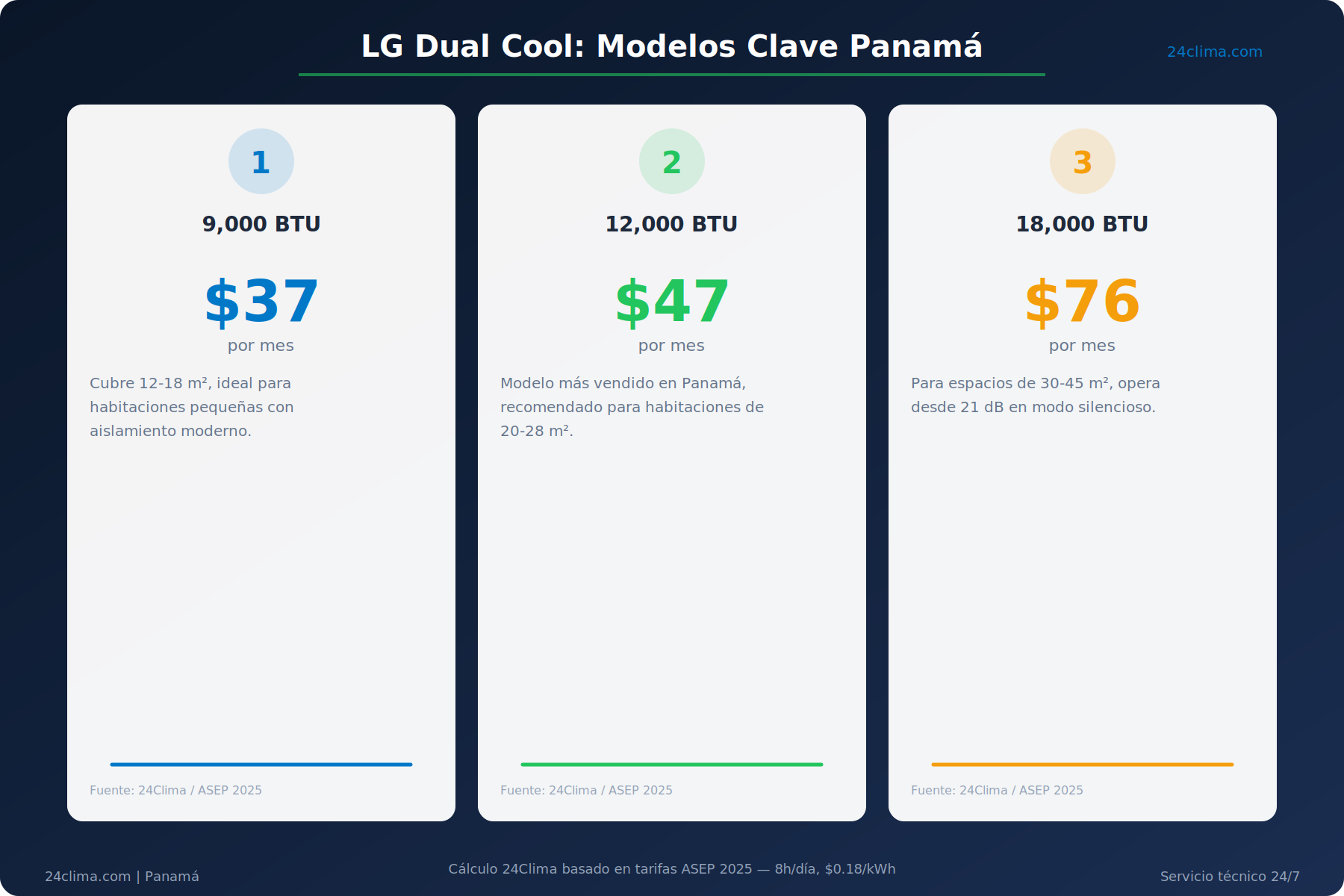
The three sizes that dominate sales are the LG Dual Cool 9,000, 12,000, and 18,000 BTU — all with inverter technology in their current versions. Here's what actually matters about each one.
LG Dual Cool 9,000 BTU Inverter
Built for rooms between 12 and 18 sq meters (roughly 130–195 sq ft). In Panama, that covers a service room, a small home office, or a bedroom in a well-insulated modern building like those in San Francisco or Marbella. Nominal consumption is 0.86 kW/h. At 2025 residential rates from Naturgy and ENSA (approximately $0.18 per kWh, per ASEP), running 8 hours a day, that's around $37 a month in electricity.
LG Dual Cool 12,000 BTU Inverter
The best-seller in Panama, and for good reason. Covers rooms from 20 to 28 sq meters (215–300 sq ft). Nominal consumption is 1.08 kW/h — roughly $47 per month under the same usage pattern. This is the model 24Clima recommends as a starting point for master bedrooms in El Cangrejo, Bellavista, or Costa del Este apartments with direct sun exposure. One caveat: if your room is larger than 25 sq meters and has big west-facing windows, go straight to the 18,000 BTU. Don't try to save $80 upfront and pay for it every month on your electricity bill.
LG Dual Cool 18,000 BTU Inverter
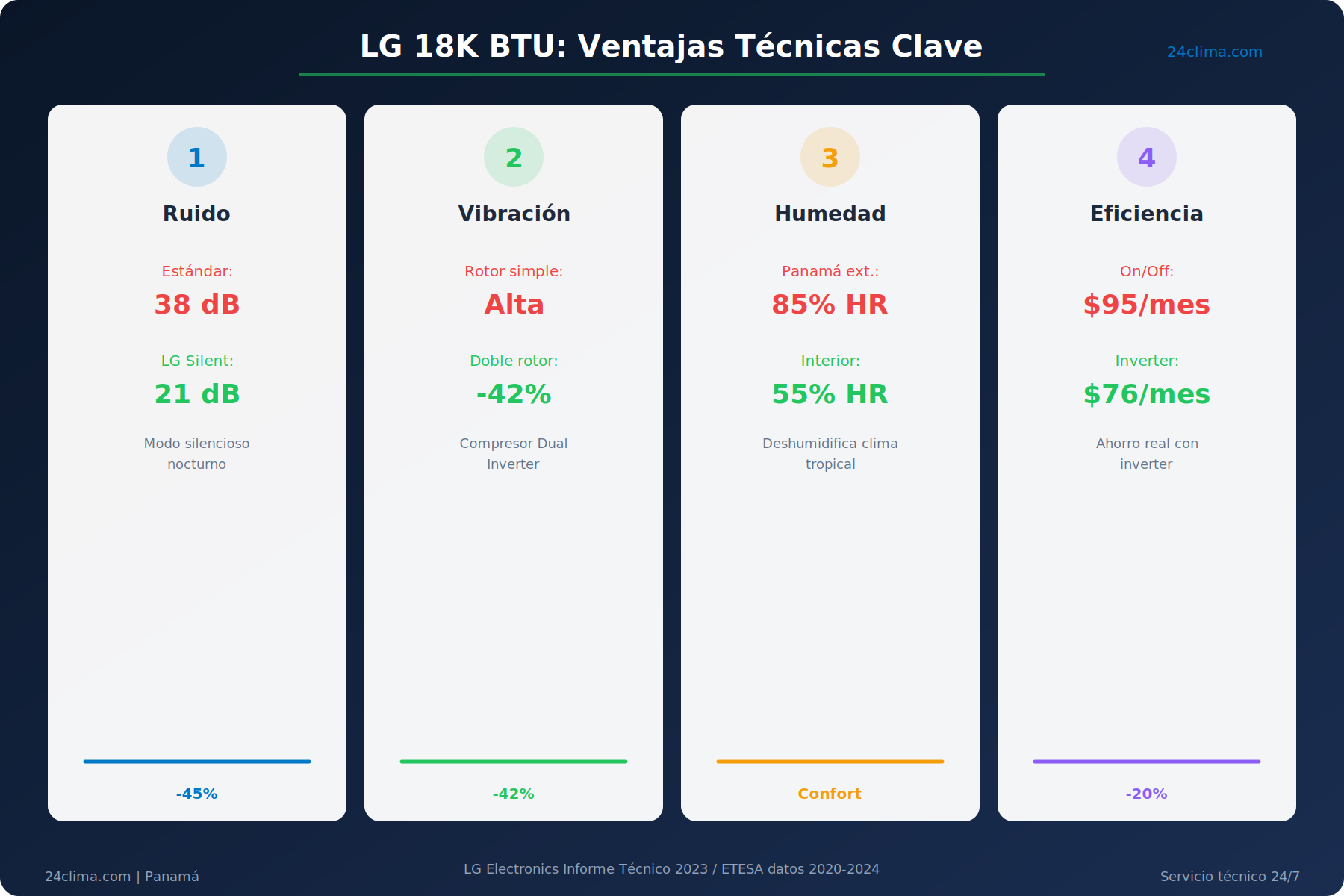
For spaces of 30 to 45 sq meters (320–485 sq ft): combined living areas, medium-sized offices, or loft-style studios. Nominal consumption: 1.76 kW/h. Estimated monthly cost: $76 running 8 hours daily. This model includes LG's Dual Inverter compressor with double rotary design, which according to LG Electronics (technical report 2023) reduces vibration by 42% and operates at noise levels as low as 21 dB in quiet mode. If you're putting this in a bedroom or a work area, that matters more than you'd think.
LG vs Competitors: Price Comparison in Panamanian Stores
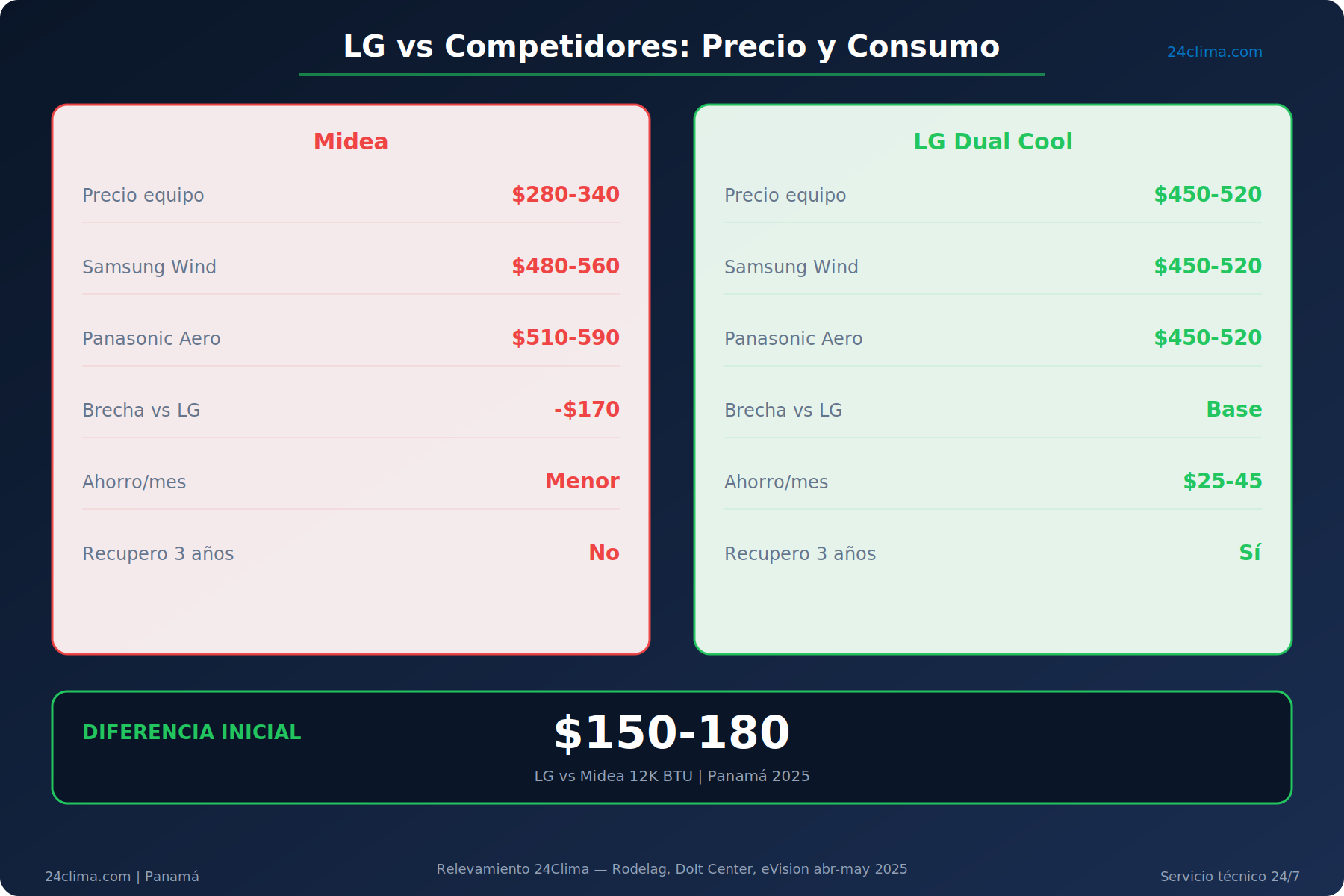
LG sits in the mid-to-premium segment — not the cheapest, not the most expensive. Its direct competition is Samsung Wind-Free, Panasonic Aero Series, and Midea on the budget end. These prices are market references gathered in April–May 2025 at Rodelag, DoIt Center, and eVision:
— LG Dual Cool 12,000 BTU Inverter: $450–$520 (unit only, installation separate) — Samsung Wind-Free 12,000 BTU Inverter: $480–$560 — Panasonic Aero 12,000 BTU Inverter: $510–$590 — Midea 12,000 BTU Inverter: $280–$340
The gap between LG and Midea is real: $150–$180 more upfront. But almost nobody asks what that difference actually costs over three years of operation. A study by ASHRAE (2022) found that units with a higher SEER rating generate savings of $25–$45 per month compared to lower-efficiency models in sustained high-temperature climates. At those numbers, the initial price difference pays for itself in 6 to 8 months.
LG reports a SEER of 21–23 on its current Dual Cool Inverter models. Midea's budget lineup sits at SEER 14–17. That gap is significant.
How Much Does an LG Inverter Actually Save vs a Conventional LG in Panama?
An inverter unit saves between 40% and 60% on electricity compared to a conventional on/off model of the same size, according to LG Electronics data corroborated by a residential energy consumption analysis published in Springer Nature (2021). In dollar terms in Panama, that difference works out to $25–$42 per month on a 12,000 BTU unit.
The concrete math:
LG Conventional 12,000 BTU (on/off): average consumption 1.4 kW/h, 8 hours daily, 30 days = 336 kWh/month. At $0.18/kWh = $60.48/month.
LG Dual Cool Inverter 12,000 BTU: average consumption 0.82 kW/h under partial load — the norm once the room stabilizes — 8 hours daily, 30 days = 197 kWh/month. At $0.18/kWh = $35.46/month.
Monthly difference: $25.02. Over one year: $300.24 in savings. Over three years: $900.72.
That savings figure exceeds the price difference between inverter and conventional models in virtually every residential use scenario in Panama. If you want to calculate the exact consumption for your specific unit based on your hours of use and room size, 24Clima's preventive maintenance service includes an electrical consumption audit.
Is LG Reliable in Panama's Tropical Climate?
The real question isn't whether LG is a good brand in the abstract — it is — but whether its components hold up under Panama's specific conditions: constant heat, extreme humidity, and in coastal areas like Punta Pacífica, Amador, and Balboa, salt air that accelerates corrosion on the outdoor unit.
LG addresses this with two concrete technical features. The Gold Fin anti-corrosion coating on the evaporator and outdoor condenser is an electrostatic treatment that, according to LG, improves corrosion resistance by 30% compared to untreated aluminum fins. The Dual Protection system combines an internal dust filter with an auto-cleaning function that reduces bacteria buildup on the evaporator — relevant in a climate where humidity actively promotes mold growth.
That said, no coating replaces maintenance. In Panama, with humidity levels of 80–85% during rainy season (May through November), an LG unit without semi-annual cleaning loses 15% to 25% of its efficiency within 12 months. 24Clima's professional cleaning service includes inspection of the anti-corrosion coating and chemical cleaning of the evaporator.
Where to Buy an LG Air Conditioner in Panama (And What to Check First)
LG has official distribution in Panama through three main chains: Rodelag (Multiplaza, Albrook Mall, and Metromall), DoIt Center (Vía España and Brisas del Golf), and eVision (David, Santiago, and Panama City). You'll also find LG units at El Rey and on marketplaces like MercadoLibre Panama — though on the latter, there's real risk of units without local warranty coverage.
Before you buy, verify these things without exception:
Valid LG Panama warranty: insist on the authorized distributor label. The official warranty is 1 year on parts and 5 years on the compressor. Without it, you have no technical support if something goes wrong.
Voltage: confirm whether the model is 110V or 220V. Units of 18,000 BTU and above require 220V and a dedicated circuit. If your apartment doesn't have that circuit, budget for additional electrical work before you commit.
Correct BTU for your space: don't rely on the salesperson's recommendation without running the numbers yourself. The basic formula for Panama is sq meters x 60 BTU, plus 10% for direct sun exposure, and another 15% if the room sits under a zinc roof or on the top floor.
Installation cost: most stores charge installation separately — between $80 and $150 depending on complexity. Get that figure before you close the deal.
Frequently Asked Questions
Is LG a good air conditioner brand for Panama's climate?
Yes. The Dual Cool Inverter lineup is well-suited to Panama: anti-corrosion coating, double-rotor compressors rated for high-temperature climates, and a local technical service network. The key is choosing the right BTU capacity for your space and keeping up with semi-annual cleaning — non-negotiable in a climate with 80%+ relative humidity year-round.
How much electricity does an LG inverter AC use in Panama?
An LG Dual Cool Inverter 12,000 BTU consumes between 190 and 220 kWh per month under normal use of 8 hours daily, which works out to $34–$40 per month at 2025 ENSA or Naturgy rates (approximately $0.18/kWh residential, per ASEP). The 9,000 BTU model drops to $30–$35/month, and the 18,000 BTU unit runs $68–$78/month under the same usage pattern.
Where can you find the best price on LG air conditioners in Panama?
DoIt Center and Rodelag tend to offer the most competitive pricing, with promotions of 10–20% off during dry season (January–April) and around Easter week. eVision has comparable prices with better coverage in the interior of the country. If you're hunting for the lowest price, skip marketplaces without official warranty coverage and compare at least two authorized distributors before deciding — the difference on the same model can be $40 to $80.
The Decision Nobody Takes Seriously Enough
Back to the Costa del Este apartment. The LG unit is running. The thermostat reads 22°C (72°F). With the right BTU calculation, proper inverter technology, and a clean installation, the air feels genuinely different: dry, actually cool, without that humid weight that makes Panama afternoons so hard to bear.
LG is worth it in Panama in 2025 — but only if you ask the right questions before you buy, not after. At 24Clima we assess your space, calculate the exact capacity you need, and recommend the model that actually makes sense for your usage, your neighborhood, and your budget. Reach out via WhatsApp at 24clima.com/contacto/ — no purchase obligation, just straight technical guidance.