AC Maintenance in Panama — Real Prices and What Each Service Actually Includes
It's 2 PM in Costa del Este. The sun is hitting the glass facade of your building head-on, humidity is sitting at 87%, and your air conditioner has been running since 7 in the morning. You step outside for five minutes to grab something from your car and come back soaked through. The unit kicks on, blows lukewarm air for a few seconds, then finally cools down. Normal, you think.
That lukewarm air at startup has a technical name: efficiency loss from a dirty evaporator. Those seconds become minutes, and those minutes become extra dollars on your Copa or Naturgy bill every single month.
Here's what nobody tells you when you move to Panama: AC maintenance isn't optional. It's not a nice-to-have. It's the difference between a unit that runs 12 years and one that dies at 6. If you don't know what's covered, what it costs, and how often you need it, you're making blind decisions about one of the most expensive appliances in your home or office.
What Almost Everyone Gets Wrong About AC Maintenance
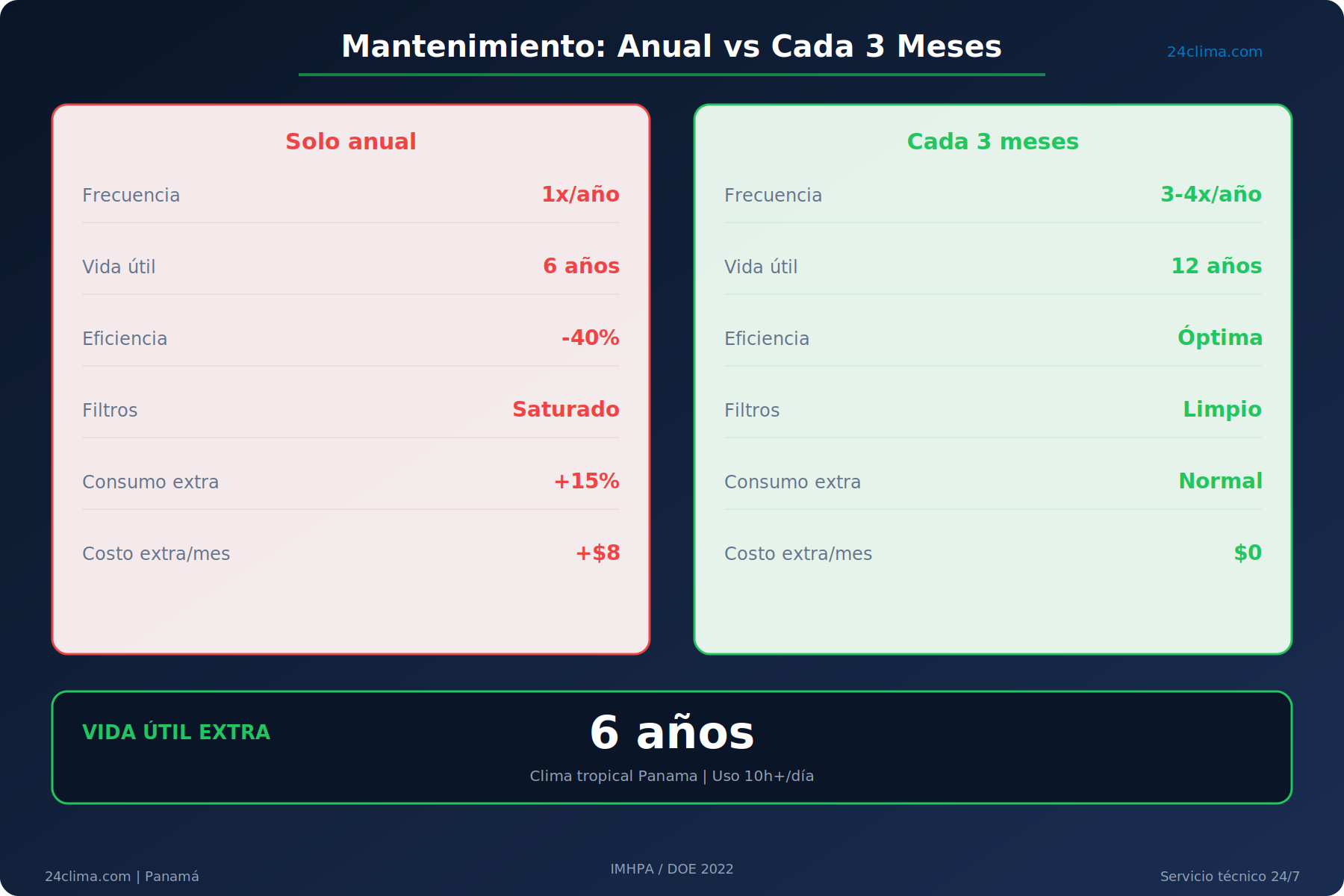
Most people in Panama service their air conditioner once a year. Some wait until it stops cooling or starts smelling strange. That's fine if you live in Chicago or Madrid, where summer temperatures average around 77°F (25°C) and humidity rarely breaks 55%.
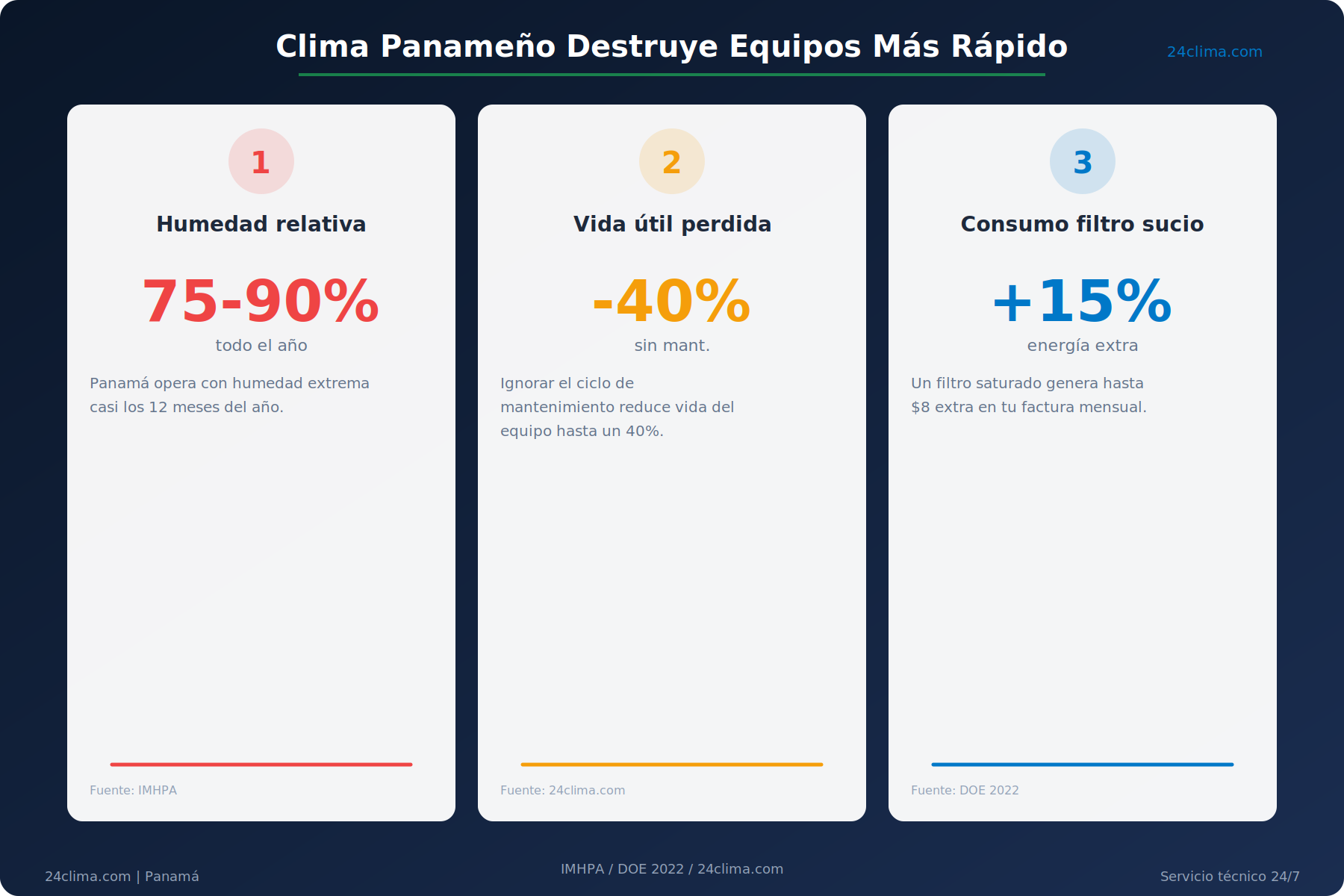
Panama is not Chicago. Panama averages 88°F (31°C) with relative humidity between 75% and 90% for virtually the entire year, according to the Instituto de Meteorología e Hidrología de Panamá (IMHPA). Your unit runs at 90–100% capacity for 10 to 12 months a year — not 3 or 4 months like in temperate climates.
The practical result: what passes for annual maintenance in a cold climate needs to happen every 3 to 4 months here. Not because a manufacturer's manual says so — almost all of them are calibrated for North American or European markets — but because the physics of the refrigeration cycle under extreme heat and humidity demand it.
You can find more guides and technical breakdowns at 24clima.com on how Panama's climate affects each component of your system.
How Often Does AC Need Maintenance in a Tropical Climate?
Every 3 to 4 months. The combination of high humidity (75–90%) and constant heat (88°F/31°C+) clogs filters, breeds mold on coils, and blocks drain lines in roughly half the time it would take in a temperate climate. Skipping this cycle shortens equipment lifespan by up to 40%.
Here's how to plan your year:
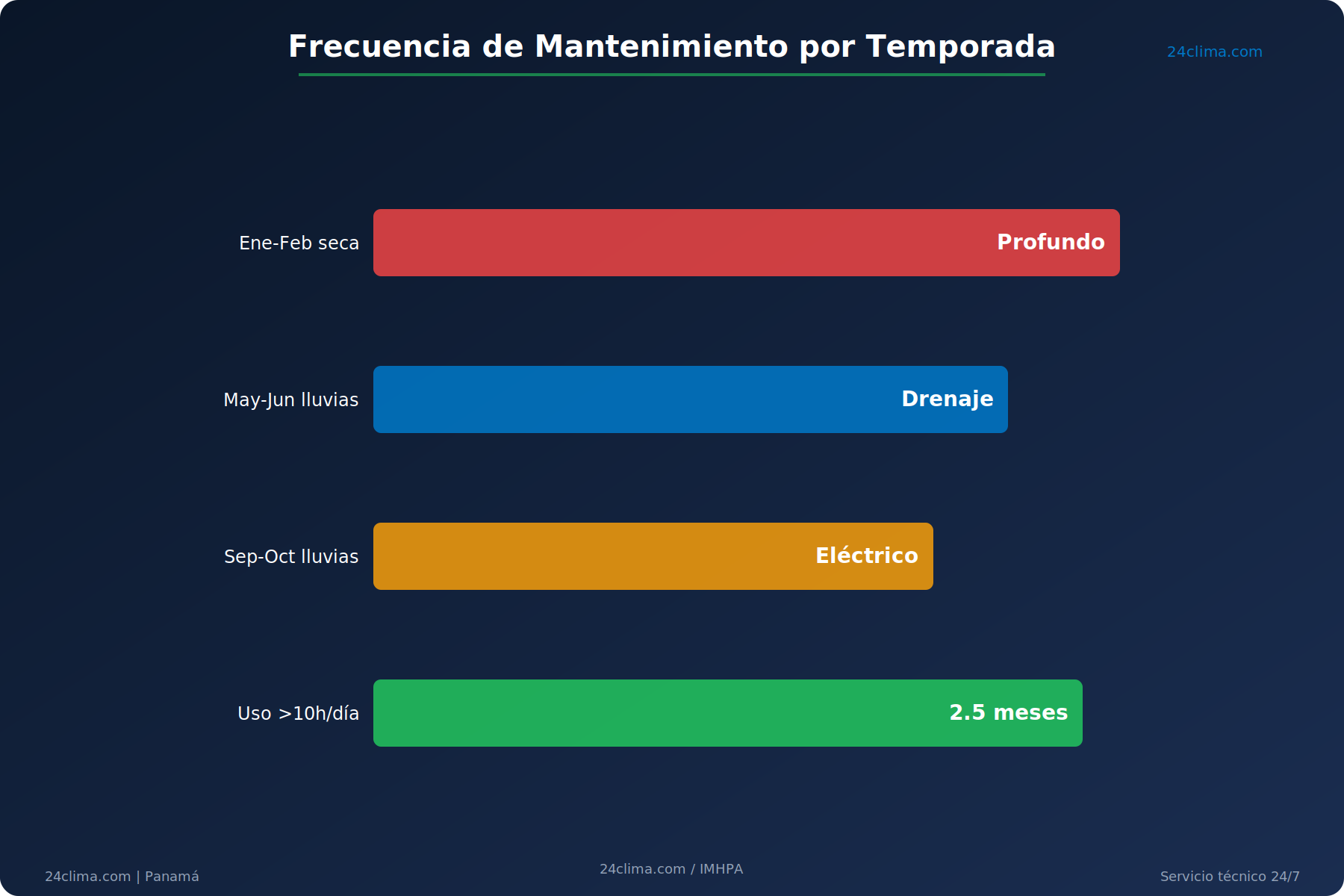
Dry season (December through April): The ideal window for a deep service. No rain means higher dust concentration in the air — filters get dirty faster than you'd expect. Schedule a full service in January or February before the heat peaks in March and April.
Rainy season, first half (May through July): Humidity climbs to its maximum. Evaporator coils can develop mold and bacteria within weeks. Schedule a second service between May and June to clean the condensation system and the drain line, which blocks frequently in this period due to algae growth.
Rainy season, second half (August through November): Your unit has been under maximum load for months. Electrical failures and refrigerant loss are most common at this stage. Get electrical connections and refrigerant levels checked between September and October.
If your AC runs more than 10 hours a day — which is most households in Panama — don't wait 4 months. Bring that interval down to 2.5 to 3 months.
What Does a Full AC Maintenance Service Include?
A complete maintenance service covers filter and evaporator cleaning, outdoor condenser washing, drain system inspection and cleaning, refrigerant level check, electrical connections and capacitor inspection, and supply air temperature differential measurement. Any service that skips one of these steps isn't preventive maintenance — it's a cosmetic wash.
Here's what a qualified technician should do on every visit:
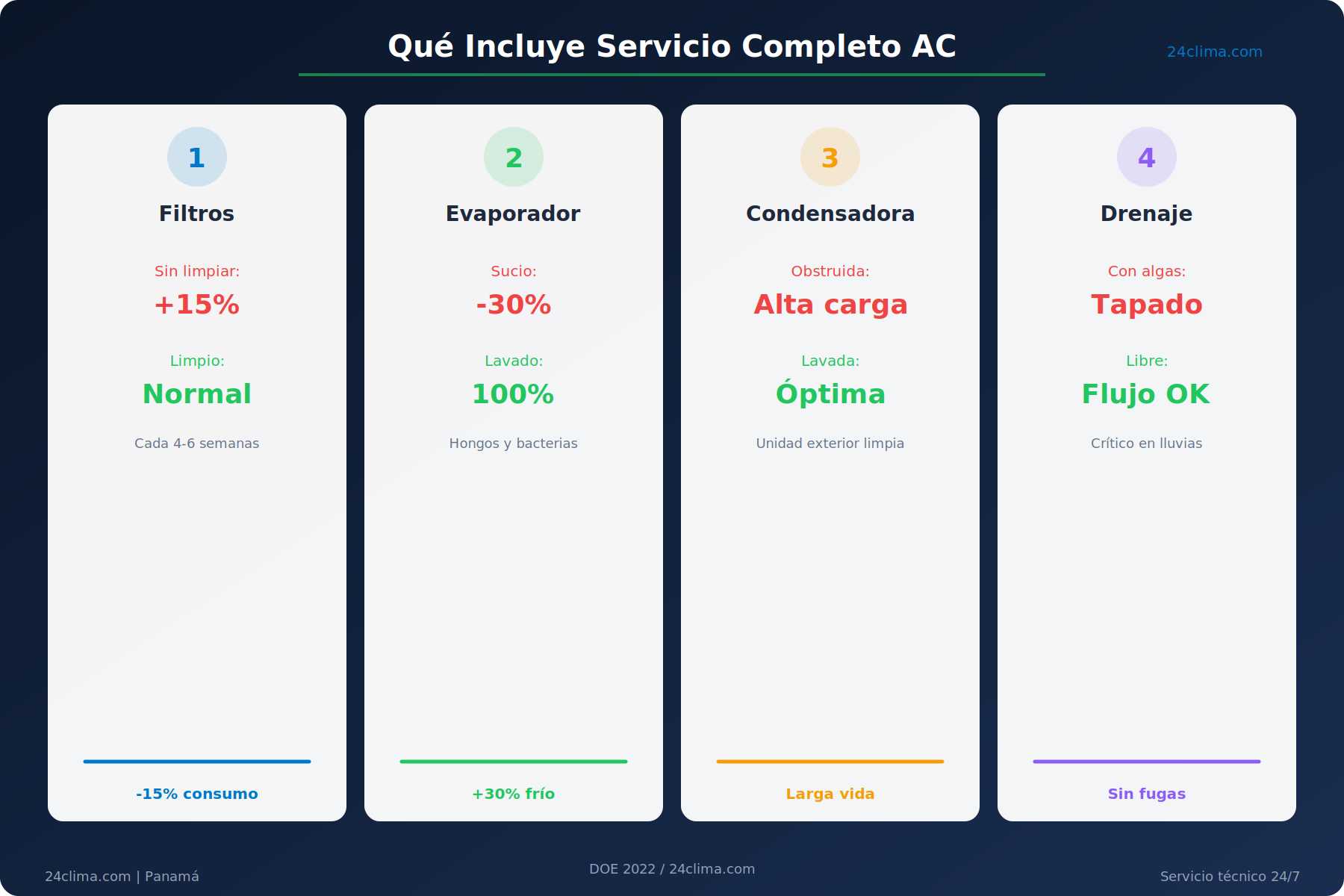
Filter cleaning and inspection Filters are the first line of defense. In Panama, a standard filter can become fully saturated in 4 to 6 weeks with continuous use. The technician should remove, wash, and properly dry the filters — or replace them if damaged. A clogged filter alone increases energy consumption by up to 15%, according to the U.S. Department of Energy (DOE, 2022), which means roughly $7–$8 extra per month on a typical residential unit.
Evaporator coil cleaning (indoor unit) The evaporator is the cold coil inside your room. In Panama's humidity, it accumulates mold, bacteria, and organic dust that are completely invisible from the outside. The wash must be done with specialized foam or alkaline solution, not water alone. A dirty evaporator reduces cooling capacity by up to 30% without the unit showing any obvious signs of failure — the room just never quite gets cold enough.
Outdoor condenser cleaning The outdoor unit expels heat to the outside. Its metal fins clog with dust, leaves, insects, and in coastal areas like Punta Pacífica or Amador, salt air. The technician should wash the unit with controlled-pressure water and verify that the fan spins without obstruction.
Drain line inspection and cleaning The drain removes condensed water from the evaporator. During Panama's rainy season, this pipe can block with algae or sediment within weeks. A blocked drain causes leaks inside the room, damages false ceilings, and in some cases causes short circuits. Cleaning must include blowing or vacuuming the full length of the line — not just a visual check.
Refrigerant level check The technician measures system operating pressure with gauges to verify that refrigerant is within the manufacturer's specified range. If there's refrigerant loss, that means there's a leak — the gas doesn't simply "run out." In a properly sealed system, refrigerant doesn't deplete. According to ASHRAE, a 10% drop in refrigerant level reduces system efficiency by up to 20%.
Electrical check: capacitors and connections Capacitors fail more often in units running under high load in hot climates than in any other condition. The technician must measure capacitance with a multimeter and verify it falls within the manufacturer's tolerance range, generally ±6%. Electrical connections should be tight and free of corrosion — a loose connection generates heat, reduces efficiency, and can start a fire.
Temperature differential measurement The technician measures the temperature of the air entering the unit and the air coming out. The difference should be between 46°F and 54°F (8°C and 12°C). A smaller differential points to a specific problem: dirty evaporator, low refrigerant, or compressor failure. This single measurement tells you more about your unit's real condition than anything else on the checklist.
Our professional maintenance service at 24clima covers every one of these steps, with documented measurements taken before and after the service.
How Much Does AC Maintenance Cost in Panama?
Maintenance costs range from $35 to $80 per unit in Panama City, depending on equipment size in BTU, the type of service, and whether materials are included. These are the standard prices as of 2025.
Units from 9,000 to 12,000 BTU (individual bedrooms, studios) Basic maintenance (filters + surface cleaning): $35 to $45 Complete maintenance (all steps above): $50 to $65
Units from 18,000 to 24,000 BTU (living rooms, mid-size offices) Basic maintenance: $45 to $55 Complete maintenance: $60 to $75
Units of 36,000 BTU or more (commercial spaces, floor units) Basic maintenance: $55 to $70 Complete maintenance: $70 to $95
Volume discounts: If you have 3 or more units at the same property, most serious companies apply a discount of $5 to $10 per additional unit. An apartment with 3 units at 12,000 BTU can get complete service for a total of $130 to $165.
Refrigerant recharge (if needed): R-410A refrigerant, the most common in residential units installed after 2015, costs an additional $30 to $60 per pound in Panama. If the technician tells you that you need a recharge, that's a leak diagnosis — not a routine top-up. Don't pay for a refrigerant recharge without a leak repair first. The gas will escape again, and you'll pay twice.
What to ask for when the technician finishes
A professional company should hand you — or at minimum show you — the values measured during the service. Before they leave, ask for:
— Evaporator inlet and outlet temperature (differential between 46°F and 54°F / 8°C and 12°C) — Refrigerant operating pressure (varies by gas type and model) — Capacitance reading from the compressor capacitor — Visual confirmation that the drain line is running clear — Filter status (washed or replaced)
If the technician can't show you these numbers, they didn't perform real preventive maintenance. They cleaned the surface and left.
Why Proper Maintenance Reduces Your Electricity Bill
A dirty, poorly maintained air conditioner consumes between 15% and 30% more energy than the same unit in optimal condition, according to the U.S. National Renewable Energy Laboratory (NREL, 2021). In Panama, a 12,000 BTU unit running 10 hours a day costs roughly $45 to $55 per month in electricity. That 20% inefficiency works out to $9 to $11 in extra charges per month per unit — before you factor in what it does to the compressor over time.
A complete service at $60 that saves you $10 a month pays for itself in 6 months. Done every 4 months, the annual cost of keeping one unit in good condition is $180. Replacing a compressor that failed from neglect runs $300 to $600, not including labor. Replacing the entire unit: $600 to $1,800 depending on capacity and brand.
The math is straightforward.
Frequently Asked Questions
How much does AC maintenance cost in Panama? Prices range from $35 to $80 per unit in Panama City, depending on BTU capacity and service type. A basic filter and evaporator cleaning for a 12,000 BTU unit costs $35 to $45. A complete service including electrical inspection, drain cleaning, and refrigerant verification runs $50 to $65 for the same unit.
How often should AC be serviced in a tropical climate? Every 3 to 4 months in Panama. The high humidity (75–90%) and constant heat (88°F/31°C+) cause filters, evaporators, and drain systems to deteriorate roughly twice as fast as in temperate climates. If the unit runs more than 10 hours a day, cut the interval to 2.5 months.
What does a complete AC maintenance service include? Filter cleaning, evaporator washing, outdoor condenser cleaning, drain line cleaning, refrigerant level check with gauges, capacitor and electrical connection inspection, and temperature differential measurement. Any service that skips the electrical check or refrigerant verification isn't full preventive maintenance — regardless of what the invoice says.
Back to that apartment in Costa del Este at 2 PM
That lukewarm air at startup is going to keep happening if nothing changes. A few seconds today, a few minutes three months from now, a burned-out compressor two years down the line. Panama gives no rest to any cooling system. The humidity doesn't stop, the heat doesn't stop, and the internal deterioration of an unmaintained unit doesn't stop either.
At 24Clima, we've spent more than 5 years doing preventive maintenance in apartments, houses, and offices across Panama City, with technicians who measure, document, and explain every step of the service. If you want to know exactly what condition your unit is in and what it costs to get it back to optimal, contáctanos por WhatsApp at https://24clima.com/contacto/ — honest assessment, no commitment required.
Last updated: May 2025