Air Conditioning for a Bedroom in Panama — How to Choose Without Making Costly Mistakes
Last updated: May 2025
11 PM in San Francisco — the neighborhood, not California. Window shut, ceiling fan on speed two, sheet already damp. Your phone reads 29°C (84°F) inside, and outside, the asphalt is still radiating heat from a day that peaked at 33°C (91°F) with 82% humidity. You make the call: this cannot go on.
Next morning you walk into Rodelag on Via España or the Do It Center at Multiplaza and ask about an air conditioner for your bedroom. The salesperson gestures at a wall full of units with numbers and price tags. One says 9,000 BTU. Another, 12,000. One has a big "Inverter" logo. Another costs $150 less. You have no idea which to pick.
Here is the mistake most people make: they choose by price, or by whatever the salesperson fits into 90 seconds. Months later, the ENSA bill comes in higher than expected, the room never quite dries out, and the unit runs nonstop without hitting the temperature on the display. That is not bad luck — that is buying the wrong unit for Panama's specific climate. At 24clima.com's guides and tips section you will find exactly what you need to avoid that.
What Most People Assume — and Why They Are Wrong
The common belief goes like this: small room, small unit, cheapest option. That logic holds in cities with mild climates. In Panama, it does not.
Panama carries a thermal load that is heavier than the Latin American average. Average outdoor temperatures of 31°C (88°F) paired with relative humidity above 80% for most of the year create what engineers call "latent load" — the heat you do not feel as temperature, but as moisture trapped in the air. An undersized unit might bring the thermostat down to 24°C (75°F) while leaving you in a damp room that still feels like 27°C (81°F). Technically it is cooling. In practice, you are not comfortable, and the compressor is running flat-out for hours, pushing up your electricity bill.
The second mistake is ignoring technology type. A conventional on/off unit and an inverter unit can carry the same BTU rating and behave completely differently in a real bedroom over a full night of sleep — and that difference shows up on your bill every single month.
How Many BTUs Does a Bedroom Need in Panama — The Real Table
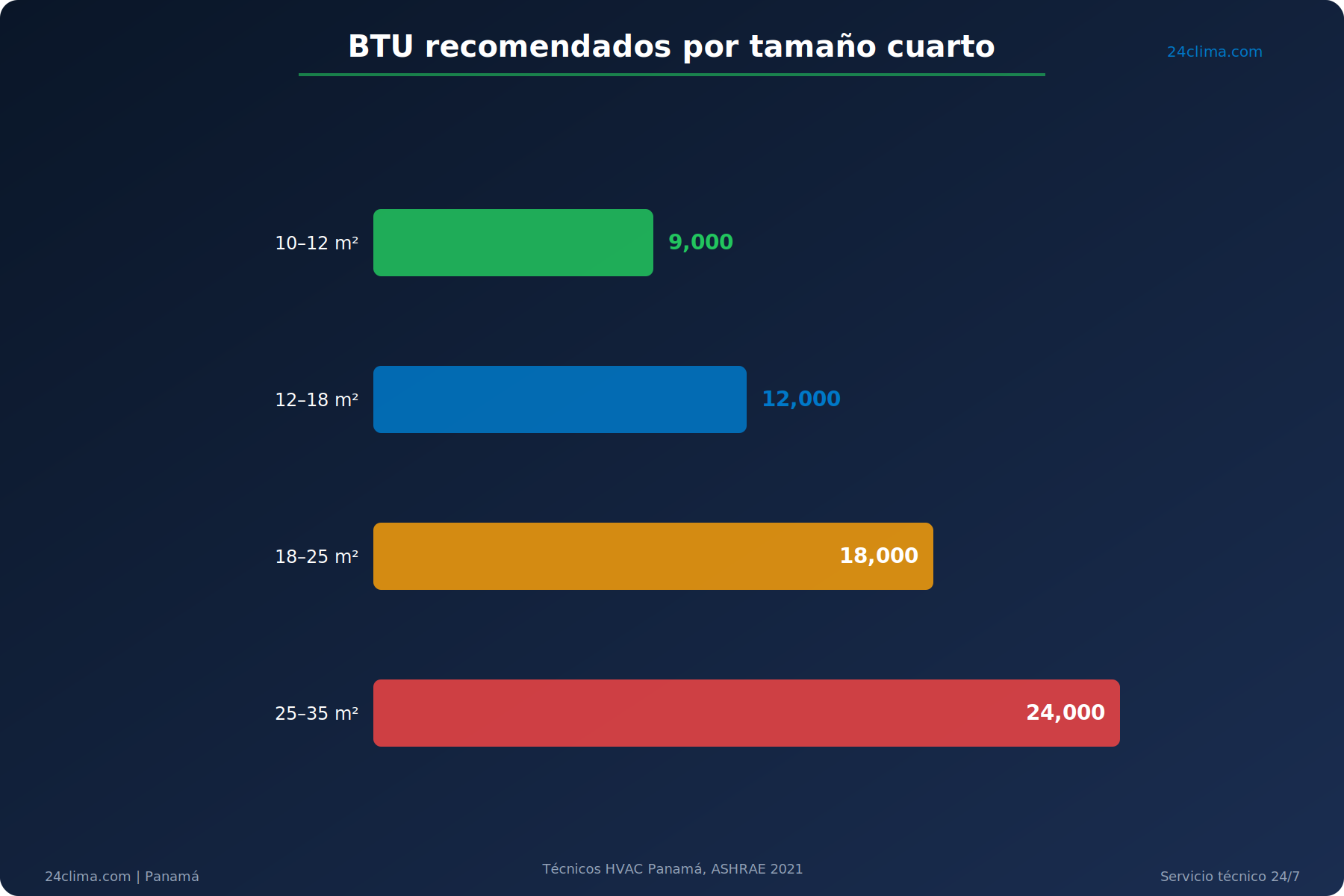
For a bedroom of about 160 sq ft (15 m²) in Panama, the minimum recommended capacity is 12,000 BTU. Standard industry formulas built around temperate climates suggest 9,000 BTU for that floor area. In Panama's tropical climate, that is simply not enough.
The basic international rule uses 600 to 700 BTU per square meter. In Panama, experienced technicians apply 700 to 900 BTU per square meter for residential bedrooms, adjusted for three factors: which floor of the building, the solar orientation of the room, and whether it has large windows.
This is the table adjusted for Panama's tropical climate:
Room Size — Recommended BTU — Typical Use — 105–130 sq ft (10–12 m²) — 9,000 BTU — Service room, small office with no direct solar exposure — 130–195 sq ft (12–18 m²) — 12,000 BTU — Standard bedroom, master bedroom on a mid-level floor — 195–270 sq ft (18–25 m²) — 18,000 BTU — Large bedroom, suite, top-floor room with west-facing windows — 270–375 sq ft (25–35 m²) — 24,000 BTU — Spacious master suite or combined bedroom-living area
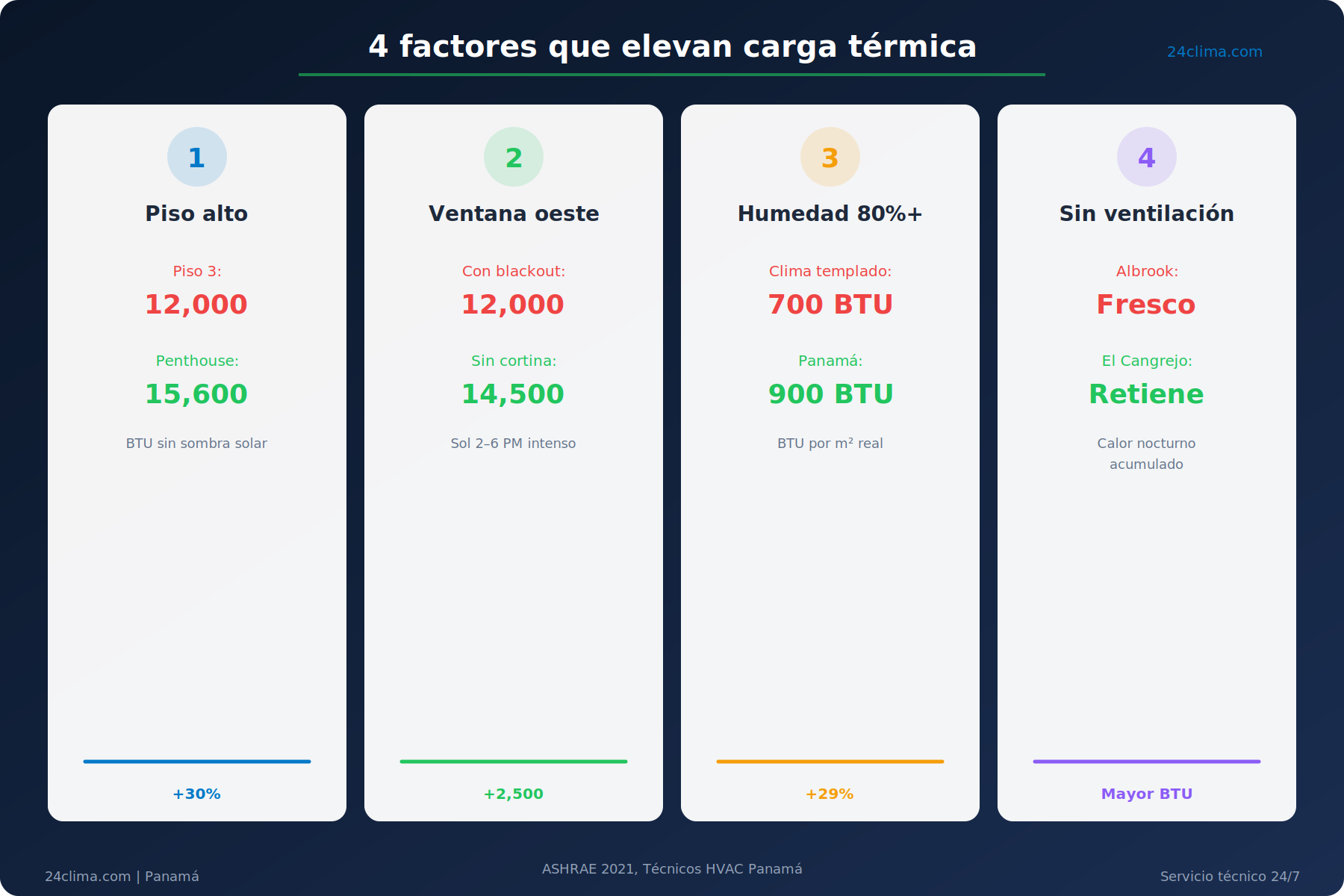
Three factors that push the load higher specifically in Panama:
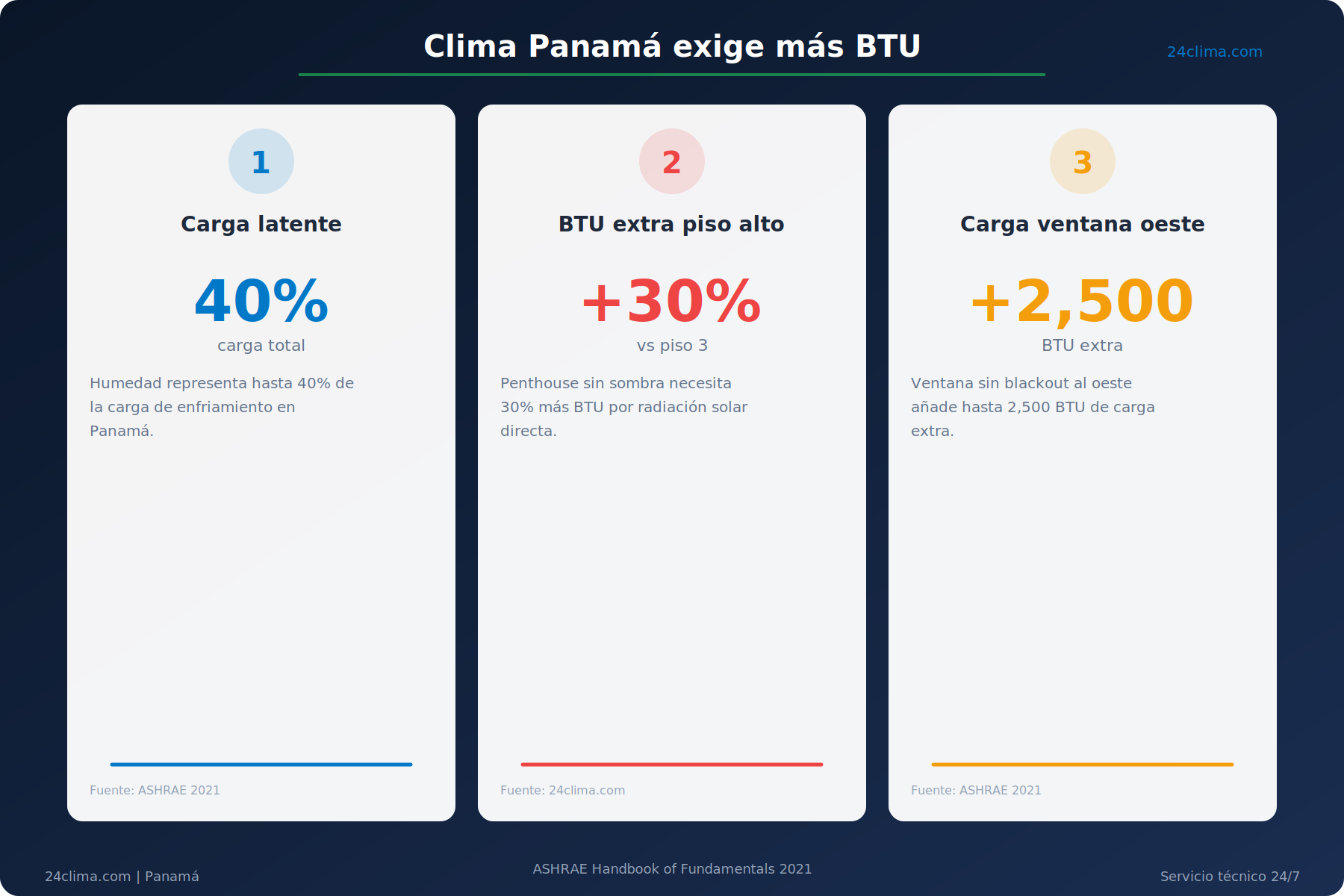
High floor, no shade — the roof absorbs direct solar radiation all day. A penthouse in Costa del Este may need up to 30% more BTU than the identical room on the third floor of the same building.
West- or southwest-facing windows — Panama's afternoon sun hits hard between 2 PM and 6 PM. A window without blackout curtains can add between 1,500 and 2,500 BTU of additional load on its own.
No cross-ventilation in dense neighborhoods — rooms in El Cangrejo or Betania trap far more nocturnal heat than rooms in areas with better airflow like Albrook or Clayton.
According to the ASHRAE Handbook of Fundamentals (2021 edition), in climates with a wet-bulb temperature of 27°C (81°F) or higher — which describes Panama City for most of the year — latent load can account for up to 40% of the total cooling load. That is the number one reason undersized units never deliver real comfort here.
Inverter vs. Conventional for a Bedroom — The Difference That Actually Matters
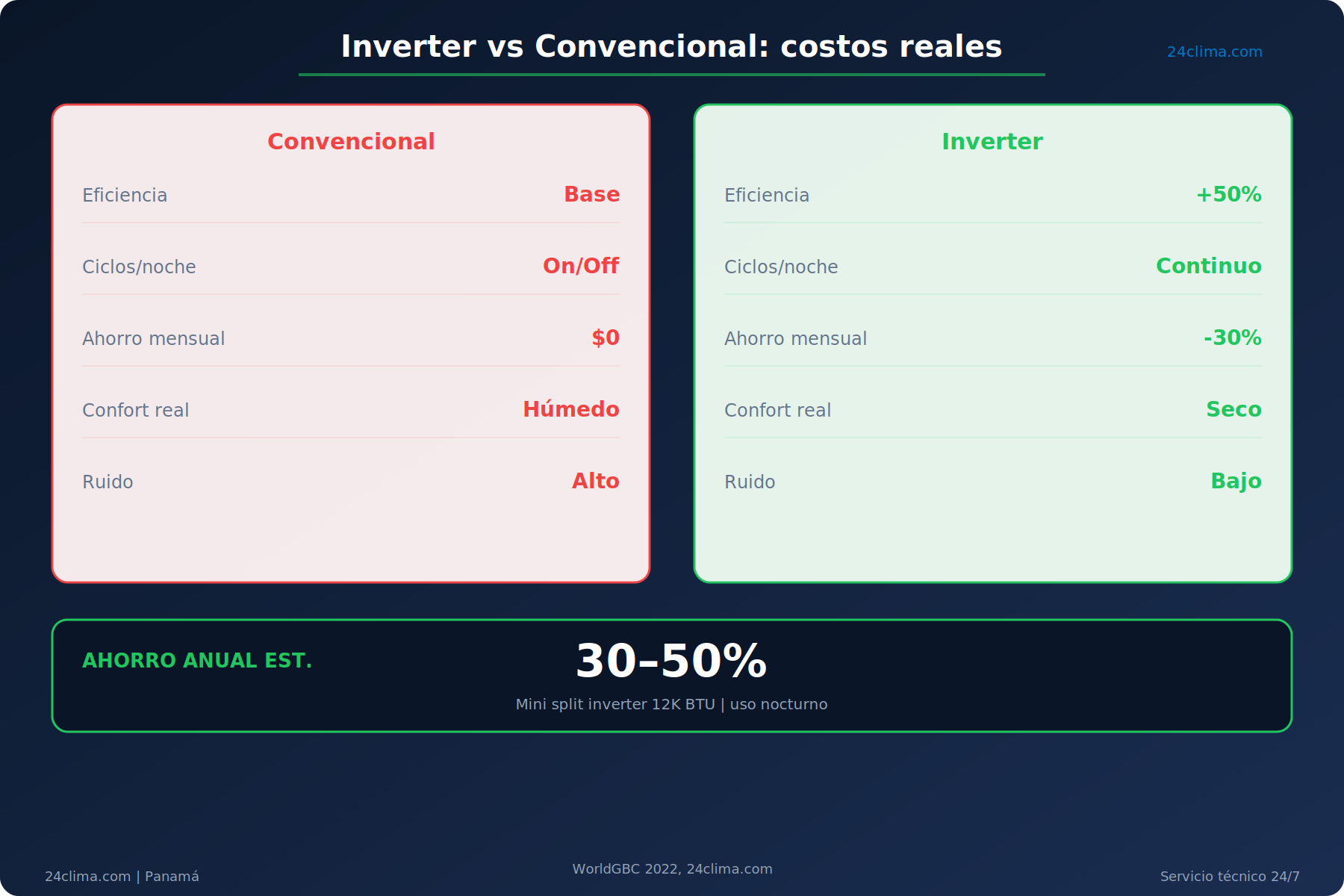
For overnight use in a single bedroom in Panama, a mini-split inverter is the right call. An inverter unit runs 30% to 50% more efficiently than a conventional unit of the same size under real-world conditions, according to research from the World Green Building Council (WorldGBC, 2022).
The technical difference is straightforward. A conventional on/off unit works like a light switch: temperature rises 1°C above the setpoint, compressor kicks on at 100% power; hits the target, shuts off. On, off, on, off — all night. Each startup draws a power spike 3 to 4 times higher than steady-state consumption.
An inverter continuously adjusts compressor speed. Instead of cutting off at 22°C (72°F), it slows to 20–30% capacity and holds the temperature there. For a bedroom in Panama that means:
— Temperature stable within ±0.5°C (±1°F) all night, versus ±2°C (±3.5°F) with a conventional unit — Quieter operation — which matters a lot when you are trying to sleep — Meaningfully lower consumption across 6–8 hours of nightly use
Now, what does that difference actually cost you?
A conventional 12,000 BTU mini-split in Panama draws approximately 1,200 watts while running. Over 8 hours, that is 9.6 kWh. At the ENSA/Naturgy residential rate current in 2025 — approximately $0.14 to $0.17 per kWh — that works out to $1.34 to $1.63 per night, or $40 to $49 per month for a single room.
An inverter unit of the same capacity, holding nighttime temperature, averages 600 to 750 watts over those same 8 hours. Consumption: 4.8 to 6.0 kWh per night. Monthly cost: $20 to $31.
Real savings: $15 to $22 per month per bedroom. Over 12 months, that is $180 to $264 — enough to recover the price gap between a conventional unit and an inverter in 18 to 24 months.
Real Prices in Panama — What You Will Find in Stores in 2025
Prices shift with inventory and retailer. These are real price ranges observed at Rodelag, Novey, and Do It Center during the first half of 2025 for residential wall-mounted mini-splits, indoor and outdoor units included:
Conventional mini-splits (on/off): — 9,000 BTU — $280 to $350 — Brands: Carrier, LG, Midea — 12,000 BTU — $320 to $420 — Brands: Carrier, LG, Gree, Midea — 18,000 BTU — $420 to $550 — Brands: Carrier, Samsung, Gree
Inverter mini-splits: — 9,000 BTU Inverter — $380 to $480 — Brands: LG, Daikin, Carrier — 12,000 BTU Inverter — $430 to $580 — Brands: LG, Daikin, Carrier, Mitsubishi Electric — 18,000 BTU Inverter — $580 to $750 — Brands: Daikin, Mitsubishi, Carrier
Add installation on top of those prices. A clean job in Panama — no long pipe runs, certified labor, properly grounded electrical connection — runs $150 to $250 depending on complexity. Our mini-split installation service covers electrical point inspection, bracket mounting, refrigerant charge if needed, and a full operational test.
One thing to watch: skip the "budget" installation offers below $80. Uninsulated pipes, improper drainage, or a bad electrical connection can destroy a $500 unit in under a year. The savings are not real.
Brand matters, but less than most people think. Daikin and Mitsubishi have the strongest track record for durability in salt-air environments — Punta Pacífica, Casco Antiguo, Amador. LG and Carrier give you solid price-to-performance for most of the city's interior. Midea and Gree are the budget-friendly end: decent out of the box, but with a thinner technical service network in Panama if something goes wrong later.
Frequently Asked Questions About Bedroom Air Conditioners in Panama
How many BTUs does an air conditioner need for a 160 sq ft (15 m²) bedroom in Panama?
In Panama, a 160 sq ft (15 m²) bedroom needs a minimum of 12,000 BTU. International sizing tables built around temperate climates suggest 9,000 BTU for that floor area, but outdoor heat averaging 31°C (88°F) combined with relative humidity above 80% pushes the real thermal load significantly higher. A 9,000 BTU unit in that space runs at the limit of its capacity continuously — it shortens its lifespan and never adequately dehumidifies the room.
Is inverter or conventional better for cooling a single bedroom in Panama?
For bedroom use, the inverter is the better choice. It runs quieter with no on/off cycling, holds a more stable temperature through the night, and consumes 30% to 50% less energy in maintenance mode. The price premium — $100 to $150 more than an equivalent conventional unit — comes back through electricity savings in 18 to 24 months of regular nightly use.
How much does a bedroom air conditioner cost to run per month in Panama?
A conventional 12,000 BTU mini-split running 8 hours nightly consumes approximately 9.6 kWh per day, which works out to $40 to $49 per month at 2025 ENSA/Naturgy rates. An equivalent inverter unit with the same usage pattern consumes 4.8 to 6.0 kWh per day, at a monthly cost of $20 to $31. Run it 12 to 14 hours a day and a conventional unit pushes past $80 per month, while an inverter stays below $55.
That sweaty 11 PM moment in San Francisco has a straightforward solution. Not expensive, not complicated — but it does require picking the right unit for the right room in the right climate. A 12,000 BTU inverter correctly installed in a 160 sq ft (15 m²) bedroom on a mid-level floor will hold 22°C (72°F) all night while consuming less electricity than most people expect.
The difference between sleeping well and sweating through a high bill is not the brand on the unit. It is the right capacity, the right technology, and an installation done properly.
At 24Clima we assess your room, calculate the real thermal load, and recommend the specific unit for your situation — no guessing at the store. Contact us on WhatsApp at https://24clima.com/contacto/ and tell us your room size, which floor you are on, and which direction your windows face. With those three details, we can give you a concrete technical recommendation right away.