Mitsubishi Air Conditioners in Panama — Are They Worth It in 2025?
It's 2 p.m. in Costa del Este. The sun hammers the concrete under a cloudless sky, the outdoor temperature reads 33°C (91°F), and humidity is sitting at 87%. You walk through the door after forty minutes in the car, hit the AC remote, and wait for that first rush of cold air that makes everything feel possible again.
The cool air arrives. But so will the electric bill at the end of the month.
That's the real dilemma for anyone shopping for a new air conditioner in Panama. You want genuine cooling power for a tropical climate, efficiency that won't make you wince at the BNB branch, and a brand still running reliably five years from now. Mitsubishi Electric comes up constantly in that search — but most articles skip the specifics: which models are actually available here, what they cost at local stores, and whether the premium price is genuinely justified over LG or Samsung. Below you'll find real numbers for all three questions. For a broader overview of how to choose the right AC in Panama, start with our guides at https://24clima.com/consejos-y-guias/
What Most People Get Wrong Before They Buy
The most common belief is "Mitsubishi is expensive but the best, end of story." That oversimplification can cost you money in both directions — you either overpay for a model you don't need, or you buy the wrong one because nobody explained the differences within the Mitsubishi lineup itself.
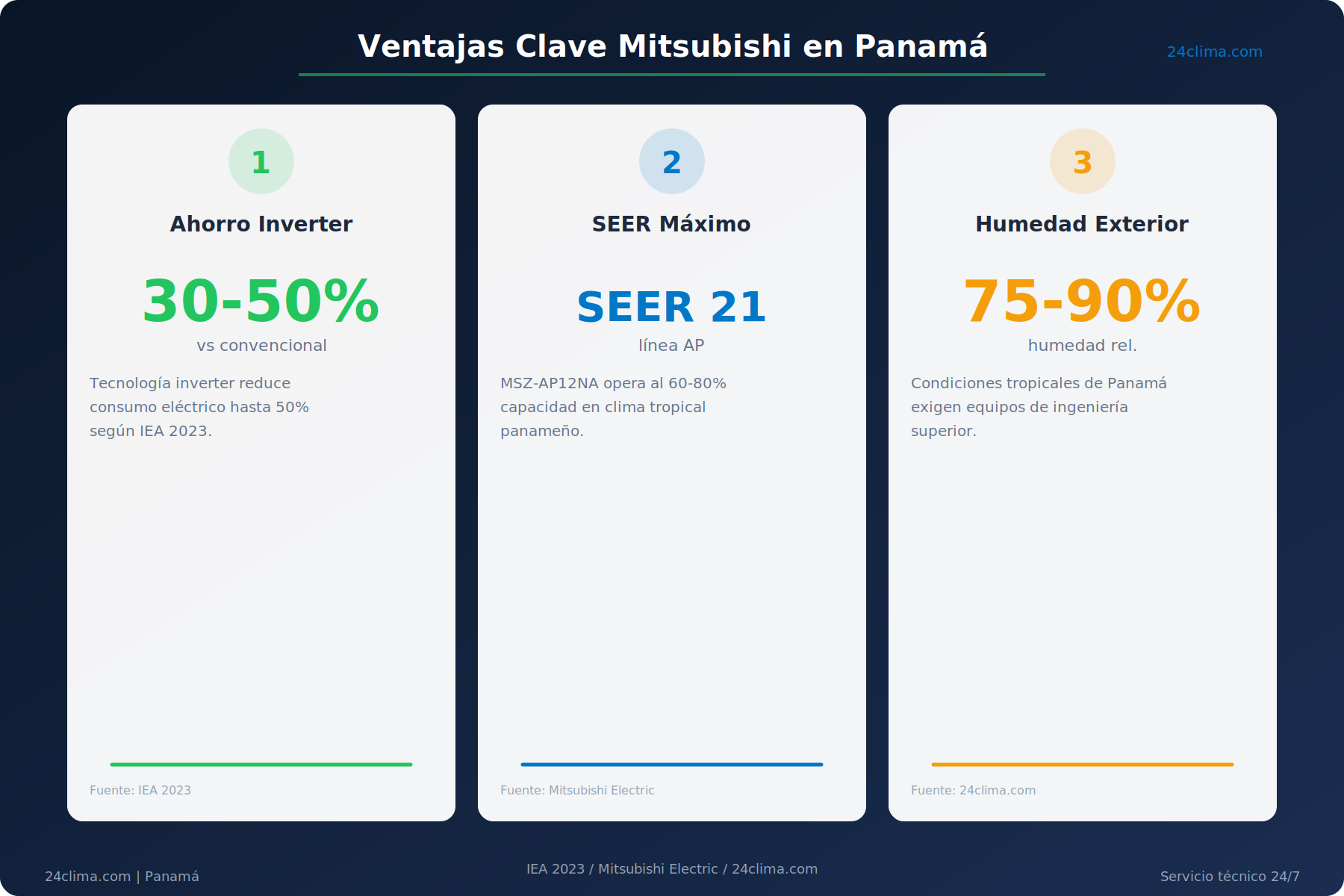
The second mistake: assuming all inverter units are basically the same. You hear "inverter" and expect your electricity bill to drop in half. Inverter technology does reduce consumption — by 30% to 50% compared to conventional units, according to the International Energy Agency (IEA, 2023) — but real-world efficiency depends on the specific model's SEER rating, the size of the space, and how well the unit was installed. A Mitsubishi MSZ-AP with a SEER of 21, dropped into a poorly insulated room, will work harder than a Samsung WindFree in the same room with proper insulation. The brand matters. The installation matters just as much, if not more.
Third misconception: that any air conditioner "works fine in Panama." Panama's climate combines heat and humidity in a way that stresses compressors and heat exchangers more aggressively than Miami or Bogotá. You need equipment built to operate efficiently at constant outdoor temperatures of 31°C to 33°C (88°F to 91°F) with relative humidity between 75% and 90%. That's where Mitsubishi Electric's Japanese engineering shows measurable technical differences.
The Best-Selling Mitsubishi Models in Panama and Their Real Specs
Mitsubishi Electric sells primarily under the MSZ line in Panama, with the AP and GL series most common at retailers like Novey, Rodelag, and eVision. Three sizes dominate the residential and small-office market.
Mitsubishi MSZ-AP12NA — 12,000 BTU Inverter
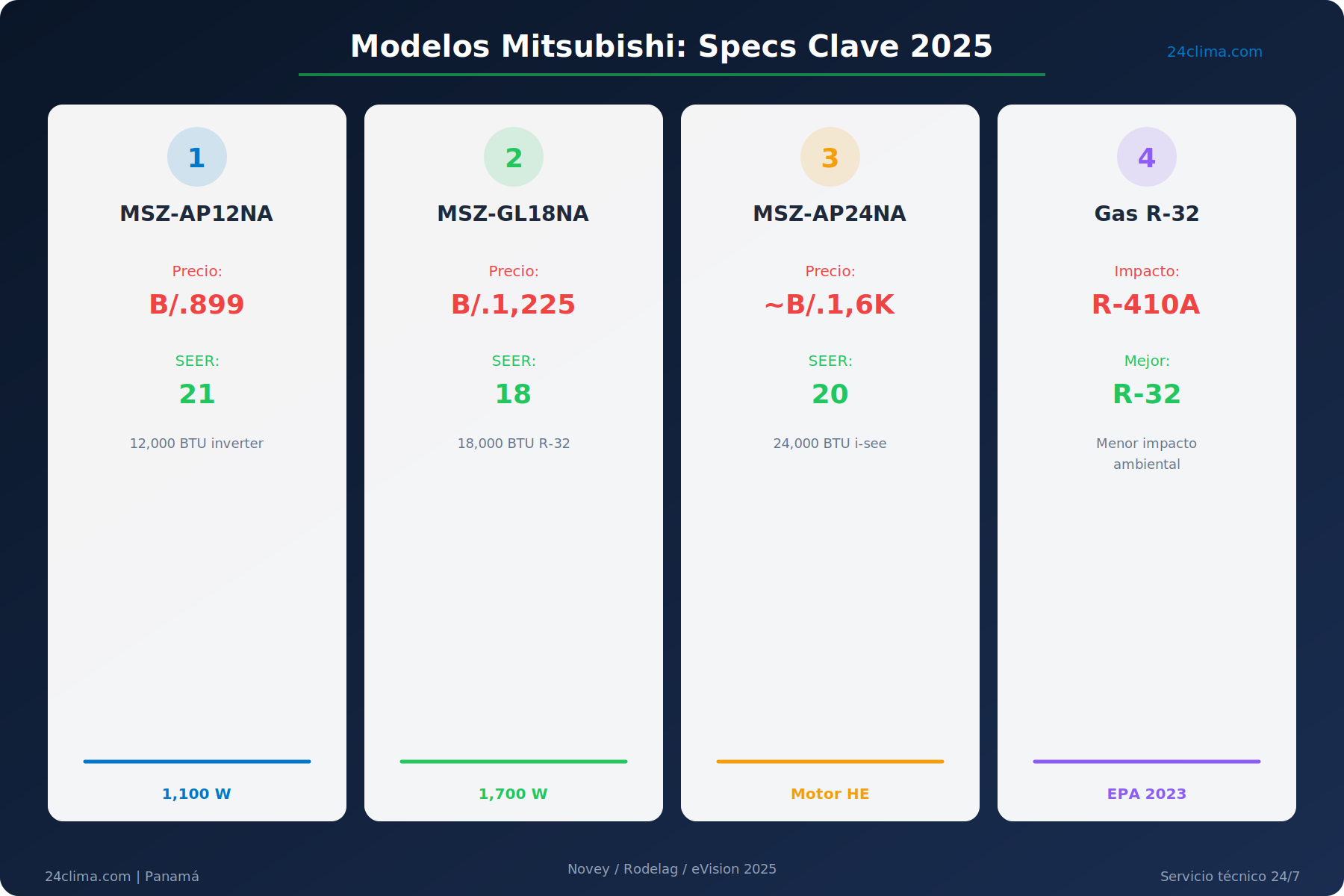
The entry-level model in the premium AP line carries a SEER of 21 under standard lab conditions, a variable-speed inverter compressor, and an enzymatic filter with auto-cleaning function. In tropical conditions — 31°C (88°F) outdoors, targeting 27°C (81°F) indoors — the compressor runs between 60% and 80% of maximum capacity during peak hours. That keeps wear on the unit low and holds electricity consumption in check.
Price in Panama (2025): B/.850 to B/.980 depending on the retailer. Novey lists it at B/.899; Rodelag and eVision vary with promotions.
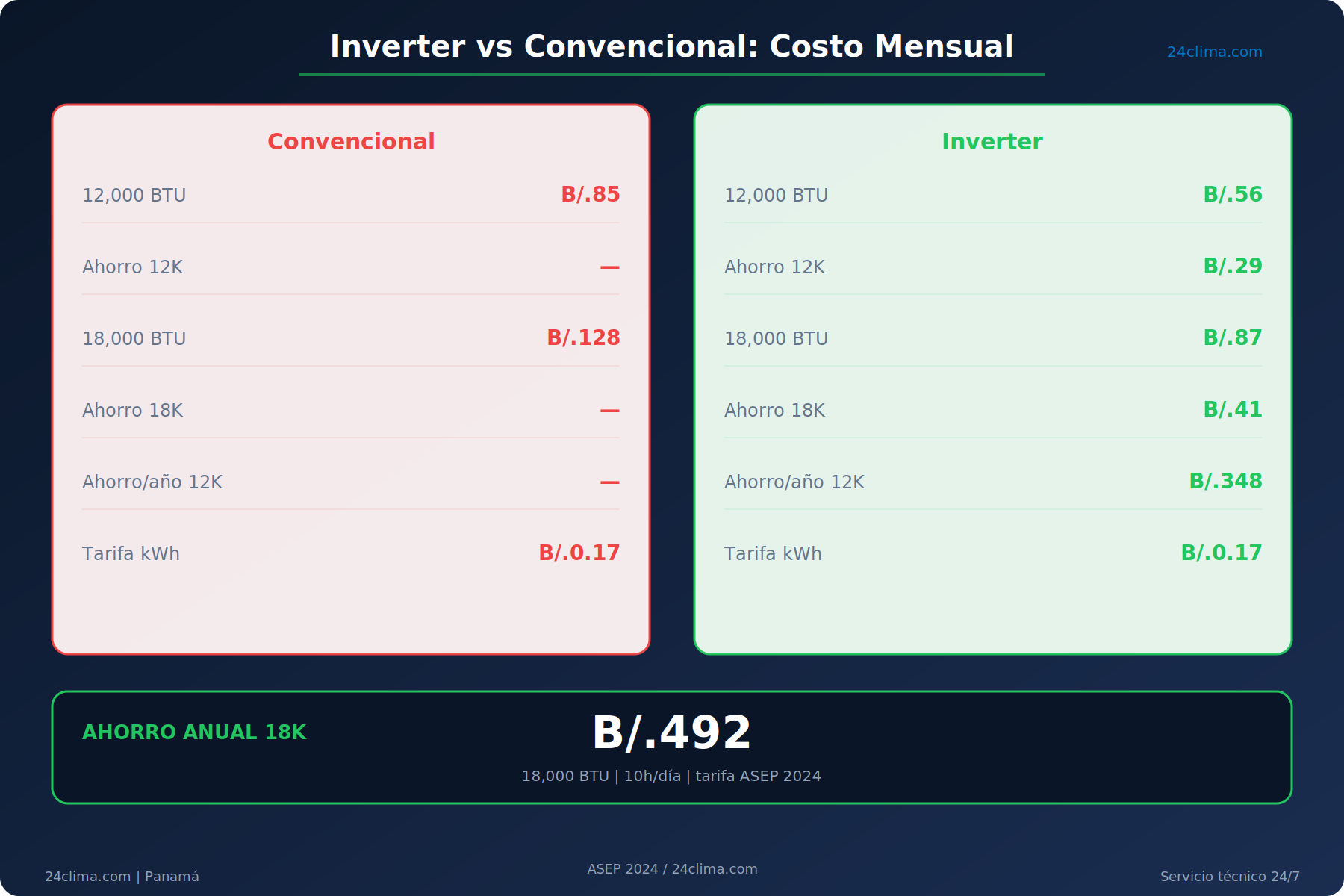
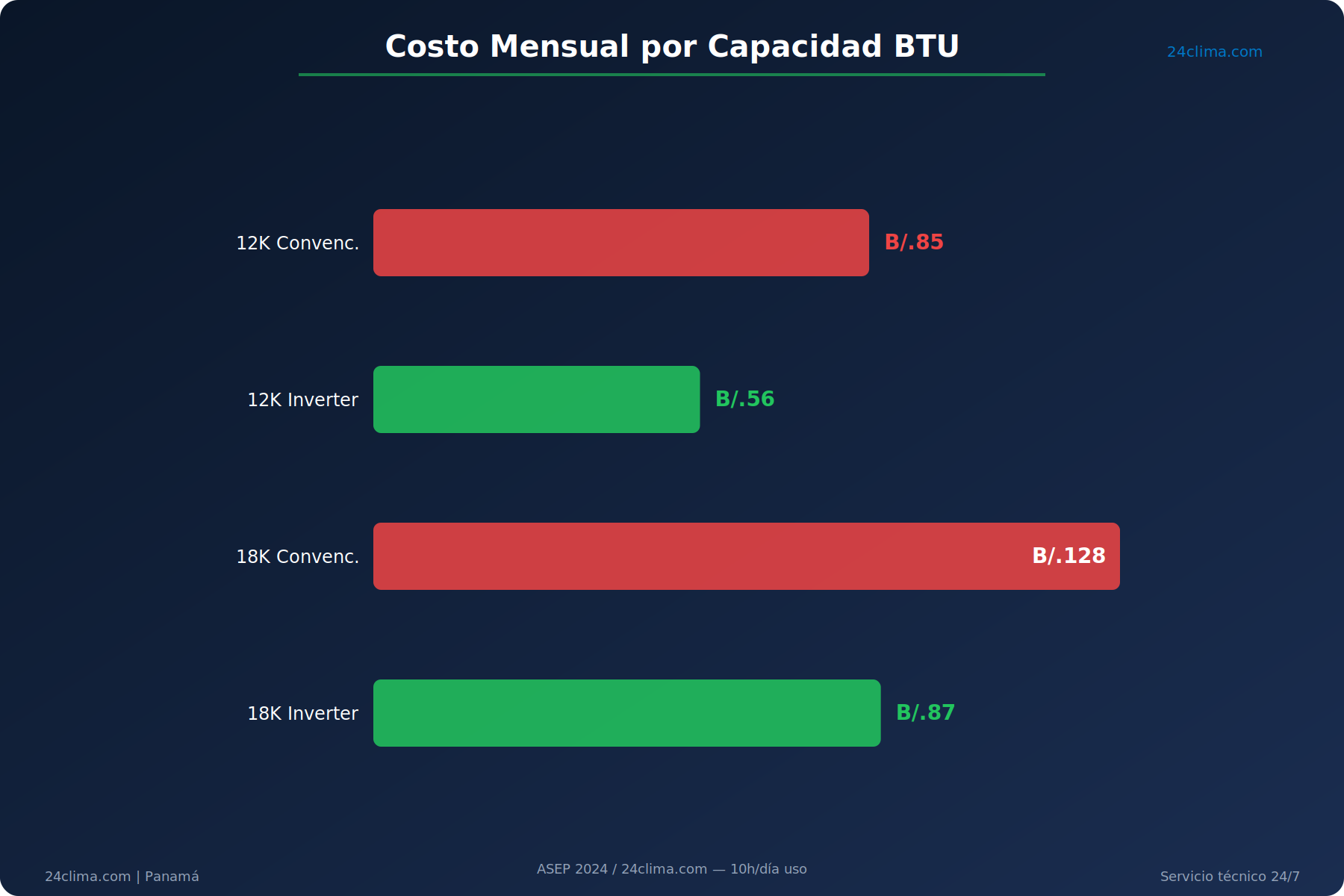
At 10 hours of daily use and the average electricity rate of B/.0.17/kWh (per ASEP, 2024), this unit costs approximately B/.56 per month to run. A conventional 12,000 BTU non-inverter unit would cost around B/.85 per month under the same conditions — a difference of B/.29 per month, B/.348 per year, on a single room.
Best for rooms between 12 and 18 square meters (130 to 195 sq ft).
Mitsubishi MSZ-GL18NA — 18,000 BTU Inverter
The GL line is slightly more basic than the AP in terms of filtration and Wi-Fi connectivity, but keeps the same technical core: inverter compressor, R-32 refrigerant (lower environmental impact than R-410A, according to the EPA, 2023), and a SEER of 18. In Panama's climate, the gap between SEER 18 and SEER 21 translates to roughly B/.12 to B/.15 less per month. Not dramatic on its own — but across 10 years, it adds up to B/.1,440 to B/.1,800.
Price in Panama (2025): B/.1,100 to B/.1,350.
Running at 10 hours daily, this unit costs approximately B/.87 per month. The conventional equivalent runs about B/.128 — savings of B/.41 per month.
Best for living rooms of 20 to 30 square meters (215 to 325 sq ft), master bedrooms with an en-suite bathroom, mid-size offices.
Mitsubishi MSZ-AP24NA — 24,000 BTU Inverter
The top residential-capacity model features a SEER of 20, a high-efficiency compressor motor, and Mitsubishi's "i-see sensor," which detects occupants and adjusts airflow direction automatically. In open-plan spaces — a small conference room or showroom — this unit holds the target temperature without the abrupt on/off cycling that wears down conventional systems over time.
Price in Panama (2025): B/.1,450 to B/.1,700.
Monthly running cost: B/.112 at 10 hours daily. Savings versus a conventional unit: approximately B/.50 per month.
Best for areas of 30 to 45 square meters (325 to 485 sq ft), open-plan studio apartments, small meeting rooms.
SEER Comparison: Mitsubishi vs LG vs Samsung in Tropical Conditions
SEER (Seasonal Energy Efficiency Ratio) measures how many units of cooling a system produces per unit of energy consumed — higher means less electricity paid. One important detail most salespeople skip: SEER is calculated under temperate lab conditions. In Panama, with outdoor temperatures consistently above 30°C (86°F), real-world efficiency drops between 8% and 15% across all brands. No exceptions.
With that in mind, here's a realistic side-by-side under Panama conditions at 12,000 BTU:
Mitsubishi MSZ-AP12NA: nominal SEER 21, estimated real tropical efficiency 18–19. Monthly cost: B/.56.
LG Dual Inverter S4-W09JA3WA: nominal SEER 21, estimated real tropical efficiency 17–18. Monthly cost: B/.60. Price in Panama: B/.680–B/.780.
Samsung WindFree AR12BXFCAWKN: nominal SEER 22, estimated real tropical efficiency 18–19. Monthly cost: B/.56–B/.58. Price in Panama: B/.750–B/.850.
The monthly electricity difference between these three brands at the same BTU is B/.4 to B/.8. What varies more significantly is the purchase price — Mitsubishi runs B/.100 to B/.200 more than LG at the same BTU — and long-term durability expectations.
One technical point that rarely comes up at the counter: Mitsubishi Electric engineers its compressors to handle 50,000 hours of operation, according to the brand's own technical documentation. At 10 hours of use per day, that's roughly 14 years. LG and Samsung do not publish equivalent figures in their commercial specification sheets for Latin America.
Does Mitsubishi Justify the Premium Price in Panama?
The direct answer: yes, in specific situations. Not across the board.
Mitsubishi Electric MSZ justifies the higher price when the unit will run intensively — 10 or more hours daily, every day of the year. In that scenario, the compressor's durability and accumulated efficiency savings recover the price difference within 3 to 4 years.
It also makes sense when the space has poor insulation — bare concrete walls, large west-facing windows. Mitsubishi's precise inverter compressor control maintains more stable temperatures without overloading the system the way a less sophisticated unit would.
Noise level is another legitimate reason. The MSZ-AP12NA operates at 19 dB in silent mode — roughly the level of a soft whisper. LG and Samsung run between 21 and 24 dB in the equivalent setting. For bedrooms where AC noise disrupts sleep, that 2 to 5 dB gap is real and noticeable.
Mitsubishi does not justify the premium when the unit is going into a guest room used two or three times a month. It also doesn't make sense when budget is the deciding factor and you need to cool multiple rooms on a fixed spend — two LG Dual Inverter 12,000 BTU units cost less than a single Mitsubishi 24,000 BTU unit and cool more total space with independent temperature control in each room.
One more situation where the brand premium means nothing: when the installation is done by an uncertified technician. A B/.980 unit installed with the wrong refrigerant charge or undersized copper lines will perform the same as — or worse than — a B/.650 unit installed correctly. To protect your investment from day one, see our installation service at https://24clima.com/servicios/instalacion/
Decision Table by Use Case
This table summarizes the recommendation by space type and user profile for Panama:
Small bedroom (up to 18 m² / 195 sq ft), daily intensive use — Best option: Mitsubishi MSZ-AP12NA. Alternative: LG S4-W09JA3WA or Samsung WindFree 12,000 BTU. Priority: durability and noise level.
Small bedroom (up to 18 m² / 195 sq ft), moderate use — Best option: LG Dual Inverter 12,000 BTU. Reason: lower purchase price, similar efficiency, faster return on investment.
Full apartment or living room of 25–35 m² (270–375 sq ft) — Best option: Mitsubishi MSZ-AP18NA or MSZ-GL18NA. Alternative: Samsung WindFree 18,000 BTU. Priority: dehumidification capacity in spaces with multiple occupants.
Mid-size office (35–50 m² / 375–540 sq ft, commercial use 8 hours daily) — Best option: Mitsubishi MSZ-AP24NA. Reason: durability for commercial use, documented compressor warranty, established technical support network.
For preventive maintenance that protects any of these units long-term, our professional maintenance service is at https://24clima.com/servicios/mantenimiento/
Frequently Asked Questions
How much does a Mitsubishi air conditioner cost in Panama in 2025?
Residential models in the MSZ line run between B/.850 and B/.1,700 depending on capacity. The 12,000 BTU model (MSZ-AP12NA) is priced between B/.850 and B/.980 at Novey, Rodelag, and eVision. The 18,000 BTU unit runs B/.1,100 to B/.1,350, and the 24,000 BTU model between B/.1,450 and B/.1,700. These prices don't include installation, which in Panama typically adds B/.120 to B/.250 depending on the complexity of the job and the technician hired.
Is Mitsubishi better than LG or Samsung for Panama's tropical climate?
Under intensive use — 10 or more hours daily, high humidity — Mitsubishi Electric MSZ shows concrete advantages: better-documented compressor durability, lower operating noise, and finer temperature control. That said, the electricity efficiency gap versus LG or Samsung is modest: B/.4 to B/.8 per month on a 12,000 BTU unit. The decision comes down to your budget and how hard you'll run the system.
Which Mitsubishi inverter model uses the least electricity in Panama?
Among models available in the Panamanian market, the MSZ-AP12NA has the highest SEER in the lineup — 21 nominal, 18 to 19 in real tropical conditions — and the lowest absolute consumption. Its estimated monthly cost at 10 hours of daily use is approximately B/.56, based on the ASEP 2024 electricity rate. The MSZ-AP24NA consumes more in total (B/.112/month) but covers nearly triple the area, so its efficiency per square meter stays competitive.
The Decision You've Been Putting Off
Back to that Costa del Este apartment at 2 p.m. The cool air arrives, the room drops to a comfortable temperature, and you don't dread the electricity bill at the end of the month — as long as you chose the right unit for your space and had it installed properly.
Mitsubishi Electric MSZ earns its premium when use is intensive, when noise matters, and when you're thinking about the next 12 to 15 years rather than just the next 12 months. If budget is your primary constraint, LG and Samsung deliver comparable electrical efficiency at a lower entry price. The real difference isn't the logo on the outdoor unit — it's the installation, the maintenance, and how you use the system every single day.
At 24Clima, we install and service units from all major brands with certified technicians across Panama. If you want a specific recommendation based on your room dimensions and window orientation, contact us on WhatsApp at https://24clima.com/contacto/ — we'll give you data, not a sales pitch.
Last updated: May 2025