Air Conditioning in Panama — The Complete Buying Guide for Getting It Right
It's 2 PM in Costa del Este. The sun bounces off the asphalt and the thermometer reads 91°F with 87% humidity. You walk into your apartment after parking, press the remote, and wait for that blast of cold air that makes everything better. But the air comes out lukewarm. The room stays sticky. And when you see last month's electricity bill from ENSA, you realize something has gone seriously wrong.
This scene plays out in thousands of homes across Panama every year. Not because air conditioners are bad, but because most people buy the wrong unit for the wrong climate — without understanding what it actually takes to live in a city that gets 70 inches of rain per year and where relative humidity rarely drops below 75%. Whether you're buying your first AC in Panama or your current unit has stopped performing, you'll find the answers here.
At 24Clima, we've spent over 5 years installing, maintaining, and diagnosing HVAC equipment across Panama City, from Albrook to San Francisco. The advice in our guides section is built specifically for Panama's climate — not recycled from blogs written for Miami or Bogotá. Read on to understand what to buy, why, and what you should actually be paying.
What Most People Believe — And Why They're Wrong
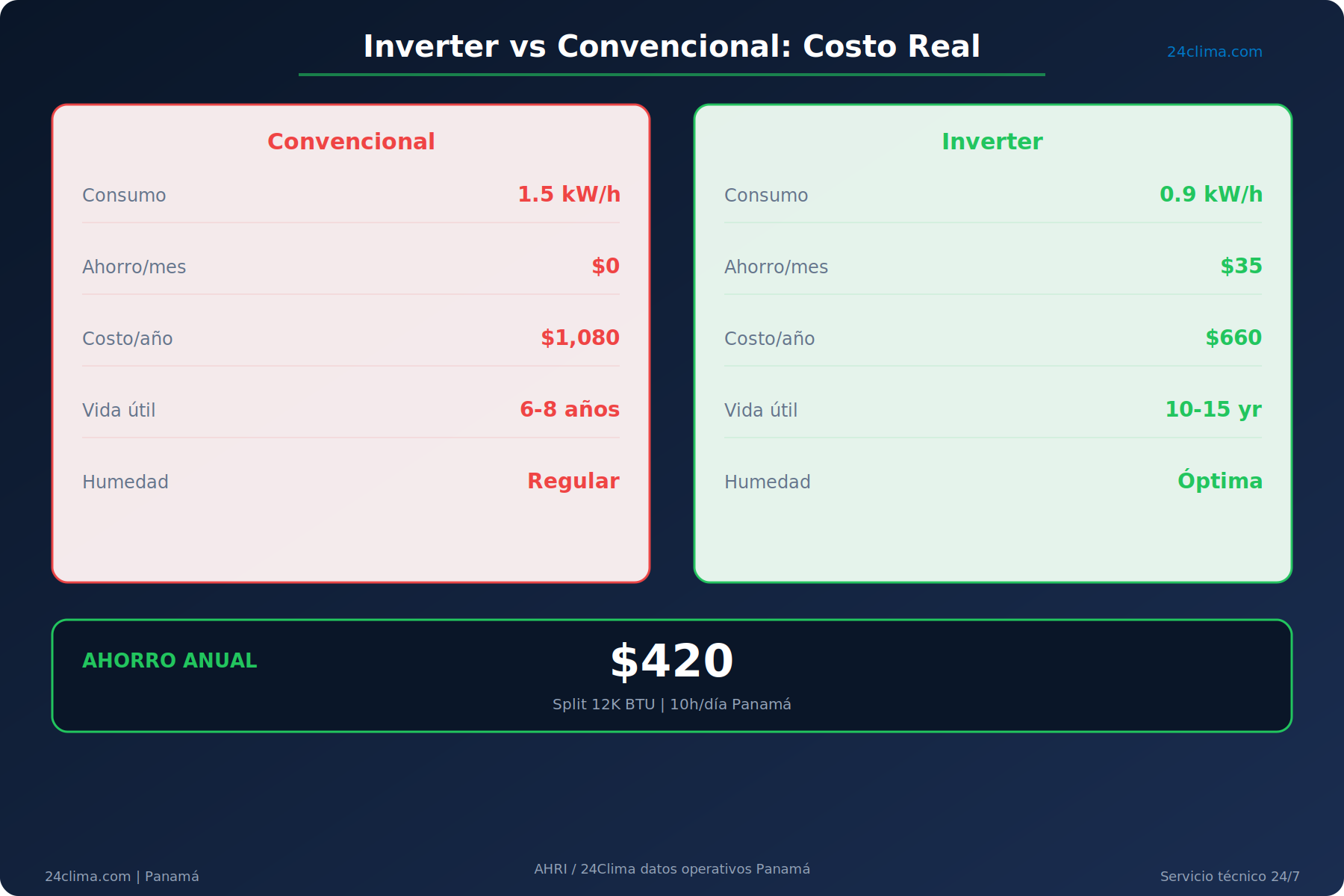
There's a widespread assumption among buyers in Panama: "the cheaper the unit, the better the deal." The logic seems reasonable. You walk into Machetazo or Do It Center, see a conventional 12,000 BTU split at $350 and an inverter of the same capacity at $550, and figure you're saving $200.
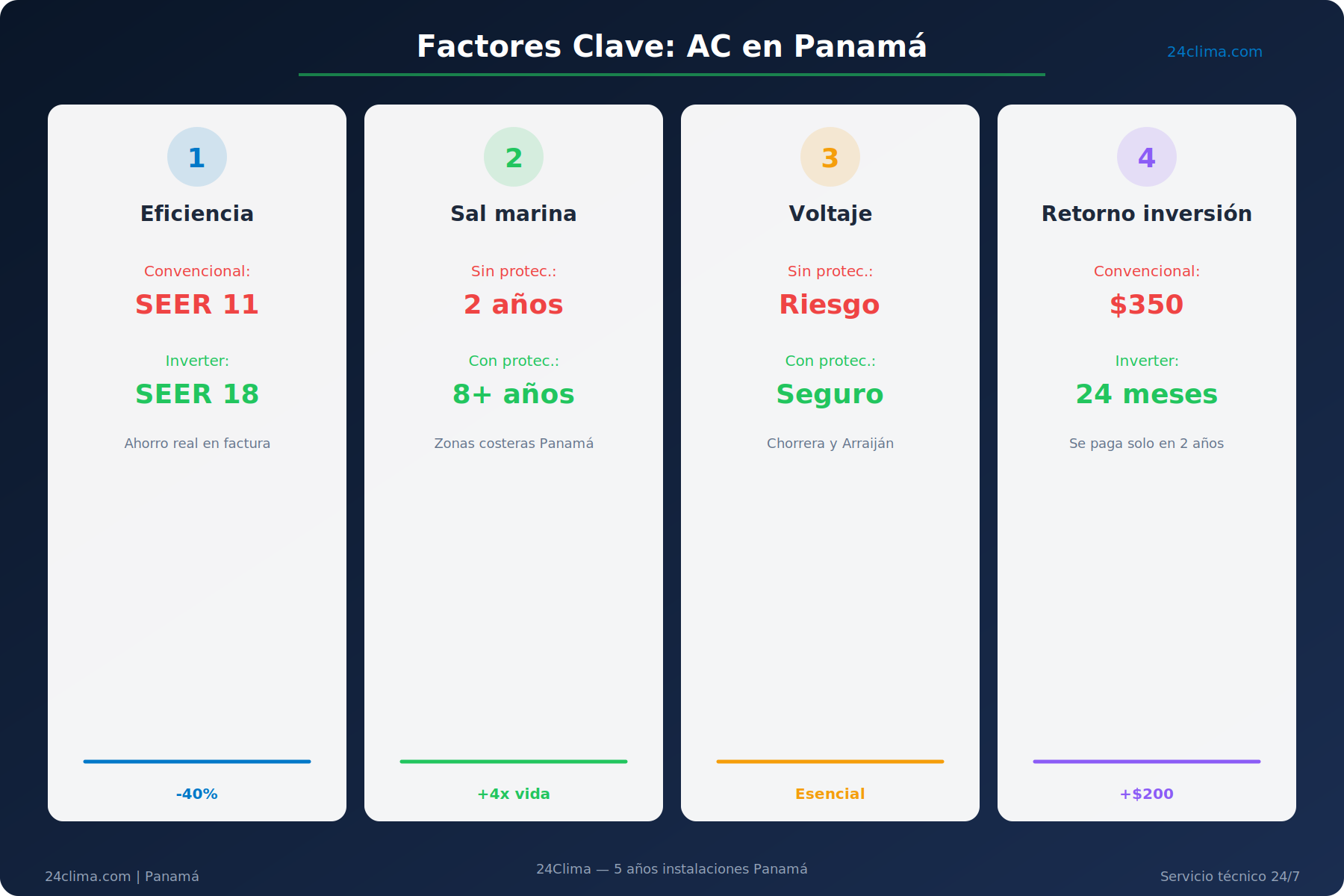
That math ignores the real cost of running that unit for 10 years in a tropical climate. A conventional split in Panama operates in constant on-off cycles, consuming between 1.2 and 1.5 kWh when running. A modern inverter with SEER 18 or higher cuts that consumption by 40% to 60% by continuously adjusting compressor speed. According to data from the AHRI energy efficiency consortium, a properly sized inverter saves between $25 and $45 per month compared to a conventional unit of the same tonnage, depending on hours of use. Within 24 months, that inverter has paid for itself.
Another common mistake: buying based on price instead of BTUs. An undersized unit runs at 100% capacity all the time, never properly reduces humidity, and wears out 3 to 4 years earlier than a unit correctly matched to the actual thermal load of the space.
Panama's Climate and What It Demands From Your AC
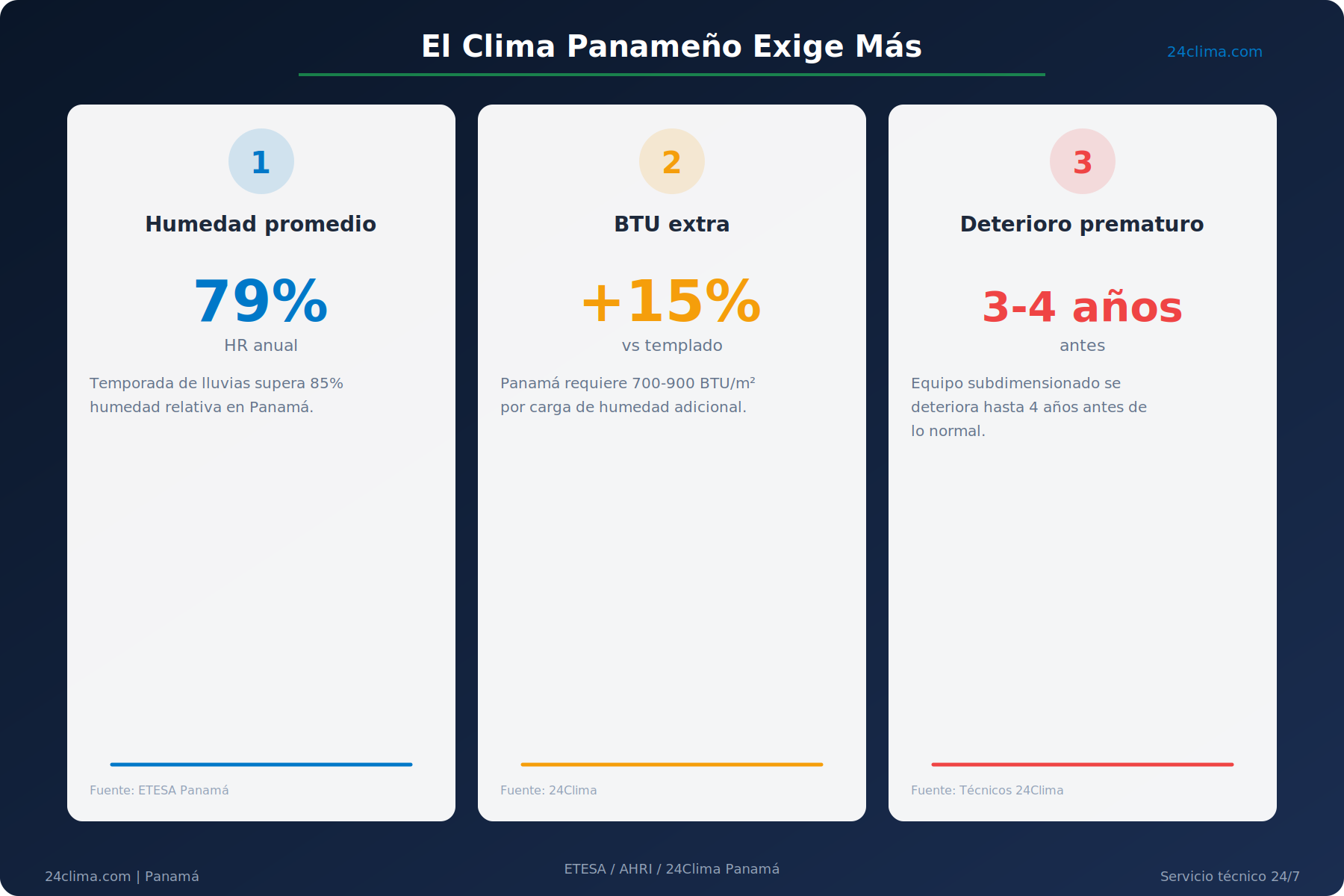
Panama City has one of the most demanding climates on the continent for cooling equipment. Average annual temperature sits at 82°F, with peaks that exceed 95°F between March and April. But temperature is only part of the story. Average relative humidity is 79%, with wet-season months — May through November — regularly pushing past 85%.
That matters because an air conditioner in Panama doesn't just need to cool. It needs to actively dehumidify. Dehumidification draws additional energy and puts sustained pressure on the evaporator and compressor. A unit designed for dry or temperate climates, even one with the right BTU rating on paper, can fail to extract enough moisture from the air — leaving a room that feels cold but still clammy.
Coastal neighborhoods like Punta Pacífica and Bella Vista add another layer: salt air that accelerates corrosion on aluminum fins and electrical contacts. And in areas with frequent voltage fluctuations, like parts of La Chorrera or Arraiján, units without voltage protection can suffer compressor damage in under 2 years.
How to Calculate the BTUs You Need for Your Space in Panama
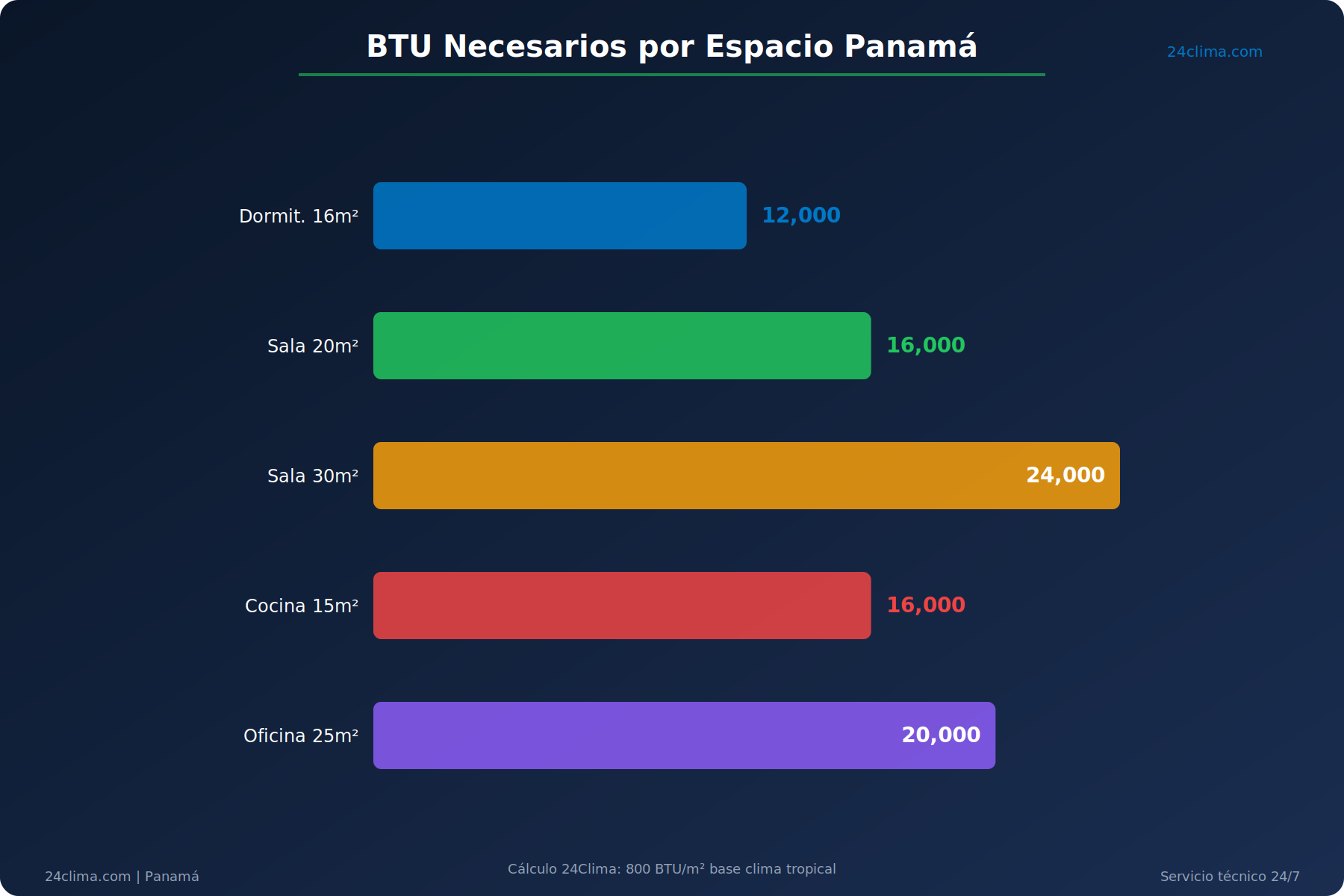
The direct answer: in Panama, calculate between 700 and 900 BTUs per square meter, adjusting upward if the room has large windows, direct afternoon sun exposure, or more than 2 people sleeping in it. This range runs about 15% higher than the standard used in temperate countries, specifically because of the additional humidity load.
Here's how to work through it:
Measure the area in square meters (length × width of the space).
Multiply by 800 BTUs as your baseline.
Add 1,000 BTUs if the room has a window with direct afternoon sun exposure.
Add 600 BTUs for each additional person who occupies the space regularly for more than 4 hours per day.
Add 4,000 BTUs if it's a kitchen or a space with significant internal heat generation.
A typical 16 square meter bedroom in Panama needs between 12,000 and 13,000 BTUs. A 30 square meter living room with west-facing windows: between 22,000 and 24,000 BTUs. Sizing slightly large — no more than 10% over — is preferable in a tropical climate. Undersizing means the compressor runs constantly, your bill climbs, and the humidity never quite goes away.
Inverter Split vs. Conventional Split — The Comparison That Actually Matters in Panama
An inverter split is the right choice for the vast majority of homes in Panama. That's not a sales pitch — it's backed by measured energy consumption data from tropical conditions. According to a study published in Energy and Buildings (Springer, 2022), inverter systems reduce electricity consumption by 30% to 58% compared to fixed-speed units operating under conditions of high humidity and sustained heat, which is precisely what Panama delivers year-round.
In real terms for your monthly bill:
— A conventional 1-ton (12,000 BTU) split running 8 hours a day in Panama consumes approximately 145 kWh per month. — An inverter split of the same capacity, under the same conditions, consumes between 80 and 95 kWh per month. — At ENSA's average 2024 residential rate of approximately $0.17/kWh in the mid-consumption tier, that difference works out to $8.50 to $11 per month, per unit. — With 2 or 3 units in the home, the cumulative savings over 12 months comes to $200 to $400.
A conventional split only makes sense in two scenarios: spaces used very infrequently — fewer than 3 hours per day — or when your initial budget is strictly limited and you plan to replace the unit within 3 to 4 years.
Brands Available in Panama and What to Expect From Each
In stores like Machetazo, Do It Center, Panafoto, and Global Appliances, you'll primarily find LG, Samsung, Carrier, Midea, Innovair, and Comfort Star. Each occupies a different position in the market.
LG and Samsung offer reliable inverter technology with 10-year compressor warranties on premium models. Their units running R32 refrigerant — less environmentally damaging and more thermally efficient than R410A — are the top recommendation if budget allows. An LG Dual Inverter 12,000 BTU unit runs between $520 and $650 in local stores as of 2024.
Midea and Innovair are the value options. Their basic inverter models come in at $380 to $450 for 12,000 BTU and are perfectly functional for residential bedrooms. Component quality is a step below LG or Carrier, which translates to an expected service life of 8 to 10 years versus 12 to 15 years for premium brands with proper maintenance.
Carrier remains the benchmark for commercial installations and high-end residential buildings in Panama. Their residential units fall in the $600 to $850 range, with local technical support and available spare parts.
One detail worth knowing: R32 refrigerant, available in newer LG, Samsung, and Midea models, has a global warming potential 67% lower than R410A, and its heat transfer efficiency is superior. If you're buying a new unit in 2024, ask specifically for R32. R410A units will keep working but will become obsolete as Panama implements stricter regulations aligned with the Kigali Amendment.
Maintenance in a Tropical Climate — The Factor That Affects Your Bill and Your Unit's Lifespan More Than Anything Else
Preventive maintenance in Panama is not optional. In dry climates, an air conditioner can run 6 to 8 months without a cleaning before performance noticeably degrades. In Panama — with dust, constant humidity, and mold spores in the air — a unit without maintenance loses between 15% and 25% of its efficiency within just 4 to 5 months of continuous use.
That degradation goes straight to your electricity bill. A unit that cost you $35 per month in January can be costing $45 by May, simply from dirty filters and an evaporator coil clogged with biofilm. According to ASHRAE data, every 10% reduction in airflow from dirt buildup increases energy consumption by 5% to 8%.
The recommended maintenance cycle for Panama:
— Every 2 months: clean the filters — actually wash them under water, don't just shake them off. — Every 4 to 6 months: full professional maintenance including evaporator coil wash, drain line check, refrigerant charge verification, and outdoor unit cleaning. — Every 2 years: complete inspection of electrical connections and compressor condition.
Our preventive maintenance service at 24Clima covers all of the above, including a photographic diagnostic report. If the unit is showing any irregularities, we catch them before they turn into an expensive breakdown.
Frequently Asked Questions About Air Conditioning in Panama
What is the best air conditioner for Panama's humid climate?
The best unit for Panama's conditions is an inverter split with R32 refrigerant, a minimum SEER rating of 16, and a BTU capacity correctly calculated for the space. Brands like LG Dual Inverter, Samsung WindFree, and Carrier Performance deliver the best results under high-humidity conditions. The key isn't just the brand — it's correct sizing. A unit oversized by more than 20% will cool quickly but won't dehumidify properly.
How much does an air conditioner cost in Panama in 2024?
Prices in Panama stores in 2024 range from $320 for a conventional 9,000 BTU split to $1,100 for a premium 24,000 BTU inverter split. The most common range for residential bedrooms — a 12,000 BTU inverter — falls between $420 and $650. Add to that the cost of installation, which runs between $150 and $280 depending on the type of installation and materials required.
Is an inverter air conditioner worth it in Panama?
Yes, in almost every case. If the unit will run more than 5 hours per day, the inverter recovers its higher upfront cost within 18 to 30 months through electricity savings. In Panama, where units run practically year-round, that break-even point arrives faster than in countries with distinct seasons. The only situation where a conventional unit makes sense is a space used very occasionally — a conference room used 2 hours a week, a guest room, and so on.
The Right Decision Starts With the Right Information
Back to that Costa del Este apartment — the one with the AC that won't cool and the bill that keeps climbing. That situation is not inevitable. It almost always has an identifiable technical cause: an undersized unit, overdue maintenance, low refrigerant, or simply the wrong equipment for the space.
With what you've read here, you have what you need to make a smart purchase decision: how to calculate the right BTUs, why an inverter with R32 is the most logical choice for Panama, and which brands the local market offers at real-world prices. The next step is assessing the unit you have — or installing the one you actually need — with technicians who genuinely understand what Panama's climate demands.
At 24Clima we assess your space, calculate the actual thermal load, and recommend the exact unit you need, without upselling capacity or pushing specific brands. Contact us on WhatsApp at https://24clima.com/contacto/ and schedule a technical visit. No commitment required, diagnostic included.