Air Conditioning for Your Panama Apartment — The Complete 2025 Guide
It's 2 in the afternoon in San Francisco. The sun is hammering directly through the floor-to-ceiling windows on the 12th floor, the thermometer reads 33°C (91°F) inside, and the humidity feels like a wet towel pressed against your skin. You open your banking app and see a number you weren't expecting: $180 this month.
The AC has been running since 7 in the morning. It's cooling, sure — but the air never quite dries out. The sheets still feel damp. The remote says 18°C (64°F) but your body is convinced it's 26°C (79°F). Something is clearly wrong.
The problem, almost always, isn't the unit itself. It's that nobody explained how to choose the right air conditioner for a Panama apartment before you bought it. Our guides and tips section covers the full range of tropical climate decisions — but let's start from the very beginning.
What Most People Assume (and Get Wrong)
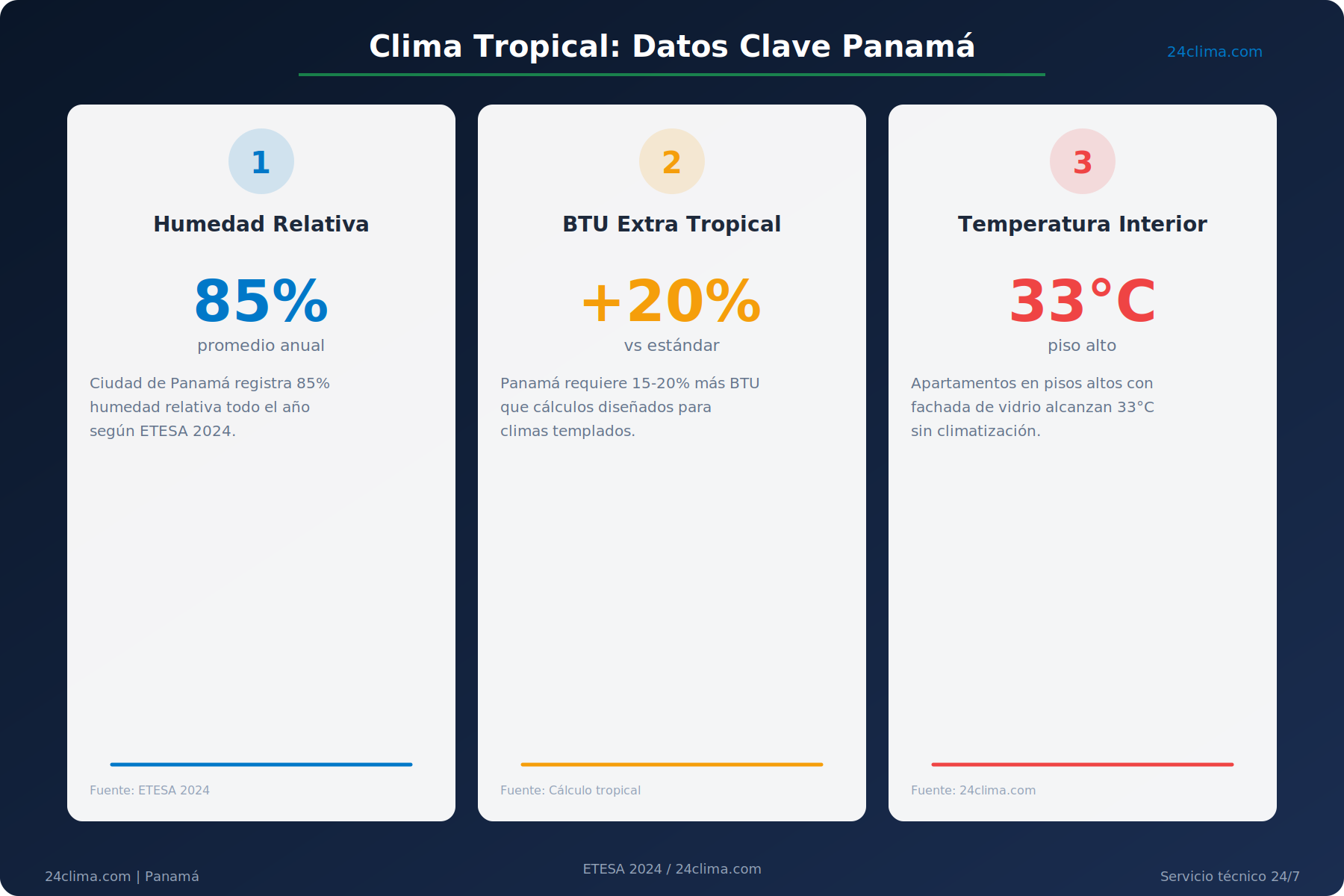
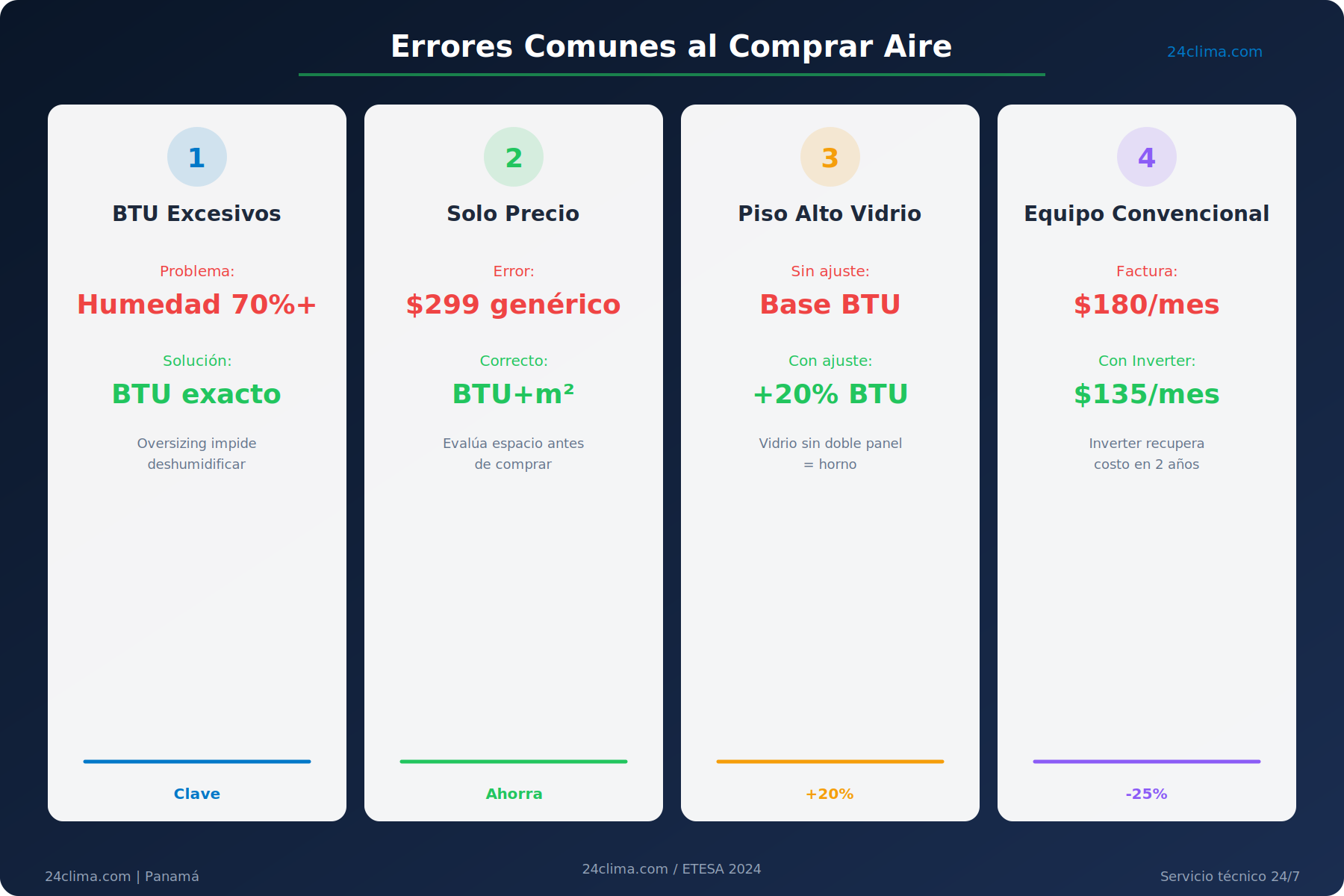
The most common assumption goes like this: colder equals better equipment. So people buy the highest BTU unit they can afford, mount it in the living room, and wait for results. What actually happens is a room that swings between arctic chill and room temperature every 20 minutes, a bill that climbs month after month, and humidity that never drops below 70%.
The other frequent mistake is shopping by price — scanning a list of cheap air conditioners at Novey or Evisión without understanding the actual conditions of the apartment. A $299 unit can be perfect or a complete disaster depending on the square footage, which direction the sun hits, the available voltage, and whether the building even allows an outdoor condenser unit.
The technical reality is more interesting than most people realize. In Panama, the challenge isn't just heat — it's humidity load. With an average relative humidity of 85% in Panama City (ETESA 2024 data), an air conditioner works simultaneously as a cooler and a dehumidifier. If the unit is oversized for the space, it cools down quickly but doesn't run long enough to pull the moisture out. You end up feeling cool and clammy at the same time.
How Many BTUs Do You Actually Need for Your Panama Apartment
In Panama's tropical climate, you need between 600 and 700 BTU per square meter in spaces with direct sun exposure, and between 500 and 600 BTU per square meter in interior rooms or spaces with consistent shade. Those figures run 15–20% higher than standard calculations designed for temperate climates.
The "30 BTU per square foot" rule in American installation manuals doesn't apply here. Panama combines outdoor temperatures of 31–34°C (88–93°F) with humidity that never drops below 75% in any month of the year — a combination that roughly doubles the real thermal load compared to Miami or Houston in summer.
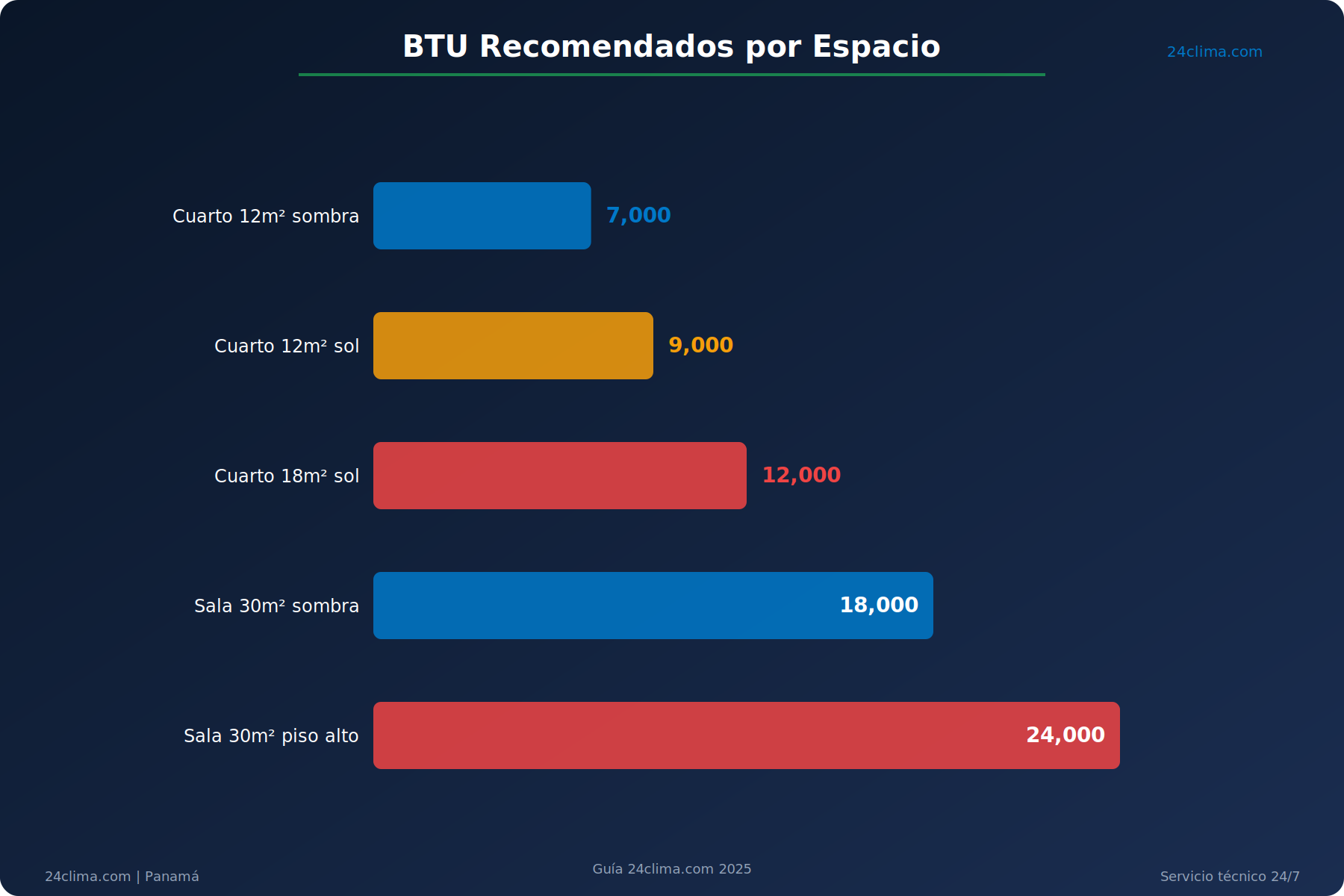
This table is your starting point for sizing the right unit:
Small bedroom — 12 m² (about 130 sq ft) — No direct sun exposure: 7,000 BTU — West or south-facing window with direct sun: 9,000 BTU
Master bedroom — 18 m² (about 195 sq ft) — No direct sun exposure: 9,000 BTU — West or south-facing window with direct sun: 12,000 BTU
Living-dining area — 30 m² (about 325 sq ft, studio or open plan) — No direct sun exposure: 18,000 BTU — Direct sun exposure on upper floors (10+): 24,000 BTU
Full 2-bedroom apartment — 60 m² (about 645 sq ft) — Typical layout: 2 units at 12,000 BTU + 1 unit at 18,000 BTU — Alternative: multi-split system with a single outdoor unit
3-bedroom or large open-plan apartment — 75–90 m² (800–970 sq ft) — Recommended setup: 3 units ranging from 12,000–18,000 BTU depending on sun orientation
One thing that catches people off guard: if your apartment is on a high floor (12th and above) with a glass facade — common in Costa del Este and Punta Pacífica — add 20% to all the figures above. Single-pane glass with no thermal break is essentially a solar oven.
Inverter vs Conventional — The Difference That Shows Up on Your Bill
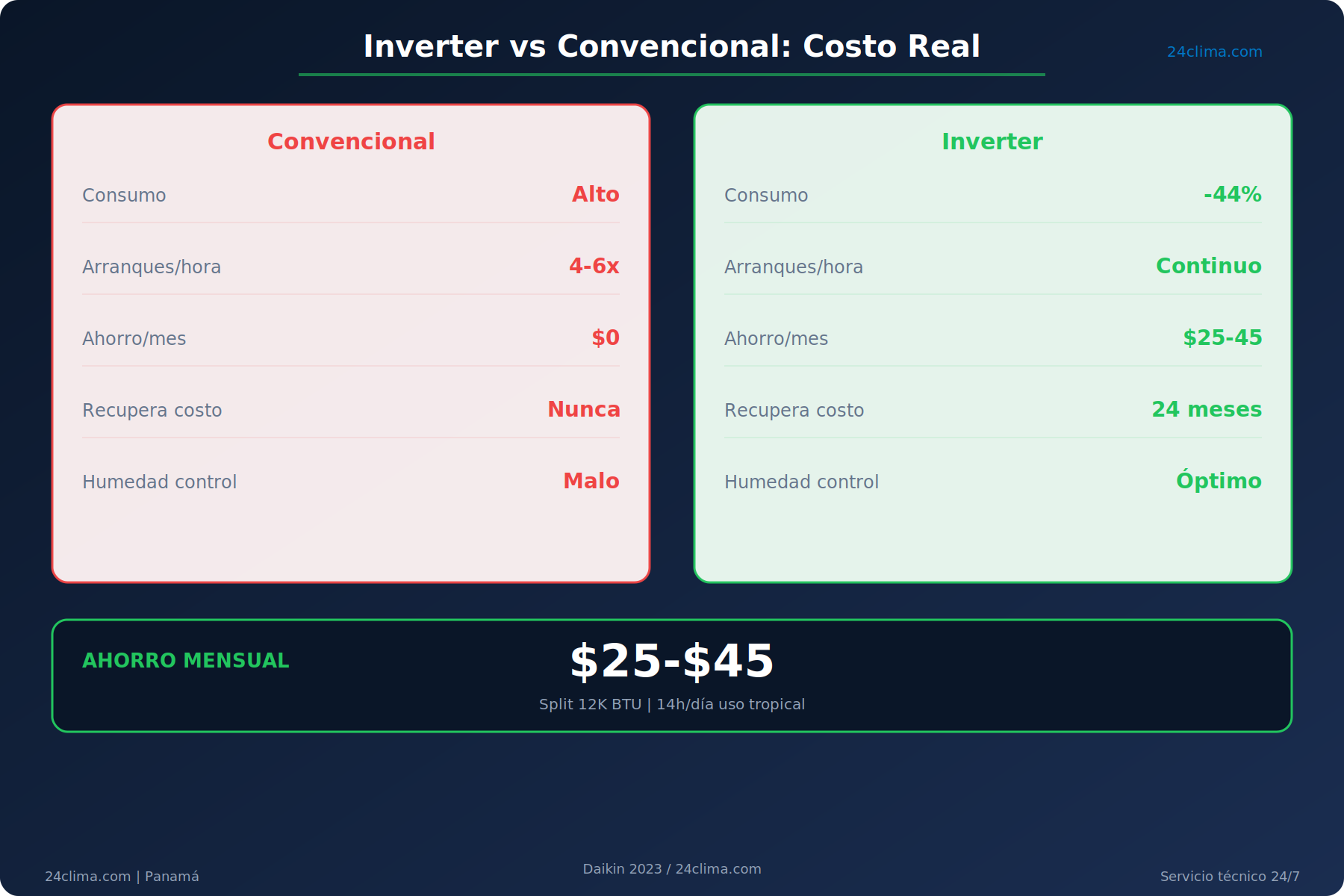
For a Panama apartment where the AC runs 10–14 hours a day, a conventional unit costs between $25 and $45 more per month in electricity than an equivalent inverter. Over 24 months, that gap more than offsets the higher purchase price of the inverter.
A conventional unit operates in binary mode: full power on, full power off, repeat. Every startup draws a power spike 3–4 times higher than steady-state operation. In Panama, where the outdoor heat keeps the cycle very short, that unit can cycle on and off 4–6 times per hour, which means your meter spins hard every time it kicks back on.
An inverter unit continuously adjusts compressor speed. Instead of shutting off completely, it throttles down to 30–40% capacity to hold the temperature steady. According to manufacturer efficiency data published by Daikin in 2023, a 12,000 BTU inverter split consumes an average of 44% less electricity than an equivalent conventional unit under continuous tropical-use conditions.
Real simulation for a 75 m² (800 sq ft) apartment in Panama — 3 units running 12 hours per day:
Conventional system (3 units × 1,200W average × 12h × 30 days × $0.18/kWh) — Estimated monthly cost: $233
Inverter system (3 units × 700W average × 12h × 30 days × $0.18/kWh) — Estimated monthly cost: $136
Monthly difference: $97 Annual difference: $1,164
If inverter units cost $150–200 more per unit ($450–600 total for 3 units), the investment pays for itself in 5 to 7 months. Everything after that is pure savings.
Brand matters less than most people think. Daikin, Midea, LG, and Gree all manufacture inverters with comparable compressor technology. What actually separates them is local technical service availability and refrigerant type. All new equipment sold in Panama should use R-32 or R-410A — if someone offers you a unit running on R-22, walk away. That's old equipment, and R-22 refrigerant is increasingly hard to find.
110V vs 220V — The Silent Problem in Panama Buildings
Units up to 12,000 BTU generally run on 110V/60Hz. Units of 18,000 BTU and above require 220V. In Panama buildings constructed before 2005, many apartments don't have a 220V outlet in the bedrooms, which limits your options without additional electrical work.
This is where people get burned. You spot an 18,000 BTU unit at a good price, buy it, and at installation discover the room only has 110V. The electrician quotes $200–400 to run a dedicated circuit from the panel. What looked like a bargain no longer is.
Before purchasing any unit for your apartment, verify these four things:
Available voltage at the installation point — ask the building superintendent for the floor electrical schematic, or have a technician check it directly.
Breaker capacity on the panel — an 18,000 BTU unit needs a dedicated 20–25 amp breaker. An apartment with a 60-amp panel shared across the kitchen, washer, and other circuits may have real limitations.
Landlord permission if you're renting — installing an outdoor condenser unit requires drilling through a wall or facade. In Panama, that requires written authorization from the property owner and, in some buildings, approval from the owners' association.
Space for the outdoor condenser — in high-rise apartments in Obarrio or El Cangrejo, there are designated technical balconies. In older buildings in Bella Vista or Calidonia, the installation can get considerably more complicated.
Can You Install AC Without an Outdoor Unit in a Panama Apartment
Window units and portable ACs exist that don't require an outdoor condenser, but they come with serious efficiency and noise limitations. In Panama, they're only worth considering as a temporary fix in spaces under 15 m² (160 sq ft), or when the building prohibits split installation entirely.
Window units need an opening in the window or wall to expel heat. They consume 30–40% more electricity than an equivalent split, and they're significantly louder — a 12,000 BTU window unit can hit 55–60 dB, clearly audible from inside the bedroom, enough to disrupt sleep night after night.
Portable units are even less efficient. They need an exhaust hose routed outside, typically under a door or through a cracked window. The compressor sits inside the room, so you're dealing with more noise and a situation where expelled heat is literally competing with the cooling effect. At 85% humidity, a portable unit simply can't keep up.
If your building restricts outdoor unit installation, the right move is a conversation with management about approved installation options. Most modern towers have pre-designed technical ducts built in for exactly this purpose.
Frequently Asked Questions
How many BTUs do I need for a 60 m² apartment in Panama?
A 60 m² (645 sq ft) apartment in Panama requires between 36,000 and 48,000 BTU total, distributed across multiple units. The most common setup is one 18,000 BTU unit for the living-dining area and two 12,000 BTU units for the bedrooms. If the floor has direct sun exposure on a west-facing facade, upgrade the bedroom units to 18,000 BTU.
Is an inverter or conventional AC better for a Panama apartment?
For Panama use, where the unit runs 10 or more hours daily, the inverter makes clear economic sense. The upfront cost is $100–200 more per unit, but monthly savings of $25–40 per unit recover that difference in under 8 months. A 2022 energy efficiency study by OLADE confirmed that inverters reduce electricity consumption by 35–55% in tropical climates across Central America and the Caribbean compared to conventional on/off technology.
Can I install AC without an outdoor unit in a Panama apartment?
Window and portable units don't need an exterior condenser, but they're less efficient and noisier than split systems. For permanent use in a Panama apartment, a wall-mounted split with an outdoor unit is always the stronger technical and economic choice. If your building has restrictions, talk to management — most new towers have technical solutions already built into the design for exactly this situation.
Making the Right Call Before the Next 2pm Meltdown
Back to that afternoon on the 12th floor. The AC is running, the bill hurts, and the air still feels like a damp blanket. The fix isn't to dial the thermostat lower or buy the biggest unit you can find. Choose the right size for each space, confirm the available voltage, and make the inverter vs conventional decision with real numbers in front of you — not gut instinct.
At 24Clima, we assess each apartment before recommending a unit. We review sun orientation, available voltage, building restrictions, and the actual total installation budget — not just the sticker price on the showroom floor. If you're at that decision point right now, our certified technicians can guide you at no additional cost. Reach out via WhatsApp at https://24clima.com/contacto/ and get a specific recommendation for your Panama apartment.
Last updated: May 2025