Air Conditioning for Your Home in Panama — The Complete Guide Nobody Gave You
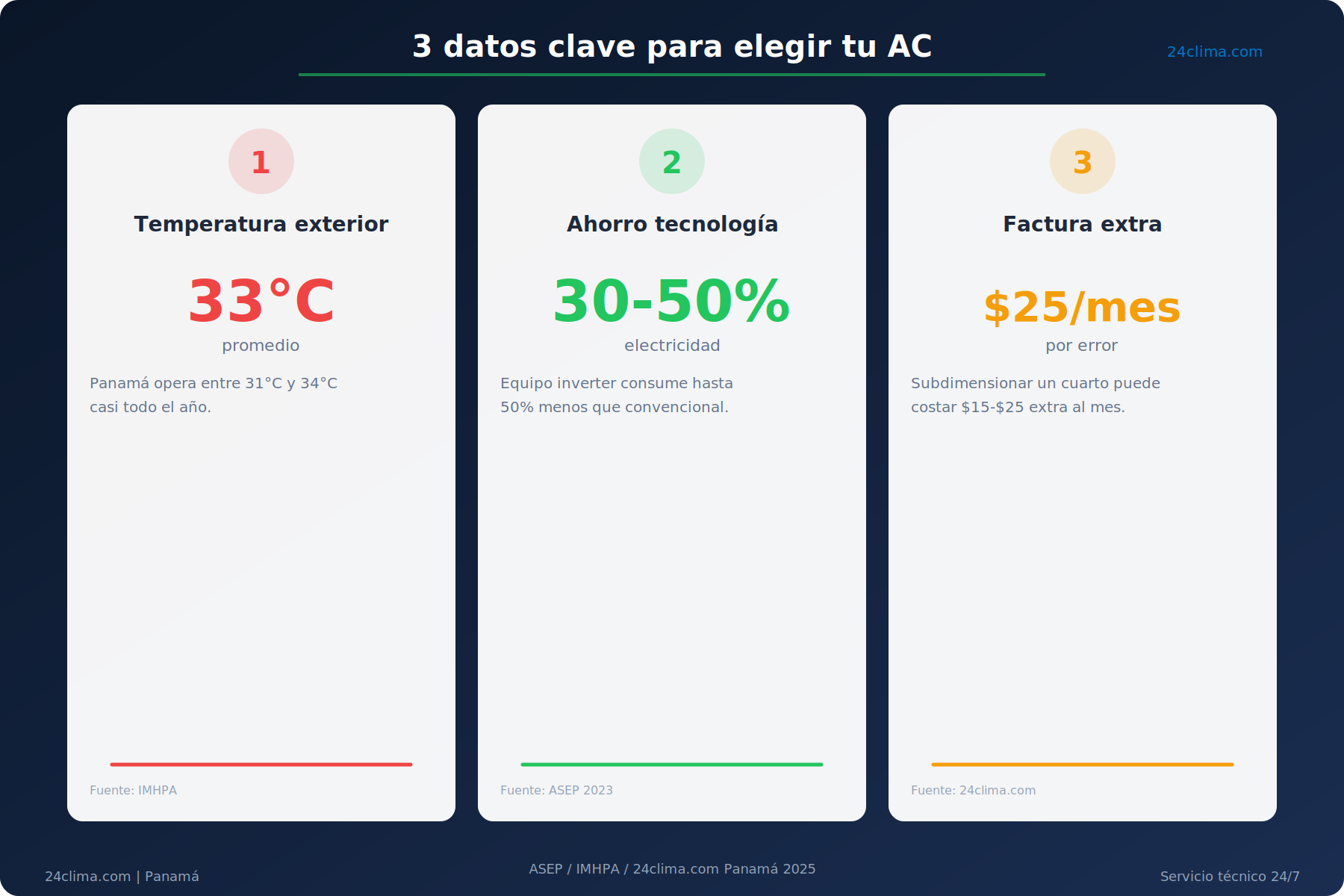
It's 2 p.m. in Costa del Este. The asphalt is radiating heat. The thermometer reads 33°C (91°F) and relative humidity is pushing past 87%. You walk inside, hit the button on your AC, and wait. The room cools down. The sweat dries. You breathe.
What you don't see is what's happening behind that wall: a unit you may have bought without calculating the right BTUs for Panama's climate, installed without proper drainage, running at full capacity for eight hours a day. That unit is going to fail sooner than it should. And your Naturgy or ENEL bill is going to remind you every single month.
Whether you're buying a home air conditioner in Panama in 2025 or you already have one and can't figure out why it's underperforming, you'll find real answers here — with real numbers, based on the specific climate conditions of this country.
What Most People Get Wrong — and Why
The most common mistake we see at 24clima starts innocently enough. The buyer walks into Novey or Rodelag, looks at the label on a 12,000 BTU unit, and thinks: "that's for medium-sized rooms, mine is about 160 square feet, perfect." The sales associate nods. They take the unit home. Three months later, the room never quite cools down in July, the air feels thick and humid, and the compressor never shuts off.
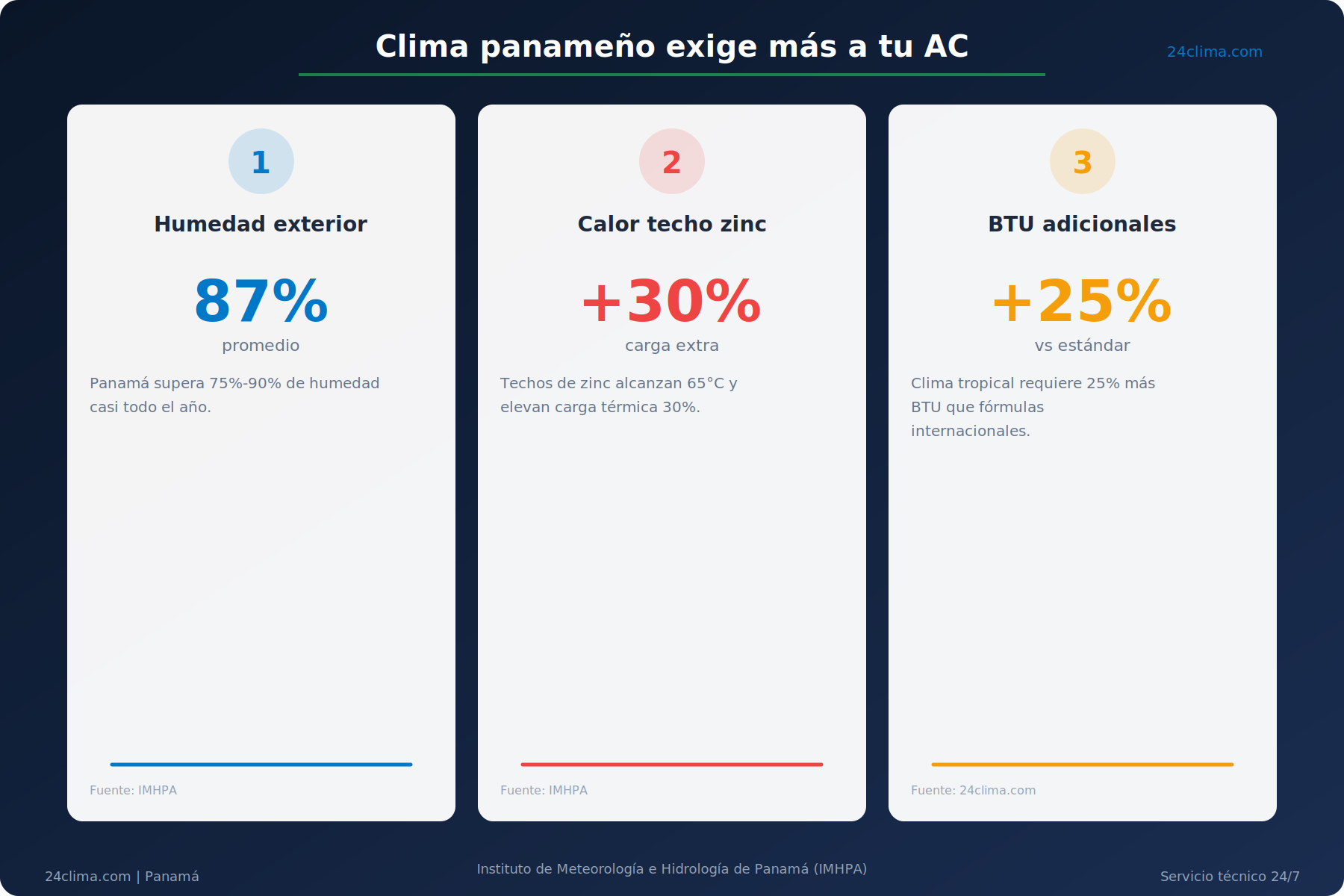
The problem isn't the unit. The problem is that the sizing guidelines on the box are calculated for standard international conditions: 75°F (24°C) exterior temperature, 50% humidity. Panama is not that. Here you're working with outdoor temperatures between 88°F and 93°F (31°C to 34°C) and humidity between 75% and 90% for most of the year. That changes the math considerably.
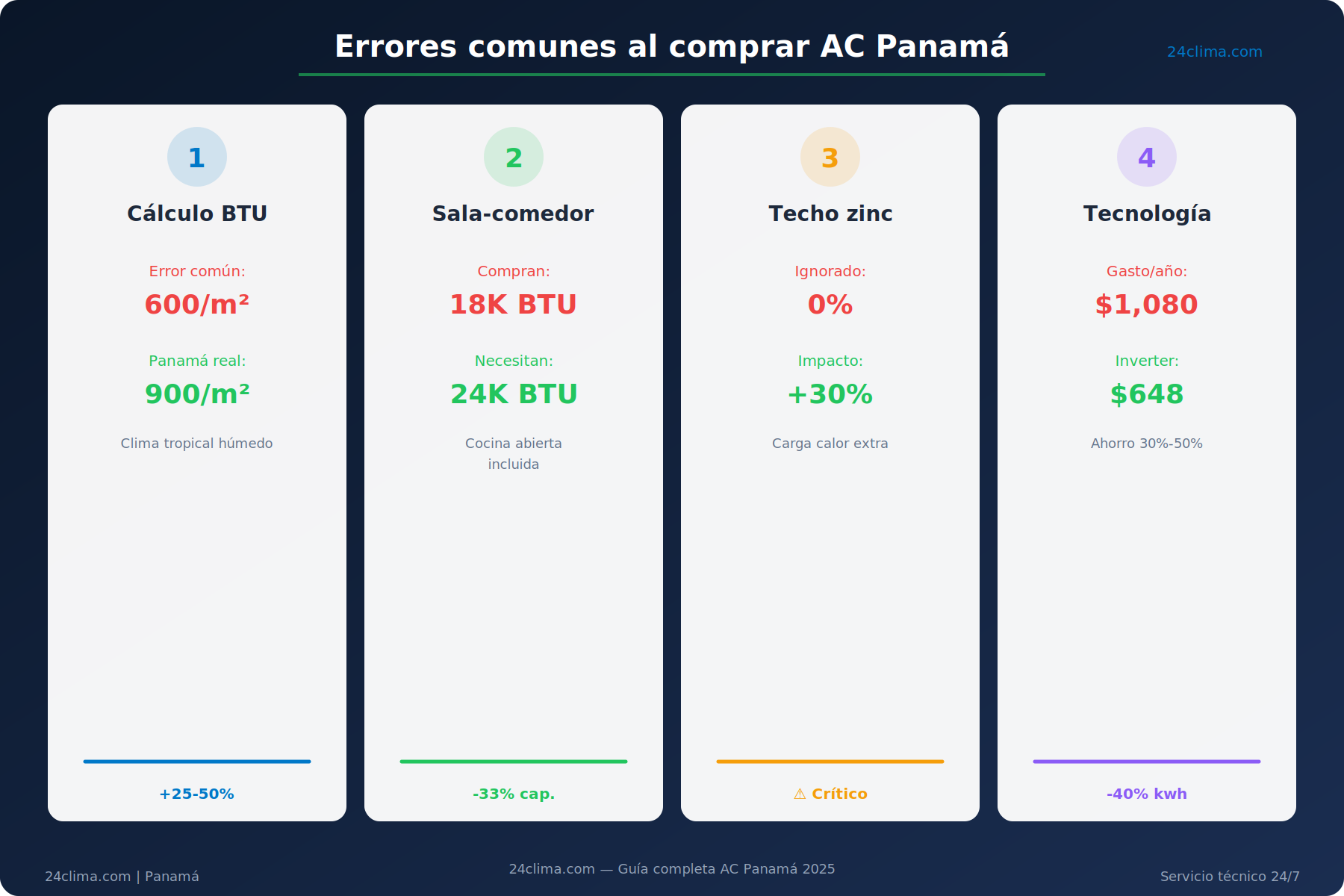
The rule of thumb you hear at hardware stores — "600 BTU per square meter" — works in cities with temperate climates. In Panama, the real coefficient is higher. Not dramatically, but enough that a bedroom of about 195 square feet in Miraflores with an afternoon-facing window needs an 18,000 BTU unit, not a 12,000 BTU one. The difference between those two units can mean $15 to $25 more per month on your electricity bill — in the wrong direction.
You can find more context on Panama's climate and how it affects equipment sizing in our guides and tips at 24clima: https://24clima.com/consejos-y-guias/
How Many BTUs Does Your Home in Panama Actually Need
In Panama — with outdoor temperatures above 88°F (31°C) and humidity between 75% and 90% — the recommended BTU calculation per room runs between 700 and 900 BTU per square meter, depending on sun exposure, roof type, floor level, and number of windows. That's 15% to 25% higher than the standard formulas designed for temperate climates, which means the box the unit came in was already lying to you before you opened it.
Here's how that applies to the most common spaces in a Panamanian home:
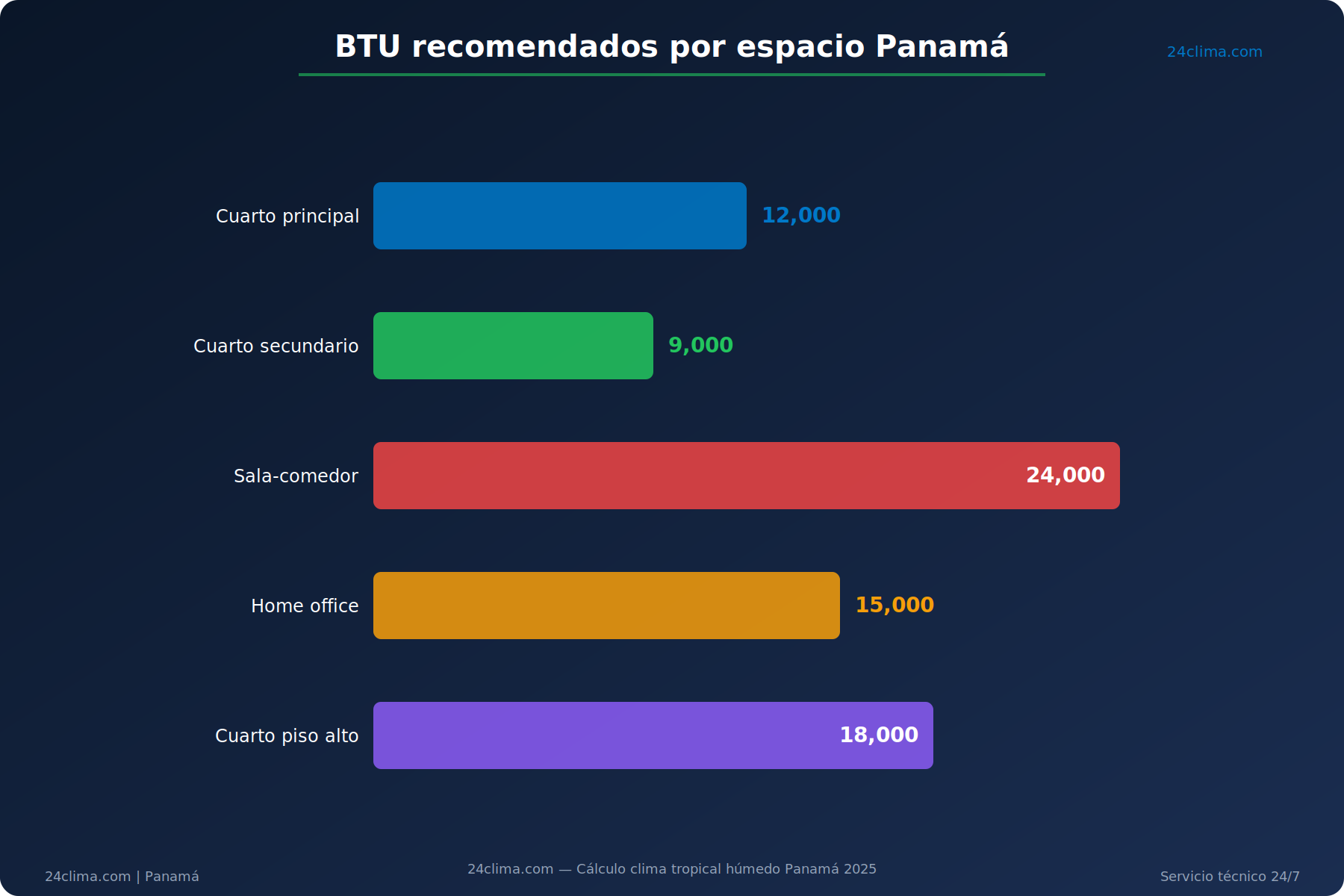
Master bedroom (130 to 195 sq ft / 12 to 18 m²): No direct sun, concrete ceiling with a dropped finish — 9,000 to 12,000 BTU. West- or south-facing window — move up to 12,000 to 15,000 BTU. Top-floor units in buildings with an uninsulated concrete slab roof can need up to 18,000 BTU.
Secondary bedroom (95 to 130 sq ft / 9 to 12 m²): In most homes in Costa del Este, Clayton, or San Francisco, 9,000 BTU is enough with no direct sun exposure. In houses in San Miguelito or along the northern corridor with zinc roofs, plan for 12,000 BTU.
Open-plan living and dining area (270 to 430 sq ft / 25 to 40 m²): This is the space that gets undersized most often. For a 325 square foot living room with an open kitchen, heat from people and appliances, and large windows, you need a minimum of 24,000 BTU. Many families install an 18,000 BTU unit and spend the next five years wondering why the compressor never gets a break.
Home office (110 to 160 sq ft / 10 to 15 m²): Computers, monitors, and people all generate heat. Add 1,200 BTU per high-draw electronic device. A home office with two screens and two people in a 130 square foot room can easily need 15,000 BTU.
One variable that gets ignored constantly in Panama is roof type. According to data from Panama's Institute of Meteorology and Hydrology (IMHPA), zinc roofs in areas like La Chorrera or Tocumen can reach surface temperatures of 149°F (65°C) during peak hours — adding up to 30% more heat load on top of the base calculation. A concrete roof with a dropped ceiling reduces that significantly, but it's still higher than what those sizing charts assume.
Inverter vs Conventional: The Decision That Affects Your Bill Most
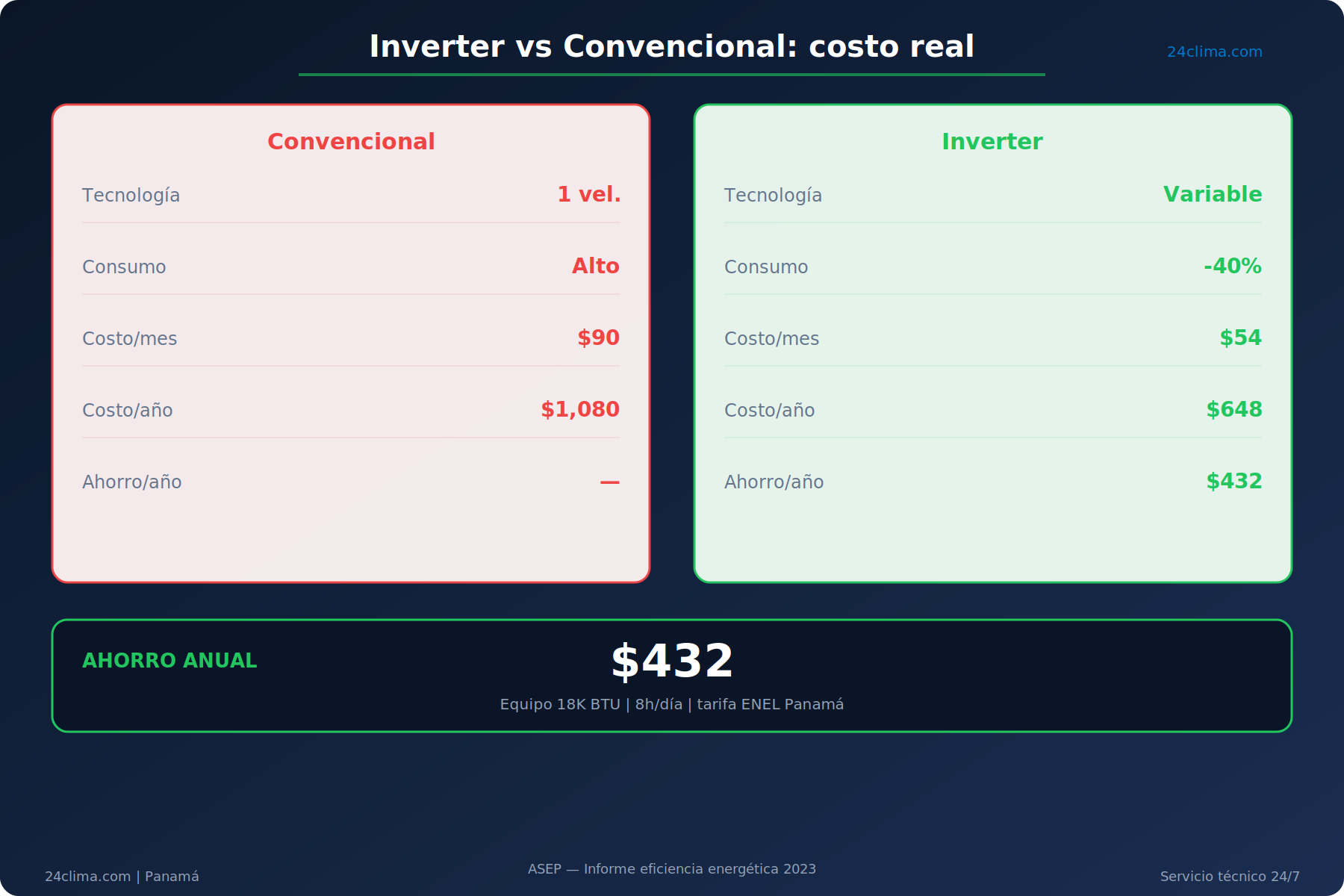
For residential use in Panama, inverter technology is the right choice in most situations. An inverter unit consumes between 30% and 50% less electricity than a conventional unit of equivalent capacity, according to data published by Panama's National Authority of Public Services (ASEP) in its 2023 energy efficiency report.
The difference isn't magic. It's mechanical. A conventional unit has a compressor that runs at one speed: full on or completely off. Once the room hits the set temperature, the compressor shuts down. When the temperature climbs again, it restarts — and that restart draws three to five times more energy than continuous operation.
An inverter continuously adjusts the compressor speed. It runs at 30% when the room is already cool, ramps up to 80% when it needs to recover temperature, and never makes that high-draw startup surge. In Panama's climate — where a unit runs eight to twelve hours a day for most of the year — that translates to $25 to $45 in monthly savings on your electricity bill, depending on unit capacity and your current Naturgy or ENEL rate.
Here's an estimated monthly electricity cost comparison at Panama's average residential rate of $0.18/kWh in 2025, based on 10 hours of daily use:
— Conventional 12,000 BTU: approximately $38 to $42 per month — Inverter 12,000 BTU: approximately $22 to $26 per month — Conventional 18,000 BTU: approximately $54 to $60 per month — Inverter 18,000 BTU: approximately $30 to $36 per month — Conventional 24,000 BTU: approximately $72 to $80 per month — Inverter 24,000 BTU: approximately $40 to $48 per month
The price difference between an inverter and a conventional unit at stores like DoIt Center or Machetazo in 2025 is roughly $80 to $150 more for the inverter. At those monthly savings, that extra cost pays for itself in three to six months.
The one case where a conventional unit makes sense is a space used less than three hours a day. A guest room that gets opened on weekends doesn't justify the inverter premium.
What Brands You'll Find in Panama and What to Expect
The best-selling residential split systems in Panama in 2025 are LG, Carrier, Midea, Gree, and Samsung. Each has its own price point and reliability profile in tropical conditions.
LG and Carrier are the premium options. Their compressors handle salt humidity better, which makes them especially appropriate for coastal areas like Punta Pacífica, Casco Antiguo, or Coronado. A 12,000 BTU LG inverter split at Rodelag or Novey runs around $450 to $550 in 2025. Carrier sits in a similar range.
Midea and Gree offer inverter technology at more accessible prices: $280 to $380 for a 12,000 BTU unit. These are Chinese-manufactured brands — the same factories that supply components to higher-priced names. Their performance in Panama's climate is solid, as long as the installation is done correctly. The real difference versus LG or Carrier shows up in compressor lifespan: eight to ten years versus twelve to fifteen years under tropical conditions.
Samsung sits in the middle: solid inverter technology, prices between $380 and $480 for a 12,000 BTU unit, and a wide spare parts network in Panama.
One thing worth knowing before you buy: any unit installed within 500 meters of the ocean needs corrosion-resistant treatment on the condenser coil — what some brands market as "golden fin" or "Blue Fin" treatment. Without it, the coil can deteriorate in two to three years instead of the expected ten to twelve.
Correct Installation in Panamanian Homes: What Nobody Tells You in the Store
A bad installation ruins a good unit. In Panama, the three most common installation errors are inadequate drainage, a poorly oriented condenser, and refrigerant lines that are too long.
Drainage is the one that bites people fastest. A unit running during the dry season can extract up to two liters of water per hour from the indoor air. That water needs to exit through a drain line with the right slope. If the installer sets the indoor unit at the wrong angle, or if the drain lacks proper trapping, water accumulates. Within weeks you'll have dripping inside the room, mold on the unit casing, and water damage to walls or ceilings.
The outdoor condenser should be oriented to maximize heat dissipation and minimize direct sun exposure. In practice in Panama, that means installing the condenser in the shade whenever possible, or on the north-facing side of the building. A condenser working under direct sun here can raise its operating temperature by 9°F to 14°F (5°C to 8°C), cutting efficiency by up to 15% and shortening the compressor's life.
The refrigerant line between indoor and outdoor unit should ideally not exceed five to seven meters in standard residential installations. Every additional meter beyond that range means pressure loss and reduced efficiency. If your layout demands more distance, the technician needs to recalculate the refrigerant charge.
Filter cleaning every two to three months is non-negotiable in Panama, where dust, humidity, and mold accumulate much faster than in dry climates. Our professional AC cleaning service https://24clima.com/servicios/limpieza/ is designed specifically for tropical conditions.
Frequently Asked Questions About Home Air Conditioning in Panama
What is the best air conditioner for a home in Panama?
There's no single answer, but there is a clear criterion: the best unit is the one correctly sized for your specific space, with inverter technology, and corrosion-resistant coil treatment in coastal areas. For most master bedrooms in Panamanian homes, a properly installed 12,000 to 18,000 BTU inverter split from LG, Carrier, or Samsung will outperform any premium unit that's been sized wrong.
How many BTUs do I need to cool a home in a tropical climate?
In Panama, the recommended range is 700 to 900 BTU per square meter for individual rooms, adjusted for sun orientation, roof type, and internal heat load. For a 325 square foot open-plan living room with a kitchen, you need at least 24,000 BTU. For a 160 square foot bedroom without direct sun, 12,000 BTU is the right starting point.
How much does a home air conditioner cost in Panama in 2025?
A name-brand 12,000 BTU inverter split runs between $280 and $550 depending on brand and store (Novey, Rodelag, DoIt Center, Machetazo). Professional installation with materials adds another $150 to $300 depending on complexity. Total installed cost for a standard bedroom unit is between $430 and $850 in 2025.
Is inverter or conventional better for residential use in Panama?
For any space you use more than four hours a day, inverter is the financially correct decision. Monthly savings of $15 to $25 recover the price premium in under six months, then represent clear savings over the next ten to fifteen years of the unit's life.
How often does an AC unit in a Panamanian home need maintenance?
Given Panama's humidity, dust, and mold conditions, preventive maintenance every three months is recommended for units running eight or more hours daily, and every six months for moderate use. That service includes filter cleaning, drainage inspection, refrigerant pressure check, and evaporator coil cleaning.
Back to That Room in Costa del Este
The right air conditioner isn't the most expensive one, or the one with the most features on the remote, or the one your cousin who "knows about this stuff" recommended. It's the unit sized precisely for your space, installed with correct drainage and a properly oriented condenser, with inverter technology that will keep your electricity bill predictable for the next ten years.
At 24Clima, we've spent more than five years sizing, installing, and servicing residential units across Panama. We know what Punta Pacífica's salt air does to an uncoated coil. We know what a bad drain line does when the rainy season hits. And we know how to calculate exactly what your home needs — not some generic home in some generic climate.
If you're ready to make the right call, or if you have questions about a unit you already have, reach out to us on WhatsApp at https://24clima.com/contacto/ and one of our technicians will walk you through it at no cost, with real data for your home's actual conditions in Panama.
Last updated: May 2025. Consumption data based on current ASEP rates for residential Naturgy and ENEL customers, Panama 2025.