Office Air Conditioning in Panama — The Guide Your Business Needs Before the Next Heat Wave
It's 10 a.m. in Costa del Este. The sun is already hitting the building's glass like it's high noon. Three people are working in a 375 sq ft room, computers running, the printer throwing off heat in the corner, and the AC unit installed when you opened the office three years ago still struggling to reach 73°F (23°C). It never quite gets there. The humidity hangs in the air, sticky and invisible, draining concentration from everyone in the room.
You pull up last month's electricity bill: $187. The month before was $164. Nothing changed — same schedule, same equipment. But the bill keeps climbing.
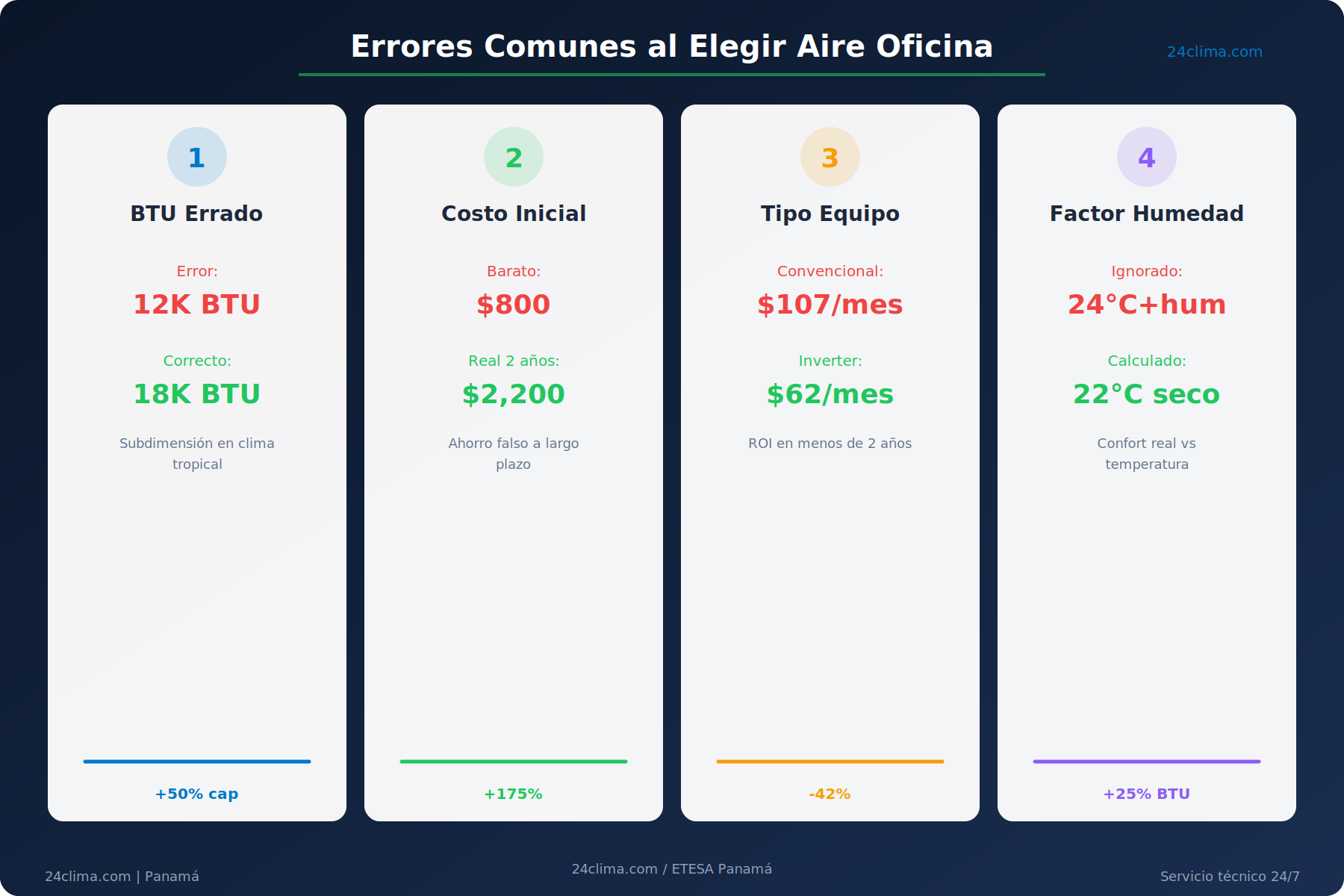
This is the trap most businesses in Panama fall into: they buy the cheapest unit available, install it without calculating the correct BTUs for the space, and then pay double in electricity for years. That $800 decision at the start ends up costing $1,400 extra in power bills within the first two years. Read on so that doesn't happen to you.
What Most Panama Offices Get Wrong From Day One
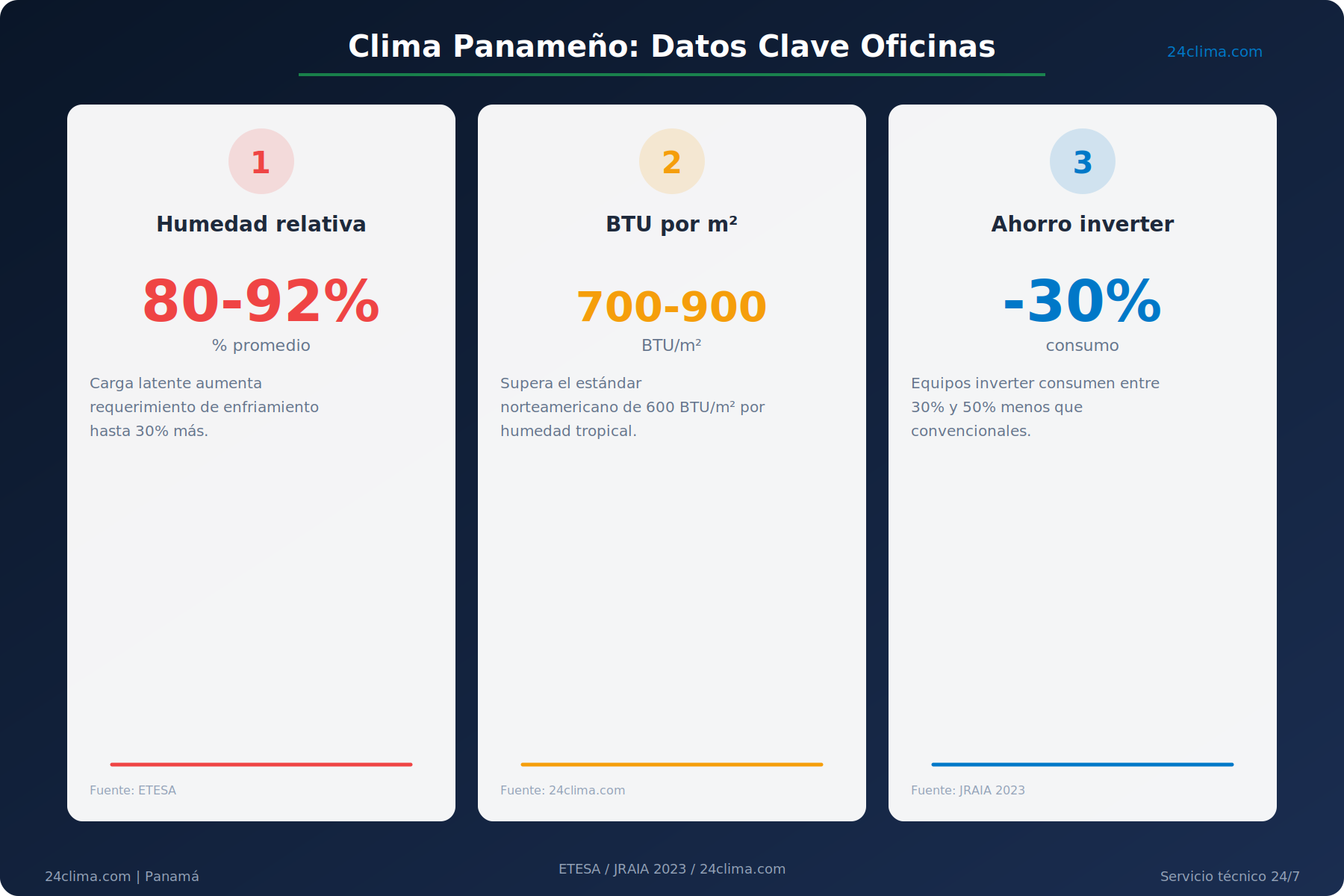
The most common assumption among business owners is that any 12,000 BTU unit "works for a small office." That logic holds in New York. In Panama, where average outdoor temperatures sit around 88°F (31°C) and relative humidity fluctuates between 80% and 92% according to ETESA data for Panama's Pacific basin, the rules change entirely.
The problem isn't just the heat. It's the latent load — the heat carried by humidity. An undersized unit can bring the air temperature down, but it never removes enough moisture. The result: the office reads 75°F (24°C) on the thermostat but feels sticky. Your team is sweating, documents feel damp, and the server in the back room is running at its thermal limit.
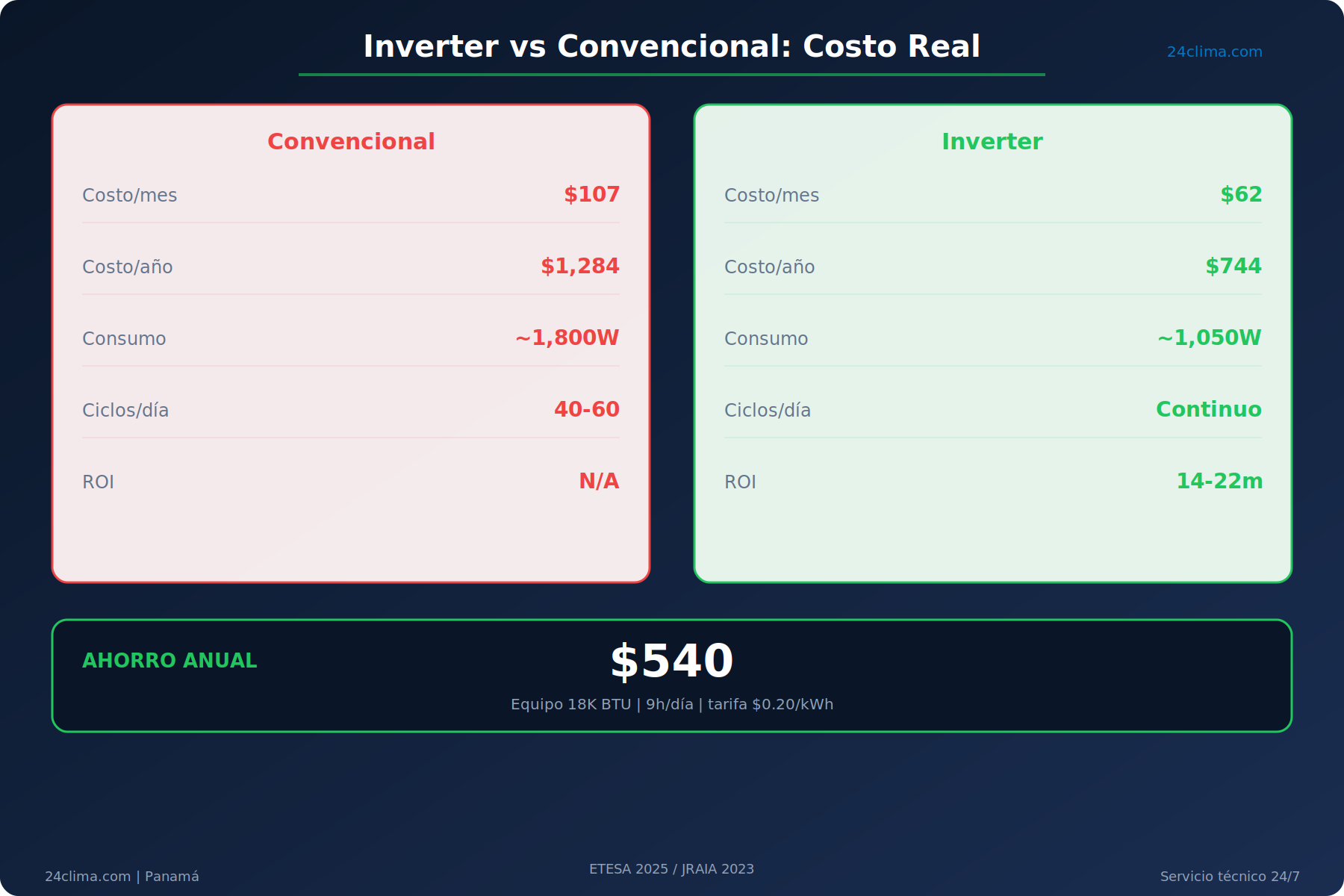
The second mistake is installing a conventional on/off unit for 9 to 10 hours of daily use without accounting for the real impact on Panama's commercial electricity rates. A conventional 18,000 BTU unit running 9 hours a day generates an estimated cost of $95 to $120 per month for that unit alone. An equivalent inverter unit brings that down to $55 to $70 per month. That's not a marginal difference — it's the difference between a profitable office and one that's quietly writing checks to the power company.
You'll find more analysis like this in our guides and tips for tropical climate at 24clima.com.
How Many BTUs Does Your Office Need in Panama — The Real Calculation for Tropical Climate
For an office in Panama, the baseline rule is 700 to 900 BTU per square meter (about 65 to 84 BTU per square foot), plus a correction factor of 15% to 25% for occupants and electronic equipment. That figure runs higher than the North American standard of around 600 BTU/m² because Panama's humidity load adds between 20% and 30% to the total cooling requirement.
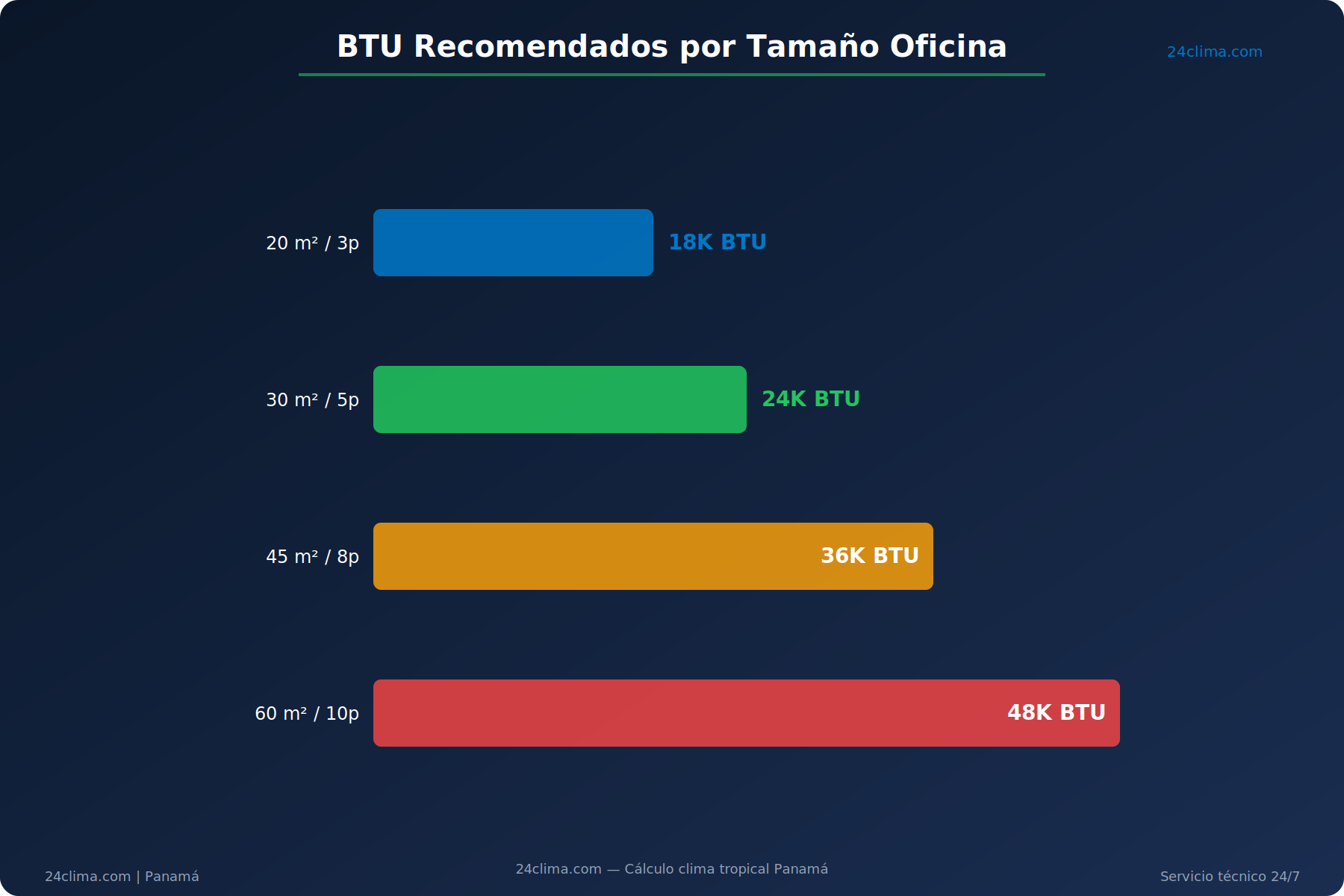
Here's how the numbers break down for the most common office sizes in Panama City:
Small offices — 215 sq ft (20 m²), 2 to 3 people — Base load: 16,000 BTU — With electronics and solar exposure: 18,000 BTU — Recommendation: 18,000 BTU inverter unit
Medium offices — 320 sq ft (30 m²), 4 to 5 people — Base load: 21,000 BTU — With LED lighting and 4 computers: 24,000 BTU — Recommendation: 24,000 BTU inverter unit or two 12,000 BTU units
Open-plan spaces — 485 sq ft (45 m²), 6 to 8 people — Base load: 31,500 BTU — With direct west-facing solar exposure: 36,000 BTU — Recommendation: 36,000 BTU cassette unit or two 18,000 BTU splits
Large open floors — 645 sq ft (60 m²), coworking or integrated conference room — Base load: 42,000 BTU — With server zone or integrated kitchen: 48,000 BTU — Recommendation: multi-split system or two 24,000 BTU units
These figures assume standard ceiling heights of 9 to 10 feet (2.7 to 3 meters). If your office has a mezzanine or double-height ceiling — common in some Casco Viejo spaces or commercial buildings in Albrook — multiply the volumetric calculation by 1.3.
Inverter vs. Conventional for Offices — The Most Important Decision You'll Make
For a Panama office running 8 to 10 hours a day, an inverter air conditioner delivers a return on investment of 14 to 22 months over an equivalent conventional unit, based on ETESA's average commercial rate of $0.18 to $0.22 per kWh for low-voltage commercial clients in 2025.
The mechanism is straightforward. A conventional unit works in cycles: it fires on at 100% power, hits the target temperature, shuts off, and when the temperature climbs again, kicks back on at full power. Each startup draws an energy spike equivalent to 3 to 5 times normal consumption for 2 to 4 seconds. In a typical office day with 40 to 60 on/off cycles, that adds up fast.
An inverter continuously adjusts the compressor speed. In an office that's already cool, it runs at 30% to 40% capacity just to hold temperature. According to data from the Japan Refrigeration and Air Conditioning Industry Association (JRAIA, 2023), inverter units consume 30% to 50% less energy under extended-use conditions compared to conventional units of the same rated capacity.
Put in real dollars:
Conventional 18,000 BTU unit, 9 hours daily, rate of $0.20/kWh — Estimated consumption: 18 kWh/day — Monthly cost: $108
Inverter 18,000 BTU unit, 9 hours daily, rate of $0.20/kWh — Estimated consumption: 10.8 kWh/day — Monthly cost: $64.80
Monthly difference: $43.20 Annual difference: $518.40
If the inverter costs $350 more than the equivalent conventional unit, you recover that difference in under 9 months. For a full comparison including brands available in Panama and additional technical criteria, see our article on inverter vs. conventional in tropical climates.
For offices with heavy daily use, the choice is inverter. Full stop.
Optimal Unit Placement — Open Floor vs. Divided Office Layouts
Where you position the unit determines up to 18% of the system's real-world efficiency, regardless of its rated capacity. That's especially critical in Panama offices where airflow collides with drywall partitions, tall furniture, and closed-off corridors.
For open-plan spaces — coworking areas, call centers, shared rooms: — Install the unit at the point farthest from the main entrance — Airflow should move from the coldest zone (near the unit) toward the entrance — Don't aim the airstream straight at people: angle it 15° to 20° upward — For spaces over 430 sq ft (40 m²), use a ceiling cassette — it distributes air in four directions and eliminates dead zones — Leave at least 6 inches (15 cm) of clearance between the unit and the ceiling
For offices with partitions or cubicles: — Any enclosed zone larger than 130 sq ft (12 m²) needs its own unit or a dedicated duct branch — Don't assume air will flow under doors — in an office with four 85 sq ft (8 m²) cubicles, a single central 24,000 BTU unit will leave two of them inadequately cooled — The outdoor condenser should sit in shade or natural ventilation, away from heat-absorbing walls with south or west exposure
A common mistake in buildings across San Francisco and Marbella: installing the condenser on a balcony without side ventilation. The condenser needs to expel heat. Box it in between walls with no airflow and its efficiency drops 12% to 20%, cutting its lifespan from 12 to 15 years down to under 8.
Maintenance for Offices — The Schedule Most People Ignore Until It's Too Late
With commercial use of 8 to 10 hours daily in a tropical climate, an office air conditioner needs professional maintenance every 3 months — not every 6 as the standard manual suggests. Those manuals were written for temperate climates that bear no resemblance to Panama.
The reason is buildup: dust, mold spores, and bacteria accumulating on the evaporator coil. In Panama's permanently humid environment, the filter and evaporator develop a biofilm layer within 60 to 90 days of heavy use. That biofilm reduces airflow by 15% to 30%, forces the compressor to work harder, and in serious cases turns the unit into an odor and particulate diffuser — meaning everyone in the office is breathing what's growing on that coil.
Maintenance schedule for Panama offices:
Monthly (can be handled by in-house cleaning staff): — Inspect and clean washable or fabric filters — Confirm vents aren't blocked by furniture or filing cabinets — Listen for unusual noises or check for excessive dripping
Every 3 months (requires a certified technician): — Deep clean of the evaporator coil with bactericidal foam — Refrigerant pressure check — Condenser coil cleaning — Compressor voltage and amperage verification — Drain pan and condensate drain line cleaning
Annually: — Full electrical circuit inspection — Measured efficiency vs. rated efficiency (actual EER reading) — Mounting bracket and vibration check — Refrigerant condition assessment (R-410A or R-32 depending on model)
A quarterly maintenance program for a typical two-unit office in Panama runs $80 to $140 per visit. Compare that to a major compressor repair ($400 to $700) or a sustained efficiency drop that adds $50 a month to your power bill, and preventive maintenance is clearly the cheapest investment on the table.
Our air conditioning maintenance service covers scheduled visits with documented technical readings — ideal for office owners who need a clear record of their equipment's condition.
Frequently Asked Questions — What Panama Office Owners Ask Most
How many BTUs do I need to cool a 320 sq ft (30 m²) office in Panama?
For a 320 sq ft office in Panama with 4 to 5 people and standard computing equipment, you need between 21,000 and 24,000 BTU. The base rule of 700 to 800 BTU per square meter applies, plus a 15% correction for occupant load and high tropical humidity. A 24,000 BTU inverter unit will cover that space with enough headroom for peak heat days without stressing the compressor.
Is an inverter or conventional AC better for a Panama office?
For office use in Panama — 8 to 10 hours daily — inverter is the right choice in every scenario. The higher purchase price ($200 to $400 over an equivalent conventional unit) pays itself back in 9 to 18 months through monthly electricity savings of $35 to $55. Over 5 years, a business running two inverter units will have saved between $2,100 and $3,300 compared to running conventional units.
How often should an office air conditioner be serviced in Panama?
Every 3 months, with commercial use of 8 to 10 hours daily. Standard manuals recommend every 6 months, but those are calibrated for climates with 40% to 50% humidity. In Panama, with 80% to 92% relative humidity, biofilm and dust accumulation on the evaporator happens twice as fast. Offices that stick to a quarterly schedule report units lasting 12 to 15 years instead of the 7 to 9 year average seen with irregular maintenance.
The Real Cost of Getting It Wrong
Back to that Costa del Este office from the opening. Bills climbing every month, air that never quite feels fresh, people working at 80% of what they're capable of. A Cornell University study (Hedge & Bharat, 2016) measured the relationship between indoor temperature and workplace productivity: offices maintained between 70°F and 73°F (21°C and 23°C) reported 44% fewer typing errors and 150% more output per hour compared to offices held at 77°F (25°C) or above.
In Panama, every degree above 73°F (23°C) carries a real, measurable cost in productivity. This isn't a comfort issue. It's a business variable.
At 24Clima, we've spent more than 5 years sizing, installing, and maintaining air conditioning systems for offices across the city — from small studios in Obarrio to commercial floors in Tocumen and La Chorrera. If you want us to calculate the exact BTUs for your space, check whether your current unit is over or undersized, or put together a preventive maintenance program for your office, contact us on WhatsApp at 24clima.com/contacto/ and we'll get back to you today. No commitment required — just answers.
Last updated: June 2025