Portable AC vs. Split System in Panama — Which One Actually Makes Sense for You?
Last updated: June 2025
2 p.m. in San Francisco — the Panama City neighborhood, not California. The asphalt steams. Humidity sits at 84% and the thermometer reads 33°C. Not a record. Not a heat wave. Just a Tuesday.
You get back to your apartment on the 9th floor, open the door, and walk straight into a wall of trapped heat. You switch on the unit you bought last month. The portable AC roars to life. It works. And yet, half an hour later, you're still sweating through your shirt.
Then you open your ENSA bill. $112. For a single room of about 194 square feet.
Here's the trap nobody explains to you in the store: the difference between a portable unit and a split system isn't just about the sticker price — it's $40 to $60 a month out of your pocket, every single month, for years. In our guides and tips for Panama's climate we cover dozens of mistakes like this one. This comparison is the one we get asked about most.
What almost everyone believes before they buy
The assumption goes like this: "The portable is cheaper, I skip the installation hassle, and I can take it with me when I move." Perfectly logical on paper. For certain situations, even correct.
But 70% of people who buy a portable AC in Panama never calculate the real operating cost — and that mistake ends up costing them more than the unit itself within the first year.
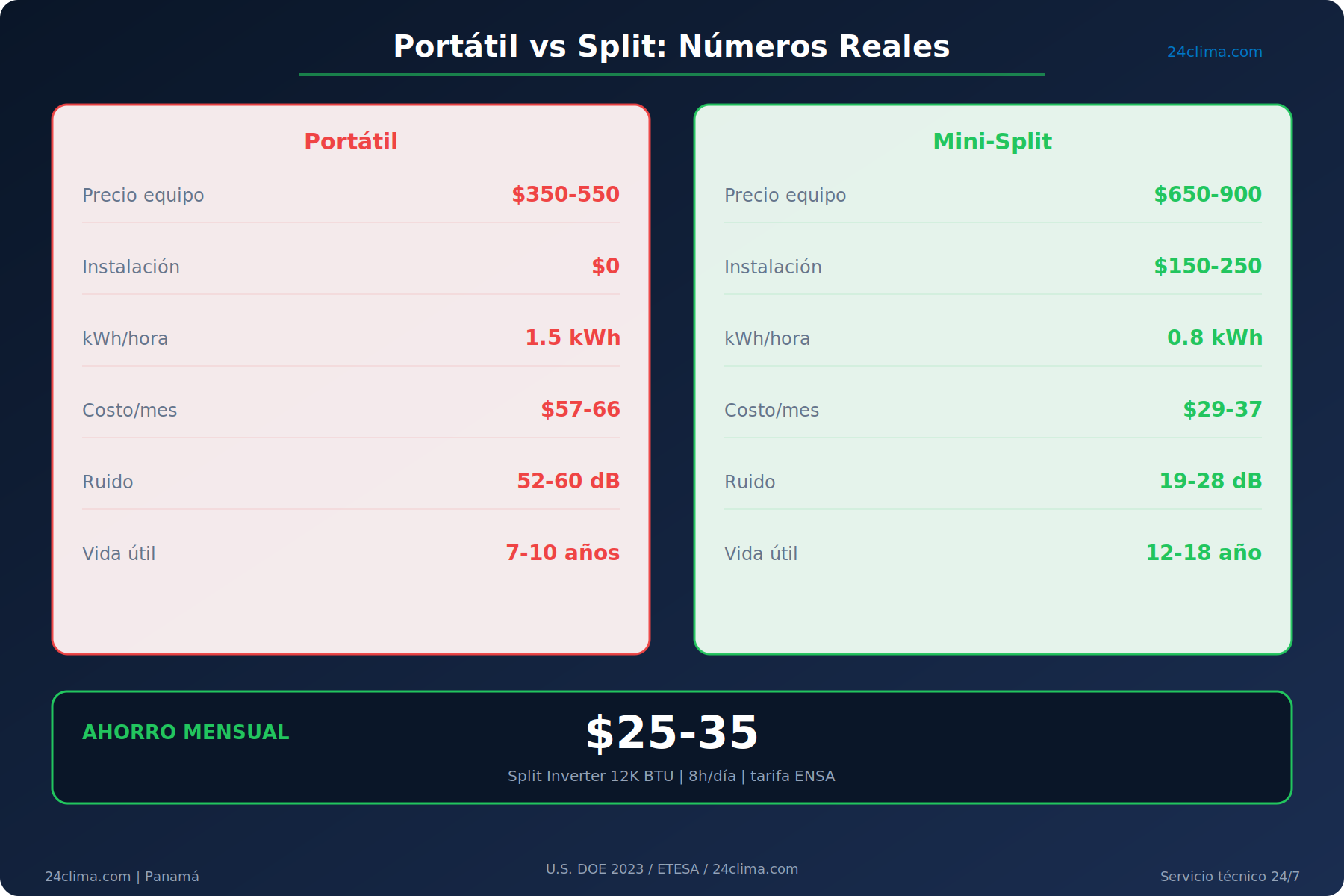
The sticker price of a portable — $350 to $550 at stores like Machetazo or Do it Center — looks more manageable than a mini-split at $650 to $900 plus installation. But there's a number the stores don't post next to the price tag: actual power consumption under Panama's conditions.
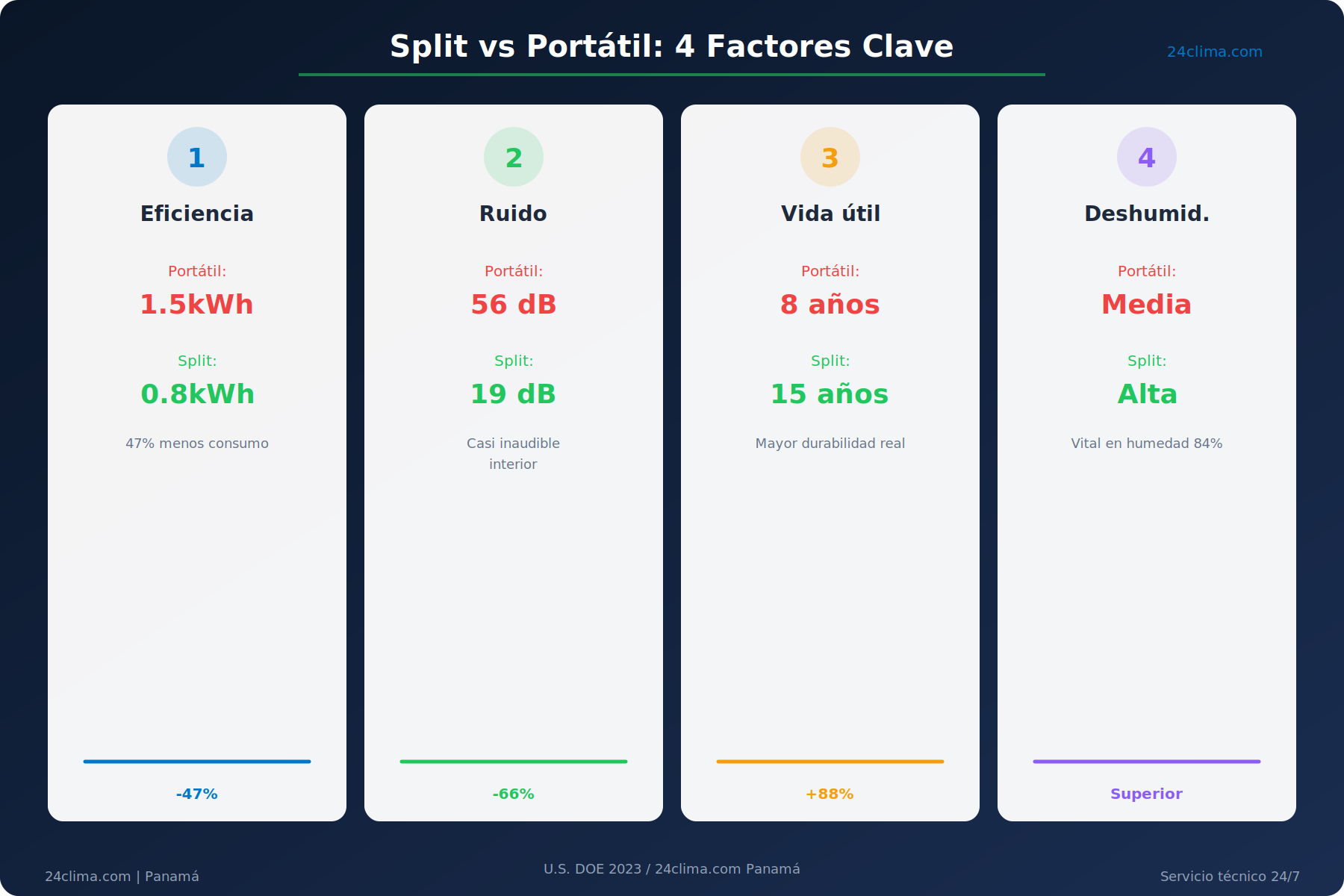
A 12,000 BTU portable AC draws an average of 1.5 kWh per hour. A split inverter of the same capacity draws between 0.7 and 0.9 kWh under the same conditions. That's 40% to 47% better efficiency in favor of the split, according to energy efficiency data published by the U.S. Department of Energy (U.S. DOE, 2023). At ETESA's residential rate of around $0.17 per kWh, that gap shows up on your bill every month.
How each system works — and why Panama punishes the portable
A split inverter physically separates the cooling work: the outdoor unit expels heat outside the building while the indoor unit distributes cool air. The cycle is efficient because heat always exits the room you're trying to cool.
A portable does everything inside the same room. It extracts heat from the indoor air, but the compressor and motor also generate heat — and that heat stays partially in the room. The exhaust tube removes some of it, not all. In a temperate climate, that's tolerable. In Panama, where outdoor air is already 31°C and humidity tops 80%, the portable has to work twice as hard to achieve half the result.
There's another technical factor most buyers never hear about: negative pressurization. When a portable pushes hot air out through the exhaust tube, it creates negative air pressure in the room. To compensate, the room pulls warm, humid air back in through any available gap — under the door, around poorly sealed windows. That's the same humid air the unit just finished removing. A self-defeating cycle that gets significantly worse here because of Panama's outdoor humidity levels.
Side-by-side: portable vs. split in real numbers
Portable Air Conditioner (12,000 BTU)
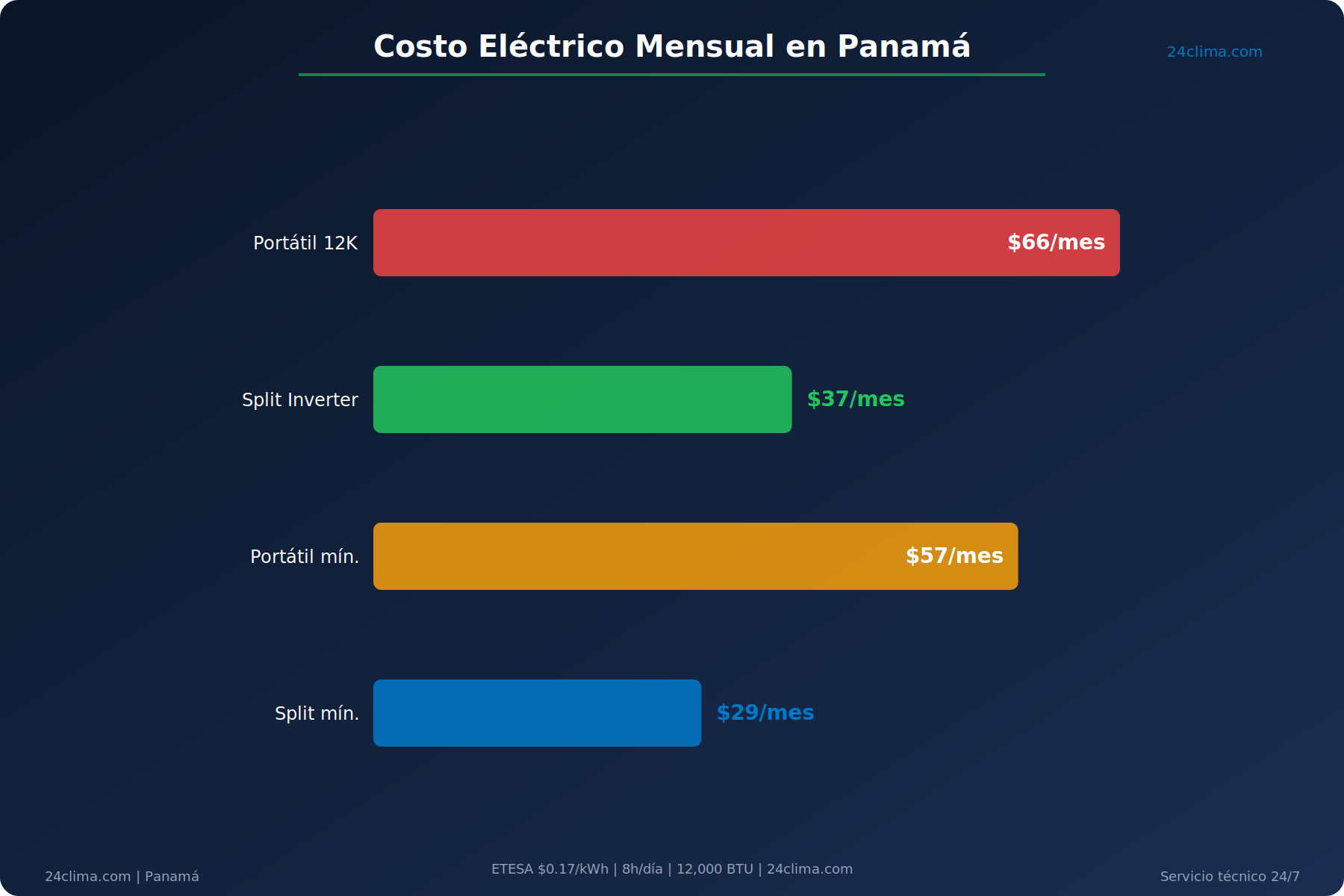
Equipment price: $350 – $550 Installation cost: $0 (plug in and go) Average consumption: 1.4 to 1.6 kWh/hour Estimated monthly electricity cost (8 hrs/day, ENSA rate $0.17/kWh): $57 – $66 Noise level: 52 – 60 dB (audible during normal conversation) Dehumidification in tropical climate: moderate Estimated lifespan: 7 – 10 years Rental installation without permits: yes
Mini-Split Inverter (12,000 BTU)
Equipment price: $650 – $900 Installation cost: $150 – $250 Average consumption: 0.7 to 0.9 kWh/hour Estimated monthly electricity cost (8 hrs/day, ENSA rate $0.17/kWh): $29 – $37 Indoor noise level: 19 – 28 dB (inaudible during normal conversation) Dehumidification in tropical climate: high Estimated lifespan: 12 – 18 years Rental installation without permits: requires wall penetration and landlord authorization
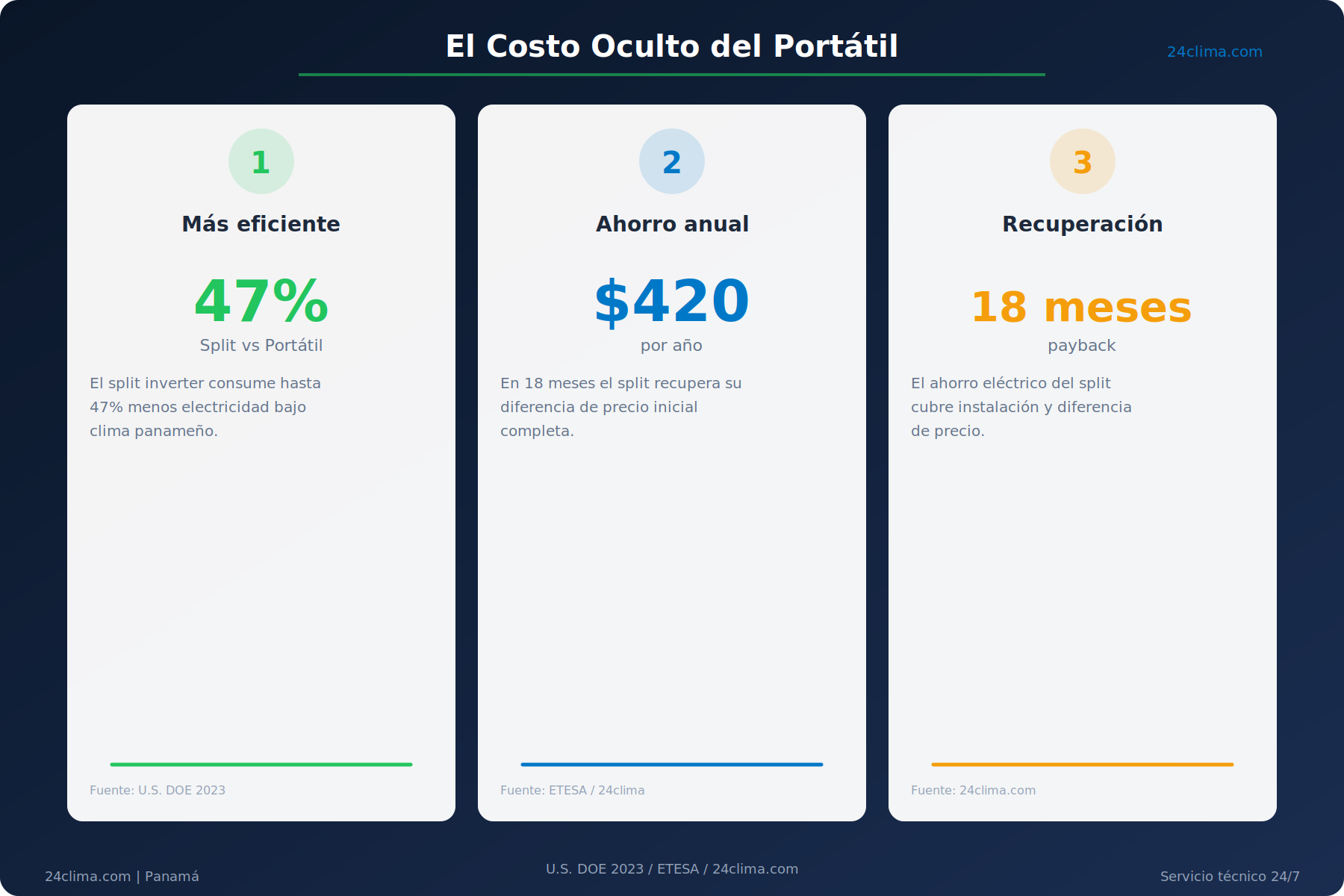
The monthly electricity gap is $25 to $35 in favor of the split. Over 12 months, that's $300 to $420 — nearly enough to cover the full installation cost of the split in year one. By month 18, the split has recovered its own price premium.
Real-world scenarios — when each option actually makes sense
There's no universal answer. These are the situations we see most often across Panama City and the practical recommendation for each.
Rental apartment where you can't drill into walls
This is the most legitimate case for a portable. Many rental contracts in buildings around Punta Pacífica, El Cangrejo, and Marbella explicitly prohibit drilling into exterior walls without the owner's written approval. In those situations, a portable is the only immediate option. If you go that route, look specifically for dual-hose models — they partially correct the negative pressurization problem and improve efficiency by 15% to 20% over single-hose units.
If you plan to stay more than 12 months, it's worth a conversation with your landlord. Many property owners in Panama will approve a split installation if the tenant covers the cost and the unit stays in the apartment at the end of the lease. That negotiation frequently pays off.
Small room with temporary or low-frequency use
For spaces under about 130 square feet with occasional use — an office you're in three days a week, a guest room, a server closet — a portable can make economic sense. The installation cost of a split doesn't amortize when use is low or your time in the space is short (under six months).
Your own apartment or long-term residence
No real ambiguity here. A split inverter is the right call. Air conditioning accounts for 50% to 65% of residential electricity consumption in urban Panama, according to the Ministry of Commerce and Industry (MICI, 2022). A variable-speed inverter split consumes up to 44% less than a fixed-speed unit or an equivalent portable, according to research by Saidur et al. published in Renewable and Sustainable Energy Reviews (2012, extensively cited in subsequent ASHRAE technical comparisons). In a home in Costa del Este or Clayton where the AC runs 10 hours a day, that's $45 to $60 a month — every month.
Home in areas with frequent power outages — interior provinces or older buildings
For locations outside Panama City — La Chorrera, Penonomé, Santiago — where outages are more common and budgets are tighter, a reliable split from a brand with solid local warranty support will always outperform a portable on efficiency. A portable isn't more resistant to power cuts — frequent starts and stops damage both types equally. The portable's only advantage in these cases is logistical, not technical.
Where to buy in Panama and which brands hold up
The main physical retail options in Panama City: Machetazo (Vía España and Chorrera), Do it Center (multiple branches), Rodelag (an AC specialist with their own installation technicians), and PriceSmart for members.
For portables, brands with local parts and service support include LG, Whirlpool, and Midea. For split inverters, the brands with the strongest technical support network in Panama right now are LG, Daikin, Midea, and Gree. Avoid any brand without a confirmed local distributor. In a climate averaging 85% humidity year-round, warranty coverage and parts availability are not minor details — they're the difference between a repair that costs $80 and a unit you throw out.
Frequently asked questions
Is a portable AC or a split system better for an apartment in Panama?
For a regularly-used apartment you own, the mini-split inverter wins in almost every category: 40% to 47% less electricity, more effective dehumidification in a tropical climate, and near-silent operation. The portable only has a genuine edge when a rental contract prohibits wall drilling or when the space will be used for fewer than six months.
How much does a portable AC cost to run vs. a split inverter in Panama?
At 8 hours of daily use and ENSA's residential rate of $0.17/kWh, a 12,000 BTU portable runs $57 to $66 per month in electricity. A split inverter of the same capacity runs $29 to $37. The monthly difference is $25 to $35 — $300 to $420 per year — which covers the split's installation cost within the first 12 months.
Can you install a split AC in a rental apartment in Panama?
Technically yes, but it requires drilling through an exterior wall to run the refrigerant line and drainage. Most rental contracts require written landlord authorization for that work. That said, many landlords will approve the installation if the tenant covers the cost and the unit stays at the end of the lease. The monthly electricity savings make that conversation worth having.
The right decision depends on your actual situation
Portables have a legitimate place in the Panama market — specifically in restrictive rental situations and genuinely temporary setups. For everything else, a split inverter pays for itself within 12 to 18 months and then keeps working in your favor for a decade beyond that.
The 2 p.m. heat in San Francisco isn't going anywhere. But you get to decide how much it costs you each month to deal with it. At 24Clima, our team assesses your space, calculates the BTUs you actually need, and recommends the right equipment for your budget and type of home — no upselling, no pressure toward the most expensive option. Reach out on WhatsApp at https://24clima.com/contacto/ and we'll get back to you the same day.