R32 Refrigerant in Air Conditioners — What Nobody Tells You When You Buy in Panama
Last updated: May 2025
It's 2 PM in Costa del Este. The sun is baking the concrete at 91°F (33°C) and the air smells like hot asphalt. You walk into your apartment, hit the remote, and hear that familiar click of the AC kicking on. Ten minutes later, the room is down to 73°F (23°C). Perfect. But back at the store, when the salesperson at Novey or Rodelag mentioned the unit uses "R32 refrigerant," you just nodded along.
What exactly is R32? Why are all the new LG, Panasonic, and Midea models using it? And what happens when that refrigerant runs low and a technician tells you it "needs to be recharged"?
Most buyers in Panama have no idea — and that gap costs real money. Wrong purchase decisions, botched service jobs, a technician charging double because "R32 is special." This piece clears all of that up. If you want broader context first, browse our guides at 24clima.com/consejos-y-guias/ — we cover the full AC ecosystem in Panama.
What Most People Believe (And Have Wrong)
There's a persistent rumor circulating in Panamanian WhatsApp groups and tech forums: R32 is just "the new gas they invented to make you spend more on maintenance." Some people say it's more dangerous than the old R22. Others insist it only works in expensive European brand equipment.
All of that is wrong.
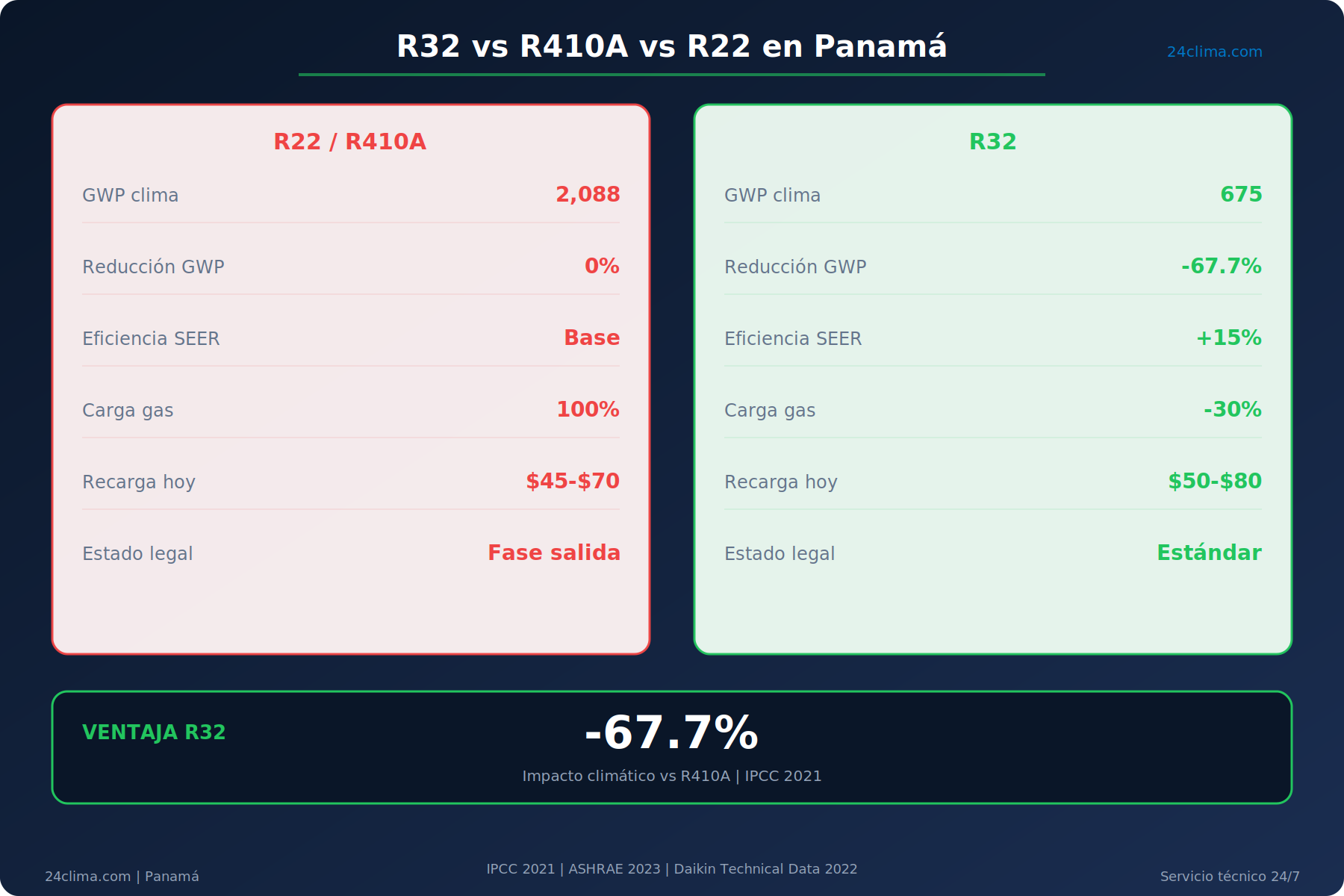
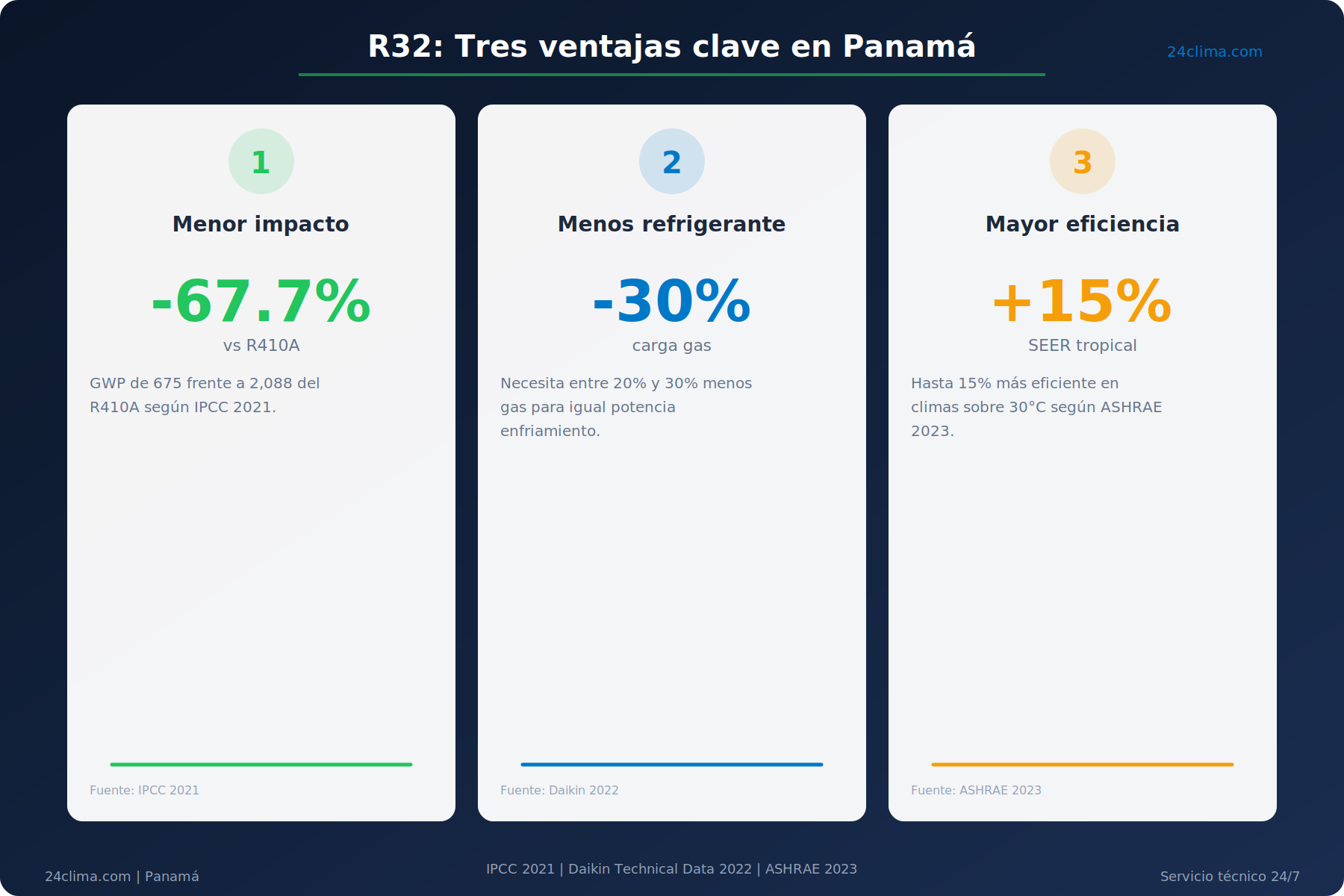
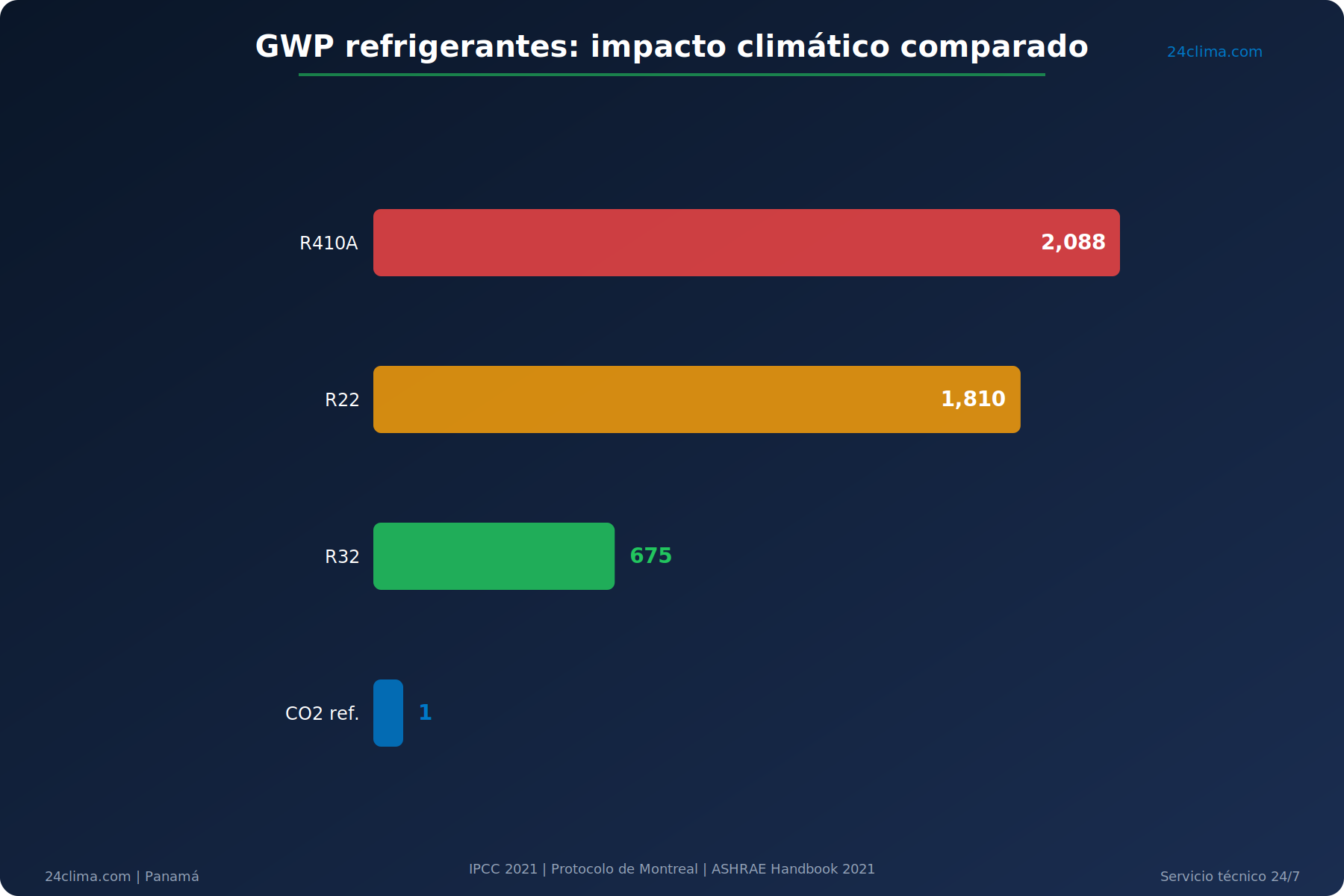
R32 is not a commercial gimmick. It's a technical and environmental response to a real problem. The previously dominant refrigerant, R410A, has a Global Warming Potential (GWP) of 2,088 — meaning gram for gram, it traps 2,088 times more heat than CO2 if released into the atmosphere. R32 has a GWP of 675. That's a 67.7% reduction in climate impact, according to the Intergovernmental Panel on Climate Change (IPCC, 2021).
But the argument that matters most to your wallet in Panama isn't the environmental one. It's energy efficiency. And on that front, R32 wins decisively.
What R32 Refrigerant Actually Is
R32 is a single-component hydrofluorocarbon (HFC), chemically known as difluoromethane (CH2F2). Unlike R410A — a blend of two gases, R32 and R125 — pure R32 has superior thermodynamic properties for the refrigeration cycle in hot, humid climates like Panama's.
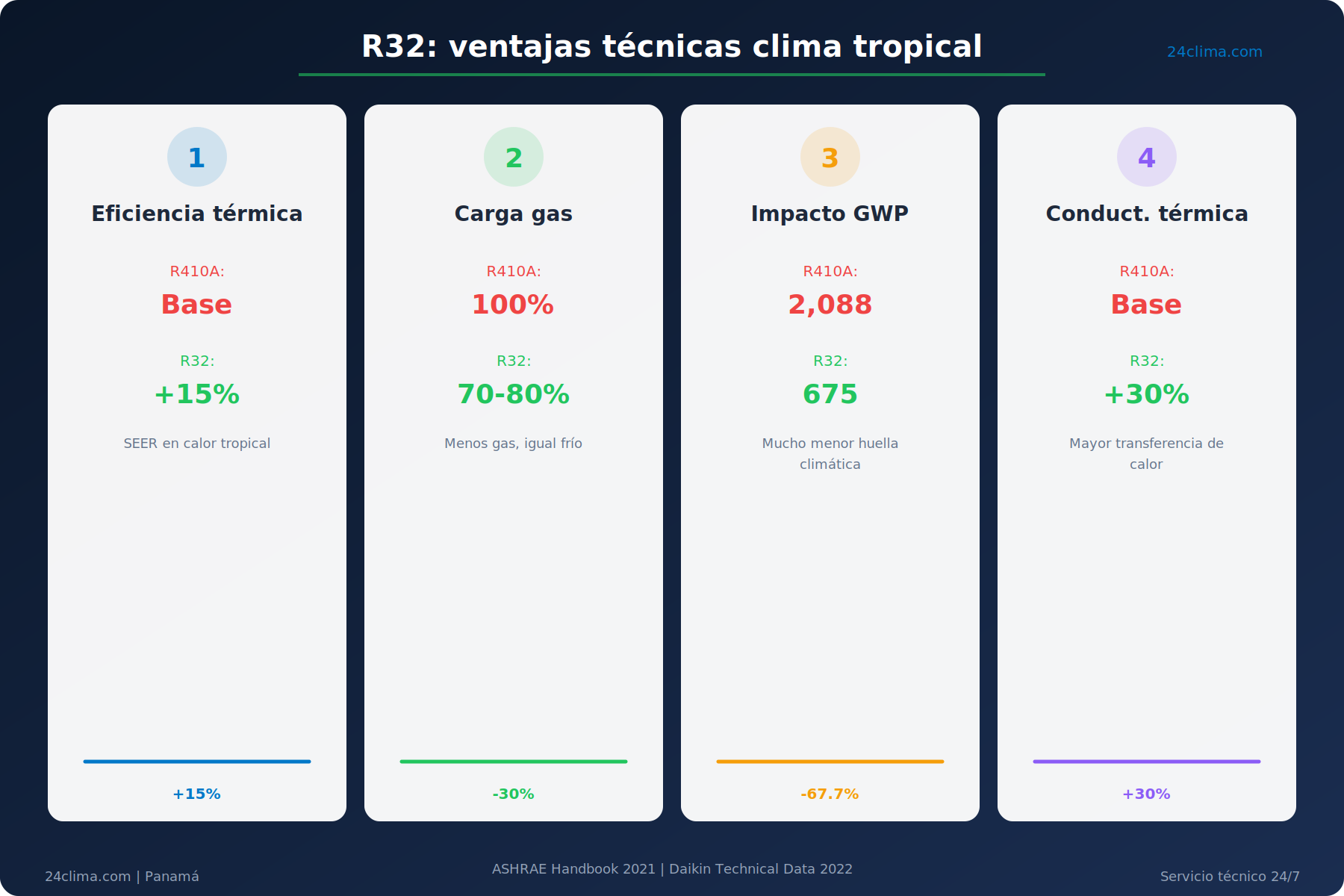
In practical terms: R32 transfers heat more efficiently because its latent heat of vaporization is higher. You need less refrigerant to achieve the same cooling effect. A typical R32 system uses 20% to 30% less refrigerant charge than an equivalent R410A system, according to Daikin's official technical documentation (Daikin Technical Data, 2022).
Less gas, same power. That means lower working pressure on the compressor, less long-term wear, and a lower electricity bill every month.
R32 vs R410A vs R22 — The Comparison That Actually Matters
This is the breakdown every buyer in Panama should understand before walking into a store.
R22 (the old standard) GWP of 1,810. Banned in new equipment since 2020 under the Montreal Protocol. Any unit still running R22 is over a decade old, and recharging it in Panama runs $80–$120 per service — when you can find the gas at all. Lowest efficiency of the three. If a technician is still working with R22, that's already a yellow flag.
R410A (the middle generation) GWP of 2,088 — actually worse than R22 for the climate. Being phased out under the Kigali Amendment, which Panama has ratified. Recharge costs $45–$70 per service. Still running in units installed between 2010 and 2020, but the clock is ticking on parts availability.
R32 (the current standard) GWP of 675. The dominant refrigerant in new inverter units in Panama since 2022. Recharge costs $50–$80 per service, and the pool of certified technicians who stock it properly is growing fast. Up to 15% more efficient than R410A in tropical conditions, with a longer compressor lifespan to boot.
One number puts this in perspective: according to ASHRAE (2023), R32 systems in climates with average outdoor temperatures of 86°F (30°C) or higher show a seasonal energy efficiency ratio (SEER) 8% to 15% higher than equivalent R410A systems. Panama City's average annual temperature runs between 81°F and 88°F (27–31°C), according to ETESA. The numbers line up exactly.
Why R32 Works Better in Panama's Heat
Panama demands more from an air conditioner than most of Europe or even parts of Mexico. It's not just the heat — it's the humidity. A typical day in San Francisco de la Caleta or Albrook sits at 75–85% relative humidity. Your AC isn't just cooling the air; it's wringing moisture out of it. That dehumidification process burns additional energy.
R32's thermodynamic advantage becomes very real here. It operates at a higher condensing pressure than R410A, which lets it pull heat out of hotter air more efficiently. Its thermal conductivity is roughly 30% higher than R410A's (ASHRAE Handbook of Fundamentals, 2021) — meaning the heat exchanger operates with better transfer efficiency throughout the full refrigeration cycle.
In concrete consumption terms: a 12,000 BTU inverter split running R32 at SEER 17 — such as the Panasonic CS-CU-XZ12ZKE or the LG S4-W12JA3AA, both available at Rodelag and DoIt Center — typically draws 650–700 watts under stable tropical conditions. An equivalent unit from ten years ago running R22 draws 900–1,100 watts for the same effect. The difference on your ENSA or EDEMET bill can reach $25–$40 every month.
Where to Buy R32 Units in Panama and What to Expect to Pay
Inverter units with R32 are now the default across Panama's major retail chains. You don't need to hunt for specialty importers.
Rodelag (Vía España, Miraflores, David, and other locations) carries the Panasonic CS/CU-WZ series (R32, SEER 17–19) from $480 to $950 depending on capacity, and LG Dual Inverter (R32, SEER 16–18) from $420 to $820.
Novey (Mall Albrook, Costa del Este, David) stocks the Midea Mission series (R32, SEER 17) from $350 to $750, and the Carrier Xpower Gold (R32, SEER 18) from $550 to $1,100.
DoIt Center (multiple locations) offers Kelvinator and Electrolux with R32 from $320, and certified Chinese brands like Aux and Chigo from $280.
On budget brands: a $280 unit can work fine for two to four years, but parts warranties in Panama for brands like Chigo are limited. Midea, despite being Chinese-manufactured, has official distribution with spare parts available in-country. Panasonic and LG both run certified service centers in Panama City — which matters the day something actually breaks.
Maintaining R32 in Panama — What a Competent Technician Should Do
R32 does not require more frequent servicing than R410A. But it does require certified technicians with specific equipment. This is where many homeowners in Panama make expensive mistakes.
First, R32 is a mildly flammable gas, classified A2L under ASHRAE's refrigerant safety classification system. Unlike R410A, which was non-flammable, R32 requires proper handling precautions. Under normal operating conditions it poses no risk, but a technician working on an R32 leak in a poorly ventilated enclosed space is creating a genuine hazard. The lower flammable limit (LFL) of R32 is 14.4% by volume in air — hard to reach in a normally ventilated room, but possible in tightly sealed spaces with a significant leak.
Second, recharge equipment must be R32-specific. You cannot mix R32 with R410A in the same cylinder or the same system. A technician who tells you they added "a blend" either doesn't know what they're doing or is lying to you — and either way, they are damaging your compressor.
Third, service manifolds and hoses must be R32-rated. Standard R410A manifolds may be incompatible due to differences in working pressure. Any properly equipped technician in Panama in 2024–2025 should already have manifolds updated for R32 systems. If they don't, send them home.
For a full preventive maintenance visit — filter cleaning, refrigerant charge inspection, evaporator cleaning — you can see what a professional service should include at 24clima.com/servicios/mantenimiento/.
R32 Safety in Panama Apartments — A Technician Checklist
This topic generates the most questions, especially from owners in high-rise towers in Punta Pacífica, Obarrio, or Coco del Mar, where units are often installed in tight spaces.
Before any R32 recharge or repair service, a qualified technician should ventilate the space by opening windows and doors at least five minutes before work begins, remove ignition sources by turning off stoves and switching off any spark-producing devices in the area, and bring a hydrocarbon/HFC gas detector to the job — not optional. They should never use an open flame for brazing without first fully evacuating the system, always recover the refrigerant before opening the circuit (releasing R32 directly into the atmosphere is illegal under Panama's MiAmbiente regulations), and verify pressures with an R32-certified manifold before adding any charge.
During normal day-to-day operation, with the system running and the circuit sealed, R32 inside the unit poses zero risk to apartment occupants. The hazard exists only during technical service with an open circuit — and it is fully controlled when the technician actually knows what they're doing.
Frequently Asked Questions — R32 in Panama
Is R32 more efficient than R410A in a tropical climate?
Yes, measurably so. At outdoor temperatures of 86°F (30°C) or above, R32 systems show 8% to 15% higher seasonal energy efficiency compared to equivalent R410A systems, according to ASHRAE (2023). In Panama, that difference translates to $20–$40 less per month on your electricity bill for a 12,000 BTU unit running 10–12 hours a day.
Is R32 refrigerant dangerous in a Panama apartment?
Under normal operating conditions, no. R32 is classified A2L — low toxicity, only mildly flammable and only at concentrations above 14.4% by volume in air, which are not reached in normally ventilated homes. The risk exists only during open-circuit technical service, and it is fully controlled through proper ventilation and elimination of ignition sources. Thousands of apartments in Panama City are already running R32 systems without incident.
How much does an R32 recharge cost in Panama?
In 2025, an R32 recharge runs between $50 and $80 including labor for a residential unit between 9,000 and 18,000 BTU. R32 refrigerant costs approximately $8–$12 per pound in the local market. Be skeptical of quotes under $40 — they typically indicate uncertified recycled gas or incorrect blends. Ask the technician to show you the cylinder and the gas certification before they start work. If they hesitate, that tells you everything you need to know.
Back to That Apartment in Costa del Este
That sweltering afternoon goes well when the equipment works as it should. But "working as it should" in Panama has a technical dimension that goes beyond pressing a button — it means having the right refrigerant, the right charge, and a technician who genuinely understands what they're handling.
R32 is not a trend. It's the standard that is here to stay in Panama's inverter AC market. Understanding it gives you a real advantage as a consumer: to negotiate better, to recognize technicians who know their craft, and to make purchase decisions based on actual data instead of whatever pitch the salesperson is running that day.
At 24Clima, we work exclusively with equipment and refrigerants certified for Panama's climate. If you have questions about your current unit, suspect a refrigerant leak, or want to know whether upgrading to an R32 inverter makes financial sense for your situation, reach us on WhatsApp at 24clima.com/contacto/ — we review your case at no charge and with no sales pressure.