AC Refrigerant Recharge in Panama — When You Need It and What It Will Cost You
It's 2 in the afternoon in Costa del Este. The sun is hammering straight down on the asphalt, the thermometer reads 91°F (33°C), and the humidity is sitting at 87%. You walk into your apartment, flip on the split unit in the living room, and wait for that wall of cold air that turns four walls into somewhere you actually want to be. But what comes out is lukewarm. Not cold. Lukewarm.
You push the thermostat down to the lowest setting, 64°F (18°C). The compressor hums louder. An hour later, the room has dropped a couple of degrees. Your electricity bill, on the other hand, is about to climb a lot more than that.
Most people's first thought is that the unit is broken. Their second thought is that it's time to buy a new one. In most cases, neither answer is right. The problem is usually that your AC has lost refrigerant — and that has a straightforward fix. For more context on common equipment problems in Panama's tropical climate, check out our guides at 24clima.com/consejos-y-guias/.
What Most People Get Wrong About Refrigerant
There's a widespread belief that refrigerant "gets used up" over time, the same way a car burns through gasoline. So people assume that every so often, you just need a top-up. That's not how it works.
A properly installed AC system with no leaks is a closed loop. The refrigerant doesn't get consumed or evaporate. If your unit has less refrigerant than it left the factory with, there is only one possible explanation: there's a leak somewhere in the circuit.
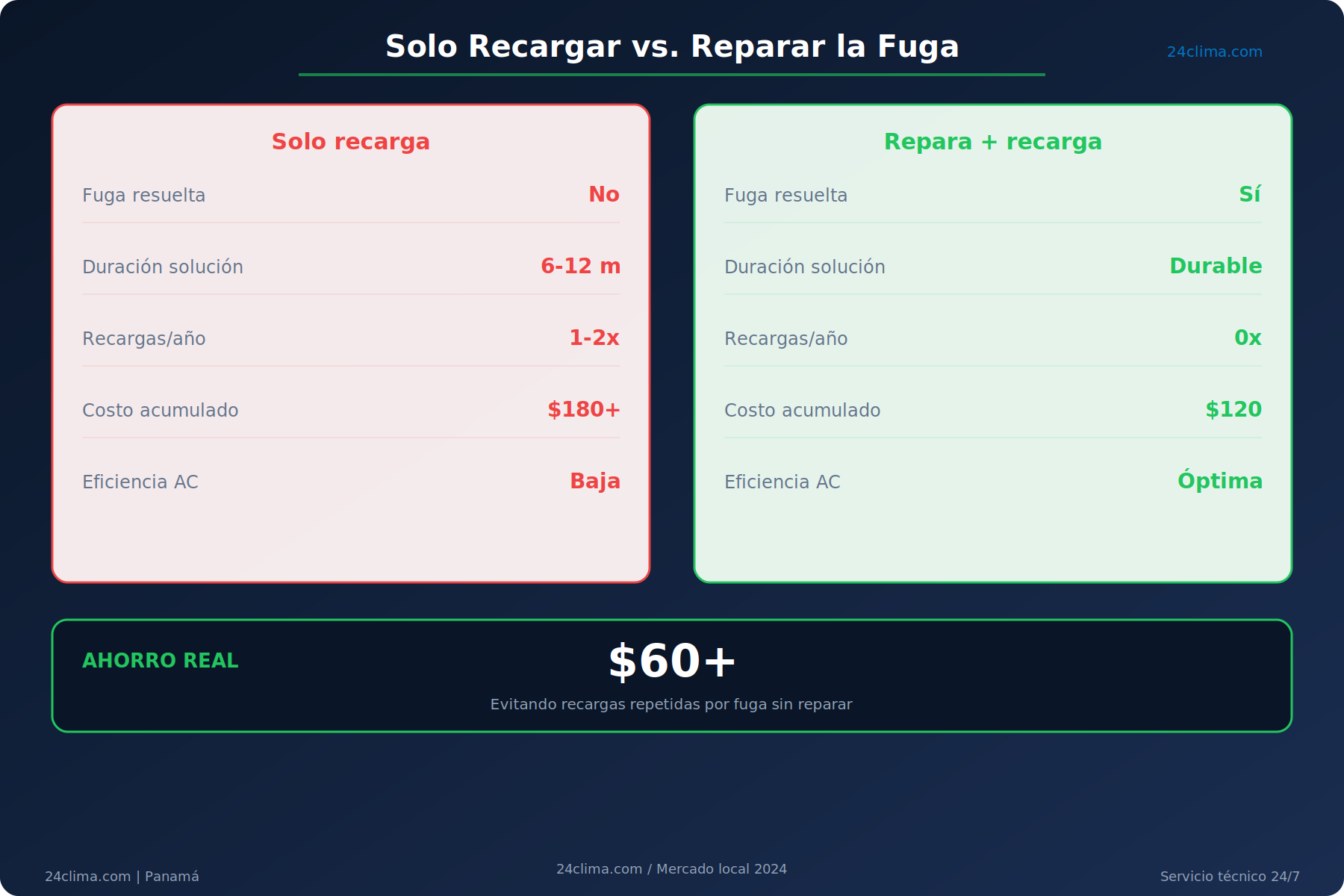
That changes everything. If you just recharge the gas without finding and fixing the leak, you'll be back in the same situation six to twelve months later. You pay for the recharge, the problem comes back, you pay again. The right diagnostic question isn't just "how much gas is missing?" — it's "where is the gas escaping?"
Refrigerant loss does happen in specific situations: poor original installation, corrosion on copper lines in coastal areas like Punta Pacífica or Balboa, or vibrations that accumulate over years of operation. In those cases, the correct procedure is locate the leak, repair it, then recharge — in that order.
The Specific Signs Your AC Needs Attention
A unit running low on refrigerant gives clear, physical, measurable signals.
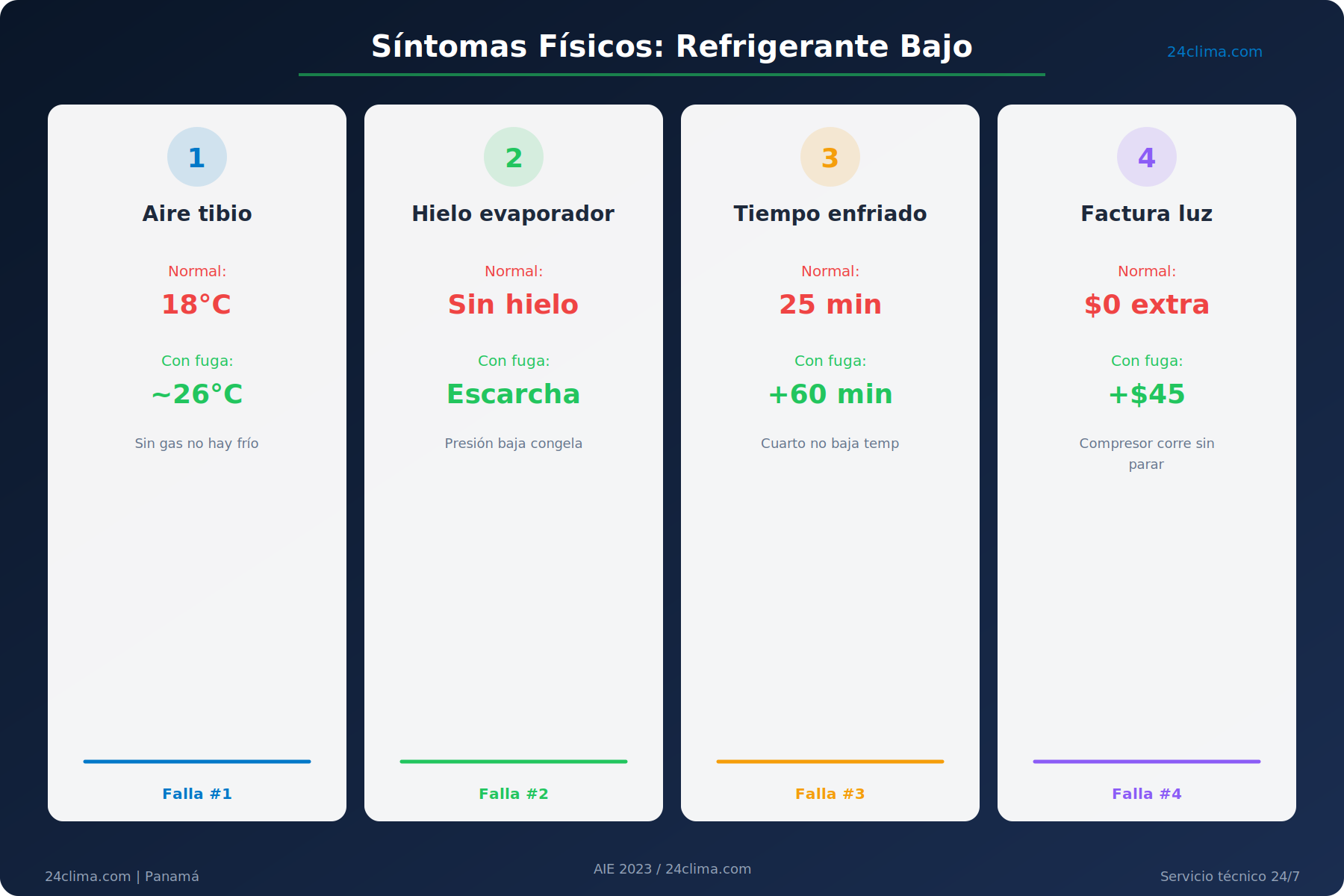
The air blowing out is room temperature or barely cool. The refrigeration cycle is compromised. Refrigerant is the working fluid that carries heat from inside your home to the outdoor condenser. Without enough of it, heat transfer breaks down and you get a fan, not an air conditioner.
Ice or frost forms on the evaporator or copper lines. It seems backwards, but low refrigerant causes ice. With pressure dropping inside the circuit, the evaporator falls to extreme temperatures and freezes moisture from the air right onto its fins. Open the indoor unit's panel and if you see frost, that's your answer.
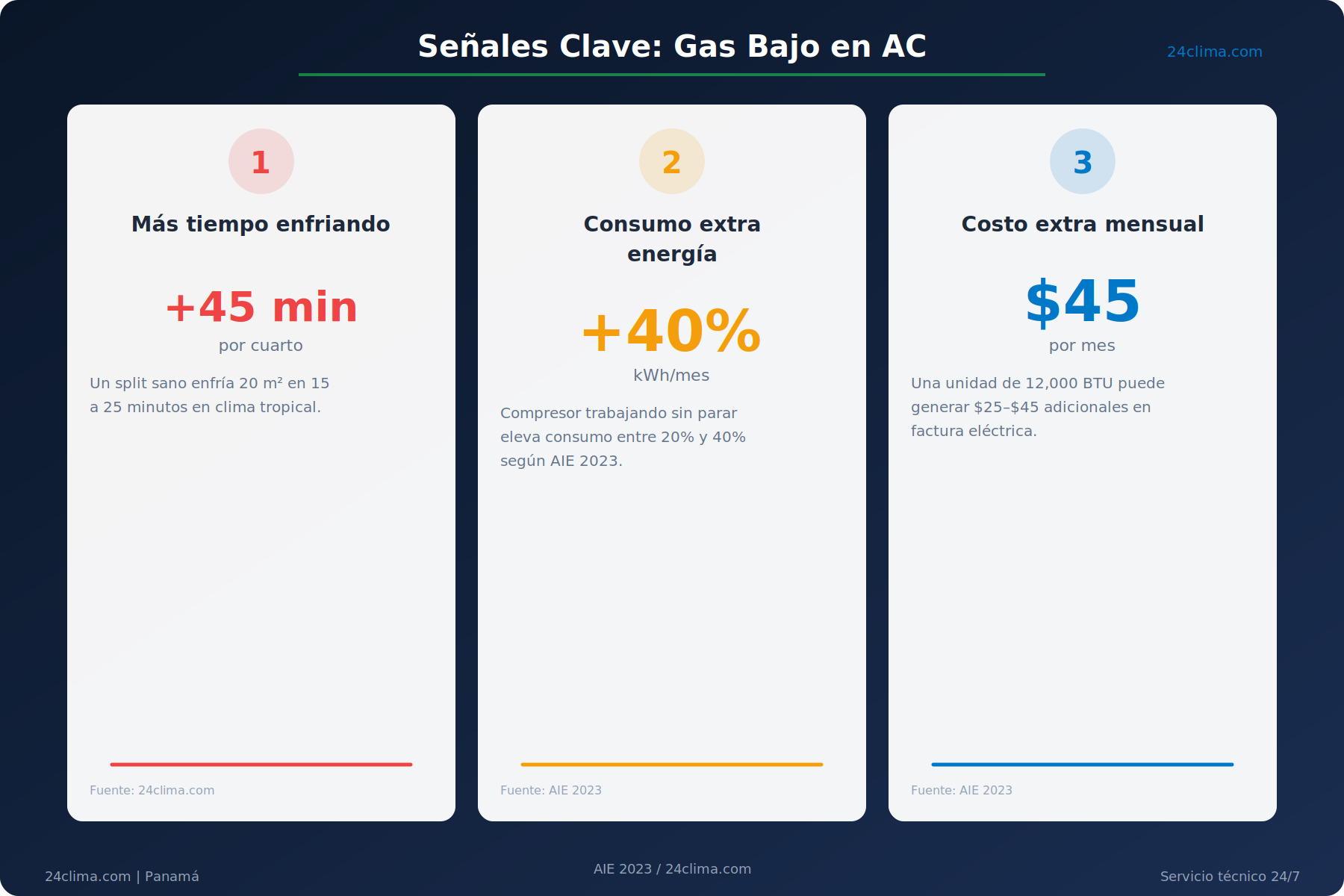
The unit takes more than 45 minutes to cool the room. A properly charged split should cool a 215 sq ft (20 m²) room in 15 to 25 minutes under tropical conditions. If it's been an hour and the room still feels warm, the system is working twice as hard to compensate.
Your electricity bill went up and nothing changed in your habits. A compressor running continuously because it can't reach the set temperature consumes 20% to 40% more energy, according to the International Energy Agency (IEA, 2023). In Panama, where the cost per kilowatt-hour runs around $0.17, that translates to $25 to $45 in extra monthly costs on a 12,000 BTU unit.
The outdoor compressor runs non-stop without cycling. Inverter units modulate their speed continuously. Traditional on/off units cycle: they run, cool the room, shut off, and repeat. If your on/off unit is running constantly without ever reaching the set temperature, something is preventing the system from reaching its correct working pressure.
Refrigerant Types in Panama — R22, R410A, and R32
The refrigerant your unit uses determines the cost of the recharge, how easy it is to source, and the environmental impact of the service.
R22 — The Old-Generation Refrigerant
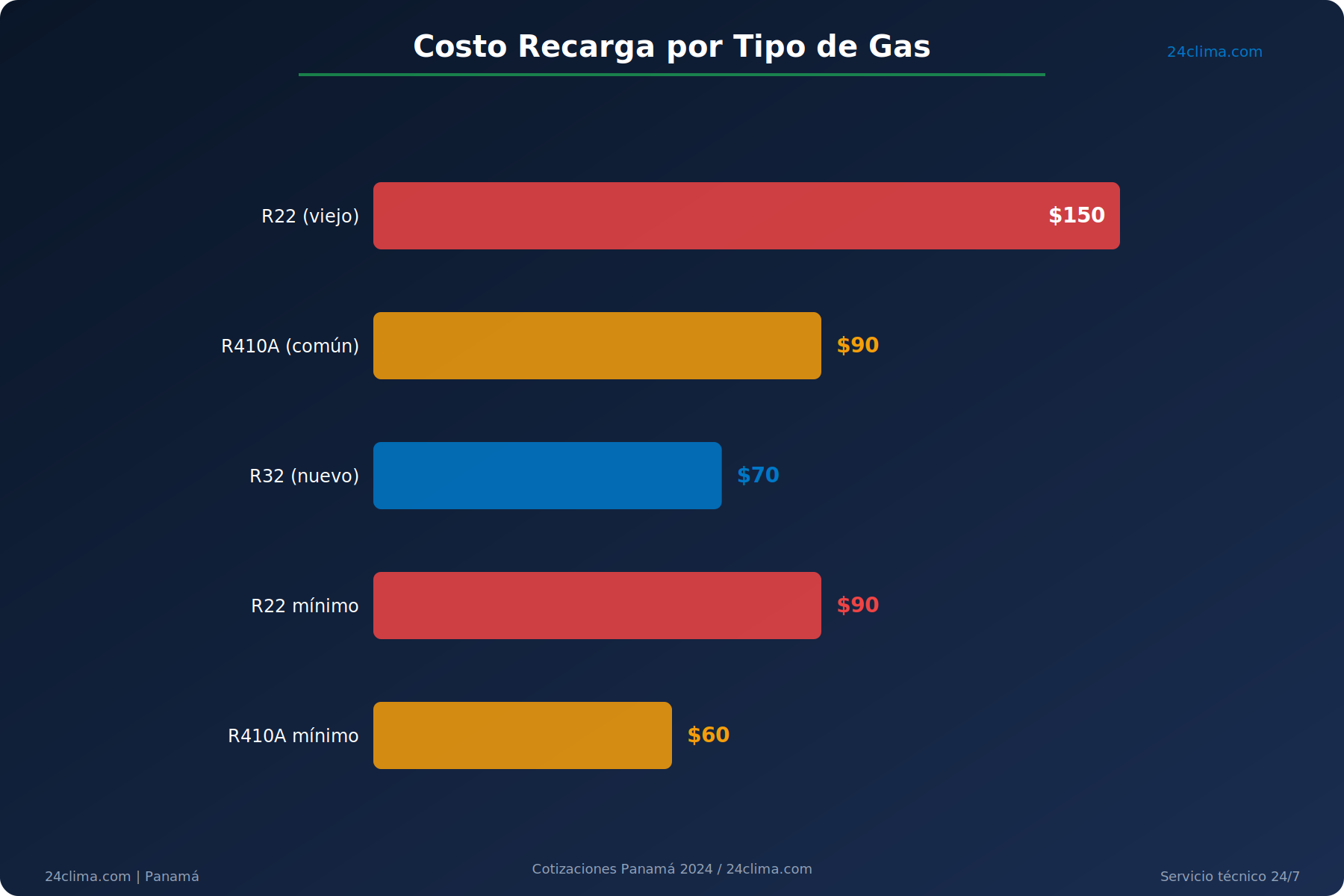
R22 was the standard for decades. If your unit is more than 12 years old, it likely runs on R22. The Montreal Protocol classified it as an ozone-depleting substance and global production has been restricted since 2020. In Panama it's still available from existing inventories, but it's becoming scarce and expensive. A recharge for a 12,000 BTU unit using R22 runs between $90 and $150, based on local market quotes from 2024.
R410A — The Most Common Current Standard
Most split units installed in Panama between 2005 and 2022 use R410A. It's more efficient than R22 and doesn't deplete the ozone layer, but it carries a high global warming potential — 2,088 times that of CO2, according to the US EPA. A recharge for a 12,000 BTU unit typically runs between $60 and $90.
R32 — The Newer Generation Refrigerant
More recent units — particularly inverter models from Daikin, Midea, LG, and Samsung manufactured since 2019 — use R32. Its global warming potential is 675, which is 68% lower than R410A, and it requires less refrigerant volume per ton of cooling capacity. R32 is increasingly available in Panama, and a recharge for a 12,000 BTU unit costs between $65 and $95 on average.
One thing that never changes regardless of refrigerant type: a certified technician should verify system pressure with gauges before adding anything. Different refrigerants should never be mixed in the same unit.
What a Refrigerant Recharge Costs in Panama — Real Prices by Capacity
Prices vary based on the type of gas, the unit's capacity, and whether the service includes leak detection and repair. These are real market ranges for Panama City in 2024.
9,000 BTU unit (small bedroom or office) — R410A: $55 to $75 — R32: $60 to $80 — R22: $80 to $110
12,000 BTU unit (1 ton, standard bedroom) — R410A: $65 to $90 — R32: $70 to $95 — R22: $90 to $130
18,000 BTU unit (living room or large bedroom) — R410A: $80 to $110 — R32: $85 to $115 — R22: $110 to $150
24,000 BTU unit (2 tons, commercial space or large living area) — R410A: $95 to $130 — R32: $100 to $135 — R22: $130 to $180
These prices cover refrigerant and labor. If leak detection using dye or nitrogen pressure testing is required, add $20 to $40. If the copper lines need to be soldered to repair the leak, add another $40 to $80 depending on location and complexity.
Preventive maintenance with pressure checks twice a year can stop a small leak from becoming a full refrigerant loss that eventually kills the compressor. You can learn more about that service at 24clima.com/servicios/mantenimiento/.
Why Panama's Climate Makes This Problem Worse
Panama averages 88°F (31°C) with relative humidity between 80% and 90% year-round, according to the Institute of Meteorology and Hydrology. AC units here run close to their design limits for most of the year — not occasionally, constantly.
A system running at 80% of its rated refrigerant charge in New York might take months before anyone notices anything wrong. That same unit in Panama, you'll feel it within weeks. The temperature gap between where you want the room to be — around 72°F (22°C) — and the outdoor air at 91°F (33°C) is nearly 20°F (11°C). The system has to pull heat out of an environment that never drops below 82°F (28°C) at night.
Extreme humidity adds another layer. The evaporator has to condense massive amounts of water vapor out of the air on top of cooling it. That double workload means any weakness in the refrigeration circuit shows up fast — in performance loss and on your electricity bill.
A study published by the Lawrence Berkeley National Laboratory (2023) on air conditioning in tropical climates found that a unit with a 20% refrigerant deficit increases energy consumption by 15% to 30% depending on outdoor conditions. In a climate like Panama's, that figure tends toward the upper end.
The Refrigeration Cycle — Where Leaks Happen and Why It Matters
Refrigerant moves through four main stages: the compressor, the condenser, the expansion valve, and the evaporator. Leaks tend to concentrate at specific points.
Copper flare fittings during installation. If the technician who installed the unit didn't properly flare the connections, those joints will bleed refrigerant slowly over months. This is one of the most common causes we see in Panama City.
Copper lines in coastal environments. Salt air in places like Punta Pacífica, San Francisco, or Balboa accelerates corrosion on copper and can create micro-fractures in the lines. Units within a kilometer of the coast are at measurably higher risk.
The compressor service valve. In older units, the valve seal deteriorates over time and causes gradual refrigerant loss — slow enough that people don't notice until the unit stops cooling.
Formaldehyde corrosion on the evaporator. In buildings where construction materials off-gas volatile organic compounds, aluminum evaporator coils can corrode from the inside out. This one gets missed often because it's not visible without pulling the unit apart.
Knowing where the leak is matters — not so you can fix it yourself, but so you can ask the technician to explain exactly where the problem was and how it was resolved. If a tech tops up the refrigerant without ever mentioning a leak, the full diagnostic wasn't done.
Frequently Asked Questions
How much does an AC refrigerant recharge cost in Panama?
In Panama City in 2024, the price range for most residential units is $55 to $135, depending on the refrigerant type (R32, R410A, or R22) and the unit's BTU capacity. Larger units and those running R22 sit at the higher end. The price should always include refrigerant and labor, plus a pressure check before and after the service.
How do I know if my AC needs a refrigerant recharge?
The clearest signs: the unit is blowing air but the room won't cool down, frost or ice appears on the lines or evaporator, the compressor runs continuously without reaching the set temperature, or your electricity bill goes up for no apparent reason. Any one of those is reason enough to call a technician with gauges to check the circuit pressure. You can also use our diagnostic tool at 24clima.com/diagnostico/ to get a clearer picture before picking up the phone.
How often does a split AC need a refrigerant recharge?
A unit with no leaks never needs a recharge. If you need more than one, the problem is an unrepaired leak — not routine refrigerant consumption. With proper installation and maintenance, refrigerant levels should hold stable for the entire service life of the unit, typically 12 to 15 years. Needing frequent recharges is a symptom of a structural problem, not a sign that maintenance is working.
Back to That Apartment in Costa del Este
The warm air that hit you at 2 in the afternoon wasn't a sign that the unit was dead. It was a signal that something in the circuit needed attention — likely a leak, a targeted repair, and then a correct refrigerant charge to bring the system back to full capacity.
At 24Clima, we run a full system diagnostic before recommending any service. We check pressures with calibrated gauges, identify the leak point when one exists, and explain exactly what we found and what needs to be done. No surprises on the bill, and no selling you something you don't need.
If your AC has stopped cooling properly or you suspect it's lost refrigerant, contact us on WhatsApp at 24clima.com/contacto/ and we'll take care of you anywhere in Panama City.
Last updated: June 2025