Samsung Air Conditioners in Panama — Are They Worth It in 2025?
2 p.m. in Costa del Este. The sun is hammering your window glass at 88°F (31°C) with 85% humidity. You open the apartment door and the heat hits you like a wall. You switch on the Samsung AC you bought 18 months ago at Rodelag. Four minutes later, the room starts to breathe again.
Then the end of the month arrives. You open your Naturgy or ENSA bill and the number stops you cold — $95, $110, sometimes more. You start wondering if you made the right call. If the Samsung everyone recommended actually fits Panama's climate, or whether you should have gone with an LG, a Panasonic, or something else entirely.
That question has a technical answer, and it's not the one the salesperson gives you. At 24clima.com/consejos-y-guias/ we've analyzed dozens of units under real tropical conditions. Here are the actual numbers.
What the Marketing Says vs. What Actually Happens
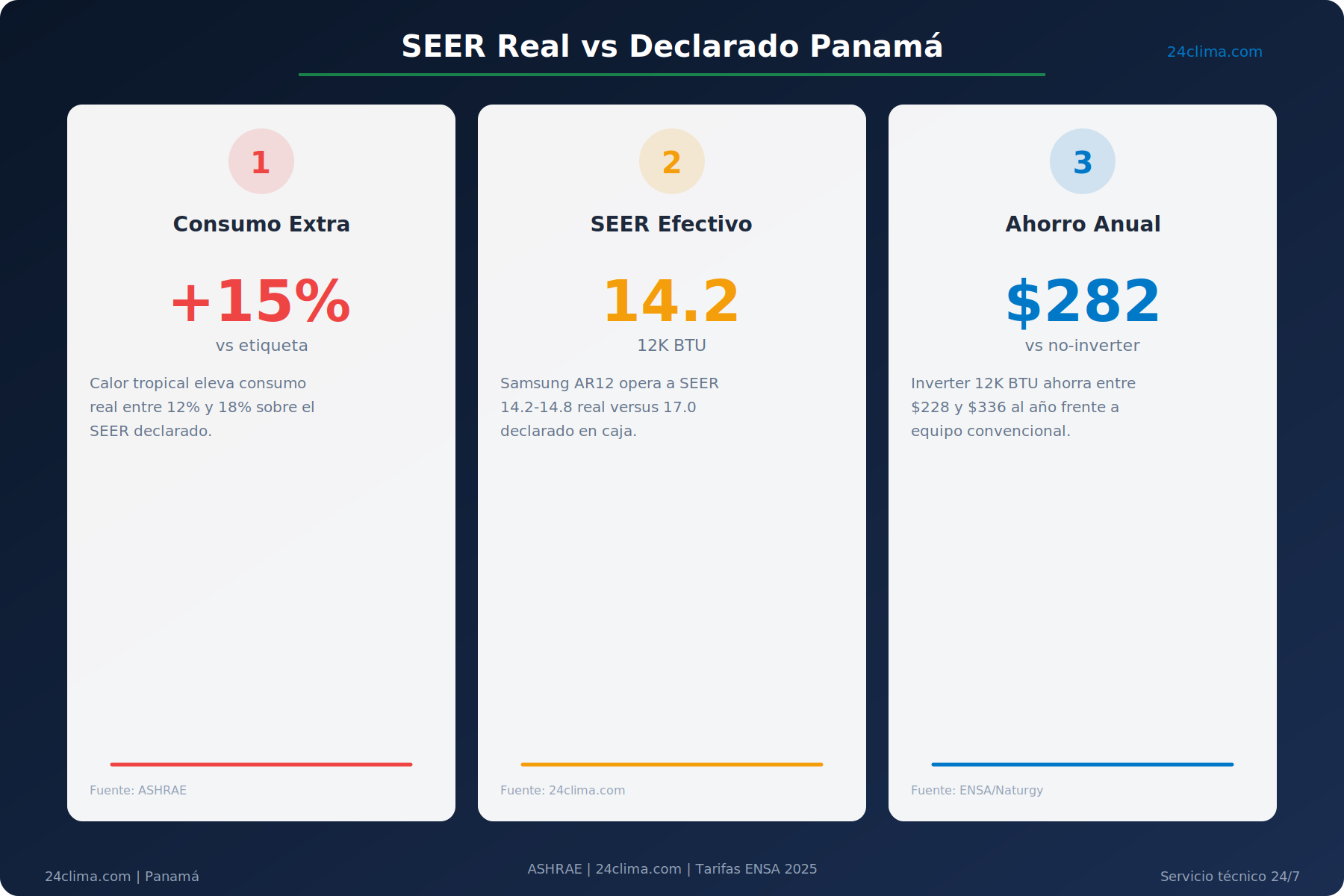
Most buyers assume "inverter" equals "efficient." That's true — but only up to a point. The real mistake is assuming all inverters are the same, and that the SEER rating printed on the box will match what shows up on your electric bill.
It won't. SEER is measured under lab conditions: 82°F (28°C) outdoor temperature, humidity controlled at 50%. In Panama, your unit runs at 88°F (31°C) or higher with 80–90% humidity for 8 to 10 months a year. Under those conditions, energy consumption runs 12% to 18% higher than the manufacturer's label, according to operational data published by ASHRAE for tropical climates.
So when a salesperson tells you "this Samsung 12,000 BTU inverter only uses 900 watts," the real figure for Panama is closer to 1,020 to 1,062 watts under actual load. Not catastrophic — but it shifts your monthly bill by $8 to $15 if the unit runs 8 hours a day.
Knowing that before you buy is what separates a smart purchase from a 10-year regret.
The Best-Selling Samsung Models in Panama in 2025
Samsung offers three lines in the Panamanian residential market: the WindFree series, the AR standard inverter series, and some legacy non-inverter models that still appear in stores like DoIt Center and eVision. This comparison focuses on the inverter units — the only ones that make financial sense in 2025.
Samsung AR09BXFAAWKN — 9,000 BTU Inverter
This model covers spaces of 750 to 970 square feet in Panama — not the 1,290 sq ft the North American catalog suggests, because tropical heat load runs significantly higher here. Its declared SEER is 16.0, but under Panamanian conditions it operates at around 13.5–14.0 SEER. Retail price at stores like Rodelag and eVision runs between $480 and $540 in 2025, installation not included.
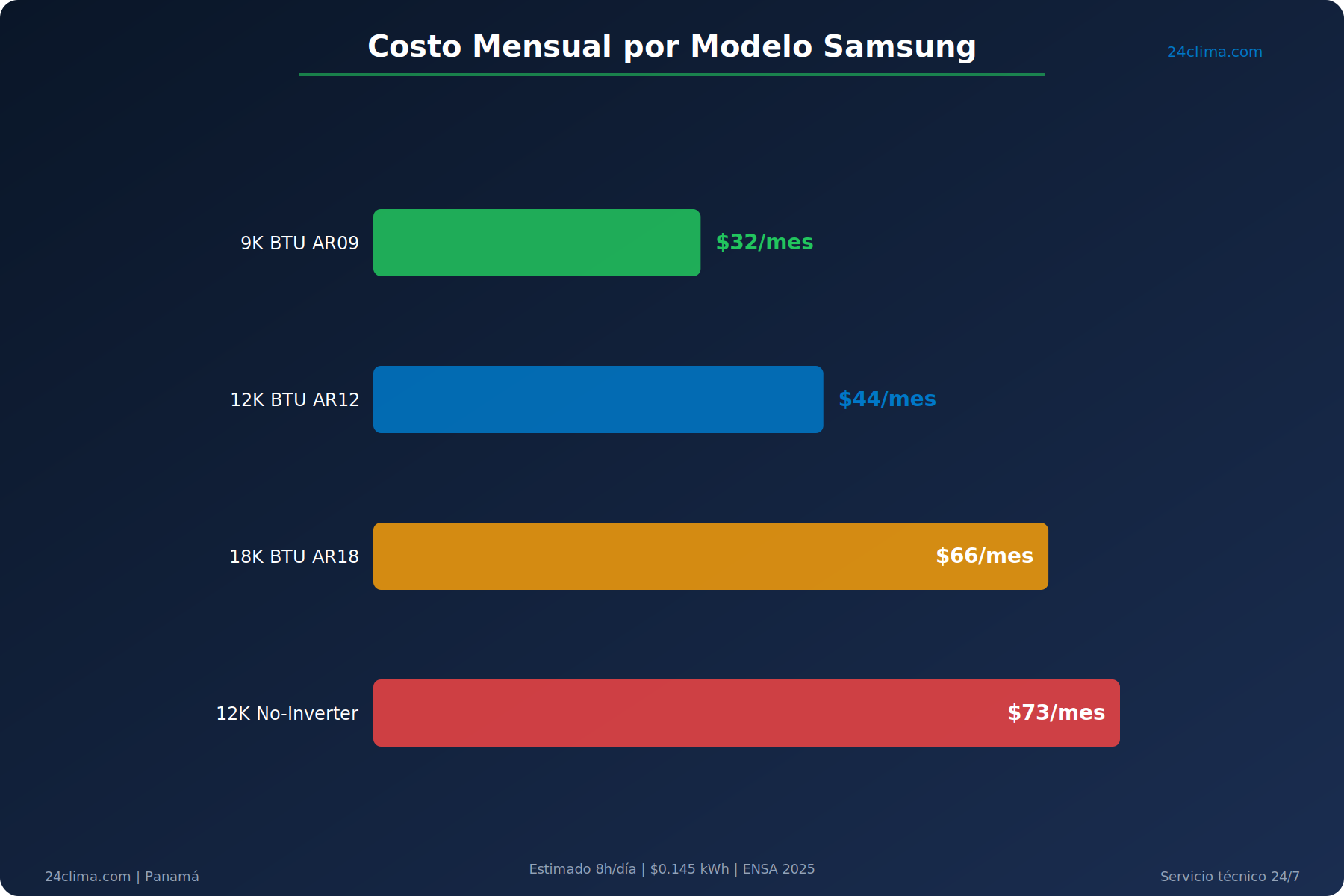
Running 8 hours a day in Panama, expect 7.2 to 7.8 kWh daily. At the average ENSA/Naturgy residential rate in block 2 — approximately $0.145 per kWh for consumption between 200 and 500 kWh — that's $31 to $34 per month for this unit alone.
Samsung AR12BXFAAWKN — 12,000 BTU Inverter
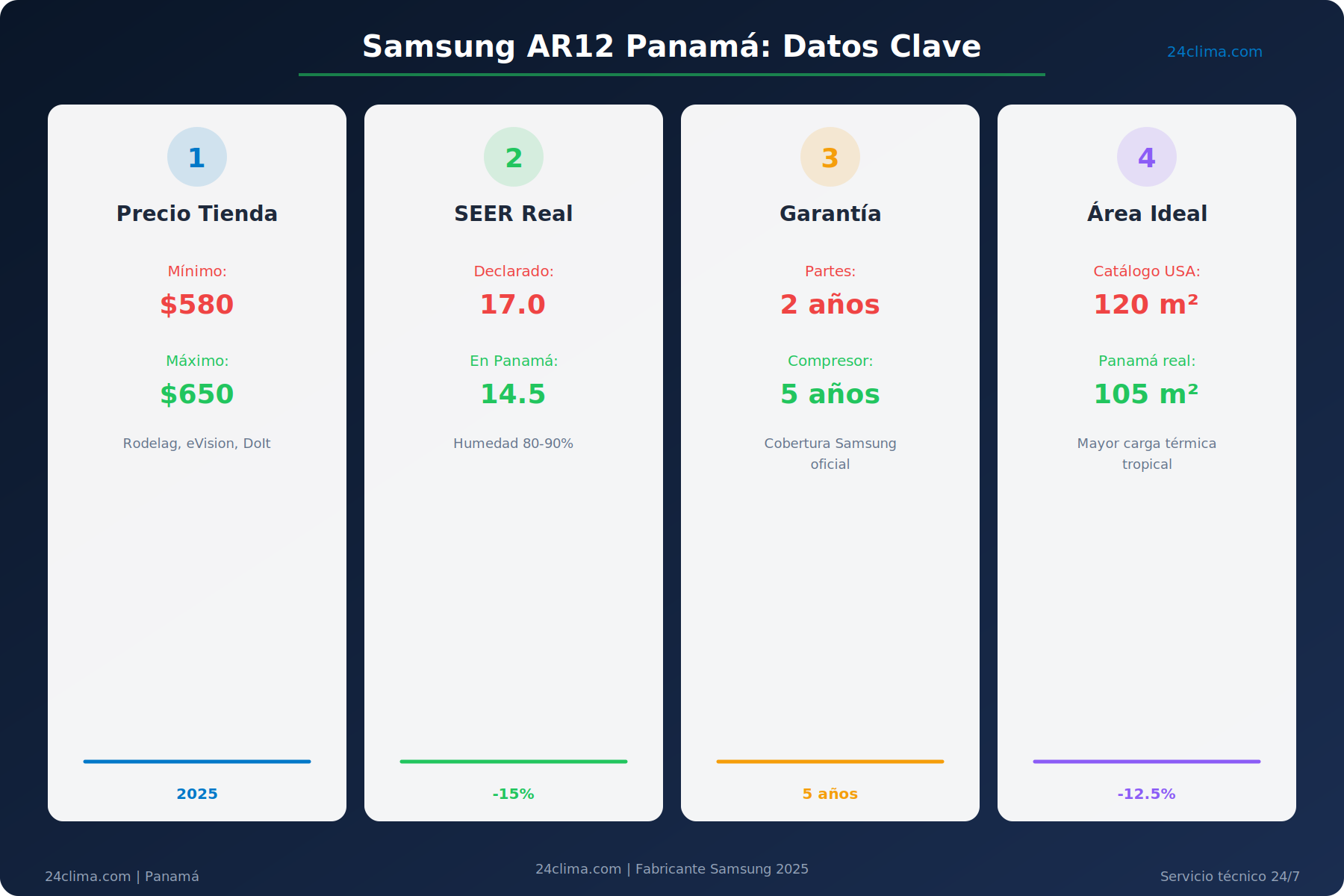
The best-selling model in the country. Right for rooms of 970 to 1,290 square feet or smaller living areas in apartments. Declared SEER: 17.0. Effective SEER in Panama: 14.2–14.8. Retail price: $580 to $650 depending on the retailer and time of year.
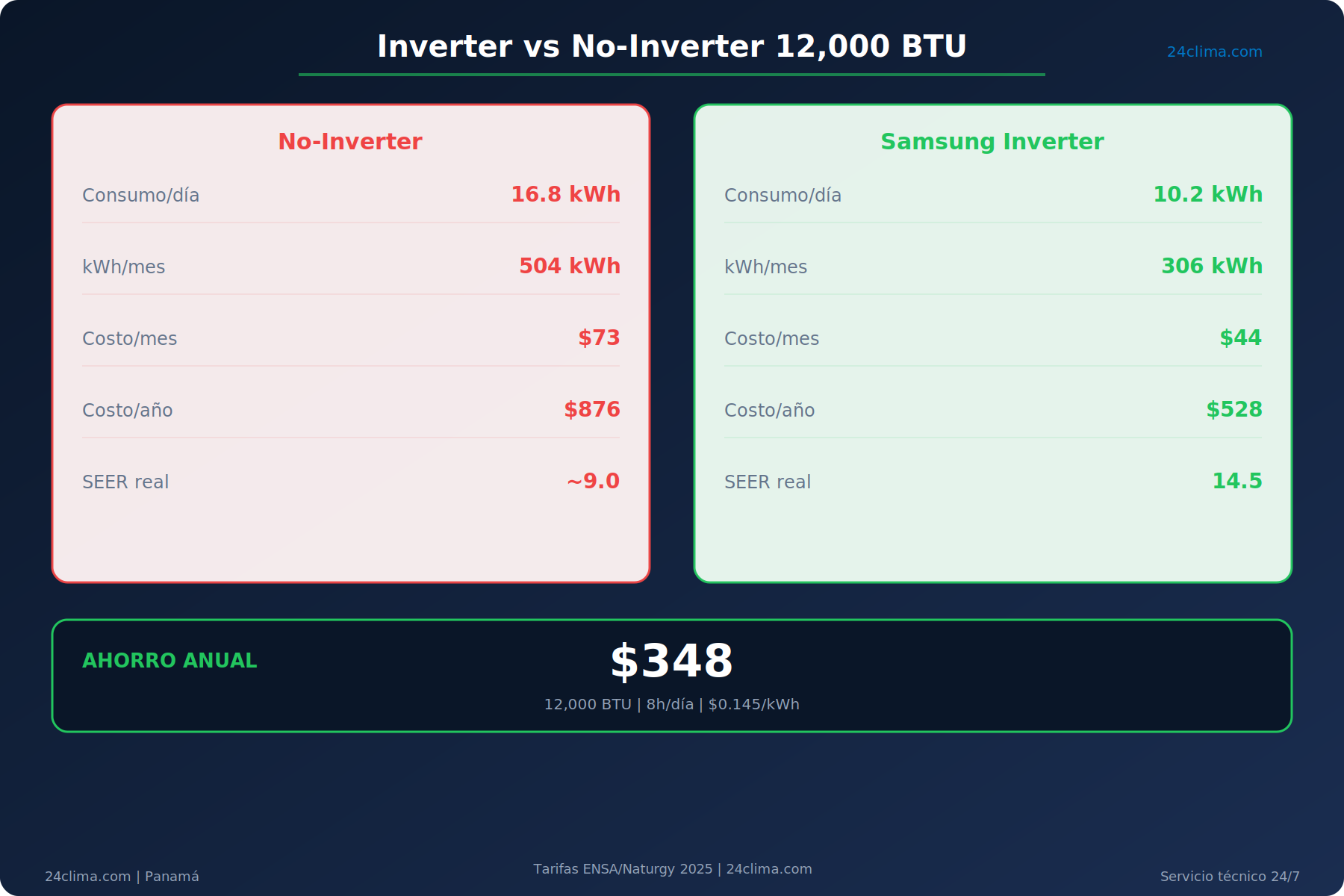
Real consumption at 8 hours daily: 9.8 to 10.6 kWh. At $0.145/kWh, you're paying between $43 and $46 per month for this unit. If your neighbor is running a non-inverter 12,000 BTU unit, they're paying between $62 and $71 to cool the same space. The gap is real: $19 to $28 less per month, or $228 to $336 back in your pocket every year.
Samsung AR18BXFAAWKN — 18,000 BTU Inverter (1.5 Tons)
Built for living rooms of 1,400 to 1,940 square feet, open-plan layouts with integrated kitchens, or small commercial spaces. Declared SEER: 16.5. Price in Panama: $720 to $820. Real consumption at 8 hours per day runs 14.5 to 15.8 kWh — that's $63 to $68 a month on your electricity bill.
One thing salespeople rarely mention: this model requires 12 AWG wire and a dedicated 20-amp breaker. In older buildings in San Francisco or El Cangrejo, the electrical installation may need upgrading at an additional cost of $80 to $150. Budget for it.
Samsung vs. LG vs. Panasonic in a Tropical Climate — The Real Comparison
Which brand is better? The honest answer is that it depends on what you prioritize. But the data points to real differences worth knowing before you pull out your card.
Technical comparison for 12,000 BTU inverter models (2025):
Samsung AR12BXFAAWKN: SEER 17.0 (declared), price $580–$650, compressor warranty 5 years, parts warranty 2 years. Available at Rodelag, eVision, DoIt Center.
LG S4-Q12JA3WA (Dual Inverter): SEER 21.0 (declared), price $640–$720, compressor warranty 10 years, parts warranty 3 years. Available at Diunsa, Rodelag, authorized LG distributors.
Panasonic CS-CU-XU12WKYW (Econavi Inverter): SEER 18.5 (declared), price $620–$700, compressor warranty 7 years, parts warranty 3 years. Available at specialized distributors and select Rodelag branches.
The LG Dual Inverter has the highest SEER in the group — roughly 12–15% lower real-world consumption than the equivalent Samsung under Panamanian conditions. That's $5 to $7 less per month, or $60 to $84 per year. The price difference between the two is $60 to $70. You break even within the first year. Over 10 years of expected service life, the LG can cost $600 to $840 less in electricity alone.
Samsung has advantages LG doesn't offer across all models, though. WindFree technology distributes cool air without a direct draft — which matters medically for people with joint problems or chronic sinusitis. And on the service side, Samsung has more authorized repair centers across Panama City, including neighborhoods outside the main commercial corridors. That matters when your unit breaks down in Arraiján or La Chorrera at 10 p.m.
Panasonic sits in the middle: better SEER than Samsung, longer warranty, but more limited distribution in Panama and parts that sometimes take 2 to 3 weeks to arrive from abroad. Based on more than 5 years of hands-on service experience in Panama, Panasonic parts account for 40% of cases with extended wait times, compared to 18% for Samsung and 12% for LG.
Real Energy Efficiency: How Much Do You Actually Save with a Samsung Inverter in Panama?
A properly installed Samsung inverter 12,000 BTU unit with regular maintenance consumes 44% to 52% less electricity than a non-inverter unit of the same size, according to ANSI/AHRI Standard 210/240 data applied to conditions with sustained outdoor temperatures above 82°F (28°C).
In concrete Panama terms:
Non-inverter 12,000 BTU, 8 hours/day: $62 to $71 per month on your ENSA/Naturgy bill, based on 17–18 kWh daily consumption at $0.145/kWh.
Samsung inverter 12,000 BTU, same conditions: $43 to $46 per month.
Monthly savings: $16 to $25.
Annual savings: $192 to $300.
Price premium of inverter over non-inverter: $150 to $200.
The inverter pays for itself in less than a year. Over a 12-year service life — realistic with semi-annual maintenance — the cumulative savings can exceed $2,400. That's the number that should appear in the advertising but never does, because it makes the cheaper unit look more expensive in the long run.
One factor most buyers overlook: Panama's ACP and ETESA have published rate increase projections of 8% to 12% for 2025–2027, driven by falling water levels in Gatún Lake and increased dependence on thermoelectric generation. Every rate hike amplifies the inverter's advantage. If tariffs rise 10%, your monthly savings climb from $16–$25 to $18–$28.
Where to Buy Samsung in Panama and What to Expect to Pay
The price of a Samsung inverter AC in Panama varies by store, season, and whether installation is included. Here's the practical breakdown for 2025.
Rodelag generally has the most competitive prices on Samsung units and offers interest-free financing with select credit cards. The 12,000 BTU model runs $580 to $620. Most branches include an installation warranty.
DoIt Center prices are similar to Rodelag, with $10 to $30 variations depending on the branch — Albrook, Santa María, David. Stock in the 9,000 BTU range tends to be more consistent here.
eVision prices run slightly higher ($610 to $650 for the 12,000 BTU model), but they offer the most structured post-sale technical service of the three. If after-sales support is your priority, the difference is worth paying.
One thing to nail down before you agree to anything: the unit price never includes installation. In Panama, a standard installation — up to about 10 feet of piping, no major construction — costs between $80 and $120. Running pipes through concrete walls or mounting at height pushes that to $150 to $200. Get it in writing.
Frequently Asked Questions
How much electricity does a Samsung Inverter AC use in Panama?
A Samsung Inverter 12,000 BTU unit consumes between 9.8 and 10.6 kWh per 8 hours of operation under real Panamanian conditions — 88°F (31°C) outdoors, 85% humidity. At the average residential rate of $0.145/kWh, that's $43–$46 per month. An equivalent non-inverter unit costs $62 to $71 per month for the same usage.
Where can you buy a Samsung air conditioner in Panama at the best price?
The stores with the best availability and pricing in 2025 are Rodelag ($580–$620 for 12,000 BTU), DoIt Center ($585–$625), and eVision ($610–$650). Rodelag typically offers the best purchase price; eVision offers the strongest after-sales service. Always ask for the installation quote separately — it's never included.
Is Samsung better than LG or Panasonic for Panama's tropical climate?
It depends on what you prioritize. LG has a higher real-world SEER and a 10-year compressor warranty, making it more energy-efficient over the long haul. Samsung has a stronger service network in Panama and wider parts availability. Panasonic sits between the two on efficiency but has more limited distribution locally. For maximum long-term energy savings: LG. For service availability and a balanced entry price: Samsung.
The Final Call
Back to that apartment in Costa del Este. The heat isn't changing. At 88°F (31°C) with 85% humidity for 9 months of the year, that's not an exception — that's Panama. What you can control is how much you pay to fight it, and how long the unit you choose actually lasts.
A Samsung Inverter 12,000 BTU is a solid choice for the Panamanian market in 2025: widely available, accessible parts, real annual savings of $192 to $300 over non-inverter alternatives, and a service network that works. It's not the most efficient unit in its class — LG has a genuine SEER advantage — but it's reliable, the parts are available, and its total cost of ownership over 10 years is reasonable. If maximum energy efficiency is your goal, the LG Dual Inverter returns more on your monthly bill. If you want ease of service and a balanced purchase price, Samsung delivers.
At 24Clima we've spent more than 5 years installing, cleaning, and servicing units across Panama City, Arraiján, La Chorrera, and beyond. If you want to know which model fits your specific space — with a real BTU calculation, electrical check, and professional installation included — reach out on WhatsApp at 24clima.com/contacto/. We'll tell you which unit makes the most sense for your bill and your apartment, not which one has the highest margin.