Split vs Portable AC: Which One Actually Makes Sense in Panama?
Last updated: June 2025
It's 2 PM in Costa del Este. The sun is hammering the concrete hard enough to make the horizon shimmer. Inside your 12th-floor apartment, the thermometer reads 91°F and the humidity feels like a wet towel pressed against your skin. You've been eyeing the same portable air conditioner at Novey for three weeks — $380, "easy setup, no installation required" — and you're about to pull out your card.
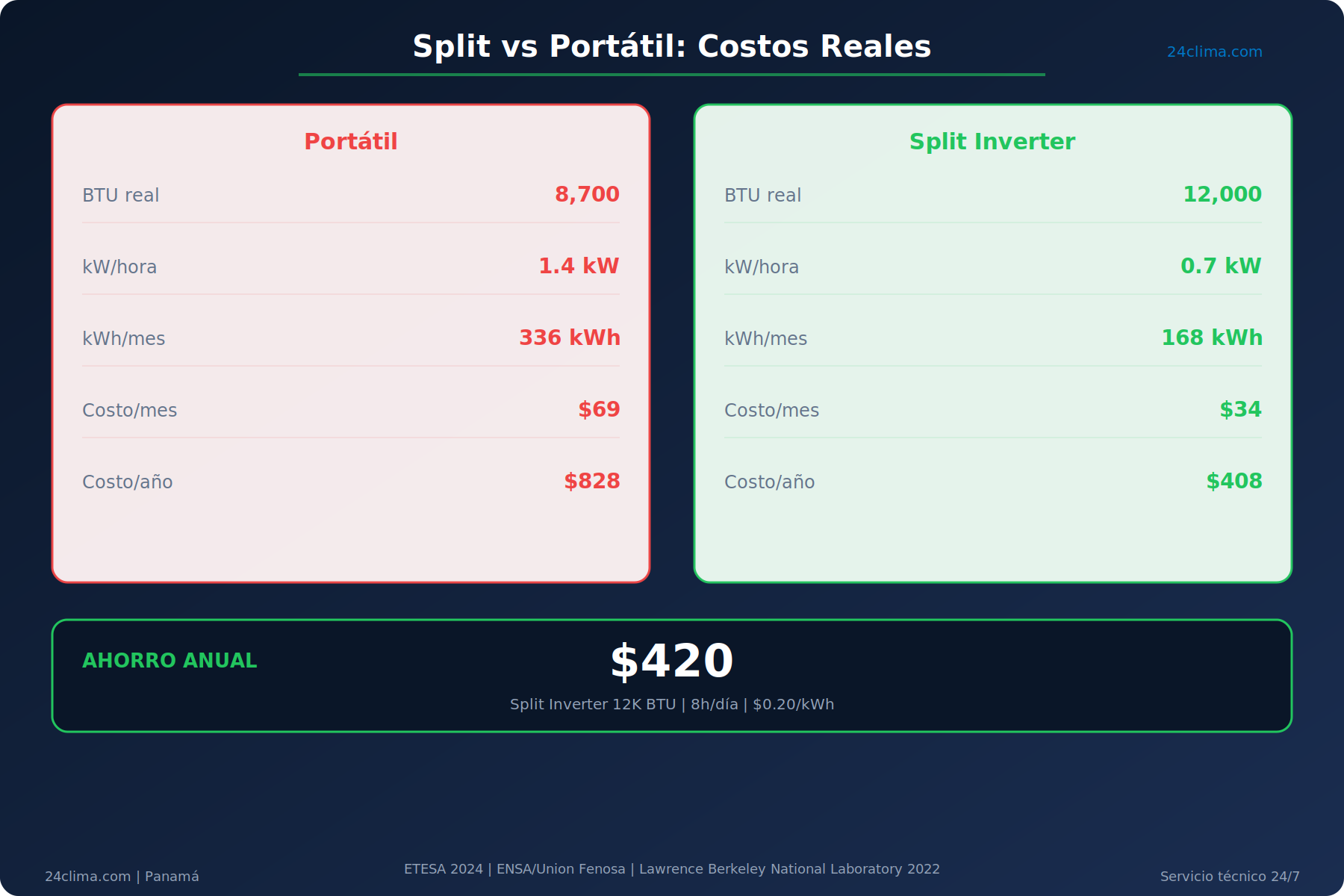
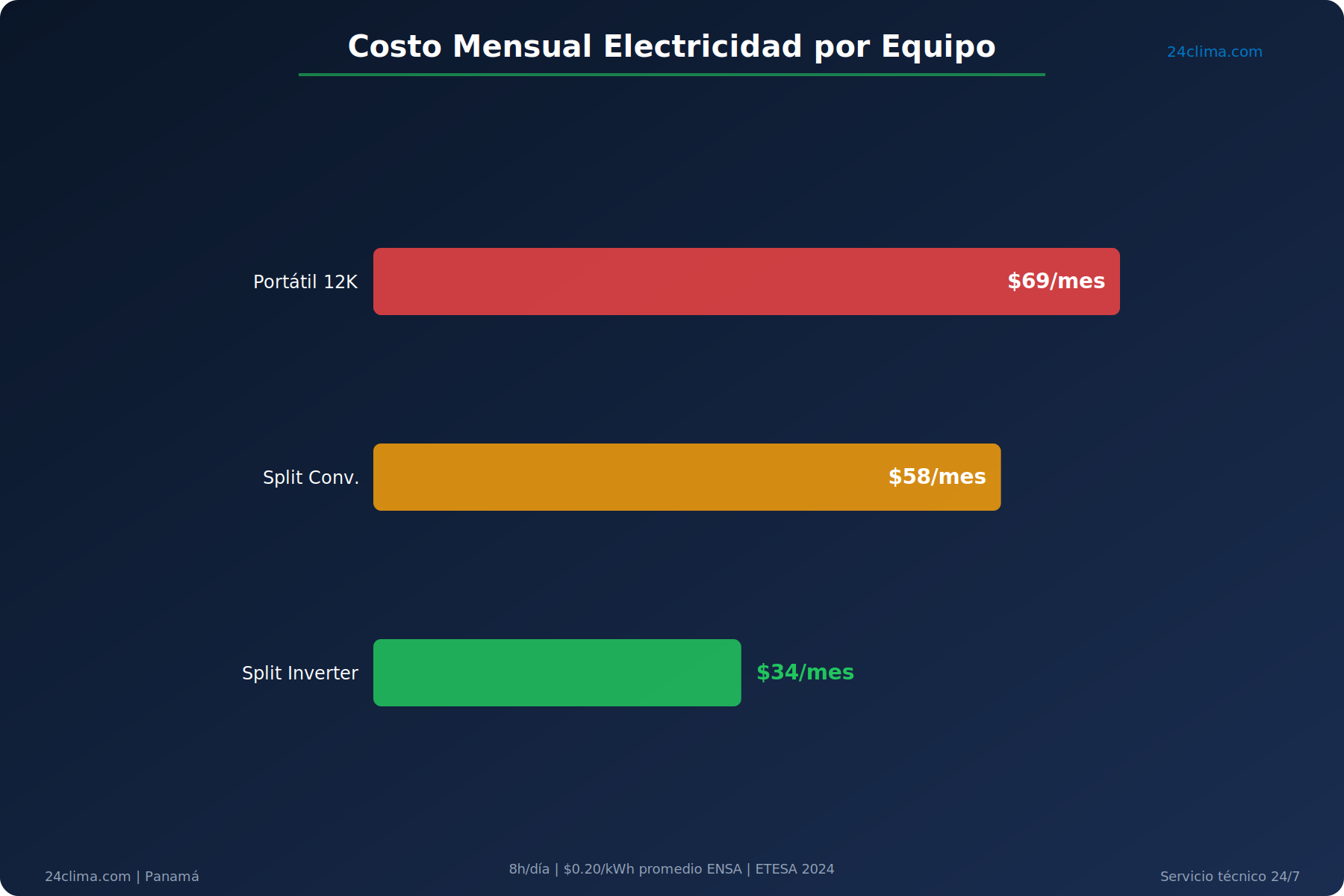
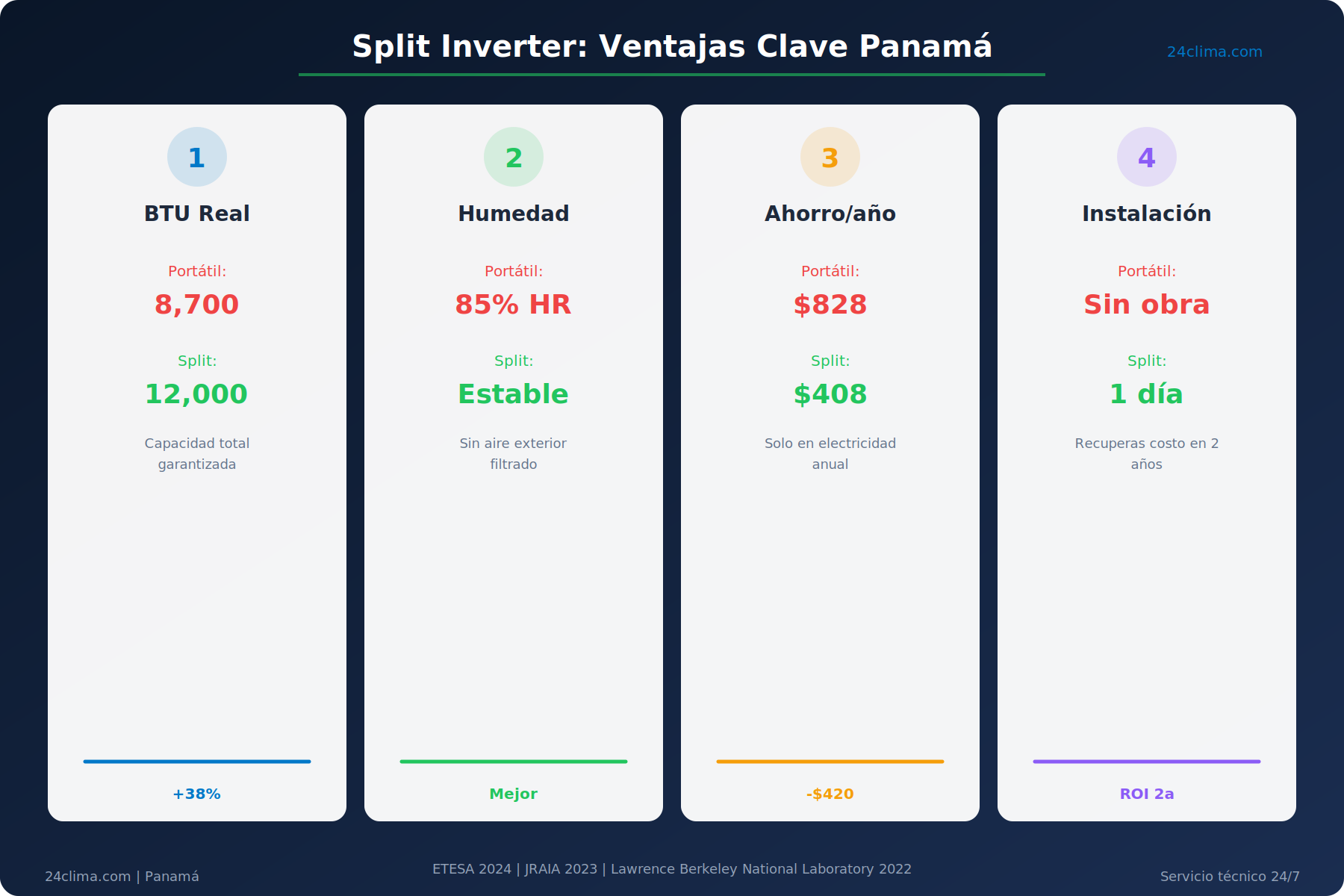
Stop for a second. There's something the sales staff won't tell you: in Panama, a portable AC doesn't perform the way the catalogs from the US or Europe suggest it will. Panama's tropical climate, with average humidity sitting around 85%, completely changes the math. What the label calls "12,000 BTU" actually delivers somewhere between 8,400 and 9,000 BTU of real cooling inside your space.
That doesn't mean a portable unit is never the right choice. It means you need to make that decision with accurate numbers — not the ones on the box.
What Most People Assume — And Why They're Wrong
The most common belief is that a portable AC is "basically the same as a split, just without the hassle." Same voltage, same BTU rating on the label, no permits, no technician — seems logical. But there's a physical difference that completely breaks that comparison in the tropics.
A split system expels heat outdoors through an external condenser unit. A portable unit, even with an exhaust hose, operates entirely inside the space it's trying to cool. Every time it pushes hot air out through the hose, it creates negative pressure — and that negative pressure pulls warm, humid outside air back in through gaps under doors, around window frames, and through any crack in the apartment. In Panama, where that outside air sits at 88°F (31°C) and 85% humidity, your portable AC is essentially fighting itself in a battle it can never quite win.
The result: higher electricity consumption, weaker cooling, and worse dehumidification. In a dry climate, that difference is manageable. Here, it's critical.
What a Split System Is and How It Performs in Panama's Climate
A split system has two units: the air handler mounted on the interior wall and the condenser mounted outside on a balcony or exterior wall. Refrigerant circulates between the two, pulling heat out of your space and releasing it outside. Interior and exterior air never mix, which means the unit holds its efficiency regardless of what's happening with the humidity outdoors.
In Panama, where outdoor temperatures average around 88°F (31°C) with 85% relative humidity according to ETESA (Empresa de Transmisión Eléctrica, S.A., 2024), a split system delivers its rated capacity because the condenser only needs to dissipate heat to the outside air — it doesn't depend on interior conditions to function.
A 12,000 BTU split delivers 12,000 BTU of real cooling. A 12,000 BTU portable delivers between 8,400 and 9,000 BTU under tropical conditions, according to the Air-Conditioning, Heating and Refrigeration Institute (AHRI), which in 2017 began requiring the SACC (Seasonally Adjusted Cooling Capacity) measurement specifically because nominal BTU ratings on portables were overstating real-world performance by up to 30% in high-humidity conditions.
Real Electricity Costs: The Numbers That Actually Matter Each Month
This is the part nobody wants to sit with — but it's the most important if you're paying between $0.19 and $0.22 per kWh to ENSA or Union Fenosa.
Two 12,000 BTU units running 8 hours a day in Panama:
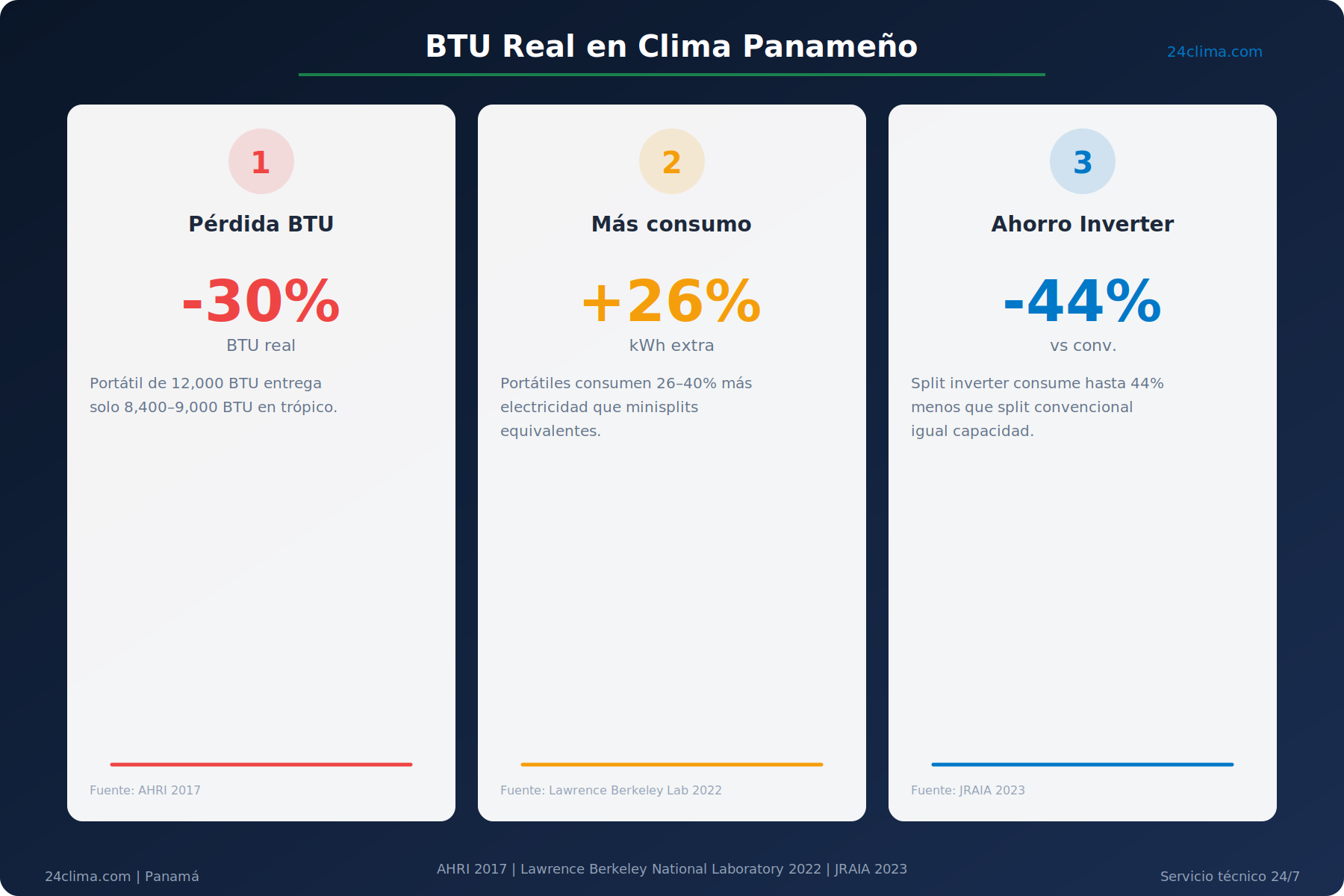
Standard (non-inverter) 12,000 BTU split: — Consumption: approximately 1.2 kW/hour — Monthly consumption: 288 kWh — Estimated monthly cost: $54 to $63
Inverter 12,000 BTU split: — Average consumption: 0.7 kW/hour (the inverter slows the compressor once target temperature is reached) — Monthly consumption: 168 kWh — Estimated monthly cost: $32 to $37
12,000 BTU portable (nominal rating) in Panama's climate: — Consumption: approximately 1.4 kW/hour (works harder to compensate for its own inefficiency) — Monthly consumption: 336 kWh — Estimated monthly cost: $64 to $74
The gap between a portable unit and an inverter split runs $27 to $37 per month — that's $324 to $444 in additional electricity costs over a year. Within two years, that difference pays for the split installation.
A residential energy consumption analysis published by Lawrence Berkeley National Laboratory (2022) found that portable units consume on average 26% more electricity than equivalent minisplits in high-humidity climates, with differences reaching 40% under extreme tropical conditions.
Inverter technology is worth understanding here. An inverter split doesn't run at constant speed — it adjusts compressor speed based on actual room temperature. In Panama's daily cycle, where solar gain is intense from 10 AM to 3 PM but eases off by late afternoon, that means the unit runs at full capacity when it needs to and around 40% capacity when it doesn't. That translates to up to 44% less electricity consumption compared to a conventional split of the same capacity, according to the Japan Refrigeration and Air Conditioning Industry Association (JRAIA, 2023).
Real Prices in the Panamanian Market
Current price ranges at local retailers — Novey, Rodelag, Do it Center — as of mid-2025:
12,000 BTU portable units: — Price range: $350 to $520 — Installation: $0 (self-contained) — Total upfront: $350 to $520
12,000 BTU standard split: — Equipment: $380 to $600 — Professional installation: $180 to $280 (includes mounting bracket, refrigerant lines, vacuum, and refrigerant charge) — Total upfront: $560 to $880
12,000 BTU inverter split: — Equipment: $550 to $900 — Professional installation: $180 to $280 — Total upfront: $730 to $1,180
The upfront gap is real. But when you run the 24-month calculation including electricity, the inverter split ends up being the cheapest of the three options. The portable — the one that looks most affordable on the Novey showroom floor — turns out to be the most expensive choice once Panama's real-world conditions enter the picture.
Which AC Makes Sense for Your Specific Situation?
There's no universal answer. There's only the right answer for your circumstances.
You're renting and the landlord won't allow permanent installation
This is the most common situation in rental apartments across San Francisco, Bella Vista, and El Cangrejo. A portable makes conditional sense here: use it while you look for a place that allows a split, or open the conversation with your landlord. Many owners in Panama will approve a split installation if the tenant covers the cost and agrees to patch and repaint the wall when they leave — which typically runs under $50.
You own your apartment or have permission for installation
There's no technical argument for choosing a portable. An inverter split recovers its additional upfront cost within 18 to 24 months through electricity savings, then puts $25 to $37 back in your pocket every single month for the rest of its lifespan — which runs 12 to 15 years with regular maintenance.
You need to cool a temporary or occasionally used space
A meeting room, a storage area, a workshop you use three times a week — a portable can be practical here. Move it where you need it, put it away when you don't. A permanent split installation for 8 hours of weekly use rarely makes financial sense.
Your budget is tight right now
Buy the portable knowing it's a temporary solution. Save the extra $30 or so per month you're not spending on installation, and in 12 months you have the budget for an inverter split. A deliberate transition beats paying inflated electricity bills for years because you never made the switch.
In our guides and tips section you'll find more resources to evaluate which system fits your space and budget before you commit.
Common Questions About Air Conditioning in Panama
Is a portable AC worth buying in Panama with 85% humidity?
At 85% humidity, a portable unit loses up to 30% of its nominal capacity because of the negative pressure it creates inside the room. The unit works harder to dehumidify and delivers less actual cooling. In practical terms: you stay warmer, you pay more, and the room never reaches the temperature the thermostat displays. Worth it only for temporary use or in situations where a split installation is genuinely not possible.
How much more electricity does a portable AC use compared to an inverter split?
Under Panama's conditions, a 12,000 BTU portable consumes between 168 and 200 kWh more per month than an equivalent inverter split. At $0.20 per kWh, that's $33 to $40 every month — or between $396 and $480 extra per year on your ENSA or Union Fenosa bill, simply because of which unit you chose.
What's the best AC type for a rental apartment in Panama?
If your landlord allows it, install an inverter split. It's the better long-term arrangement by any measure. If your lease restricts modifications, use a portable as a temporary solution and start the conversation with your landlord — many owners agree once they understand it adds value to the property. If you get the green light, professional installation is the step that can't be skipped: a poorly installed split loses 15 to 20% of its efficiency from day one.
A Note on Installation and Maintenance
The best equipment installed poorly is equipment that never works right. In Panama, it's common to find splits with long refrigerant lines that have no insulation, systems that were never properly evacuated, or units running with incorrect refrigerant charges. Each of those errors costs you 10% to 25% in efficiency from the very first day.
Ongoing maintenance matters just as much. Cleaning the filters, checking refrigerant levels, and servicing the condenser unit determines both how long the equipment lasts and what it costs you to run. A dirty split can consume up to 20% more electricity than a clean one, according to the Energy Star Program (EPA, 2023). You can learn more about the preventive maintenance service we offer at 24Clima.
Back to That 12th-Floor Apartment in Costa del Este
The portable unit you've been eyeing at Novey isn't the enemy. It's a tool designed for a different climate — one that in Panama works twice as hard to deliver less than it promises. The right decision comes down to your lease situation, your available upfront budget, and how long you plan to stay in that space.
If you can install an inverter split, do it. If you want help figuring out the right capacity for your room, whether installation is feasible in your building, or how many BTUs you actually need given your windows and sun exposure, the team at 24Clima will give you a straight answer with real Panama market numbers — no sales pitch, no call center in another country. Reach us on WhatsApp at https://24clima.com/contacto/ and you'll hear back within 24 hours from someone who actually knows what Panama's climate feels like.