Ceiling and Floor-to-Ceiling AC in Panama — What to Install and Why Nobody Tells You This Before You Buy
Two in the afternoon in Costa del Este. The asphalt is steaming. Humidity is sitting at 85% and the thermometer reads 33°C (91°F) in the shade. You walk into your commercial space, flip on the wall-mounted split you installed three years ago, and wait. Five minutes later, the corner where your customers are standing is still a sauna. The unit is running — but only the area directly in front of the evaporator is getting any relief. The rest of the space is suffering.
That's the problem nobody explains when you buy an air conditioner in Panama. The stores show you the BTU rating and the price. Nobody talks about airflow distribution, ceiling height, or whether a conventional split even makes sense in an 860-square-foot space with 11-foot ceilings.
If you're considering a floor-to-ceiling or cassette unit for your commercial space, large apartment, or office in Panama City, here's what the catalogs don't give you: the technical logic behind every decision. You can also browse our guides at https://24clima.com/consejos-y-guias/ for other climate control topics specific to Panama's tropical conditions.
What Most People Get Wrong
The most common assumption goes like this: "more BTU = colder air = better unit." If the space isn't cooling properly, the obvious fix seems to be adding capacity. Throw another 24,000 BTU split on the opposite wall and call it done.
That's not the real problem. The real problem is distribution.
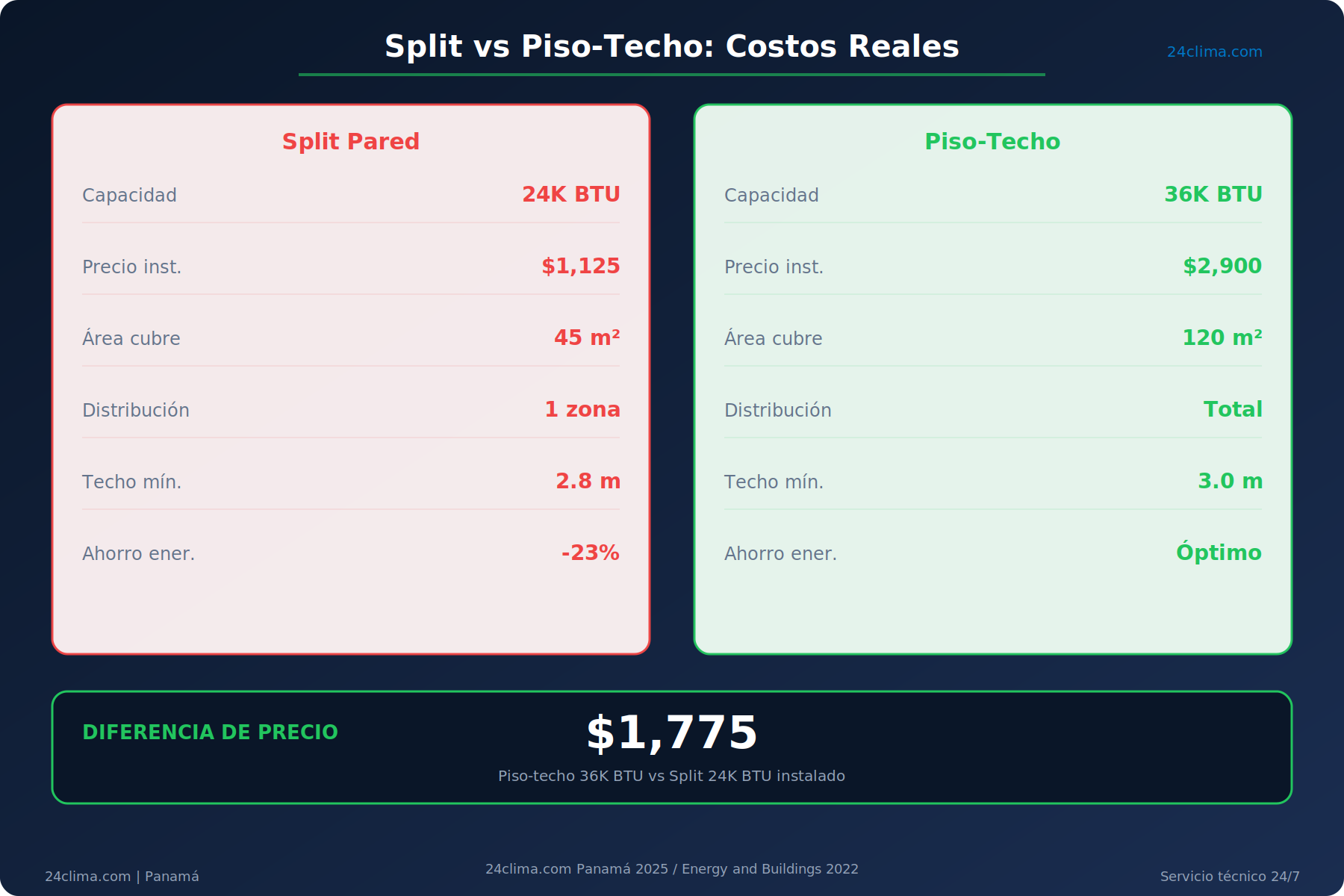
A conventional wall-mounted split projects air in a single horizontal direction at roughly 6.5 to 8 feet off the ground. In a rectangular space of 650 to 1,100 square feet with ceilings at 10 feet or higher — the norm in most commercial spaces in Marbella, San Francisco, or near Albrook Mall — that airflow pattern creates cold zones near the unit and warm zones far from it. The result: high electricity bills, uncomfortable customers, and compressors running flat-out without ever achieving even temperature.
A study published in Energy and Buildings (2022) confirmed that non-uniform air distribution in commercial spaces can create temperature differences of up to 4°C (7°F) between zones served by a single unit, pushing energy consumption up by as much as 23% compared to centralized distribution systems.
The equipment isn't the problem. Choosing the wrong type of equipment for the space is.
Floor-to-Ceiling vs Cassette vs Split: What Goes Where
The right decision comes down to three variables: square footage, ceiling height, and type of use — residential, commercial, or office. Here's the direct comparison.
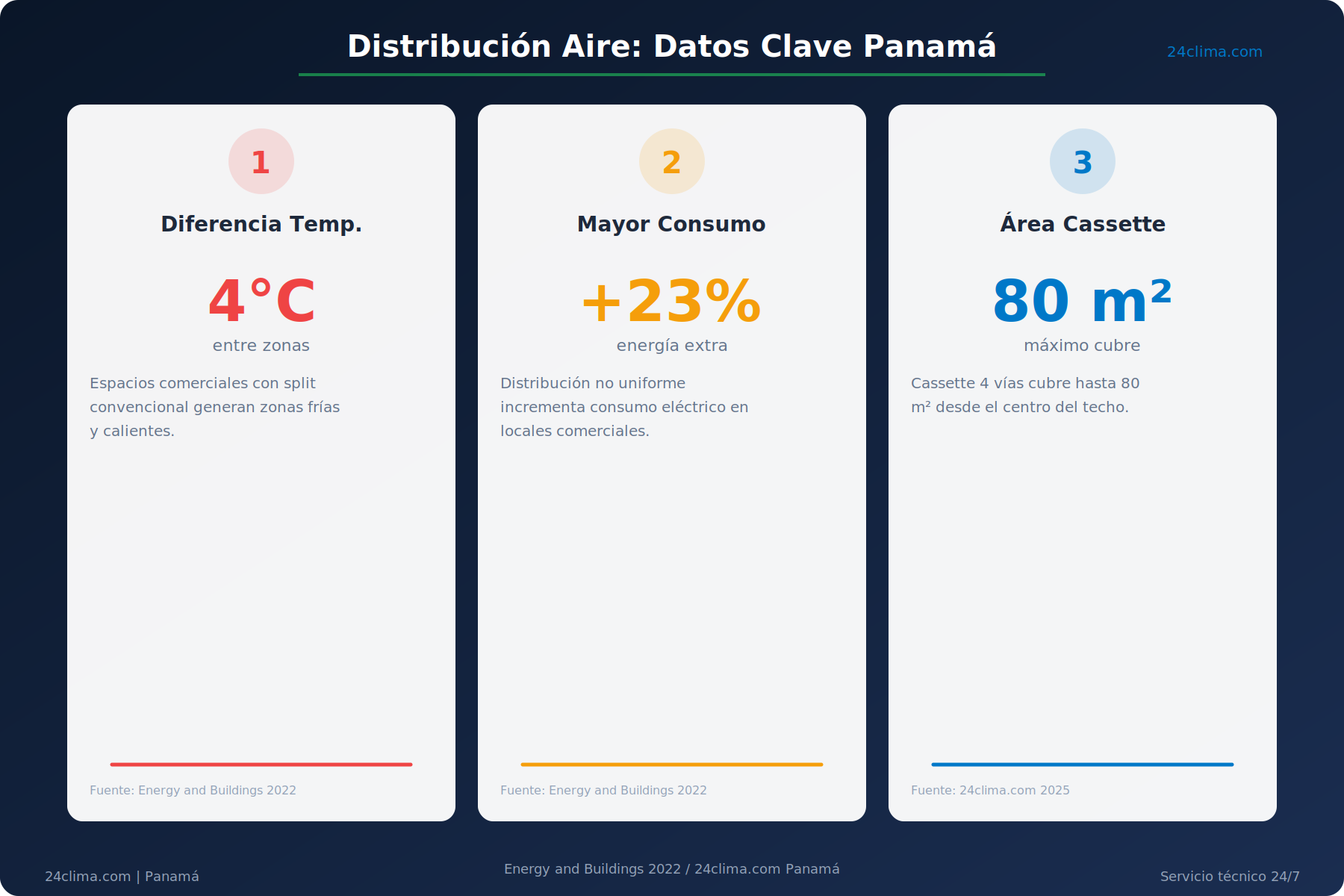
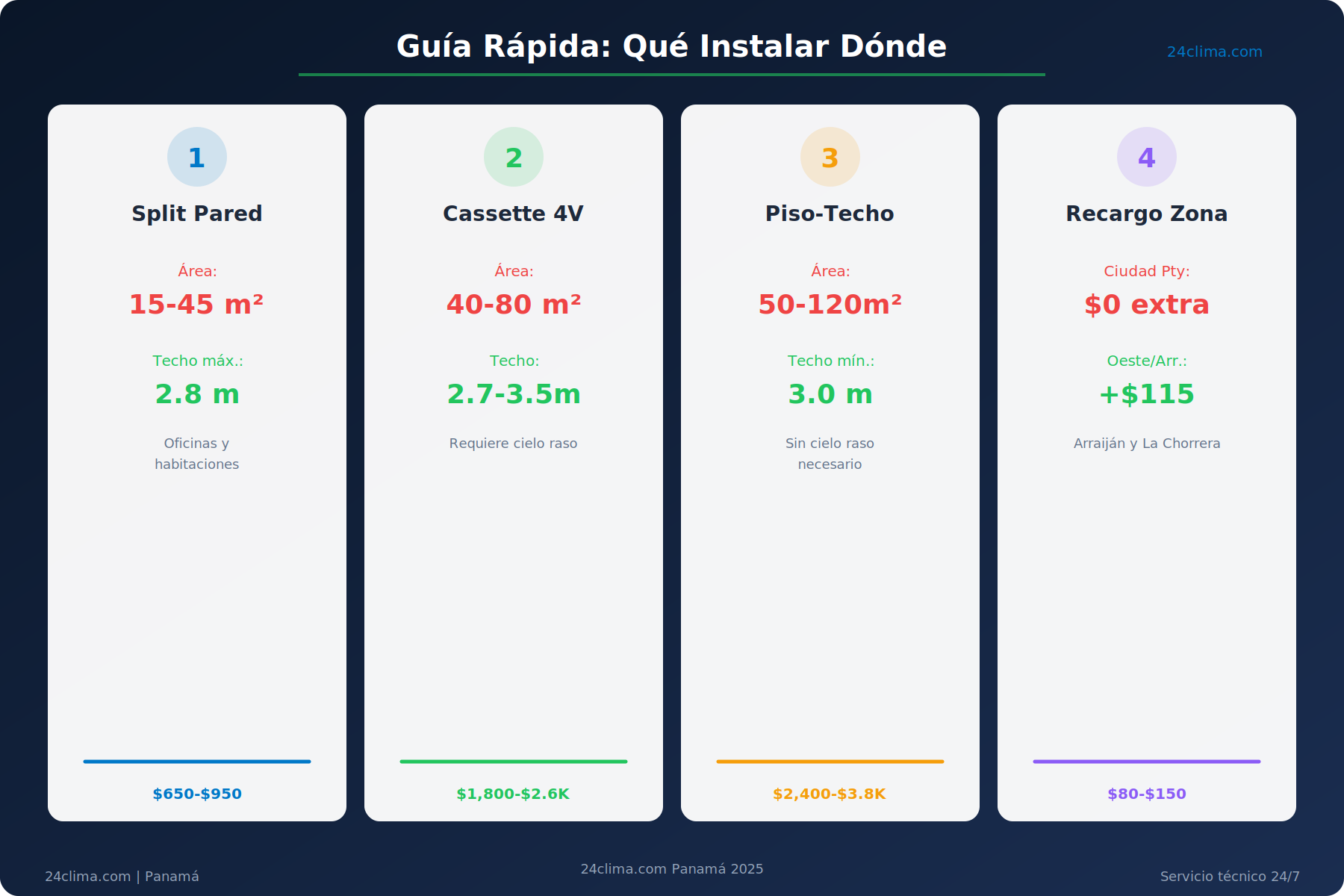
Conventional wall-mounted split — Recommended area: 160 to 480 sq ft — Ceiling height: up to 9 feet — Distribution: single horizontal direction — Installation: simplest and most affordable — Reference price in Panama 2025 (18,000 BTU): $650 to $950 installed — Best for: bedrooms, small offices, studio apartments
4-way ceiling cassette — Recommended area: 430 to 860 sq ft — Ceiling height: 9 to 11.5 feet (requires drop ceiling) — Distribution: four simultaneous directions from the center of the ceiling — Reference price in Panama 2025 (24,000 BTU): $1,800 to $2,600 installed — Best for: conference rooms, restaurants, mid-sized retail, penthouse-style apartments
Floor-to-ceiling unit (high wall) — Recommended area: 540 to 1,300 sq ft — Ceiling height: 10 feet or more, no drop ceiling required — Distribution: vertical or angled, covers the full height of the space — Reference price in Panama 2025 (36,000 BTU): $2,400 to $3,800 installed — Best for: commercial spaces, showrooms, restaurants with exposed ceilings, light industrial spaces, open-plan apartments
The key difference between a floor-to-ceiling unit and a cassette isn't just aesthetic. A cassette requires a drop ceiling because the evaporator is recessed into it. A floor-to-ceiling unit mounts on the upper wall or at floor level and works fine in exposed concrete or metal ceiling spaces — which is exactly what you find across Panama City's commercial corridors.
Reference Price Table — Panama 2025
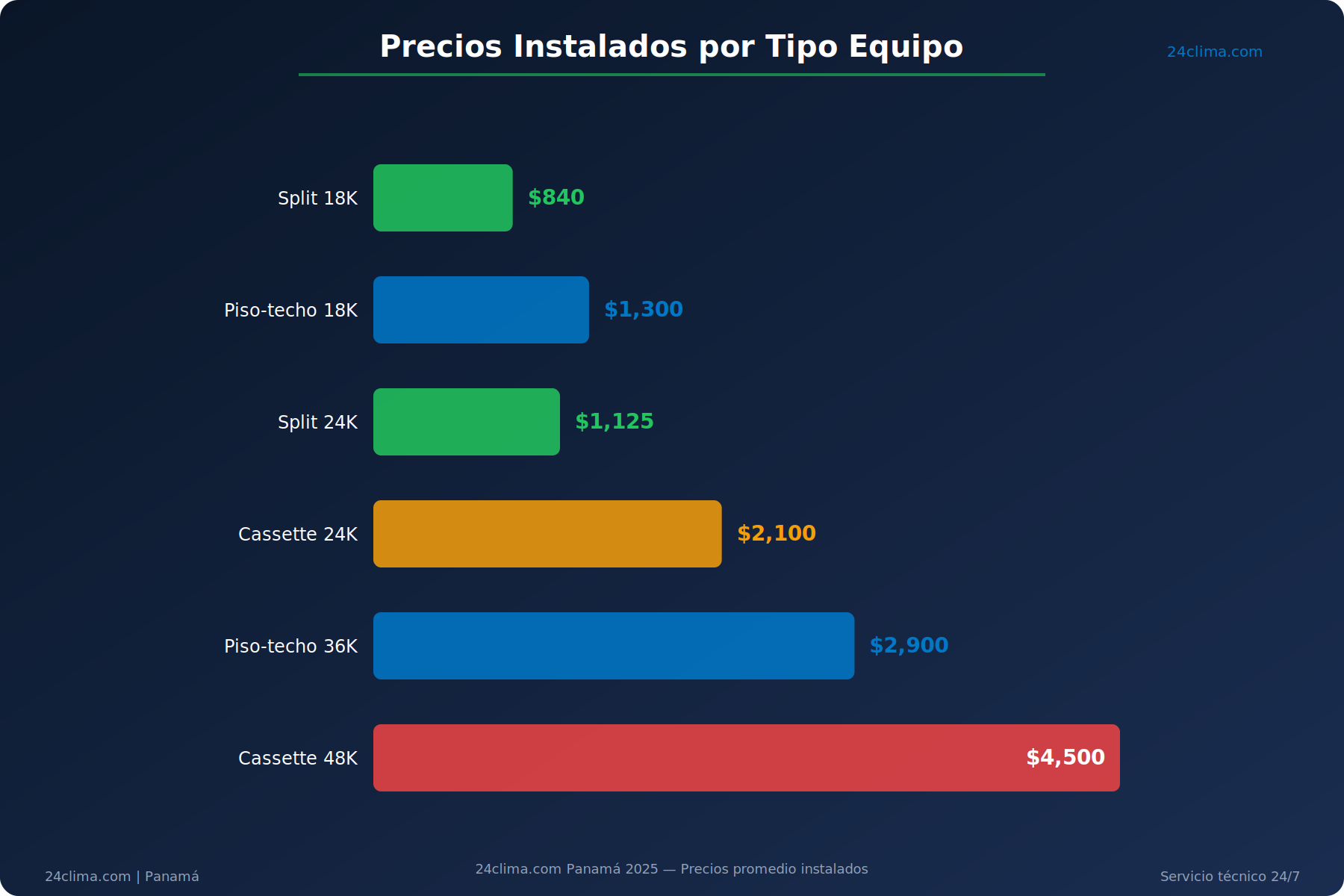
Prices below include equipment and standard installation. They do not include pipe runs exceeding 16 feet or specialized masonry work.
Capacity / Type / Approximate installed price
18,000 BTU — Wall split inverter — $700 to $980 18,000 BTU — Floor-to-ceiling — $1,100 to $1,500 24,000 BTU — Wall split inverter — $950 to $1,300 24,000 BTU — 4-way cassette — $1,800 to $2,400 36,000 BTU — Floor-to-ceiling inverter — $2,400 to $3,400 36,000 BTU — 4-way cassette — $2,600 to $3,600 48,000 BTU — Floor-to-ceiling inverter — $3,500 to $4,800 48,000 BTU — 4-way cassette — $3,800 to $5,200
Note: prices include basic labor in Panama City. For Panama Oeste, Arraiján, or La Chorrera, an additional travel charge of $80 to $150 may apply.
What System Do I Need: A Decision Framework
Answer these four questions in order and you'll land on the right answer.
1️⃣ What is the square footage of the space? Under 480 sq ft → conventional wall split (12,000 to 24,000 BTU) Between 480 and 860 sq ft → cassette or floor-to-ceiling (24,000 to 36,000 BTU) Over 860 sq ft → floor-to-ceiling or multi-split system (36,000 to 48,000 BTU)
2️⃣ Does the space have a removable drop ceiling? Yes → cassette is a viable option No → floor-to-ceiling is the right choice
3️⃣ What is the ceiling height? Up to 9 ft → wall-mounted split works fine Between 10 and 13 ft → floor-to-ceiling with vertical distribution Over 13 ft → industrial floor-to-ceiling or ducted system
4️⃣ Is the use residential or commercial? Residential (open-plan, combined living and dining area) → cassette or floor-to-ceiling Commercial (retail, restaurant, open-plan office) → floor-to-ceiling with inverter to control consumption
In Panama, commercial spaces with ceilings at 11 feet or higher — the norm in areas like Vía España, El Cangrejo, and the Transistmica corridor — almost always do better with a floor-to-ceiling unit than a cassette, precisely because they lack drop ceilings and the air needs to travel vertically through the full column of the space.
Brands Available in the Panamanian Market — What You Actually Need to Know
The four brands with the strongest presence in the floor-to-ceiling and cassette segment in Panama are LG, Panasonic, Carrier, and Midea. Here's what matters for your decision, without the sales pitch.
LG — Offers inverter technology in its ART COOL and ARTCOOL Mirror floor-to-ceiling lines — Its Dual Inverter compressor carries a 10-year warranty on select models — SEER ratings up to 22 on its most efficient lines — Available through Rodelag and certified LG distributors in Panama — Average price on 36,000 BTU units: $2,800 to $3,600 installed
Panasonic — Known for holding up in tropical climates; coastal-use units include anti-corrosion protection on the condenser — The CS-E18RKUAW line and similar floor-to-ceiling series carry high SCOP ratings for tropical conditions — The go-to choice for spaces near the Pacific or Atlantic coast where salt air eats through unprotected components — Average price on 36,000 BTU units: $2,600 to $3,400 installed
Carrier — The brand with the longest track record in commercial systems in Panama — Their cassette and floor-to-ceiling units in the 40GXQ line are the most commonly specified in corporate projects and hotels — The most established local technical support for large installations — Average price on 36,000 BTU units: $3,000 to $4,000 installed
Midea — The best price-to-performance ratio in the entry segment — Their inverter floor-to-ceiling units from 18,000 to 36,000 BTU compete on efficiency with premium brands at a lower cost — Available at Novey and independent distributors across Panama City — Average price on 36,000 BTU units: $1,900 to $2,600 installed
According to regional HVAC market data (AHRI 2024), inverter systems in the 24,000 to 48,000 BTU range consume between 35% and 44% less electricity than their fixed-speed equivalents. At Panama's commercial electricity rates averaging $0.18 per kWh (ASEP 2024), that gap translates to $60 to $120 per month in savings for a high-use commercial space — and the higher upfront cost of an inverter unit typically pays for itself within 18 to 30 months through electricity savings alone.
For more on the preventive maintenance that protects your investment long-term, see our maintenance service at https://24clima.com/servicios/mantenimiento/.
Frequently Asked Questions About Ceiling AC Units in Panama
When does a floor-to-ceiling AC make more sense than a standard split in Panama?
A floor-to-ceiling unit makes sense when the space exceeds 540 square feet, has ceilings at 10 feet or higher, and lacks the drop ceiling needed for a cassette installation. In Panamanian commercial spaces with exposed ceilings — common in areas like Marbella, El Dorado, and the Transistmica corridor — a floor-to-ceiling unit pushes air vertically throughout the full height of the space, eliminating the hot spots that a conventional wall split leaves behind. It's also the right call for open-plan apartments where the living room and kitchen share one continuous space.
How much does it cost to install a ceiling AC unit in Panama in 2025?
Cost depends on type and capacity. A 24,000 BTU cassette installed runs between $1,800 and $2,400. A 36,000 BTU inverter floor-to-ceiling unit runs approximately $2,400 to $3,400. These prices include equipment and basic labor in Panama City. Additional work — extended pipe runs, custom drainage, or three-phase electrical installation — is quoted separately and can add $200 to $600 depending on the project.
Which brands offer the best floor-to-ceiling units for Panama's tropical climate?
For Panama's conditions — sustained heat, humidity between 75% and 90%, and coastal salt air in some locations — Panasonic and LG lead in durability and efficiency. Carrier is the strongest option for large commercial projects where local technical support matters. Midea is the most budget-friendly alternative with solid performance for moderate-use commercial spaces. All four offer inverter models in the 18,000 to 48,000 BTU range, which are the recommended choice for intensive use in Panama.
Back to That Space in Costa del Este
That Costa del Este commercial space with the wall split that won't cool 860 square feet isn't failing because it's a bad unit. It's failing because it was designed for a different space.
Swap it for a 36,000 BTU inverter floor-to-ceiling unit mounted on the upper wall — projecting air vertically across 10.5 feet of ceiling height — and that same space cools evenly, electricity costs drop by $50 to $90 per month, and customers stop migrating toward whichever corner happens to feel slightly less like a greenhouse.
The right decision doesn't start with a catalog. It starts with measuring the space, understanding the ceiling, and knowing how the space actually gets used.
At 24Clima, we evaluate your space before recommending any equipment. If you have questions about what system to install in your commercial space, office, or apartment in Panama, contact us on WhatsApp at https://24clima.com/contacto/ and a technician will respond with a specific recommendation — not a brochure.
Last updated: May 2025