How to Clean an Air Conditioner Without Taking It Apart — A Step-by-Step Guide for Panama
Last updated: May 2025
It's 2 in the afternoon in San Francisco, Panama City. The sun hammers straight down on the concrete, the thermometer reads 33°C (91°F), and the humidity feels like a wet towel pressed against your skin. You walk through the door, flip on the split unit, and wait for that blast of cold air that should hit you within seconds. Instead, you get a lukewarm puff. With a strange smell. Something like damp and stale air trapped in a box.
The unit probably isn't broken. In most cases, the problem is simpler — and dirtier — than you think. The filter is saturated. The evaporator coil has a layer of dust fused with mold. The condensate tray is pooling stagnant water. Together, those three problems turn your AC into a fan that circulates bad air instead of cooling it.
The good news: you can handle 80% of a residential split unit's cleaning yourself, without disassembling anything, without special tools, and without being a certified technician. This guide — written specifically for Panama's real tropical conditions — tells you exactly how.
What Most Homeowners Get Wrong
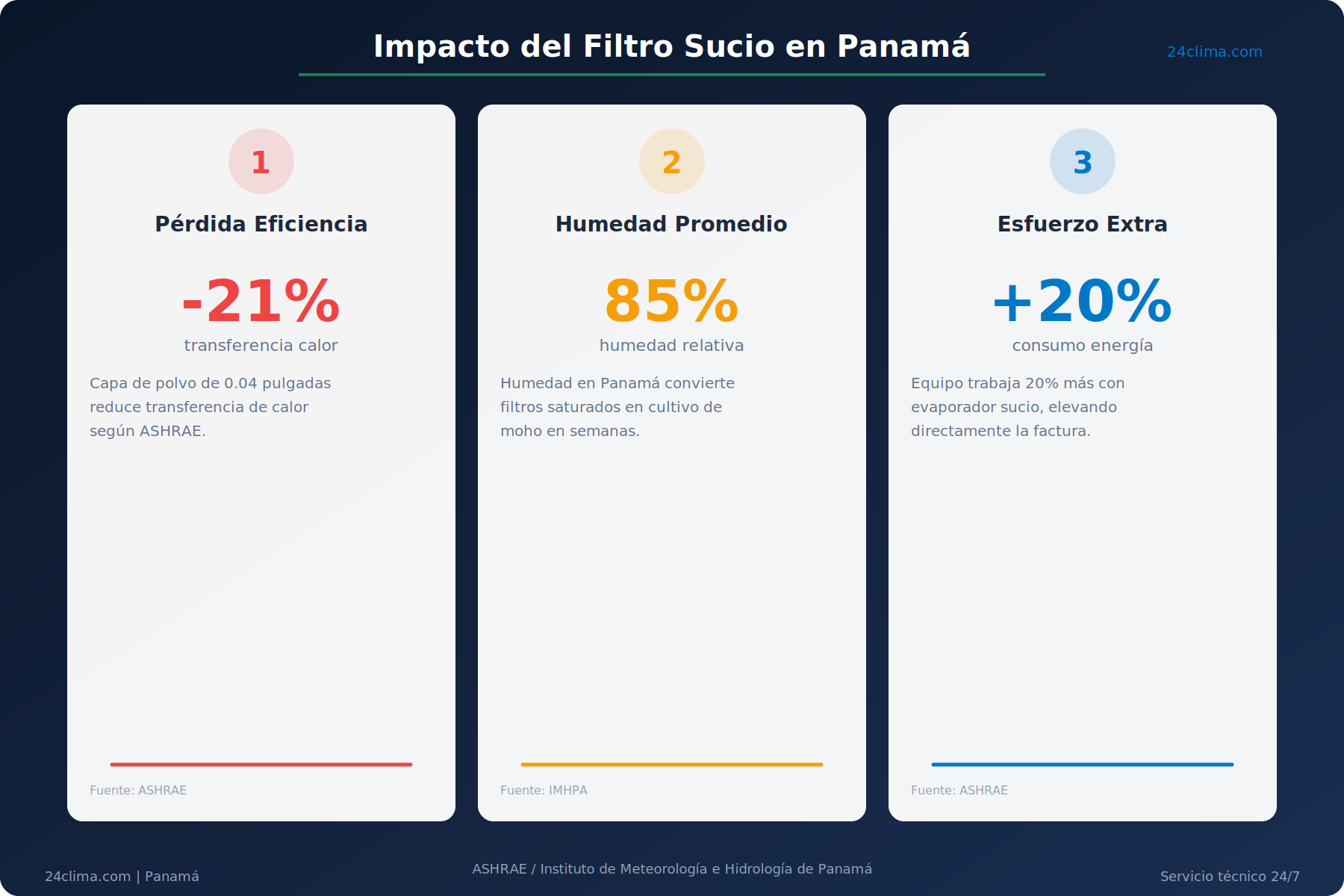
There's a widespread assumption that AC units clean themselves because they have filters. They don't. Filters trap particles — they don't self-clean. Over time, that dust layer acts like a sponge holding moisture, and in Panama — where average humidity runs at 85% according to the Instituto de Meteorología e Hidrología de Panamá — that sponge becomes a mold colony within weeks.
Another common belief: if the unit is still cooling, it must be fine. Not quite. A study by the American Society of Heating, Refrigerating and Air-Conditioning Engineers (ASHRAE) documented that just 0.04 inches of dust buildup on an evaporator coil reduces heat transfer efficiency by 21%. Your unit can keep cooling while running 20% harder — and that extra effort shows up directly on your electricity bill.
The third myth: deep cleaning requires a technician. There's a grain of truth here. Complete disassembly of the evaporator or cleaning the outdoor compressor coil is professional territory. But preventive cleaning of the filters, housing, deflectors, and condensate tray is something you can and should do yourself, regularly.
For more resources on preventive maintenance in tropical climates, check out our guides and tips at 24clima — but read on first, because this page walks you through the full DIY process you can start today.
Tools You Need (All Available in Panama)
Four items. Nothing imported, nothing expensive. Everything on this list is available at SuperFarma, Do It Center, or any neighborhood hardware store.
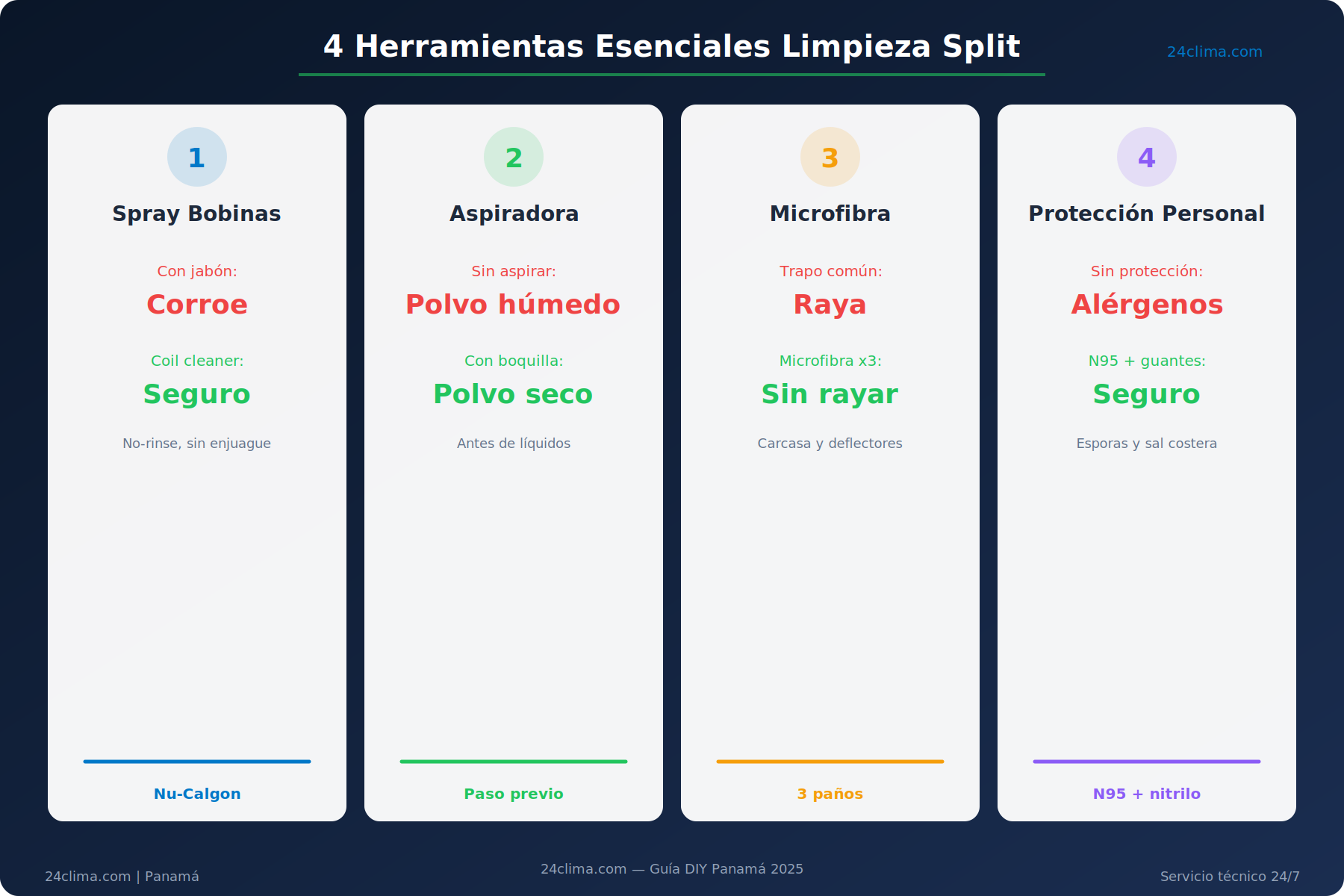
— No-rinse coil cleaner spray: products like Nu-Calgon Evap Foam No Rinse or local equivalents work well. Don't substitute dish soap — conventional detergents corrode the aluminum fins on the evaporator coil.
— Vacuum with a narrow attachment, or a compressed air gun: to remove dry dust before applying any liquid.
— Microfiber cloths (at least 3): one dry for the housing, one damp for the deflectors, one for drying.
— Antibacterial spray or a 10% white vinegar solution: for the condensate tray and to kill early-stage mold growth.
— Nitrile gloves and an N95 mask: filter dust contains allergens, mold spores, and — in coastal areas like Punta Pacífica — corrosive salt particles.
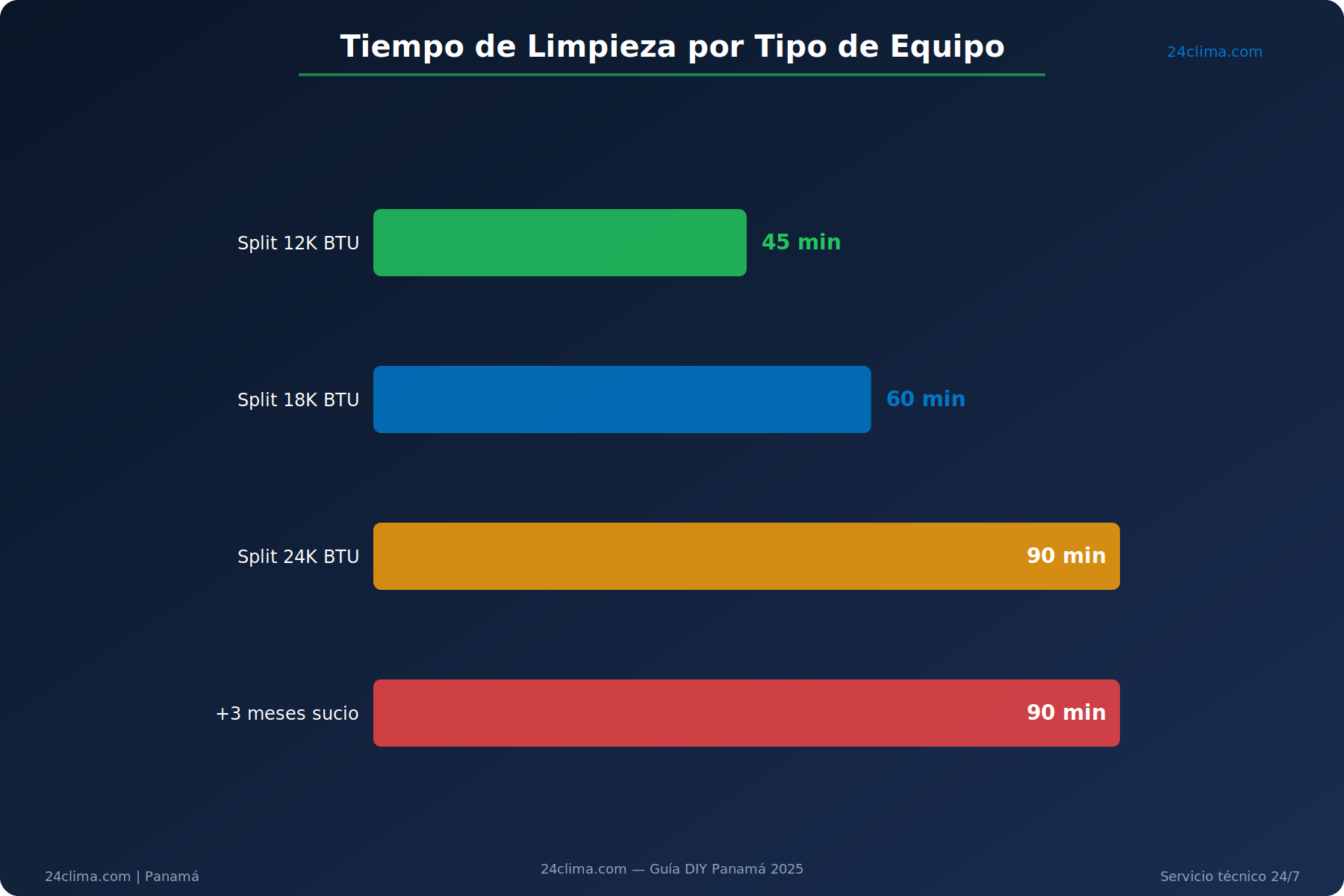
The whole process takes 45 to 60 minutes on a standard 12,000 to 18,000 BTU unit. If yours is larger than 24,000 BTU or hasn't been cleaned in more than three months, budget 90 minutes.
Step by Step: Full Cleaning Without Disassembly
Step 1: Turn Off the Unit and Kill the Power
Before touching any part of the air conditioner, turn the unit off from the remote, then go to your breaker panel and cut the dedicated AC circuit. This is not optional. Internal electrical components operate at 110V to 220V depending on your unit's capacity.
Turn off from the remote and wait 5 minutes for the fan to stop completely. Find the dedicated AC breaker — usually labeled "AC" or "Split" on your panel. Leave a note or signal at the panel so no one reactivates it while you're working.
Step 2: Clean the Filters — The Most Important Part
The filters on a split unit are the first line of defense and the component that clogs fastest in Panama's climate. To access them: open the front panel of the indoor unit by lifting it from the bottom edge — almost every residential model from LG, Midea, Carrier, and Daikin uses the same top-hinge design. The mesh filters will slide out toward you.
Remove the filters carefully. If they're heavily loaded with dust, slide them straight into a plastic bag to avoid dispersing particles into the room. Take them to a bathroom or outdoor area and rinse with cold water at moderate pressure — never hot water, which can warp the mesh. If you can see grease or visible mold, apply a drop of neutral dish soap, scrub gently with an old toothbrush, and rinse completely. Let them air dry in the shade for at least 30 minutes. Never reinstall a damp filter — residual moisture accelerates mold growth directly on the evaporator coil.
A clean filter versus a clogged one doesn't just affect air quality — it directly affects what you pay ENSA or Naturgy at the end of the month. According to Panama's Autoridad Nacional de los Servicios Públicos (ASEP), air conditioning accounts for 50% to 65% of electricity consumption in Panamanian households. A dirty filter can push that consumption up 10% to 15% per month — in a home with three split units, that's $15 to $25 extra on your bill every single month, just because the filters are clogged.
Step 3: Clean the Evaporator Coil With a Coil Spray
The evaporator coil is those thin aluminum fins visible behind the filter — stacked at an angle, packed closely together. This is where the actual cooling happens. In Panama, the combination of ultrafine dust and constant humidity forms a gray-green film over those fins that dramatically reduces heat transfer.
Using the vacuum with the narrow attachment, pass gently over the fins to remove loose dust. Never press hard — the fins bend easily, and a bent fin blocks airflow. Apply the no-rinse coil cleaner spray in smooth horizontal passes, covering the entire visible surface. The foam activates on contact and carries the dirt downward into the condensate tray — nothing more needed. Wait 10 to 15 minutes. If the smell was strong — mold or trapped humidity — apply a second coat.
Don't pressure-wash the evaporator coil directly unless you're trained to do so. The risk of bending fins or soaking adjacent electrical components is real.
Step 4: Clean the Housing and Deflectors
The deflectors — the plastic louvers that direct airflow — collect surface dust that also restricts air delivery. With a slightly damp microfiber cloth, wipe each deflector from the inside out. For tight gaps, a cotton swab works perfectly.
The outer housing of the indoor unit deserves the same attention. Use a dry microfiber cloth for dust, a damp one for stains. Skip alcohol-based products directly on plastic — over time they dry out and crack the surface.
Step 5: Treat the Condensate Tray
The condensate tray collects the water the unit pulls out of the air. In Panama, with 85% average humidity, that tray holds water continuously — and standing water is the ideal environment for bacteria and mold.
If you can see the tray visually (it sits below the evaporator coil), pour in a 10% white vinegar solution or apply the antibacterial spray directly. Let it sit for 5 minutes, then wipe clean with a cloth. Check that the drain line isn't blocked — a clogged drain causes the indoor unit to drip water into the room, a common problem in units that haven't been serviced in 18 months or more.
How Often Should You Clean by Zone in Panama?
The standard cleaning interval in manufacturer manuals is every 90 days. That recommendation was designed for temperate climates like northern Europe or the northern United States, where average humidity runs 40% to 60%. Panama's equation is completely different.
Costa del Este, Punta Pacífica, Balboa — sea breeze plus airborne salt plus high humidity — clean every 30 days.
San Francisco, Miraflores, El Dorado — dense urban environment, traffic, dust — every 35 to 40 days.
Clayton, Albrook, Ancón — more vegetation, plant spores, high humidity — every 30 to 35 days.
Arraiján, La Chorrera, peri-urban areas — construction dust plus variable humidity — every 30 to 40 days.
Mountain areas (Boquete, El Valle) — cooler but extreme humidity and heavy mold — every 25 to 30 days.
If you have pets, tighten those intervals across the board. Animal hair saturates filters up to 40% faster than standard dust alone, according to ASHRAE Technical Committee 2.4 data.
Frequently Asked Questions
How often should I clean my air conditioner in Panama?
Every 30 to 45 days — not every 90 days as standard manuals suggest. Panama's 85% average humidity and temperatures consistently above 31°C (88°F) accelerate mold and dust accumulation up to three times faster than in temperate climates. In coastal zones like Punta Pacífica or Balboa, salt-laden sea breezes add chemical corrosion that justifies even shorter intervals.
What products can I safely use to clean the evaporator coil without disassembling the unit?
The most effective and safest option is a no-rinse coil cleaner spray, available at hardware stores and HVAC supply shops across Panama. Don't use bleach directly — it corrodes the aluminum fins within a few applications. For the condensate tray, a 10% white vinegar solution eliminates mold without damaging plastic or metal components. Keep acetone and strong alcohol products away from any electronic components.
Can I clean the AC myself or do I need a technician?
You can — and should — handle the preventive cleaning of filters, housing, deflectors, and the condensate tray on your own. No technical training required, no special tools. What does require a professional is full evaporator disassembly and deep coil cleaning, refrigerant level checks, outdoor compressor coil cleaning, and annual electrical inspection. The practical rule: you handle the monthly cleaning, a certified technician handles the full service once a year.
The Real Cost of Skipping Cleanings — Concrete Numbers
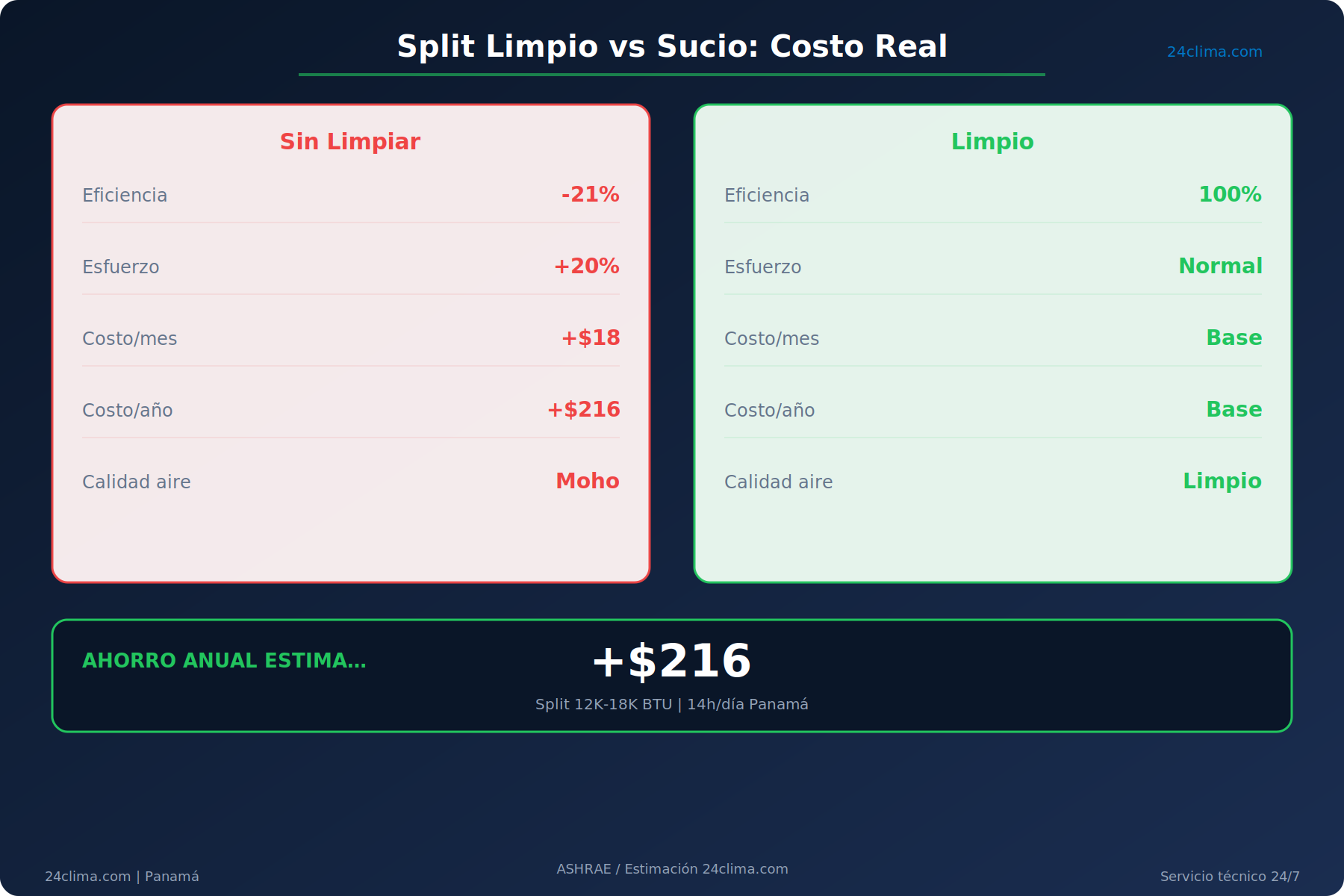
A 12,000 BTU split unit running in optimal condition consumes roughly 1.1 kW/h. With filters and evaporator coil dirty at 30% obstruction, that same unit consumes between 1.3 and 1.4 kW/h to hold the same temperature — an increase of 18% to 27%. At Panama's average residential electricity rate from ETESA of approximately $0.18 per kWh, that's $12 to $22 in additional cost per month, per unit. Run two split units for eight hours a day and skip the cleanings, and you're burning $24 to $44 extra every month — or $288 to $528 per year in electricity you didn't need to buy.
The money is only part of it. A unit running under constant overload has a significantly shorter lifespan. A well-maintained split unit in Panama lasts 12 to 15 years. One that runs without regular cleaning can fail in 6 to 8 years, according to service data compiled by Daikin for tropical climate markets. The hour you spent cleaning today isn't lost time — it's a documented return on a measurable investment.
The Air You're Breathing Tells You More Than You Think
Back in that San Francisco apartment — but this time the unit is clean. Filters rinsed, evaporator treated, tray free of mold. You switch on the split and the air is different: genuinely cold, no trace of that stale, damp smell. The room hits 22°C (72°F) in eight minutes instead of twenty. Next month's electricity bill will confirm what you already feel.
Everything in this guide covers what a homeowner can handle on their own. But once a year — or whenever your unit shows symptoms this cleaning doesn't resolve — professional service is irreplaceable: full evaporator disassembly, refrigerant verification, outdoor coil cleaning, complete electrical inspection. At 24Clima, we offer that professional maintenance service with certified technicians who know Panama's actual climate conditions, not generic manuals written for a completely different hemisphere. If your unit hasn't had a professional inspection in over a year, or performance is still weak after cleaning the filters, contact us on WhatsApp — we provide same-day diagnosis across the main zones of Panama City.
Schedule your professional maintenance at https://24clima.com/contacto/