How Many BTUs Do I Need? — The Right Way to Size an Air Conditioner in Panama
Last updated: May 2025
2 pm in Costa del Este. The sun is hammering floor-to-ceiling windows on the 14th floor and the thermometer reads 91°F (33°C) with 86% humidity. You turn on the air conditioner you bought six months ago and wait. The room drops to 79°F (26°C) but never reaches the 73°F (23°C) you set on the remote. The unit runs nonstop, your electricity bill keeps climbing, and you're still sweating inside your own apartment.
The technician who sold you the unit said a 12,000 BTU system was "more than enough" for your 270 sq ft room. On paper, he was right. In Panama, paper doesn't sweat.
The problem wasn't the brand or the model. It was the size. Choosing the wrong BTU capacity is the single most expensive mistake air conditioner buyers make here — and it costs money every month until you fix it.
What Most People Believe — And Why It Falls Apart Here
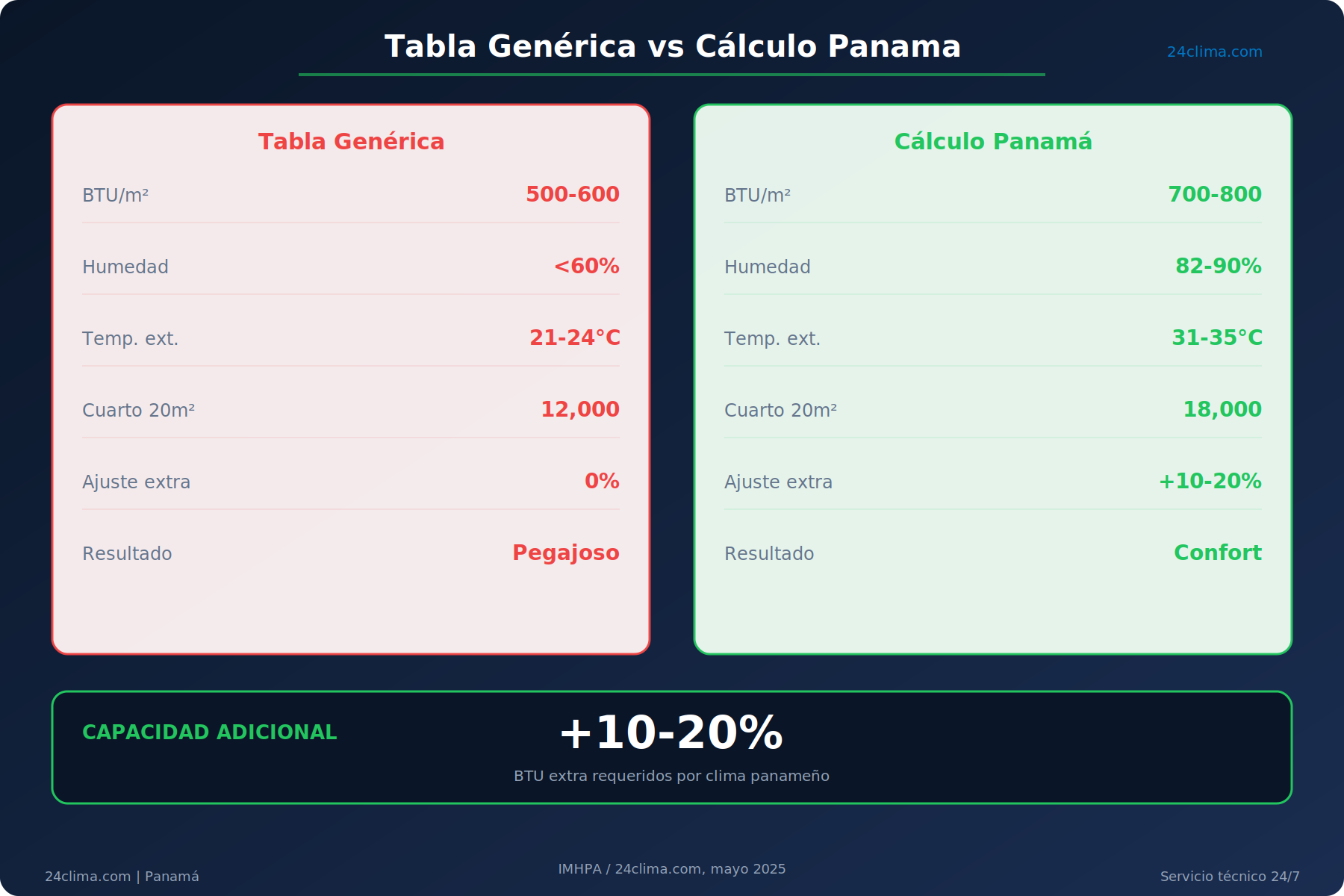
The standard approach goes like this: find a BTU-per-square-foot chart online, do the multiplication, buy that unit. Charts saying "9,000 BTU for 200 sq ft, 12,000 BTU for 270 sq ft, 18,000 BTU for 380 sq ft."
Those charts were built for the United States and Europe, where summer temperatures hover around 70-75°F (21-24°C) and humidity stays below 60%. Panama is a different animal entirely.
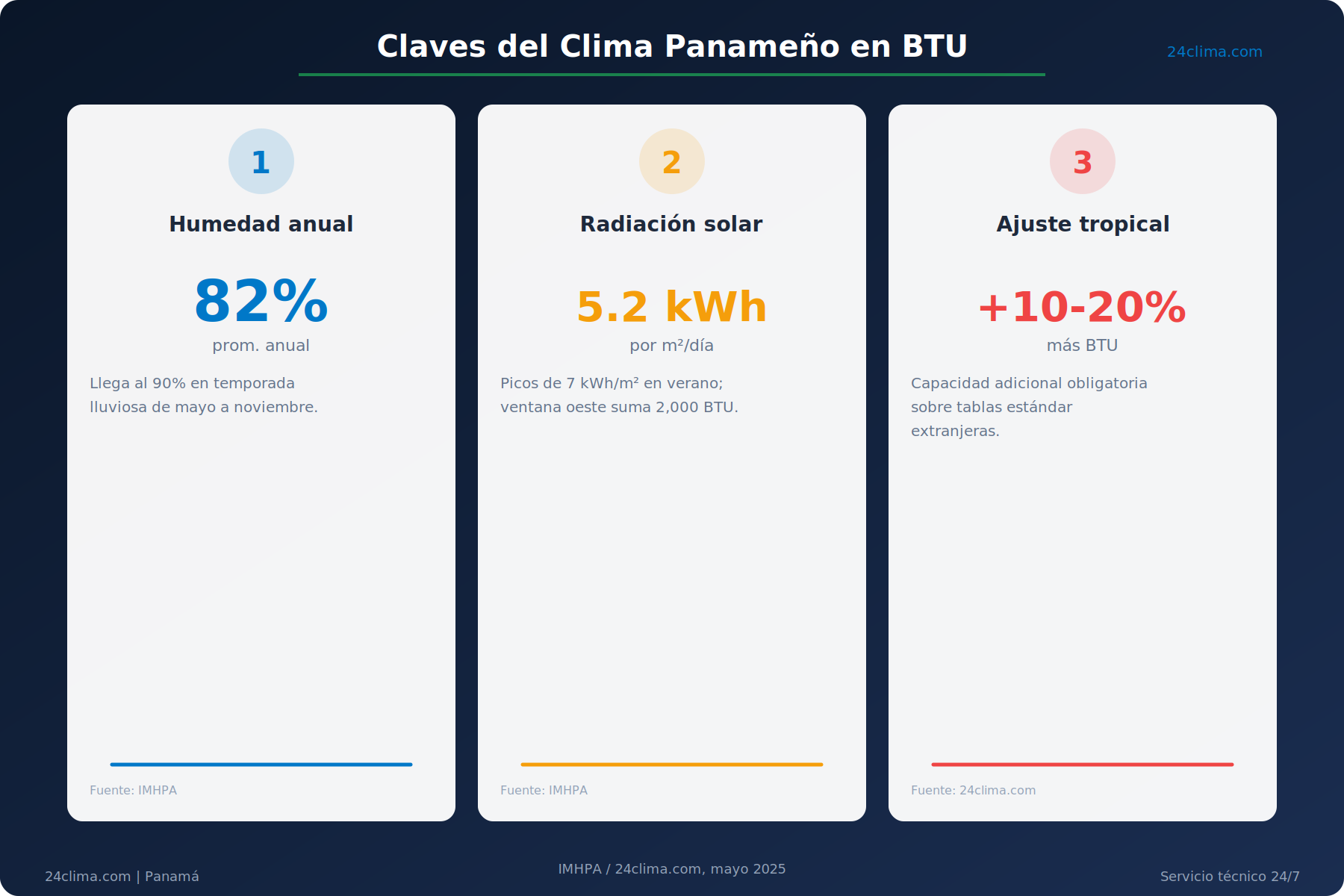
The problem runs two ways. Outdoor temperatures in Panama City average 88°F (31°C) during the day with peaks of 95°F (35°C) from March through April — meaning the gap your unit has to close is larger from the moment it starts. Then there's humidity: 82% year-round, climbing to 90% during rainy season from May through November. That moisture doesn't just make you feel hotter. It creates a separate thermal load the unit must pull out of the air in the form of liters of condensed water. An undersized unit cools the air but never fully dehumidifies it. The result is that cool-but-clammy feeling anyone who has lived in Panama knows immediately.
The practical rule: you need 10% to 20% more BTU capacity than a standard chart suggests — and that's before accounting for the specific details of your space.
You can find more climate guides and tips for Panama at https://24clima.com/consejos-y-guias/
The Base Formula: How Many BTUs Per Square Foot in Panama
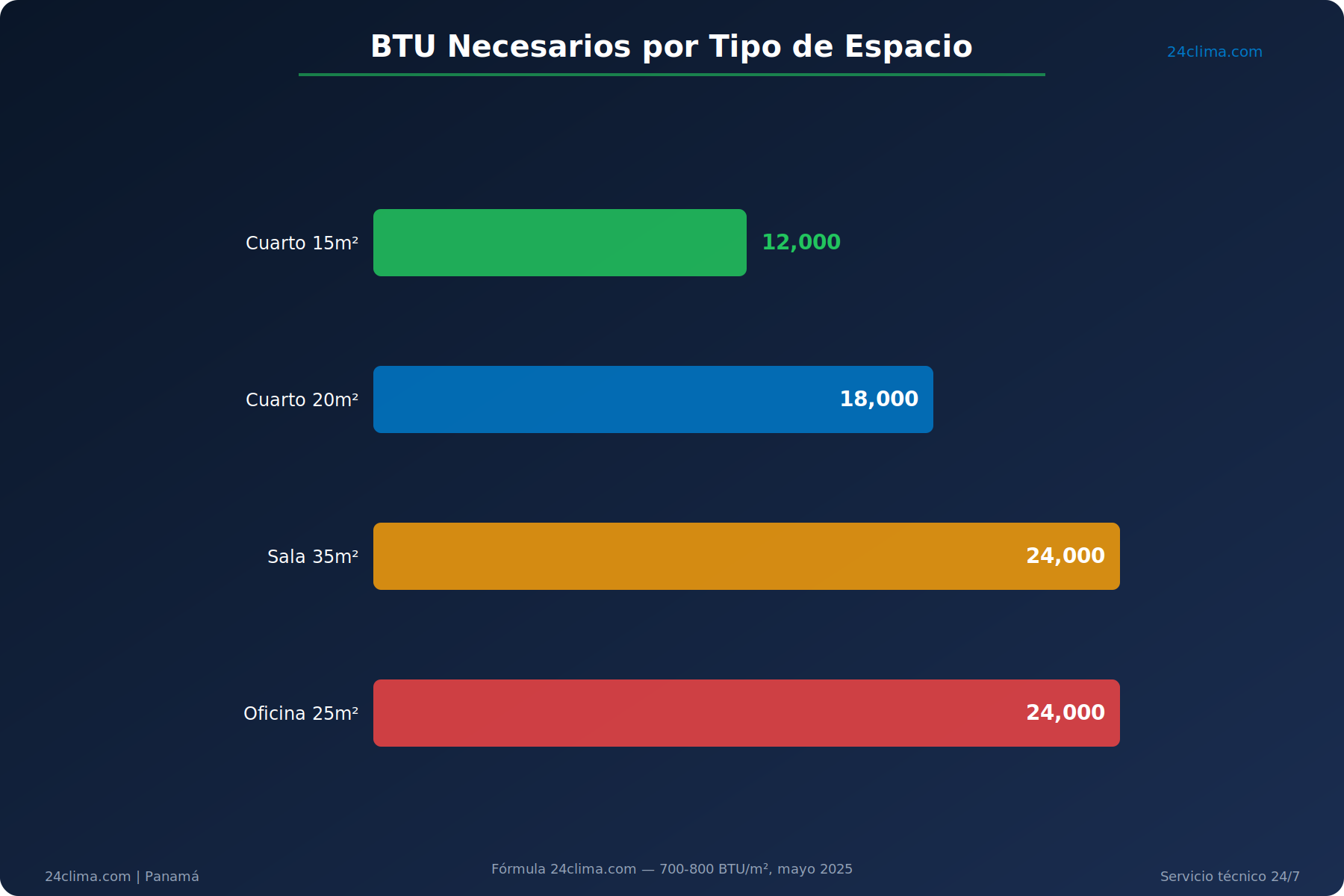
For residential spaces here, the starting point is 65 to 75 BTU per square foot — not the 45-55 BTU that generic guides use. This range already accounts for Panama's baseline humidity and temperature. From there, you adjust based on what your specific room is actually dealing with.
Start by measuring the area of the space in square feet (length x width). If the space has good shade, interior walls, and sits on a low floor, multiply by 65 BTU/sq ft. If it has large windows, sits on the 5th floor or higher, or takes direct sunlight for a significant part of the day, multiply by 75 BTU/sq ft. Then apply the additional adjustments below.
Some concrete examples from spaces I've evaluated in Panama:
— 160 sq ft bedroom, low floor, north-facing window: 160 x 65 = 10,400 BTU → 12,000 BTU unit — 215 sq ft bedroom, 10th floor, west-facing window: 215 x 75 = 16,125 BTU → 18,000 BTU unit — 375 sq ft living room, ground floor, minimal direct light: 375 x 65 = 24,375 BTU → 24,000 BTU unit — 270 sq ft office with 4 people and desktop computers: 270 x 75 = 20,250 BTU plus occupancy adjustment → 24,000 BTU unit
These are starting points, not final answers. But they cut out the serious mistake of going too small.
The 5 Factors That Drive Up Thermal Load in Panama
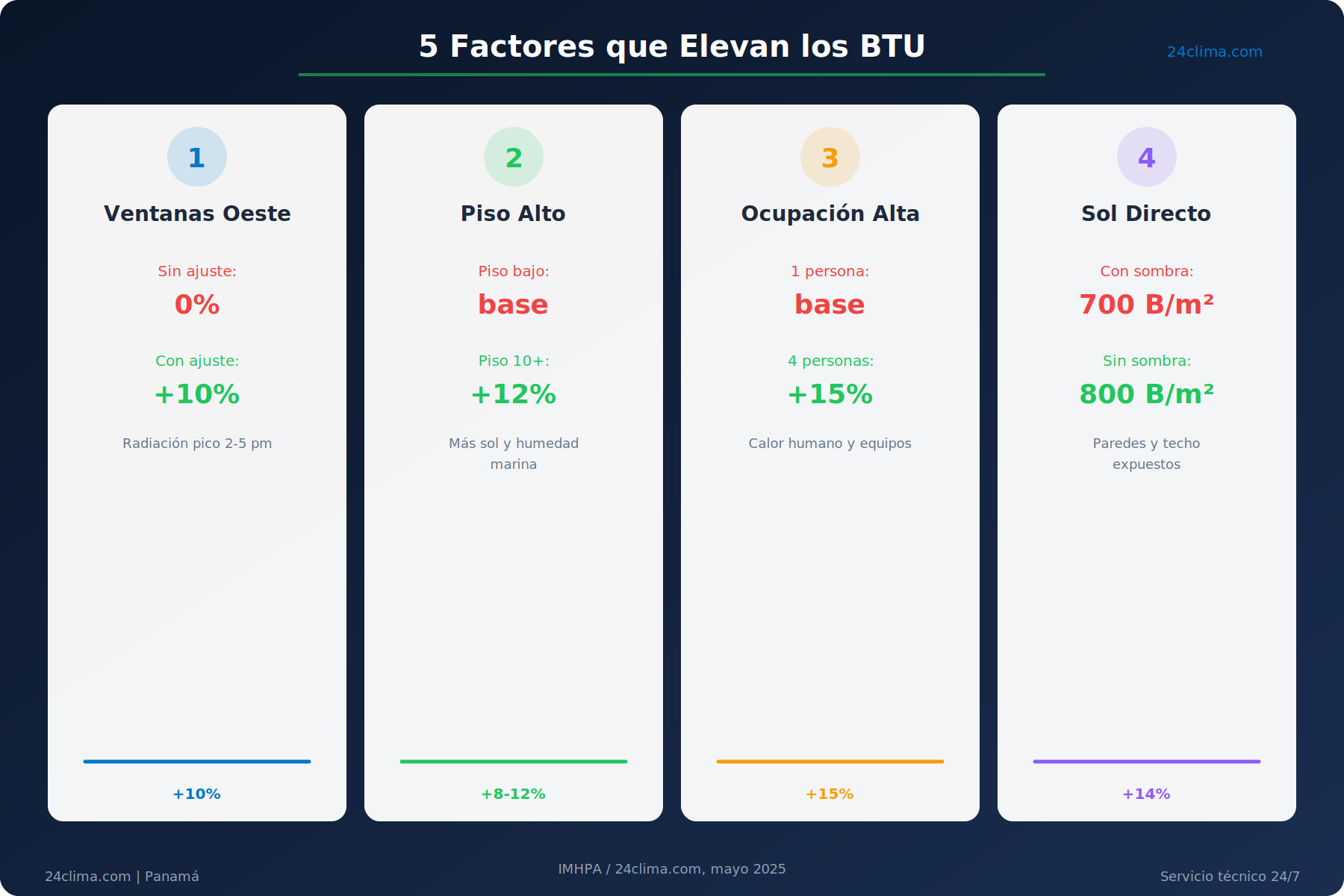
Beyond square footage, five factors specific to the Panamanian environment push BTU requirements higher. Miss even one of them and a correctly calculated unit will still come up short.
Factor 1: Window Orientation
West-facing windows take direct solar radiation between 2 pm and 5 pm — exactly when outdoor heat peaks. Panama City averages 5.2 kWh/m² of solar radiation per day according to IMHPA data, with peaks up to 7 kWh/m² during summer. A single west-facing window of roughly 20 sq ft can add the equivalent of 2,000 BTUs of thermal load during those hours. Add 10% to your base calculation for each large west- or south-facing window.
Factor 2: Floor Height
Upper floors — 10th and above — catch more solar radiation through exposed walls, and the urban heat island effect is stronger up there. In Punta Pacífica and Avenida Balboa, you add elevated marine humidity on top of that. Add 8-12% to your base calculation for the 10th floor and higher.
Factor 3: Roof Type
Corrugated zinc metal roofing is everywhere in Panama — Arraiján, La Chorrera, most of Panamá Oeste. Under direct sun, a zinc roof without insulation can reach 160°F (70°C) and pumps that heat straight into the room below. Compared to an insulated concrete slab roof, a bare zinc roof can increase thermal load by up to 30%. This is the most consistently underestimated factor I see across the country.
Factor 4: Occupancy and Electronics
Each person in a space generates roughly 100 BTU per hour of body heat. An office with 5 people and 5 desktop computers — each pulling 250-300 watts — can add 5,000 to 7,000 BTU of internal load. For conference rooms or commercial spaces, skipping this adjustment is a guaranteed problem.
Factor 5: Ceiling Height
Standard calculations assume 8-foot (2.4 m) ceilings. Apartments in Costa del Este, Santa María, or renovated Casco Antiguo routinely run 9 to 10.5 feet (2.7 to 3.2 m). More air volume means more capacity needed to move it. For ceilings of 10 feet or higher, add 15-20% to your base calculation.
What Happens When BTU Capacity Is Wrong: Short Cycling and Continuous Running
Two failure modes. Both cost money in different ways.
Undersized unit — too few BTUs: The compressor runs without stopping, never hitting the set temperature, never resting. Electricity consumption rises because the unit never reaches operating efficiency. Humidity stays high because the air doesn't spend enough time across the cold evaporator coil. According to ENERGY STAR data (2024), a unit running more than 80% of the time without proper cycling sees its lifespan drop from 12-15 years to just 6-9 years. That's a $600-$1,200 investment gone years ahead of schedule.
Oversized unit — too many BTUs: Less talked about, but equally damaging. A unit that's too large cools the space so fast that the thermostat cuts it off before it's had time to pull the humidity out. This is short cycling — the unit starts, drops the temperature 3-4 degrees, shuts off, the temperature climbs back, and it fires up again, sometimes dozens of times per hour. The room feels cold and sticky at the same time. The compressor wears out faster from repeated hard starts than it would from steady operation.
The practical conclusion: never jump more than one BTU range above your calculated need. If your calculation lands at 15,000 BTU, the right unit is 18,000 BTU — not 24,000 BTU.
The Role of Inverter Technology
An inverter air conditioner handles mild oversizing better because the compressor modulates speed instead of shutting off entirely — it drops to 30-40% capacity and keeps extracting humidity. A study published in Applied Energy (2023) found that inverter units in tropical climates use 35% to 44% less energy than conventional units of the same capacity under identical load conditions, which translates to roughly $25-$60 per month depending on usage.
That said, inverter technology is not a license to oversize. A properly sized inverter — or one that's one range above the calculation — manages load variation better than a conventional unit. In Panama, where temperatures swing from 82°F (28°C) before dawn to 95°F (35°C) at 3 pm, that modulation matters: the unit reduces its draw during cooler hours rather than hammering on and off.
The 12,000 BTU inverter is the most widely sold model in Panama for bedrooms of 160-195 sq ft under standard conditions. For larger rooms or spaces with compounding load factors, stepping up to 18,000 BTU regularly makes the difference between a room that's genuinely cool and one that almost gets there.
Reference Table: Recommended BTUs by Space Type in Panama
Small bedroom (130-160 sq ft), standard conditions: 9,000-12,000 BTU — Recommendation: 12,000 BTU inverter
Medium bedroom (170-215 sq ft), standard conditions: 12,000-15,000 BTU — Recommendation: 12,000 BTU inverter with few load factors, or 18,000 BTU with a west-facing window or high floor
Large bedroom (225-300 sq ft) or small living area: 16,000-21,000 BTU — Recommendation: 18,000 or 24,000 BTU inverter depending on load factors
Living room or open space (310-430 sq ft): 22,000-28,000 BTU — Recommendation: 24,000 BTU inverter
Spaces over 430 sq ft: require a detailed load calculation or multiple units — Recommendation: get a Manual J or equivalent calculation from a certified technician before buying anything
Factors that push your BTU requirement higher:
— Zinc metal roof without insulation: +25-30% — West- or south-facing windows over 20 sq ft: +10% per window — 10th floor or higher: +10-12% — More than 2 people regularly in the space: +5% per additional person — Open kitchen integrated into the space: +15-20% — More than 2 electronic devices running regularly: +8-10% — Ceiling height above 9 feet (2.7 m): +15-20% — Commercial space or medical office: +20% above residential base calculation
Frequently Asked Questions
How many BTUs do I need for a 215 sq ft room in Panama?
Under average conditions — no extreme load factors — a 215 sq ft room needs 14,000 to 16,000 BTU, which puts you at an 18,000 BTU inverter as the safe call. Add a west-facing window, a zinc roof, or a high floor and 18,000 BTU stops being a question. A 12,000 BTU unit for that space will run continuously and still leave you uncomfortable.
Is it better to buy more BTUs than needed for a tropical climate?
Not as a rule. Oversizing by one range — say, 18,000 BTU for a space that calculates to 15,000 BTU — is manageable, especially with an inverter. Jumping two ranges creates the short-cycling problem: the unit cools the air without dehumidifying it, the room feels clammy, and the compressor wears out from constant restarts. In Panama's climate, dehumidification matters just as much as temperature drop.
What happens if the air conditioner has too few BTUs for the space?
The compressor runs nonstop trying to hit a temperature it can't reach. Your electricity bill climbs because the unit never reaches operating efficiency. Humidity stays high because the air moves through the evaporator too fast to shed moisture. And the unit may fail at 6-8 years instead of 12-15 — a premature loss of $500-$900.
Get the Calculation Right Before You Buy
Sizing an air conditioner for Panama is not a 30-second exercise with an online chart. It requires actual square footage, room orientation, construction type, floor height, and a clear picture of how many people and devices are in that space every day. Generic charts fail because they were built for climates where heat and humidity don't compound each other the way they do here.
Get the calculation right and you save $25 to $60 per month on electricity and get 12-15 years from your equipment. Get it wrong and you spend more every month for a unit that wears out in 6-8 years.
At 24Clima, we evaluate the space before recommending anything. If you're not sure what size you need — or if your current unit isn't performing the way it should — reach out on WhatsApp at https://24clima.com/contacto/ and a technician with real hands-on experience in Panama's climate will walk through it with you, no commitment required.