Air Conditioner Prices in Panama — Complete 2025 Guide
It's 2 PM in Costa del Este. The sun hammers down on the concrete, humidity sits at 87%, and the outdoor thermometer reads 33°C (91°F). You walk into your apartment, press the button on the remote, and hear that familiar click. Cool air starts flowing. Relief.
Then the AES bill arrives. $180. Last month it was $145. You didn't buy any new appliances — the heat just hit harder this week. And suddenly you're asking yourself: am I paying more than I should? Is my unit the problem? What does an air conditioner actually cost in Panama in 2025?
That question has a specific answer, with real numbers. And the answer changes completely depending on whether you go with conventional or inverter technology. Here at 24Clima — where we publish advice calibrated for Panama's tropical climate — you'll find prices updated for 2025, store comparisons, savings calculations, and an honest take on whether a premium unit is worth the extra money.
What Most People Get Wrong About AC Prices in Panama
The most common mistake is comparing only the sticker price. Someone walks into Novey, sees a conventional 12,000 BTU split at $320 and an inverter unit of the same capacity at $520, and decides the first one is the smart choice. They save $200 upfront. Case closed.
But that logic ignores the real cost: what you pay in electricity over the next 36 months. In Panama, where an air conditioner in an average home runs 8 to 12 hours a day throughout the entire year — there's no genuine off-season here — energy consumption completely overwhelms any upfront savings.
The other misconception is that all units with the same BTU rating cool equally. They don't. A conventional 12,000 BTU unit that cycles on and off every 10 minutes creates power consumption spikes that an inverter eliminates by modulating its compressor. Same room, same temperature, very different electricity bills.
Real Air Conditioner Prices in Panama 2025
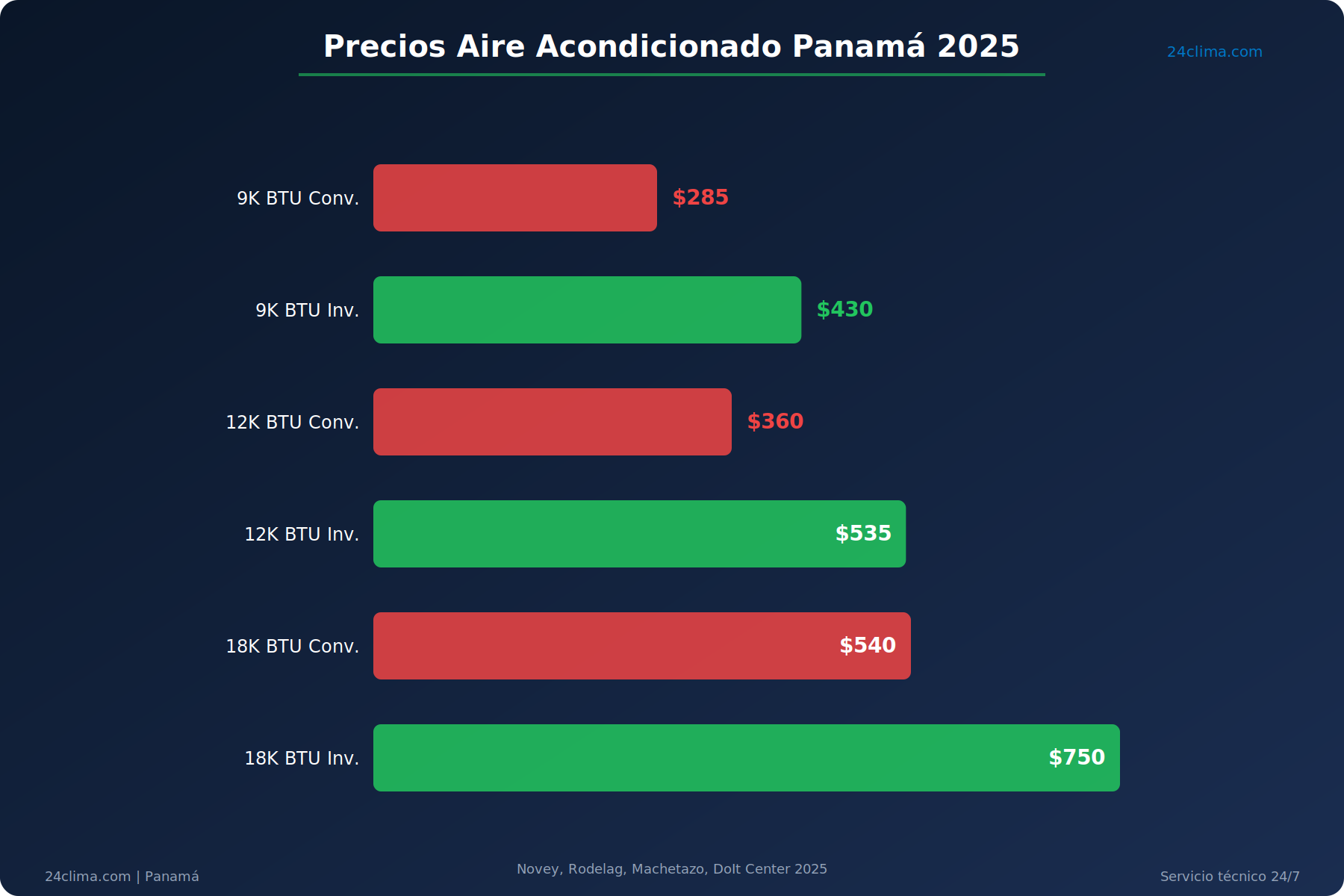
Prices at Panama's main retailers — Novey, Rodelag, Machetazo, and DoIt Center — vary based on BTU capacity and technology. The ranges below are verified for 2025, based on publicly available price lists from those stores.
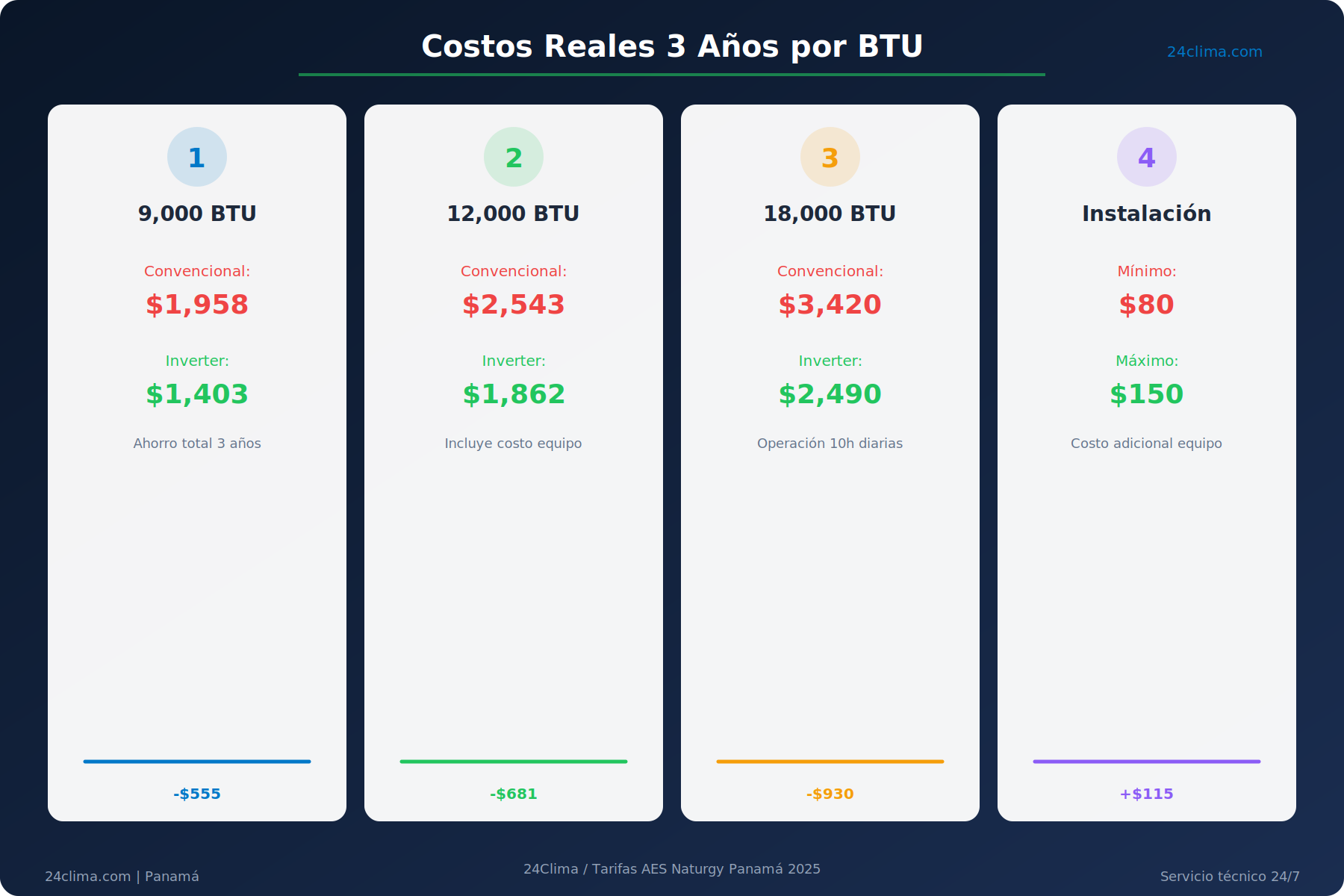
These prices cover the unit only. Professional installation in Panama runs an additional $80 to $150 depending on the length of refrigerant line needed and whether an exterior metal mounting bracket is required.
Price Table by BTU and Technology — Panama 2025
9,000 BTU — Conventional: $250 — $320 — Inverter: $380 — $480
12,000 BTU — Conventional: $300 — $420 — Inverter: $450 — $620
18,000 BTU — Conventional: $480 — $600 — Inverter: $650 — $850
24,000 BTU — Conventional: $650 — $820 — Inverter: $900 — $1,200
The most widely available brands in these stores include LG, Samsung, Carrier, Midea, and Gree. Midea and Gree dominate the budget end of the market. LG and Samsung lead the mid-range inverter segment. Carrier is the go-to for high-capacity commercial and office installations.
How Much Does an Inverter Actually Save on Your Panama Electric Bill?
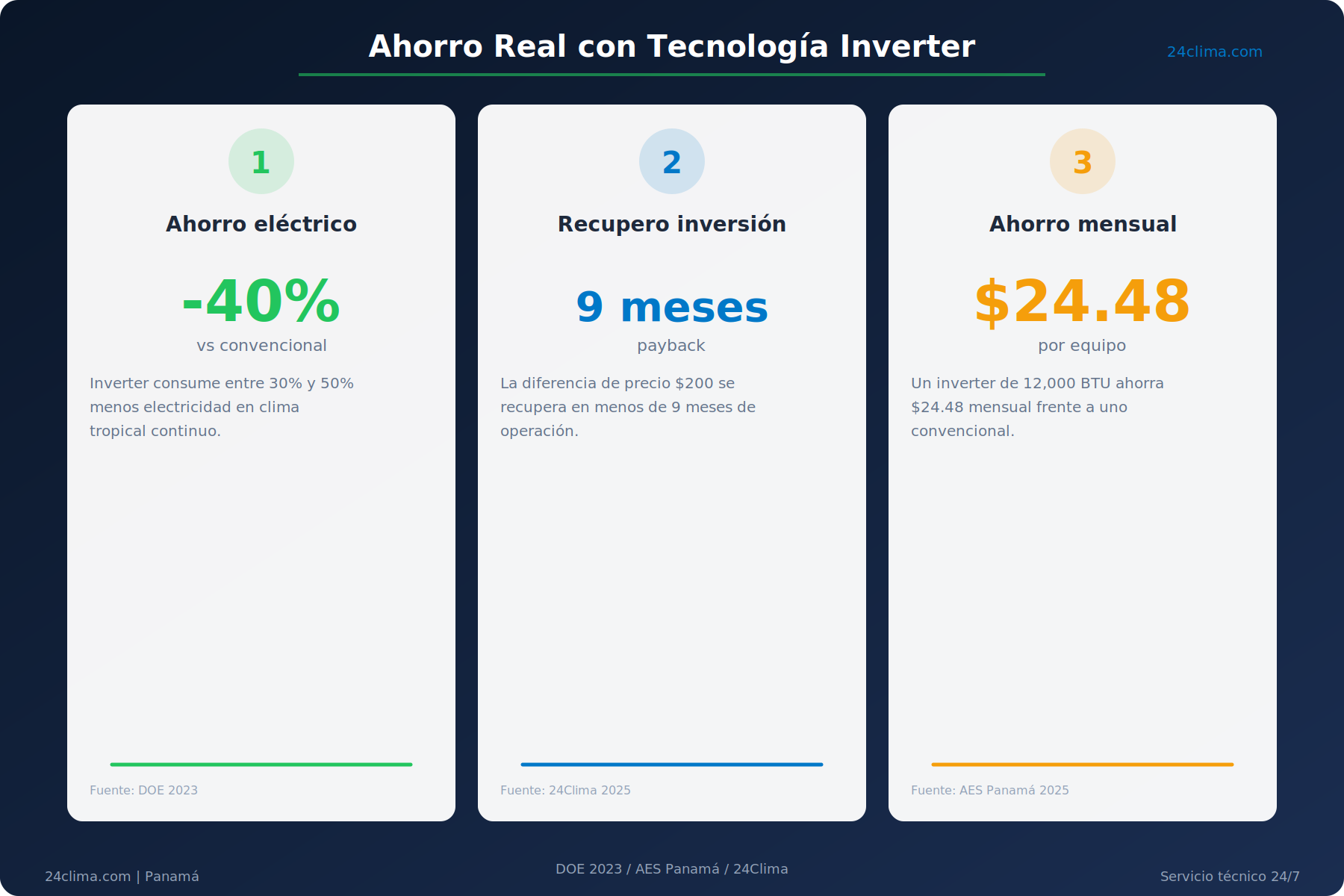
An inverter air conditioner uses between 30% and 50% less electricity than a conventional unit of the same capacity, according to data from the U.S. Department of Energy (DOE, 2023) applied to tropical climates with continuous operation. In Panama, where AES and Naturgy residential rates average roughly $0.17 per kWh in the higher consumption block, that percentage translates into concrete dollar figures.
Take the most common scenario: a 12,000 BTU split unit in a 20 m² bedroom in Panama City, running 10 hours per day.
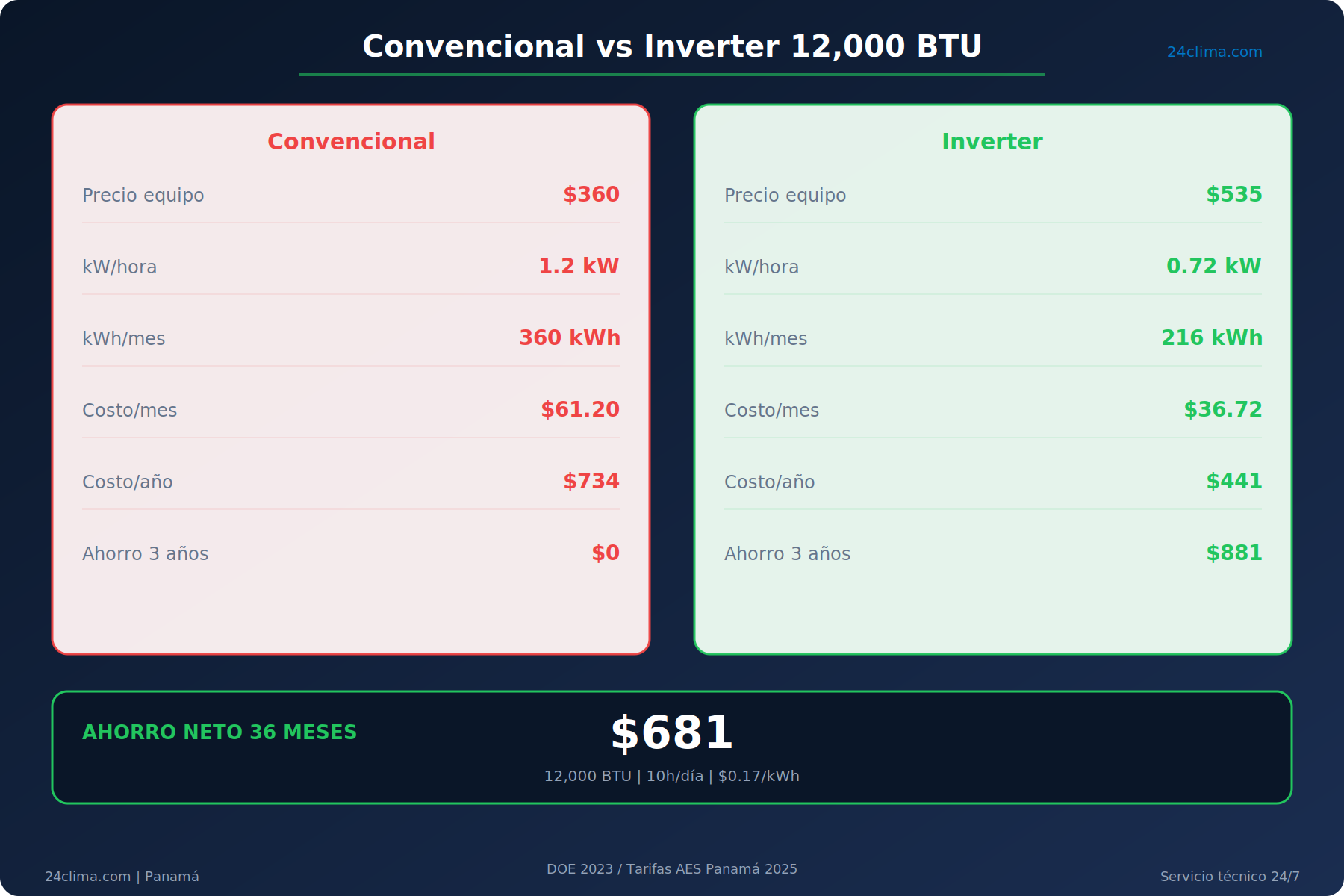
Conventional 12,000 BTU unit: — Estimated draw: 1.2 kW per hour — Daily consumption: 12 kWh — Monthly consumption: 360 kWh — Monthly cost (at $0.17/kWh): $61.20
Inverter 12,000 BTU unit: — Estimated draw: 0.72 kW per hour (average during continuous operation) — Daily consumption: 7.2 kWh — Monthly consumption: 216 kWh — Monthly cost (at $0.17/kWh): $36.72
Monthly difference: $24.48 less with the inverter. Over one year: $293.76. Over three years: $881.28.
The price gap between a conventional and inverter 12,000 BTU unit is roughly $200. The inverter pays for itself in under 9 months and then generates net savings for the remaining 27 months of that same three-year window. Cumulative savings over 36 months exceed $680 above the additional upfront cost.
These calculations are conservative. If you have more than one unit in your home — which is standard in two or three-bedroom apartments in San Francisco, Marbella, or Albrook — the savings multiply with every inverter unit you install.
What BTU Size Do You Need in Panama?
The right capacity depends on the area being cooled, sun exposure, and how many people regularly occupy the space. In Panama's tropical climate, where outdoor temperatures rarely drop below 26°C (79°F) even at night, the general rule is 600 BTU per square meter for spaces with direct sun exposure, and 500 BTU per square meter for partially shaded spaces.
Quick reference for residential use in Panama:
— 9,000 BTU: bedrooms of 12 to 15 m² with limited sun exposure — 12,000 BTU: bedrooms of 16 to 22 m², or any room with east- or west-facing windows — 18,000 BTU: living rooms of 23 to 35 m², home offices, or open-plan spaces — 24,000 BTU: areas of 36 to 50 m², offices with multiple occupants, or small commercial spaces
One of the most frequent mistakes expats make when setting up a new apartment in Panama is buying an undersized unit to save money upfront. A 9,000 BTU unit in a 25 m² living room in Punta Pacífica with ocean-facing windows will run at maximum capacity continuously, never reach the target temperature, and wear out within 3 to 4 years. A properly sized unit lasts 12 to 15 years with regular maintenance.
If you're unsure about the right capacity for your space, 24Clima's maintenance service includes a capacity assessment at no additional charge.
Where to Buy Air Conditioners in Panama City
The four main retail chains offer real differences in price, availability, and after-sales support. Here's how they stack up.
Novey — Main locations at Vía España, Costa del Este, and La Chorrera — Strong selection of LG and Carrier — In-store financing available with zero down payment using their own card — General price range: mid to high — Advantage: established after-sales service and parts availability
Rodelag — Locations in El Dorado, Albrook, and San Miguelito — Good inventory of Midea and Samsung — Frequent price promotions during peak heat months (March through May) — General price range: mid — Advantage: competitive pricing on mid-range inverter units
Machetazo — Locations across Panama City and the interior (La Chorrera, Arraiján, Colón) — Budget-friendly options from brands like Gree and unbranded models — General price range: low to mid — Advantage: lowest upfront costs for tight budgets — Note: always verify warranty terms and parts availability before purchasing
DoIt Center — Locations in Clayton, Costa del Este, and newer growth areas — Strong selection of construction and renovation-grade equipment — Good availability of installation accessories (refrigerant line, brackets, electrical cable) — General price range: mid — Advantage: some locations offer unit-plus-installation packages
Before buying, compare the exact same model number between Novey and Rodelag. The difference can be $40 to $80 on the same unit — and on higher-capacity equipment, that gap can exceed $100.
After-sales support matters more than most expats expect. A cheap no-name unit that fails at 18 months in Panama can end up costing more in labor, downtime, and replacement parts than the money saved at the register.
Frequently Asked Questions About Air Conditioners in Panama
How much does an air conditioner cost in Panama in 2025?
A conventional 12,000 BTU split unit runs between $300 and $420 at Panama's main retailers. The same size in inverter technology costs between $450 and $620. Add $80 to $150 for professional installation. The total range for a unit that's installed and running goes from roughly $380 to $770 depending on technology and brand.
Where can you find the cheapest air conditioners in Panama?
Machetazo and Rodelag offer the lowest prices on conventional units from brands like Gree and Midea. For budget inverter options, Rodelag runs frequent promotions on Samsung and Midea models. Checking prices online before visiting the store can reveal differences of up to $100 on the same model. Factor installation cost into your comparison too — some stores include basic installation in the listed price.
Is it worth paying more for an inverter AC in Panama?
Yes, in almost every situation. The inverter costs $150 to $200 more than a comparable conventional unit, but generates monthly savings of $20 to $35 on your electricity bill with normal use of 8 to 10 hours per day. The break-even point lands somewhere between 6 and 10 months, and cumulative net savings over 3 years exceed $600. In a country where AC units run essentially year-round, the inverter is mathematically the better investment.
The heat in Costa del Este at 2 in the afternoon isn't going to change. Your AES bill can — depending on which unit you choose today.
A properly installed 12,000 BTU inverter in that same apartment cuts your monthly consumption by $24 to $35, runs quieter, holds temperature more steadily, and holds up longer under the stress of Panama's tropical climate. The higher sticker price dissolves within the first 9 months. What remains are years of compounding savings.
At 24Clima, we assess your space, calculate the right capacity, and point you toward the unit that best balances upfront investment with long-term savings in Panama. Reach out to us on WhatsApp at https://24clima.com/contacto/ — no commitment required.