AC Shuts Off by Itself in Panama — Why It Happens and How to Fix It
Last updated: May 2025
It's 2 PM in Costa del Este. The sun is hammering down on the concrete. Your phone reads 91°F (33°C) with 87% humidity. You turn on the AC, sink into the couch, and for about 20 minutes everything feels fine. Then — silence. The unit shuts off on its own. No warning. No error code on the remote. Just silence and the immediate return of that suffocating heat.
You turn it back on. It runs another 15 minutes. Shuts off again.
This isn't a random malfunction. Your unit is sending you a clear signal — one with a specific technical cause that can be identified and fixed. Below you'll find the 7 most common reasons why an AC shuts off by itself in Panama, how to diagnose them yourself, and when you need to call a technician. You can also browse our HVAC guides and tips at 24clima.com for related issues.
What Most People Assume — And Why They're Wrong
When an AC keeps shutting off, most people conclude the unit is "too old" or just "broken." They spend $600–1,200 on a replacement, and weeks later the problem comes back. Why? Because the new unit inherits the same clogged filter, the same outdoor unit baking in direct sun, the same electrical circuit with voltage swings.
The problem is almost never the equipment itself. It's the conditions it's operating in.
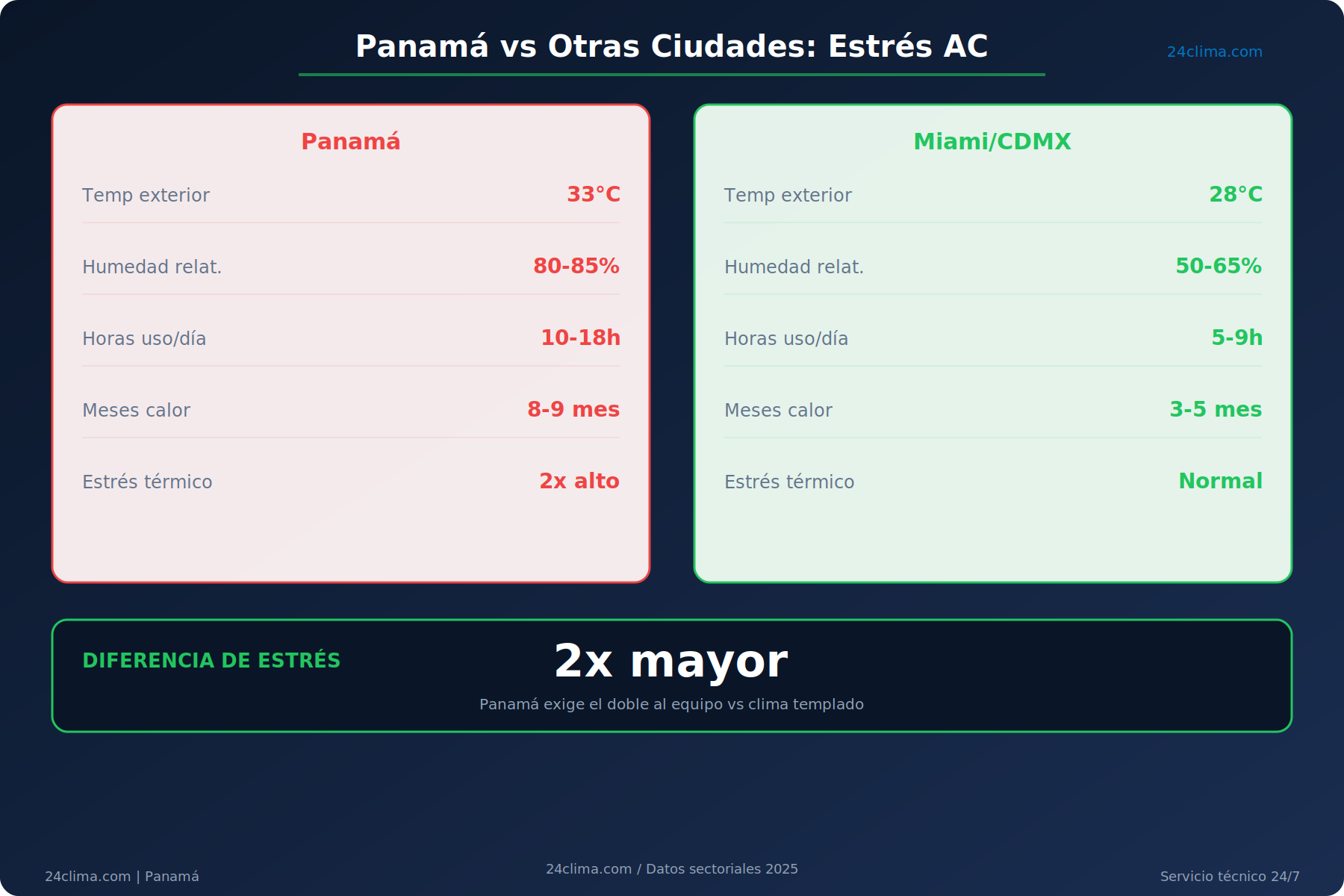
Panama puts extreme stress on air conditioning systems. A residential unit here runs 10 to 18 hours a day, in outdoor temperatures above 88°F (31°C) for 8 to 9 months a year, with relative humidity hovering around 80–85% in the city. That's roughly double the thermal stress compared to Mexico City or Miami during a normal season. Specific problems develop under those conditions — and every one of them has a solution, once you know what you're looking for.
The 7 Main Reasons Your AC Shuts Off by Itself in Panama
Reason 1 — Blocked Filter: The Number One Issue in Tropical Climates
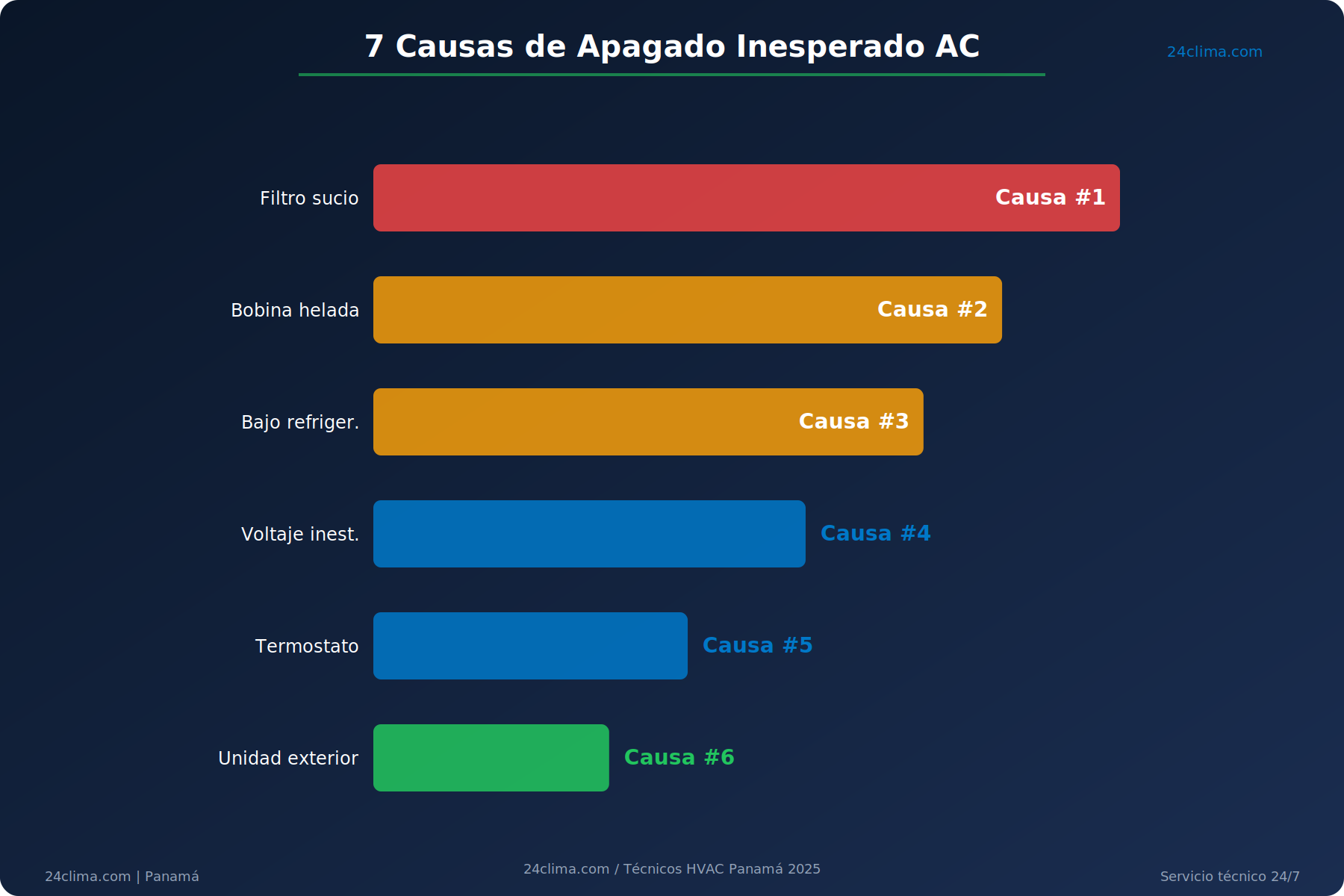
A dirty filter is the single most common cause of unexpected shutdowns in Panama. When the filter builds up dust, lint, and mold spores — which thrive in humid tropical air — it chokes off airflow to the evaporator coil. The temperature sensor detects that the room isn't cooling, interprets this as a system fault, and shuts the unit off as a protective measure.
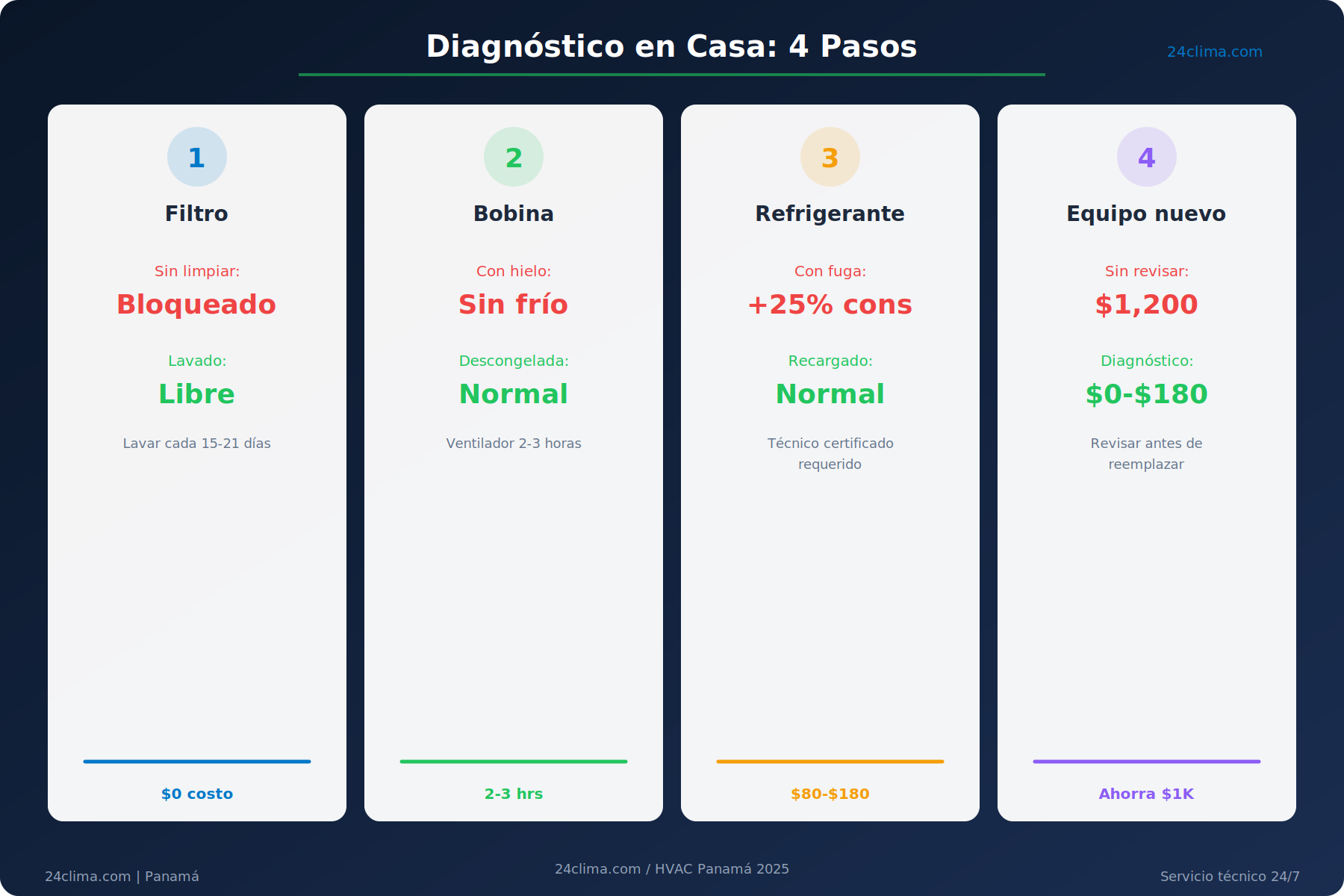
In tropical climates like Panama's, manufacturers recommend cleaning the filter every 15 to 21 days. In temperate climates the standard is every 30 to 45 days. The difference comes down to the sheer volume of airborne particles that constant humidity generates.
How to check it yourself:
Turn off the unit and open the front panel of the indoor unit. Pull out the filter — if it's dark gray or black, it's blocked. Rinse it with warm water, let it dry completely, and reinstall it. Turn the unit back on and see if the shutdown cycle repeats.
If the unit runs normally after cleaning the filter, that was your problem. Cost of diagnosis: $0. Time: 20 minutes.
Reason 2 — Frozen Evaporator Coil: When Cold Becomes the Enemy
A frozen evaporator coil cuts off cold airflow almost completely. The unit runs but doesn't cool. The thermostat detects no temperature drop, triggers the safety cutoff, and the AC shuts down.
In Panama this happens for two main reasons: a dirty filter (see above) or low refrigerant. When refrigerant levels drop, pressure inside the evaporator falls below the freezing point of the moisture in Panama's humid air — and that moisture turns to ice on the coil.
Visible signs: unusual water dripping from the indoor unit, frost on the copper pipes coming out of the unit, air blowing but no cold.
Don't try to defrost the coil with any tool or object. Switch the unit to fan-only mode for 2 to 3 hours and let the ice melt naturally. If the problem comes back, you need a technician to check refrigerant levels — that requires specialized gauges and equipment.
Reason 3 — Low R-32 or R-410A Refrigerant
Refrigerant doesn't get used up like engine oil. A properly sealed system holds its charge for the entire service life of the unit — typically 12 to 15 years. If the level is low, there's a leak somewhere in the system.
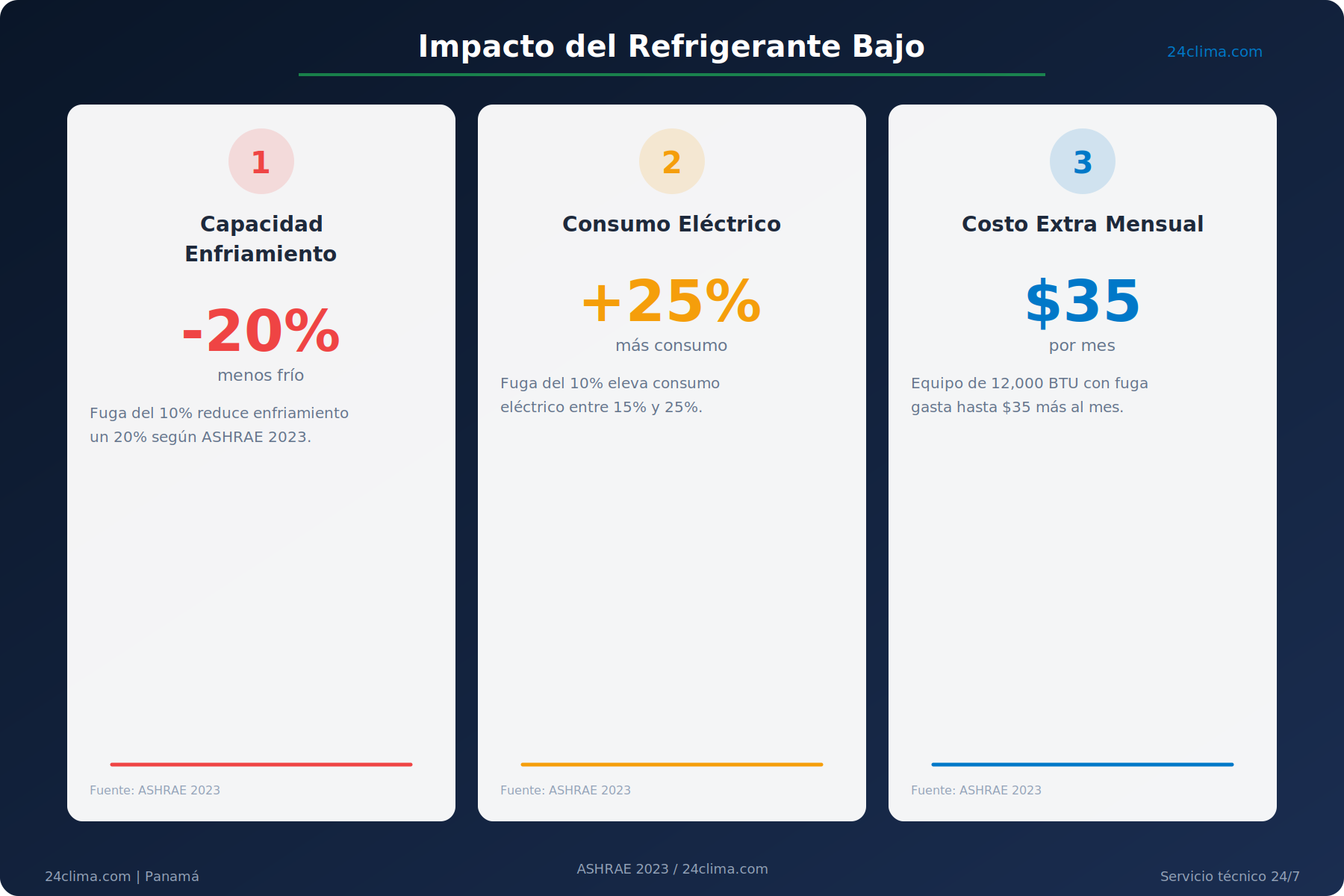
According to industry data published by ASHRAE in 2023, a 10% refrigerant leak reduces cooling capacity by 20% and increases electricity consumption by 15 to 25%. In practical terms for a 12,000 BTU unit in Panama: you're paying $20 to $35 more per month in electricity, and the unit still can't keep up.
R-32 — found in most inverter units sold in Panama since 2020 — operates at higher pressures than the older R-410A. Detecting and repairing leaks requires a certified technician with high-pressure gauges and electronic leak detection equipment. Refrigerant recharging in Panama in 2025 runs between $80 and $180 depending on type and quantity — a small cost compared to the damage done by running a compressor with an insufficient charge.
Reason 4 — Overheated Compressor from Direct Sun Exposure
The compressor is the heart of the system. When its internal temperature exceeds its design threshold — typically 158°F to 176°F (70°C to 80°C) — an internal thermal switch shuts it down automatically to prevent permanent damage. The unit restarts once it cools, usually 15 to 30 minutes later. That on-off-restart pattern is the signature of this problem.
In Panama, outdoor units are often installed on rooftops or exterior walls with full sun exposure during peak heat hours — between 11 AM and 3 PM. At an ambient temperature of 91°F (33°C) plus direct solar radiation beating down on the metal casing, the actual temperature around the compressor can exceed 113°F to 122°F (45°C to 50°C) before the unit even begins its compression cycle.
A University of Florida study published in 2022 found that outdoor ambient temperature has a direct 8 to 10% impact on system efficiency for every 9°F (5°C) difference. A solar shade structure over the outdoor unit — not an enclosure that blocks airflow, which would make things worse — can significantly cut down shutdown events caused by overheating in exposed installations.
Check that there's at least 12 inches (30 cm) of clear space around the outdoor unit on all sides, and that no vegetation, walls, or furniture is blocking the hot air exhaust from the fan.
Reason 5 — Voltage Fluctuations on Panama's Electrical Grid
Voltage fluctuations are more common than your electricity provider will admit. In areas like San Miguelito, La Chorrera, Arraiján, and parts of Panamá Oeste, voltage regularly drops below 100V or spikes above 130V during peak consumption hours — roughly 6 PM to 10 PM when residential demand is highest.
Modern AC units include out-of-range voltage protection. When voltage falls or rises beyond the tolerance threshold — generally ±10% of the 120V nominal — the unit shuts down automatically to protect the compressor.
To detect it: pick up an affordable voltmeter (available at Romero or Do it Center for $15 to $25) or a smart outlet with a built-in voltage display. If voltage swings more than 12 volts between readings during peak hours, you have an electrical problem.
The fix: an automatic voltage regulator (AVR) rated at 3,000 to 5,000 VA costs between $45 and $90 in Panama and protects both your AC and other sensitive appliances. Think of it as an investment, not an expense.
Reason 6 — Miscalibrated Thermostat or Damaged Sensor
The temperature sensor — called a thermistor — inside the indoor unit measures room air temperature and tells the system when it has reached the set point. If the sensor is miscalibrated, it reads that the target temperature has been reached when the room is still hot, shutting the unit off prematurely.
In humid tropical climates, the sensor accumulates dirt and moisture that skew its readings. A professional cleaning of the component — typically included in a professional AC deep clean service — can fix the problem without replacing any parts.
If the thermostat itself is damaged — more common in units with more than 7 years of continuous use — replacement in Panama costs between $25 and $60 in parts, plus technician labor.
Reason 7 — Dirty Condenser Coil on the Outdoor Unit
The condenser coil inside the outdoor unit releases the heat extracted from your home back into the outside air. When its fins get clogged with dust, dirt, cotton fluff from nearby vegetation, or salt residue in coastal areas like Punta Pacífica or Casco Antiguo, it can't dissipate heat efficiently.
The result is the same as sun-driven overheating: the compressor temperature climbs, the thermal switch activates, and the unit shuts down.
Cleaning the condenser coil requires moderate water pressure applied from the inside out — not a high-pressure power washer, which bends the delicate fins. A professional gets this right. In Panama, this service costs between $35 and $65 and should be done every 6 months in coastal areas, every 12 months inland.
Take a look at the AC maintenance service we offer at 24clima to understand what a full preventive maintenance visit actually covers.
Quick Diagnosis — What Do I Check First?
Before calling a technician, run through this checklist in order:
Check the indoor filter — is it gray or black? Clean it. Look at the copper pipes — is there frost or ice visible? Switch to fan-only mode for 2 to 3 hours. Inspect the outdoor unit — does it have at least 12 inches of clearance on all sides? Is it in direct sun? Measure the voltage at the outlet during peak hours — does it swing more than 12 volts? When was the last professional maintenance? If it's been more than 12 months, you're probably dealing with a combination of factors.
If the first two checks don't resolve the problem, a refrigerant check and an electrical inspection require a technician.
Cost Comparison: DIY vs. Professional Repair in Panama 2025
Dirty filter — DIY: $0 — Professional: included in maintenance ($45–70) Frozen coil from dirty filter — DIY: $0 after cleaning the filter — Professional: $45–70 if there's an underlying issue Refrigerant recharge — DIY: not possible (requires certification) — Professional: $80–180 Solar protection for outdoor unit — DIY: $20–40 in materials — Professional: $60–120 installed Voltage regulator (AVR) — DIY: $45–90 (simple plug-in installation) — Professional: $90–140 installed Condenser coil cleaning — DIY: possible with care — Professional: $35–65 Thermostat/sensor replacement — DIY: not recommended — Professional: $60–120 parts plus labor Refrigerant leak detection and repair — DIY: not possible — Professional: $120–280
Frequently Asked Questions
Why does my AC shut off by itself in Panama?
The most common causes in Panama's climate are a blocked filter, frozen evaporator coil, overheated compressor from direct sun exposure, and voltage fluctuations on the electrical grid. Panama's extreme heat and humidity — above 88°F (31°C) and 80–87% humidity for most of the year — accelerate all of these problems compared to temperate climates. A unit running 12 to 16 hours a day under those conditions needs preventive maintenance every 6 months, not every 12 months as the manual written for European climates recommends.
Can Panama's extreme heat actually cause the AC to shut down from overheating?
Yes. When outdoor temperatures exceed 91°F (33°C) and the outdoor unit is in direct sunlight, the compressor's operating temperature can exceed its thermal protection threshold even in newer units. The internal thermal switch shuts the compressor down automatically — a built-in safety mechanism designed to prevent permanent damage. A sun shade over the outdoor unit, without blocking airflow, combined with adequate clearance on all sides, takes care of most of these cases.
How much does it cost to fix an AC that keeps shutting off in Panama?
It depends on the cause. If it's a dirty filter, the cost is zero. If it's low refrigerant with a detected and repaired leak, the range is $120 to $280. A full preventive maintenance service that addresses most of these causes costs between $45 and $70 in Panama in 2025. The cost of ignoring the problem — a burned compressor from running without enough refrigerant or from repeated overheating — is a compressor replacement running $350 to $600, or a brand-new unit altogether.
Can I fix the problem myself if my AC keeps shutting off?
Some causes are straightforward DIY: cleaning the filter, verifying clearance around the outdoor unit, installing a voltage regulator, and adding sun protection. What you should not attempt without proper training: handling the refrigerant system (illegal without certification in Panama), cleaning the condenser coil without the correct technique — you can permanently bend the fins — or opening the compressor or electrical components of the unit.
When is it time to replace my AC instead of repairing it?
The standard HVAC industry guideline is the "50% rule": if the repair cost exceeds 50% of the price of a comparable new unit, replace it. In practical terms: if your unit is more than 10 years old, uses R-22 refrigerant (discontinued, which makes recharging dramatically more expensive), and the compressor shows structural damage, replacement is the financially sound decision. Under 7 years old with a repairable problem? Fix it.
Back to That Apartment in Costa del Este
The silence you hear when the unit shuts off at 2 in the afternoon isn't a random failure. It's information. Your AC is telling you exactly what's wrong — you just need to know how to read it.
The vast majority of unexpected shutdowns in Panama come down to preventive maintenance that most owners keep putting off. A clean filter, a clear condenser coil, the correct refrigerant charge, and a properly positioned outdoor unit. That's it.
At 24Clima we provide full technical diagnostics and AC maintenance service for residential and commercial units across Panama. If your unit keeps shutting off and you've already worked through the basic checks in this guide, contact us on WhatsApp — we'll pinpoint the problem before touching a single screw.