Heat-and-Cool Air Conditioners in Panama — Are You Paying Extra for a Feature You'll Never Use?
Last updated: June 2025 | By the 24Clima Technical Team
It's 11 PM in Boquete. The thermometer reads 12°C (54°F). Outside, fog rolls down from Volcán Barú and seeps through every gap in the windows. A tourist renting the cabin is desperately searching for some kind of heat, picks up the mini-split remote on the wall, and notices something unexpected — a button with a sun icon. Heat mode. The same machine that cools him in the summer can warm him on the coldest night of the year.
Meanwhile, in Costa del Este, Panama City, another homeowner just bought a heat-and-cool air conditioner because the store salesperson told him it was "the complete option." He installed it in January. Six months later, he has never once touched the heat function. His apartment temperature has never dropped below 26°C (79°F) at any point during the year.
Here is the technical truth nobody explains to you at the store: a heat-and-cool air conditioner is not a bad investment. But for 80% of Panamanians living in coastal areas or the capital, it's also not necessary. This guide explains when it makes sense, when it doesn't, and how to run the numbers before paying $80 extra for a feature you may never activate. You'll find more analysis like this in our guides and tips at https://24clima.com/consejos-y-guias/
What a Heat-and-Cool Air Conditioner Actually Is (and How the Reversible Cycle Works)
A heat-and-cool air conditioner — also called a reversible heat pump — moves heat in two directions: outward (cooling mode, the standard setting) or inward (heating mode). It does not generate heat by burning fuel. It moves heat from outside to inside using the same refrigerant cycle, but in reverse. That's why it runs circles around a conventional electric space heater in terms of efficiency.
The reversible cycle, step by step:
In cooling mode, the compressor pressurizes the refrigerant. Heat from inside your room transfers to the refrigerant at the evaporator, and that heat gets expelled outside through the condenser. Your room cools down.
In heating mode, a four-way reversing valve switches the direction of refrigerant flow. The unit now extracts heat from the outdoor air — even when it's cold outside — and pumps it indoors. The condenser begins operating as an evaporator, and vice versa.
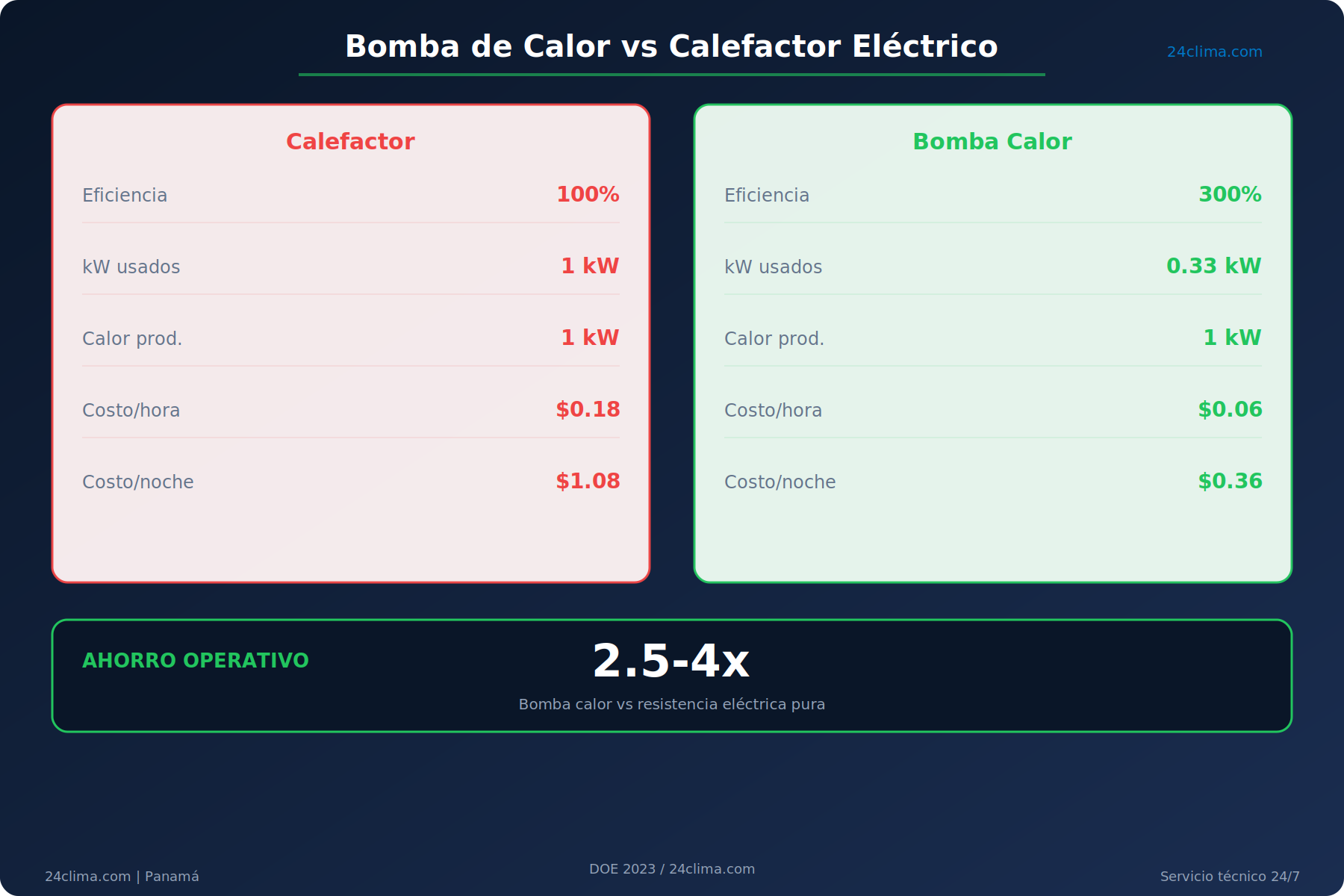
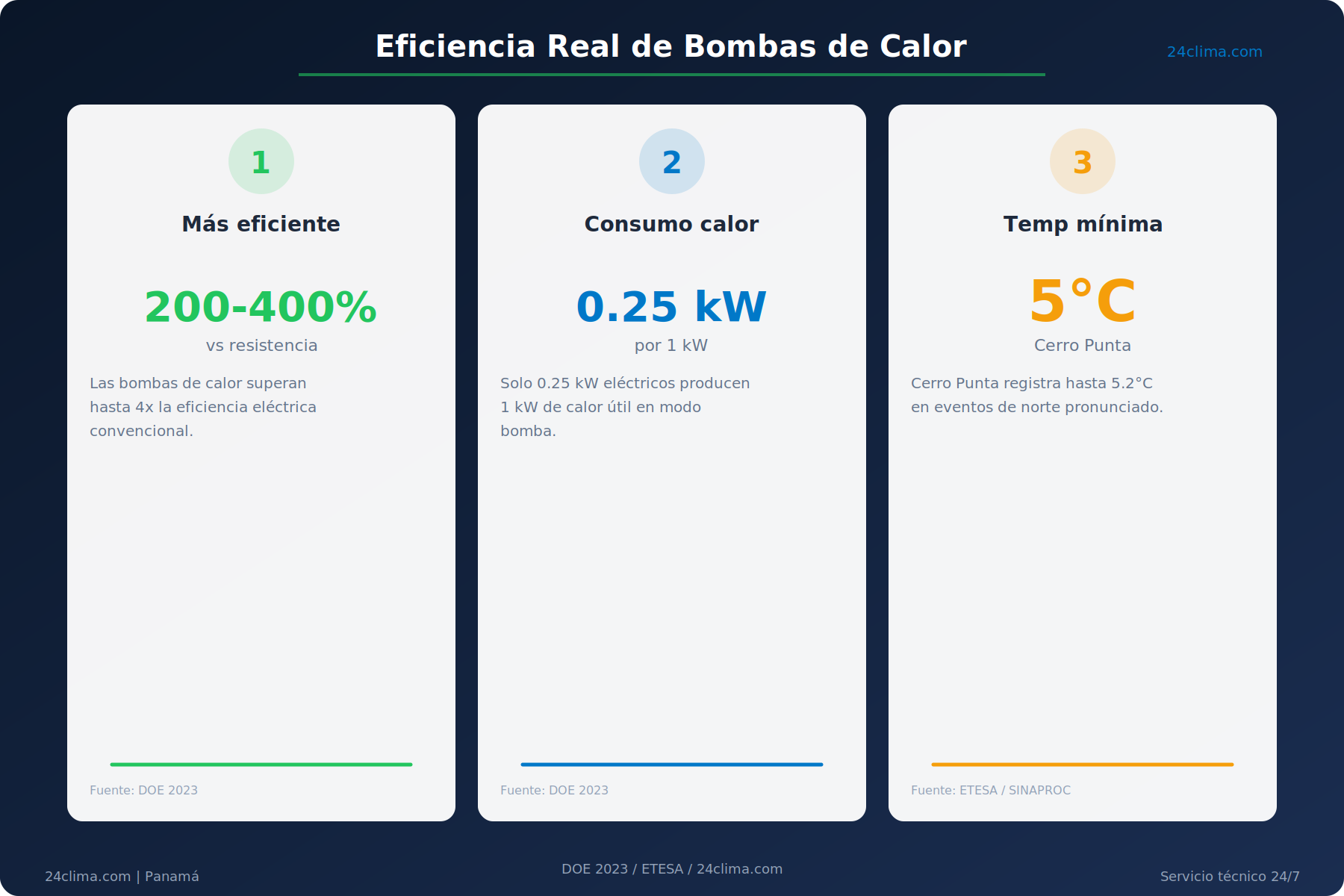
The result: to produce 1 kW of heat, a heat pump consumes between 0.25 and 0.4 kW of electricity, depending on outdoor temperature. A conventional electric heater needs a full 1 kW to produce that same 1 kW of heat. That's 2.5 to 4 times the energy efficiency, which starts to mean real money when Boquete nights drop to 10°C (50°F) and you're running a heater for six hours straight.
According to the U.S. Department of Energy (DOE, 2023), air-to-air heat pumps are 200% to 400% more efficient than electric resistance heating, depending on outdoor temperature. In areas where exterior temperature stays above 5°C (41°F), efficiency stays high. In Boquete, with lows around 10°C (50°F), you're operating right in the sweet spot.
The Panama Climate Map No Salesperson Ever Shows You
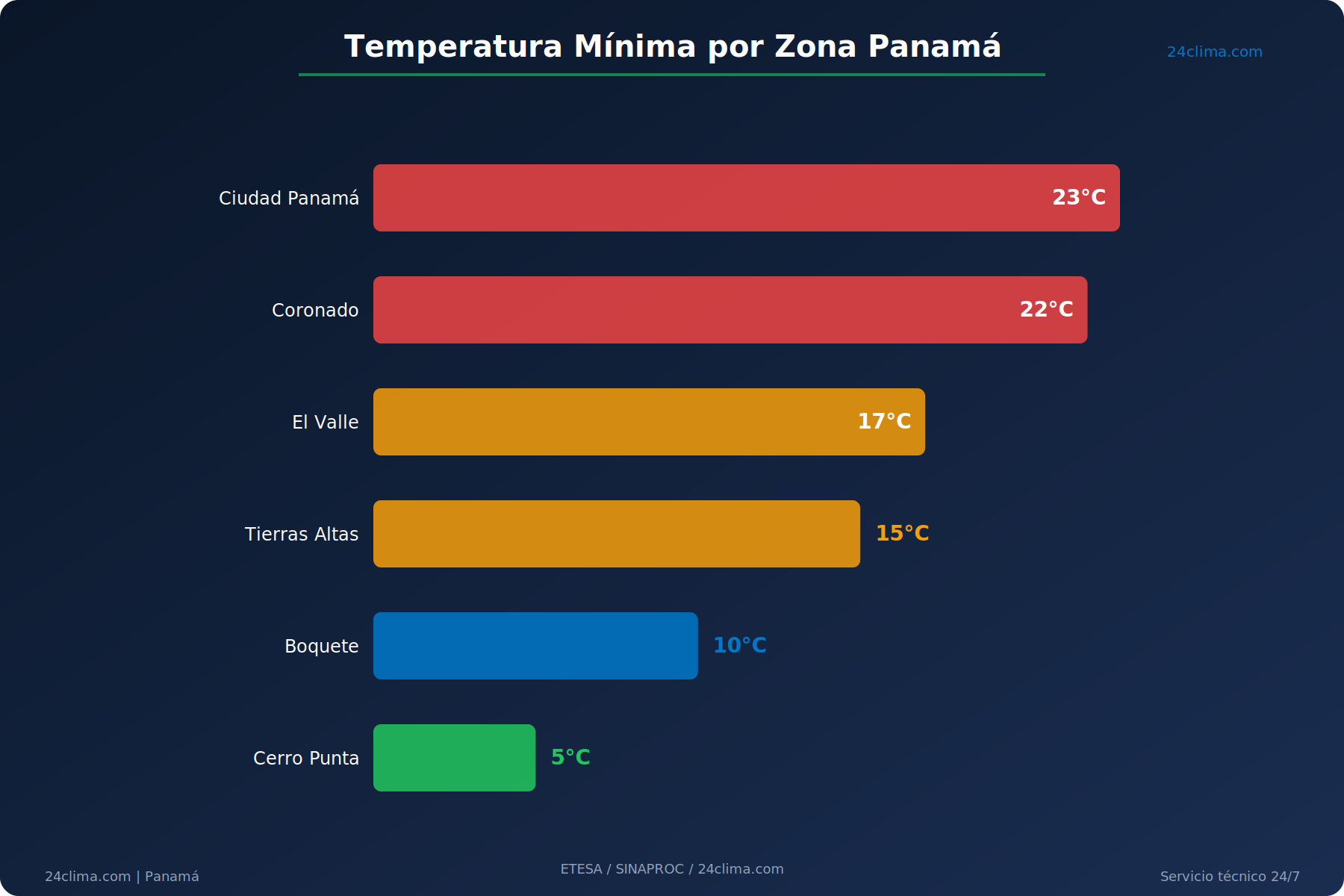
Direct answer first: in Panama City, the heat function on a reversible air conditioner is unnecessary for 90% of users. The average annual temperature in the capital is 27.5°C (81.5°F), with overnight lows of 23-24°C (73-75°F) even in the coolest months of December and January. At those temperatures, the human body doesn't need active heating.
But Panama is not just the capital. The country has three distinct climate zones that matter for this decision:
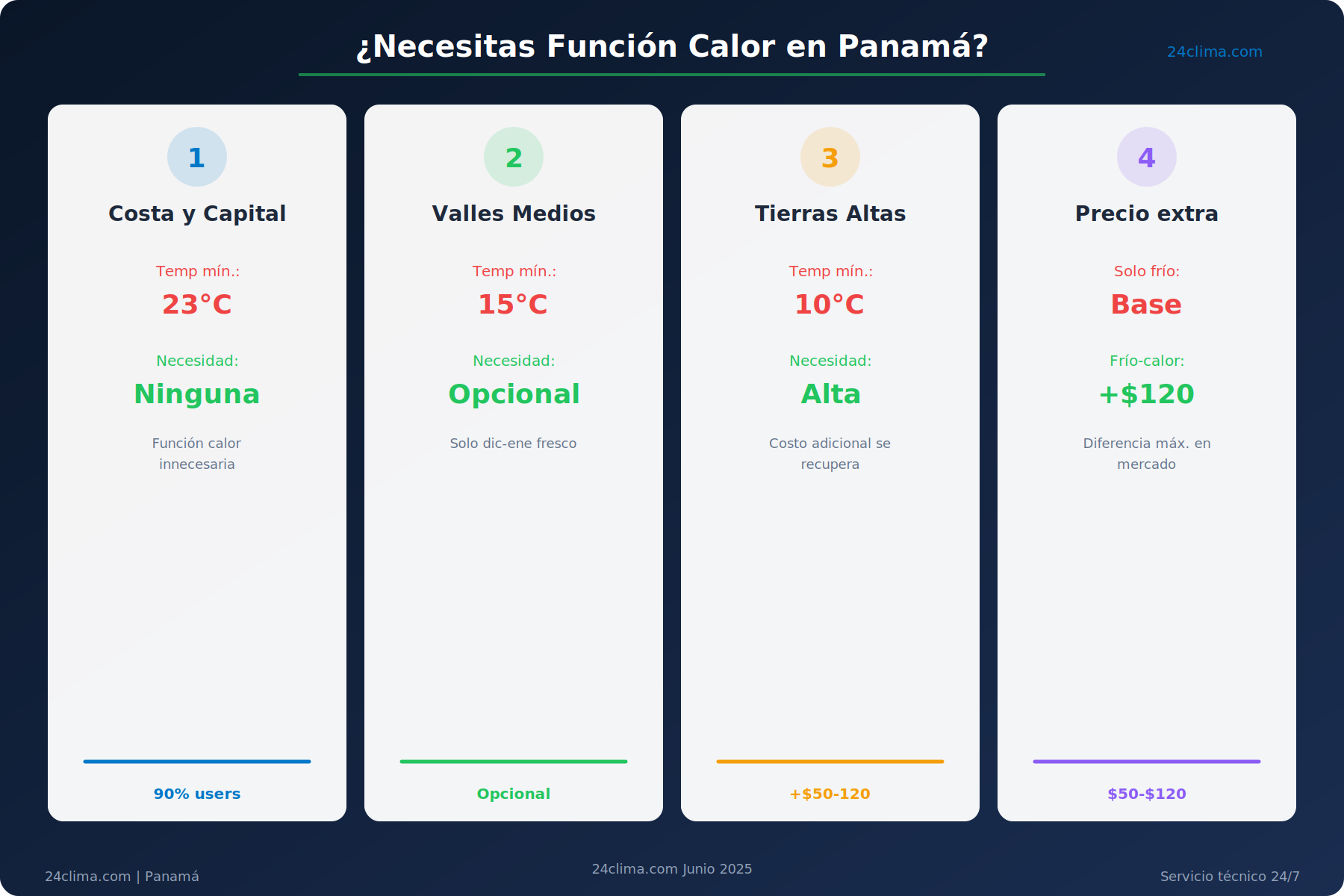
Zone 1 — Pacific and Caribbean Coast (0-300 meters / 0-1,000 feet above sea level) Includes: Panama City, Costa del Este, Colón, Chitré, Las Tablas, Santiago, Coronado Average minimum temperature: 22-25°C (72-77°F) Recommendation: cooling-only unit (standard inverter). The heat function will never be used.
Zone 2 — Valleys and Mid-Elevation Areas (300-1,200 meters / 1,000-3,900 feet) Includes: El Valle de Antón, Santa Fe de Veraguas, Tierras Altas, Cerro La Vieja Average minimum temperature: 15-20°C (59-68°F) Recommendation: optional. Cool nights do occur, especially in January and December, but active heating is rarely needed in a well-constructed house.
Zone 3 — Interior Highlands (1,200+ meters / 3,900+ feet above sea level) Includes: Boquete, Volcán, Cerro Punta, Bambito, La Amistad Average minimum temperature: 10-16°C (50-61°F), with historical lows down to 5°C (41°F) in Cerro Punta Recommendation: the heat function has genuine practical value here and can justify the additional unit cost.
Historical records from ETESA (Empresa de Transmisión Eléctrica, S.A.) and SINAPROC show Boquete recording minimum temperatures of 9.8°C (49.6°F) in January, and Cerro Punta dropping to 5.2°C (41.4°F) during strong north wind events. Try sleeping without heat at those temperatures. The discomfort is real — and so are the savings on your monthly electricity bill when you run a heat pump instead of a conventional electric heater.
Real Price Comparison: Cooling-Only vs. Heat-and-Cool in Panamanian Stores
The price difference between a cooling-only inverter mini-split and a heat-and-cool model from the same brand and BTU capacity runs $50 to $120 in the current Panamanian market (2025), based on verified prices at Panafoto, Novey, and direct distributors. That gap isn't enormous. But before concluding that "it's worth paying the extra $100 just in case," you need to know whether those $100 actually pay for themselves.
Brands with heat pump function available in Panama (verified models):
LG — Dual Inverter Series with heat function Reference model: 12,000 BTU, inverter, heat-and-cool Approximate store price: $780-$950 (installation not included) Same model, cooling only: $680-$820 Difference: $80-$130
Samsung — WindFree Series with heat pump Reference model: 12,000 BTU, inverter, heat-and-cool Approximate store price: $820-$990 Same model, cooling only: $720-$860 Difference: $70-$130
Midea — U-Inverter Series with reversible function Reference model: 12,000 BTU, inverter, heat-and-cool Approximate store price: $620-$750 Same model, cooling only: $550-$680 Difference: $50-$90
Panasonic — Inverter CS/CU Series with heat pump Reference model: 12,000 BTU, inverter, heat-and-cool Approximate store price: $850-$1,050 Same model, cooling only: $750-$920 Difference: $80-$130
All prices include indoor and outdoor units. Installation is not included and typically runs $150 to $350 in Panama, depending on the type of installation and distance between units.
Real Savings Calculator: Heat Pump vs. Conventional Electric Heater
This is the analysis that actually matters when deciding whether the extra cost of a heat-and-cool unit makes economic sense. The following scenario applies to highland areas where heating is genuinely used.
Base scenario: — 25 m² (270 sq ft) bedroom — Outdoor nighttime temperature: 12°C (54°F) — Hours of heating per night: 8 hours — Cool nights per year (October through March, highland zones): approximately 120 nights — Electricity rate in Panama: $0.18/kWh (residential Chiriquí rate, ETESA 2024 reference)
With conventional electric resistance heater (1,500 W): — Consumption per night: 1.5 kW × 8 hours = 12 kWh — Cost per night: 12 × $0.18 = $2.16 — Cost per season (120 nights): $259.20 — Heater purchase price: $60-$120
With heat pump (same thermal output, COP of 3.0 at 12°C / 54°F outdoor temperature): — Actual electrical consumption per night: 12 kWh ÷ 3.0 COP = 4 kWh — Cost per night: 4 × $0.18 = $0.72 — Cost per season (120 nights): $86.40 — Annual savings versus electric heater: $172.80
In this scenario, the price difference between a cooling-only mini-split and a heat-and-cool model ($80-$130) pays for itself in under one heating season. From the second year onward, the savings are pure net benefit.
In Panama City, where the heat function is never activated, none of that math applies. The extra $80-$130 is a cost with no return.
The Coefficient of Performance (COP) of a heat pump in heating mode ranges between 2.5 and 4.5 depending on outdoor temperature, according to the American Society of Heating, Refrigerating and Air-Conditioning Engineers (ASHRAE, Handbook of Fundamentals, 2021). At 12°C (54°F) outdoor temperature, a COP of 3.0 is a conservative, achievable figure for any modern inverter unit from LG, Samsung, or Panasonic.
What the Store Technician Won't Tell You About Maintenance
A heat-and-cool mini-split requires exactly the same maintenance as a cooling-only unit: filter cleaning every 2-4 weeks, deep evaporator cleaning every 6-12 months, refrigerant level checks, and outdoor unit cleaning. The reversing valve is a durable component that rarely fails in units from established brands.
One thing that does change: in highland areas where the heat function gets real use, the outdoor unit can accumulate frost under conditions of high humidity and temperatures near 5°C (41°F). Modern units have automatic defrost cycles built in, but if you're installing a heat-and-cool mini-split in Cerro Punta, that detail matters when choosing the right model.
A certified technician should confirm that the unit you purchase includes an active defrost cycle if you're installing above 1,500 meters (4,900 feet). You can review our preventive maintenance service at https://24clima.com/servicios/mantenimiento/ for a full breakdown of what to check in highland-area units.
Frequently Asked Questions About Heat-and-Cool Air Conditioners in Panama
Does a heat-and-cool air conditioner make sense in Panama's tropical climate?
It depends entirely on where you live. In Panama City, where overnight lows stay at 23-24°C (73-75°F) year-round, the heat function never activates and the extra cost isn't justified. In highland areas like Boquete (lows around 10°C / 50°F) or Cerro Punta (lows around 5°C / 41°F), the heat function gets real use and generates significant savings compared to a conventional electric heater.
How much more does a heat-and-cool air conditioner cost compared to a cooling-only unit?
In the current Panamanian market (2025), the difference between a cooling-only inverter mini-split and a heat-and-cool model from the same brand and BTU capacity is $50 to $120. LG, Samsung, Midea, and Panasonic all carry heat pump models at local stores. It's not an enormous gap, but it only pays back economically if the heat function actually gets used.
Which areas of Panama actually make sense for using the heat function?
The heat function earns its keep in areas above 1,200 meters (3,900 feet): Boquete, Volcán, Cerro Punta, Bambito, and the La Amistad sector in Chiriquí. In mid-elevation areas like El Valle de Antón or Santa Fe de Veraguas (600-900 meters / 2,000-3,000 feet), it can be useful during the coolest months, but usage would be occasional at best. In the capital and coastal zones, it has no practical application.
Does a heat-and-cool air conditioner consume more electricity when running in cooling mode only?
No. In cooling mode, a reversible unit operates exactly like a cooling-only unit with the same technology (inverter or non-inverter). The four-way valve simply stays in its cooling position. There is no additional consumption or loss of efficiency.
Can I install a heat-and-cool air conditioner in Panama City even if I won't use the heat function?
Yes, it runs perfectly in cooling mode like any other unit. The only argument against it is that you'll pay $80-$120 extra for a feature you won't use. If that price difference doesn't bother you, there's no technical drawback.
Back to Boquete One Last Time
The tourist in the cabin found the sun button, activated it, and within 20 minutes the room went from 14°C (57°F) to 20°C (68°F). The unit consumed less electricity that night than a basic resistance space heater would have. For him, the heat-and-cool air conditioner was exactly the right call.
The homeowner in Costa del Este also made a reasonable decision — he just made it without the right information. He bought a function he never uses, but his unit works perfectly in cooling mode. Not a disaster. Just $100 that could have stayed in his pocket.
The right decision starts with an honest question: where is the unit being installed, and how cold does it actually get there in the coldest months of the year? With that answer, the rest is straightforward.
At 24Clima, we look at your location and your actual needs before recommending any equipment. If you're considering a heat-and-cool mini-split for a property in the highlands — or you simply want to know whether the model you saw at the store is the right fit for your situation — reach out to us on WhatsApp at https://24clima.com/contacto/ and we'll give you a no-obligation technical assessment.