WiFi Air Conditioning in Panama — Is It Worth It in 2025?
It's 6:15 in the evening. You're packed into the Metro on Line 2, squeezed between other commuters after a long day downtown. Outside, it's 91°F (33°C) with humidity pushing past 85%. You already know what's waiting at your apartment in San Francisco: a room that smells like a closed box, walls still radiating hours of stored heat, and at least 20 minutes before the AC turns that oven into something livable.
This time you pull out your phone, open an app, and with three taps you switch on the AC from the train car. By the time you walk through the door, the temperature is already at 73°F (23°C). You step inside, take a breath. The difference is immediate.
That's what a WiFi-enabled air conditioner actually does. Not a tech luxury — a practical tool. In Panama, where electricity rates average $0.18 per kWh according to the Autoridad Nacional de los Servicios Públicos (ASEP), controlling when and how hard your unit runs has a direct impact on your monthly bill. Most buyers browsing the aisles at Novey, Rodelag, or DoIt Center still don't know this when they're comparing models.
What Most People Assume — and Why They're Wrong
Most people in Panama who buy an inverter air conditioner think they're already doing everything possible to save on electricity. Inverter technology matters, yes. But leaving that unit running all day "just in case," or only switching it off manually when you go to bed, wipes out a significant portion of the savings that inverter technology actually delivers.
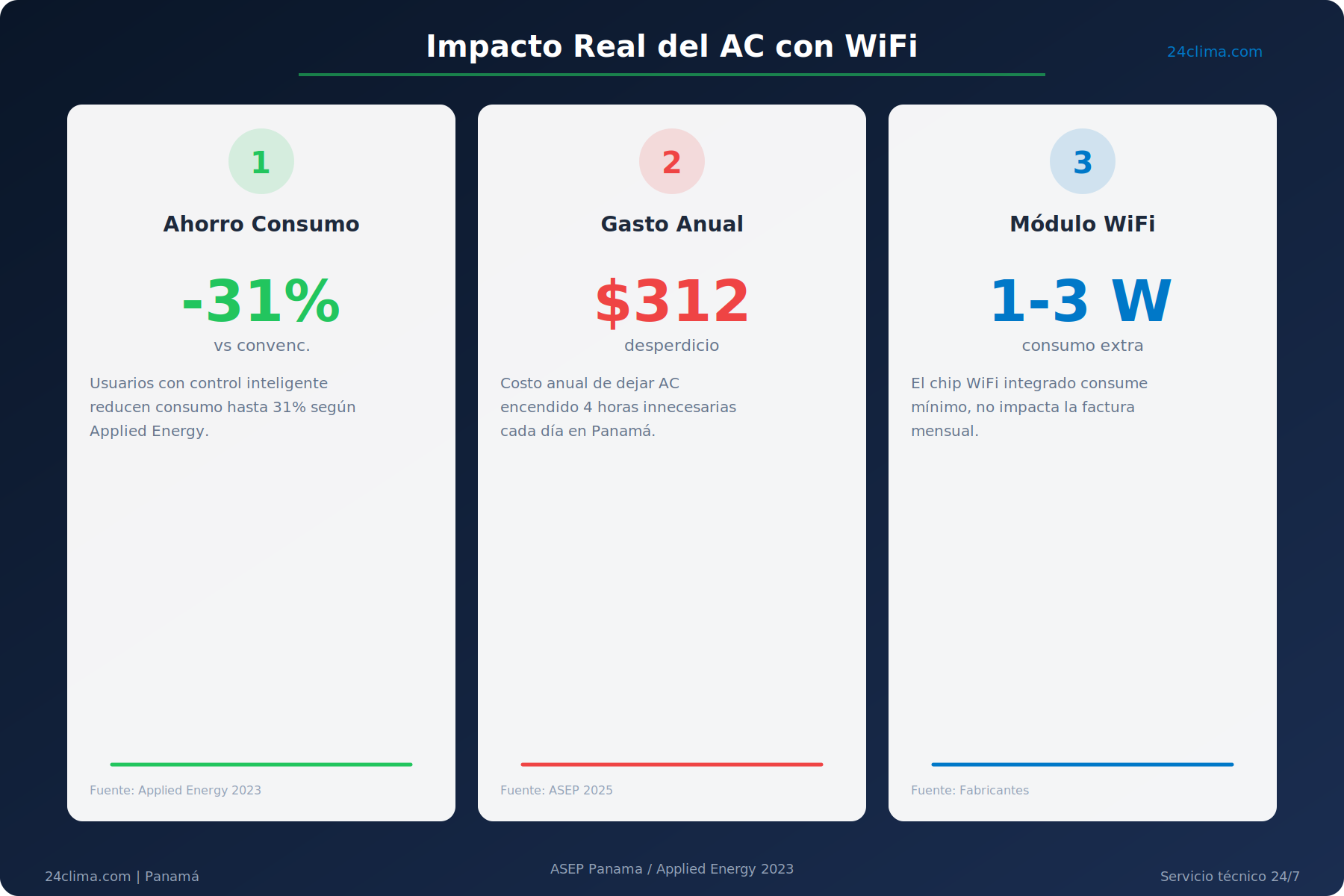
There's another common misconception: that a WiFi-equipped unit consumes more electricity than one without connectivity. The reality is the opposite. The integrated WiFi module in a modern split draws between 1 and 3 additional watts — a completely negligible amount. What changes is your ability to schedule, monitor, and adjust the unit with precision from anywhere, eliminating the inefficient habits that inflate your bill in the first place.
If you've been browsing our HVAC guides and tips for Panama, you'll know that user behavior is the single biggest factor affecting real-world electricity consumption — more than any technical specification on the manufacturer's label.
Why WiFi AC Makes Particular Sense in Panama
Panama's combination of constant heat, expensive electricity, and unpredictable work schedules creates exactly the conditions where remote AC control produces real, measurable savings.
A study published in Applied Energy (2023) found that users of smart climate control systems reduced energy consumption by 18% to 31% compared to users of similar conventional units, primarily because they could pre-cool spaces precisely rather than keeping units running during hours of inactivity.
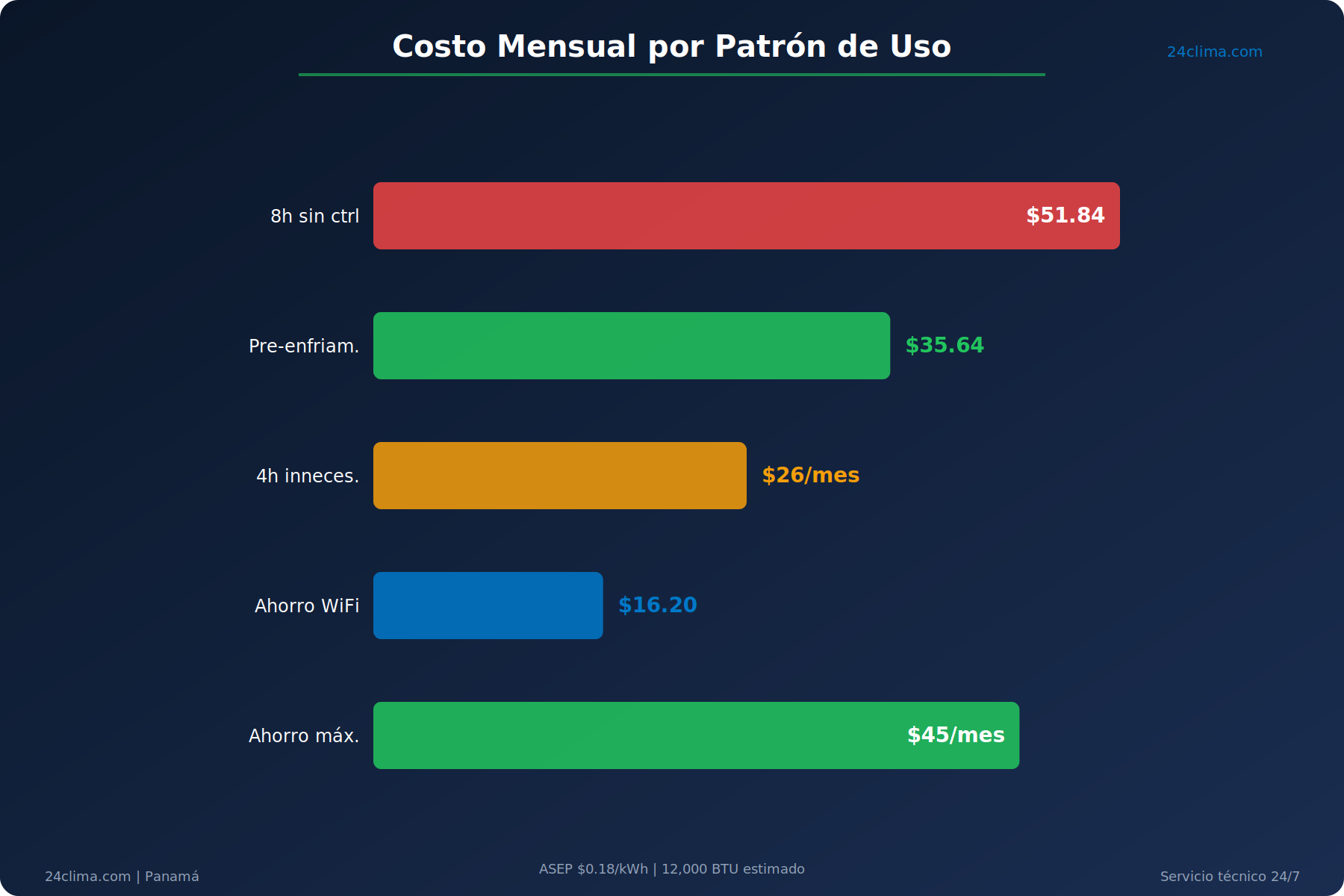
Put that in concrete terms for Panama: a 12,000 BTU unit consumes approximately 1.2 kW/h. If it runs 4 unnecessary hours per day — very common when people leave and forget to switch it off — that's 4.8 kWh wasted daily. At ASEP's $0.18/kWh rate, that's $0.86 per day, $26 per month, $312 per year. A WiFi unit eliminates that waste because you can turn it off from the office with one tap.
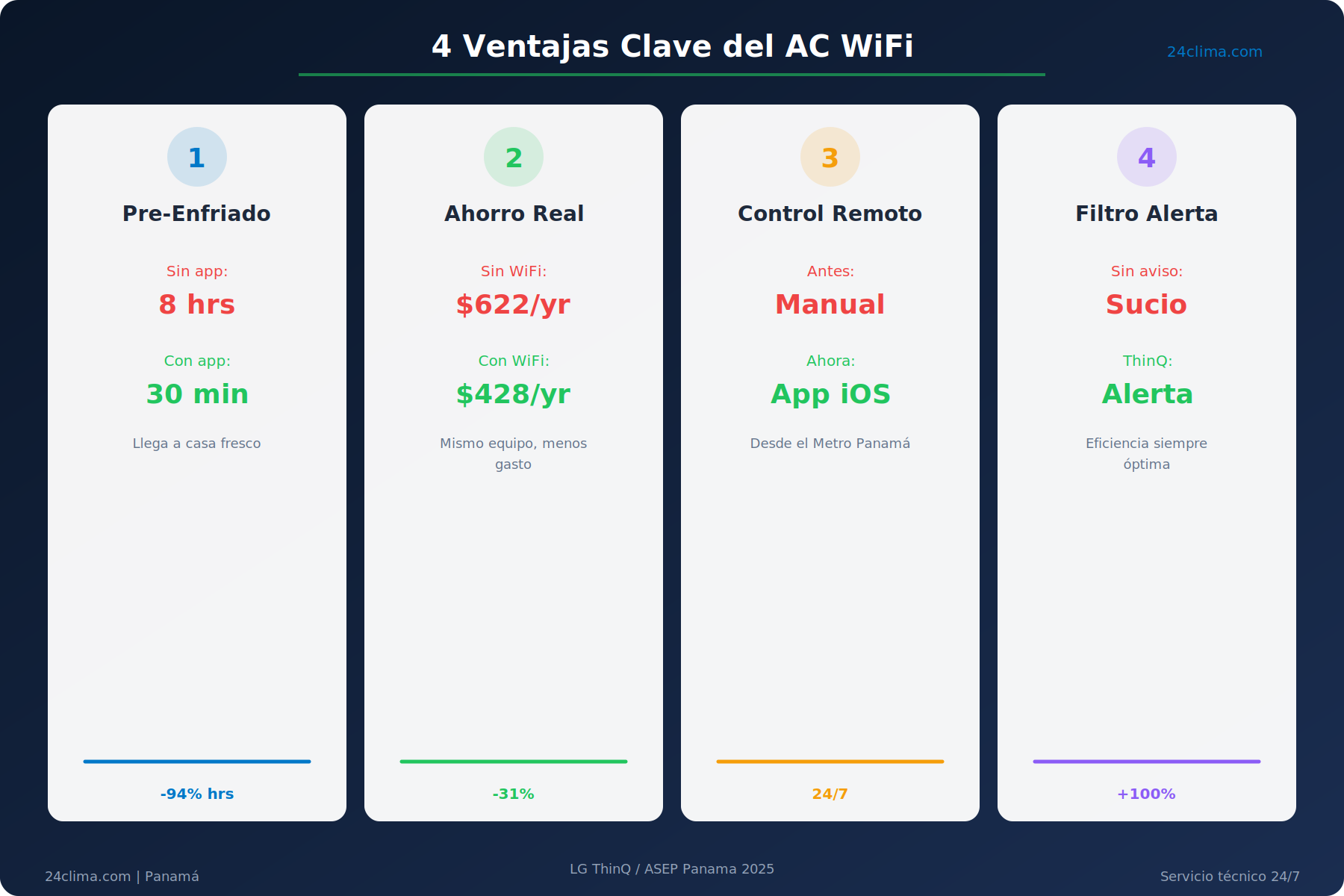
Smart pre-cooling is the other side of the equation. Switching the unit on 25 to 30 minutes before you arrive, instead of running it for 8 hours straight, can mean $35 to $45 in monthly savings in a two-bedroom apartment in Costa del Este or Miraflores, based on ASEP's residential tariff rates current as of 2025.
Infographic: Smart Pre-Cooling vs. Running It All Day
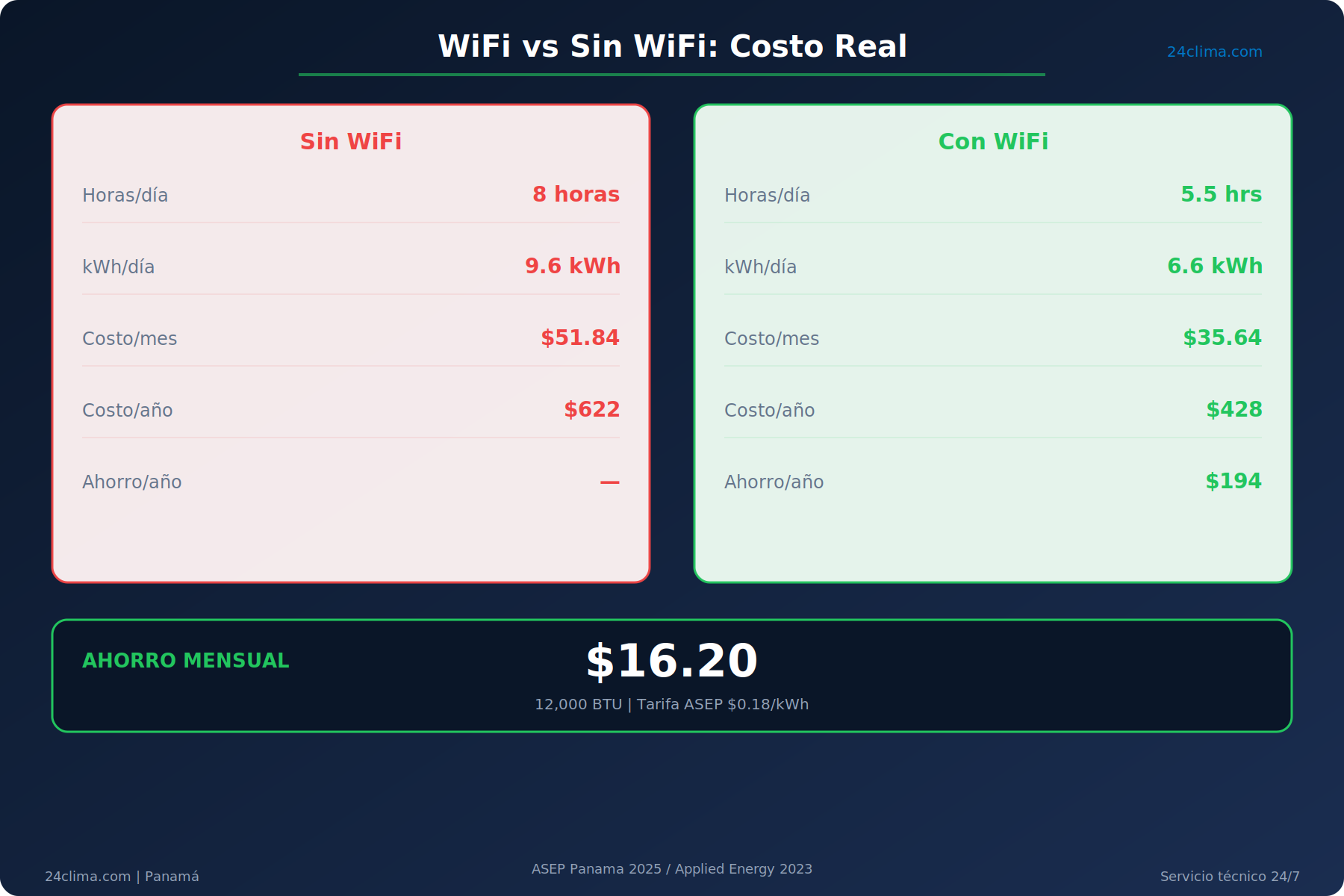
Scenario A — Unit left running while you're at work — Unit running: 8 hours daily with no one home — Estimated consumption: 9.6 kWh/day — Estimated monthly cost: $51.84
Scenario B — Pre-cool from your phone (30 minutes before you arrive) — Unit running: 30 min + actual hours of use (approximately 5 hours) — Estimated consumption: 6.6 kWh/day — Estimated monthly cost: $35.64
Monthly difference: approximately $16.20 from a single behavior change enabled by WiFi — same unit, same comfort level.
The WiFi AC Brands Available in Panama — and Which Ones Make the Most Sense
The main WiFi air conditioner brands available in Panama in 2025 are LG (ThinQ platform), Samsung (SmartThings), and Panasonic (nanoe-X WiFi series). All three are sold at Novey, Rodelag, and DoIt Center, with prices ranging from $650 to $1,400 depending on BTU capacity and model.
LG ThinQ
LG has the strongest presence in the Panamanian market for connected split units. The ThinQ app runs on iOS and Android, works with Amazon Alexa and Google Home, and lets you set schedules, view energy consumption history, and run remote diagnostics. The 12,000 BTU Dual Inverter WiFi models at Novey are generally priced between $780 and $920. ThinQ also sends alerts when the filter needs cleaning — genuinely useful in Panama, where humidity and dust can degrade unit efficiency within weeks.
Samsung SmartThings
Samsung integrates its air conditioners into the SmartThings ecosystem, which connects with other Samsung devices in your home — TVs, refrigerators, washing machines. It's the most complete option if you're already running a partially integrated Samsung household. Compatible with iOS, Android, Alexa, and Google Home. Samsung's 12,000 BTU inverter WiFi splits are available at DoIt Center and Rodelag between $820 and $1,050.
Panasonic nanoe-X with WiFi
Panasonic has a differentiator that's genuinely relevant to Panama's climate: nanoe-X technology, which ionizes the air and reduces bacteria, viruses, and odors. In a tropical environment with 85% humidity, where mold growth inside ducts and on the evaporator coil is a real and recurring problem, this feature has practical value — not just marketing appeal. Compatible with iOS and Android through the Panasonic Comfort Cloud app, with Google Home integration. Prices at Novey range from $950 to $1,300 for 12,000 BTU models.
Compatibility Table by Brand
Brand — App — iOS — Android — Alexa — Google Home — Where to Buy LG ThinQ — ThinQ — Yes — Yes — Yes — Yes — Novey, Rodelag, DoIt Center Samsung — SmartThings — Yes — Yes — Yes — Yes — DoIt Center, Rodelag Panasonic — Comfort Cloud — Yes — Yes — No — Yes — Novey, DoIt Center
Installing a WiFi AC in a Panama City Apartment — What You Need to Know
Installing a WiFi air conditioner in a Panamanian apartment follows the same process as any inverter split, with one additional step: network configuration. Most apartments in modern buildings in Punta Pacífica, Santa María, or Costa del Este have 220V circuits for units 18,000 BTU and above, and 110V for 9,000 to 12,000 BTU units. Verify this before you buy — getting it wrong means the unit goes back on a truck.
The full process:
1️⃣ Check the circuit voltage in the installation area (110V or 220V) — this determines which models you can actually install
2️⃣ Have a certified technician install the inverter split (indoor unit, outdoor unit, and data cabling)
3️⃣ Connect the unit to power and confirm basic operation before setting up the WiFi
4️⃣ Download the relevant app (ThinQ, SmartThings, or Comfort Cloud) on iOS or Android
5️⃣ Make sure your home WiFi runs on 2.4 GHz — most AC units are not compatible with 5 GHz-only networks, which are increasingly common with modern routers in Panama
6️⃣ Follow the pairing process inside the app — it typically takes between 4 and 8 minutes
7️⃣ Set your preferred schedules, arrival temperatures, and consumption alerts
One thing I see consistently in Panama City: buildings in San Francisco, Bella Vista, and the banking district often have weak WiFi signal in bedrooms far from the main router. If the unit's WiFi module can't hold a stable connection, the smart functions drop out entirely. Fix it before the technician arrives — a network extender or secondary access point solves it cleanly.
For the electrical side, our air conditioner installation service in Panama City covers all districts and checks your wiring before any work begins.
Infographic: WiFi Setup Process in a Panama Apartment
Step 1 — Verify available voltage (110V or 220V) Step 2 — Physical installation of the split by a certified technician Step 3 — Confirm router is broadcasting on 2.4 GHz Step 4 — Download the brand's official app Step 5 — Pair the unit with the app (4 to 8 minutes) Step 6 — Set arrival schedule and preferred temperature Step 7 — Activate consumption and maintenance alerts
Does a WiFi Inverter Use Less Power Than a Regular Inverter?
At the hardware level, the difference in consumption between a WiFi inverter and a non-WiFi inverter is 1 to 3 watts — essentially nothing. According to ENERGY STAR data (2024 update), smart-platform-equipped units, when used correctly, show 20 to 25% lower annual consumption compared to equivalent units without remote control, entirely because of improved owner behavior patterns.
The inverter optimizes the compression cycle. The WiFi optimizes what people actually do. Both together are what produce the real savings on your ENSA or EDEMET bill.
If you want a closer look at how inverter technology works and why it's especially efficient in Panama's climate, our AC maintenance service at 24Clima includes an energy performance review and model-specific recommendations.
Frequently Asked Questions
Which WiFi air conditioner brands are sold in Panama?
In 2025, the main brands with integrated WiFi available in Panama are LG (ThinQ), Samsung (SmartThings), and Panasonic (nanoe-X with Comfort Cloud). All are available at Novey, Rodelag, and DoIt Center. LG has the widest range of models and the lowest entry price of the three.
Can I control my air conditioner from my phone in Panama?
Yes, as long as the unit has a built-in WiFi module and your home network runs on 2.4 GHz. The LG, Samsung, and Panasonic apps all work in Panama without any regional restrictions. You can add voice control through Alexa or Google Home if you already have those devices at home.
Does a smart AC actually use less electricity in a tropical climate?
The unit itself doesn't consume less power just because it has WiFi. What reduces consumption is the change in how you use it: switching it off remotely, pre-cooling for 25 to 30 minutes instead of running it all day, and monitoring real consumption through the app. In Panama's climate, that control translates into $20 to $45 in monthly savings depending on the unit size and your actual usage hours.
Back on the Metro
That packed train car scenario isn't a future fantasy. WiFi-equipped units are already sitting on the shelves at Novey at prices comparable to what standard splits cost three years ago. The difference between walking into a hot apartment and walking into a cool one isn't magic — it's a schedule built around your actual daily routine.
At 24Clima we install and configure WiFi units throughout Panama City, check your apartment's electrical wiring before any work starts, and leave you with the app running and your schedules set from day one. If you're weighing options or want to know which model fits your space, contact us on WhatsApp at https://24clima.com/contacto/ — straight answers, no sales brochure.
Last updated: May 2025