Real AC Power Consumption — What Your Electric Bill Actually Shows in Panama (And How to Calculate It Precisely)
It's 2 in the afternoon in Costa del Este. The sun hammers down on the concrete and the thermometer reads 91°F with humidity that feels like a damp towel pressed against your skin. You walk through the door, flip on the 12,000 BTU unit in the bedroom, and the relief is instant. You do it every day. You do it without thinking.
Then the ENSA or EDEMET bill arrives.
The number stops you. Not catastrophic, but higher — again. And the question nobody has ever answered with real data surfaces: exactly how much power does that air conditioner use per hour, and how do I calculate it without guessing? That's what this article solves. No vague promises, no marketing language. Just numbers.
What Most People Believe — And Why They're Wrong
The most common assumption is that AC power consumption depends mainly on BTU rating. More BTUs, more electricity. Simple. But that logic is incomplete, and in Panama's tropical climate — where humidity hovers around 85% and nighttime temperatures rarely drop below 79°F — ignoring the other variables costs you real money every month.
What actually determines how much your air conditioner consumes is a combination of four variables: the unit's nominal BTU rating, the technology type (conventional fixed-speed or inverter), daily hours of use, and the condition of the equipment. A dirty filter alone can increase consumption by up to 15%, according to the U.S. Department of Energy (DOE, 2023). Most people only know the first variable.
The second common mistake is assuming an inverter unit "barely uses any power." It uses less, yes — but how much less depends entirely on how you use it and under what conditions. Let's get to the numbers.
How Real AC Consumption Is Measured in kWh
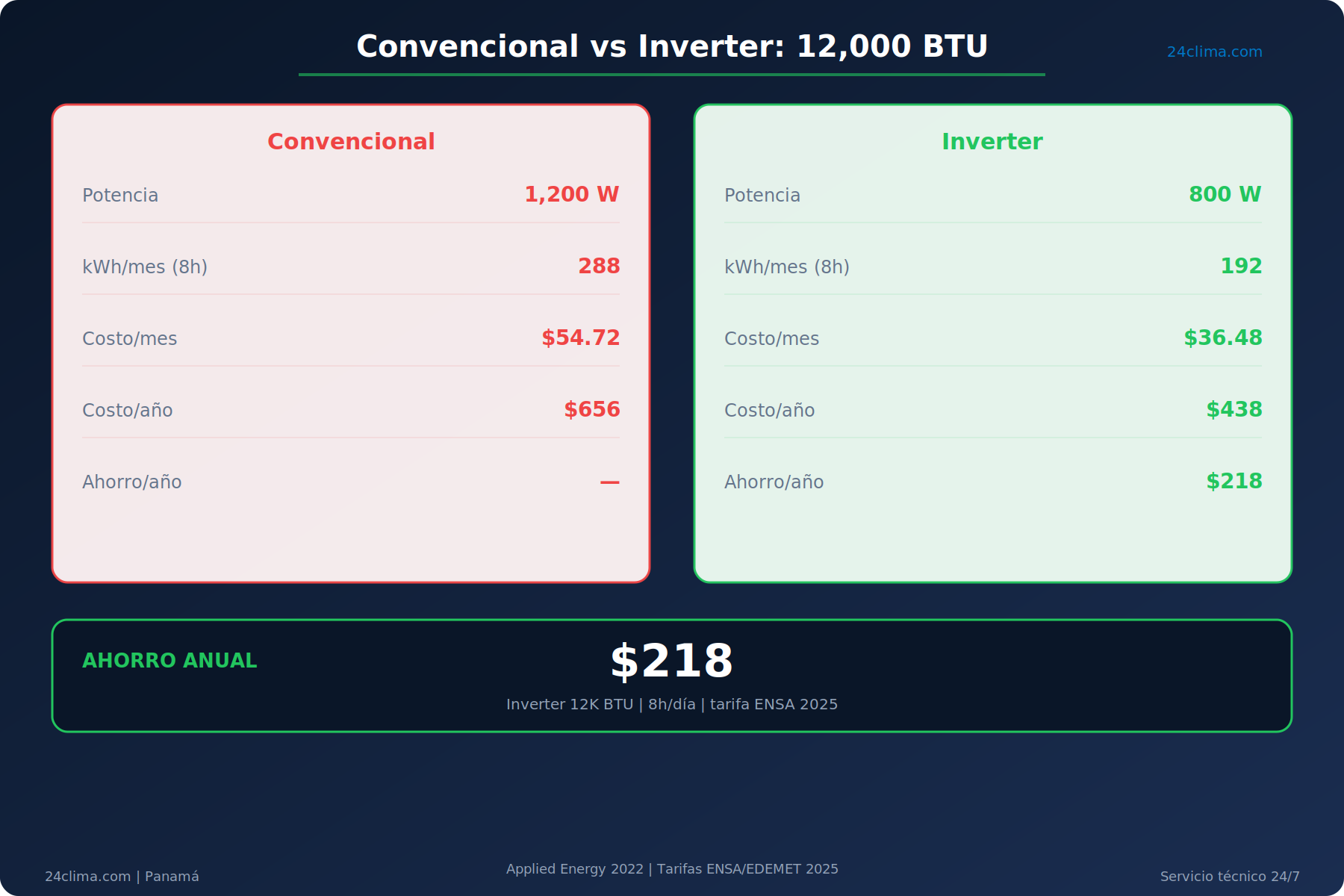
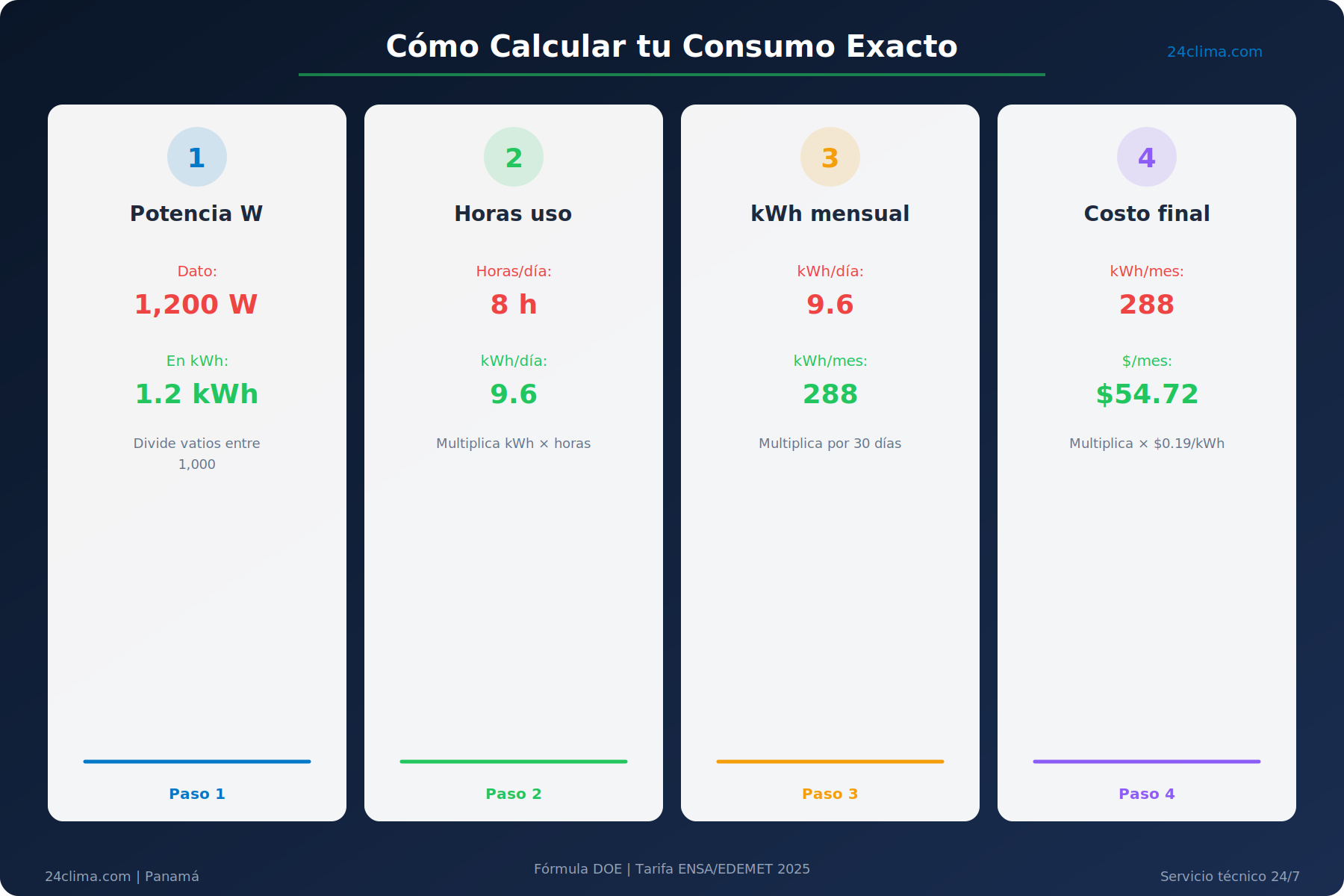
The formula is straightforward: divide the nominal wattage by 1,000, then multiply by hours of use. A conventional 12,000 BTU unit drawing 1,200 watts consumes 1.2 kWh for every hour of continuous operation. In Panama, continuous operation is the rule, not the exception.
The reason is the climate. A conventional fixed-speed unit runs at 100% capacity or shuts off completely — there is no middle setting. With outdoor temperatures between 88°F and 93°F and humidity above 80%, a conventional unit in a standard room runs between 75% and 90% of the time it stays switched on. Leave it running for 8 hours and the compressor is actively pumping refrigerant for 6 to 7.2 of those hours.
An inverter unit works differently. It adjusts compressor speed continuously — starting at full power to pull the temperature down quickly, then dialing back to 30% to 50% capacity to hold the target temperature. A study published in Applied Energy (2022) found that inverter systems consume between 30% and 50% less energy than equivalent conventional units under continuous tropical use conditions. In Panama, that range matches what we see consistently in the field.
Actual Consumption by Unit Size — Panama 2025 Data
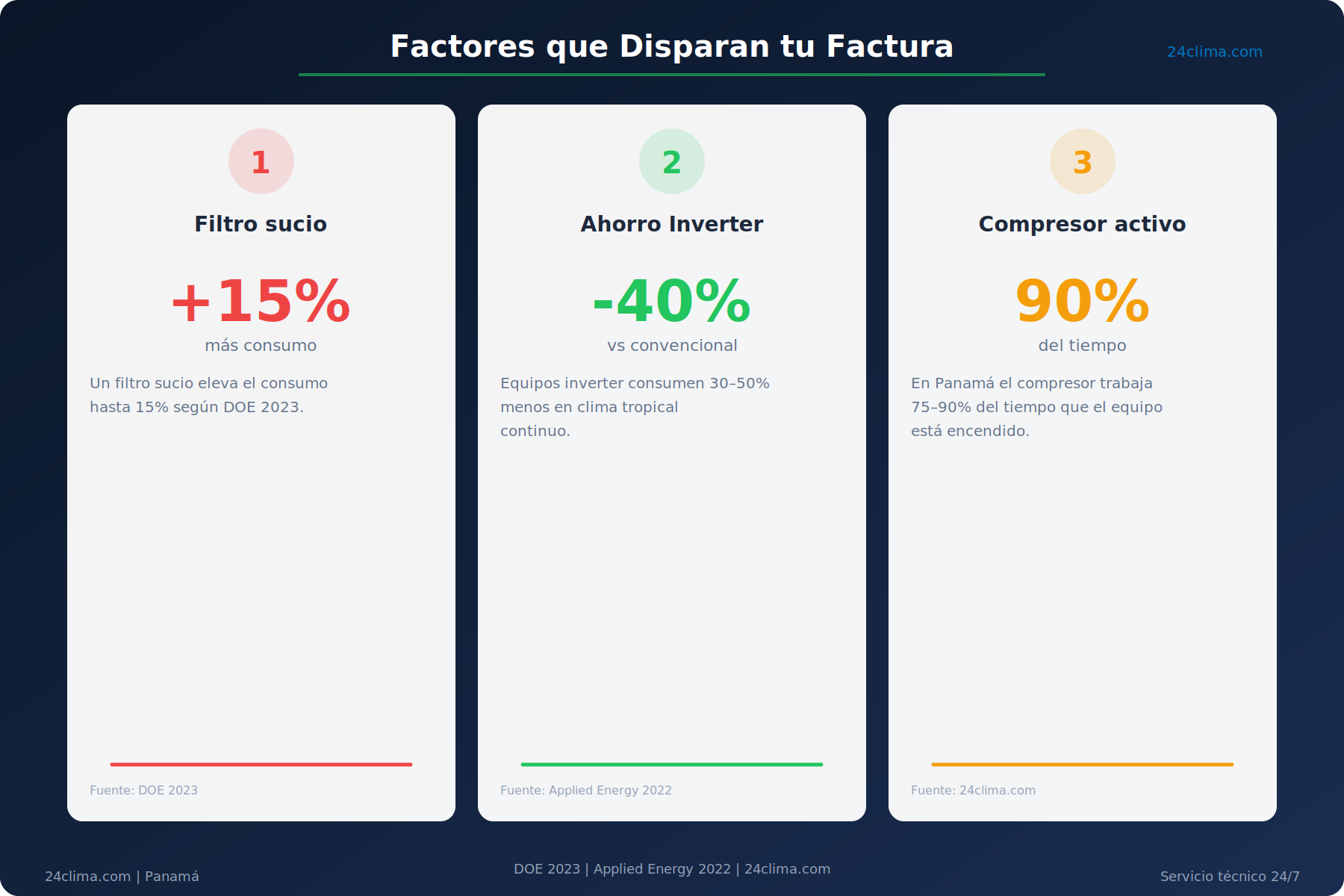
This is the information people search for most and find least — real local data. The figures below use typical wattage values for mid-range equipment available in Panama (brands including LG, Daikin, Midea, and Gree), applied against the current ENSA/EDEMET average residential tariff for 2025, which runs between $0.17 and $0.19 per kWh depending on your consumption tier and distributor.
9,000 BTU Unit — Conventional
— Typical nominal draw: 900 W (0.9 kWh per hour) — 6 hours daily: 5.4 kWh/day → 162 kWh/month → $27.54 to $30.78/month — 8 hours daily: 7.2 kWh/day → 216 kWh/month → $36.72 to $41.04/month — 12 hours daily: 10.8 kWh/day → 324 kWh/month → $55.08 to $61.56/month
9,000 BTU Unit — Inverter
— Average real operating draw: ~600 W (variable cycle) — 6 hours daily: 3.6 kWh/day → 108 kWh/month → $18.36 to $20.52/month — 8 hours daily: 4.8 kWh/day → 144 kWh/month → $24.48 to $27.36/month — 12 hours daily: 7.2 kWh/day → 216 kWh/month → $36.72 to $41.04/month
12,000 BTU Unit — Conventional
— Typical nominal draw: 1,200 W (1.2 kWh per hour) — 6 hours daily: 7.2 kWh/day → 216 kWh/month → $36.72 to $41.04/month — 8 hours daily: 9.6 kWh/day → 288 kWh/month → $48.96 to $54.72/month — 12 hours daily: 14.4 kWh/day → 432 kWh/month → $73.44 to $82.08/month
12,000 BTU Unit — Inverter
— Average real operating draw: ~800 W — 6 hours daily: 4.8 kWh/day → 144 kWh/month → $24.48 to $27.36/month — 8 hours daily: 6.4 kWh/day → 192 kWh/month → $32.64 to $36.48/month — 12 hours daily: 9.6 kWh/day → 288 kWh/month → $48.96 to $54.72/month
18,000 BTU Unit — Conventional
— Typical nominal draw: 1,750 W (1.75 kWh per hour) — 6 hours daily: 10.5 kWh/day → 315 kWh/month → $53.55 to $59.85/month — 8 hours daily: 14.0 kWh/day → 420 kWh/month → $71.40 to $79.80/month — 12 hours daily: 21.0 kWh/day → 630 kWh/month → $107.10 to $119.70/month
18,000 BTU Unit — Inverter
— Average real operating draw: ~1,150 W — 6 hours daily: 6.9 kWh/day → 207 kWh/month → $35.19 to $39.33/month — 8 hours daily: 9.2 kWh/day → 276 kWh/month → $46.92 to $52.44/month — 12 hours daily: 13.8 kWh/day → 414 kWh/month → $70.38 to $78.66/month
24,000 BTU Unit — Conventional
— Typical nominal draw: 2,200 W (2.2 kWh per hour) — 6 hours daily: 13.2 kWh/day → 396 kWh/month → $67.32 to $75.24/month — 8 hours daily: 17.6 kWh/day → 528 kWh/month → $89.76 to $100.32/month — 12 hours daily: 26.4 kWh/day → 792 kWh/month → $134.64 to $150.48/month
24,000 BTU Unit — Inverter
— Average real operating draw: ~1,450 W — 6 hours daily: 8.7 kWh/day → 261 kWh/month → $44.37 to $49.59/month — 8 hours daily: 11.6 kWh/day → 348 kWh/month → $59.16 to $66.12/month — 12 hours daily: 17.4 kWh/day → 522 kWh/month → $88.74 to $99.18/month
Technical note: inverter average wattage figures represent mean load during continuous operation with 88°F (31°C) outdoor temperature and a 75°F (24°C) indoor target — representative conditions for Panama. Actual draw varies based on room insulation, solar orientation, and equipment condition.
Why Your Bill Climbs Higher Than These Numbers Suggest
The figures above assume a unit in good working condition. In practice, three factors push real consumption well above those baselines in Panama.
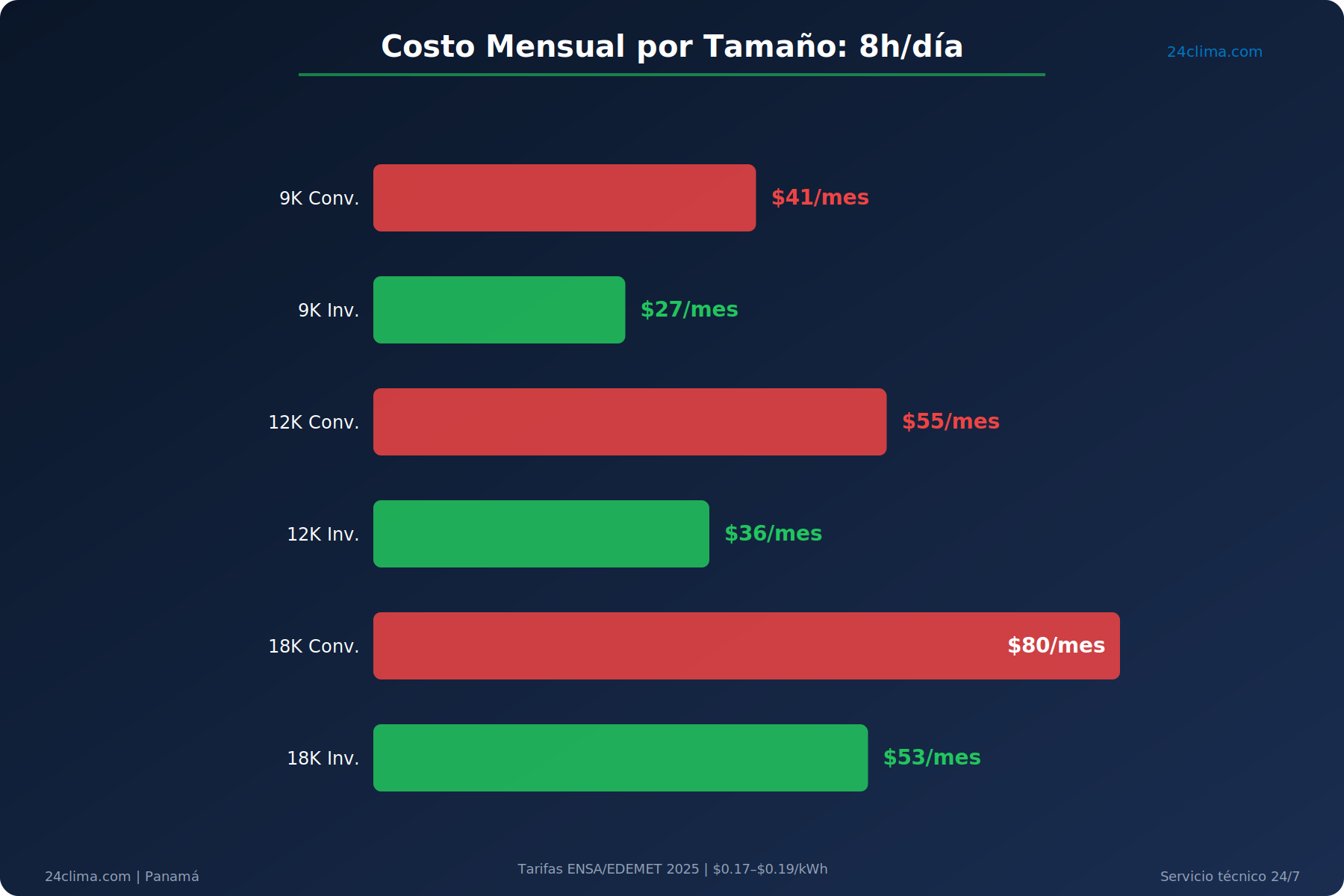
Dirty filters. A clogged filter restricts airflow and forces the compressor to run longer to reach the target temperature. The DOE calculates that a dirty filter can increase consumption by 5% to 15%. In Panama, where humidity and dust accelerate buildup, a unit that has gone more than three months without cleaning can easily sit in that penalty range. A professional cleaning service addresses this directly and can produce a measurable reduction on your bill starting the first month.
Low refrigerant. If your unit has a refrigerant leak, the compressor runs nonstop trying to hit the temperature the thermostat is asking for — and never gets there. Maximum power draw, minimum cooling output. This is the classic scenario behind the complaint: "the AC doesn't cool like it used to and my bill keeps going up." There is no mystery — it's straightforward physics.
Wrong size for the space. A 9,000 BTU unit in a sun-facing living room in San Francisco (Panama) covering 430 square feet will run at 100% capacity permanently without ever reaching the target temperature. It draws power like a large unit but delivers the performance of a small one. Oversizing creates the opposite problem: a unit too large for the space cools the air fast but fails to dehumidify properly, and the short on-off cycles wear down the compressor while generating extra consumption during each restart surge.
Inverter vs Conventional — Real Hour-by-Hour Consumption
A 12,000 BTU inverter unit in a typical 200 square foot bedroom in Panama operates like this on an average night: full power (1,200 to 1,400 W) for the first 15 to 25 minutes, dropping to mid-range (600 to 700 W) during the hold phase, and tapering to around 30% capacity (roughly 350 W) during the cooler predawn hours.
A conventional unit of the same size in the same room runs at 1,200 W, cools down, shuts off, then restarts. Each restart draws a surge equivalent to 3 to 5 times the nominal wattage for a fraction of a second during compressor startup. Over a single night, a conventional unit may cycle on and off between 15 and 30 times. That adds up.
The practical result: based on field data from Panama installers monitoring consumption with Kill-A-Watt meters, a 12,000 BTU inverter used 8 hours daily costs between $12 and $18 less per month than an equivalent conventional unit under identical conditions. Over a year, that's $144 to $216 in savings — enough to close the price gap between the two technologies within a reasonable time frame.
Habits That Lower Your Bill Without Sacrificing Comfort
None of these require buying new equipment. They're usage adjustments with a direct impact on what you pay.
Raise the thermostat from 72°F to 75°F (22°C to 24°C). Each additional degree of target temperature reduces consumption by 6% to 8% (ASHRAE, 2021). At 75°F in Panama, the air genuinely feels cool because the humidity is already being controlled — which is what actually makes you uncomfortable, not the temperature alone.
Use the fan on "Auto" mode, not "High." High fan speed makes noise but doesn't cool the room faster — it just circulates air that's already cold. The compressor is what does the cooling.
Switch the unit off 30 minutes before you leave. The room holds its temperature during that window and you stop burning energy to cool a space no one is using.
Keep doors and windows closed while the unit runs. This seems obvious. It's not — many people quietly air-condition adjacent hallways and rooms without realizing it.
Clean or replace the filter every 30 days in Panama. Not every 90 days as the manual states — because that manual was written for South Korea or the American Midwest. Panama has higher humidity, more airborne particulate matter, and more organic particles in the air. Thirty days.
Don't place the unit opposite a window with direct sun exposure. The temperature sensor picks up radiant heat and reads the room as warmer than it actually is, which causes the compressor to overwork.
Frequently Asked Questions About AC Consumption in Panama
How many kWh does a 12,000 BTU air conditioner use per hour in Panama?
A conventional 12,000 BTU unit consumes approximately 1.2 kWh per hour of operation. An inverter unit of the same size averages between 0.7 and 0.9 kWh per hour, depending on outdoor temperature and equipment condition. In Panama's climate — 88°F (31°C) outdoors, 85% humidity — real consumption tends toward the upper end of that range during peak daytime hours.
How much does running AC 8 hours a day add to my electric bill?
With a conventional 12,000 BTU unit running 8 hours daily, the additional charge on your bill runs between $49 and $55 per month at the current ENSA/EDEMET residential rate ($0.17 to $0.19/kWh). With an equivalent inverter unit, that figure drops to between $33 and $36 per month. If your baseline bill before adding AC was $60 to $80, a realistic total with moderate use lands between $100 and $130.
Does an inverter really use less power than a conventional unit in practice?
Yes, and the difference is measurable. Under conditions of continuous use in a tropical climate — which describes Panama precisely — the inverter advantage is more pronounced than in temperate regions. When outdoor temperatures rarely drop, the unit never gets a real break. In that scenario, the inverter's ability to modulate output instead of cycling on and off generates real monthly savings of $12 to $18 on a 12,000 BTU unit with 8 hours of daily use. The inverter is not a marketing trick — it is a thermodynamic advantage.
The Bill That Arrived This Month Has a Technical Explanation
Go back to that afternoon in Costa del Este. The unit you switched on without thinking draws between 1.2 and 2.2 kWh every hour, depending on the equipment. Multiply by the hours in a month, multiply by your distributor's rate, and that number is exactly what appears on your bill. No mystery.
What can vary significantly — and in your favor — is whether that consumption is running clean or whether you're paying 15% to 20% more than necessary because of a dirty filter, a refrigerant leak, or a usage habit that takes five minutes to fix. If you want to know exactly what condition your unit is in and how much you could realistically save with a technical adjustment, contact us on WhatsApp at https://24clima.com/contacto/ — at 24Clima we assess your unit's actual consumption, not just the brand name and BTU rating. No commitment required, just a straight answer.
Last updated: June 2025