How Long Does It Take an Air Conditioner to Cool a Room in Panama?
It's 2 in the afternoon in Costa del Este. The sun is hammering the concrete, the asphalt radiates heat like an open oven, and your phone shows 33°C (91°F) — but the "feels like" is pushing 40°C (104°F) with 87% humidity. You get back to your apartment, switch on the 12,000 BTU split you bought six months ago, and stand there in front of the indoor unit waiting for that instant relief you imagined when you signed the lease.
Five minutes pass. Ten minutes. The room still feels like a sauna. You check the panel, confirm it's in cool mode, drop the temperature setting to 18°C (64°F) — nothing changes. And that's when the question hits you, the same one thousands of expats and locals ask every year: is this thing broken, or does it just take longer than I expected?
The honest answer: cooling a room in Panama does not work the same way it does in Miami, Madrid, or any city with a temperate climate. The laws of physics don't change, but the starting conditions are completely different — and understanding that difference is what separates a real problem from normal operation. You'll find more across the guides and tips at 24clima.com, but this article goes straight to the point.
What Most People Assume — And Why They're Wrong
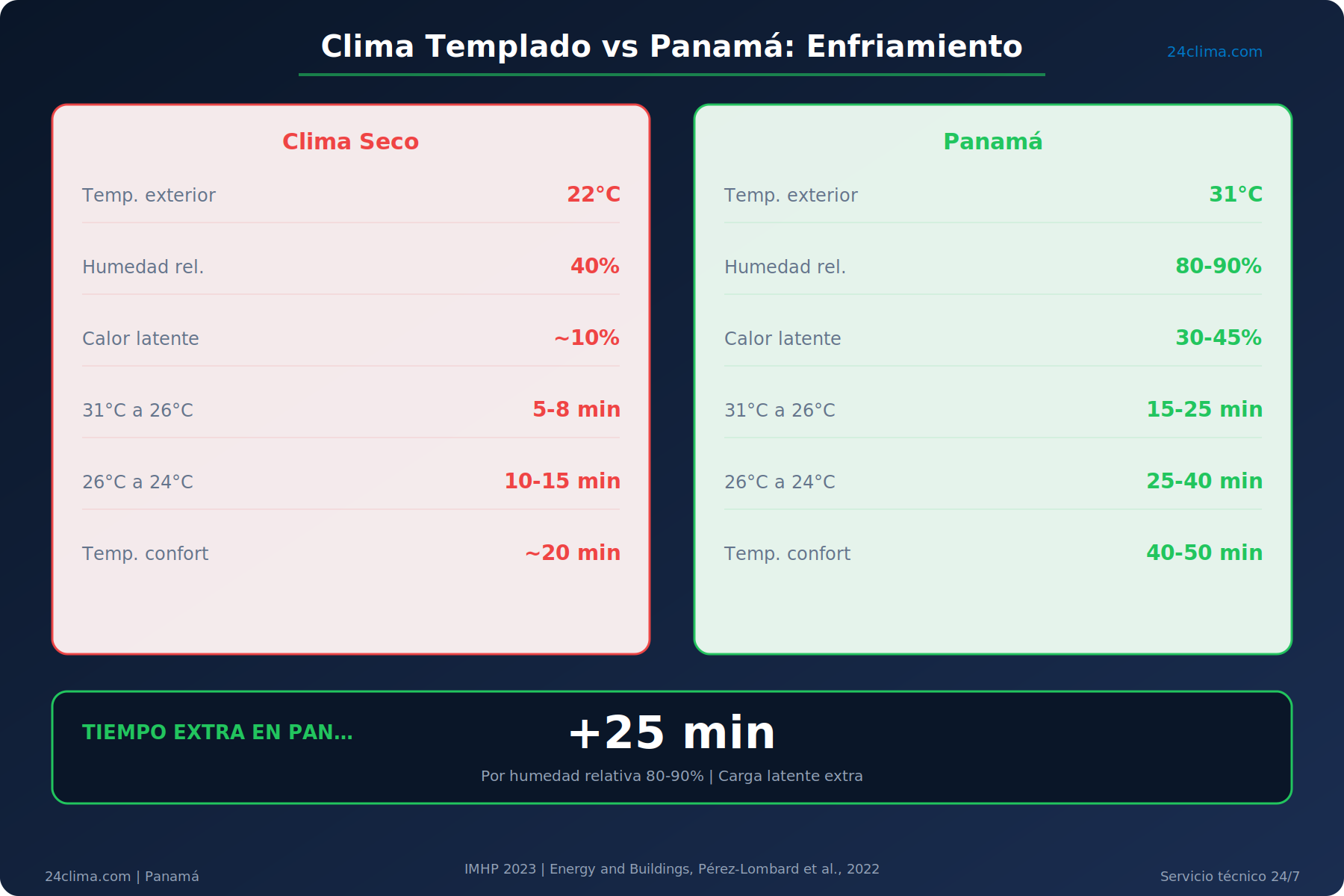
The most common assumption is that a "new, powerful" air conditioner should cool a room in under five minutes. If it doesn't, something's wrong. That idea comes from advertisements and from experiences in cooler countries where outdoor air is already around 22°C (72°F) and the unit only needs to shave off a few degrees.
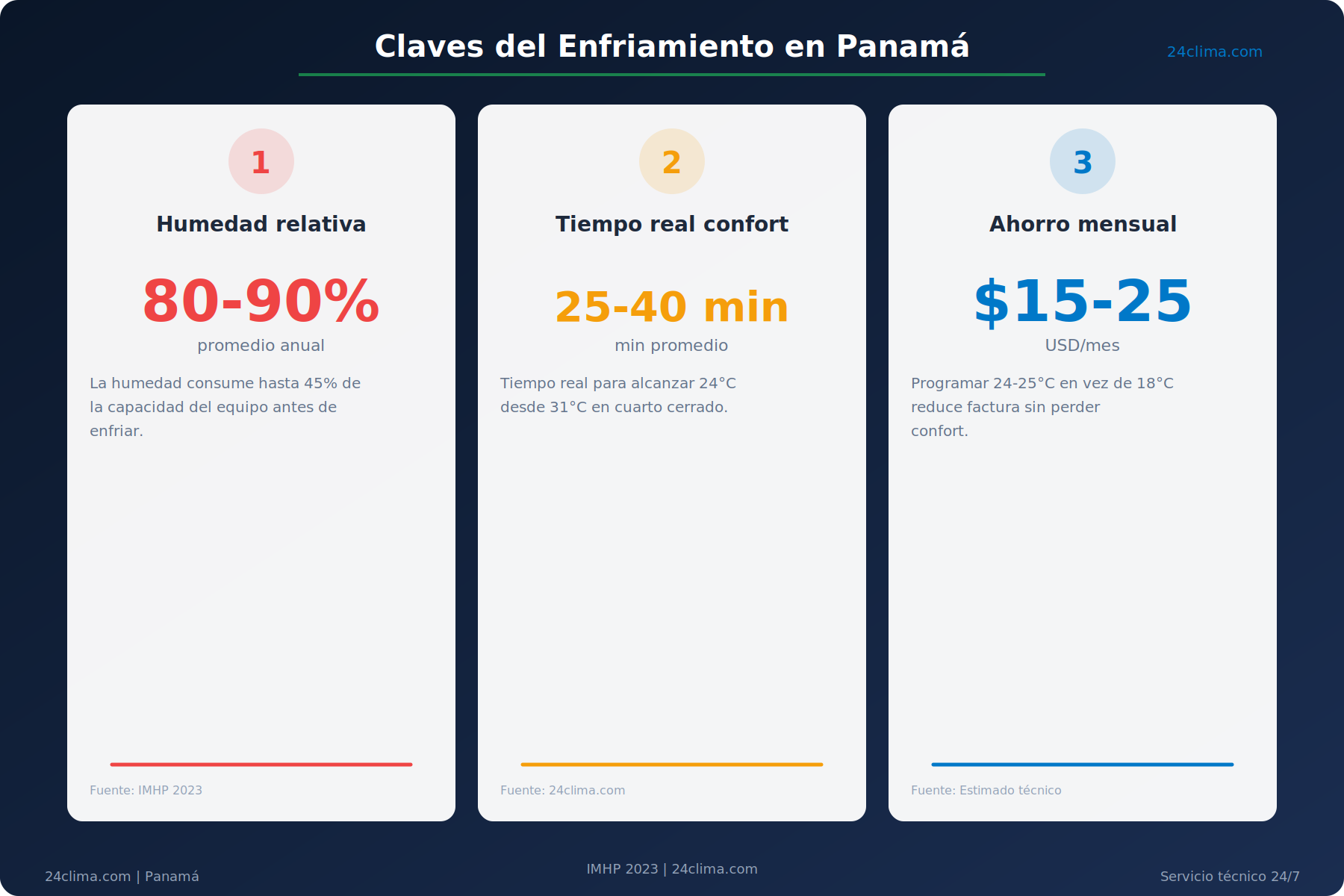
Panama is a different situation entirely. Outdoor air averages 31°C (88°F) with relative humidity between 75% and 90% for most of the year, according to data from Panama's Institute of Meteorology and Hydrology (IMHP, 2023). That means your AC isn't just lowering the temperature — it's pulling massive amounts of moisture out of the air before you actually feel any cooling effect on your skin. Humidity is the invisible enemy nobody mentioned when you bought the unit.
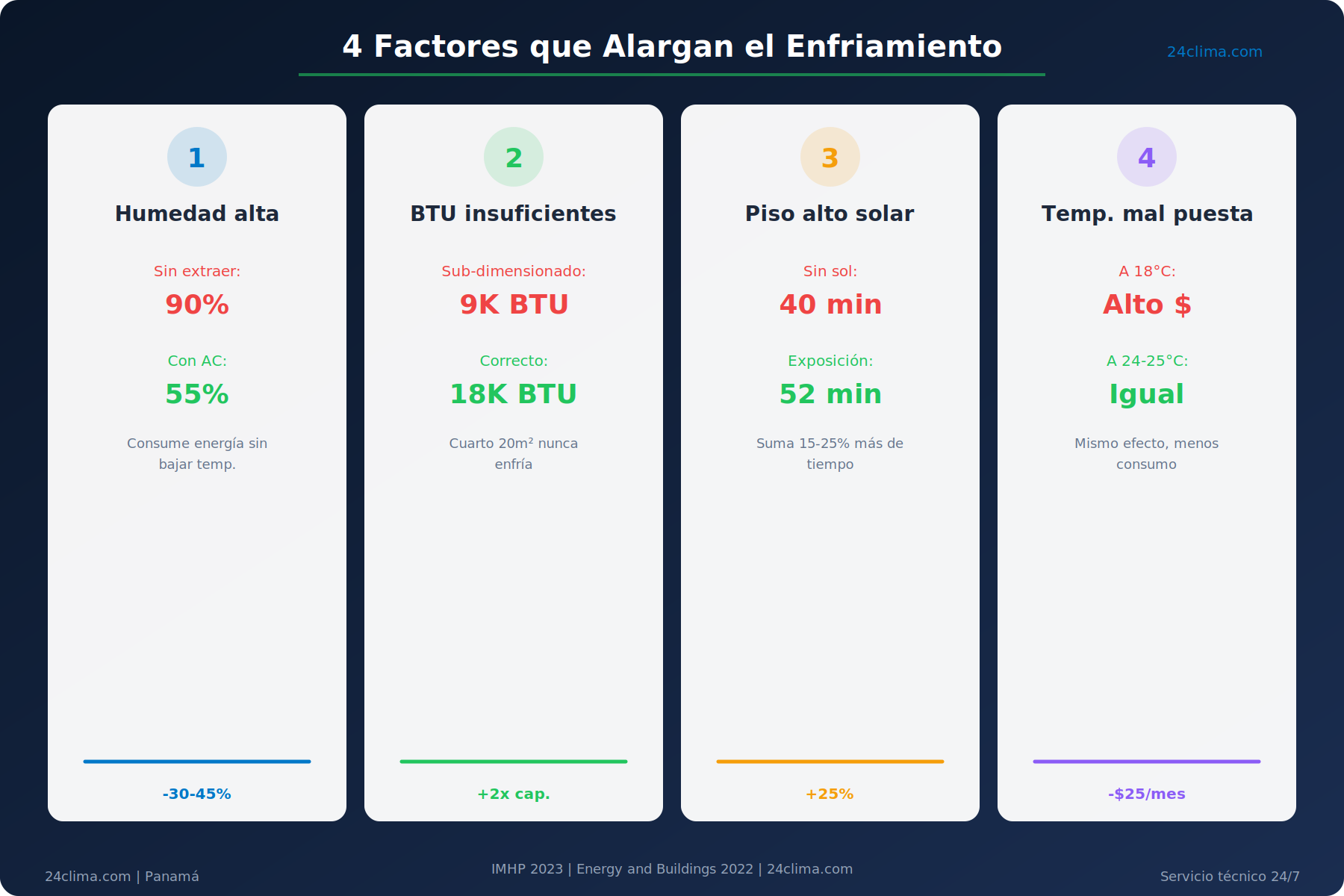
A lot of people also crank the thermostat down to 18°C (64°F) thinking it will cool the room faster. It doesn't. A split system doesn't speed up its refrigeration cycle because you set a lower target — it runs at the same rate until it hits that number, burning more electricity and delaying the automatic shutoff. Setting 24°C or 25°C (75°F or 77°F) cools the room just as fast and saves you between $15 and $25 a month on your electricity bill.
How Long It Should Actually Take
Under normal Panama conditions — room sealed, outdoor temperature 31°C (88°F), humidity around 80% — a correctly sized air conditioner should drop the temperature from 31°C to 26°C (88°F to 79°F) within the first 15 to 20 minutes, and reach a comfortable 24°C–25°C (75°F–77°F) between 25 and 40 minutes of continuous operation.
That's slower than what you'd see in a dry climate with 25°C (77°F) outdoor air, and there's a concrete physical reason for it: the system must first condense moisture out of the air — a process that consumes energy without visibly dropping the room temperature — before the cooling effect becomes something you can actually feel.
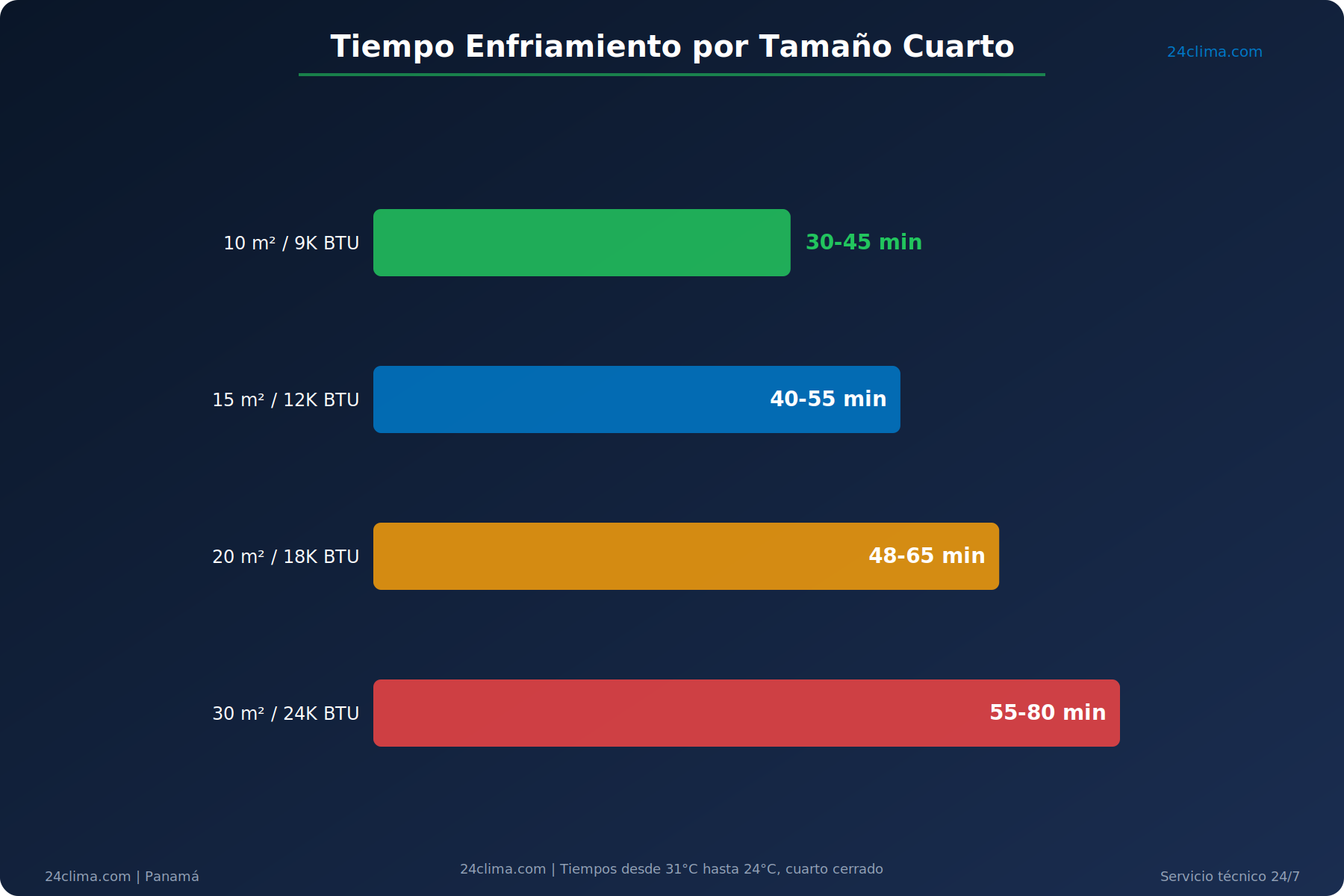
The table below shows estimated cooling times for residential rooms in Panama's climate, with correctly sized equipment, a sealed room, and a starting temperature of 31°C (88°F):
Recommended BTU and Cooling Time by Room Size in Panama
— 10 m² (108 sq ft) — 9,000 BTU minimum — From 31°C to 26°C (88°F to 79°F) in 10–15 min — From 26°C to 24°C (79°F to 75°F) in an additional 20–30 min — 15 m² (161 sq ft) — 12,000 BTU minimum — From 31°C to 26°C (88°F to 79°F) in 15–20 min — From 26°C to 24°C (79°F to 75°F) in an additional 25–35 min — 20 m² (215 sq ft) — 18,000 BTU minimum — From 31°C to 26°C (88°F to 79°F) in 18–25 min — From 26°C to 24°C (79°F to 75°F) in an additional 30–40 min — 30 m² (323 sq ft) — 24,000 BTU minimum — From 31°C to 26°C (88°F to 79°F) in 20–30 min — From 26°C to 24°C (79°F to 75°F) in an additional 35–50 min
Technical note: these times assume adequate insulation (windows closed, door sealed), correct refrigerant charge, and clean filters. On upper floors with direct sun exposure, add 15% to 25% more time.
Why Panama's Climate Demands More Time Than Temperate Climates
Sensible heat versus latent heat — that distinction explains everything.
When your air conditioner runs, it extracts two types of heat from the space: sensible heat (which lowers the temperature on a thermometer) and latent heat (which removes moisture from the air). In dry climates, nearly all of the unit's energy goes toward sensible heat — the room cools quickly and the thermometer drops fast.
In Panama, with relative humidity between 80% and 90%, a significant portion of the unit's capacity goes toward pulling water out of the air before the temperature drops. A study published in Energy and Buildings (Pérez-Lombard et al., 2022) documented that in tropical climates with humidity above 75%, latent heat can account for 30% to 45% of the total thermal load in a residential space. That means your 12,000 BTU unit is effectively spending between 3,600 and 5,400 BTU on moisture removal before it even starts cooling the air you can feel.
The practical result: in Panama you need 20% to 30% more BTU capacity than a standard sizing calculation designed for temperate climates would suggest. If a generic chart says a 15 m² (161 sq ft) room needs 9,000 BTU, here you need at least 12,000 — and on floors with direct sun exposure or metal roofing, 14,000 BTU or more.
Older buildings in neighborhoods like El Cangrejo, Bellavista, or Casco Viejo add another layer of difficulty. Their walls have no thermal insulation. Heat conducts through from the outside far more easily than in modern construction, increasing the room's thermal load and extending the time needed to stabilize the temperature.
Real Reasons Your AC Is Cooling Slowly — And How to Diagnose Them
If your air conditioner is taking more than 50 to 60 minutes to cool a correctly sized room, there's a real problem. Here are the most common causes, ranked from most to least frequent:
Dirty filters
This is the number one cause. A clogged filter reduces airflow by up to 40%, according to ASHRAE Standard 52.2. The unit works harder, draws more electricity, and cools less. Rinse the filter with water, let it dry completely, and reinstall it. Do this every 30 days in Panama — not every three months like the manual says, because that manual was written for dry climates.
Low refrigerant charge
A unit that has lost refrigerant struggles to cool. Warning signs: the split runs continuously but the room won't drop below 28°C (82°F), the outdoor unit has visible frost on the lines, or the copper piping between the two units feels unusually cold or warm to the touch. This isn't a DIY diagnosis — it requires a technician with pressure gauges. If you suspect this, get a professional inspection before the issue damages the compressor.
Insufficient BTU for the actual space
An undersized unit runs constantly and never reaches the set temperature. It's working, it's extracting heat, but the room's thermal load permanently exceeds its capacity. Clear sign: the unit never shuts off (on non-inverter models) or the compressor runs at 100% continuously (on inverter models) and the room still feels warm. No technical adjustment fixes a sizing error — the unit needs to be replaced.
Warm air infiltration
Worn door seals, windows that don't close fully, or gaps around the installation sleeve let warm, humid air flow in constantly. A gap of just 1 centimeter around a window frame can introduce the equivalent thermal load of leaving the door slightly open. Quick check: turn off the lights, hold a flashlight along the edges of windows and doors — if you see daylight coming through, you have infiltration.
Blocked or dirty outdoor unit
The outdoor condenser needs to dissipate the heat it extracts from the room. If it's blocked by plants, caked with dust, or sitting in a space with poor airflow, heat can't escape and performance drops by 15% to 25%. Rinse the outdoor unit with water (not high pressure), and make sure it has at least 30 cm (12 inches) of clear space on all sides.
What Should Happen in Your Room During the First 30 Minutes
0 to 5 minutes — The compressor starts, the indoor fan begins circulating air. At this stage you should not notice any temperature change. The system is stabilizing pressures and beginning the refrigeration cycle. If the room already feels different, it's airflow — not actual cooling yet.
5 to 15 minutes — The evaporator is active. Moisture condensation begins — the air coming out of the unit starts feeling drier. Temperature may drop by 1°C or 2°C (2°F to 3°F). On an inverter unit, the compressor is running at high speed during this phase.
15 to 25 minutes — This is where you should feel a real, noticeable change. Temperature should be around 27°C to 28°C (81°F to 82°F) in a 15–20 m² room. If the room is still above 30°C (86°F) at the 20-minute mark, something is wrong.
25 to 40 minutes — The descent toward comfort temperature. A correctly sized unit should reach 24°C–25°C (75°F–77°F) in this window. Inverter units will begin reducing compressor speed as they approach the set temperature.
Past 45 minutes without reaching 25°C (77°F) — That's a red flag. Check the filters first. If they're clean and the room is still warm, use 24clima's diagnostic tool to pin down the problem.
Frequently Asked Questions
How long should a split AC take to cool a 12 m² (130 sq ft) room in Panama?
With a 12,000 BTU unit and a sealed room, a split should drop the temperature from 31°C to 26°C (88°F to 79°F) within the first 10 to 15 minutes, and reach 24°C (75°F) within a total of 25 to 35 minutes of continuous operation. If the room is still above 27°C (81°F) after 40 minutes, check the filters and look for air infiltration around windows and doors.
Why is my air conditioner slow to cool even though it's brand new?
A new unit can cool slowly for three main reasons: it's undersized for the room (insufficient BTU for Panama's actual thermal load), the filters weren't cleaned before the first use, or there are warm air gaps around the wall sleeve where the unit was installed. Also verify the mode is set to "cool" and not "fan only" — more common a mistake than it sounds.
How many BTU do I need to cool quickly in Panama's climate (31°C+, 85% humidity)?
The standard rule of thumb used in temperate climates — roughly 600 BTU per square meter — is not enough here. The correct reference for Panama is 800 to 900 BTU per square meter for standard rooms, and up to 1,000 BTU per m² for rooms with direct sun exposure, high ceilings, or uninsulated walls. For a 15 m² (161 sq ft) room, that means 12,000 BTU as a minimum — not 9,000.
My 30 m² room has high ceilings (3 meters or more). Does that change the calculation?
Yes, significantly. A 3-meter (10-foot) ceiling increases the room's volume by 50% compared to a standard 2.5-meter ceiling. Calculate BTU based on volume, not just floor area, and add 20% to 30% on top for the extra thermal load. For a 30 m² (323 sq ft) room with 3-meter ceilings in Panama, a 30,000 BTU unit is the right call.
That 2 PM Afternoon in Costa del Este Has a Solution
Back to that apartment. If your unit takes 30 minutes to bring the room down to 24°C (75°F) with clean filters, a sealed room, and correctly sized equipment — everything is working exactly as it should. That's just how physics plays out in a tropical climate. It's not broken. It's doing its job.
But if the room is still warm at 45 minutes, if the unit never shuts off, or if your electricity bill has climbed without explanation — that's no longer Panama's climate talking. That's a technical problem. At 24Clima, we've spent more than 5 years diagnosing and fixing exactly these situations across Panama City and surrounding areas. Contact us on WhatsApp and within 24 hours a technician can inspect your unit, measure the refrigerant charge, clean the system, and give you an honest diagnosis — no hidden charges, no runaround, a real explanation of everything we find.
Reach out to 24Clima at https://24clima.com/contacto/ and give your room the relief it deserves.