Air Conditioning for a Child's Bedroom in Panama — The Safe Setup Guide for 2025
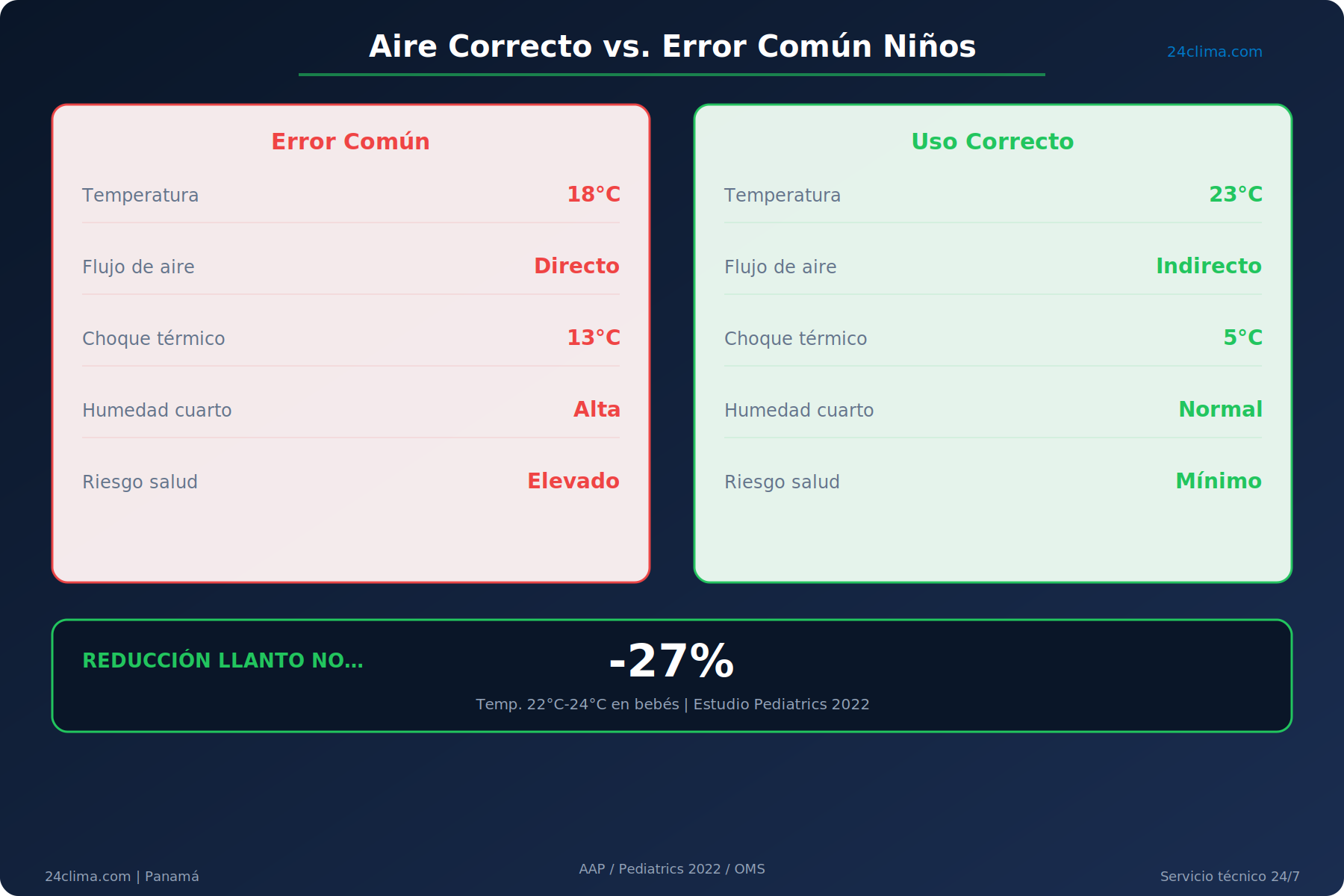
It's 11 PM in Miraflores. Humidity outside is above 85%. Your baby has been crying for two hours, the crib sheets are damp, and the thermometer reads 29°C (84°F) inside the room. You switch on the AC, crank it down to 18°C (64°F) so it cools down fast, and aim the airflow directly at the crib — because that's what you do in the adults' bedroom and it works fine.
That instinct is completely understandable. It's also exactly what causes the most harm in a child's bedroom.
The mistake isn't turning on the AC. It's that nobody explained that a child's room plays by different rules: a different target temperature, different airflow direction, and a unit that needs to behave differently overnight. This guide covers all of it — pediatric data, real numbers for Panama's climate, and specific equipment you can actually find here.
What Most Parents Get Wrong — And Why It Makes Perfect Sense
Adult logic says: if I'm hot, I turn it colder and point the air at myself. For adults, that works. The adult body regulates core temperature efficiently, and a cold draft is uncomfortable but manageable.
Children under 5 have a very different surface-to-volume ratio. Their thermoregulation system is still developing, which means they lose body heat faster in a cold airstream — and they can't tell you they're cold until they've already been mildly hypothermic for a while.
The American Academy of Pediatrics states that babies under 12 months cannot generate enough muscular heat to compensate for the cooling caused by direct airflow. This isn't about being fragile. It's basic physiology.
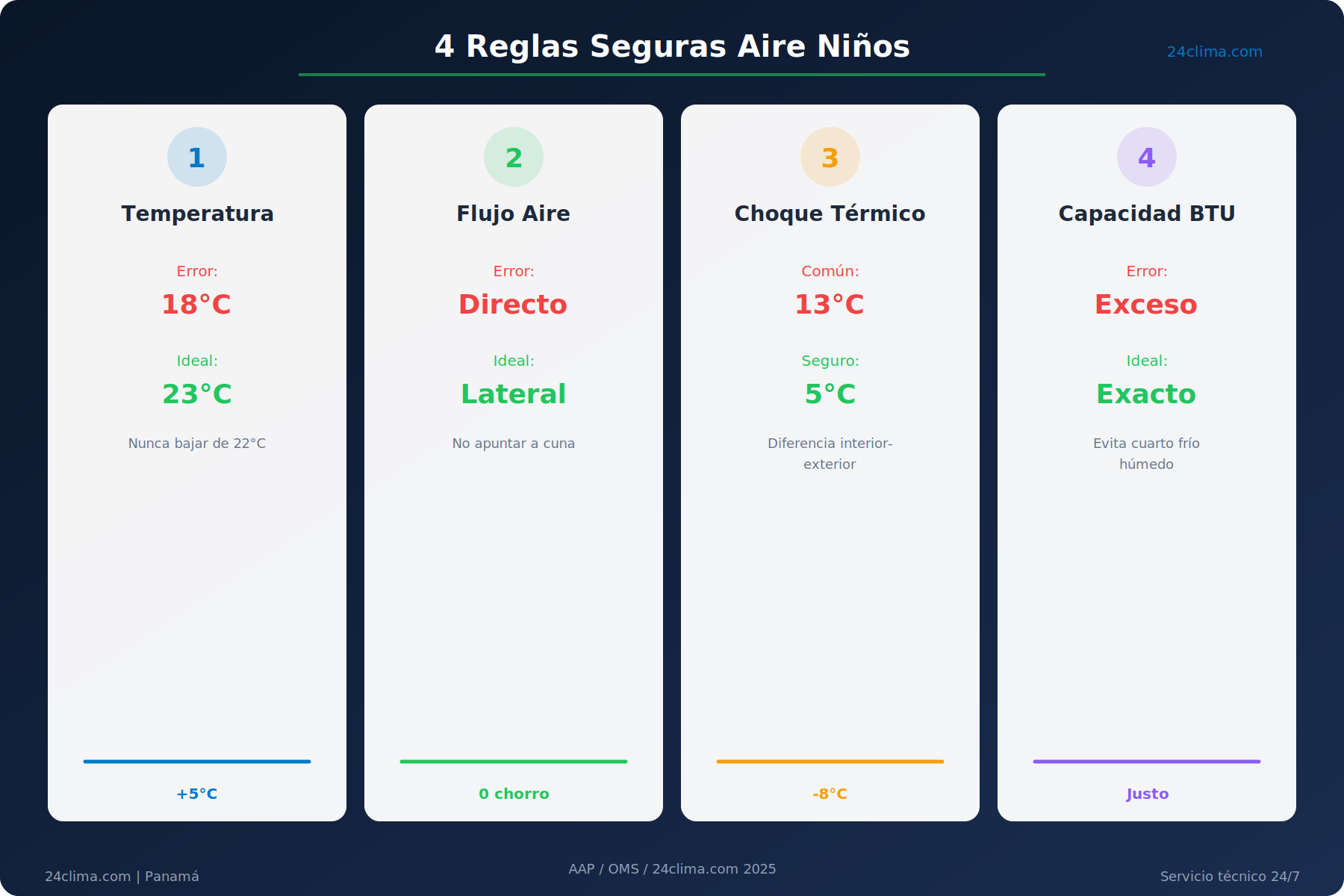
In Panama, the problem gets worse. The gap between 31°C (88°F) outside and 18°C (64°F) on the thermostat is a 13-degree thermal shock — bigger than the average temperature difference between Panama City and Bogotá, which sits around 8°C (14°F). And that transition hits every time a child enters or leaves the room.
The answer is not to avoid air conditioning. Panama's heat and extreme humidity are real health risks for children. The answer is using it correctly. You'll find more on equipment setup and maintenance in our guides at 24clima.com/consejos-y-guias/.
The Right Temperature by Age — What Pediatricians Recommend
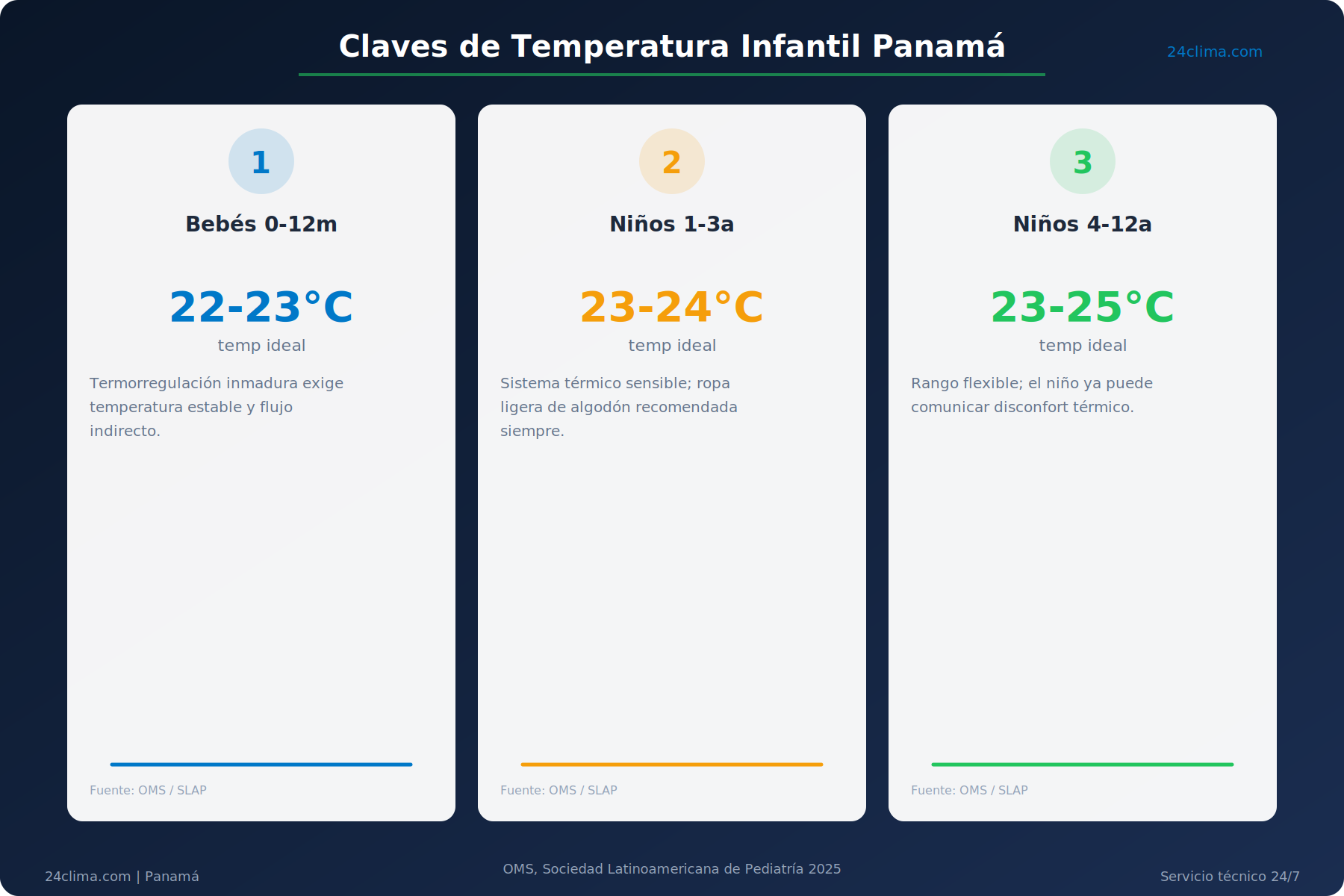
Based on World Health Organization guidelines and Latin American Society of Pediatrics recommendations calibrated for tropical climates, the target ranges are:
Babies (0 to 12 months) — Target temperature: 22°C to 23°C (72°F–73°F) — Reason: immature thermoregulation, higher risk of mild hypothermia — Note: never direct the airflow over the crib
Ages 1 to 3 — Target temperature: 23°C to 24°C (73°F–75°F) — Reason: thermoregulation improving but still sensitive — Note: lightweight cotton clothing, avoid over-bundling
Ages 4 to 12 — Target temperature: 23°C to 25°C (73°F–77°F) — Reason: more mature thermoregulation, closer to a young adult — Note: more flexible range — the child can actually tell you if they're too cold or too warm
A 2022 study published in the journal Pediatrics found that maintaining temperatures between 22°C and 24°C (72°F–75°F) in the sleep environment of babies under 12 months reduced nighttime crying episodes related to thermal discomfort by 27% in tropical climates.
How Many BTUs Does Your Child's Room Actually Need — Panama Sizing Table
The most common technical mistake in children's bedrooms is installing an oversized unit. A unit that's too powerful for the space cools the air quickly but doesn't run long enough to dehumidify it — leaving the room cold and still humid. In Panama, that's the worst of both worlds.
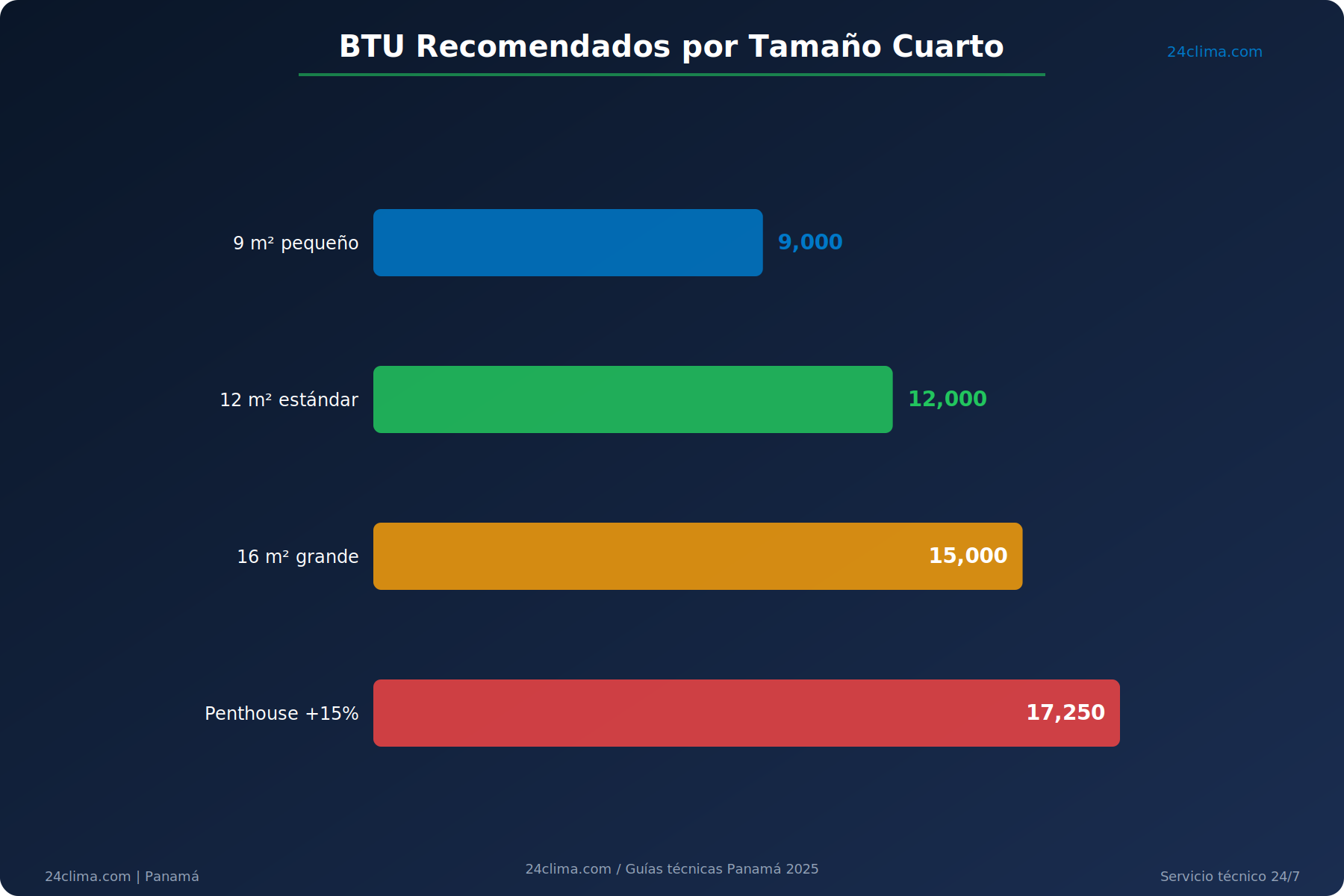
The right BTU capacity depends on room size, sun exposure, number of occupants, and floor level. For children's bedrooms in typical Panama City apartments:
Room of 97 sq ft (small room, 1 child) — Recommended BTUs: 9,000 BTU — Equivalent: 3/4-ton mini-split — Condition: mid-floor, no direct sun exposure
Room of 129 sq ft (standard room, 1–2 children) — Recommended BTUs: 12,000 BTU — Equivalent: 1-ton mini-split — Condition: mid-floor, west-facing window (add 10% correction)
Room of 172 sq ft (large room or children's suite) — Recommended BTUs: 12,000 to 18,000 BTU — Equivalent: 1 to 1.5-ton mini-split — Condition: use the upper range with multiple children or high sun exposure
Top-floor or penthouse units carry an extra heat load from the roof — add 15% to the base capacity. Buildings in Costa del Este and Punta Pacífica with glass facades may need an additional 10–20% adjustment on top of that.
A correctly sized unit dehumidifies while it cools. In Panama, where indoor relative humidity can sit between 70% and 80% without adequate equipment, that's not a cosmetic detail. High humidity encourages dust mites, mold, and bacteria — the three main triggers of childhood rhinitis and asthma.
Why Inverter Units Are the Safest Choice for a Child's Bedroom
An inverter air conditioner is the right call for a child's bedroom for three specific reasons: it runs in continuous quiet mode, holds a stable temperature without on/off cycling, and uses 30–44% less electricity than a conventional unit of the same capacity.
Noise first. A conventional unit cycling on and off can hit 52–58 decibels — roughly the level of a normal conversation. An inverter running in sleep mode operates between 19 and 32 decibels, closer to rustling leaves. For a baby whose deep sleep is critical for neurological development, that gap matters every single night.
Then there's thermal stability. A conventional unit runs on all-or-nothing logic: it cools to the set temperature, shuts off, the room warms 2–3°C (3–5°F), then kicks back on. For an adult, that's tolerable. For a sleeping baby, those swings can interrupt sleep cycles or, in poorly calibrated units, let the room drift to unintended temperatures. A University of Tokyo study cited in Daikin's 2023 technical documentation found that an inverter holds the target temperature within ±0.5°C (±1°F), compared to ±2°C to ±3°C (±3–5°F) for a fixed-speed unit.
The electricity cost matters too. A 12,000 BTU inverter mini-split running overnight (8 hours) at 23°C (73°F) in sleep mode consumes approximately 4.8 kWh per night — roughly $3.50–$4.00 per month at current Naturgy/Gas Natural Fenosa residential rates. A comparable conventional unit running the same pattern runs $6.50–$8.00 per month.
Specific Models Available in Panama for Overnight Use in Children's Bedrooms
Three options with confirmed availability in the Panamanian market in 2025:
LG DUALCOOL Inverter (S12ET series) — Capacity: 12,000 BTU — Noise level in sleep mode: 19 dB — Filters: dual protection filter with anti-bacterial layer — Feature: Plasmaster Ionizer+ for allergen reduction — Estimated price in Panama: $550–$650 (installation not included) — Best for: rooms of 129–150 sq ft, continuous overnight use
Samsung Wind-Free Elite (model AR12TXCAAWKNEU or regional equivalent) — Capacity: 12,000 BTU — Noise level: 16 dB in Wind-Free mode — Technology: disperses cool air through 23,000 micro-perforations, which physically eliminates direct airflow — Estimated price in Panama: $680–$780 — Best for: babies under 12 months or children with respiratory sensitivity — this is the one I'd point parents to first
Panasonic CS-XU12ZKYW (Econavi series) — Capacity: 12,000 BTU — Econavi sensor: detects human presence and automatically adjusts temperature and airflow — nanoG filter capturing particles down to 0.1 microns — Noise level: 20 dB in quiet mode — Estimated price in Panama: $620–$720 — Best for: rooms where the child sleeps alone and you need automatic overnight operation without getting up at midnight to adjust anything
All three brands have active distributors and service technicians in Panama City. When scheduling installation, ask the technician to verify airflow direction before they pack up and leave — not just mount the unit and go.
Safety Checklist for the Child's Bedroom
Before leaving the room with the AC running, check these seven points:
The airflow is directed toward the wall opposite the child — never directly over the bed or crib.
The unit has sleep mode activated — this gradually raises the temperature by 0.5°C (1°F) per hour to prevent over-cooling during deep sleep.
The filters are clean. A dirty filter doesn't just reduce efficiency — it releases dust particles, spores, and bacteria into the air your child breathes for 8–10 hours straight.
The temperature is set between 22°C and 24°C (72°F–75°F), not below 22°C (72°F).
The room has no air leaks through doors or windows that force the unit to overwork and create uncontrolled drafts.
If the unit has a HEPA or equivalent filter, it's installed and in use — especially important for children with a history of allergies or asthma.
The timer or automatic mode is set to maintain the overnight cycle without anyone having to get up at 3 AM to fix it.
Frequently Asked Questions
What temperature should I set the AC in my child's bedroom in Panama?
Between 22°C and 24°C (72°F–75°F) for babies, and between 23°C and 25°C (73°F–77°F) for children ages 1–12. Never below 22°C (72°F) for continuous overnight use. In Panama, where ambient humidity is high, this range lets the unit dehumidify effectively without turning the room into a refrigerator.
Is it safe to leave the air conditioning on all night in a baby's room?
Yes — if the unit is correctly sized, the temperature is set between 22°C and 23°C (72°F–73°F), and the airflow isn't pointed at the crib. The real danger isn't a running unit. It's a misconfigured or oversized unit that over-cools the room. An inverter with sleep mode is the safest option for continuous overnight use.
What type of air conditioner is safest and quietest for a child's bedroom?
A 9,000–12,000 BTU inverter mini-split with sleep mode and a noise level below 25 dB in overnight mode. Samsung Wind-Free models eliminate direct airflow through micro-perforations, making them particularly well-suited for babies. LG units with Plasmaster and Panasonic units with the nanoG filter add active allergen filtration — worth prioritizing if your child has any respiratory sensitivities.
Back to that bedroom in Miraflores at 11 PM. With a correctly installed 12,000 BTU inverter, temperature set to 23°C (73°F), airflow directed toward the wall, and sleep mode on, the baby sleeps through the night, the room dehumidifies to safe levels, and the unit costs less per day than a cup of coffee to run. No magic. Just correct sizing and proper setup.
At 24Clima, we help families across Panama City choose, install, and configure the right equipment for every space — including children's bedrooms, where getting the details right matters more than anywhere else. If you want a specific recommendation for your child's room, reach out at 24clima.com/contacto/ and we'll respond with data, not a product catalog.
Last updated: May 2025