Air Conditioner vs Dehumidifier — Which One Do You Actually Need in Panama?
Last updated: June 2025 | By the 24clima.com technical team
Picture this: it's 11 in the morning in San Francisco, Panama City. Your bedroom split has been running for three hours. The temperature drops from 30°C (86°F) to 23°C (73°F) and you're feeling comfortable. Then you walk into the hallway and catch that unmistakable musty smell. You open the closet and find a dark patch in the corner of the wall. Mold. Right on your favorite shirt.
You flip on the living room AC hoping that helps. It doesn't. The mold didn't grow because it was hot — it grew because the relative humidity in your apartment has been above 75% for weeks. And your air conditioner, even though it cools just fine, can't handle that in enclosed spaces without direct ventilation.
This is the misconception we run into constantly in Panama: people assume that turning on the AC is enough to manage tropical humidity. Sometimes it is. Often it isn't. The difference comes down to understanding how each piece of equipment actually works, what it extracts, and what it costs to run.
What Most People Believe (And Why They're Half Right)
"If the air is cold, humidity isn't a problem." That's partially true. When an air conditioner cools a room, it condenses water vapor on the evaporator coil and drains it outside. In that process, it's pulling real moisture out of the air — a typical 12,000 BTU split removes between 1.5 and 2.5 liters of water per hour while running in cooling mode.
The problem isn't that the AC doesn't dehumidify. The problem is that its primary job is lowering temperature, not controlling humidity. When the thermostat hits the set temperature, the compressor shuts off or reduces its cycle — and at that point, moisture extraction stops. In a climate like Panama's, where average annual relative humidity sits at 85% according to the Instituto de Meteorología e Hidrología de Panamá, that gap matters enormously.
A dehumidifier has one job: pull water out of the air without meaningfully changing the temperature. It processes air more slowly in terms of cubic meters per hour, but it runs continuously regardless of how cold the room already is. That makes it the right tool for storage rooms, windowless spaces, utility areas — anywhere you want moisture control without dropping the temperature.
You'll find more tips calibrated for Panama's climate in our guides section at 24clima.com.
How the Refrigeration Cycle Works — And Where the Humidity Magic Happens
A split air conditioner dehumidifies as a byproduct of cooling, not as its primary function. That distinction is everything when it comes to knowing when it works for you and when it falls short.
The refrigerant moves through a closed loop: compressed in the outdoor unit (raising temperature and pressure), passed through the condenser where it releases heat outside, expanded through the expansion valve (dropping its temperature sharply), and arriving at the evaporator coil inside your room at between 5°C (41°F) and 12°C (54°F). When warm room air passes over that cold coil, water vapor condenses on the surface — exactly like condensation forming on a cold glass on a humid day. That water drips into a drain pan and exits through the drainage hose.
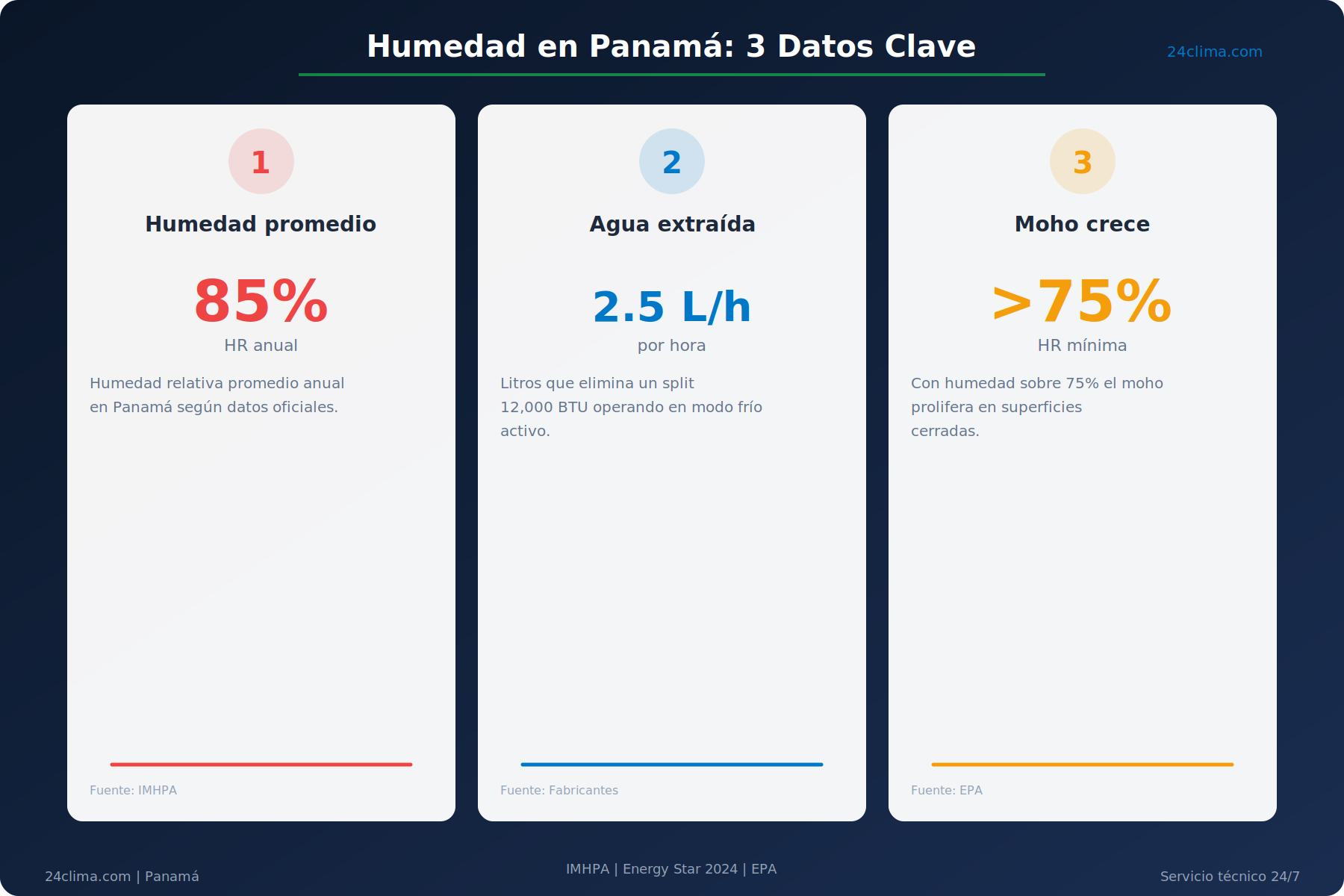
Here's the critical point: if the room temperature is already where you want it — say, 22°C (72°F) — and the compressor shuts off, that coil stops being cold. Air still circulates through the fan, but there's no active condensation happening. Humidity can climb right back up if humid outdoor air is seeping in through gaps. In an apartment in Marbella with ocean-facing windows, that's happening constantly.
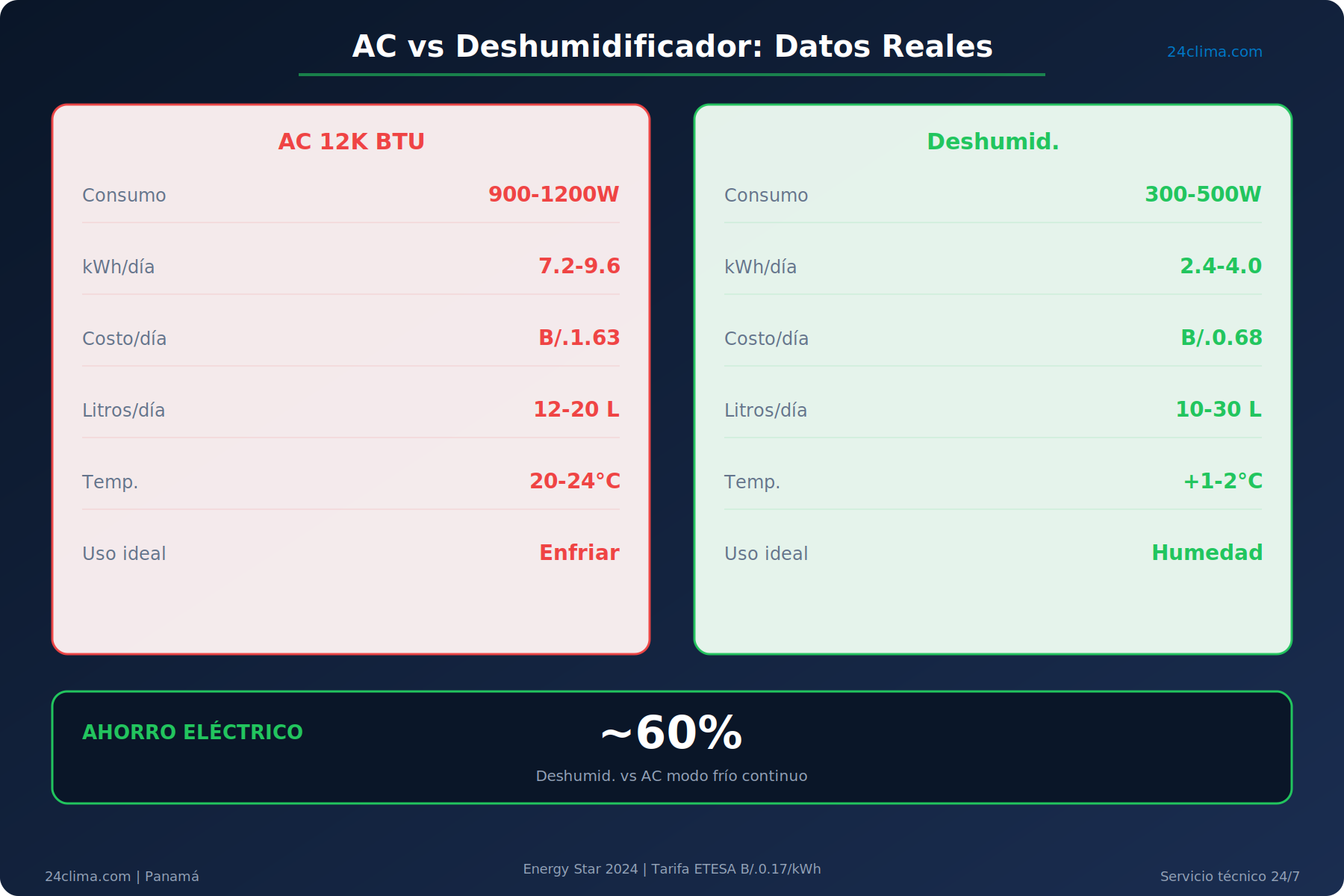
A dehumidifier works on the same physical principle, but with its own dedicated compressor and coil built exclusively for that function. It extracts between 10 and 30 liters of water per day depending on the model and ambient conditions, while raising room temperature by no more than 1°C to 2°C (2°F to 4°F). According to Energy Star data (2024), a certified 30-pint dehumidifier draws between 300 and 500 watts, while a 12,000 BTU split draws between 900 and 1,200 watts. The dehumidifier does a specific job at a lower electrical cost.
Real Comparison: Moisture Removed vs Electricity Cost Under Panama Conditions
Here are the concrete numbers so you can decide based on data, not guesswork.
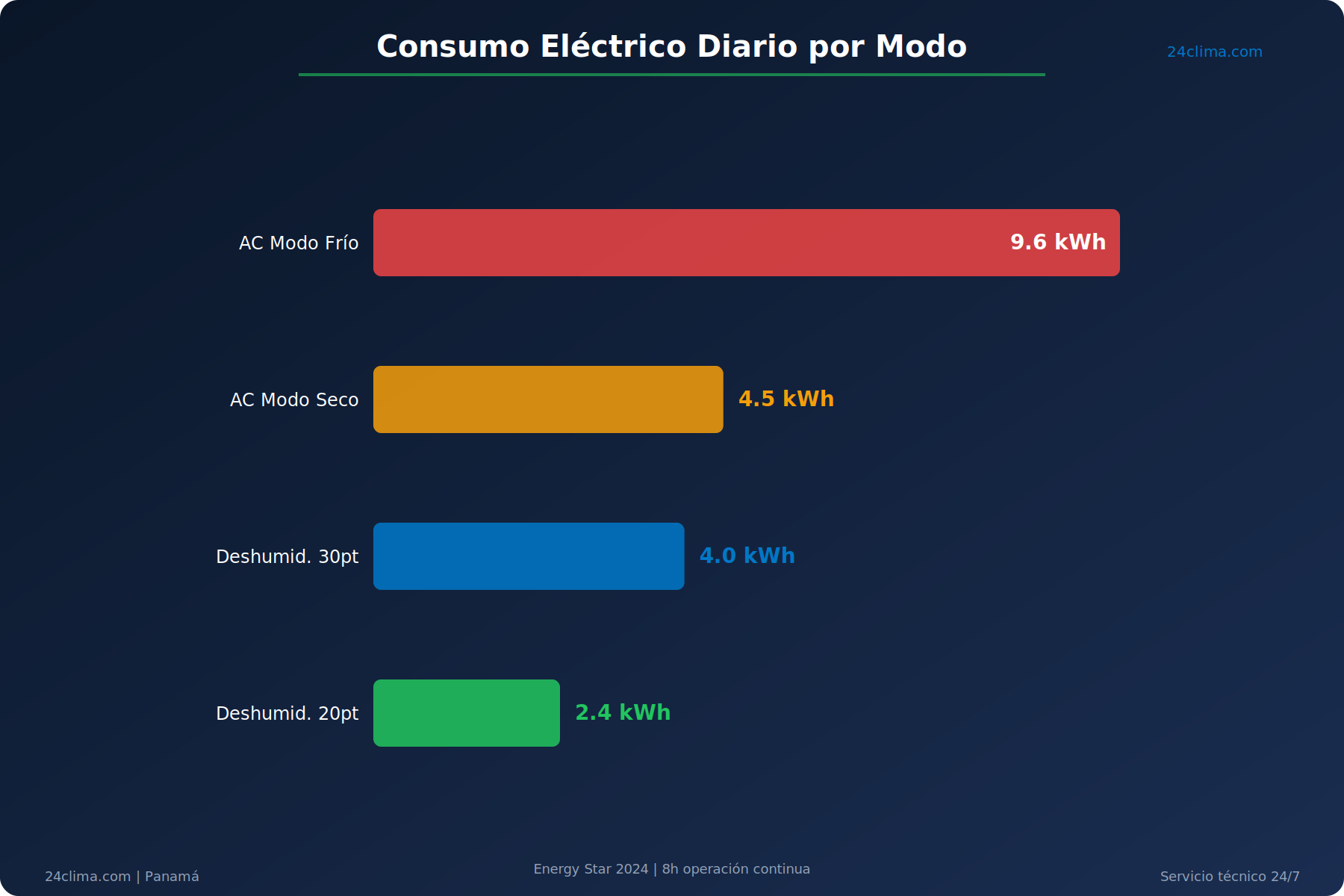
Equipment: Split inverter 12,000 BTU (cooling mode) — Liters of water removed per day: 12-20 liters (estimated at 8 hours continuous operation) — Daily electricity consumption: 7.2-9.6 kWh — Approximate daily cost (Panama residential rate, B/.0.17/kWh): B/.1.22 - B/.1.63 — Room temperature: drops to 20-24°C (68-75°F) — Works without AC running: No
Equipment: Split inverter 12,000 BTU (dry mode) — Liters of water removed per day: 6-10 liters (8 hours continuous operation) — Daily electricity consumption: 3.0-4.5 kWh — Approximate daily cost: B/.0.51 - B/.0.77 — Room temperature: drops slightly, 1-3°C (2-5°F) — Works without AC running: No
Equipment: Portable dehumidifier 30 pints (Midea or LG, available at Novey and Do it Center) — Liters of water removed per day: 14-18 liters at 85% relative humidity conditions — Daily electricity consumption: 2.4-4.0 kWh — Approximate daily cost: B/.0.41 - B/.0.68 — Room temperature: rises 1-2°C (2-4°F) from residual heat release — Works without AC running: Yes
Dry mode on your split is a useful middle-ground — but it has one hard limitation: it requires a split unit to already be installed and running. For storage rooms, utility areas, or sections of your home without a unit, a portable dehumidifier is the only practical solution.
Real Panama Scenarios: Which Equipment Makes Sense for You?
These scenarios come directly from consultations we handle in the Panamanian market. See if your situation shows up here.
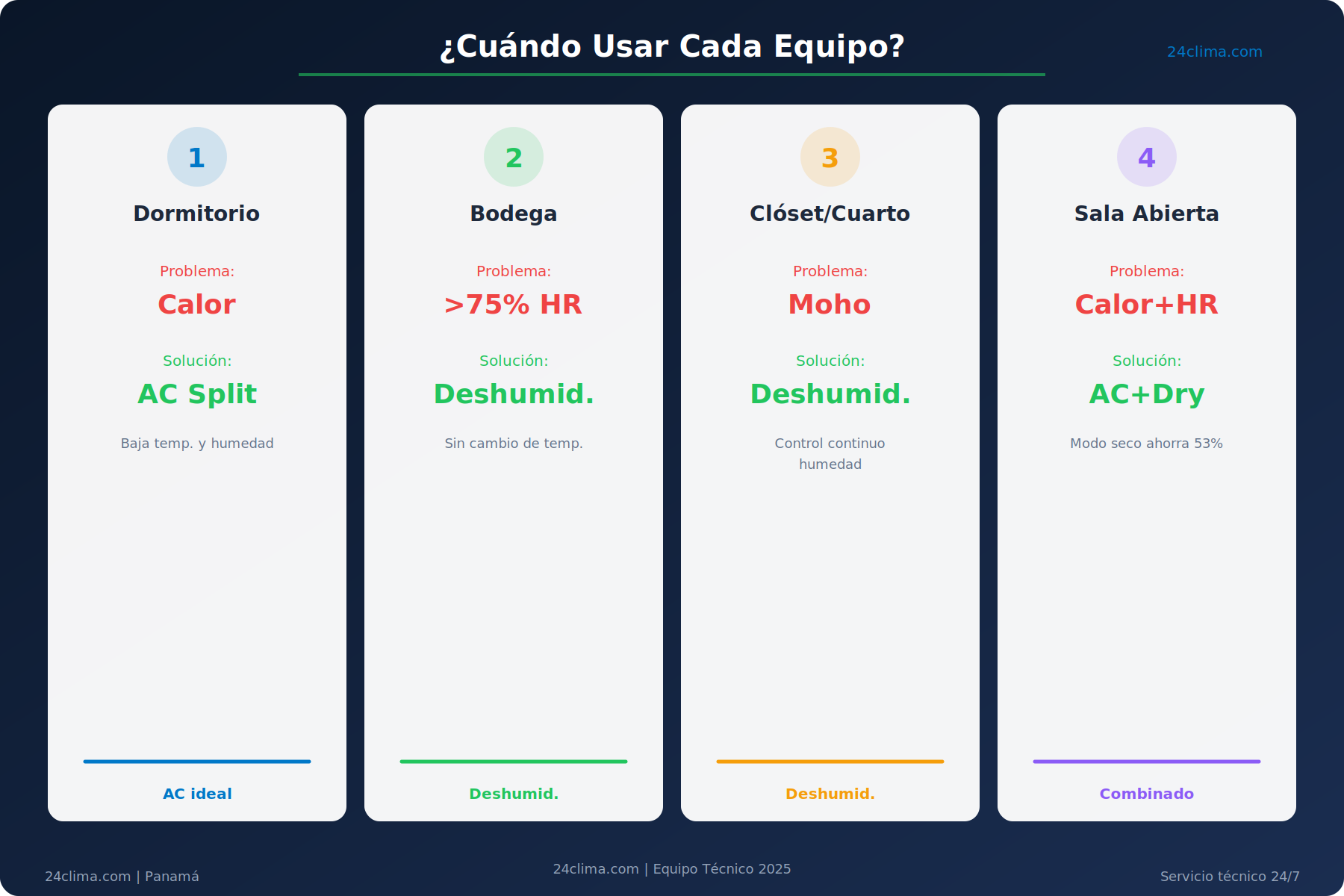
Scenario 1 — Apartment in San Francisco, Panama City 15 m² bedroom, 9,000 BTU split installed, visible humidity on bathroom walls and inside the closet. Recommendation: Run the split in dry mode during peak humidity hours — afternoon through evening. If mold keeps coming back in the closet, add a 20-pint portable dehumidifier placed inside or near the problem area. Reference price at Do it Center: B/.180-220 (Midea 20-pint model).
Scenario 2 — Storage unit in La Chorrera 40 m² space without climate control, used to store furniture, documents, and tools. Indoor relative humidity consistently above 80%. Recommendation: Industrial dehumidifier, 50-70 pints. Don't install a split just to control humidity in a space with no regular occupancy — the electricity cost doesn't justify it. A 50-pint dehumidifier at Novey runs B/.350-500 and uses roughly half the electricity of an AC for this purpose.
Scenario 3 — Windowless room in an older building, Bella Vista 10 m² room, no exterior window, no split installed. Humidity condensing on walls and ceiling. Active mold. Recommendation: A 30-pint portable dehumidifier as the primary solution. Installing a split here would require drilling through exterior walls, which can be expensive or prohibited by building rules. The dehumidifier needs no construction work. If you also need cooling, reach out to our technical team and we'll walk through your options.
Scenario 4 — House in Clayton, Panama (cooler elevation, approximately 500 meters above sea level) Two-story house with split on the ground floor. Upper floor has no AC, relative humidity around 70-75%. Recommendation: Humidity in Clayton is more manageable than down in the city. A 20-pint portable dehumidifier on the upper floor may be all you need, without the investment of a second split installation. Measure your actual consumption first before committing to additional cooling equipment.
What Indoor Humidity Level Is Actually Healthy?
The World Health Organization (WHO) and the U.S. Environmental Protection Agency (EPA) both recommend keeping indoor relative humidity between 40% and 60% to prevent mold growth, dust mites, and bacteria. In Panama, where outdoor air sits around 85%, staying in that range requires active intervention — AC, a dehumidifier, or both depending on the space.
Above 65% relative humidity, dust mites reproduce at an accelerated rate, according to a study published in Indoor Air (Bornehag et al., 2021). Above 70%, mold can begin forming on surfaces in less than 48 hours when organic material is present — wood, fabric, paper. A practical target for a home in Panama is 50-55%.
To measure the humidity in your home, a digital hygrometer costs between B/.8 and B/.25 at any local hardware store. Buy that before you buy any equipment — it takes the guesswork out of the decision.
Frequently Asked Questions — What Expats and Locals Ask Us Most About Humidity in Panama
Does an air conditioner also dehumidify in Panama's climate?
Yes, an air conditioner dehumidifies as part of its cooling process. As air passes over the cold evaporator coil, water vapor condenses and drains outside. But how much moisture it actually removes depends entirely on the compressor being active. When the room hits the set temperature and the compressor shuts off or slows down, dehumidification stops. In Panama, with 85% outdoor humidity, that's often not enough for spaces with constant humid air infiltration.
When do I need a dehumidifier versus just using the air conditioner?
Your AC is enough when the space is regularly occupied, has a split already installed, and visible humidity problems like mold or condensation are under control. You need a dehumidifier when the space has no AC installed, when mold keeps coming back despite the AC running, when the space is a storage area where you don't want to lower the temperature, or when dry mode on your split still leaves humidity above 65%.
What indoor humidity level is healthy for a home in Panama?
The healthy range is 45% to 60% relative humidity indoors. Below 40% the air is too dry — you'll feel it in your sinuses, and wood furniture can crack. Above 65% you face real risk of mold and dust mites. In Panama, with outdoor air at 85%, staying in that range means some form of active control: dry mode on your split, a portable dehumidifier, or a combination of both depending on the space.
The Right Decision Starts With Knowing Your Space
Back to that apartment in San Francisco. Now you understand that the mold in the closet isn't the AC's fault. The split is doing its job when it's running. The problem is that enclosed, low-circulation space where humidity builds up beyond the reach of the air conditioner. The answer isn't buying a bigger split — it's matching the right tool to the actual problem.
If your space has AC and temperature control is working well, try dry mode before spending money on additional equipment. If you have areas without climate control — storage rooms, large closets, windowless rooms — a 20-30 pint portable dehumidifier (B/.180-400 at Novey or Do it Center) is the most direct and cost-effective fix.
At 24Clima we look at your specific situation — actual measurements of your space and the humidity levels you're dealing with — before recommending anything. If you're not sure which solution fits your home or office in Panama, reach out to us on WhatsApp at https://24clima.com/contacto/ and our technical team will give you a straight answer. No commitment required.