AC Error Codes — What That Blinking Display Is Actually Trying to Tell You in Panama
It's 2 PM in Costa del Este. The sun is hammering sideways through your apartment glass, humidity is sitting at 85%, and the thermometer outside reads 33°C (91°F). You turn on the living room split, hear the startup beep... and nothing happens. The display starts blinking. A code you've never seen before appears in red: E1.
Most people's first instinct is to turn it off, turn it back on, and hope. The second instinct is to search YouTube. The third — already frustrated and sweating — is to call whatever technician answers first, with no idea whether this is a serious problem, a minor issue, or something a 30-second reset would fix.
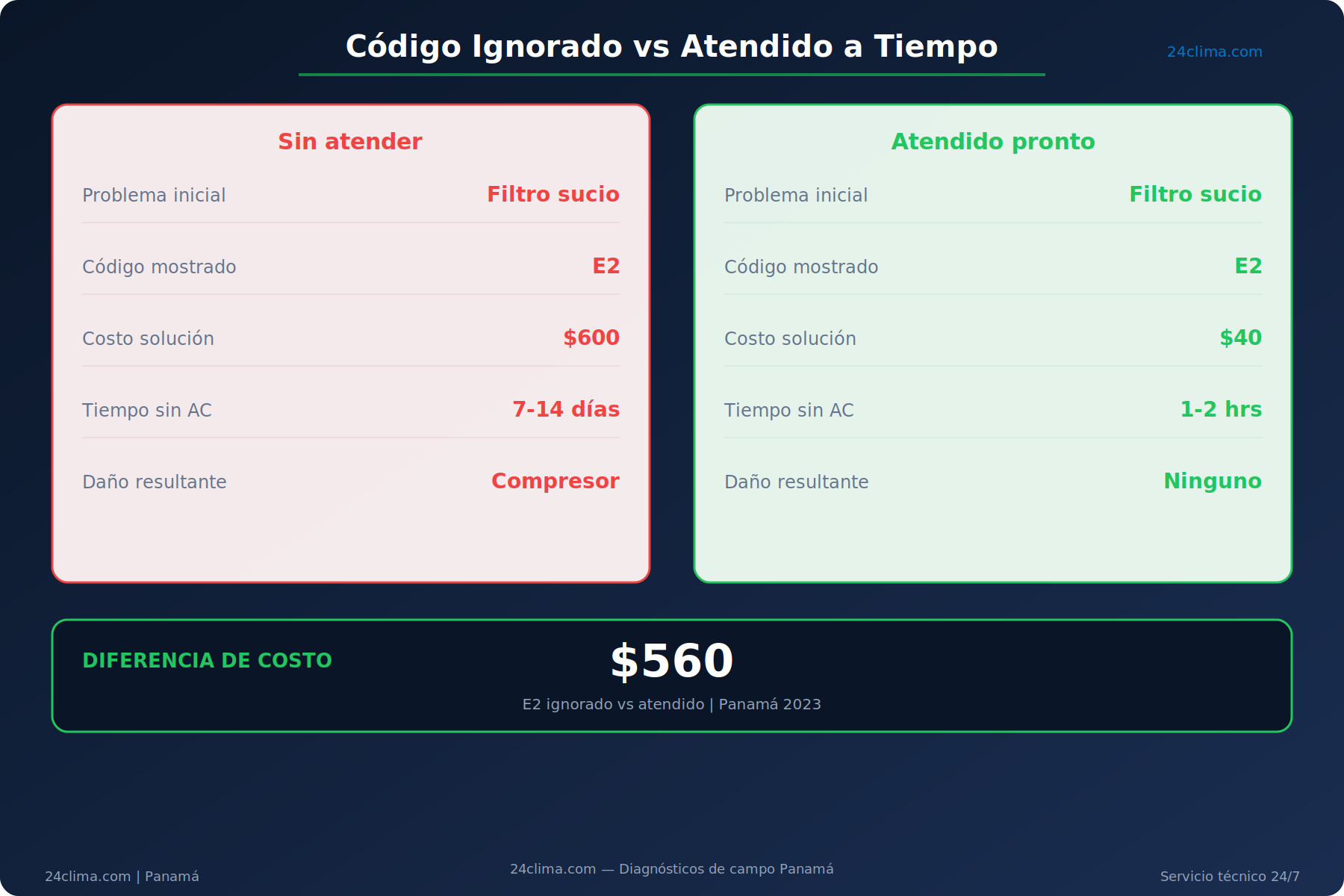
At 24clima, we've handled hundreds of diagnostics across Panama, and error codes are — by a wide margin — the number one cause of panic calls that turn out to have simple solutions. But they're also the warning signs that, when ignored, turn a $40 cleaning into a $600 compressor replacement. For more technical guides, visit our tips and guides section at https://24clima.com/consejos-y-guias/
What You Think an Error Code Means (And Why You're Probably Wrong)
Most people in Panama assume that an error code means the unit is broken. That assumption is wrong — and correcting it can save you hundreds of dollars.
Error codes are not signs of irreversible damage. They're diagnostic signals. The unit's control system — the electronic brain managing temperature, compressor speed, and refrigerant pressure — detects a condition outside the normal operating range and throws a code to identify it. Think of it like your car's check engine light: it might mean a loose gas cap or it might mean the engine. The code tells you which one.
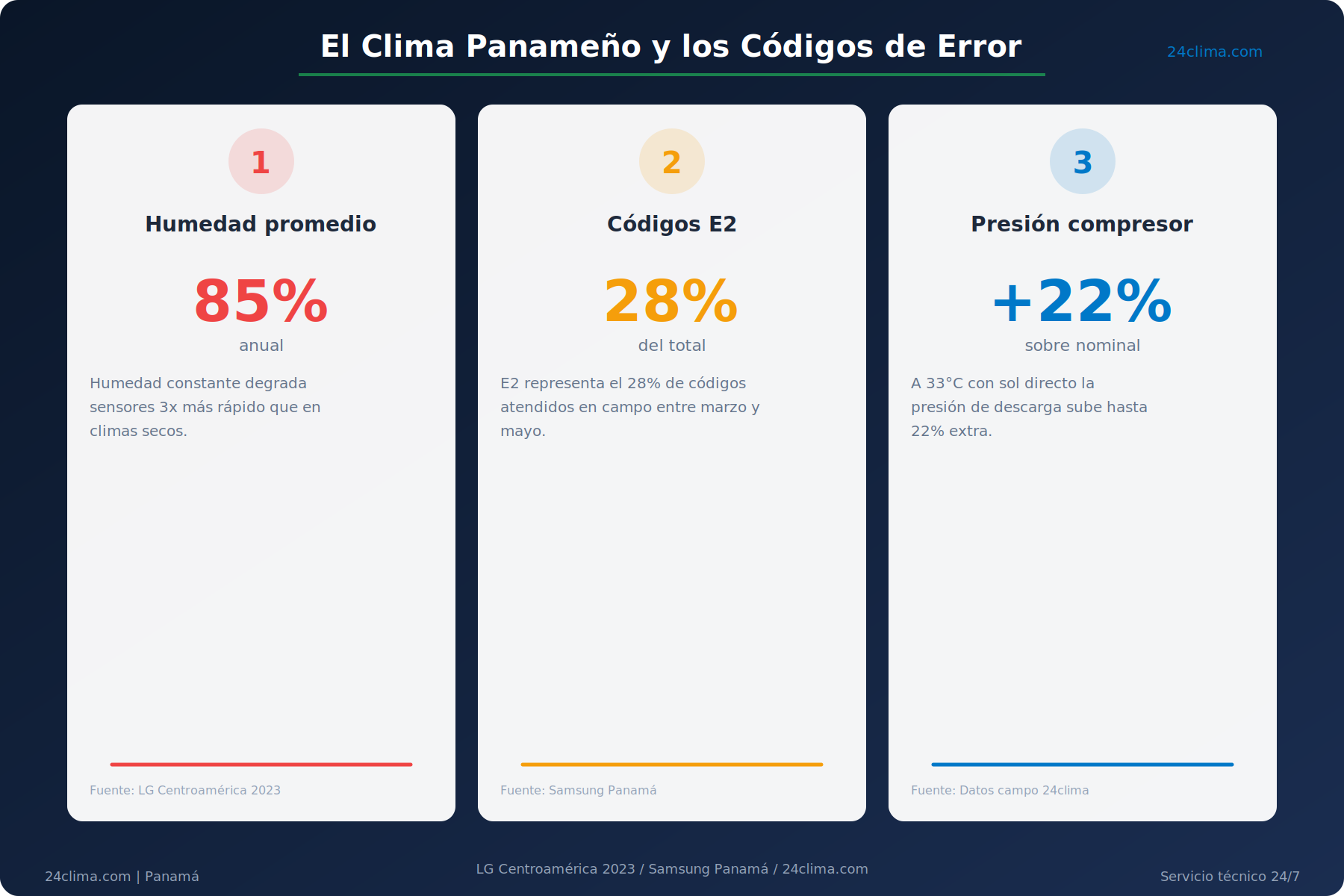
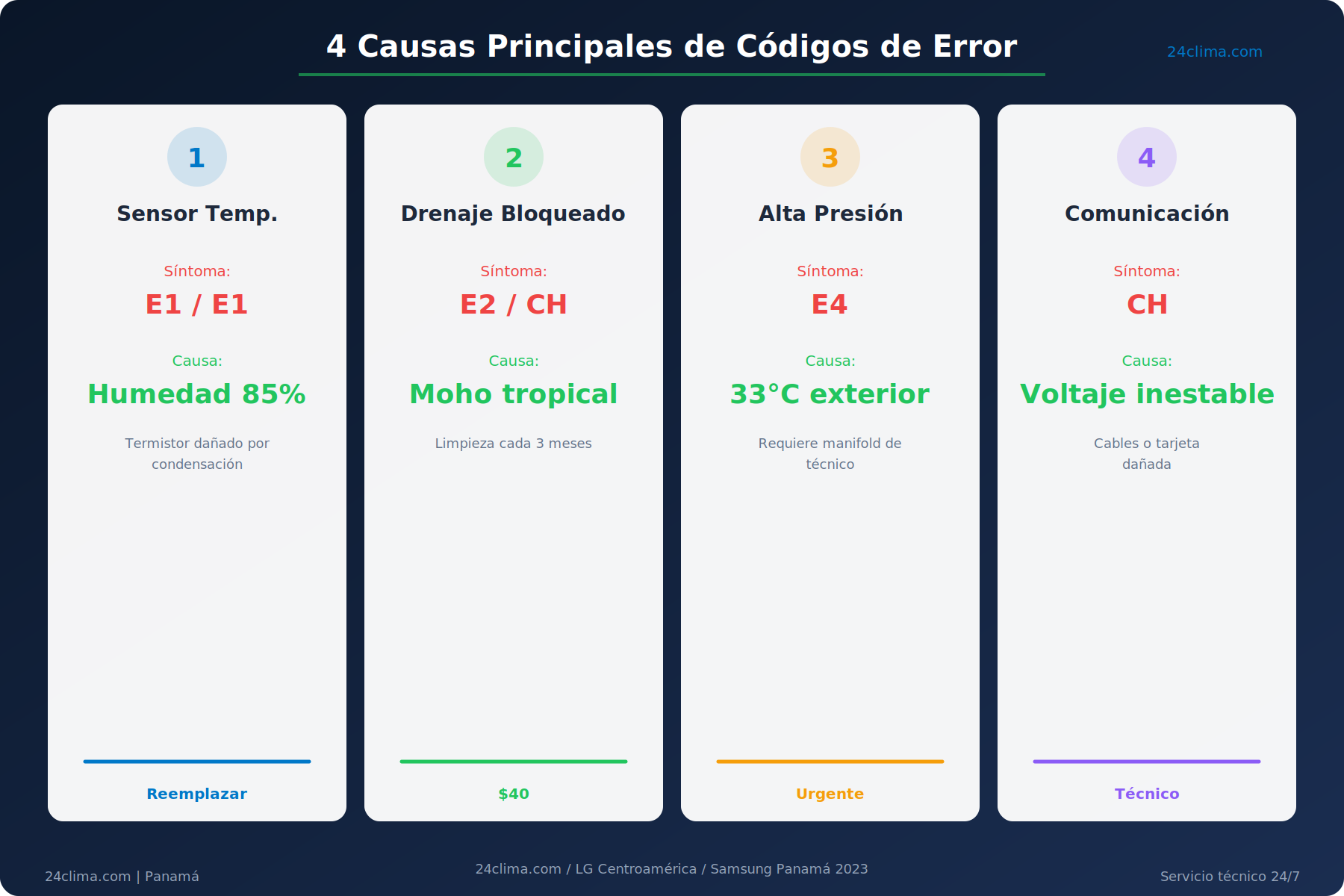
The real issue in Panama isn't the code itself. Panama's tropical climate creates specific conditions that trigger certain codes far more often than in temperate countries. With average annual humidity of 85% and temperatures exceeding 31°C (88°F) for nine months of the year, three failures dominate: temperature sensors thrown off by condensation, drain lines clogged by mold growth, and compressors pushed to their limits during heat spikes. If you live in Panama Viejo, San Francisco, or Miraflores, you know exactly what we're talking about.
That doesn't mean the climate is causing the failure. It means preventive maintenance has to be calibrated to the climate. A unit in Oslo might run fine with yearly cleaning. A unit in Panama City needs attention every three months.
The Most Common AC Error Codes in Panama — By Brand and By Cause
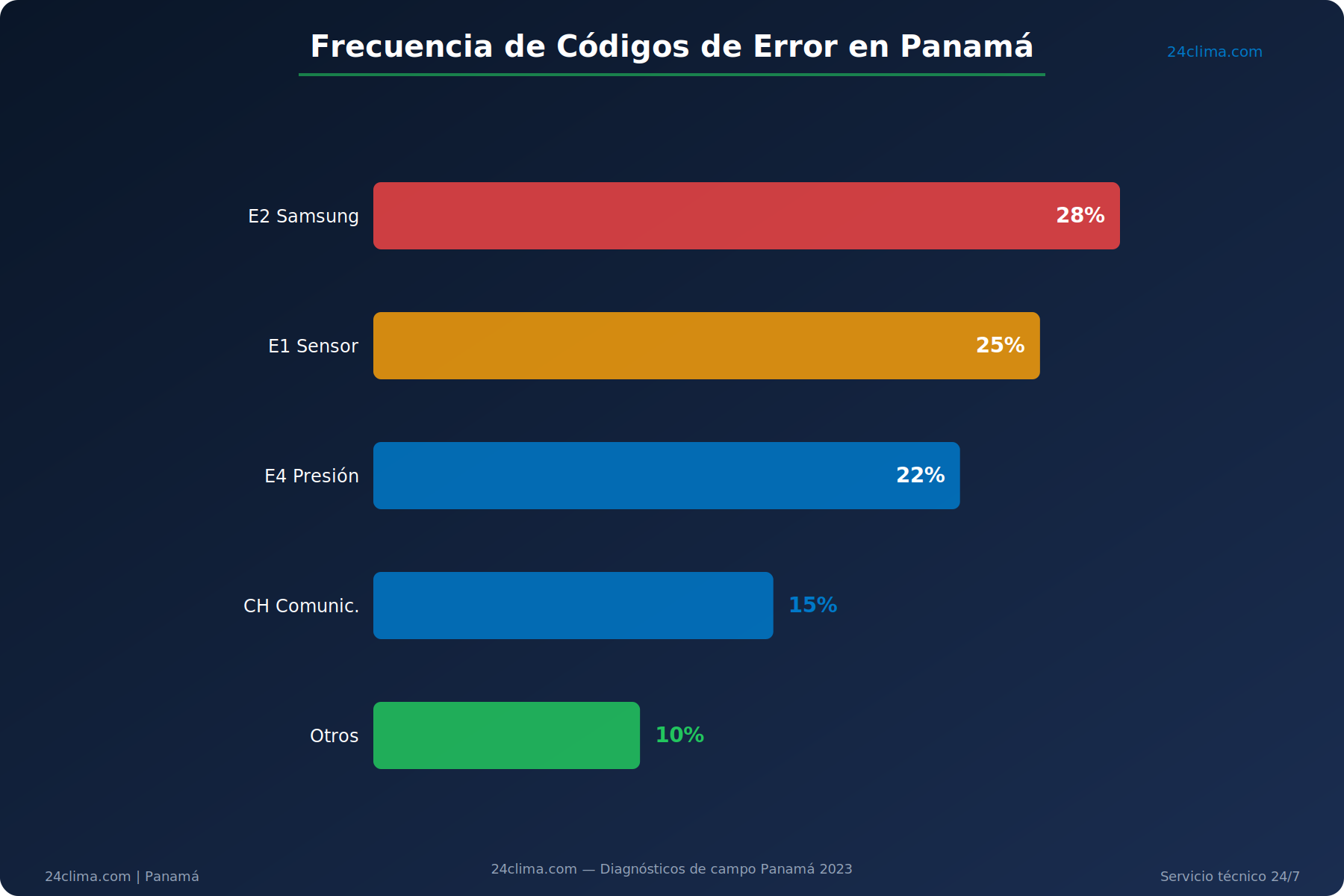
Error codes vary between manufacturers, but the underlying causes are almost always the same here: a faulty temperature sensor, a blocked drain, abnormal refrigerant pressure, or an activated compressor protection. These are the codes we see most often on local service calls.
LG — Common Codes
E1 — Indoor temperature sensor error (return air thermistor) What causes it in Panama: Extreme condensation on the evaporator degrades the sensor over time. At constant humidity levels of 80–90%, the thermistor fails three times faster than in dry climates, according to field maintenance data published by LG Central America in 2023. Can I fix it myself? Possibly. Turn the unit off for 30 minutes, reset from the breaker, and see if the code comes back. If it does, you're looking at a sensor replacement — that's a job for a technician.
E4 — Compressor high-pressure protection What causes it in Panama: The compressor is working too hard because the outdoor unit is blocked, dirty, or the refrigerant is overcharged. At 33°C (91°F) with direct sun on the condenser, discharge pressure can spike 18–22% above the nominal range. Can I fix it myself? No. This code requires pressure measurements with a manifold gauge — certified technician territory.
CH — Communication error between indoor and outdoor unit What causes it in Panama: Interconnection cables deteriorated by moisture or chewed by rodents. It can also be a control board damaged by electrical surge — a frequent problem in areas with voltage fluctuations, like Arraiján and La Chorrera. Can I fix it myself? Check that the cables are properly connected. If the connection looks fine, you're likely dealing with a board failure.
Samsung — Common Codes
E1 — Return air temperature sensor failure Same story as LG. The E1 code on Samsung specifically indicates that the thermistor resistance has moved outside the expected range — normally 10kΩ at 25°C (77°F). A sensor exposed to constant humidity drifts in its readings, and the system flags it as an error.
E2 — Evaporator freeze-up What causes it in Panama: Reduced airflow from dirty filters or a low fan speed setting. The evaporator drops below 0°C (32°F) and freezes over. According to Samsung Panama service data, E2 accounts for 28% of codes handled in the field during March through May. Can I fix it myself? Yes, if dirty filters are the cause. Turn the unit off for two hours to let it thaw, clean the filters, and test again. If the code returns, you have a refrigerant flow issue — time to call a technician.
P1 — Voltage out of range What causes it in Panama: Electrical fluctuations. This code shows up frequently in older buildings in El Chorrillo, Calidonia, and Santa Ana, where the electrical infrastructure can vary ±15% from nominal voltage. A voltage regulator solves this without needing an AC technician at all.
Panasonic — Common Codes
H11 — Indoor-outdoor communication error Cause: Similar to LG's CH code. On Panasonic units installed in coastal areas like Punta Pacífica or San Carlos, salt air corrodes the connection terminals within 12–18 months without preventive maintenance.
H97, H98 — Condenser fan motor failure What causes it in Panama: The condenser fan motor runs continuously in ambient temperatures above 35°C (95°F), especially on units installed on rooftop terraces with no shade. The motor windings overheat when dust accumulates on the fan blades.
Carrier — Common Codes
FL — Drain float switch activated This is, without question, the code we deal with most in Panama. The drain line gets blocked with algae, mold, and sediment — all direct byproducts of the humid climate. When the water level in the drip tray rises too high, the float switch shuts the unit down to prevent overflow. Can I fix it myself? Yes. Find the drain line (the thin tube coming out of the indoor unit) and gently blow it clear with a rubber bulb, or apply moderate water pressure. For deeper blockages, a wet/dry shop vacuum run in reverse works well.
E1 — Pipe sensor error (evaporator sensor) What causes it in Panama: A sensor that shifted position after a cleaning, or one degraded by humidity. Carrier's 2024 technical bulletin reported that 34% of E1 codes in the Central American region originate from sensors displaced during informal maintenance visits.
Midea — Common Codes
E1 — Room temperature sensor E2 — Evaporator temperature sensor E3 — Communication failure P2 — Compressor high-temperature protection
Midea holds the largest market share in Panama's budget residential segment. The units are functional, but their sensors are the most humidity-sensitive of any major brand. A Midea unit without quarterly cleaning in Panama has a statistically higher probability of triggering E1 or E2 within the first 18 months of use.
Can I Fix It Myself or Do I Need a Technician? — Decision Guide
Run through this flow before you call anyone. It saves time and money.
1️⃣ Did the code just appear for the first time right now? — Yes: Turn the unit off with the remote. Wait 5 minutes. Cut power at the AC breaker for 30 seconds. Turn it back on. — Code is gone: It was a transient fault. Monitor for 24 hours. — Code came back: Move to step 2.
2️⃣ Is it a drain code (FL, E3 on Carrier/Midea, dE on some LG units)? — Yes: Check and clean the drain line yourself. 80% of cases are resolved right here. — No: Move to step 3.
3️⃣ Is it a sensor code (E1 or E2 on most brands)? — Yes: When was the last time this unit was cleaned? If it's been more than 3 months, call for a professional cleaning before anything else. The sensor may simply be coated in damp dust that's throwing off its reading. — No recent maintenance: Schedule a cleaning before any electrical diagnosis. — Unit has been recently serviced: Likely a genuine sensor failure — technician required.
4️⃣ Is it a pressure or compressor code (E4, E5, P1, P2, H97, H98)? — Always a certified technician. There is no safe user action for these codes.
5️⃣ Is it a communication code (CH, H11, E3 communication type)? — Visually check that the cables between the indoor and outdoor units are not cut or loose. — If the physical connection looks fine: control board issue — technician required.
Every diagnostic service we perform at 24clima starts with exactly this flow. Our preventive maintenance service at https://24clima.com/servicios/mantenimiento/ includes a full check of sensors, drain lines, and refrigerant pressures — the three most common failure points in Panama's climate.
Frequently Asked Questions
What does the E1 code mean on my air conditioner?
The E1 code on most brands — LG, Samsung, Carrier, Midea, Panasonic — indicates a failure in the return air temperature sensor or evaporator sensor. The system has detected that the sensor's reading is outside the expected range. In Panama, the most common cause is sensor degradation from humidity or physical displacement during a maintenance visit. A breaker reset tells you whether it's transient; if the code returns, the sensor needs inspection or replacement.
Why does my inverter AC show an error code and shut off by itself in Panama?
Inverter units have more sensitive protection systems than fixed-speed equipment. In Panama's climate, automatic shutdowns with error codes happen primarily for three reasons: compressor protection from high pressure (outdoor temperatures of 33°C/91°F or above with a dirty condenser), evaporator freeze-up from blocked filters, or electrical protection triggered by voltage fluctuations. According to 2023 field data from Panama's Ministry of Commerce and Industry, voltage variations in 22% of residential zones exceed ±10% of nominal — enough to trigger protection shutdowns in high-sensitivity inverter units.
Can I reset an AC error code without calling a technician?
Yes, in many cases. Turn the unit off with the remote, cut power at the AC breaker for 30 seconds, restore power and turn the unit back on. If the code disappears and doesn't return within 24 hours, it was a transient fault. If it comes back, the reset didn't fix the root cause and you need a diagnosis. Don't ignore a code that keeps returning — what starts as a $15 sensor issue can escalate to a $180 control board replacement if the unit keeps running under abnormal conditions.
The Real Cost of Ignoring an Error Code in Panama
An ignored code doesn't go away. It gets worse.
A Carrier FL code from a blocked drain, ignored for two weeks, results in water overflowing onto the control board. Cost of clearing the drain: $0 if you do it yourself, $40 if you call a technician. Cost of a replacement control board: $150–220 depending on the model.
An LG E4 from high pressure, left long enough, can end in a burned-out compressor. Compressor replacement in Panama runs $350–600 depending on tonnage. That same unit, with quarterly preventive maintenance, can reach 12–15 years of service life with no major component replacements.
A study on HVAC equipment efficiency in tropical climates published by the Universidad Tecnológica de Panamá in 2022 found that units with regular preventive maintenance showed a 70% reduction in critical failure frequency compared to units without scheduled upkeep. That 70% isn't a marketing number — it's the difference between cleaning an evaporator every three months or replacing a compressor every three years.
At 24clima, we see exactly that kind of situation every day across Panama. The preventive maintenance we perform covers deep cleaning of the evaporator and condenser, drain line inspection, refrigerant pressure verification, sensor testing, and an electrical check — everything a unit needs to stop throwing error codes for the next several months.
If your unit is showing a code right now, or if you can't remember the last time it was serviced, reach out to us on WhatsApp at https://24clima.com/contacto/ — we'll tell you what the code means and let you know if it's something you can handle yourself before sending a technician. No pressure. That's how a company that prefers informed clients over dependent ones operates.
Last updated: May 2025 Author: 24clima Technical Team — 5+ years of HVAC service across Panama City and the greater metropolitan area